Science can be simple
ERASMUS+
Helena Trigo Teixeira
José Orlando
Escola Maria Amália Vaz de Carvalho
Background:
“Even the artists appreciate sunsets, and the
ocean waves, and the march of the stars across the
sky. There is then some reason to talk sometimes of
other things. As we look into these things we get an
aesthetic pleasure from them directly from
observation. There is also a rhythm and a pattern
between the phenomena of nature which is not
apparent to the eye, but only to the eye of analysis;
and it is these rhythms and patterns which we call
Physical Laws.”
Feynman, R; The Character of Physical Law (p 13)
Background:
Algebra is an indispensable tool for problem
solving in science, and although algebraic
expressions are simplified expressions of natural
language, […]
To be fluent in science requires the ability to
translate concepts from natural language into
algebraic expressions and translate algebraic
expressions into natural language.
Bass, Jossey; The Sourcebook for Teaching Science Grades (p 264 & 266)
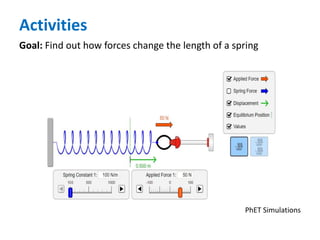
Activities
Goal: Find out how forces change the length of a spring
PhET Simulations
Activities
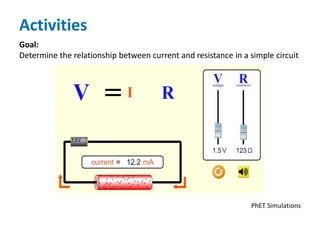
Goal:
Determine the relationship between current and resistance in a simple circuit
PhET Simulations
Science is a fusion of experimental observation
& mathematics
Other Laws
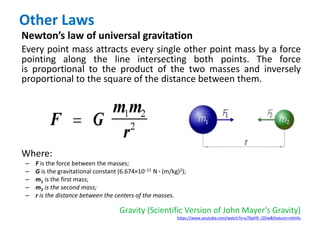
Newton’s law of universal gravitation
Every point mass attracts every single other point mass by a force
pointing along the line intersecting both points. The force
is proportional to the product of the two masses and inversely
proportional to the square of the distance between them.
Where:
– F is the force between the masses;
– G is the gravitational constant (6.674×10⁻¹¹ N · (m/kg)2);
– m1 is the first mass;
– m2 is the second mass;
– r is the distance between the centers of the masses.
Gravity (Scientific Version of John Mayer's Gravity)
https://www.youtube.com/watch?v=u7KpH9_I2Dw&feature=relmfu
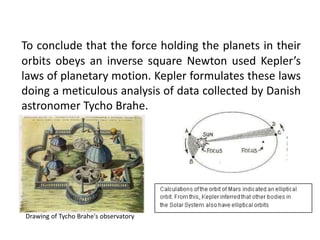
To conclude that the force holding the planets in their
orbits obeys an inverse square Newton used Kepler’s
laws of planetary motion. Kepler formulates these laws
doing a meticulous analysis of data collected by Danish
astronomer Tycho Brahe.
Drawing of Tycho Brahe's observatory
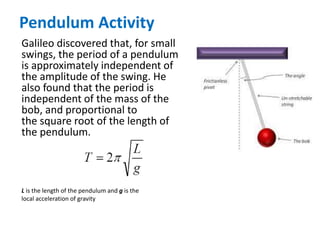
Pendulum Activity
Galileo discovered that, for small
swings, the period of a pendulum
is approximately independent of
the amplitude of the swing. He
also found that the period is
independent of the mass of the
bob, and proportional to
the square root of the length of
the pendulum.
L is the length of the pendulum and g is the
local acceleration of gravity
Curiosity
Galileo interest had been sparked by the
swinging motion of a chandelier in Pisa
Cathedral.
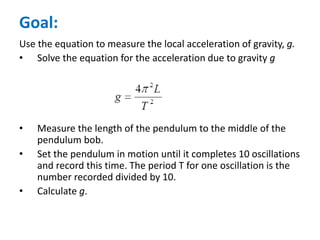
Goal:
Use the equation to measure the local acceleration of gravity, g.
• Solve the equation for the acceleration due to gravity g
• Measure the length of the pendulum to the middle of the
pendulum bob.
• Set the pendulum in motion until it completes 10 oscillations
and record this time. The period T for one oscillation is the
number recorded divided by 10.
• Calculate g.

Science can be simple- Physics workshop

  • 1.
    Science can besimple ERASMUS+ Helena Trigo Teixeira José Orlando Escola Maria Amália Vaz de Carvalho
  • 2.
    Background: “Even the artistsappreciate sunsets, and the ocean waves, and the march of the stars across the sky. There is then some reason to talk sometimes of other things. As we look into these things we get an aesthetic pleasure from them directly from observation. There is also a rhythm and a pattern between the phenomena of nature which is not apparent to the eye, but only to the eye of analysis; and it is these rhythms and patterns which we call Physical Laws.” Feynman, R; The Character of Physical Law (p 13)
  • 3.
    Background: Algebra is anindispensable tool for problem solving in science, and although algebraic expressions are simplified expressions of natural language, […] To be fluent in science requires the ability to translate concepts from natural language into algebraic expressions and translate algebraic expressions into natural language. Bass, Jossey; The Sourcebook for Teaching Science Grades (p 264 & 266)
  • 4.
    Activities Goal: Find outhow forces change the length of a spring PhET Simulations
  • 5.
    Activities Goal: Determine the relationshipbetween current and resistance in a simple circuit PhET Simulations
  • 6.
    Science is afusion of experimental observation & mathematics
  • 7.
    Other Laws Newton’s lawof universal gravitation Every point mass attracts every single other point mass by a force pointing along the line intersecting both points. The force is proportional to the product of the two masses and inversely proportional to the square of the distance between them. Where: – F is the force between the masses; – G is the gravitational constant (6.674×10⁻¹¹ N · (m/kg)2); – m1 is the first mass; – m2 is the second mass; – r is the distance between the centers of the masses. Gravity (Scientific Version of John Mayer's Gravity) https://www.youtube.com/watch?v=u7KpH9_I2Dw&feature=relmfu
  • 8.
    To conclude thatthe force holding the planets in their orbits obeys an inverse square Newton used Kepler’s laws of planetary motion. Kepler formulates these laws doing a meticulous analysis of data collected by Danish astronomer Tycho Brahe. Drawing of Tycho Brahe's observatory
  • 9.
    Pendulum Activity Galileo discoveredthat, for small swings, the period of a pendulum is approximately independent of the amplitude of the swing. He also found that the period is independent of the mass of the bob, and proportional to the square root of the length of the pendulum. L is the length of the pendulum and g is the local acceleration of gravity
  • 10.
    Curiosity Galileo interest hadbeen sparked by the swinging motion of a chandelier in Pisa Cathedral.
  • 11.
    Goal: Use the equationto measure the local acceleration of gravity, g. • Solve the equation for the acceleration due to gravity g • Measure the length of the pendulum to the middle of the pendulum bob. • Set the pendulum in motion until it completes 10 oscillations and record this time. The period T for one oscillation is the number recorded divided by 10. • Calculate g.