Induction furnaces 
The large scale application of electromagnetic induction has become very 
c ommonplac e in today’s manufac turing industries. Many c omponents are heated 
in very large ovens or furnaces to several thousand degrees Celsius. 
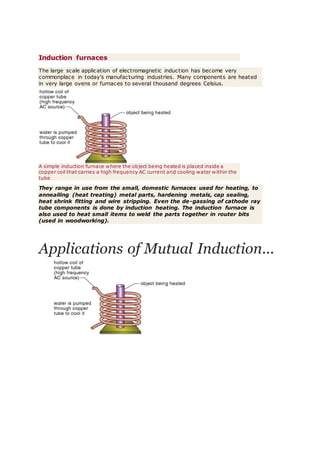
A simple induction furnace where the object being heated is placed inside a 
copper coil that carries a high frequency AC current and cooling water within the 
tube 
They range in use from the small, domestic furnaces used for heating, to 
annealling (heat treating) metal parts, hardening metals, cap sealing, 
heat shrink fitting and wire stripping. Even the de-gassing of cathode ray 
tube components is done by induction heating. The induction furnace is 
also used to heat small items to weld the parts together in router bits 
(used in woodworking). 
Applications of Mutual Induction...
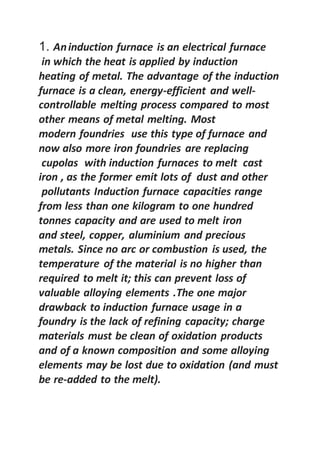
1. An induction furnace is an electrical furnace 
in which the heat is applied by induction 
heating of metal. The advantage of the induction 
furnace is a clean, energy-efficient and well-controllable 
melting process compared to most 
other means of metal melting. Most 
modern foundries use this type of furnace and 
now also more iron foundries are replacing 
cupolas with induction furnaces to melt cast 
iron , as the former emit lots of dust and other 
pollutants Induction furnace capacities range 
from less than one kilogram to one hundred 
tonnes capacity and are used to melt iron 
and steel, copper, aluminium and precious 
metals. Since no arc or combustion is used, the 
temperature of the material is no higher than 
required to melt it; this can prevent loss of 
valuable alloying elements .The one major 
drawback to induction furnace usage in a 
foundry is the lack of refining capacity; charge 
materials must be clean of oxidation products 
and of a known composition and some alloying 
elements may be lost due to oxidation (and must 
be re-added to the melt).
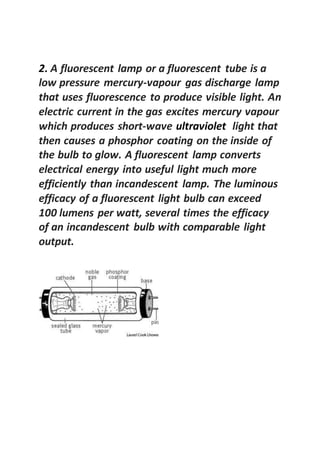
2. A fluorescent lamp or a fluorescent tube is a 
low pressure mercury-vapour gas discharge lamp 
that uses fluorescence to produce visible light. An 
electric current in the gas excites mercury vapour 
which produces short-wave ultraviolet light that 
then causes a phosphor coating on the inside of 
the bulb to glow. A fluorescent lamp converts 
electrical energy into useful light much more 
efficiently than incandescent lamp. The luminous 
efficacy of a fluorescent light bulb can exceed 
100 lumens per watt, several times the efficacy 
of an incandescent bulb with comparable light 
output.
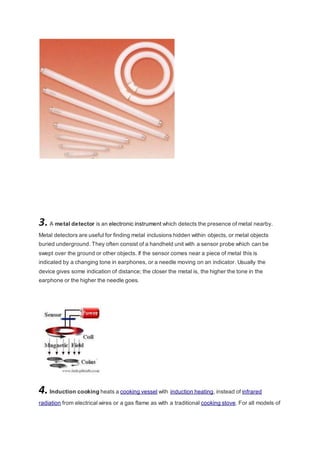
3. A metal detector is an electronic instrument which detects the presence of metal nearby. 
Metal detectors are useful for finding metal inclusions hidden within objects, or metal objects 
buried underground. They often consist of a handheld unit with a sensor probe which can be 
swept over the ground or other objects. If the sensor comes near a piece of metal this is 
indicated by a changing tone in earphones, or a needle moving on an indicator. Usually the 
device gives some indication of distance; the closer the metal is, the higher the tone in the 
earphone or the higher the needle goes. 
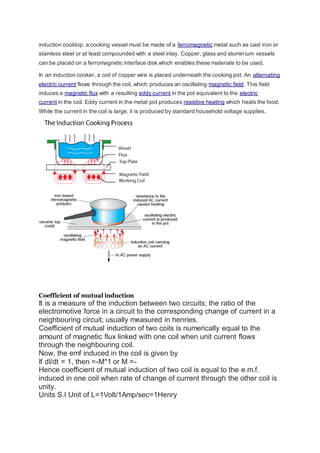
4. Induction cooking heats a cooking vessel with induction heating, instead of infrared 
radiation from electrical wires or a gas flame as with a traditional cooking stove. For all models of
induction cooktop, a cooking vessel must be made of a ferromagnetic metal such as cast iron or 
stainless steel or at least compounded with a steel inlay. Copper, glass and aluminium vessels 
can be placed on a ferromagnetic interface disk which enables these materials to be used. 
In an induction cooker, a coil of copper wire is placed underneath the cooking pot. An alternating 
electric current flows through the coil, which produces an oscillating magnetic field. This field 
induces a magnetic flux with a resulting eddy current in the pot equivalent to the electric 
current in the coil. Eddy current in the metal pot produces resistive heating which heats the food. 
While the current in the coil is large, it is produced by standard household voltage supplies. 
Coefficient of mutual induction 
It is a measure of the induction between two circuits; the ratio of the 
electromotive force in a circuit to the corresponding change of current in a 
neighbouring circuit; usually measured in henries. 
Coefficient of mutual induction of two coils is numerically equal to the 
amount of magnetic flux linked with one coil when unit current flows 
through the neighbouring coil. 
Now, the emf induced in the coil is given by 
If dI/dt = 1, then =-M*1 or M =- 
Hence coefficient of mutual induction of two coil is equal to the e.m.f. 
induced in one coil when rate of change of current through the other coil is 
unity. 
Units S.I Unit of L=1Volt/1Amp/sec=1Henry
The SI unit of M is Henry, when a current change at the rate of one 
ampere/sec in one coil induces an e.m.f. of one volt in the other coil. 
Self Induction 
When a time-dependent i.e. a varying current flows through a coil, the flux through the coil )due to the 
magnetic field produced by current in it) will keep on changing. Hence an induced e.m.f. will be 
produced in it. This process is called self induction. 
For any given coil it is found that , where L is constant for the given coil. 
The quantity L depends on the geometry of the coil and is called Coefficient of Self Inductance. 
S.I Unit of L = 1 Volt / 1 Amp / sec = 1 Henry 
Note : 1 Volt / Amp = 1 Ohm 
 1 Henry = 1 Ohm ´ sec 
Mutual Induction 
If two coils are kept close to each other and if a varying current flows through one of them then the 
intensity of the magnetic field intensity () due to the current will vary. Hence flux through the other coil 
will keep on changing with time; therefore an e. m. f. will be induced in the other coil. For any given 
combination of coils it is found that , where M is constant and is called the Coefficient of Mutual 
Inductance of the given arrangement of the given coils. The quantity M, like L, also depends on the 
geometry of coils and their arrangements. 
S.I Unit of M = 1 henry. 
Diff........... 
if an emf is induced in a coil due to the current flowing through itself is called SELF INDUCTANCE. on 
the other hand if an emf is induced on another coil due to the current flowing through the previous coil 
then it is called MUTUAL INDUCTANCE. suppose there are two coils A and B a current is flowing 
through A. now if the flux produced due to this current induce an emf on the same coil A, then it is SELF 
INDUCTANCE, and if it produce emf on B, then it is MUTUAL INDUCTANCE due to coil A.

Induction furnaces

  • 1.
    Induction furnaces Thelarge scale application of electromagnetic induction has become very c ommonplac e in today’s manufac turing industries. Many c omponents are heated in very large ovens or furnaces to several thousand degrees Celsius. A simple induction furnace where the object being heated is placed inside a copper coil that carries a high frequency AC current and cooling water within the tube They range in use from the small, domestic furnaces used for heating, to annealling (heat treating) metal parts, hardening metals, cap sealing, heat shrink fitting and wire stripping. Even the de-gassing of cathode ray tube components is done by induction heating. The induction furnace is also used to heat small items to weld the parts together in router bits (used in woodworking). Applications of Mutual Induction...
  • 2.
    1. An inductionfurnace is an electrical furnace in which the heat is applied by induction heating of metal. The advantage of the induction furnace is a clean, energy-efficient and well-controllable melting process compared to most other means of metal melting. Most modern foundries use this type of furnace and now also more iron foundries are replacing cupolas with induction furnaces to melt cast iron , as the former emit lots of dust and other pollutants Induction furnace capacities range from less than one kilogram to one hundred tonnes capacity and are used to melt iron and steel, copper, aluminium and precious metals. Since no arc or combustion is used, the temperature of the material is no higher than required to melt it; this can prevent loss of valuable alloying elements .The one major drawback to induction furnace usage in a foundry is the lack of refining capacity; charge materials must be clean of oxidation products and of a known composition and some alloying elements may be lost due to oxidation (and must be re-added to the melt).
  • 3.
    2. A fluorescentlamp or a fluorescent tube is a low pressure mercury-vapour gas discharge lamp that uses fluorescence to produce visible light. An electric current in the gas excites mercury vapour which produces short-wave ultraviolet light that then causes a phosphor coating on the inside of the bulb to glow. A fluorescent lamp converts electrical energy into useful light much more efficiently than incandescent lamp. The luminous efficacy of a fluorescent light bulb can exceed 100 lumens per watt, several times the efficacy of an incandescent bulb with comparable light output.
  • 4.
    3. A metaldetector is an electronic instrument which detects the presence of metal nearby. Metal detectors are useful for finding metal inclusions hidden within objects, or metal objects buried underground. They often consist of a handheld unit with a sensor probe which can be swept over the ground or other objects. If the sensor comes near a piece of metal this is indicated by a changing tone in earphones, or a needle moving on an indicator. Usually the device gives some indication of distance; the closer the metal is, the higher the tone in the earphone or the higher the needle goes. 4. Induction cooking heats a cooking vessel with induction heating, instead of infrared radiation from electrical wires or a gas flame as with a traditional cooking stove. For all models of
  • 5.
    induction cooktop, acooking vessel must be made of a ferromagnetic metal such as cast iron or stainless steel or at least compounded with a steel inlay. Copper, glass and aluminium vessels can be placed on a ferromagnetic interface disk which enables these materials to be used. In an induction cooker, a coil of copper wire is placed underneath the cooking pot. An alternating electric current flows through the coil, which produces an oscillating magnetic field. This field induces a magnetic flux with a resulting eddy current in the pot equivalent to the electric current in the coil. Eddy current in the metal pot produces resistive heating which heats the food. While the current in the coil is large, it is produced by standard household voltage supplies. Coefficient of mutual induction It is a measure of the induction between two circuits; the ratio of the electromotive force in a circuit to the corresponding change of current in a neighbouring circuit; usually measured in henries. Coefficient of mutual induction of two coils is numerically equal to the amount of magnetic flux linked with one coil when unit current flows through the neighbouring coil. Now, the emf induced in the coil is given by If dI/dt = 1, then =-M*1 or M =- Hence coefficient of mutual induction of two coil is equal to the e.m.f. induced in one coil when rate of change of current through the other coil is unity. Units S.I Unit of L=1Volt/1Amp/sec=1Henry
  • 6.
    The SI unitof M is Henry, when a current change at the rate of one ampere/sec in one coil induces an e.m.f. of one volt in the other coil. Self Induction When a time-dependent i.e. a varying current flows through a coil, the flux through the coil )due to the magnetic field produced by current in it) will keep on changing. Hence an induced e.m.f. will be produced in it. This process is called self induction. For any given coil it is found that , where L is constant for the given coil. The quantity L depends on the geometry of the coil and is called Coefficient of Self Inductance. S.I Unit of L = 1 Volt / 1 Amp / sec = 1 Henry Note : 1 Volt / Amp = 1 Ohm 1 Henry = 1 Ohm ´ sec Mutual Induction If two coils are kept close to each other and if a varying current flows through one of them then the intensity of the magnetic field intensity () due to the current will vary. Hence flux through the other coil will keep on changing with time; therefore an e. m. f. will be induced in the other coil. For any given combination of coils it is found that , where M is constant and is called the Coefficient of Mutual Inductance of the given arrangement of the given coils. The quantity M, like L, also depends on the geometry of coils and their arrangements. S.I Unit of M = 1 henry. Diff........... if an emf is induced in a coil due to the current flowing through itself is called SELF INDUCTANCE. on the other hand if an emf is induced on another coil due to the current flowing through the previous coil then it is called MUTUAL INDUCTANCE. suppose there are two coils A and B a current is flowing through A. now if the flux produced due to this current induce an emf on the same coil A, then it is SELF INDUCTANCE, and if it produce emf on B, then it is MUTUAL INDUCTANCE due to coil A.