INDOOR
POSITIONING
SYSTEM
CONTENTS

What is IPS?
Why not GPS?
GPS vs IPS
Choosing Wi-Fi over other sensor
techniques
Wi-Fi Fingerprinting
Uses of IPS
Conclusion
What is IPS?
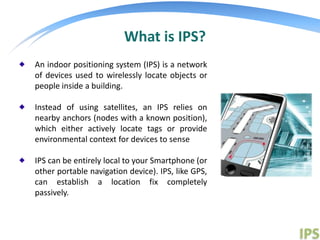
An indoor positioning system (IPS) is a network
of devices used to wirelessly locate objects or
people inside a building.

Instead of using satellites, an IPS relies on
nearby anchors (nodes with a known position),
which either actively locate tags or provide
environmental context for devices to sense

IPS can be entirely local to your Smartphone (or
other portable navigation device). IPS, like GPS,
can establish a location fix completely
passively.
Why not GPS?
A satellite navigation is a system of satellites
that provide autonomous geo-spatial
positioning with global coverage may be
termed a global navigation satellite
system (GNSS or GPS).

GPS has two fundamental laws :
    They don’t work indoors
    They only really operate in two
    dimensions

GPS are generally not suitable to establish
indoor locations, since microwaves will be
attenuated and scattered by roofs, walls and
other objects.
GPS vs IPS
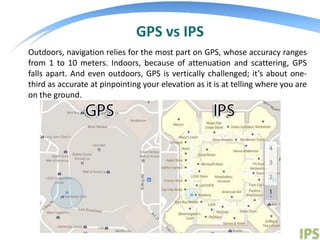
Outdoors, navigation relies for the most part on GPS, whose accuracy ranges
from 1 to 10 meters. Indoors, because of attenuation and scattering, GPS
falls apart. And even outdoors, GPS is vertically challenged; it’s about one-
third as accurate at pinpointing your elevation as it is at telling where you are
on the ground.
Choosing Wi-Fi over other sensor
                 techniques
GPS is suitable for the outdoor navigation, as the navigable spaces are wide
enough. The accuracy positioning of GPS is between 6 and 12 meters 95%
of the time. The problem is that the reception of the GPS signals is bad in
densely build areas, including the indoor environment.

Radio Frequency Identification (RFID) makes use of tags and readers, which
allow fast read/write data communication, but there is no real localization
and positioning involved

Ultra Wide Band (UWB) offers fast, low-power and large capacity data
transfer. The advantage is that it is capable of very precise localization
(near 15 cm) but it is rather expensive

Finally, The IEEE 802.11 (Wi-Fi) technology of data exchange proves to be
the most balanced, as the signal range of around 30-40 meter indoor is
acceptable and its economic viability is stable.
Technique             Range / accuracy      Remarks
(A)GPS                Accuracy:             + Low barrier entry
                      6.0 m - 10.0 m        - Slow computation and processing
                                            time Very susceptible to reflectance
                                            and multi-paths
GSM / UMTS            Range:                + Globally available
                      ≈ 35.0 km             - Cell-based accuracy
Bluetooth             Range:                + High speed data transfer
                      ≈ 100 m               - Positioning via triangulation (no
                      Accuracy:10 m – 20    objects into account),Explicit links
                      m                     between devices required
IR                    Range:              - Short range of detection limits
                      0.7 m – 2.5 m       infrastructure, No penetration of
                                          materials / multipath, Line of sight,
                                          Signal can be disturbed easily
IEEE 802.11 (Wi-Fi)   Range:              + Large scale available over the
                      ≈ 32 m (indoor)     world .Economical viable
                      ≈ 95 m (outdoor)    - High power consumption, Slightly
                      Accuracy: 1 m – 5 m multipath susceptible
Wi-Fi Fingerprinting
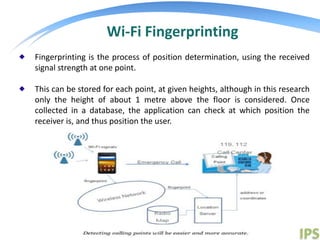
Fingerprinting is the process of position determination, using the received
signal strength at one point.

This can be stored for each point, at given heights, although in this research
only the height of about 1 metre above the floor is considered. Once
collected in a database, the application can check at which position the
receiver is, and thus position the user.
Uses of IPS
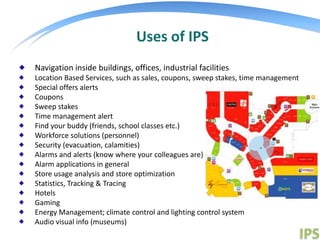
Navigation inside buildings, offices, industrial facilities
Location Based Services, such as sales, coupons, sweep stakes, time management
Special offers alerts
Coupons
Sweep stakes
Time management alert
Find your buddy (friends, school classes etc.)
Workforce solutions (personnel)
Security (evacuation, calamities)
Alarms and alerts (know where your colleagues are)
Alarm applications in general
Store usage analysis and store optimization
Statistics, Tracking & Tracing
Hotels
Gaming
Energy Management; climate control and lighting control system
Audio visual info (museums)
Conclusion
To increase the accuracy of finding your location, mapping developers
are considering methods of supplementing Wi-Fi signals. Using measured
Wi-Fi signal strengths to develop Wi-Fi fingerprints is an area that has
been receiving attention from researchers, and is certainly a valid
approach for indoor environments.

Not only will it reduce the stress of getting lost, but this technology can
also inspire other services to improve your shopping experience. For
instance, one of your favourite clothing stores at the mall can send a
coupon to your phone when you pass by their doors.

Already, indoor mapping is creating buzz as the hot technology of 2013.
Indoor positioning system

Indoor positioning system

  • 1.
  • 2.
    CONTENTS What is IPS? Whynot GPS? GPS vs IPS Choosing Wi-Fi over other sensor techniques Wi-Fi Fingerprinting Uses of IPS Conclusion
  • 3.
    What is IPS? Anindoor positioning system (IPS) is a network of devices used to wirelessly locate objects or people inside a building. Instead of using satellites, an IPS relies on nearby anchors (nodes with a known position), which either actively locate tags or provide environmental context for devices to sense IPS can be entirely local to your Smartphone (or other portable navigation device). IPS, like GPS, can establish a location fix completely passively.
  • 4.
    Why not GPS? Asatellite navigation is a system of satellites that provide autonomous geo-spatial positioning with global coverage may be termed a global navigation satellite system (GNSS or GPS). GPS has two fundamental laws : They don’t work indoors They only really operate in two dimensions GPS are generally not suitable to establish indoor locations, since microwaves will be attenuated and scattered by roofs, walls and other objects.
  • 5.
    GPS vs IPS Outdoors,navigation relies for the most part on GPS, whose accuracy ranges from 1 to 10 meters. Indoors, because of attenuation and scattering, GPS falls apart. And even outdoors, GPS is vertically challenged; it’s about one- third as accurate at pinpointing your elevation as it is at telling where you are on the ground.
  • 6.
    Choosing Wi-Fi overother sensor techniques GPS is suitable for the outdoor navigation, as the navigable spaces are wide enough. The accuracy positioning of GPS is between 6 and 12 meters 95% of the time. The problem is that the reception of the GPS signals is bad in densely build areas, including the indoor environment. Radio Frequency Identification (RFID) makes use of tags and readers, which allow fast read/write data communication, but there is no real localization and positioning involved Ultra Wide Band (UWB) offers fast, low-power and large capacity data transfer. The advantage is that it is capable of very precise localization (near 15 cm) but it is rather expensive Finally, The IEEE 802.11 (Wi-Fi) technology of data exchange proves to be the most balanced, as the signal range of around 30-40 meter indoor is acceptable and its economic viability is stable.
  • 7.
    Technique Range / accuracy Remarks (A)GPS Accuracy: + Low barrier entry 6.0 m - 10.0 m - Slow computation and processing time Very susceptible to reflectance and multi-paths GSM / UMTS Range: + Globally available ≈ 35.0 km - Cell-based accuracy Bluetooth Range: + High speed data transfer ≈ 100 m - Positioning via triangulation (no Accuracy:10 m – 20 objects into account),Explicit links m between devices required IR Range: - Short range of detection limits 0.7 m – 2.5 m infrastructure, No penetration of materials / multipath, Line of sight, Signal can be disturbed easily IEEE 802.11 (Wi-Fi) Range: + Large scale available over the ≈ 32 m (indoor) world .Economical viable ≈ 95 m (outdoor) - High power consumption, Slightly Accuracy: 1 m – 5 m multipath susceptible
  • 8.
    Wi-Fi Fingerprinting Fingerprinting isthe process of position determination, using the received signal strength at one point. This can be stored for each point, at given heights, although in this research only the height of about 1 metre above the floor is considered. Once collected in a database, the application can check at which position the receiver is, and thus position the user.
  • 9.
    Uses of IPS Navigationinside buildings, offices, industrial facilities Location Based Services, such as sales, coupons, sweep stakes, time management Special offers alerts Coupons Sweep stakes Time management alert Find your buddy (friends, school classes etc.) Workforce solutions (personnel) Security (evacuation, calamities) Alarms and alerts (know where your colleagues are) Alarm applications in general Store usage analysis and store optimization Statistics, Tracking & Tracing Hotels Gaming Energy Management; climate control and lighting control system Audio visual info (museums)
  • 10.
    Conclusion To increase theaccuracy of finding your location, mapping developers are considering methods of supplementing Wi-Fi signals. Using measured Wi-Fi signal strengths to develop Wi-Fi fingerprints is an area that has been receiving attention from researchers, and is certainly a valid approach for indoor environments. Not only will it reduce the stress of getting lost, but this technology can also inspire other services to improve your shopping experience. For instance, one of your favourite clothing stores at the mall can send a coupon to your phone when you pass by their doors. Already, indoor mapping is creating buzz as the hot technology of 2013.