New Service Boosters to prevent churn A social network  based scheme Jagadish .S.M. Jothiswaran .R Govindaraj .K Internal guide: Mrs A.Kala B.Tech
Objectives : Value added services are a major source of revenue for telecom operators. We present a new concept for providing charging solutions for these value added services. This concept also results in creation of communities , which helps to a great extent in churn control.  The concept also entails broadcasting any new service for a better response( to operator).
Literature survey : The present solution, concentrates only on the  creation and presentation of services. There is no flexible charging mechanism for these services. Invariably it’s the charging mechanism that controls the usage of these services. Hence, we really need to turn our attention towards it.
Issues : The default  charging mechanism offers no real benefit to the customer, other than the satisfaction of using the service. Consequently, there is no special feature to encourage its usage. The set-up also doesn’t have an explicit community identification scheme. Operator needs a special way of determining communities based on the service usage, which would streamline his service proposals.
Existing work : The present charging mechanism is relatively straight-forward. The user chooses or subscribes to a service that he’s interested in. The process involves a one-time download fee. Then on, the charging is on a monthly/bi-monthly basis.
Proposed work : We introduce the concept of groups, which are intended to promote re-usability. Every group has a single owner and multiple members. Any service currently being used by the owner/members gets added to the group. Addition of members doesn’t need owner’s consent.
Logistics : When a group member needs to use a service,  the system first searches the group If its present in the group, then the member can simply reuse it. As he’s reusing it, he gets the service at a discounted price. The parent of the service( the service creator) gets an incentive for reuse by another group member
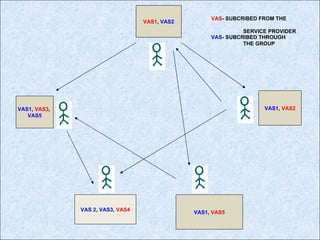
VAS1,  VAS3 ,  VAS5 VAS1 , VAS2 VAS1 ,  VAS2 VAS 2 ,  VAS3 ,  VAS4 VAS1 ,  VAS5 VAS1 ,  VAS3 ,  VAS5 VAS1 ,  VAS2 VAS - SUBCRIBED FROM THE  SERVICE PROVIDER VAS - SUBCRIBED THROUGH  THE GROUP
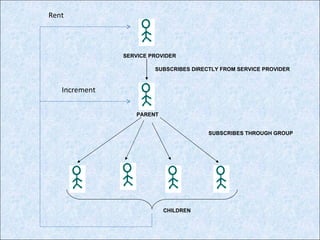
Logistics : Thus there’s a two-way benefit which encourages users to subscribe for services. Every user has to pay a monthly rental for being a group member. A portion of this rental is given as incentive to the group creator(i.e. owner). A member of a group can be an owner in another group.
SERVICE PROVIDER PARENT CHILDREN SUBSCRIBES DIRECTLY FROM SERVICE PROVIDER SUBSCRIBES THROUGH GROUP Rent Increment
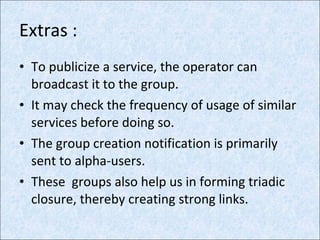
Extras : To publicize a service, the operator can broadcast it to the group. It may check the frequency of usage of similar services before doing so. The group creation notification is primarily sent to alpha-users. These  groups also help us in forming triadic closure, thereby creating strong links.
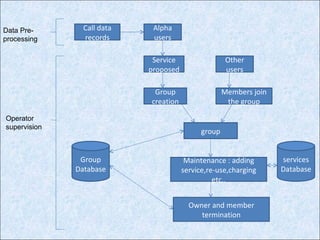
Call data records Alpha users Service proposed Other users Group creation Members join the group group Maintenance : adding service,re-use,charging etc.. Owner and member termination Group Database services Database Data Pre- processing Operator supervision
System requirements : A large secondary memory is needed to deal with the potentially large volume of data. A high-speed main memory is also required for facilitating quicker query processing. To store the cdr details a high speed server like blade server is a must. The software must be such that it integrates smoothly into the underlying infrastructure.
References : Paper name :Creating Value Added Services in Internet Telephony: An Overview and a Case Study on a High-Level Service Creation Environment. Published by :Roch H. Glitho, Senior Member, IEEE, Ferhat Khendek, Member, IEEE, and Alessandro De Marco, Member, IEEE Details :IEEE TRANSACTIONS ON SYSTEMS, MAN, AND CYBERNETICS—PART C: APPLICATIONS AND REVIEWS, VOL. 33, NO. 4, NOVEMBER 2007 Other references : http://telecomandinternet.com/innovation-of-value-added-service-vas/ ACM International Conference Proceeding Series; Vol. 261  archive Proceedings of the 11th international conference on Extending database technology: Advances in database technology.  Year of Publication:2008
Thank You

First Review(Ppt)

  • 1.
    New Service Boostersto prevent churn A social network based scheme Jagadish .S.M. Jothiswaran .R Govindaraj .K Internal guide: Mrs A.Kala B.Tech
  • 2.
    Objectives : Valueadded services are a major source of revenue for telecom operators. We present a new concept for providing charging solutions for these value added services. This concept also results in creation of communities , which helps to a great extent in churn control. The concept also entails broadcasting any new service for a better response( to operator).
  • 3.
    Literature survey :The present solution, concentrates only on the creation and presentation of services. There is no flexible charging mechanism for these services. Invariably it’s the charging mechanism that controls the usage of these services. Hence, we really need to turn our attention towards it.
  • 4.
    Issues : Thedefault charging mechanism offers no real benefit to the customer, other than the satisfaction of using the service. Consequently, there is no special feature to encourage its usage. The set-up also doesn’t have an explicit community identification scheme. Operator needs a special way of determining communities based on the service usage, which would streamline his service proposals.
  • 5.
    Existing work :The present charging mechanism is relatively straight-forward. The user chooses or subscribes to a service that he’s interested in. The process involves a one-time download fee. Then on, the charging is on a monthly/bi-monthly basis.
  • 6.
    Proposed work :We introduce the concept of groups, which are intended to promote re-usability. Every group has a single owner and multiple members. Any service currently being used by the owner/members gets added to the group. Addition of members doesn’t need owner’s consent.
  • 7.
    Logistics : Whena group member needs to use a service, the system first searches the group If its present in the group, then the member can simply reuse it. As he’s reusing it, he gets the service at a discounted price. The parent of the service( the service creator) gets an incentive for reuse by another group member
  • 8.
    VAS1, VAS3, VAS5 VAS1 , VAS2 VAS1 , VAS2 VAS 2 , VAS3 , VAS4 VAS1 , VAS5 VAS1 , VAS3 , VAS5 VAS1 , VAS2 VAS - SUBCRIBED FROM THE SERVICE PROVIDER VAS - SUBCRIBED THROUGH THE GROUP
  • 9.
    Logistics : Thusthere’s a two-way benefit which encourages users to subscribe for services. Every user has to pay a monthly rental for being a group member. A portion of this rental is given as incentive to the group creator(i.e. owner). A member of a group can be an owner in another group.
  • 10.
    SERVICE PROVIDER PARENTCHILDREN SUBSCRIBES DIRECTLY FROM SERVICE PROVIDER SUBSCRIBES THROUGH GROUP Rent Increment
  • 11.
    Extras : Topublicize a service, the operator can broadcast it to the group. It may check the frequency of usage of similar services before doing so. The group creation notification is primarily sent to alpha-users. These groups also help us in forming triadic closure, thereby creating strong links.
  • 12.
    Call data recordsAlpha users Service proposed Other users Group creation Members join the group group Maintenance : adding service,re-use,charging etc.. Owner and member termination Group Database services Database Data Pre- processing Operator supervision
  • 13.
    System requirements :A large secondary memory is needed to deal with the potentially large volume of data. A high-speed main memory is also required for facilitating quicker query processing. To store the cdr details a high speed server like blade server is a must. The software must be such that it integrates smoothly into the underlying infrastructure.
  • 14.
    References : Papername :Creating Value Added Services in Internet Telephony: An Overview and a Case Study on a High-Level Service Creation Environment. Published by :Roch H. Glitho, Senior Member, IEEE, Ferhat Khendek, Member, IEEE, and Alessandro De Marco, Member, IEEE Details :IEEE TRANSACTIONS ON SYSTEMS, MAN, AND CYBERNETICS—PART C: APPLICATIONS AND REVIEWS, VOL. 33, NO. 4, NOVEMBER 2007 Other references : http://telecomandinternet.com/innovation-of-value-added-service-vas/ ACM International Conference Proceeding Series; Vol. 261 archive Proceedings of the 11th international conference on Extending database technology: Advances in database technology. Year of Publication:2008
  • 15.