• Introduction
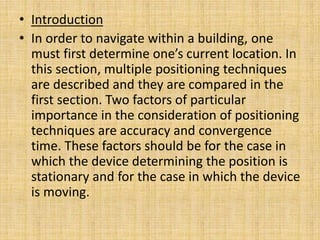
• In order to navigate within a building, one
must first determine one’s current location. In
this section, multiple positioning techniques
are described and they are compared in the
first section. Two factors of particular
importance in the consideration of positioning
techniques are accuracy and convergence
time. These factors should be for the case in
which the device determining the position is
stationary and for the case in which the device
is moving.
Potential technologies
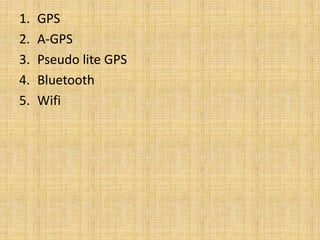
1. GPS
2. A-GPS
3. Pseudo lite GPS
4. Bluetooth
5. Wifi
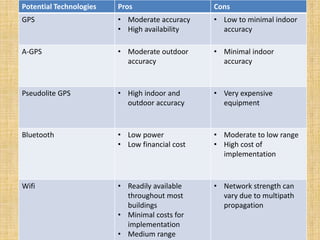
Potential Technologies Pros Cons
GPS • Moderate accuracy
• High availability
• Low to minimal indoor
accuracy
A-GPS • Moderate outdoor
accuracy
• Minimal indoor
accuracy
Pseudolite GPS • High indoor and
outdoor accuracy
• Very expensive
equipment
Bluetooth • Low power
• Low financial cost
• Moderate to low range
• High cost of
implementation
Wifi • Readily available
throughout most
buildings
• Minimal costs for
implementation
• Medium range
• Network strength can
vary due to multipath
propagation
Wireless Fidelity:
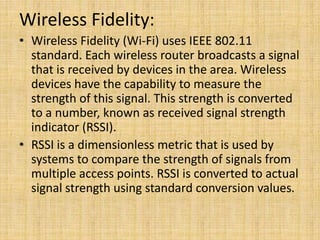
• Wireless Fidelity (Wi-Fi) uses IEEE 802.11
standard. Each wireless router broadcasts a signal
that is received by devices in the area. Wireless
devices have the capability to measure the
strength of this signal. This strength is converted
to a number, known as received signal strength
indicator (RSSI).
• RSSI is a dimensionless metric that is used by
systems to compare the strength of signals from
multiple access points. RSSI is converted to actual
signal strength using standard conversion values.
• Wi-Fi devices such as laptops and
smartphones typically perform this conversion
automatically in order to provide signal
strength information to applications running
on the device.
• An advantage of Wi-Fi is that wireless
networks are universal. They exist in
population-dense areas and are continuously
spreading outward. This causes Wi-Fi based
systems to have a lower cost of
implementation.
• Our system proposes an indoor position
detection using Wi-Fi signal strength and a
formula to determine position of a user. Three
access points (AP) are needed in order to
determine the position of a user in an indoor
location.
• Wireless routers provide coverage of about
100 feet (30.5 meters), signal strength is used
to find the collision point in order to specify
the accurate position of an object.
• We assume the three APs are known as AP1,
AP2, and AP3.
• Then, based on three coordinates of the APs, we need to find the
coordinates of the user’s position that is represented as Z.
• Let’s assume that a user is using a smart phones that serves as a receiver
of the signals transmitted from the access points. Application of Wi-Fi
analyzer in the smart phone presents the signal strength in terms of
percentage. The highest percentage of signal strength indicates that Z is
closest to the AP whereas the lowest percentage implies that Z is
maximum range of AP.
• The percentage of signal strength obtained from the Wi-Fi analyzer can be
converted to distance between a user’s to each AP using this equation :
• Distance, di = p ( 1 – mi )
• Where;
• m = is the percentage of signal strength
• p = is the maximum coverage of signal strength
• i = 1,2,3
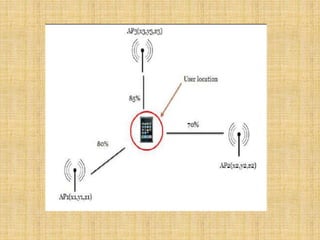
• From Figure 1, let each AP be placed at the center. Assume a scenario
where a student who uses a smart phone, is looking for a store in a mall.
Then, we assuming that signal strength for each AP will spread the signal
in wave forms.
Shortest Path
• Dijkstra’s algorithm is one of the most used routing
algorithm.This algorithm is suitable for problems dealing
with a single source node and one or more destination
nodes. The algorithm works by advancing a single node at a
time, starting from the source node. At each step during
the loop, the algorithm chooses a node that has the
minimum cost from the source node. This node has been
visited from the source and has not yet been optimized.
This node is then marked as optimized and the cost to all
the adjacent nodes will be evaluated.The optimized cost to
the destination is found once the algorithm reaches the
destination nodes.
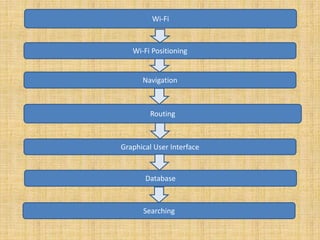
Scope
Wi-Fi
Wi-Fi Positioning
Navigation
Routing
Graphical User Interface
Database
Searching

Potential technogies

  • 1.
    • Introduction • Inorder to navigate within a building, one must first determine one’s current location. In this section, multiple positioning techniques are described and they are compared in the first section. Two factors of particular importance in the consideration of positioning techniques are accuracy and convergence time. These factors should be for the case in which the device determining the position is stationary and for the case in which the device is moving.
  • 2.
  • 3.
    1. GPS 2. A-GPS 3.Pseudo lite GPS 4. Bluetooth 5. Wifi
  • 4.
    Potential Technologies ProsCons GPS • Moderate accuracy • High availability • Low to minimal indoor accuracy A-GPS • Moderate outdoor accuracy • Minimal indoor accuracy Pseudolite GPS • High indoor and outdoor accuracy • Very expensive equipment Bluetooth • Low power • Low financial cost • Moderate to low range • High cost of implementation Wifi • Readily available throughout most buildings • Minimal costs for implementation • Medium range • Network strength can vary due to multipath propagation
  • 5.
    Wireless Fidelity: • WirelessFidelity (Wi-Fi) uses IEEE 802.11 standard. Each wireless router broadcasts a signal that is received by devices in the area. Wireless devices have the capability to measure the strength of this signal. This strength is converted to a number, known as received signal strength indicator (RSSI). • RSSI is a dimensionless metric that is used by systems to compare the strength of signals from multiple access points. RSSI is converted to actual signal strength using standard conversion values.
  • 6.
    • Wi-Fi devicessuch as laptops and smartphones typically perform this conversion automatically in order to provide signal strength information to applications running on the device. • An advantage of Wi-Fi is that wireless networks are universal. They exist in population-dense areas and are continuously spreading outward. This causes Wi-Fi based systems to have a lower cost of implementation.
  • 7.
    • Our systemproposes an indoor position detection using Wi-Fi signal strength and a formula to determine position of a user. Three access points (AP) are needed in order to determine the position of a user in an indoor location. • Wireless routers provide coverage of about 100 feet (30.5 meters), signal strength is used to find the collision point in order to specify the accurate position of an object. • We assume the three APs are known as AP1, AP2, and AP3.
  • 9.
    • Then, basedon three coordinates of the APs, we need to find the coordinates of the user’s position that is represented as Z. • Let’s assume that a user is using a smart phones that serves as a receiver of the signals transmitted from the access points. Application of Wi-Fi analyzer in the smart phone presents the signal strength in terms of percentage. The highest percentage of signal strength indicates that Z is closest to the AP whereas the lowest percentage implies that Z is maximum range of AP. • The percentage of signal strength obtained from the Wi-Fi analyzer can be converted to distance between a user’s to each AP using this equation : • Distance, di = p ( 1 – mi ) • Where; • m = is the percentage of signal strength • p = is the maximum coverage of signal strength • i = 1,2,3 • From Figure 1, let each AP be placed at the center. Assume a scenario where a student who uses a smart phone, is looking for a store in a mall. Then, we assuming that signal strength for each AP will spread the signal in wave forms.
  • 10.
    Shortest Path • Dijkstra’salgorithm is one of the most used routing algorithm.This algorithm is suitable for problems dealing with a single source node and one or more destination nodes. The algorithm works by advancing a single node at a time, starting from the source node. At each step during the loop, the algorithm chooses a node that has the minimum cost from the source node. This node has been visited from the source and has not yet been optimized. This node is then marked as optimized and the cost to all the adjacent nodes will be evaluated.The optimized cost to the destination is found once the algorithm reaches the destination nodes.
  • 12.
  • 13.