Presented by:
Sherwin Rodrigues
1
Introduction
The increasing demand for location based services inside buildings has made
indoor positioning a significant research topic. The applications of indoor
positioning are many, for instance, indoor navigation for people or robots,
inventory tracking, locating patients in a hospital, guiding blind people,
tracking small children or elderly individuals, location based advertising,
ambient intelligence etc. Although the Global Positioning System is the most
popular outdoor positioning system, its signals are easily blocked by most
construction materials making it useless for indoor positioning. This study
deals with indoor positioning using the Wireless Ethernet IEEE 802.11(Wi-Fi)
standard that has a distinct advantage of low cost over other indoor wireless
technologies – it has relatively cheap equipment and in many areas usually a
Wi-Fi network already exists as a part of the communication infrastructure
avoiding expensive and time consuming infrastructure deployment.
2
Abstract
The increasing demand for location based services
inside buildings has made indoor positioning a significant
research topic. This study deals with indoor positioning using
the Wireless Ethernet IEEE 802.11 (Wireless Fidelity, Wi-Fi)
standard that has a distinct advantage of low cost over other
indoor wireless technologies. The aim of this study is to
examine several aspects of location fingerprinting based
indoor positioning that affect positioning accuracy. Overall,
the positioning accuracy achieved in the performed
experiments is 2.0 to 2.5 meters.
3
What is Wi-Fi?
• “Wireless Fidelity”
• Wi-Fi, also spelled Wifi or WiFi, is a technology that allows an
electronic device to exchange data or connect to the
internet wirelessly using microwaves in the 2.4 GHz and 5 GHz
bands.
• The Wi-Fi Alliance defines Wi-Fi as any "wireless local area
network (WLAN) products that are based on the Institute of
Electrical and Electronics Engineers' (IEEE) 802.11 standards"
4
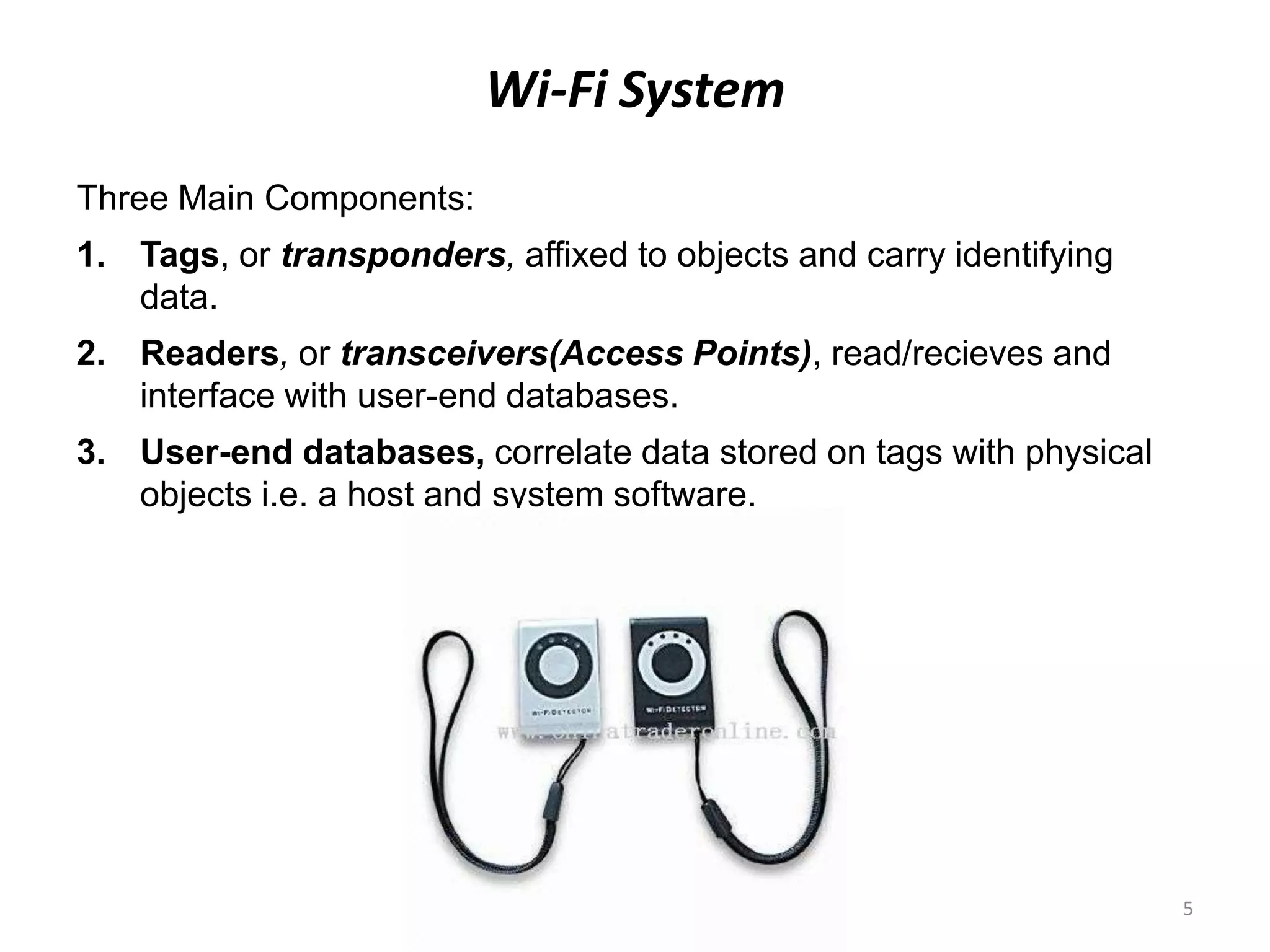
Wi-Fi System
Three Main Components:
1. Tags, or transponders, affixed to objects and carry identifying
data.
2. Readers, or transceivers(Access Points), read/recieves and
interface with user-end databases.
3. User-end databases, correlate data stored on tags with physical
objects i.e. a host and system software.
5
6
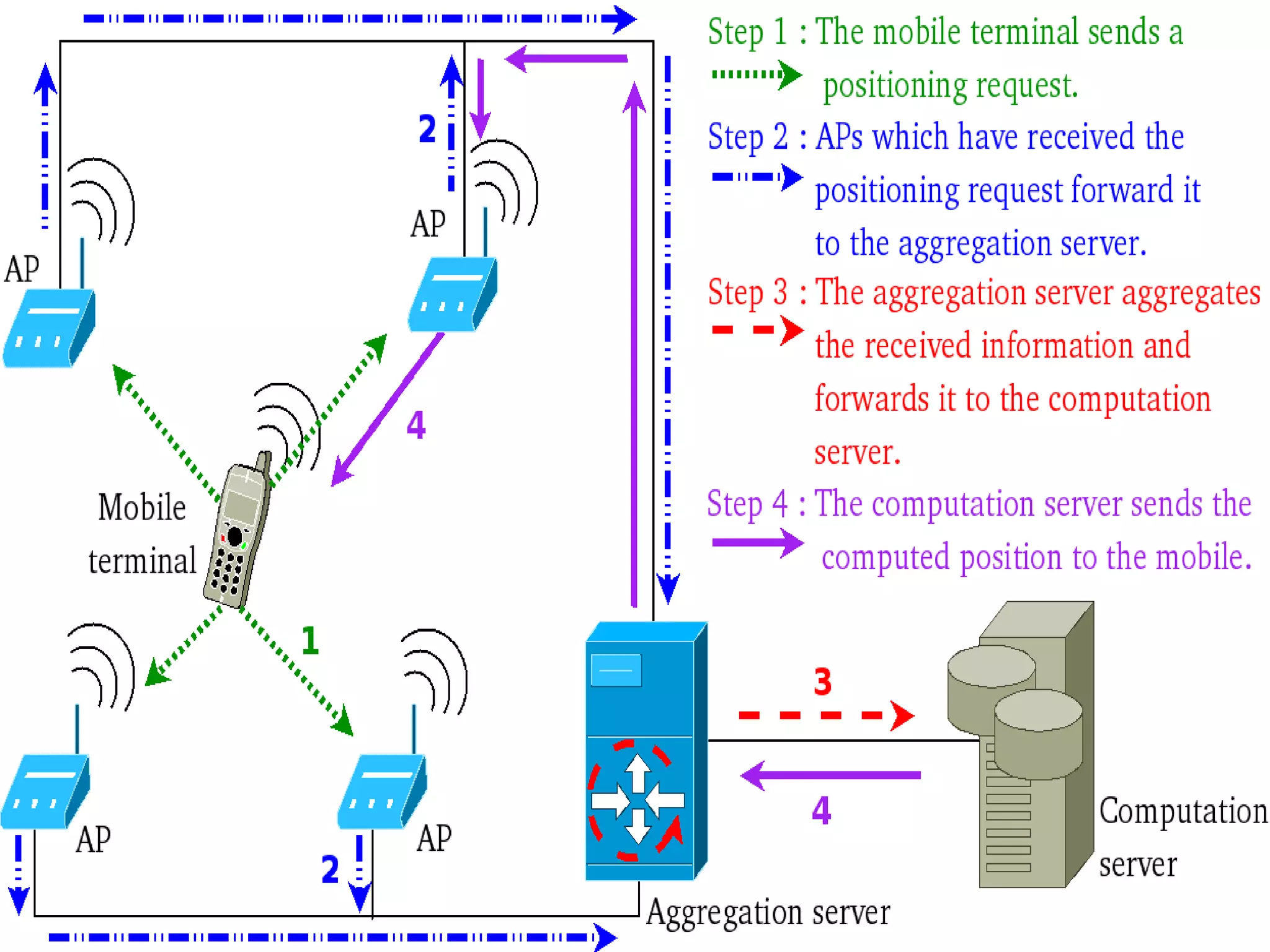
System Operation
The Basic Operation of Wi-Fi positioning System is :
• A device having wifi is attached to the object that needs to be identified.
• When this tagged object is presented in front of a suitable wifi access
point(reader), the device transmits its identification data to the access
point(AP).
• The AP then reads the data and has the capability to forward it over
suitable communication channels.
• This application can then uses this unique data to identify the object and
presents it to the aggregation and computation server software.
• The computation server performs the required location estimation
algorithms and sends the output indication on the radio map.
7
8
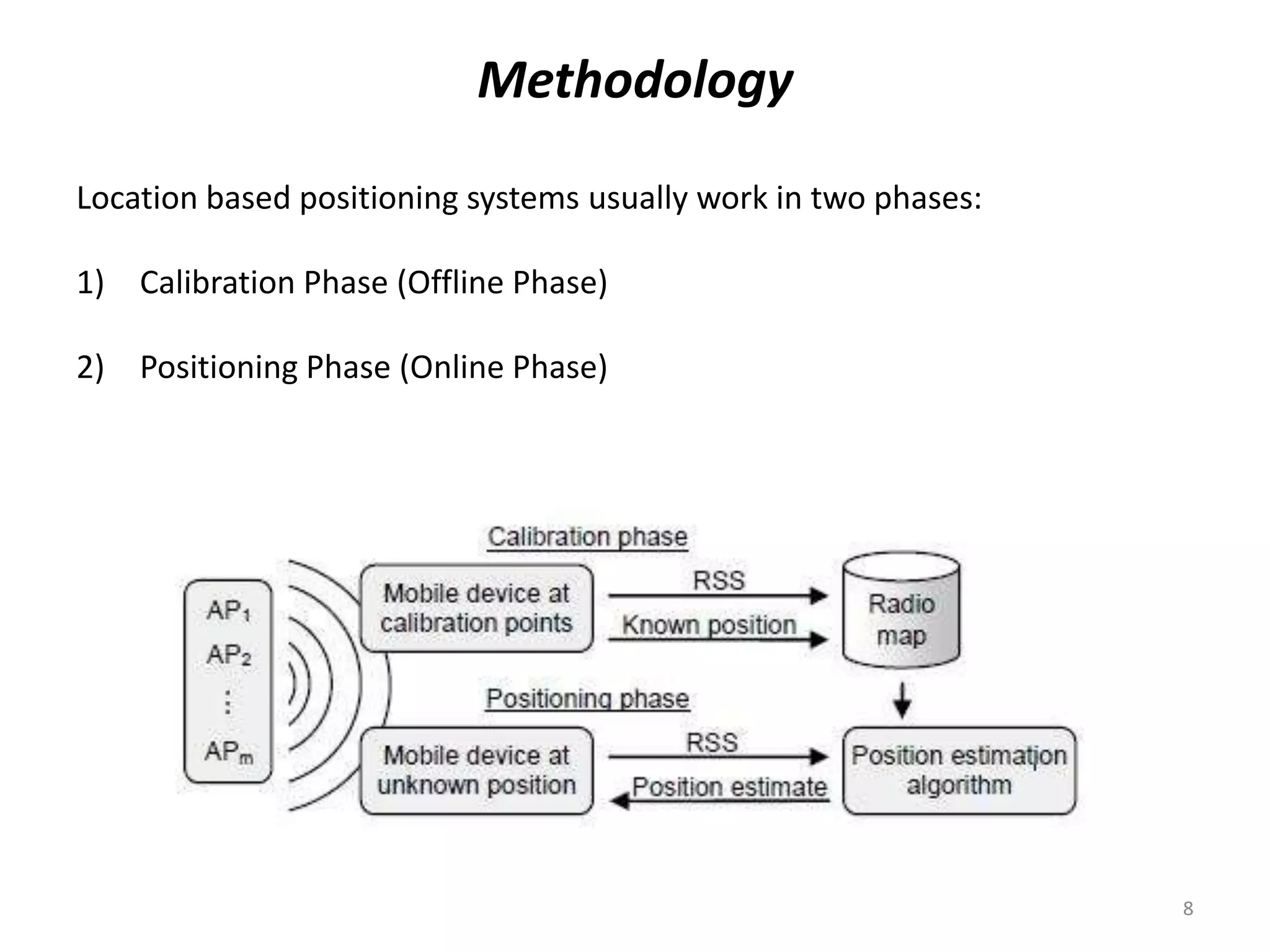
Methodology
Location based positioning systems usually work in two phases:
1) Calibration Phase (Offline Phase)
2) Positioning Phase (Online Phase)
9
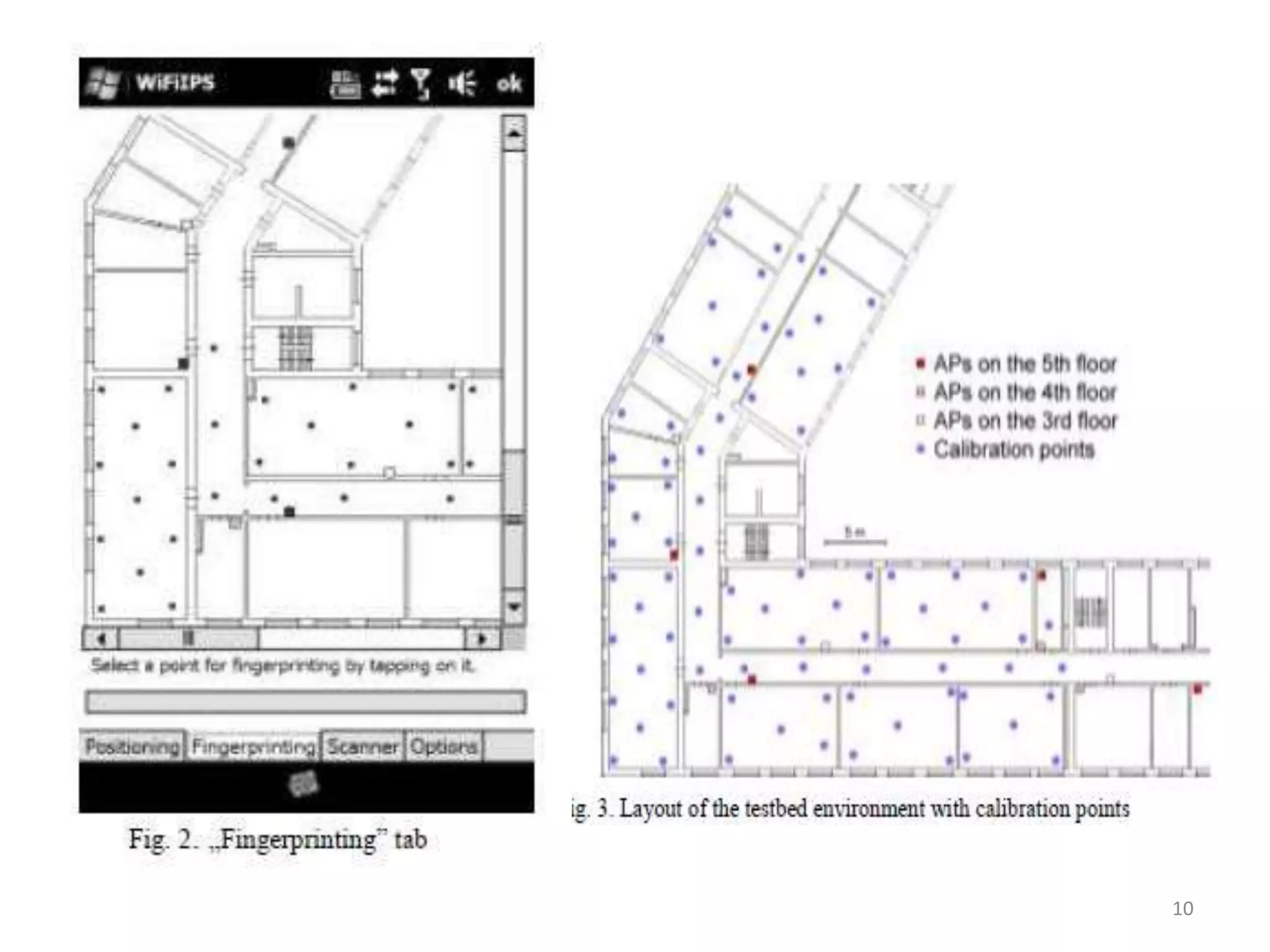
• In the calibration phase, a mobile device is used to measure RSS values (in
dBm) from several APs at the chosen calibration points in the area of
interest. An average of several samples recorded per location is stored.
• In the positioning phase, a mobile device measures the RSS values in an
unknown location and applies a location estimation algorithm to estimate
its current location using the previously created radio map.
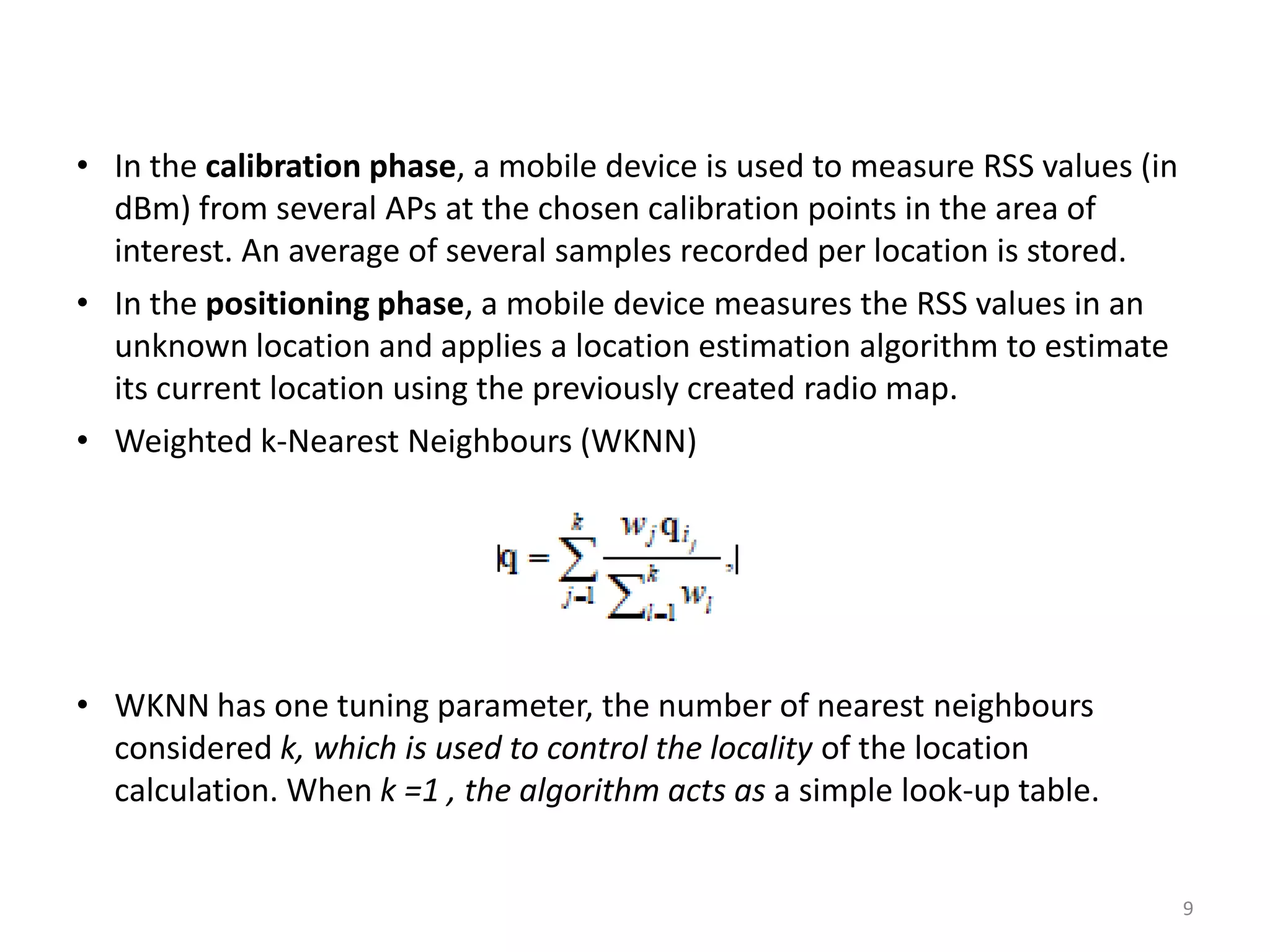
• Weighted k-Nearest Neighbours (WKNN)
• WKNN has one tuning parameter, the number of nearest neighbours
considered k, which is used to control the locality of the location
calculation. When k =1 , the algorithm acts as a simple look-up table.
10
11
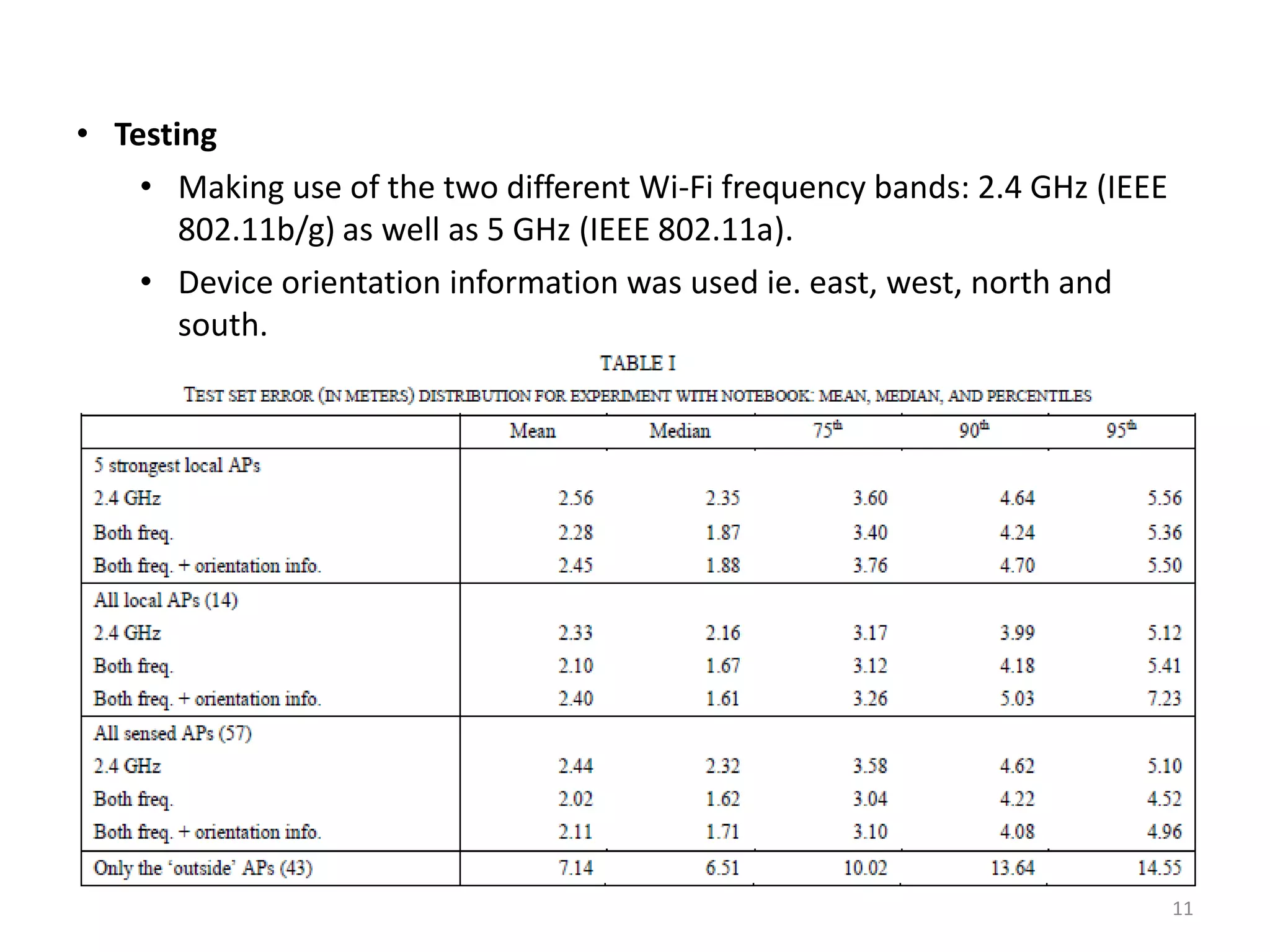
• Testing
• Making use of the two different Wi-Fi frequency bands: 2.4 GHz (IEEE
802.11b/g) as well as 5 GHz (IEEE 802.11a).
• Device orientation information was used ie. east, west, north and
south.
12
• The impact of varying the number of used APs was studied in more
detail and without regarding the origin of an AP.
• Here, the best results are achieved mostly using about 20 APs
13
• The dependence of average positioning error (in meters) on the choice of
the method (WKNN versus k-Nearest Neighbours[KNN]) and selected number
of nearest neighbours k is shown (from 1 to 10).
• The smallest positioning error in this experiment was 2.35 meters using
WKNN method while that of KNN was 2.48 meters.
Wi-Fi Advantages
• Contactless: An Wi-Fi tag can be read without any physical contact
between the tag and the AP/reader.
• Cost Effective: Wi-Fi allows cost effective LAN deployment indoor as well
as outdoor.
• Absence of line of sight. A line of sight is generally not required
• Better Security: Wi-Fi Protected Access encryption (WPA2)
• Variable range: 2.4 GHz - 5 GHz bandwidth
• Support for multiple tag reads.
• Easy availability: Easily available for most new electronic devices such as
laptops, mobile phones etc
14
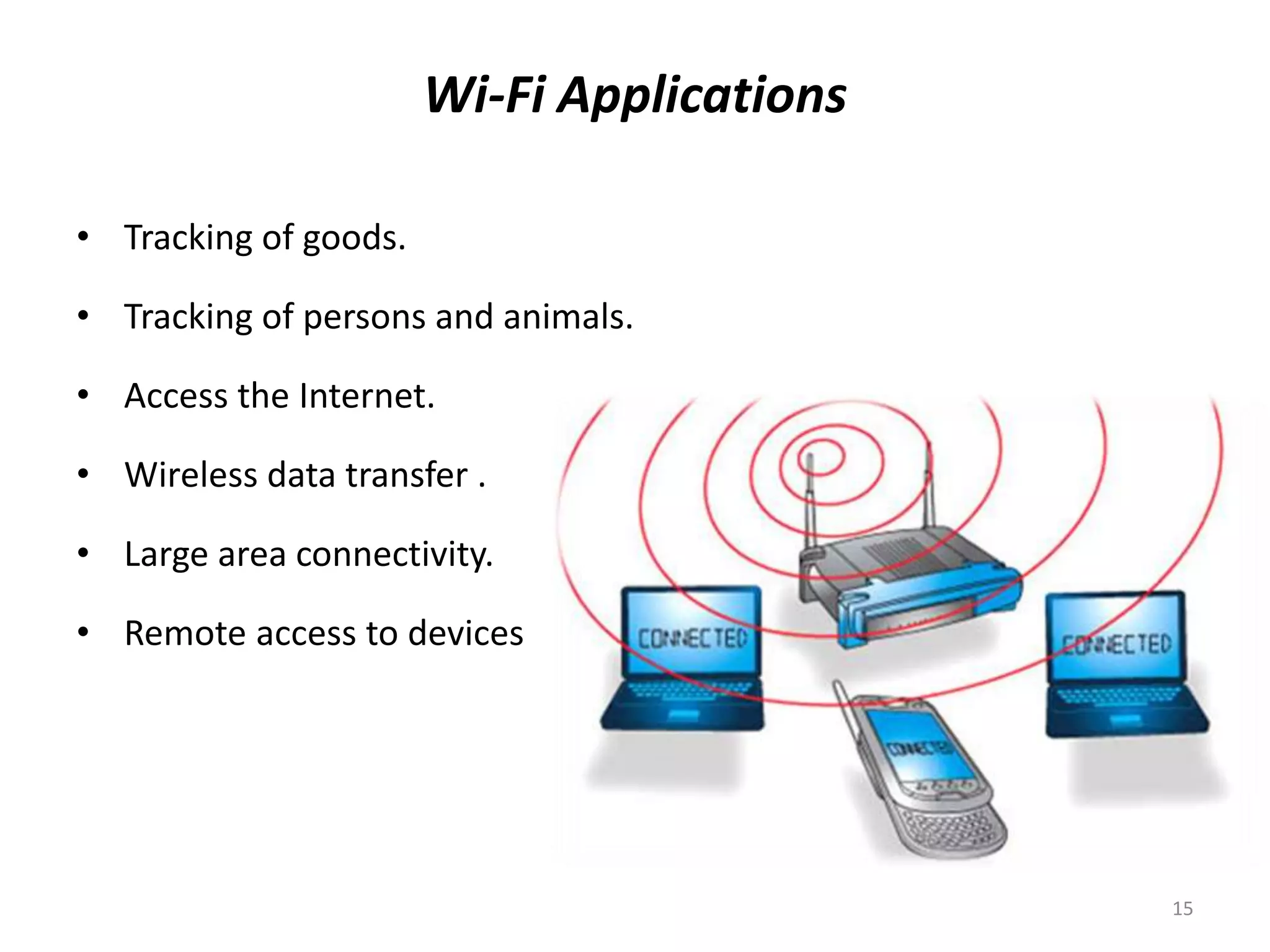
Wi-Fi Applications
• Tracking of goods.
• Tracking of persons and animals.
• Access the Internet.
• Wireless data transfer .
• Large area connectivity.
• Remote access to devices
15
Conclusion
• It was observed that a positioning system can benefit from the availability of
additional weakly-sensed APs as well as APs working in 5 GHz frequency band
(using IEEE 802.11a/n). RSS readings from these APs gave a notable
improvement in positioning accuracy. In fact, in this study, using exclusively
the APs from other buildings nearby, the positioning error was still a decent
7.14 m.
• This Positioning System is based on RSS value which is a measurement of the
power present in a received radio signal to determine the location of an
object
• Cost effective
• Feasibility
16
References
•F. Thomas and L. Ros, Revisiting trilateration for robot localization. IEEE
ransactions on Robotics, 21(1), 2005, pp. 93-101.
•Widyawan, M. Klepal and D. Pesch, “Influence of Predicted and Measured
Fingerprint on the Accuracy of RSSI-based Indoor Location Systems, ” in
Proceedings of 4th Workshop on Positioning, Navigation, and Communication
2007 (WPNC’07), 2007, pp. 145-151.
•J. Yim, S. Jeong, K. Gwon and J. Joo, Improvement of Kalman filters for WLAN
based indoor tracking. Expert Systems with Applications, 37(1), 2010, pp. 426-
433.
•G. Jekabsons, V. Zuravlyov, Refining Wi-Fi based indoor positioning. In:
Proceedings of 4th International Scientific Conference Applied Information and
Communication Technologies (AICT), Jelgava, Latvia, 2010, pp. 87-95.
•O. M. Badawy and M. Hasan, Decision tree approach to estimate user location
in WLAN based on location fingerprinting. In: Proceedings of 24th National
Radio Science Conference, Ain Shams Univ., Egypt, 2007, pp. 1-10.
•M. Brunato and R. Battiti, Statistical learning theory for location fingerprinting
in wireless LANs. Computer Networks and ISDN Systems, 47(6), Elsevier, 2005,
pp. 825-845.
17
18

Wi-Fi based indoor positioning

  • 1.
  • 2.
    Introduction The increasing demandfor location based services inside buildings has made indoor positioning a significant research topic. The applications of indoor positioning are many, for instance, indoor navigation for people or robots, inventory tracking, locating patients in a hospital, guiding blind people, tracking small children or elderly individuals, location based advertising, ambient intelligence etc. Although the Global Positioning System is the most popular outdoor positioning system, its signals are easily blocked by most construction materials making it useless for indoor positioning. This study deals with indoor positioning using the Wireless Ethernet IEEE 802.11(Wi-Fi) standard that has a distinct advantage of low cost over other indoor wireless technologies – it has relatively cheap equipment and in many areas usually a Wi-Fi network already exists as a part of the communication infrastructure avoiding expensive and time consuming infrastructure deployment. 2
  • 3.
    Abstract The increasing demandfor location based services inside buildings has made indoor positioning a significant research topic. This study deals with indoor positioning using the Wireless Ethernet IEEE 802.11 (Wireless Fidelity, Wi-Fi) standard that has a distinct advantage of low cost over other indoor wireless technologies. The aim of this study is to examine several aspects of location fingerprinting based indoor positioning that affect positioning accuracy. Overall, the positioning accuracy achieved in the performed experiments is 2.0 to 2.5 meters. 3
  • 4.
    What is Wi-Fi? •“Wireless Fidelity” • Wi-Fi, also spelled Wifi or WiFi, is a technology that allows an electronic device to exchange data or connect to the internet wirelessly using microwaves in the 2.4 GHz and 5 GHz bands. • The Wi-Fi Alliance defines Wi-Fi as any "wireless local area network (WLAN) products that are based on the Institute of Electrical and Electronics Engineers' (IEEE) 802.11 standards" 4
  • 5.
    Wi-Fi System Three MainComponents: 1. Tags, or transponders, affixed to objects and carry identifying data. 2. Readers, or transceivers(Access Points), read/recieves and interface with user-end databases. 3. User-end databases, correlate data stored on tags with physical objects i.e. a host and system software. 5
  • 6.
    6 System Operation The BasicOperation of Wi-Fi positioning System is : • A device having wifi is attached to the object that needs to be identified. • When this tagged object is presented in front of a suitable wifi access point(reader), the device transmits its identification data to the access point(AP). • The AP then reads the data and has the capability to forward it over suitable communication channels. • This application can then uses this unique data to identify the object and presents it to the aggregation and computation server software. • The computation server performs the required location estimation algorithms and sends the output indication on the radio map.
  • 7.
  • 8.
    8 Methodology Location based positioningsystems usually work in two phases: 1) Calibration Phase (Offline Phase) 2) Positioning Phase (Online Phase)
  • 9.
    9 • In thecalibration phase, a mobile device is used to measure RSS values (in dBm) from several APs at the chosen calibration points in the area of interest. An average of several samples recorded per location is stored. • In the positioning phase, a mobile device measures the RSS values in an unknown location and applies a location estimation algorithm to estimate its current location using the previously created radio map. • Weighted k-Nearest Neighbours (WKNN) • WKNN has one tuning parameter, the number of nearest neighbours considered k, which is used to control the locality of the location calculation. When k =1 , the algorithm acts as a simple look-up table.
  • 10.
  • 11.
    11 • Testing • Makinguse of the two different Wi-Fi frequency bands: 2.4 GHz (IEEE 802.11b/g) as well as 5 GHz (IEEE 802.11a). • Device orientation information was used ie. east, west, north and south.
  • 12.
    12 • The impactof varying the number of used APs was studied in more detail and without regarding the origin of an AP. • Here, the best results are achieved mostly using about 20 APs
  • 13.
    13 • The dependenceof average positioning error (in meters) on the choice of the method (WKNN versus k-Nearest Neighbours[KNN]) and selected number of nearest neighbours k is shown (from 1 to 10). • The smallest positioning error in this experiment was 2.35 meters using WKNN method while that of KNN was 2.48 meters.
  • 14.
    Wi-Fi Advantages • Contactless:An Wi-Fi tag can be read without any physical contact between the tag and the AP/reader. • Cost Effective: Wi-Fi allows cost effective LAN deployment indoor as well as outdoor. • Absence of line of sight. A line of sight is generally not required • Better Security: Wi-Fi Protected Access encryption (WPA2) • Variable range: 2.4 GHz - 5 GHz bandwidth • Support for multiple tag reads. • Easy availability: Easily available for most new electronic devices such as laptops, mobile phones etc 14
  • 15.
    Wi-Fi Applications • Trackingof goods. • Tracking of persons and animals. • Access the Internet. • Wireless data transfer . • Large area connectivity. • Remote access to devices 15
  • 16.
    Conclusion • It wasobserved that a positioning system can benefit from the availability of additional weakly-sensed APs as well as APs working in 5 GHz frequency band (using IEEE 802.11a/n). RSS readings from these APs gave a notable improvement in positioning accuracy. In fact, in this study, using exclusively the APs from other buildings nearby, the positioning error was still a decent 7.14 m. • This Positioning System is based on RSS value which is a measurement of the power present in a received radio signal to determine the location of an object • Cost effective • Feasibility 16
  • 17.
    References •F. Thomas andL. Ros, Revisiting trilateration for robot localization. IEEE ransactions on Robotics, 21(1), 2005, pp. 93-101. •Widyawan, M. Klepal and D. Pesch, “Influence of Predicted and Measured Fingerprint on the Accuracy of RSSI-based Indoor Location Systems, ” in Proceedings of 4th Workshop on Positioning, Navigation, and Communication 2007 (WPNC’07), 2007, pp. 145-151. •J. Yim, S. Jeong, K. Gwon and J. Joo, Improvement of Kalman filters for WLAN based indoor tracking. Expert Systems with Applications, 37(1), 2010, pp. 426- 433. •G. Jekabsons, V. Zuravlyov, Refining Wi-Fi based indoor positioning. In: Proceedings of 4th International Scientific Conference Applied Information and Communication Technologies (AICT), Jelgava, Latvia, 2010, pp. 87-95. •O. M. Badawy and M. Hasan, Decision tree approach to estimate user location in WLAN based on location fingerprinting. In: Proceedings of 24th National Radio Science Conference, Ain Shams Univ., Egypt, 2007, pp. 1-10. •M. Brunato and R. Battiti, Statistical learning theory for location fingerprinting in wireless LANs. Computer Networks and ISDN Systems, 47(6), Elsevier, 2005, pp. 825-845. 17
  • 18.

Editor's Notes

  • #5 The term Wi-Fi, commercially used at least as early as August 2000,[17] was coined by a brand-consulting firm called Interbrand Corporation. The Wi-Fi Alliance had hired Interbrand to determine a name that was "a little catchier than 'IEEE 802.11b Direct Sequence'"