 Title
 Content
 Introduction
 Paper I
 Paper II
 Comparison
 Conclusion
 References
•The increasing demand for location based services inside buildings has
made indoor positioning a significant research topic.
•The applications of indoor positioning are many, for instance, indoor
navigation for people or robots, inventory tracking, locating patients in a
hospital, guiding blind people, tracking small children or elderly
individuals, location based advertising, ambient intelligence etc.
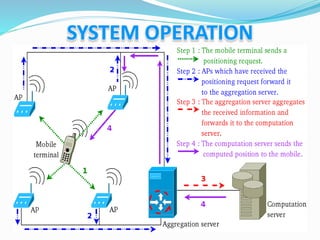
•There are many different kinds of positioning technologies such as Global
Positioning System (GPS), cellular phone tracking system, Wi‐Fi
positioning system and RFID Positioning System .
•Although the Global Positioning System is the most popular outdoor
positioning system, its signals are easily blocked by most construction
materials making it useless for indoor positioning.
•The most appropriate indoor technology for positioning and tracking is
either RFID or WIFI based system.
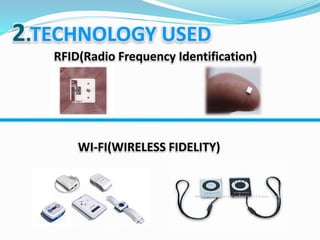
• Radio frequency identification (RFID) is the technology that put
an RFID tag on objects or people, so that they can be identified,
tracked, and managed automatically. With its wide application
in the automobile assembly industry, warehouse management
and the supply chain network, RFID has been recognized as the
next promising technology in serving the positioning purpose.
Existing positioning technologies such as GPS are not available
indoors as the terminal cannot get the signal from satellites.
Results of experiment show that readability of the passive RFID
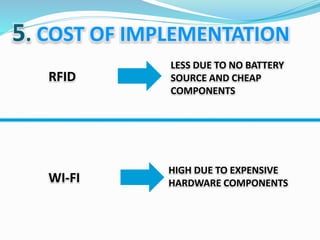
positioning system is satisfactory, and it is a more cost effective
solution when compared with other positioning technologies.
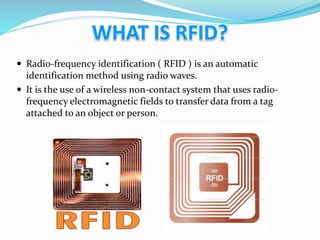
 Radio-frequency identification ( RFID ) is an automatic
identification method using radio waves.
 It is the use of a wireless non-contact system that uses radio-
frequency electromagnetic fields to transfer data from a tag
attached to an object or person.
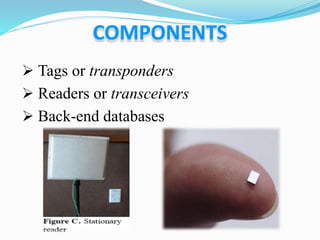
 Tags or transponders
 Readers or transceivers
 Back-end databases
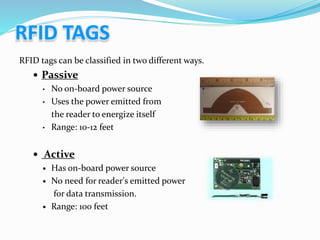
RFID tags can be classified in two different ways.
 Passive
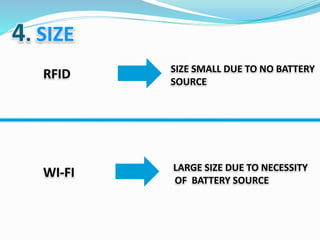
• No on-board power source
• Uses the power emitted from
the reader to energize itself
• Range: 10-12 feet
 Active
 Has on-board power source
 No need for reader's emitted power
for data transmission.
 Range: 100 feet
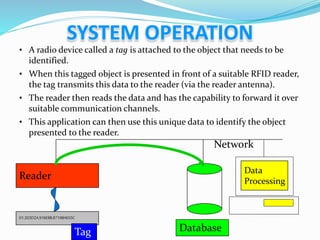
• A radio device called a tag is attached to the object that needs to be
identified.
• When this tagged object is presented in front of a suitable RFID reader,
the tag transmits this data to the reader (via the reader antenna).
• The reader then reads the data and has the capability to forward it over
suitable communication channels.
• This application can then use this unique data to identify the object
presented to the reader.
Reader
01.203D2A.916E8B.8719BAE03C
Tag Database
Network
Data
Processing
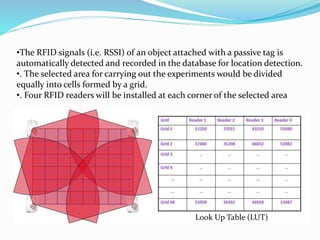
•The RFID signals (i.e. RSSI) of an object attached with a passive tag is
automatically detected and recorded in the database for location detection.
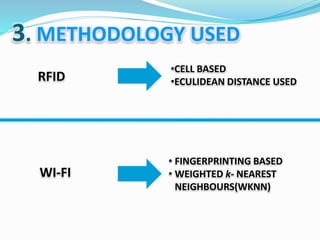
•. The selected area for carrying out the experiments would be divided
equally into cells formed by a grid.
•. Four RFID readers will be installed at each corner of the selected area
Look Up Table (LUT)
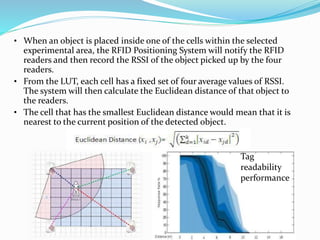
• When an object is placed inside one of the cells within the selected
experimental area, the RFID Positioning System will notify the RFID
readers and then record the RSSI of the object picked up by the four
readers.
• From the LUT, each cell has a fixed set of four average values of RSSI.
The system will then calculate the Euclidean distance of that object to
the readers.
• The cell that has the smallest Euclidean distance would mean that it is
nearest to the current position of the detected object.
Tag
readability
performance
• Tracking of goods.
• Tracking of persons and animals.
• Toll collection and contactless
payment.
• Tracking Books in Libraries.
• Machine readable travel
documents.
• Passport & Airport baggage
tracking logistics.
• Car keys, wireless entry and
ignition
• Contactless. An RFID tag can be
read without any physical contact
between the tag and the reader.
• Writable data. The data of a
read-write (RW) RFID tag can be
rewritten a large number of times.
• Absence of line of sight. A line
of sight is generally not required
for an RFID reader to read an
RFID tag.
• Variety of read ranges.
• Wide data-capacity range.
• Support for multiple tag reads.
• Perform smart tasks.
• The increasing demand for location based services inside
buildings has made indoor positioning a significant research
topic.
• This study deals with indoor positioning using the Wireless
Ethernet IEEE 802.11 (Wireless Fidelity, Wi-Fi) standard that has
a distinct advantage of low cost over other indoor wireless
technologies.
• The aim of this study is to examine several aspects of location
fingerprinting based indoor positioning that affect positioning
accuracy. Overall, the positioning accuracy achieved in the
performed experiments is 2.0 to 2.5 meters.
• “Wireless Fidelity”
• Wi-Fi is a technology that allows an electronic device to
exchange data or connect to the internet wirelessly using
microwaves in the 2.4 GHz and 5 GHz bands.
• The Wi-Fi Alliance defines Wi-Fi as any "wireless local area
network (WLAN) products that are based on the Institute of
Electrical and Electronics Engineers' (IEEE) 802.11 standards"
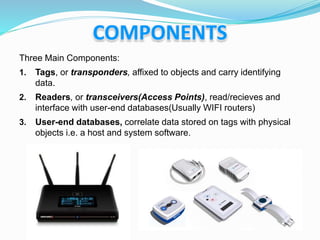
Three Main Components:
1. Tags, or transponders, affixed to objects and carry identifying
data.
2. Readers, or transceivers(Access Points), read/recieves and
interface with user-end databases(Usually WIFI routers)
3. User-end databases, correlate data stored on tags with physical
objects i.e. a host and system software.
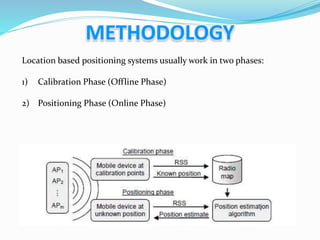
Location based positioning systems usually work in two phases:
1) Calibration Phase (Offline Phase)
2) Positioning Phase (Online Phase)
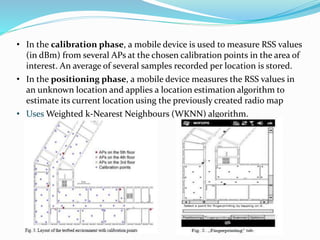
• In the calibration phase, a mobile device is used to measure RSS values
(in dBm) from several APs at the chosen calibration points in the area of
interest. An average of several samples recorded per location is stored.
• In the positioning phase, a mobile device measures the RSS values in
an unknown location and applies a location estimation algorithm to
estimate its current location using the previously created radio map
• Uses Weighted k-Nearest Neighbours (WKNN) algorithm.
• Tracking of goods.
• Tracking of persons and
animals.
• Access the Internet.
• Wireless data transfer .
• Large area connectivity.
• Remote access to devices
• Contactless: An Wi-Fi tag can be
read without any physical contact
between the tag and the AP/reader.
• Cost Effective: Wi-Fi allows cost
effective LAN deployment indoor as
well as outdoor.
• Absence of line of sight. A line of
sight is generally not required
• Better Security: Wi-Fi Protected
Access encryption (WPA2)
• Variable range: 2.4 GHz - 5 GHz
bandwidth
• Support for multiple tag reads.
• Easy availability: Easily available for
most new electronic devices such as
laptops, mobile phones etc
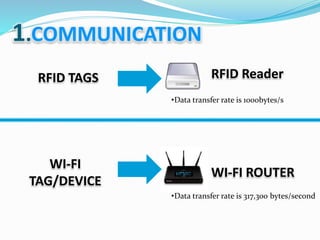
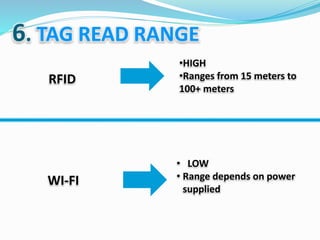
•Data transfer rate is 1000bytes/s
•Data transfer rate is 317,300 bytes/second
•The RFID Technology and WI-FI Technology both are
highly efficient and they are still progressive
developments
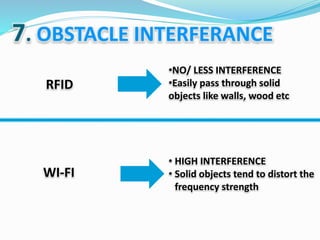
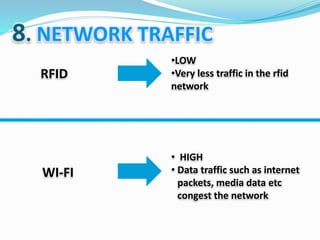
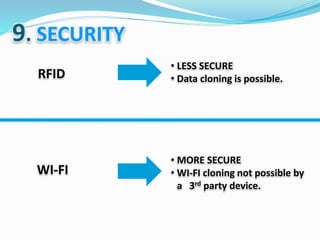
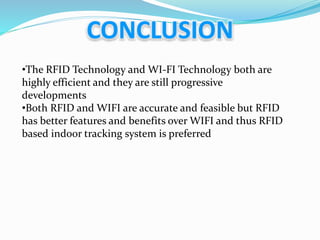
•Both RFID and WIFI are accurate and feasible but RFID
has better features and benefits over WIFI and thus RFID
based indoor tracking system is preferred
• M. Brunato and R. Battiti, Statistical learning theory for location
fingerprinting in wireless LANs. Computer Networks and ISDN Systems,
47(6), Elsevier, 2005
• Chang N., Rashidzadeh, R., Ahmadi, M., (2010).
Robust indoor positioning using differential wi‐fi access points, IEEE
Transactions on Consumer Electronics,56(3), 1860‐1867, 2010 Daito, M.
and Tanida, N., (2008).
• Bekkali, H. Sanson, M. Matsumoto, (2007).RFID indoor positioning based
on probabilistic RFID map and kalman filtering, In: Proceedings of the
WiMOB, 2007.
• O. M. Badawy and M. Hasan, Decision tree approach to estimate user
location in WLAN based on location fingerprinting. In: Proceedings of 24th
National Radio Science Conference, Ain Shams Univ., Egypt, 2007, pp. 1-10.
Indoor Tracking System

Indoor Tracking System

  • 2.
     Title  Content Introduction  Paper I  Paper II  Comparison  Conclusion  References
  • 3.
    •The increasing demandfor location based services inside buildings has made indoor positioning a significant research topic. •The applications of indoor positioning are many, for instance, indoor navigation for people or robots, inventory tracking, locating patients in a hospital, guiding blind people, tracking small children or elderly individuals, location based advertising, ambient intelligence etc. •There are many different kinds of positioning technologies such as Global Positioning System (GPS), cellular phone tracking system, Wi‐Fi positioning system and RFID Positioning System . •Although the Global Positioning System is the most popular outdoor positioning system, its signals are easily blocked by most construction materials making it useless for indoor positioning. •The most appropriate indoor technology for positioning and tracking is either RFID or WIFI based system.
  • 4.
    • Radio frequencyidentification (RFID) is the technology that put an RFID tag on objects or people, so that they can be identified, tracked, and managed automatically. With its wide application in the automobile assembly industry, warehouse management and the supply chain network, RFID has been recognized as the next promising technology in serving the positioning purpose. Existing positioning technologies such as GPS are not available indoors as the terminal cannot get the signal from satellites. Results of experiment show that readability of the passive RFID positioning system is satisfactory, and it is a more cost effective solution when compared with other positioning technologies.
  • 5.
     Radio-frequency identification( RFID ) is an automatic identification method using radio waves.  It is the use of a wireless non-contact system that uses radio- frequency electromagnetic fields to transfer data from a tag attached to an object or person.
  • 6.
     Tags ortransponders  Readers or transceivers  Back-end databases
  • 7.
    RFID tags canbe classified in two different ways.  Passive • No on-board power source • Uses the power emitted from the reader to energize itself • Range: 10-12 feet  Active  Has on-board power source  No need for reader's emitted power for data transmission.  Range: 100 feet
  • 8.
    • A radiodevice called a tag is attached to the object that needs to be identified. • When this tagged object is presented in front of a suitable RFID reader, the tag transmits this data to the reader (via the reader antenna). • The reader then reads the data and has the capability to forward it over suitable communication channels. • This application can then use this unique data to identify the object presented to the reader. Reader 01.203D2A.916E8B.8719BAE03C Tag Database Network Data Processing
  • 9.
    •The RFID signals(i.e. RSSI) of an object attached with a passive tag is automatically detected and recorded in the database for location detection. •. The selected area for carrying out the experiments would be divided equally into cells formed by a grid. •. Four RFID readers will be installed at each corner of the selected area Look Up Table (LUT)
  • 10.
    • When anobject is placed inside one of the cells within the selected experimental area, the RFID Positioning System will notify the RFID readers and then record the RSSI of the object picked up by the four readers. • From the LUT, each cell has a fixed set of four average values of RSSI. The system will then calculate the Euclidean distance of that object to the readers. • The cell that has the smallest Euclidean distance would mean that it is nearest to the current position of the detected object. Tag readability performance
  • 11.
    • Tracking ofgoods. • Tracking of persons and animals. • Toll collection and contactless payment. • Tracking Books in Libraries. • Machine readable travel documents. • Passport & Airport baggage tracking logistics. • Car keys, wireless entry and ignition • Contactless. An RFID tag can be read without any physical contact between the tag and the reader. • Writable data. The data of a read-write (RW) RFID tag can be rewritten a large number of times. • Absence of line of sight. A line of sight is generally not required for an RFID reader to read an RFID tag. • Variety of read ranges. • Wide data-capacity range. • Support for multiple tag reads. • Perform smart tasks.
  • 12.
    • The increasingdemand for location based services inside buildings has made indoor positioning a significant research topic. • This study deals with indoor positioning using the Wireless Ethernet IEEE 802.11 (Wireless Fidelity, Wi-Fi) standard that has a distinct advantage of low cost over other indoor wireless technologies. • The aim of this study is to examine several aspects of location fingerprinting based indoor positioning that affect positioning accuracy. Overall, the positioning accuracy achieved in the performed experiments is 2.0 to 2.5 meters.
  • 13.
    • “Wireless Fidelity” •Wi-Fi is a technology that allows an electronic device to exchange data or connect to the internet wirelessly using microwaves in the 2.4 GHz and 5 GHz bands. • The Wi-Fi Alliance defines Wi-Fi as any "wireless local area network (WLAN) products that are based on the Institute of Electrical and Electronics Engineers' (IEEE) 802.11 standards"
  • 14.
    Three Main Components: 1.Tags, or transponders, affixed to objects and carry identifying data. 2. Readers, or transceivers(Access Points), read/recieves and interface with user-end databases(Usually WIFI routers) 3. User-end databases, correlate data stored on tags with physical objects i.e. a host and system software.
  • 16.
    Location based positioningsystems usually work in two phases: 1) Calibration Phase (Offline Phase) 2) Positioning Phase (Online Phase)
  • 17.
    • In thecalibration phase, a mobile device is used to measure RSS values (in dBm) from several APs at the chosen calibration points in the area of interest. An average of several samples recorded per location is stored. • In the positioning phase, a mobile device measures the RSS values in an unknown location and applies a location estimation algorithm to estimate its current location using the previously created radio map • Uses Weighted k-Nearest Neighbours (WKNN) algorithm.
  • 18.
    • Tracking ofgoods. • Tracking of persons and animals. • Access the Internet. • Wireless data transfer . • Large area connectivity. • Remote access to devices • Contactless: An Wi-Fi tag can be read without any physical contact between the tag and the AP/reader. • Cost Effective: Wi-Fi allows cost effective LAN deployment indoor as well as outdoor. • Absence of line of sight. A line of sight is generally not required • Better Security: Wi-Fi Protected Access encryption (WPA2) • Variable range: 2.4 GHz - 5 GHz bandwidth • Support for multiple tag reads. • Easy availability: Easily available for most new electronic devices such as laptops, mobile phones etc
  • 20.
    •Data transfer rateis 1000bytes/s •Data transfer rate is 317,300 bytes/second
  • 30.
    •The RFID Technologyand WI-FI Technology both are highly efficient and they are still progressive developments •Both RFID and WIFI are accurate and feasible but RFID has better features and benefits over WIFI and thus RFID based indoor tracking system is preferred
  • 31.
    • M. Brunatoand R. Battiti, Statistical learning theory for location fingerprinting in wireless LANs. Computer Networks and ISDN Systems, 47(6), Elsevier, 2005 • Chang N., Rashidzadeh, R., Ahmadi, M., (2010). Robust indoor positioning using differential wi‐fi access points, IEEE Transactions on Consumer Electronics,56(3), 1860‐1867, 2010 Daito, M. and Tanida, N., (2008). • Bekkali, H. Sanson, M. Matsumoto, (2007).RFID indoor positioning based on probabilistic RFID map and kalman filtering, In: Proceedings of the WiMOB, 2007. • O. M. Badawy and M. Hasan, Decision tree approach to estimate user location in WLAN based on location fingerprinting. In: Proceedings of 24th National Radio Science Conference, Ain Shams Univ., Egypt, 2007, pp. 1-10.