Differentiated Instruction
The Basic Steps Towards
Differentiating
Brian Evans, Peter McDermott, Jennifer Pankowski
One Size Doesn’t Fit All
https://www.youtube.com/watch?v=loPxwQ4yUro
Let’s Define Differentiated
Instruction
Differentiating instruction is doing what’s fair for
students. It means creating multiple paths so that
students of different abilities, interests, or learning
needs experience equally appropriate ways to learn.
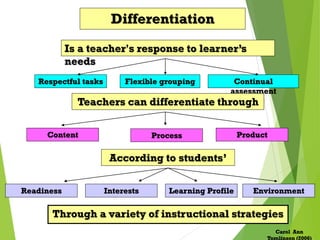
Product
Through a variety of instructional strategies
Carol Ann
Tomlinson (2006)
Differentiation
Is a teacher's response to learner’s
needs
Respectful tasks Continual
assessment
Flexible grouping
Teachers can differentiate through
Content Process
According to students’
Readiness Interests Learning Profile Environment
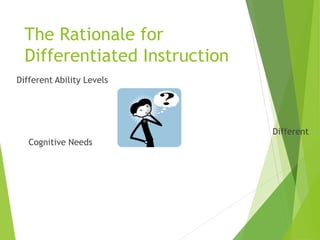
The Rationale for
Differentiated Instruction
Different Ability Levels
Different
Cognitive Needs
Culturally Responsive
Teaching
 Technology advancement
 Family structure
 Economical influences
 Societal expectations
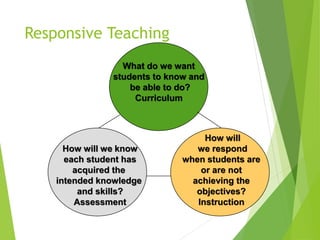
What do we want
students to know and
be able to do?
Curriculum
How will we know
each student has
acquired the
intended knowledge
and skills?
Assessment
How will
we respond
when students are
or are not
achieving the
objectives?
Instruction
Responsive Teaching
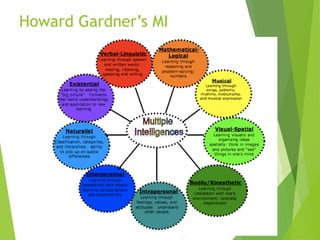
Howard Gardner’s MI
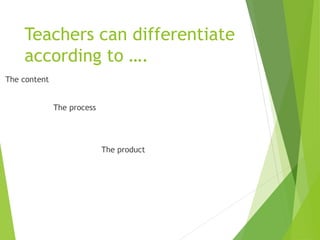
Teachers can differentiate
according to ….
The content
The process
The product
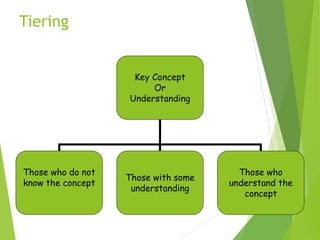
Tiering
Key Concept
Or
Understanding
Those who do not
know the concept
Those with some
understanding
Those who
understand the
concept
What Can Be Tiered?
 Processes,
content and
products
 Assignments
 Homework
 Assessments
 Writing prompts
What Can We Adjust?
 Amount of structure of an assignment
 Concrete to abstract
 Options based on student interests
 Options based on learning styles
Tiering Instruction
1. Identify the standards, concepts, or generalizations
you want the students to learn.
2. Decide if students have the background necessary to
be successful with the lesson.
3. Assess the students’ readiness, interests, and learning
profiles.
Tiering Instructions
4. Create an activity or project that is
clearly focused on the standard,
concept or generalization of the
lesson.
5. Adjust the activity to provide
different levels or tiers of difficulty
that will lead all students to an
understanding.
6. Develop an assessment component
for the lesson. Remember, it is on-
going!
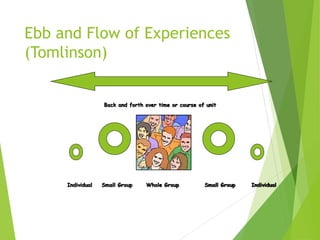
Ebb and Flow of Experiences
(Tomlinson)
Back and forth over time or course of unit
Individual Small Group Whole Group Small Group Individual
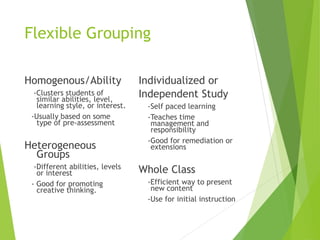
Flexible Grouping
Homogenous/Ability
-Clusters students of
similar abilities, level,
learning style, or interest.
-Usually based on some
type of pre-assessment
Heterogeneous
Groups
-Different abilities, levels
or interest
- Good for promoting
creative thinking.
Individualized or
Independent Study
-Self paced learning
-Teaches time
management and
responsibility
-Good for remediation or
extensions
Whole Class
-Efficient way to present
new content
-Use for initial instruction
Strategies to Make
Differentiation Work
Compacting Curriculum
Compacting the curriculum means
assessing a student’s knowledge and
skills, and providing alternative
activities for the student who has
already mastered curriculum content.
This can be achieved by pre-testing basic
concepts or using performance
assessment methods. Students
demonstrating they do not require
instruction move on to tiered problem
solving activities while others receive
instruction.
Strategies
 Informal and formative as opposed to summative
 Classroom assessment is ongoing through personal
communications:
 Questioning: try to question all students – level the
question to ability and aim at higher order thinking
 Observation: move around the room, have a room
chart and make notes
 Observation II (class management): you should know
when you have lost “them”
 Discussion: with the whole class, group, or individual
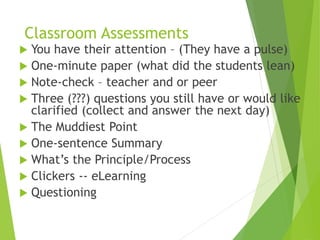
Classroom Assessments
 You have their attention – (They have a pulse)
 One-minute paper (what did the students lean)
 Note-check – teacher and or peer
 Three (???) questions you still have or would like
clarified (collect and answer the next day)
 The Muddiest Point
 One-sentence Summary
 What’s the Principle/Process
 Clickers -- eLearning
 Questioning
Interest Centers or Interest
Groups
 Interest centers are set up so that learning experiences
are directed toward a specific learner interest.
Allowing students to choose a topic can be motivating to
them. The teacher may select a variety of topics or
areas that students or groups can select.
Choice Boards
 Organizers that contain a variety of activities
 Students choose activities to complete as they learn a
skill or develop a product
 These may contain small groups, pairs, or individual
assignments
What Differentiation Is …
 Student
Centered
 Best practices
 Different
approaches
 Multiple
approaches to
content,
process, and
product
 A way of thinking
and planning

Differentiated instruction

  • 1.
    Differentiated Instruction The BasicSteps Towards Differentiating Brian Evans, Peter McDermott, Jennifer Pankowski
  • 2.
    One Size Doesn’tFit All https://www.youtube.com/watch?v=loPxwQ4yUro
  • 3.
    Let’s Define Differentiated Instruction Differentiatinginstruction is doing what’s fair for students. It means creating multiple paths so that students of different abilities, interests, or learning needs experience equally appropriate ways to learn.
  • 4.
    Product Through a varietyof instructional strategies Carol Ann Tomlinson (2006) Differentiation Is a teacher's response to learner’s needs Respectful tasks Continual assessment Flexible grouping Teachers can differentiate through Content Process According to students’ Readiness Interests Learning Profile Environment
  • 5.
    The Rationale for DifferentiatedInstruction Different Ability Levels Different Cognitive Needs
  • 6.
    Culturally Responsive Teaching  Technologyadvancement  Family structure  Economical influences  Societal expectations
  • 7.
    What do wewant students to know and be able to do? Curriculum How will we know each student has acquired the intended knowledge and skills? Assessment How will we respond when students are or are not achieving the objectives? Instruction Responsive Teaching
  • 8.
  • 9.
    Teachers can differentiate accordingto …. The content The process The product
  • 10.
    Tiering Key Concept Or Understanding Those whodo not know the concept Those with some understanding Those who understand the concept
  • 11.
    What Can BeTiered?  Processes, content and products  Assignments  Homework  Assessments  Writing prompts
  • 12.
    What Can WeAdjust?  Amount of structure of an assignment  Concrete to abstract  Options based on student interests  Options based on learning styles
  • 13.
    Tiering Instruction 1. Identifythe standards, concepts, or generalizations you want the students to learn. 2. Decide if students have the background necessary to be successful with the lesson. 3. Assess the students’ readiness, interests, and learning profiles.
  • 14.
    Tiering Instructions 4. Createan activity or project that is clearly focused on the standard, concept or generalization of the lesson. 5. Adjust the activity to provide different levels or tiers of difficulty that will lead all students to an understanding. 6. Develop an assessment component for the lesson. Remember, it is on- going!
  • 15.
    Ebb and Flowof Experiences (Tomlinson) Back and forth over time or course of unit Individual Small Group Whole Group Small Group Individual
  • 16.
    Flexible Grouping Homogenous/Ability -Clusters studentsof similar abilities, level, learning style, or interest. -Usually based on some type of pre-assessment Heterogeneous Groups -Different abilities, levels or interest - Good for promoting creative thinking. Individualized or Independent Study -Self paced learning -Teaches time management and responsibility -Good for remediation or extensions Whole Class -Efficient way to present new content -Use for initial instruction
  • 17.
    Strategies to Make DifferentiationWork Compacting Curriculum Compacting the curriculum means assessing a student’s knowledge and skills, and providing alternative activities for the student who has already mastered curriculum content. This can be achieved by pre-testing basic concepts or using performance assessment methods. Students demonstrating they do not require instruction move on to tiered problem solving activities while others receive instruction.
  • 18.
    Strategies  Informal andformative as opposed to summative  Classroom assessment is ongoing through personal communications:  Questioning: try to question all students – level the question to ability and aim at higher order thinking  Observation: move around the room, have a room chart and make notes  Observation II (class management): you should know when you have lost “them”  Discussion: with the whole class, group, or individual
  • 19.
    Classroom Assessments  Youhave their attention – (They have a pulse)  One-minute paper (what did the students lean)  Note-check – teacher and or peer  Three (???) questions you still have or would like clarified (collect and answer the next day)  The Muddiest Point  One-sentence Summary  What’s the Principle/Process  Clickers -- eLearning  Questioning
  • 20.
    Interest Centers orInterest Groups  Interest centers are set up so that learning experiences are directed toward a specific learner interest. Allowing students to choose a topic can be motivating to them. The teacher may select a variety of topics or areas that students or groups can select.
  • 21.
    Choice Boards  Organizersthat contain a variety of activities  Students choose activities to complete as they learn a skill or develop a product  These may contain small groups, pairs, or individual assignments
  • 22.
    What Differentiation Is…  Student Centered  Best practices  Different approaches  Multiple approaches to content, process, and product  A way of thinking and planning