REVISION
Present Simple – Present Continuous
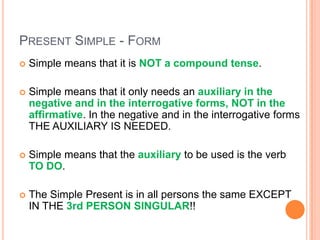
PRESENT SIMPLE - FORM
   Simple means that it is NOT a compound tense.

   Simple means that it only needs an auxiliary in the
    negative and in the interrogative forms, NOT in the
    affirmative. In the negative and in the interrogative forms
    THE AUXILIARY IS NEEDED.

   Simple means that the auxiliary to be used is the verb
    TO DO.

   The Simple Present is in all persons the same EXCEPT
    IN THE 3rd PERSON SINGULAR!!
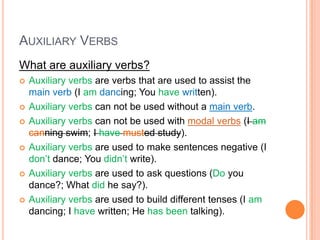
AUXILIARY VERBS
What are auxiliary verbs?
   Auxiliary verbs are verbs that are used to assist the
    main verb (I am dancing; You have written).
   Auxiliary verbs can not be used without a main verb.
   Auxiliary verbs can not be used with modal verbs (I am
    canning swim; I have musted study).
   Auxiliary verbs are used to make sentences negative (I
    don’t dance; You didn’t write).
   Auxiliary verbs are used to ask questions (Do you
    dance?; What did he say?).
   Auxiliary verbs are used to build different tenses (I am
    dancing; I have written; He has been talking).
PRESENT SIMPLE - FORM

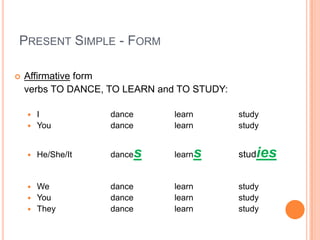
   Affirmative form
    verbs TO DANCE, TO LEARN and TO STUDY:

     I             dance       learn        study
     You           dance       learn        study


       He/She/It   dance   s   learn   s    studies


     We            dance       learn        study
     You           dance       learn        study
     They          dance       learn        study
PRESENT SIMPLE - FORM

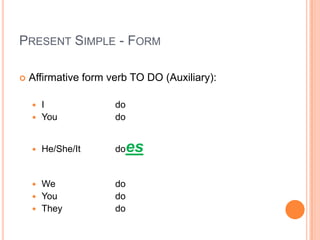
   Affirmative form verb TO DO (Auxiliary):

     I               do
     You             do


       He/She/It     does

     We              do
     You             do
     They            do
PRESENT SIMPLE - FORM

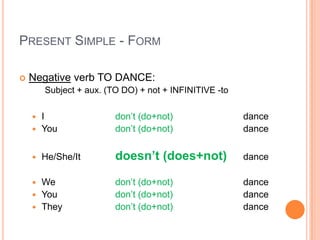
   Negative verb TO DANCE:
        Subject + aux. (TO DO) + not + INFINITIVE -to

     I                  don’t (do+not)                 dance
     You                don’t (do+not)                 dance


       He/She/It        doesn’t (does+not)             dance

     We                 don’t (do+not)                 dance
     You                don’t (do+not)                 dance
     They               don’t (do+not)                 dance
PRESENT SIMPLE - FORM

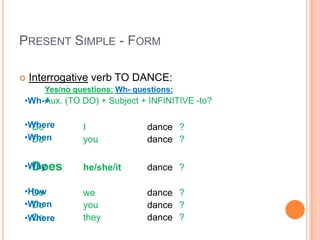
   Interrogative verb TO DANCE:
       Yes/no questions: Wh- questions:
•Wh-+
    Aux. (TO DO) + Subject + INFINITIVE -to?

•Where
  Do            I               dance ?
•When
  Do            you             dance ?

•Why
  Does          he/she/it       dance ?

•How
  Do            we              dance ?
•When
  Do            you             dance ?
•Where
  Do            they            dance ?
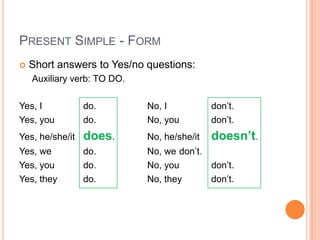
PRESENT SIMPLE - FORM
   Short answers to Yes/no questions:
    Auxiliary verb: TO DO.

Yes, I           do.         No, I           don’t.
Yes, you         do.         No, you         don’t.
Yes, he/she/it   does.       No, he/she/it   doesn’t.
Yes, we          do.         No, we don’t.
Yes, you         do.         No, you       don’t.
Yes, they        do.         No, they      don’t.
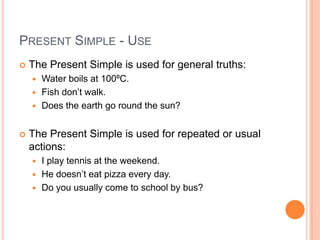
PRESENT SIMPLE - USE
   The Present Simple is used for general truths:
     Water boils at 100ºC.
     Fish don’t walk.
     Does the earth go round the sun?


   The Present Simple is used for repeated or usual
    actions:
     I play tennis at the weekend.
     He doesn’t eat pizza every day.
     Do you usually come to school by bus?
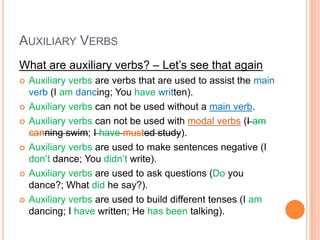
AUXILIARY VERBS
What are auxiliary verbs? – Let’s see that again
   Auxiliary verbs are verbs that are used to assist the main
    verb (I am dancing; You have written).
   Auxiliary verbs can not be used without a main verb.
   Auxiliary verbs can not be used with modal verbs (I am
    canning swim; I have musted study).
   Auxiliary verbs are used to make sentences negative (I
    don’t dance; You didn’t write).
   Auxiliary verbs are used to ask questions (Do you
    dance?; What did he say?).
   Auxiliary verbs are used to build different tenses (I am
    dancing; I have written; He has been talking).
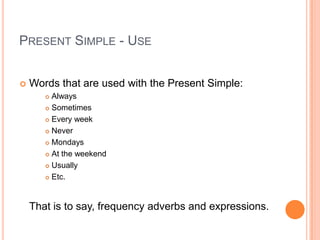
PRESENT SIMPLE - USE


   Words that are used with the Present Simple:
        Always
        Sometimes

        Every week

        Never

        Mondays

        At the weekend

        Usually

        Etc.


    That is to say, frequency adverbs and expressions.
PRESENT CONTINUOUS - FORM

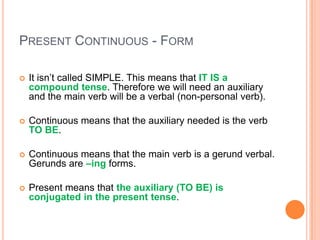
   It isn’t called SIMPLE. This means that IT IS a
    compound tense. Therefore we will need an auxiliary
    and the main verb will be a verbal (non-personal verb).

   Continuous means that the auxiliary needed is the verb
    TO BE.

   Continuous means that the main verb is a gerund verbal.
    Gerunds are –ing forms.

   Present means that the auxiliary (TO BE) is
    conjugated in the present tense.
PRESENT CONTINUOUS - FORM

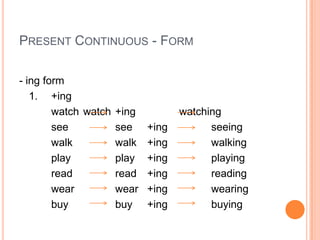
- ing form
   1. +ing
        watch watch +ing          watching
        see         see    +ing         seeing
        walk        walk   +ing         walking
        play        play   +ing         playing
        read        read   +ing         reading
        wear        wear   +ing         wearing
        buy         buy    +ing         buying
PRESENT CONTINUOUS - FORM

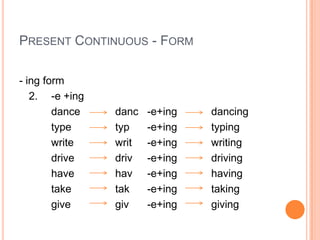
- ing form
   2. -e +ing
        dance   danc   -e+ing   dancing
        type    typ    -e+ing   typing
        write   writ   -e+ing   writing
        drive   driv   -e+ing   driving
        have    hav    -e+ing   having
        take    tak    -e+ing   taking
        give    giv    -e+ing   giving
PRESENT CONTINUOUS - FORM

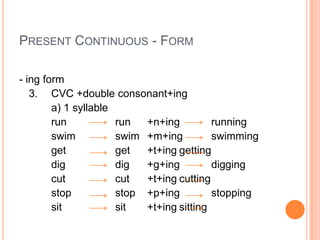
- ing form
   3. CVC +double consonant+ing
        a) 1 syllable
        run           run  +n+ing         running
        swim          swim +m+ing         swimming
        get           get  +t+ing getting
        dig           dig  +g+ing         digging
        cut           cut  +t+ing cutting
        stop          stop +p+ing         stopping
        sit           sit  +t+ing sitting
PRESENT CONTINUOUS - FORM

- ing form
   3. CVC +double consonant+ing
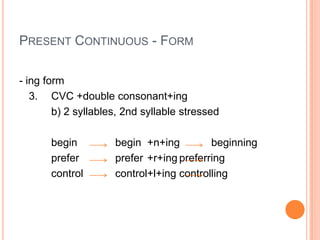
        b) 2 syllables, 2nd syllable stressed

       begin         begin +n+ing         beginning
       prefer        prefer +r+ing preferring
       control       control+l+ing controlling
PRESENT CONTINUOUS- FORM

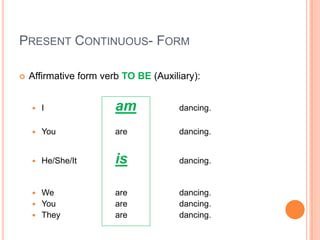
   Affirmative form verb TO BE (Auxiliary):


       I               am             dancing.

       You             are            dancing.


       He/She/It       is             dancing.


     We                are            dancing.
     You               are            dancing.
     They              are            dancing.
PRESENT CONTINUOUS- FORM

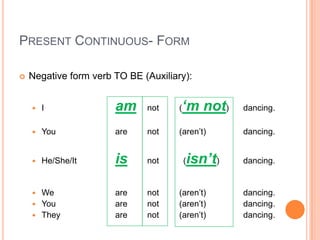
   Negative form verb TO BE (Auxiliary):


       I              am     not     (   ‘m not)      dancing.

       You            are    not     (aren’t)         dancing.


       He/She/It      is     not         (   isn’t)   dancing.


     We               are    not     (aren’t)         dancing.
     You              are    not     (aren’t)         dancing.
     They             are    not     (aren’t)         dancing.
PRESENT CONTINUOUS- FORM

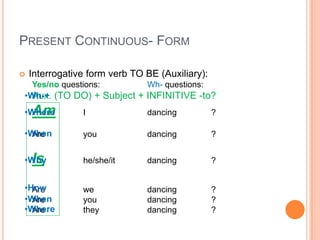
   Interrogative form verb TO BE (Auxiliary):
    Yes/no questions:          Wh- questions:
•Wh-+ (TO DO) + Subject + INFINITIVE -to?
  Aux.
    Am
•Where          I              dancing           ?

•When
  Are           you            dancing           ?


•WhyIs          he/she/it      dancing           ?


•How
  Are           we             dancing           ?
•When
  Are           you            dancing           ?
•Where
  Are           they           dancing           ?
PRESENT CONTINUOUS- FORM
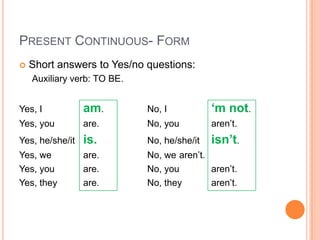
   Short answers to Yes/no questions:
    Auxiliary verb: TO BE.


Yes, I           am.         No, I           ‘m not.
Yes, you         are.        No, you         aren’t.
Yes, he/she/it   is.         No, he/she/it   isn’t.
Yes, we          are.        No, we aren’t.
Yes, you         are.        No, you        aren’t.
Yes, they        are.        No, they       aren’t.
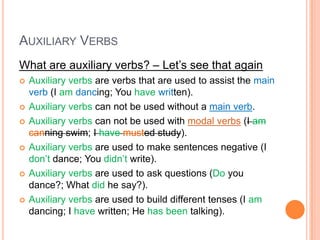
AUXILIARY VERBS
What are auxiliary verbs? – Let’s see that again
   Auxiliary verbs are verbs that are used to assist the main
    verb (I am dancing; You have written).
   Auxiliary verbs can not be used without a main verb.
   Auxiliary verbs can not be used with modal verbs (I am
    canning swim; I have musted study).
   Auxiliary verbs are used to make sentences negative (I
    don’t dance; You didn’t write).
   Auxiliary verbs are used to ask questions (Do you
    dance?; What did he say?).
   Auxiliary verbs are used to build different tenses (I am
    dancing; I have written; He has been talking).
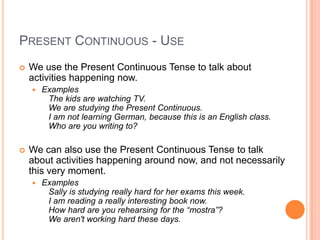
PRESENT CONTINUOUS - USE
   We use the Present Continuous Tense to talk about
    activities happening now.
       Examples
         The kids are watching TV.
         We are studying the Present Continuous.
         I am not learning German, because this is an English class.
         Who are you writing to?

   We can also use the Present Continuous Tense to talk
    about activities happening around now, and not necessarily
    this very moment.
       Examples
         Sally is studying really hard for her exams this week.
         I am reading a really interesting book now.
         How hard are you rehearsing for the “mostra”?
         We aren't working hard these days.
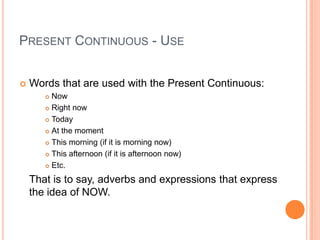
PRESENT CONTINUOUS - USE


   Words that are used with the Present Continuous:
        Now
        Right now

        Today

        At the moment

        This morning (if it is morning now)

        This afternoon (if it is afternoon now)

        Etc.


    That is to say, adverbs and expressions that express
    the idea of NOW.
PRESENT SIMPLE
AND PRESENT CONTINUOUS - EXAMPLES

   Where are you going?
   I’m going to the library. Wednesdays I always go to
    the library.

   Are you sleeping?
   No, I’m not sleeping now. I never sleep until so late.

   What are you doing?
   I’m learning the Present Simple and the Present
    Continuous. They’re difficult!
PRESENT SIMPLE
AND PRESENT CONTINUOUS - VIDEOS


   Now you’re going to watch two videos. Note as
    many verbs as possible from what you hear.

     What’s Bert doing?
     What’s Ernie doing?
     What happens?


     What’s the coyote doing?
     And the road runner?
     What happens always with the coyote?
PRESENT SIMPLE
AND PRESENT CONTINUOUS - VIDEOS


   Video 1

   Video 2

   Video 3
SIMPLE PRESENT
AND PRESENT CONTINUOUS - EXERCISES


     Exercise 1

     Exercise 2

     Exercise 3

     Exercise 4
IF YOU’VE STILL GOT
QUESTIONS, PLEASE ASK!!

Present simple and present continuous moodle

  • 1.
    REVISION Present Simple –Present Continuous
  • 2.
    PRESENT SIMPLE -FORM  Simple means that it is NOT a compound tense.  Simple means that it only needs an auxiliary in the negative and in the interrogative forms, NOT in the affirmative. In the negative and in the interrogative forms THE AUXILIARY IS NEEDED.  Simple means that the auxiliary to be used is the verb TO DO.  The Simple Present is in all persons the same EXCEPT IN THE 3rd PERSON SINGULAR!!
  • 3.
    AUXILIARY VERBS What areauxiliary verbs?  Auxiliary verbs are verbs that are used to assist the main verb (I am dancing; You have written).  Auxiliary verbs can not be used without a main verb.  Auxiliary verbs can not be used with modal verbs (I am canning swim; I have musted study).  Auxiliary verbs are used to make sentences negative (I don’t dance; You didn’t write).  Auxiliary verbs are used to ask questions (Do you dance?; What did he say?).  Auxiliary verbs are used to build different tenses (I am dancing; I have written; He has been talking).
  • 4.
    PRESENT SIMPLE -FORM  Affirmative form verbs TO DANCE, TO LEARN and TO STUDY:  I dance learn study  You dance learn study  He/She/It dance s learn s studies  We dance learn study  You dance learn study  They dance learn study
  • 5.
    PRESENT SIMPLE -FORM  Affirmative form verb TO DO (Auxiliary):  I do  You do  He/She/It does  We do  You do  They do
  • 6.
    PRESENT SIMPLE -FORM  Negative verb TO DANCE: Subject + aux. (TO DO) + not + INFINITIVE -to  I don’t (do+not) dance  You don’t (do+not) dance  He/She/It doesn’t (does+not) dance  We don’t (do+not) dance  You don’t (do+not) dance  They don’t (do+not) dance
  • 7.
    PRESENT SIMPLE -FORM  Interrogative verb TO DANCE: Yes/no questions: Wh- questions: •Wh-+ Aux. (TO DO) + Subject + INFINITIVE -to? •Where Do I dance ? •When Do you dance ? •Why Does he/she/it dance ? •How Do we dance ? •When Do you dance ? •Where Do they dance ?
  • 8.
    PRESENT SIMPLE -FORM  Short answers to Yes/no questions: Auxiliary verb: TO DO. Yes, I do. No, I don’t. Yes, you do. No, you don’t. Yes, he/she/it does. No, he/she/it doesn’t. Yes, we do. No, we don’t. Yes, you do. No, you don’t. Yes, they do. No, they don’t.
  • 9.
    PRESENT SIMPLE -USE  The Present Simple is used for general truths:  Water boils at 100ºC.  Fish don’t walk.  Does the earth go round the sun?  The Present Simple is used for repeated or usual actions:  I play tennis at the weekend.  He doesn’t eat pizza every day.  Do you usually come to school by bus?
  • 10.
    AUXILIARY VERBS What areauxiliary verbs? – Let’s see that again  Auxiliary verbs are verbs that are used to assist the main verb (I am dancing; You have written).  Auxiliary verbs can not be used without a main verb.  Auxiliary verbs can not be used with modal verbs (I am canning swim; I have musted study).  Auxiliary verbs are used to make sentences negative (I don’t dance; You didn’t write).  Auxiliary verbs are used to ask questions (Do you dance?; What did he say?).  Auxiliary verbs are used to build different tenses (I am dancing; I have written; He has been talking).
  • 11.
    PRESENT SIMPLE -USE  Words that are used with the Present Simple:  Always  Sometimes  Every week  Never  Mondays  At the weekend  Usually  Etc. That is to say, frequency adverbs and expressions.
  • 12.
    PRESENT CONTINUOUS -FORM  It isn’t called SIMPLE. This means that IT IS a compound tense. Therefore we will need an auxiliary and the main verb will be a verbal (non-personal verb).  Continuous means that the auxiliary needed is the verb TO BE.  Continuous means that the main verb is a gerund verbal. Gerunds are –ing forms.  Present means that the auxiliary (TO BE) is conjugated in the present tense.
  • 13.
    PRESENT CONTINUOUS -FORM - ing form 1. +ing watch watch +ing watching see see +ing seeing walk walk +ing walking play play +ing playing read read +ing reading wear wear +ing wearing buy buy +ing buying
  • 14.
    PRESENT CONTINUOUS -FORM - ing form 2. -e +ing dance danc -e+ing dancing type typ -e+ing typing write writ -e+ing writing drive driv -e+ing driving have hav -e+ing having take tak -e+ing taking give giv -e+ing giving
  • 15.
    PRESENT CONTINUOUS -FORM - ing form 3. CVC +double consonant+ing a) 1 syllable run run +n+ing running swim swim +m+ing swimming get get +t+ing getting dig dig +g+ing digging cut cut +t+ing cutting stop stop +p+ing stopping sit sit +t+ing sitting
  • 16.
    PRESENT CONTINUOUS -FORM - ing form 3. CVC +double consonant+ing b) 2 syllables, 2nd syllable stressed begin begin +n+ing beginning prefer prefer +r+ing preferring control control+l+ing controlling
  • 17.
    PRESENT CONTINUOUS- FORM  Affirmative form verb TO BE (Auxiliary):  I am dancing.  You are dancing.  He/She/It is dancing.  We are dancing.  You are dancing.  They are dancing.
  • 18.
    PRESENT CONTINUOUS- FORM  Negative form verb TO BE (Auxiliary):  I am not ( ‘m not) dancing.  You are not (aren’t) dancing.  He/She/It is not ( isn’t) dancing.  We are not (aren’t) dancing.  You are not (aren’t) dancing.  They are not (aren’t) dancing.
  • 19.
    PRESENT CONTINUOUS- FORM  Interrogative form verb TO BE (Auxiliary): Yes/no questions: Wh- questions: •Wh-+ (TO DO) + Subject + INFINITIVE -to? Aux. Am •Where I dancing ? •When Are you dancing ? •WhyIs he/she/it dancing ? •How Are we dancing ? •When Are you dancing ? •Where Are they dancing ?
  • 20.
    PRESENT CONTINUOUS- FORM  Short answers to Yes/no questions: Auxiliary verb: TO BE. Yes, I am. No, I ‘m not. Yes, you are. No, you aren’t. Yes, he/she/it is. No, he/she/it isn’t. Yes, we are. No, we aren’t. Yes, you are. No, you aren’t. Yes, they are. No, they aren’t.
  • 21.
    AUXILIARY VERBS What areauxiliary verbs? – Let’s see that again  Auxiliary verbs are verbs that are used to assist the main verb (I am dancing; You have written).  Auxiliary verbs can not be used without a main verb.  Auxiliary verbs can not be used with modal verbs (I am canning swim; I have musted study).  Auxiliary verbs are used to make sentences negative (I don’t dance; You didn’t write).  Auxiliary verbs are used to ask questions (Do you dance?; What did he say?).  Auxiliary verbs are used to build different tenses (I am dancing; I have written; He has been talking).
  • 22.
    PRESENT CONTINUOUS -USE  We use the Present Continuous Tense to talk about activities happening now.  Examples The kids are watching TV. We are studying the Present Continuous. I am not learning German, because this is an English class. Who are you writing to?  We can also use the Present Continuous Tense to talk about activities happening around now, and not necessarily this very moment.  Examples Sally is studying really hard for her exams this week. I am reading a really interesting book now. How hard are you rehearsing for the “mostra”? We aren't working hard these days.
  • 23.
    PRESENT CONTINUOUS -USE  Words that are used with the Present Continuous:  Now  Right now  Today  At the moment  This morning (if it is morning now)  This afternoon (if it is afternoon now)  Etc. That is to say, adverbs and expressions that express the idea of NOW.
  • 24.
    PRESENT SIMPLE AND PRESENTCONTINUOUS - EXAMPLES  Where are you going?  I’m going to the library. Wednesdays I always go to the library.  Are you sleeping?  No, I’m not sleeping now. I never sleep until so late.  What are you doing?  I’m learning the Present Simple and the Present Continuous. They’re difficult!
  • 25.
    PRESENT SIMPLE AND PRESENTCONTINUOUS - VIDEOS  Now you’re going to watch two videos. Note as many verbs as possible from what you hear.  What’s Bert doing?  What’s Ernie doing?  What happens?  What’s the coyote doing?  And the road runner?  What happens always with the coyote?
  • 26.
    PRESENT SIMPLE AND PRESENTCONTINUOUS - VIDEOS  Video 1  Video 2  Video 3
  • 27.
    SIMPLE PRESENT AND PRESENTCONTINUOUS - EXERCISES Exercise 1 Exercise 2 Exercise 3 Exercise 4
  • 28.
    IF YOU’VE STILLGOT QUESTIONS, PLEASE ASK!!