Lilia y Ceci   2008 Rev. Ceci  Adverbs of Quantity Indirect questions from Wh-questions UNIT 2
ADVERBS OF QUANTITY With count nouns There are + too many/ few, fewer There are  too many  cars. There should be  fewer  cars. We need  more  subway lines. There are n’t   enough   buses.
ADVERBS OF QUANTITY With noncount nouns There is + too much/little, less There is  too much  traffic. There should be  less   pollution. We need  more  public transportation. There is n’t   enough   parking .
When to use much / many? We use  much  with  uncountable nouns  (food, wine) to talk about a quantity of something. We use it only  in questions  and  in negative sentences . Do they make  much  wine? They don’t make much wine. There is too  much   traffic. We use  many  with  plural nouns  (people) to talk about a number of things or people. We use it  in questions  and in  negative sentences , and  sometimes  is used  in affirmative sentences , particularly  at the beginning  of a sentence. Do  many  people drink a traditional British tea? There aren’t  many  vineyards in Britain. Many  people eat breakfast cereals.
1. Complete these sentences with much, many, too much, too many, not much, not many, fewer, less, more, not enough There is _________ water in Saudi Arabia There is _________ sand in the desert. There are _________ trees in a forest. There are ________ books in a library There is _________ parking spaces in the school. There should be _______ noise outside the classroom. We need to study ________.
INDIRECT QUESTIONS  FROM WH-QUESTIONS Wh-questions with be Where is the bank? Where are the rest rooms? Indirect questions Could you tell me  where the bank is? Do you know  where the rest rooms are?
INDIRECT QUESTIONS  FROM WH-QUESTIONS Wh-questions with do or did How often do the buses leave? What time does the bank open? When did Flight 566 arrive? Indirect questions Can you tell me  how often the buses leave? Do you know  what time the bank opens? Do you know  when Flight 566 arrived?
Why to use indirect questions?? Direct questions are often considered rude when speaking to strangers. To be more polite we often use  indirect  question forms. Indirect questions serve the same purpose as direct questions, but are considered more formal. When using an indirect question, use an introductory phrase followed by the question itself in  positive sentence structure . Connect the two phrases with the question word or ‘if’ in the case the question is a ‘yes’, ‘no’ question.  Read again the previews slides and notice the difference between being polite or rude. By Kenneth Beare, About.com
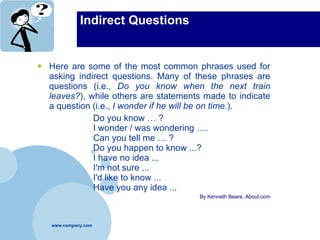
Indirect Questions Here are some of the most common phrases used for asking indirect questions. Many of these phrases are questions (i.e.,  Do you know when the next train leaves? ), while others are statements made to indicate a question (i.e.,  I wonder if he will be on time. ).  Do you know … ? I wonder / was wondering …. Can you tell me … ? Do you happen to know ...? I have no idea ... I'm not sure ... I'd like to know ... Have you any idea ...  By Kenneth Beare, About.com
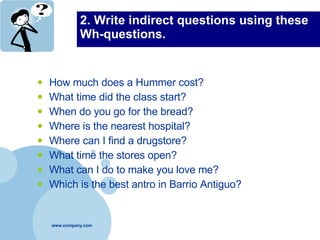
2. Write indirect questions using these Wh-questions. How much does a Hummer cost? What time did the class start? When do you go for the bread? Where is the nearest hospital? Where can I find a drugstore? What time the stores open? What can I do to make you love me? Which is the best antro in Barrio Antiguo?
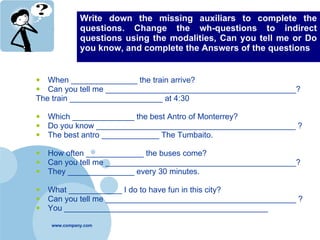
Write down the missing auxiliars to complete the questions. Change the wh-questions to indirect questions using the modalities, Can you tell me or Do you know, and complete the Answers of the questions When _______________ the train arrive? Can you tell me ___________________________________________? The train _____________________ at 4:30 Which ______________ the best Antro of Monterrey? Do you know _____________________________________________ ? The best antro _____________ The Tumbaito. How often _____________ the buses come? Can you tell me ___________________________________________? They _______________ every 30 minutes. What ____________ I do to have fun in this city? Can you tell me ___________________________________________ ? You ______________________________________________
BIBLIOGRAPHY Interchange 2 Teacher’s Book by Jack C. Richards, Hull and Susan Proctor. About.com, Indirect questions by Kenneth Beare. Multilevel English Grammar Programme by Jhin Shepherd Grammar in Steps, by David Bolton and Noel Goodey

Unit 2 (Level 2)

  • 1.
    Lilia y Ceci 2008 Rev. Ceci Adverbs of Quantity Indirect questions from Wh-questions UNIT 2
  • 2.
    ADVERBS OF QUANTITYWith count nouns There are + too many/ few, fewer There are too many cars. There should be fewer cars. We need more subway lines. There are n’t enough buses.
  • 3.
    ADVERBS OF QUANTITYWith noncount nouns There is + too much/little, less There is too much traffic. There should be less pollution. We need more public transportation. There is n’t enough parking .
  • 4.
    When to usemuch / many? We use much with uncountable nouns (food, wine) to talk about a quantity of something. We use it only in questions and in negative sentences . Do they make much wine? They don’t make much wine. There is too much traffic. We use many with plural nouns (people) to talk about a number of things or people. We use it in questions and in negative sentences , and sometimes is used in affirmative sentences , particularly at the beginning of a sentence. Do many people drink a traditional British tea? There aren’t many vineyards in Britain. Many people eat breakfast cereals.
  • 5.
    1. Complete thesesentences with much, many, too much, too many, not much, not many, fewer, less, more, not enough There is _________ water in Saudi Arabia There is _________ sand in the desert. There are _________ trees in a forest. There are ________ books in a library There is _________ parking spaces in the school. There should be _______ noise outside the classroom. We need to study ________.
  • 6.
    INDIRECT QUESTIONS FROM WH-QUESTIONS Wh-questions with be Where is the bank? Where are the rest rooms? Indirect questions Could you tell me where the bank is? Do you know where the rest rooms are?
  • 7.
    INDIRECT QUESTIONS FROM WH-QUESTIONS Wh-questions with do or did How often do the buses leave? What time does the bank open? When did Flight 566 arrive? Indirect questions Can you tell me how often the buses leave? Do you know what time the bank opens? Do you know when Flight 566 arrived?
  • 8.
    Why to useindirect questions?? Direct questions are often considered rude when speaking to strangers. To be more polite we often use indirect question forms. Indirect questions serve the same purpose as direct questions, but are considered more formal. When using an indirect question, use an introductory phrase followed by the question itself in positive sentence structure . Connect the two phrases with the question word or ‘if’ in the case the question is a ‘yes’, ‘no’ question. Read again the previews slides and notice the difference between being polite or rude. By Kenneth Beare, About.com
  • 9.
    Indirect Questions Hereare some of the most common phrases used for asking indirect questions. Many of these phrases are questions (i.e., Do you know when the next train leaves? ), while others are statements made to indicate a question (i.e., I wonder if he will be on time. ). Do you know … ? I wonder / was wondering …. Can you tell me … ? Do you happen to know ...? I have no idea ... I'm not sure ... I'd like to know ... Have you any idea ... By Kenneth Beare, About.com
  • 10.
    2. Write indirectquestions using these Wh-questions. How much does a Hummer cost? What time did the class start? When do you go for the bread? Where is the nearest hospital? Where can I find a drugstore? What time the stores open? What can I do to make you love me? Which is the best antro in Barrio Antiguo?
  • 11.
    Write down themissing auxiliars to complete the questions. Change the wh-questions to indirect questions using the modalities, Can you tell me or Do you know, and complete the Answers of the questions When _______________ the train arrive? Can you tell me ___________________________________________? The train _____________________ at 4:30 Which ______________ the best Antro of Monterrey? Do you know _____________________________________________ ? The best antro _____________ The Tumbaito. How often _____________ the buses come? Can you tell me ___________________________________________? They _______________ every 30 minutes. What ____________ I do to have fun in this city? Can you tell me ___________________________________________ ? You ______________________________________________
  • 12.
    BIBLIOGRAPHY Interchange 2Teacher’s Book by Jack C. Richards, Hull and Susan Proctor. About.com, Indirect questions by Kenneth Beare. Multilevel English Grammar Programme by Jhin Shepherd Grammar in Steps, by David Bolton and Noel Goodey