Lecture-III
BUDDHIST ARCHITECTURE
Buddhism began in India 2,500 years ago and remains the
dominant world religion in the East.
It is based on the teachings of an Indian prince named Siddharta
Gautama who lived around 500 BCE.
According to Buddhist tradition, the sheltered young prince was
shocked by the suffering he saw outside his palace walls, so he left
his life of luxury to seek answers.
Eventually he succeeded, becoming the Buddha--the "Enlightened
One.“
 He spent the remaining 45 years of his life teaching the dharma
(the path to liberation from suffering) and establishing the sangha
(a community of monks).
A Buddhist temple is called Vihara and is a place for education. In
a temple, there is a shrine room with a large Buddha and statues
of his disciples. It also has relics and manuscripts. There is also a
lecture room, meditation room and a library.
Buddha is known as a teacher not a god.
Candles and incense sticks are lit and Buddhists recite verses in the
Vihara.
Flowers and food are placed on the front of the Buddhist Statue.
The flowers are to remind the person that they will not live forever.
The food is given to the Monks since they own nothing of their own
and Buddhists feel that giving food will help them reach Nirvana
Facts about Buddhism
The following principles are said to help Buddhists to act well: 1.
Not to hurt living things, 2. Do not take advantage of what is not
there, 3. Use senses correctly, 4. Speak kindly, and, 5. Do not take
or use drugs or alcohol.
Buddhism goes beyond religion and is more of a philosophy or
'way of life'. It is a philosophy because philosophy 'means love of
wisdom' and the Buddhist path can be summed up as:
(1)to lead a moral life,
(2) to be mindful and aware of thoughts and actions, and
(3) to develop wisdom and understanding.
 The Buddhist architecture has its root deeply implanted in the
Indian soil- the birthplace of the Buddha's teachings.
 Indian emperor Ashoka, not only established Buddhism as the
state religion of his large Magadh empire, but also opted for the
architectural monuments to spread Buddhism in different
places.
The major features of this style are
 Stupas
 stambhas
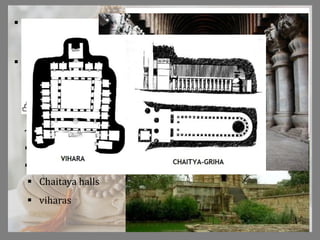
 Chaitaya halls
 viharas
STUPA
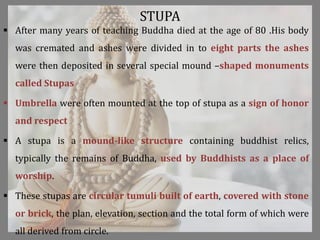
 After many years of teaching Buddha died at the age of 80 .His body
was cremated and ashes were divided in to eight parts the ashes
were then deposited in several special mound –shaped monuments
called Stupas
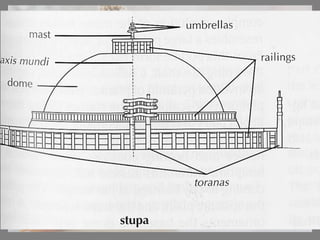
 Umbrella were often mounted at the top of stupa as a sign of honor
and respect
 A stupa is a mound-like structure containing buddhist relics,
typically the remains of Buddha, used by Buddhists as a place of
worship.
 These stupas are circular tumuli built of earth, covered with stone
or brick, the plan, elevation, section and the total form of which were
all derived from circle.
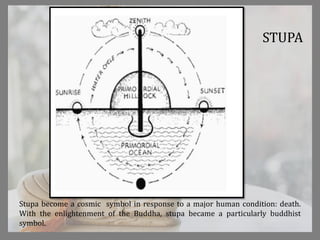
STUPA
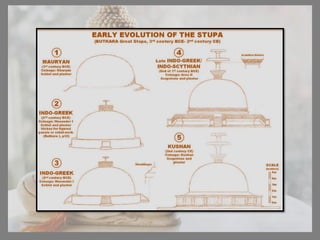
Stupa become a cosmic symbol in response to a major human condition: death.
With the enlightenment of the Buddha, stupa became a particularly buddhist
symbol.
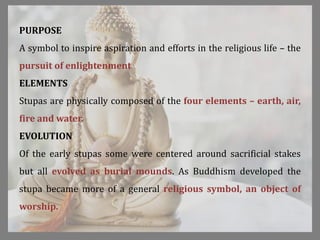
PURPOSE
A symbol to inspire aspiration and efforts in the religious life – the
pursuit of enlightenment
ELEMENTS
Stupas are physically composed of the four elements – earth, air,
fire and water.
EVOLUTION
Of the early stupas some were centered around sacrificial stakes
but all evolved as burial mounds. As Buddhism developed the
stupa became more of a general religious symbol, an object of
worship.
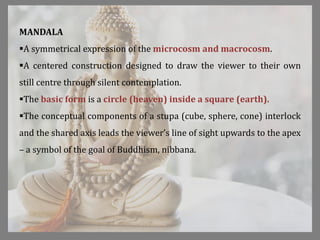
MANDALA
A symmetrical expression of the microcosm and macrocosm.
A centered construction designed to draw the viewer to their own
still centre through silent contemplation.
The basic form is a circle (heaven) inside a square (earth).
The conceptual components of a stupa (cube, sphere, cone) interlock
and the shared axis leads the viewer’s line of sight upwards to the apex
– a symbol of the goal of Buddhism, nibbana.
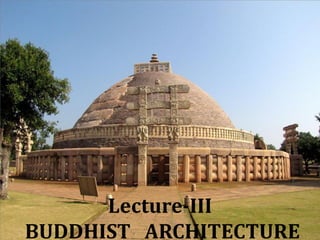
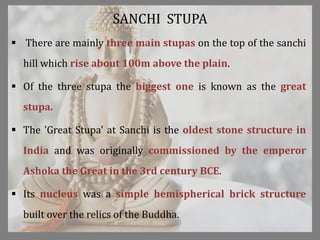
SANCHI STUPA
 There are mainly three main stupas on the top of the sanchi
hill which rise about 100m above the plain.
 Of the three stupa the biggest one is known as the great
stupa.
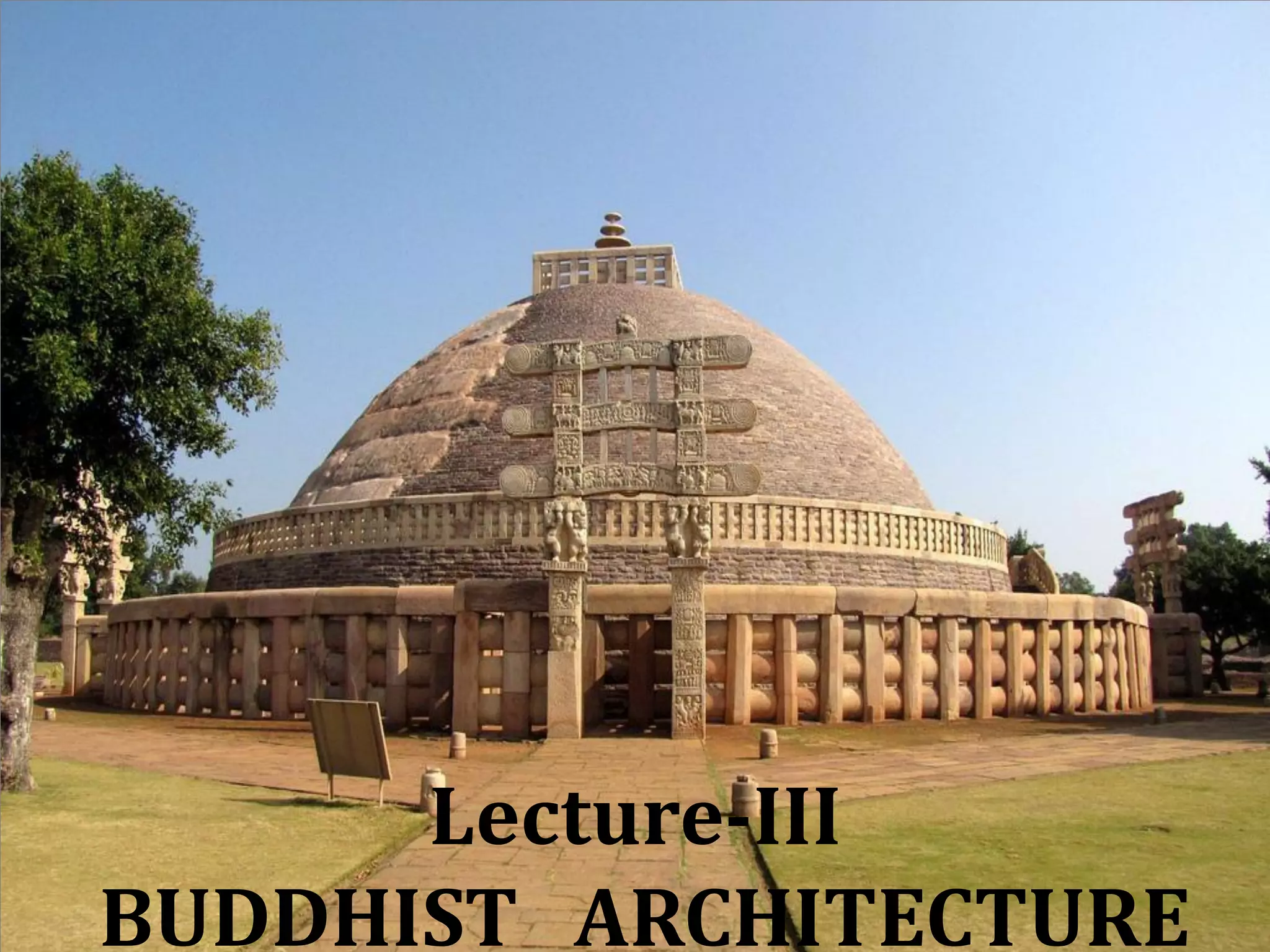
 The 'Great Stupa' at Sanchi is the oldest stone structure in
India and was originally commissioned by the emperor
Ashoka the Great in the 3rd century BCE.
 Its nucleus was a simple hemispherical brick structure
built over the relics of the Buddha.
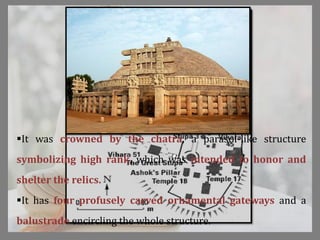
It was crowned by the chatra, a parasol-like structure
symbolizing high rank, which was intended to honor and
shelter the relics.
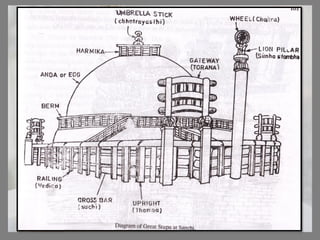
It has four profusely carved ornamental gateways and a
balustrade encircling the whole structure.
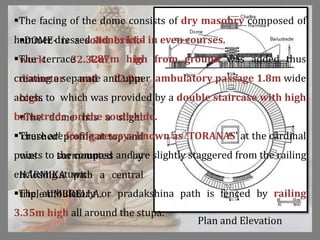
DOME- is a solid brick-
work 32.32m in
diameter and 12.8m
high.
The dome has a slight
‘crushed’ profile at top and
was surmounted by
HARMIKA with a central
triple UMBRELLA.
Plan and Elevation
The facing of the dome consists of dry masonry composed of
hammer dressed stones laid in even courses.
The terrace 4.87m high from ground was added thus
creating a separate and upper ambulatory passage 1.8m wide
access to which was provided by a double staircase with high
balustrade, on the south side.
There are four gateways known as ‘TORANAS’ at the cardinal
points to the compass and are slightly staggered from the railing
enclosing stupa.
The ambulatory or pradakshina path is fenced by railing
3.35m high all around the stupa.
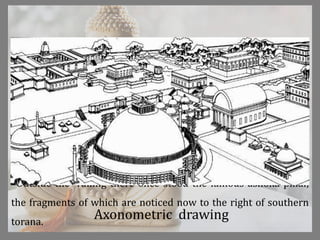
Outside the railing there once stood the famous ashoka pillar,
the fragments of which are noticed now to the right of southern
torana.
Axonometric drawing
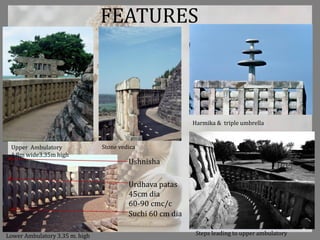
Steps leading to upper ambulatoryLower Ambulatory 3.35 m. high
Harmika & triple umbrella
Upper Ambulatory
1.8m wide3.35m high
Stone vedica
Suchi 60 cm dia
Urdhava patas
45cm dia
60-90 cmc/c
Ushnisha
FEATURES
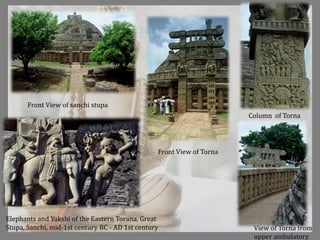
View of Torna from
upper ambulatory
Elephants and Yakshi of the Eastern Torana, Great
Stupa, Sanchi, mid-1st century BC - AD 1st century
Front View of sanchi stupa
Front View of Torna
Column of Torna
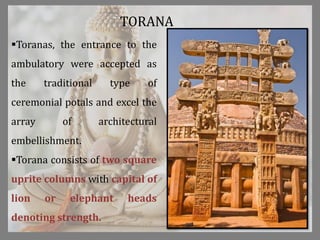
TORANA
Toranas, the entrance to the
ambulatory were accepted as
the traditional type of
ceremonial potals and excel the
array of architectural
embellishment.
Torana consists of two square
uprite columns with capital of
lion or elephant heads
denoting strength.
The first Torana gateway to be built is the one at the
principal entrance on the South.
These columns support three separate horizontal panels
between each of which is a row of ornamental balusters.
These panels are supported by atlantean figures, a group of
dwarfs, lions and elephant.
The total height of this erection is somewhat 10.36m with a
width of 3m.
No images of the Buddha was depicted; use only symbols such
as footprint, lotus flower, an empty throne.
 The entire panel of the gateways is covered with
sculptured scenes from the life of Buddha, the Jataka
Tales, events of the Buddhist times and rows of floral or
lotus motifs.
 The scenes from Buddha's life show Buddha represented
by symbols - the lotus, wheel a rider less caparisoned
horse, an umbrella held above a throne, foot prints and the
triratnas which are symbolic of Buddha, Dharma and
Sangha.
 The top panel has a Dharma chakra with two Yakshas on
either side.
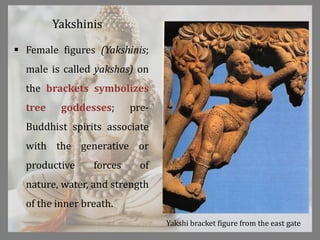
Yakshinis
 Female figures (Yakshinis;
male is called yakshas) on
the brackets symbolizes
tree goddesses; pre-
Buddhist spirits associate
with the generative or
productive forces of
nature, water, and strength
of the inner breath.
Yakshi bracket figure from the east gate
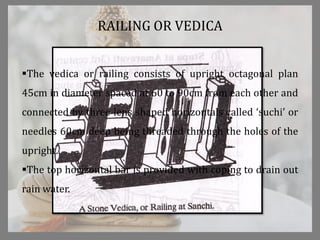
RAILING OR VEDICA
The vedica or railing consists of upright octagonal plan
45cm in diameter spaced at 60 to 90cm from each other and
connected by three lens shaped horizontals called ‘suchi’ or
needles 60cm deep being threaded through the holes of the
upright.
The top horizontal bar is provided with coping to drain out
rain water.
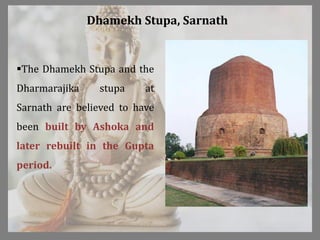
Dhamekh Stupa, Sarnath
The Dhamekh Stupa and the
Dharmarajika stupa at
Sarnath are believed to have
been built by Ashoka and
later rebuilt in the Gupta
period.
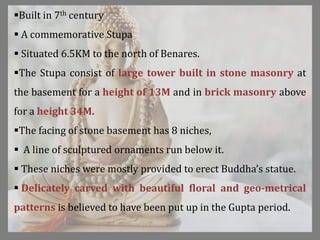
Built in 7th century
 A commemorative Stupa
 Situated 6.5KM to the north of Benares.
The Stupa consist of large tower built in stone masonry at
the basement for a height of 13M and in brick masonry above
for a height 34M.
The facing of stone basement has 8 niches,
 A line of sculptured ornaments run below it.
 These niches were mostly provided to erect Buddha’s statue.
 Delicately carved with beautiful floral and geo-metrical
patterns is believed to have been put up in the Gupta period.
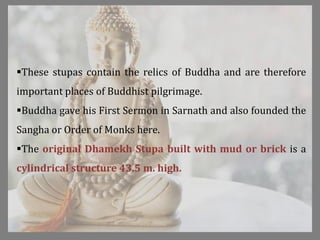
These stupas contain the relics of Buddha and are therefore
important places of Buddhist pilgrimage.
Buddha gave his First Sermon in Sarnath and also founded the
Sangha or Order of Monks here.
The original Dhamekh Stupa built with mud or brick is a
cylindrical structure 43.5 m. high.
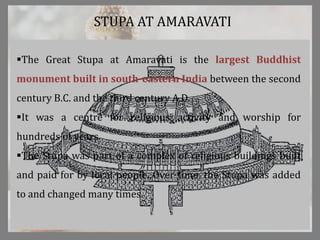
STUPA AT AMARAVATI
The Great Stupa at Amaravati is the largest Buddhist
monument built in south-eastern India between the second
century B.C. and the third century A.D.
It was a centre for religious activity and worship for
hundreds of years.
The Stupa was part of a complex of religious buildings built
and paid for by local people. Over time, the Stupa was added
to and changed many times.
.
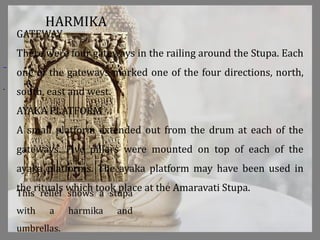
This relief shows a stupa
with a harmika and
umbrellas.
HARMIKA
GATEWAY
There were four gateways in the railing around the Stupa. Each
one of the gateways marked one of the four directions, north,
south, east and west.
AYAKA PLATFORM
A small platform extended out from the drum at each of the
gateways. Five pillars were mounted on top of each of the
ayaka platforms. The ayaka platform may have been used in
the rituals which took place at the Amaravati Stupa.
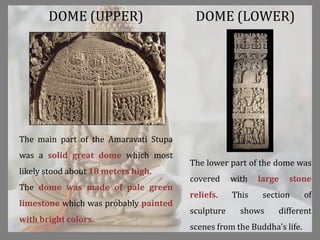
The lower part of the dome was
covered with large stone
reliefs. This section of
sculpture shows different
scenes from the Buddha's life.
DOME (LOWER)DOME (UPPER)
The main part of the Amaravati Stupa
was a solid great dome which most
likely stood about 18 meters high.
The dome was made of pale green
limestone which was probably painted
with bright colors.
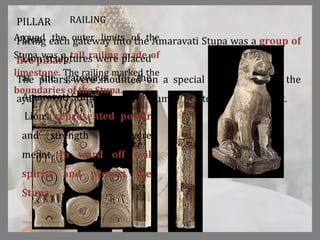
PILLAR
Facing each gateway into the Amaravati Stupa was a group of
five pillars.
The pillars were mounted on a special platform called the
ayaka which was part of the drum and extended out from it.
RAILING
Around the outer limits of the
Stupa was a tall railing made of
limestone. The railing marked the
boundaries of the Stupa.
Lion
Lion sculptures were placed
at the gateways to the
Amaravati Stupa.
Lions represented power
and strength and were
meant to ward off evil
spirits and protect the
Stupa.
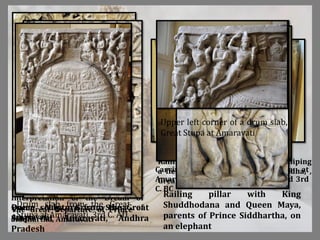
The Great Departure of Prince
Siddhartha, Amaravati
Railing crossbar with monks worshiping
a fiery pillar, a symbol of the Buddha, ,
Great Stupa of Amaravati
Railing pillar with the
Interpretation of the Dream of
Queen Maya, Great Stupa of
Amaravati
Carvings from the Great Stupa at
Amaravati, Andhra Pradesh, founded 3rd
C. BC
Dome sculpture from the Great
Stupa at Amaravati, Andhra
Pradesh
Railing pillar with King
Shuddhodana and Queen Maya,
parents of Prince Siddhartha, on
an elephant
Drum slab from the Great
Stupa at Amaravati, 3rd C. AD
Upper left corner of a drum slab,
Great Stupa at Amaravati
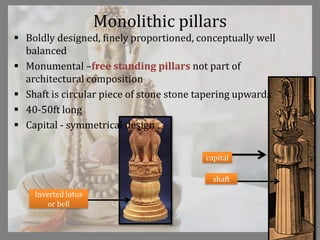
Monolithic pillars
 Boldly designed, finely proportioned, conceptually well
balanced
 Monumental –free standing pillars not part of
architectural composition
 Shaft is circular piece of stone stone tapering upwards
 40-50ft long
 Capital - symmetrical design
capital
shaft
Inverted lotus
or bell
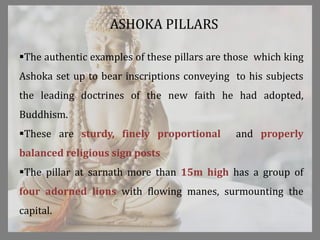
The authentic examples of these pillars are those which king
Ashoka set up to bear inscriptions conveying to his subjects
the leading doctrines of the new faith he had adopted,
Buddhism.
These are sturdy, finely proportional and properly
balanced religious sign posts
The pillar at sarnath more than 15m high has a group of
four adorned lions with flowing manes, surmounting the
capital.
ASHOKA PILLARS
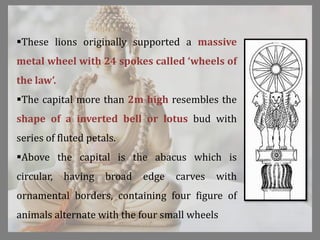
These lions originally supported a massive
metal wheel with 24 spokes called ‘wheels of
the law’.
The capital more than 2m high resembles the
shape of a inverted bell or lotus bud with
series of fluted petals.
Above the capital is the abacus which is
circular, having broad edge carves with
ornamental borders, containing four figure of
animals alternate with the four small wheels
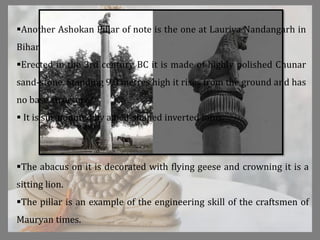
Another Ashokan Pillar of note is the one at Lauriya Nandangarh in
Bihar.
Erected in the 3rd century BC it is made of highly polished Chunar
sand-stone. Standing 9.8 metres high it rises from the ground and has
no base structure.
 It is surmounted by a bell-shaped inverted lotus.
The abacus on it is decorated with flying geese and crowning it is a
sitting lion.
The pillar is an example of the engineering skill of the craftsmen of
Mauryan times.
CHAITYA HALLS
 A Buddhist shrine or prayer hall with stupa at one end.
 Made for large gatherings of devotees
 Made in rock-cut due to permanency of structure
 Chaityas were influenced by ascetic lifestyle of Vedic period
and tendency of hermits to retire in solitude
Basic Characteristics
 Accommodates Stupa
 Apsidal Plan
 No division between nave and chaitya i.e space for
congregational service not clearly defined.
 Vaulted hall
 Colonnades
 Side aisles
Architectural Features
• Wooden construction inspired from Vedic period imitated in
natural rock
• Supplemented with wooden surfaces for e.g.. Screens etc.
(half timber construction)
• Shows similarities to Roman concept of column and arch, but
no evidence of any relation
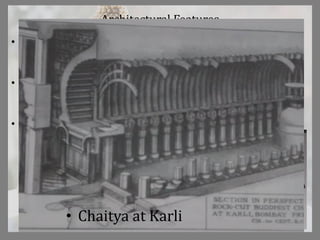
• Chaitya at Karli
• Rectangular halls with finely polished interior walls
• Well proportioned pillars with capitals(around 35)
• Semi circular roof
• Pillar had three parts: prop, base buried in ground and shaft
• Extensive use of motifs, decorative and symbolic.
VIHARAS
• A monastery, arrangement of cells for accommodation of
monks
• Dwellings were simply wooden construction/thatched
bamboo huts
• Near settlements on trade routes
• After first century AD, Viharas came in as educational
institutes.
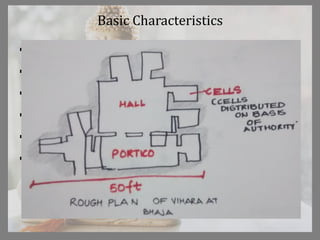
Basic Characteristics
 Quadrangular court for gathering
 Surrounded by small cells
 Front wall incorporated a shrine for image of Buddha
 Cells had rock cut platforms for beds
 Viharas were not alike in design
 Doorways were on sides of the walls of main hall.
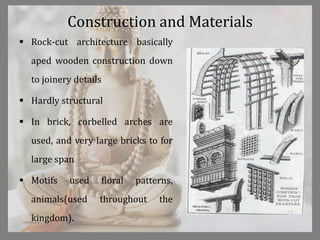
Construction and Materials
 Rock-cut architecture basically
aped wooden construction down
to joinery details
 Hardly structural
 In brick, corbelled arches are
used, and very large bricks to for
large span
 Motifs used floral patterns,
animals(used throughout the
kingdom).
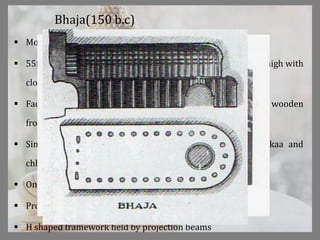
Bhaja(150 b.c)
 Most primitive hall
 55ft by 26ft, side aisles 3.5ft wide and high stilted vault 29ft high with
closed rank wood ribs
 Facades have numerous mortice holes for fixing elaborate wooden
frontages.
 Simple stupa with cylindrical base and a wooden harmikaa and
chhatri.
 One central doorway+2 side ones
 Projection balcony supported on four pillars
 H shaped framework held by projection beams
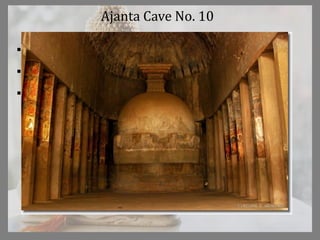
Ajanta Cave No. 10
 100ft by 40ft by 33ft
 Same roof ribs
 Two tiered stupa with
circular base and
elongated dome
Vihara at Kondane
 Central hall was pillared
 23 by 29 columns in colonnades, with cells on three side
 Cornice over the portico, copy of wooden construction
methods.
 Portico was pillared and had 3 square headed openings.
 Portico also had motifs
 Columns supported roof.
MONASATARIES AT GANDHARA
 Buddhist interpretation of Hellenic model of Greece called
Greco-Bactrian Style
 Sites situated at modern day Peshawar and Rawalpindi
 Region was visited by Hiuen Tsang in 7th century, spreading
Buddhism(cult religion) B.C followed by Alexander in 350
B.C bringing Greek style
 Gandhara became independent in 250 B.C, finally
conquered by Scythians
Basic Characteristics
 Intention Indian, treatment Greek for e.g.. Fire-altar, animal
capitals, sculpture, pediments, entablature introduced
 Stimulation of image worship.
 Statues of Buddha's etc, Corinthian capitals with Buddha in
leaves of Acanthus
 Monastery had irregular aggregation consisting of Stupa
and Sanghrama
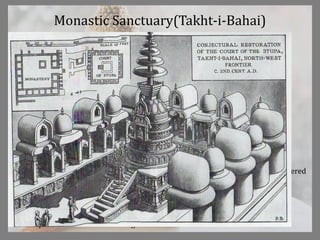
Monastic Sanctuary(Takht-i-Bahai)
 Axial Planing, logical arranged
 Rectangular plan(200 ft long)
 Stupa court on South, monastery on north
 Small chapel on terrace
 West had conference hall
 Stupa treated artisiticallly
 Courtyard-quadrangle 45ft by 55ft
 Central platform 20ft by 8 ft high on which there was a Stupa with six-tiered
umbrella
 No true arches
 Simple unadorned room in Sanghrama
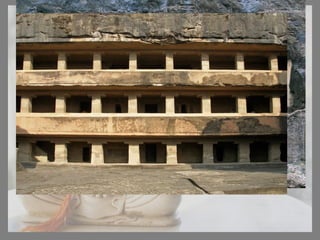
Vihara(Cave no. 11, 7 and 6)
 Wooden construction
 11 and 6 had four central pillars while 7th had 2
 2 storied
 Had colonnades on all sides and a verandah with a 54sq. Ft hall
 doorway and windows on two sides
 Pillars had vast capital base.
Vihara Cave no. 1 and 16
 Exterior verandah 65ft long with 65sq, ft main hall
 Colonnades of twenty pillars
 16 square cells, has a sacrarium with figure of Buddha
Ellora Caves
 Caves excavated out of low ridge hills, Buddhists occupied
best site.
 Dhedwada group(caves 1 to 5) and 6 to 12 were two main
groups
 Mahanwada cave(no.5) had both monastery and hall, it had
two parallel platforms for seating of priests
 Later group had chaitya hall no. 10
 Cave no. 2 has 48 pillars colonnade attached with side
gallery.
 Cushion pillar comes in focus now
Cave 6 to 12
 Largest monasteries
 No. 12 is knows as tin
thaal(thre stories), can lodge
40 priests (108ft by 60 ft)
 Does not have any
ornamentation
 Access is through pillared
verandah
 All three floors are different
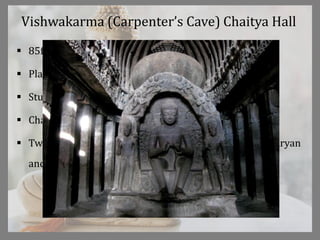
Vishwakarma (Carpenter’s Cave) Chaitya Hall
 85ft by 44ft by 34ft
 Plainer than Ajanta
 Stupa is foundation to support a shrine of buddha
 Chaitya Arch compressed to a samll opening
 Two canopies over the niches, predecessors of Indo Aryan
and Dravidian temple shrine styles.
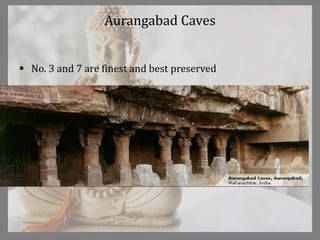
Aurangabad Caves
 No. 3 and 7 are finest and best preserved
 No. 3 is deep cut in the rock, cella leading out of pillared
hall
 No.7 has a passage of ambulation around it
 Pillars have combination of the bracket with vase and
foliage motif.

Lecture iv buddhist architecture

  • 1.
  • 2.
    Buddhism began inIndia 2,500 years ago and remains the dominant world religion in the East. It is based on the teachings of an Indian prince named Siddharta Gautama who lived around 500 BCE. According to Buddhist tradition, the sheltered young prince was shocked by the suffering he saw outside his palace walls, so he left his life of luxury to seek answers. Eventually he succeeded, becoming the Buddha--the "Enlightened One.“  He spent the remaining 45 years of his life teaching the dharma (the path to liberation from suffering) and establishing the sangha (a community of monks).
  • 3.
    A Buddhist templeis called Vihara and is a place for education. In a temple, there is a shrine room with a large Buddha and statues of his disciples. It also has relics and manuscripts. There is also a lecture room, meditation room and a library. Buddha is known as a teacher not a god. Candles and incense sticks are lit and Buddhists recite verses in the Vihara. Flowers and food are placed on the front of the Buddhist Statue. The flowers are to remind the person that they will not live forever. The food is given to the Monks since they own nothing of their own and Buddhists feel that giving food will help them reach Nirvana Facts about Buddhism
  • 4.
    The following principlesare said to help Buddhists to act well: 1. Not to hurt living things, 2. Do not take advantage of what is not there, 3. Use senses correctly, 4. Speak kindly, and, 5. Do not take or use drugs or alcohol. Buddhism goes beyond religion and is more of a philosophy or 'way of life'. It is a philosophy because philosophy 'means love of wisdom' and the Buddhist path can be summed up as: (1)to lead a moral life, (2) to be mindful and aware of thoughts and actions, and (3) to develop wisdom and understanding.
  • 5.
     The Buddhistarchitecture has its root deeply implanted in the Indian soil- the birthplace of the Buddha's teachings.  Indian emperor Ashoka, not only established Buddhism as the state religion of his large Magadh empire, but also opted for the architectural monuments to spread Buddhism in different places. The major features of this style are  Stupas  stambhas  Chaitaya halls  viharas
  • 6.
    STUPA  After manyyears of teaching Buddha died at the age of 80 .His body was cremated and ashes were divided in to eight parts the ashes were then deposited in several special mound –shaped monuments called Stupas  Umbrella were often mounted at the top of stupa as a sign of honor and respect  A stupa is a mound-like structure containing buddhist relics, typically the remains of Buddha, used by Buddhists as a place of worship.  These stupas are circular tumuli built of earth, covered with stone or brick, the plan, elevation, section and the total form of which were all derived from circle.
  • 7.
    STUPA Stupa become acosmic symbol in response to a major human condition: death. With the enlightenment of the Buddha, stupa became a particularly buddhist symbol.
  • 9.
    PURPOSE A symbol toinspire aspiration and efforts in the religious life – the pursuit of enlightenment ELEMENTS Stupas are physically composed of the four elements – earth, air, fire and water. EVOLUTION Of the early stupas some were centered around sacrificial stakes but all evolved as burial mounds. As Buddhism developed the stupa became more of a general religious symbol, an object of worship.
  • 11.
    MANDALA A symmetrical expressionof the microcosm and macrocosm. A centered construction designed to draw the viewer to their own still centre through silent contemplation. The basic form is a circle (heaven) inside a square (earth). The conceptual components of a stupa (cube, sphere, cone) interlock and the shared axis leads the viewer’s line of sight upwards to the apex – a symbol of the goal of Buddhism, nibbana.
  • 12.
    SANCHI STUPA  Thereare mainly three main stupas on the top of the sanchi hill which rise about 100m above the plain.  Of the three stupa the biggest one is known as the great stupa.  The 'Great Stupa' at Sanchi is the oldest stone structure in India and was originally commissioned by the emperor Ashoka the Great in the 3rd century BCE.  Its nucleus was a simple hemispherical brick structure built over the relics of the Buddha.
  • 14.
    It was crownedby the chatra, a parasol-like structure symbolizing high rank, which was intended to honor and shelter the relics. It has four profusely carved ornamental gateways and a balustrade encircling the whole structure.
  • 15.
    DOME- is asolid brick- work 32.32m in diameter and 12.8m high. The dome has a slight ‘crushed’ profile at top and was surmounted by HARMIKA with a central triple UMBRELLA. Plan and Elevation The facing of the dome consists of dry masonry composed of hammer dressed stones laid in even courses. The terrace 4.87m high from ground was added thus creating a separate and upper ambulatory passage 1.8m wide access to which was provided by a double staircase with high balustrade, on the south side. There are four gateways known as ‘TORANAS’ at the cardinal points to the compass and are slightly staggered from the railing enclosing stupa. The ambulatory or pradakshina path is fenced by railing 3.35m high all around the stupa.
  • 16.
    Outside the railingthere once stood the famous ashoka pillar, the fragments of which are noticed now to the right of southern torana. Axonometric drawing
  • 17.
    Steps leading toupper ambulatoryLower Ambulatory 3.35 m. high Harmika & triple umbrella Upper Ambulatory 1.8m wide3.35m high Stone vedica Suchi 60 cm dia Urdhava patas 45cm dia 60-90 cmc/c Ushnisha FEATURES
  • 18.
    View of Tornafrom upper ambulatory Elephants and Yakshi of the Eastern Torana, Great Stupa, Sanchi, mid-1st century BC - AD 1st century Front View of sanchi stupa Front View of Torna Column of Torna
  • 19.
    TORANA Toranas, the entranceto the ambulatory were accepted as the traditional type of ceremonial potals and excel the array of architectural embellishment. Torana consists of two square uprite columns with capital of lion or elephant heads denoting strength.
  • 20.
    The first Toranagateway to be built is the one at the principal entrance on the South. These columns support three separate horizontal panels between each of which is a row of ornamental balusters. These panels are supported by atlantean figures, a group of dwarfs, lions and elephant. The total height of this erection is somewhat 10.36m with a width of 3m. No images of the Buddha was depicted; use only symbols such as footprint, lotus flower, an empty throne.
  • 21.
     The entirepanel of the gateways is covered with sculptured scenes from the life of Buddha, the Jataka Tales, events of the Buddhist times and rows of floral or lotus motifs.  The scenes from Buddha's life show Buddha represented by symbols - the lotus, wheel a rider less caparisoned horse, an umbrella held above a throne, foot prints and the triratnas which are symbolic of Buddha, Dharma and Sangha.  The top panel has a Dharma chakra with two Yakshas on either side.
  • 22.
    Yakshinis  Female figures(Yakshinis; male is called yakshas) on the brackets symbolizes tree goddesses; pre- Buddhist spirits associate with the generative or productive forces of nature, water, and strength of the inner breath. Yakshi bracket figure from the east gate
  • 23.
    RAILING OR VEDICA Thevedica or railing consists of upright octagonal plan 45cm in diameter spaced at 60 to 90cm from each other and connected by three lens shaped horizontals called ‘suchi’ or needles 60cm deep being threaded through the holes of the upright. The top horizontal bar is provided with coping to drain out rain water.
  • 24.
    Dhamekh Stupa, Sarnath TheDhamekh Stupa and the Dharmarajika stupa at Sarnath are believed to have been built by Ashoka and later rebuilt in the Gupta period.
  • 25.
    Built in 7thcentury  A commemorative Stupa  Situated 6.5KM to the north of Benares. The Stupa consist of large tower built in stone masonry at the basement for a height of 13M and in brick masonry above for a height 34M. The facing of stone basement has 8 niches,  A line of sculptured ornaments run below it.  These niches were mostly provided to erect Buddha’s statue.  Delicately carved with beautiful floral and geo-metrical patterns is believed to have been put up in the Gupta period.
  • 26.
    These stupas containthe relics of Buddha and are therefore important places of Buddhist pilgrimage. Buddha gave his First Sermon in Sarnath and also founded the Sangha or Order of Monks here. The original Dhamekh Stupa built with mud or brick is a cylindrical structure 43.5 m. high.
  • 27.
    STUPA AT AMARAVATI TheGreat Stupa at Amaravati is the largest Buddhist monument built in south-eastern India between the second century B.C. and the third century A.D. It was a centre for religious activity and worship for hundreds of years. The Stupa was part of a complex of religious buildings built and paid for by local people. Over time, the Stupa was added to and changed many times.
  • 28.
    . This relief showsa stupa with a harmika and umbrellas. HARMIKA GATEWAY There were four gateways in the railing around the Stupa. Each one of the gateways marked one of the four directions, north, south, east and west. AYAKA PLATFORM A small platform extended out from the drum at each of the gateways. Five pillars were mounted on top of each of the ayaka platforms. The ayaka platform may have been used in the rituals which took place at the Amaravati Stupa.
  • 29.
    The lower partof the dome was covered with large stone reliefs. This section of sculpture shows different scenes from the Buddha's life. DOME (LOWER)DOME (UPPER) The main part of the Amaravati Stupa was a solid great dome which most likely stood about 18 meters high. The dome was made of pale green limestone which was probably painted with bright colors.
  • 30.
    PILLAR Facing each gatewayinto the Amaravati Stupa was a group of five pillars. The pillars were mounted on a special platform called the ayaka which was part of the drum and extended out from it. RAILING Around the outer limits of the Stupa was a tall railing made of limestone. The railing marked the boundaries of the Stupa. Lion Lion sculptures were placed at the gateways to the Amaravati Stupa. Lions represented power and strength and were meant to ward off evil spirits and protect the Stupa.
  • 31.
    The Great Departureof Prince Siddhartha, Amaravati Railing crossbar with monks worshiping a fiery pillar, a symbol of the Buddha, , Great Stupa of Amaravati Railing pillar with the Interpretation of the Dream of Queen Maya, Great Stupa of Amaravati Carvings from the Great Stupa at Amaravati, Andhra Pradesh, founded 3rd C. BC Dome sculpture from the Great Stupa at Amaravati, Andhra Pradesh Railing pillar with King Shuddhodana and Queen Maya, parents of Prince Siddhartha, on an elephant Drum slab from the Great Stupa at Amaravati, 3rd C. AD Upper left corner of a drum slab, Great Stupa at Amaravati
  • 32.
    Monolithic pillars  Boldlydesigned, finely proportioned, conceptually well balanced  Monumental –free standing pillars not part of architectural composition  Shaft is circular piece of stone stone tapering upwards  40-50ft long  Capital - symmetrical design capital shaft Inverted lotus or bell
  • 33.
    The authentic examplesof these pillars are those which king Ashoka set up to bear inscriptions conveying to his subjects the leading doctrines of the new faith he had adopted, Buddhism. These are sturdy, finely proportional and properly balanced religious sign posts The pillar at sarnath more than 15m high has a group of four adorned lions with flowing manes, surmounting the capital. ASHOKA PILLARS
  • 34.
    These lions originallysupported a massive metal wheel with 24 spokes called ‘wheels of the law’. The capital more than 2m high resembles the shape of a inverted bell or lotus bud with series of fluted petals. Above the capital is the abacus which is circular, having broad edge carves with ornamental borders, containing four figure of animals alternate with the four small wheels
  • 35.
    Another Ashokan Pillarof note is the one at Lauriya Nandangarh in Bihar. Erected in the 3rd century BC it is made of highly polished Chunar sand-stone. Standing 9.8 metres high it rises from the ground and has no base structure.  It is surmounted by a bell-shaped inverted lotus. The abacus on it is decorated with flying geese and crowning it is a sitting lion. The pillar is an example of the engineering skill of the craftsmen of Mauryan times.
  • 36.
    CHAITYA HALLS  ABuddhist shrine or prayer hall with stupa at one end.  Made for large gatherings of devotees  Made in rock-cut due to permanency of structure  Chaityas were influenced by ascetic lifestyle of Vedic period and tendency of hermits to retire in solitude Basic Characteristics  Accommodates Stupa  Apsidal Plan  No division between nave and chaitya i.e space for congregational service not clearly defined.  Vaulted hall  Colonnades  Side aisles
  • 37.
    Architectural Features • Woodenconstruction inspired from Vedic period imitated in natural rock • Supplemented with wooden surfaces for e.g.. Screens etc. (half timber construction) • Shows similarities to Roman concept of column and arch, but no evidence of any relation • Chaitya at Karli
  • 38.
    • Rectangular hallswith finely polished interior walls • Well proportioned pillars with capitals(around 35) • Semi circular roof • Pillar had three parts: prop, base buried in ground and shaft • Extensive use of motifs, decorative and symbolic.
  • 39.
    VIHARAS • A monastery,arrangement of cells for accommodation of monks • Dwellings were simply wooden construction/thatched bamboo huts • Near settlements on trade routes • After first century AD, Viharas came in as educational institutes.
  • 40.
    Basic Characteristics  Quadrangularcourt for gathering  Surrounded by small cells  Front wall incorporated a shrine for image of Buddha  Cells had rock cut platforms for beds  Viharas were not alike in design  Doorways were on sides of the walls of main hall.
  • 41.
    Construction and Materials Rock-cut architecture basically aped wooden construction down to joinery details  Hardly structural  In brick, corbelled arches are used, and very large bricks to for large span  Motifs used floral patterns, animals(used throughout the kingdom).
  • 42.
    Bhaja(150 b.c)  Mostprimitive hall  55ft by 26ft, side aisles 3.5ft wide and high stilted vault 29ft high with closed rank wood ribs  Facades have numerous mortice holes for fixing elaborate wooden frontages.  Simple stupa with cylindrical base and a wooden harmikaa and chhatri.  One central doorway+2 side ones  Projection balcony supported on four pillars  H shaped framework held by projection beams
  • 43.
    Ajanta Cave No.10  100ft by 40ft by 33ft  Same roof ribs  Two tiered stupa with circular base and elongated dome
  • 44.
    Vihara at Kondane Central hall was pillared  23 by 29 columns in colonnades, with cells on three side  Cornice over the portico, copy of wooden construction methods.  Portico was pillared and had 3 square headed openings.  Portico also had motifs  Columns supported roof.
  • 45.
    MONASATARIES AT GANDHARA Buddhist interpretation of Hellenic model of Greece called Greco-Bactrian Style  Sites situated at modern day Peshawar and Rawalpindi  Region was visited by Hiuen Tsang in 7th century, spreading Buddhism(cult religion) B.C followed by Alexander in 350 B.C bringing Greek style  Gandhara became independent in 250 B.C, finally conquered by Scythians
  • 46.
    Basic Characteristics  IntentionIndian, treatment Greek for e.g.. Fire-altar, animal capitals, sculpture, pediments, entablature introduced  Stimulation of image worship.  Statues of Buddha's etc, Corinthian capitals with Buddha in leaves of Acanthus  Monastery had irregular aggregation consisting of Stupa and Sanghrama
  • 47.
    Monastic Sanctuary(Takht-i-Bahai)  AxialPlaning, logical arranged  Rectangular plan(200 ft long)  Stupa court on South, monastery on north  Small chapel on terrace  West had conference hall  Stupa treated artisiticallly  Courtyard-quadrangle 45ft by 55ft  Central platform 20ft by 8 ft high on which there was a Stupa with six-tiered umbrella  No true arches  Simple unadorned room in Sanghrama
  • 48.
    Vihara(Cave no. 11,7 and 6)  Wooden construction  11 and 6 had four central pillars while 7th had 2  2 storied  Had colonnades on all sides and a verandah with a 54sq. Ft hall  doorway and windows on two sides  Pillars had vast capital base. Vihara Cave no. 1 and 16  Exterior verandah 65ft long with 65sq, ft main hall  Colonnades of twenty pillars  16 square cells, has a sacrarium with figure of Buddha
  • 49.
    Ellora Caves  Cavesexcavated out of low ridge hills, Buddhists occupied best site.  Dhedwada group(caves 1 to 5) and 6 to 12 were two main groups  Mahanwada cave(no.5) had both monastery and hall, it had two parallel platforms for seating of priests  Later group had chaitya hall no. 10  Cave no. 2 has 48 pillars colonnade attached with side gallery.  Cushion pillar comes in focus now Cave 6 to 12  Largest monasteries  No. 12 is knows as tin thaal(thre stories), can lodge 40 priests (108ft by 60 ft)  Does not have any ornamentation  Access is through pillared verandah  All three floors are different
  • 50.
    Vishwakarma (Carpenter’s Cave)Chaitya Hall  85ft by 44ft by 34ft  Plainer than Ajanta  Stupa is foundation to support a shrine of buddha  Chaitya Arch compressed to a samll opening  Two canopies over the niches, predecessors of Indo Aryan and Dravidian temple shrine styles.
  • 51.
    Aurangabad Caves  No.3 and 7 are finest and best preserved  No. 3 is deep cut in the rock, cella leading out of pillared hall  No.7 has a passage of ambulation around it  Pillars have combination of the bracket with vase and foliage motif.