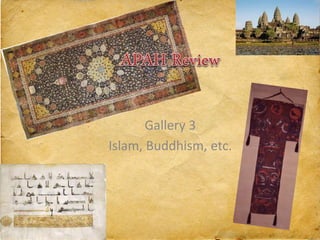
Gallery 3
Islam, Buddhism, etc.
So, tell me, how are you feeling
about this gallery?
A. I will OWN this part of the exam. I can confidently answer any question about
Muslim, Buddhist, and Hindu art
B. I’m familiar with the major stuff, but I need to work on the details.
C. I did the work but I’m not too sure what I learned.
D. Um….I can’t.
What would you like to know
more about?
Reality check:
• West, Central, South, East, and Southeast Asia account for 12%
of the AP exam
• 32 works
• That’s 9-10 multiple choice questions or 1 extended
response/essay or combination thereof
Islam: Essential Background
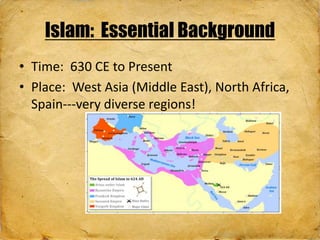
• Time: 630 CE to Present
• Place: West Asia (Middle East), North Africa,
Spain---very diverse regions!
• How was Islam spread?
Islam: Essential Background
• How was Islam spread?
– Pilgrimages
– Crusades
– Conquest
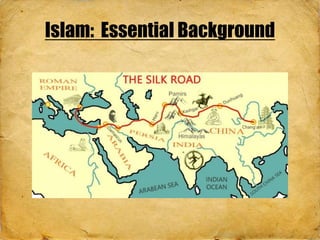
– Trade routes (like the Silk Road)
Islam: Essential Background
Let’s look at some art….
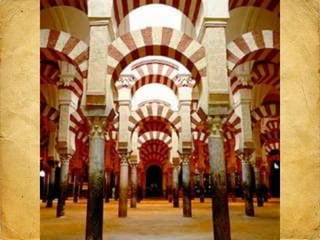
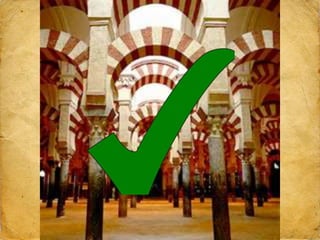
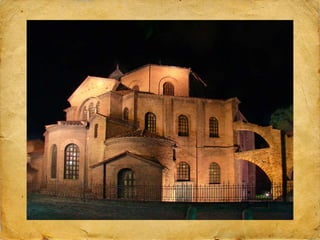
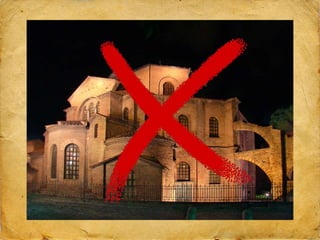
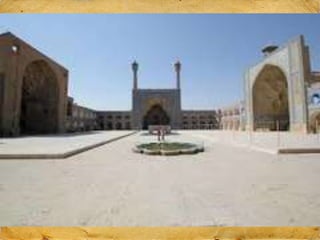
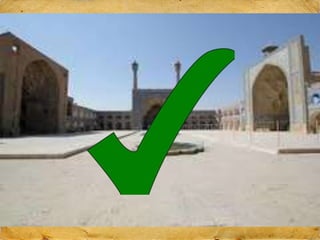
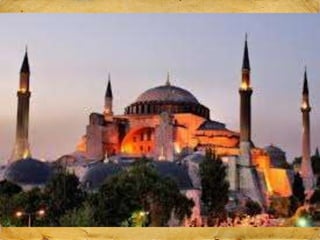
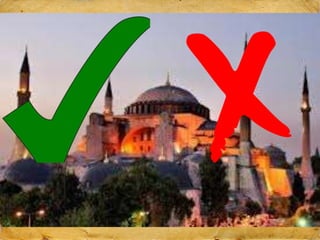
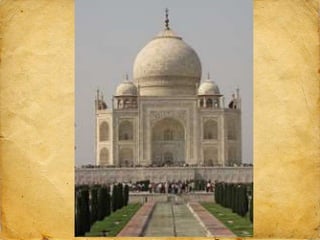
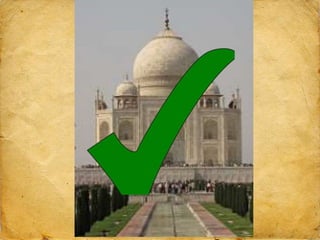
I’m going to show you some buildings. I want a
green check if it’s an Islamic building or a red
if it isn’t.
Ready………….Set…………….GO!
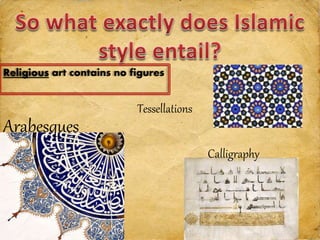
Religious art contains no figures
Arabesques
Tessellations
Calligraphy
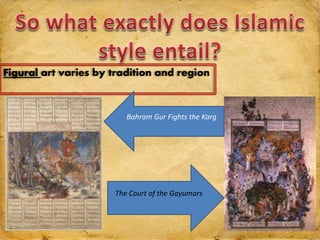
Figural art varies by tradition and region
Bahram Gur Fights the Karg
The Court of the Gayumars
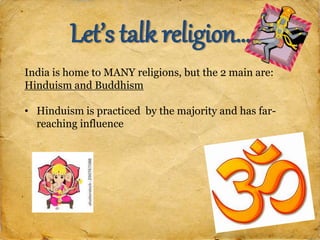
India is home to MANY religions, but the 2 main are:
Hinduism and Buddhism
• Hinduism is practiced by the majority and has far-
reaching influence
Let’s talk religion…
Hinduism FYI
• Polytheistic: multiple gods
• Infinite variety of The Divine expressed in
gods, nature, human beings
• Brahmins act as intermediaries between
humans and gods
• Goal is to break cycle of reincarnations
through prayer, good deeds, and religious
devotion
Hinduism FYI
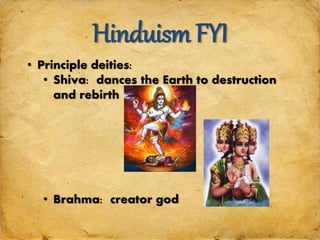
• Principle deities:
• Shiva: dances the Earth to destruction
and rebirth
• Brahma: creator god
Hinduism FYI
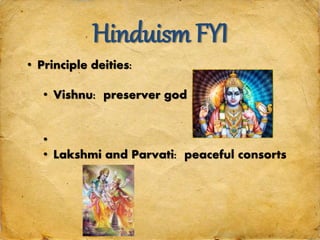
• Principle deities:
• Vishnu: preserver god
•
• Lakshmi and Parvati: peaceful consorts
Architecture/Sculpture
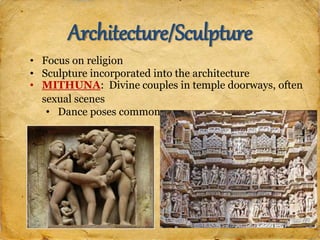
• Focus on religion
• Sculpture incorporated into the architecture
• MITHUNA: Divine couples in temple doorways, often
sexual scenes
• Dance poses common
Architecture/Sculpture
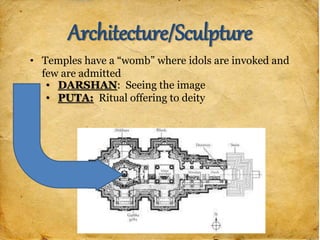
• Temples have a “womb” where idols are invoked and
few are admitted
• DARSHAN: Seeing the image
• PUTA: Ritual offering to deity
Architecture/Sculpture
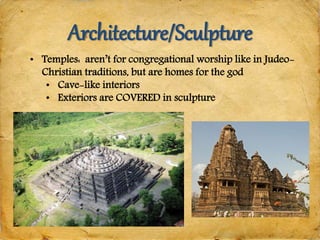
• Temples: aren’t for congregational worship like in Judeo-
Christian traditions, but are homes for the god
• Cave-like interiors
• Exteriors are COVERED in sculpture
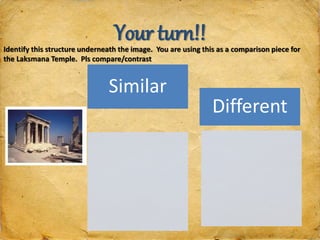
Your turn!!Identify this structure underneath the image. You are using this as a comparison piece for
the Laksmana Temple. Pls compare/contrast
Similar
Different
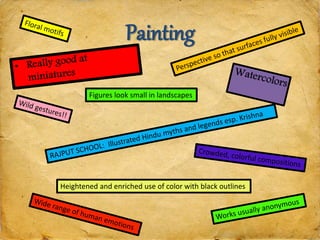
Painting
Figures look small in landscapes
Heightened and enriched use of color with black outlines
Buddhism
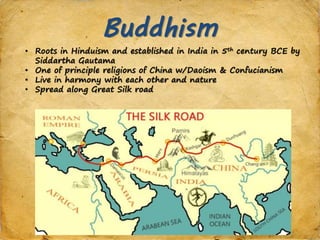
• Roots in Hinduism and established in India in 5th century BCE by
Siddartha Gautama
• One of principle religions of China w/Daoism & Confucianism
• Live in harmony with each other and nature
• Spread along Great Silk road
Buddhism
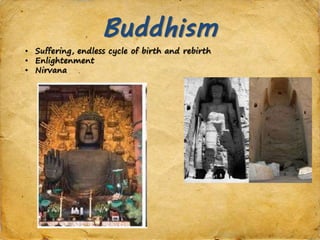
• Suffering, endless cycle of birth and rebirth
• Enlightenment
• Nirvana
Buddhism
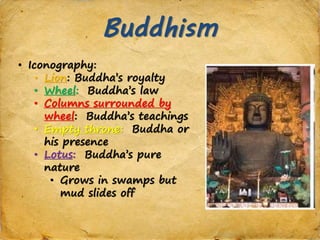
• Iconography:
• Lion: Buddha’s royalty
• Wheel: Buddha’s law
• Columns surrounded by
wheel: Buddha’s teachings
• Empty throne: Buddha or
his presence
• Lotus: Buddha’s pure
nature
• Grows in swamps but
mud slides off
Buddhism
• Sitting or laying down
• Some use drapery
• Viewis frontal, symterical,and a nimbus/halo
• Usuallydetachedvisage to depictmediation
Depictions will varyby location/culture
Buddhism
Buddhism
<iframe allowfullscreen frameborder="0" width="698" height="573"
scrolling="no" id="molvideoplayer" title="MailOnline Embed Player"
src="http://www.dailymail.co.uk/embed/video/1192157.html"></ifram
e>
https://savemedia.com/watch?v=JDEk9rjM39c
Buddhism
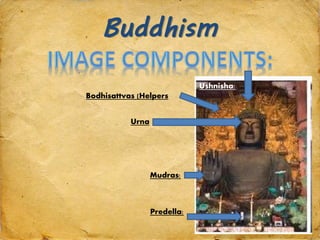
Bodhisattvas (Helpers
Mudras:
Ushnisha:
Urna
Predella:
Buddhism
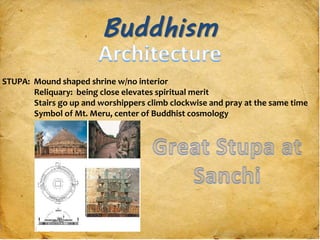
STUPA: Mound shaped shrine w/no interior
Reliquary: being close elevates spiritual merit
Stairs go up and worshippers climb clockwise and pray at the same time
Symbol of Mt. Meru, center of Buddhist cosmology
3 Jewels of Buddhism
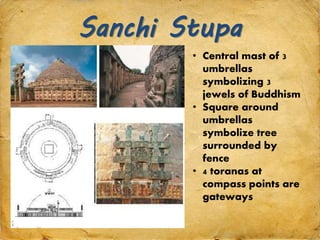
Sanchi Stupa
• Central mast of 3
umbrellas
symbolizing 3
jewels of Buddhism
• Square around
umbrellas
symbolize tree
surrounded by
fence
• 4 toranas at
compass points are
gateways
Your turn!!
Directions: Using your Framework, find a comparison piece for the Sanchi Stupa and be
prepared to discuss your choice! Please paste your image below. You have 3 minutes and
GO!
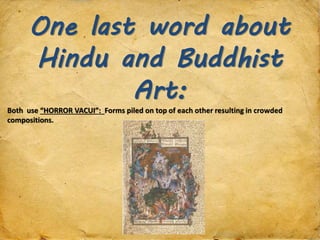
One last word about
Hindu and Buddhist
Art:
Both use “HORROR VACUI”: Forms piled on top of each other resulting in crowded
compositions.
• Paintingon scrollsw/limited color
• Materials will vary by region
• Include Buddhist and Hinduimages and buildings
• Calligraphy (this is HUGE)
• Art periods labeledby the ruling family/dynastyat the time
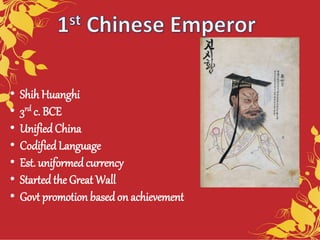
• Shih Huanghi
• 3rd c. BCE
• UnifiedChina
• CodifiedLanguage
• Est. uniformed currency
• Startedthe Great Wall
• Govt promotion based on achievement
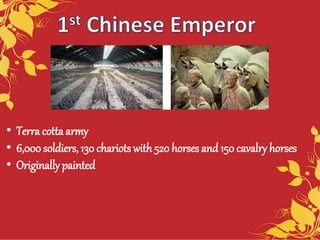
• Terra cotta army
• 6,000 soldiers, 130 chariots with 520 horses and 150 cavalry horses
• Originally painted
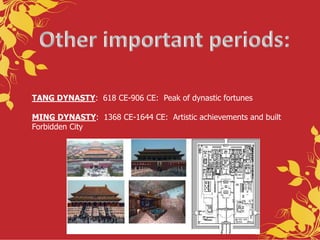
TANG DYNASTY: 618 CE-906 CE: Peak of dynastic fortunes
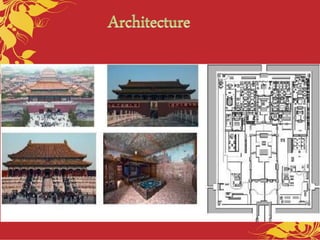
MING DYNASTY: 1368 CE-1644 CE: Artistic achievements and built
Forbidden City
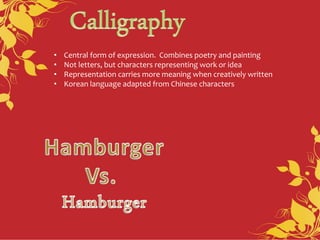
• Central form of expression. Combines poetry and painting
• Not letters, but characters representing work or idea
• Representation carries more meaning when creatively written
• Korean language adapted from Chinese characters
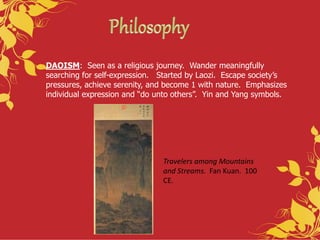
DAOISM: Seen as a religious journey. Wander meaningfully
searching for self-expression. Started by Laozi. Escape society’s
pressures, achieve serenity, and become 1 with nature. Emphasizes
individual expression and “do unto others”. Yin and Yang symbols.
Travelers among Mountains
and Streams. Fan Kuan. 100
CE.
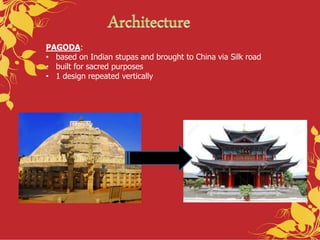
PAGODA:
• based on Indian stupas and brought to China via Silk road
• built for sacred purposes
• 1 design repeated vertically
Common characteristics:
• Residences had exterior walls to create an atrium so the family can
experience tranquility and to keep the world out
• Elders were honored and meant to live in the warmer norther rooms.
Primarily done on scrolls, album leaves, fans, murals, and scrolls
HAND SCROLLS: horizontal and meant to be read on table or desk
* Read right to left
* Silk preferred but sometimes used paper
* Acceptable to write poetry praising the work and have it included on last
panel
HANGING SCROLLS: hung vertically
NOTE: Scrolls were not meant to be displayed permanently. Read/study them, then
put away in special cabinet (kinda like your mom tells you to do…)
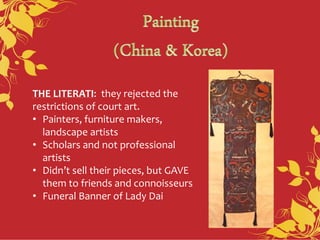
THE LITERATI: they rejected the
restrictions of court art.
• Painters, furniture makers,
landscape artists
• Scholars and not professional
artists
• Didn’t sell their pieces, but GAVE
them to friends and connoisseurs
• Funeral Banner of Lady Dai
• Influenced by Shintoism and Zen philosophy
• Calligraphy central to their art
• Will influence European art heavily (Hello, Mr. van
Gogh…)
• One of few nations to never be invaded
• Ukiyo-e prints one of most influential art forms
exported
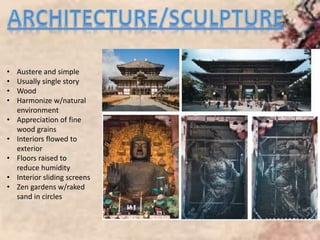
• Austere and simple
• Usually single story
• Wood
• Harmonize w/natural
environment
• Appreciation of fine
wood grains
• Interiors flowed to
exterior
• Floors raised to
reduce humidity
• Interior sliding screens
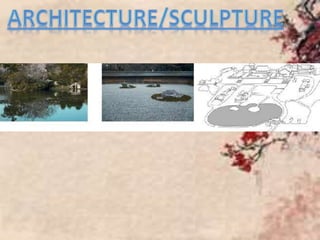
• Zen gardens w/raked
sand in circles
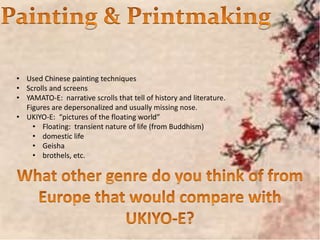
• Used Chinese painting techniques
• Scrolls and screens
• YAMATO-E: narrative scrolls that tell of history and literature.
Figures are depersonalized and usually missing nose.
• UKIYO-E: “pictures of the floating world”
• Floating: transient nature of life (from Buddhism)
• domestic life
• Geisha
• brothels, etc.
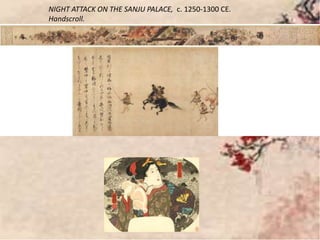
NIGHT ATTACK ON THE SANJU PALACE, c. 1250-1300 CE.
Handscroll.
Let’s answer a few questions and see
how we do. You’ll have 45 seconds for
each, just like the exam
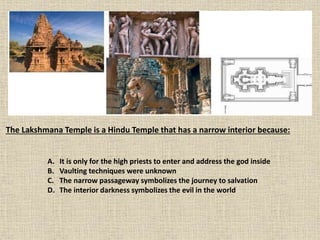
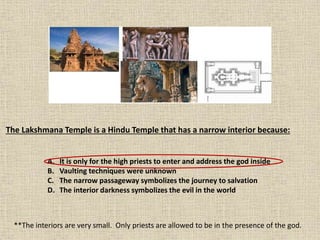
The Lakshmana Temple is a Hindu Temple that has a narrow interior because:
A. It is only for the high priests to enter and address the god inside
B. Vaulting techniques were unknown
C. The narrow passageway symbolizes the journey to salvation
D. The interior darkness symbolizes the evil in the world
The Lakshmana Temple is a Hindu Temple that has a narrow interior because:
A. It is only for the high priests to enter and address the god inside
B. Vaulting techniques were unknown
C. The narrow passageway symbolizes the journey to salvation
D. The interior darkness symbolizes the evil in the world
**The interiors are very small. Only priests are allowed to be in the presence of the god.
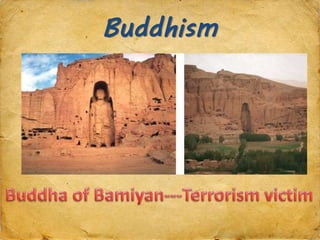
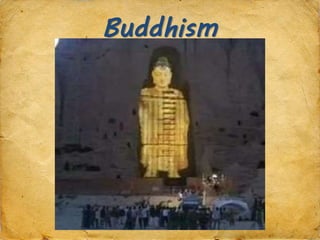
The Bamiyan Buddhas were destroyed in 2001 in an act of
A. Iconography
B. Impluvium
C. Isocephalism
D. Iconoclasm
The Bamiyan Buddhas were destroyed in 2001 in an act of
A. Iconography
B. Impluvium
C. Isocephalism
D. Iconoclasm
**Iconoclasm is the destruction of images . They were considered to be false idols by
the Taliban
The tomb of the terra cotta warriors from the 1st Emperor of China has more than
6000 soldiers who are
A. Alike to show their uniformity in protecting the emperor
B. Unpainted to contrast with the colorful image of the emperor more forcefully
C. Subtly different to show the ethnic diversity of China
D. From every social class, gender, and age in China
The tomb of the terra cotta warrios from the 1st Emperor of China has more than
6000 soldiers who are
A. Alike to show their uniformity in protecting the emperor
B. Unpainted to contrast with the colorful image of the emperor more forcefully
C. Subtly different to show the ethnic diversity of China
D. From every social class, gender, and age in China
**each of the figures is subtly different to depict various ethnic features in different
regions of China. There’s no women, children, or elderly.
Japanese woodblock prints can be seen as directly influencing works like Mary
Cassat’s The Coiffure in that they both
A. Share an affinity for brilliant color
B. Place figures at odd angles to the picture plane
C. Are concerned with solid modeling and massing of forms
D. Use the conventional three-dimensional linear perspective
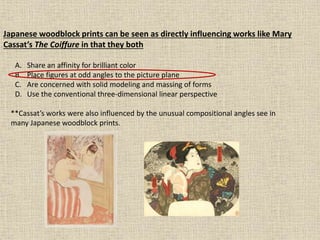
Japanese woodblock prints can be seen as directly influencing works like Mary
Cassat’s The Coiffure in that they both
A. Share an affinity for brilliant color
B. Place figures at odd angles to the picture plane
C. Are concerned with solid modeling and massing of forms
D. Use the conventional three-dimensional linear perspective
**Cassat’s works were also influenced by the unusual compositional angles see in
many Japanese woodblock prints.
A. I’m ready to DOMINATE this exam.
B. I’m feeling better, but I still need to study some.
C. Oh, man….I will need to go back and re-read this gallery
Ticket out the door!
(and to 75 points)
Write your name below and sit tight. You can also take a screen shot. Please submit this
As one of your enrichment assignments.

Gallery 3

  • 1.
  • 2.
    So, tell me,how are you feeling about this gallery? A. I will OWN this part of the exam. I can confidently answer any question about Muslim, Buddhist, and Hindu art B. I’m familiar with the major stuff, but I need to work on the details. C. I did the work but I’m not too sure what I learned. D. Um….I can’t.
  • 3.
    What would youlike to know more about?
  • 4.
    Reality check: • West,Central, South, East, and Southeast Asia account for 12% of the AP exam • 32 works • That’s 9-10 multiple choice questions or 1 extended response/essay or combination thereof
  • 5.
    Islam: Essential Background •Time: 630 CE to Present • Place: West Asia (Middle East), North Africa, Spain---very diverse regions!
  • 6.
    • How wasIslam spread? Islam: Essential Background
  • 7.
    • How wasIslam spread? – Pilgrimages – Crusades – Conquest – Trade routes (like the Silk Road) Islam: Essential Background
  • 8.
  • 9.
    Let’s look atsome art…. I’m going to show you some buildings. I want a green check if it’s an Islamic building or a red if it isn’t. Ready………….Set…………….GO!
  • 21.
    Religious art containsno figures Arabesques Tessellations Calligraphy
  • 22.
    Figural art variesby tradition and region Bahram Gur Fights the Karg The Court of the Gayumars
  • 24.
    India is hometo MANY religions, but the 2 main are: Hinduism and Buddhism • Hinduism is practiced by the majority and has far- reaching influence Let’s talk religion…
  • 25.
    Hinduism FYI • Polytheistic:multiple gods • Infinite variety of The Divine expressed in gods, nature, human beings • Brahmins act as intermediaries between humans and gods • Goal is to break cycle of reincarnations through prayer, good deeds, and religious devotion
  • 26.
    Hinduism FYI • Principledeities: • Shiva: dances the Earth to destruction and rebirth • Brahma: creator god
  • 27.
    Hinduism FYI • Principledeities: • Vishnu: preserver god • • Lakshmi and Parvati: peaceful consorts
  • 28.
    Architecture/Sculpture • Focus onreligion • Sculpture incorporated into the architecture • MITHUNA: Divine couples in temple doorways, often sexual scenes • Dance poses common
  • 29.
    Architecture/Sculpture • Temples havea “womb” where idols are invoked and few are admitted • DARSHAN: Seeing the image • PUTA: Ritual offering to deity
  • 30.
    Architecture/Sculpture • Temples: aren’tfor congregational worship like in Judeo- Christian traditions, but are homes for the god • Cave-like interiors • Exteriors are COVERED in sculpture
  • 31.
    Your turn!!Identify thisstructure underneath the image. You are using this as a comparison piece for the Laksmana Temple. Pls compare/contrast Similar Different
  • 32.
    Painting Figures look smallin landscapes Heightened and enriched use of color with black outlines
  • 33.
    Buddhism • Roots inHinduism and established in India in 5th century BCE by Siddartha Gautama • One of principle religions of China w/Daoism & Confucianism • Live in harmony with each other and nature • Spread along Great Silk road
  • 34.
    Buddhism • Suffering, endlesscycle of birth and rebirth • Enlightenment • Nirvana
  • 35.
    Buddhism • Iconography: • Lion:Buddha’s royalty • Wheel: Buddha’s law • Columns surrounded by wheel: Buddha’s teachings • Empty throne: Buddha or his presence • Lotus: Buddha’s pure nature • Grows in swamps but mud slides off
  • 36.
    Buddhism • Sitting orlaying down • Some use drapery • Viewis frontal, symterical,and a nimbus/halo • Usuallydetachedvisage to depictmediation Depictions will varyby location/culture
  • 37.
  • 38.
  • 39.
    <iframe allowfullscreen frameborder="0"width="698" height="573" scrolling="no" id="molvideoplayer" title="MailOnline Embed Player" src="http://www.dailymail.co.uk/embed/video/1192157.html"></ifram e> https://savemedia.com/watch?v=JDEk9rjM39c
  • 40.
  • 41.
    Buddhism STUPA: Mound shapedshrine w/no interior Reliquary: being close elevates spiritual merit Stairs go up and worshippers climb clockwise and pray at the same time Symbol of Mt. Meru, center of Buddhist cosmology
  • 42.
    3 Jewels ofBuddhism
  • 43.
    Sanchi Stupa • Centralmast of 3 umbrellas symbolizing 3 jewels of Buddhism • Square around umbrellas symbolize tree surrounded by fence • 4 toranas at compass points are gateways
  • 44.
    Your turn!! Directions: Usingyour Framework, find a comparison piece for the Sanchi Stupa and be prepared to discuss your choice! Please paste your image below. You have 3 minutes and GO!
  • 45.
    One last wordabout Hindu and Buddhist Art: Both use “HORROR VACUI”: Forms piled on top of each other resulting in crowded compositions.
  • 47.
    • Paintingon scrollsw/limitedcolor • Materials will vary by region • Include Buddhist and Hinduimages and buildings • Calligraphy (this is HUGE) • Art periods labeledby the ruling family/dynastyat the time
  • 48.
    • Shih Huanghi •3rd c. BCE • UnifiedChina • CodifiedLanguage • Est. uniformed currency • Startedthe Great Wall • Govt promotion based on achievement
  • 49.
    • Terra cottaarmy • 6,000 soldiers, 130 chariots with 520 horses and 150 cavalry horses • Originally painted
  • 50.
    TANG DYNASTY: 618CE-906 CE: Peak of dynastic fortunes MING DYNASTY: 1368 CE-1644 CE: Artistic achievements and built Forbidden City
  • 51.
    • Central formof expression. Combines poetry and painting • Not letters, but characters representing work or idea • Representation carries more meaning when creatively written • Korean language adapted from Chinese characters
  • 52.
    DAOISM: Seen asa religious journey. Wander meaningfully searching for self-expression. Started by Laozi. Escape society’s pressures, achieve serenity, and become 1 with nature. Emphasizes individual expression and “do unto others”. Yin and Yang symbols. Travelers among Mountains and Streams. Fan Kuan. 100 CE.
  • 53.
    PAGODA: • based onIndian stupas and brought to China via Silk road • built for sacred purposes • 1 design repeated vertically
  • 54.
    Common characteristics: • Residenceshad exterior walls to create an atrium so the family can experience tranquility and to keep the world out • Elders were honored and meant to live in the warmer norther rooms.
  • 56.
    Primarily done onscrolls, album leaves, fans, murals, and scrolls HAND SCROLLS: horizontal and meant to be read on table or desk * Read right to left * Silk preferred but sometimes used paper * Acceptable to write poetry praising the work and have it included on last panel HANGING SCROLLS: hung vertically NOTE: Scrolls were not meant to be displayed permanently. Read/study them, then put away in special cabinet (kinda like your mom tells you to do…)
  • 57.
    THE LITERATI: theyrejected the restrictions of court art. • Painters, furniture makers, landscape artists • Scholars and not professional artists • Didn’t sell their pieces, but GAVE them to friends and connoisseurs • Funeral Banner of Lady Dai
  • 59.
    • Influenced byShintoism and Zen philosophy • Calligraphy central to their art • Will influence European art heavily (Hello, Mr. van Gogh…) • One of few nations to never be invaded • Ukiyo-e prints one of most influential art forms exported
  • 60.
    • Austere andsimple • Usually single story • Wood • Harmonize w/natural environment • Appreciation of fine wood grains • Interiors flowed to exterior • Floors raised to reduce humidity • Interior sliding screens • Zen gardens w/raked sand in circles
  • 62.
    • Used Chinesepainting techniques • Scrolls and screens • YAMATO-E: narrative scrolls that tell of history and literature. Figures are depersonalized and usually missing nose. • UKIYO-E: “pictures of the floating world” • Floating: transient nature of life (from Buddhism) • domestic life • Geisha • brothels, etc.
  • 63.
    NIGHT ATTACK ONTHE SANJU PALACE, c. 1250-1300 CE. Handscroll.
  • 64.
    Let’s answer afew questions and see how we do. You’ll have 45 seconds for each, just like the exam
  • 65.
    The Lakshmana Templeis a Hindu Temple that has a narrow interior because: A. It is only for the high priests to enter and address the god inside B. Vaulting techniques were unknown C. The narrow passageway symbolizes the journey to salvation D. The interior darkness symbolizes the evil in the world
  • 66.
    The Lakshmana Templeis a Hindu Temple that has a narrow interior because: A. It is only for the high priests to enter and address the god inside B. Vaulting techniques were unknown C. The narrow passageway symbolizes the journey to salvation D. The interior darkness symbolizes the evil in the world **The interiors are very small. Only priests are allowed to be in the presence of the god.
  • 67.
    The Bamiyan Buddhaswere destroyed in 2001 in an act of A. Iconography B. Impluvium C. Isocephalism D. Iconoclasm
  • 68.
    The Bamiyan Buddhaswere destroyed in 2001 in an act of A. Iconography B. Impluvium C. Isocephalism D. Iconoclasm **Iconoclasm is the destruction of images . They were considered to be false idols by the Taliban
  • 69.
    The tomb ofthe terra cotta warriors from the 1st Emperor of China has more than 6000 soldiers who are A. Alike to show their uniformity in protecting the emperor B. Unpainted to contrast with the colorful image of the emperor more forcefully C. Subtly different to show the ethnic diversity of China D. From every social class, gender, and age in China
  • 70.
    The tomb ofthe terra cotta warrios from the 1st Emperor of China has more than 6000 soldiers who are A. Alike to show their uniformity in protecting the emperor B. Unpainted to contrast with the colorful image of the emperor more forcefully C. Subtly different to show the ethnic diversity of China D. From every social class, gender, and age in China **each of the figures is subtly different to depict various ethnic features in different regions of China. There’s no women, children, or elderly.
  • 71.
    Japanese woodblock printscan be seen as directly influencing works like Mary Cassat’s The Coiffure in that they both A. Share an affinity for brilliant color B. Place figures at odd angles to the picture plane C. Are concerned with solid modeling and massing of forms D. Use the conventional three-dimensional linear perspective
  • 72.
    Japanese woodblock printscan be seen as directly influencing works like Mary Cassat’s The Coiffure in that they both A. Share an affinity for brilliant color B. Place figures at odd angles to the picture plane C. Are concerned with solid modeling and massing of forms D. Use the conventional three-dimensional linear perspective **Cassat’s works were also influenced by the unusual compositional angles see in many Japanese woodblock prints.
  • 73.
    A. I’m readyto DOMINATE this exam. B. I’m feeling better, but I still need to study some. C. Oh, man….I will need to go back and re-read this gallery
  • 74.
    Ticket out thedoor! (and to 75 points) Write your name below and sit tight. You can also take a screen shot. Please submit this As one of your enrichment assignments.

Editor's Notes

  • #7 Pilgrimages, conquest, Crusades, trade routes, Silk Route,
  • #8 Pilgrimages, conquest, Crusades, trade routes, Silk Route,
  • #9 Pilgrimages, conquest, Crusades, trade routes, Silk Route,
  • #10 Pilgrimages, conquest, Crusades, trade routes, Silk Route,
  • #11 Great Mosque of Cordoba Spain
  • #12 Great Mosque of Cordoba Spain
  • #13 San Vitale in ravenna
  • #14 San Vitale in ravenna
  • #15 Great Mosque of damascus
  • #16 Great Mosque of damascus
  • #17 Tricky----could be both!!
  • #18 Tricky----could be both!!
  • #19 Tricky----could be both!!
  • #20 Tricky----could be both!!
  • #21 Tricky----could be both!!
  • #22 Tricky----could be both!!
  • #23 Tricky----could be both!!
  • #24 Tricky----could be both!!
  • #25 Tricky----could be both!!
  • #26 Tricky----could be both!!
  • #27 Tricky----could be both!!
  • #28 Tricky----could be both!!