Buddhism
Prepared for FA 18 by Prof. Fara Manuel
UP College of Fine Arts, Department of Theory
INDUS CIVILIZATION
• Early South Asian
• Centered in the Indus Valley, Pakistan and
extended beyond India
• The earliest South Asia cities in the Indus Valley
have rational plans and sophisticated water
supply and sewage system
• Indus Civilization art is small scale and has
stylistic parallels in the art of Mesopotamia
• Alexander the Great reached India ca. 300 BCE
and witnessed the developed civilization
2600-1500 BCE
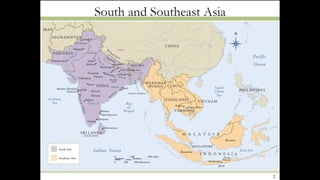
South ASIA
• Present-day
India,
Afghanistan,
Pakistan,
Nepal,
Bhutan,
Bangladesh,
and
Sri Lanka
Countries
map
Indus Civilization:
Mohenjo-Daro (Pakistan)
• Population of around 35,000
• Sophisticated water-supply (wells providing fresh
water) and sewage system
• Private baths
• Feature: The Great Bath – used for ritual bathing
still practiced in South Asia today
Seals on Clay
• Seal depicting a
figure wearing a
horned
headdress and
seated in yogic
posture indicates
that this Indian
practice began
during the period
of Indus
civilization
Vedic
Period
• Veda – “knowledge”
• (c. 1750-500 BCE) is named for the Vedas, the oldest scriptures in
Hinduism, which were composed during this period
• Vedas - Oral hymns of the Aryans – a mobile herding people that originated from
Central Asia and occupied Punjab
Aryans and
Brahmins
Aryans –”The noble ones”
composed 1st of 4 vedas in 1500
BCE
- spoke SANSKRIT, the
oldest language spoken in South
Asia
VEDAS - intended for Brahmins or
priests; headed the social
hierarchy or caste system that
still form basis of the Indian
society today.
The Aryan religion centered on
sacrifice where ritual offering is
auspicious
Hindu Caste
system
• Brahmin
• Warriors
• Traders
• Manual Laborers
(artists and architects)
• Untouchables
Upanishads
Period
• Ca. 800 to 500 BCE;
religious thinkers
composed a variety of
texts called Upanishads
• They were innovative
ideas like: samsara or
belief in an endless cycle
of re-births. Rebirth can
vary and depending on
deeds or past actions
(karma) either good or
bad determine nature of
future rebirths.
The wheel of Samsara >
Buddha’s life
• Mayadevi, queen of the Shakya clan and mother of
the Buddha receives a prophecy through a dream
that she will bear a son who would become a great
world conqueror or a great religious leader. His
husband, King of the Shakya clan, aspired for the
secular role and would groom their son for kingship.
Mayadevi dies 7 days after giving birth to his son,
later known as Buddha, the Enlightened One.
• 562 BCE Prince Siddharta Gautama was born,
eldest of the Shakya clan
• At 29 y.o. Prince Siddharta rode out of the palace
and abandoned his wife and family, outside the
palace, he encountered the pain of old age,
sickness and death for the first time. Siddharta
responded by renouncing his opulent lifeand
becoming a wandering ascetic. 6 years later, he
attains enlightenment or complete Buddhahood
while meditating under a Bodhi tree.
Birthplace of the Buddha at Lumbini
(present-day Nepal)
Bodh Gaya in Eastern India
(“Place of Enlightenment)
Buddhism
• Theravada earliest form of Buddhism; main
thrust is to attain nirvana by following
Buddha’s path
• Mahayana belief in a larger goal of
Buddhahood for all; they also revere
Bodhisattvas (Buddhas-to-be) – they wrho
restrain themselves at the threshold of
nirvana to aid others in earning merit and
achieving Buddhahood.
• Amitabha buddhist sect – worships
Amitabha Buddha (Amida in Japanese)
Birthplace of the Buddha at Lumbini
(present-day Nepal)
Bodh Gaya in Eastern India
(“Place of Enlightenment)
Buddhism
• Theravada Buddhism dominant sect in
Southern India, Sri Lanka, and mainland
Southeast Asia
• Mahayana Buddhism took root in Northern
India and spread to China, Korea, Japan
and Nepal
Birthplace of the Buddha at Lumbini
(present-day Nepal)
Bodh Gaya in Eastern India
(“Place of Enlightenment)
Four Noble Truths
• 1 Life is Suffering
• 2 The cause of suffering is desire
• 3 One can overcome and extinguish desire
• 4 the way to conquer desire and end suffering is to follow
the Buddha’s Eight-fold Path of:
right understanding, right thought, right speech,
right action, right livelihood, right effort, right mindfulness
and right concentration
The Buddha’s path
leads to Nirvana
• Claimed from observance of Buddha’s path
• Ending the endless cycle of painful life, death and re-birth
• Cessation from re-birth samsara
Maurya Period
• Ashoka (r. 272-231 BCE) converts to Buddhism
• He builds the Great Stupa at Sanchi, India
• Lion – Buddha as son a leader;
The Lions on this capital from Sarnath
supported the Wheel of the Law. Texts refer
to Buddha as the leader of the Shakya clan.
323-185 BCE
Ashoka’s pillars
The Lion Pillar
• Monolithic structure that
contained inscriptions of
Ashoka’s legal code
• Axis mundi – connecting earth
and sky; towering 30-40 ft.
• First large-scale stone work in
India
• Lion – king beast and symbol
od Mauryan royal motif
Shunga, Satavahana, Kushan
• Successors of Maurya
• First representations of the
Buddha in human form appear
based on Greco-Roman art
prototypes
185 BCE-320 CE
Standing Buddha by Gandhara artists, 3rd CE
The Stupa at Sanchi, India
The Stupa
• A large circular mound modeled on earlier South
Asian burial mounds of a type familiar in many
other ancient cultures
• Monument housing the remains of Buddha
(not a tomb)
• Functioned as a reliquary of the cremated
remains of Buddha
• Originally, Buddha’s ashes were spread int 8
stupas
• Buried in solid earthen mound; not accessible
• King Ashoka opened the 8 and distributed
Buddha’s ashes in thousands of stupas in all
corners of the land he ruled
A R C H I T E C T U R A L B A S I C S
The Stupa
• Circumambulation – Buddhists
venerated the Buddha’s (walking
around the stupa in a clockwise
direction)
• Echoing the movement of the
earth and sun – to be in harmony
with the cosmos
• Monumental stupas (like Sanchi)
are 3D mandalas or sacred
diagrams of the universe
A R C H I T E C T U R A L B A S I C S
The Stupa
• Domed stupa – world mountain
• Toranas – gateways; mark the
cardinal points
• Harmika – atop the stupa;
encloses a square area
symbolizing the sacred domain
• yasti – pole marking center/axis of
the universe
• 3 chatras – stone disks; crown the
yasti
Yakshi
Goddesses that personify
fertility and vegetation
The Sanchi yakshis make mango
trees
Relief sculpture of toranas
depict episodes of Buddha’s life
and tales of his past lives
(jatakas)
Union between heaven
and earth
Yasti rises from the Mountain dome passes through the Harmika
Stone fence separates Buddha’s relics from the profane world outside
The Stupa
and space
A R C H I T E C T U R A L B A S I C S
Chaitya halls at
Karle, India
• C. 100 CE; 45 ft. high x 125 ft. long
• Buddhist stupa hall
• Rock-cut cave imitate the earliest timber
halls
• The pillared ambulatory (walking path)
enabled worshipers to circumambulate the
stupa in the apse of the cave
• Mithunas or amorous couples flank the
entrance; symbolize the creative life force
B U D D H I S T I C O N O G R A P H Y
Meditating Buddha from
Gandhara, Pakistan 2nd C.
• Many early portrayals of the
Buddha in human form come from
Gandhara and depicted the
Enlightened one as a robed monk
and divinity (rather than
enlightened mortal)
• The style owes much to Greco-
Roman Art
• Hand gesture of meditation –
dyana mudra
Buddhist Iconography
• Earliest (1st century CE) depictions depict Buddha in human
form as a robed monk
• lakshanas (body attributes indicating Buddha’s suprahuman
nature):
- Urna – curl of hair between eyebrows, shown as a dot
- Ushnisha – cranial bump (shown as hair and later part of the
head
- Palms and soles imprinted with a wheel
- Elongated ears – royal status as a prince (he wore heavy
earrings)
- Halo or sundisk behind his head (Enlightenment)
Episodes from
Buddha’s Life
• Birth at Lumbini from the side of her mother,
Queen Maya
• Achievement of Buddhahood under a Bodhi
Tree
• First Sermon at Sarnath to 5 followers
• Attainment of Nirvana (Paranirvana) when he
died at Kushinagara
B U D D H I S T I C O N O G R A P H Y
Meditating Buddha
from Mathura, India
Gupta and Post-Gupta
• Gupta sculptors set the standard
for canonical image of the Buddha
• Ajanta cave painting – oldest
preserved
320-647
Preah Khan, Cambodia
Angkor Thom, Cambodia
Death of the Buddha
(Paranirvana)
Gal Vihara, near Polonnaruwa, Sri Lanka
Medieval
• Distinct regional styles emerge in South Asian temple
architecture
• Regional variations from both sculptural and
architectural prototypes appear throughout Southeast
Asia
647-1200
reference
• Kleiner, F. Gardner’s Art Through the Ages, 15th edition.

2 Buddhism

  • 1.
    Buddhism Prepared for FA18 by Prof. Fara Manuel UP College of Fine Arts, Department of Theory
  • 2.
    INDUS CIVILIZATION • EarlySouth Asian • Centered in the Indus Valley, Pakistan and extended beyond India • The earliest South Asia cities in the Indus Valley have rational plans and sophisticated water supply and sewage system • Indus Civilization art is small scale and has stylistic parallels in the art of Mesopotamia • Alexander the Great reached India ca. 300 BCE and witnessed the developed civilization 2600-1500 BCE
  • 3.
  • 4.
  • 5.
    Indus Civilization: Mohenjo-Daro (Pakistan) •Population of around 35,000 • Sophisticated water-supply (wells providing fresh water) and sewage system • Private baths • Feature: The Great Bath – used for ritual bathing still practiced in South Asia today
  • 8.
    Seals on Clay •Seal depicting a figure wearing a horned headdress and seated in yogic posture indicates that this Indian practice began during the period of Indus civilization
  • 10.
    Vedic Period • Veda –“knowledge” • (c. 1750-500 BCE) is named for the Vedas, the oldest scriptures in Hinduism, which were composed during this period • Vedas - Oral hymns of the Aryans – a mobile herding people that originated from Central Asia and occupied Punjab
  • 11.
    Aryans and Brahmins Aryans –”Thenoble ones” composed 1st of 4 vedas in 1500 BCE - spoke SANSKRIT, the oldest language spoken in South Asia VEDAS - intended for Brahmins or priests; headed the social hierarchy or caste system that still form basis of the Indian society today. The Aryan religion centered on sacrifice where ritual offering is auspicious
  • 12.
    Hindu Caste system • Brahmin •Warriors • Traders • Manual Laborers (artists and architects) • Untouchables
  • 13.
    Upanishads Period • Ca. 800to 500 BCE; religious thinkers composed a variety of texts called Upanishads • They were innovative ideas like: samsara or belief in an endless cycle of re-births. Rebirth can vary and depending on deeds or past actions (karma) either good or bad determine nature of future rebirths. The wheel of Samsara >
  • 14.
    Buddha’s life • Mayadevi,queen of the Shakya clan and mother of the Buddha receives a prophecy through a dream that she will bear a son who would become a great world conqueror or a great religious leader. His husband, King of the Shakya clan, aspired for the secular role and would groom their son for kingship. Mayadevi dies 7 days after giving birth to his son, later known as Buddha, the Enlightened One. • 562 BCE Prince Siddharta Gautama was born, eldest of the Shakya clan • At 29 y.o. Prince Siddharta rode out of the palace and abandoned his wife and family, outside the palace, he encountered the pain of old age, sickness and death for the first time. Siddharta responded by renouncing his opulent lifeand becoming a wandering ascetic. 6 years later, he attains enlightenment or complete Buddhahood while meditating under a Bodhi tree. Birthplace of the Buddha at Lumbini (present-day Nepal) Bodh Gaya in Eastern India (“Place of Enlightenment)
  • 15.
    Buddhism • Theravada earliestform of Buddhism; main thrust is to attain nirvana by following Buddha’s path • Mahayana belief in a larger goal of Buddhahood for all; they also revere Bodhisattvas (Buddhas-to-be) – they wrho restrain themselves at the threshold of nirvana to aid others in earning merit and achieving Buddhahood. • Amitabha buddhist sect – worships Amitabha Buddha (Amida in Japanese) Birthplace of the Buddha at Lumbini (present-day Nepal) Bodh Gaya in Eastern India (“Place of Enlightenment)
  • 16.
    Buddhism • Theravada Buddhismdominant sect in Southern India, Sri Lanka, and mainland Southeast Asia • Mahayana Buddhism took root in Northern India and spread to China, Korea, Japan and Nepal Birthplace of the Buddha at Lumbini (present-day Nepal) Bodh Gaya in Eastern India (“Place of Enlightenment)
  • 17.
    Four Noble Truths •1 Life is Suffering • 2 The cause of suffering is desire • 3 One can overcome and extinguish desire • 4 the way to conquer desire and end suffering is to follow the Buddha’s Eight-fold Path of: right understanding, right thought, right speech, right action, right livelihood, right effort, right mindfulness and right concentration
  • 18.
    The Buddha’s path leadsto Nirvana • Claimed from observance of Buddha’s path • Ending the endless cycle of painful life, death and re-birth • Cessation from re-birth samsara
  • 19.
    Maurya Period • Ashoka(r. 272-231 BCE) converts to Buddhism • He builds the Great Stupa at Sanchi, India • Lion – Buddha as son a leader; The Lions on this capital from Sarnath supported the Wheel of the Law. Texts refer to Buddha as the leader of the Shakya clan. 323-185 BCE
  • 20.
    Ashoka’s pillars The LionPillar • Monolithic structure that contained inscriptions of Ashoka’s legal code • Axis mundi – connecting earth and sky; towering 30-40 ft. • First large-scale stone work in India • Lion – king beast and symbol od Mauryan royal motif
  • 22.
    Shunga, Satavahana, Kushan •Successors of Maurya • First representations of the Buddha in human form appear based on Greco-Roman art prototypes 185 BCE-320 CE Standing Buddha by Gandhara artists, 3rd CE
  • 23.
    The Stupa atSanchi, India
  • 24.
    The Stupa • Alarge circular mound modeled on earlier South Asian burial mounds of a type familiar in many other ancient cultures • Monument housing the remains of Buddha (not a tomb) • Functioned as a reliquary of the cremated remains of Buddha • Originally, Buddha’s ashes were spread int 8 stupas • Buried in solid earthen mound; not accessible • King Ashoka opened the 8 and distributed Buddha’s ashes in thousands of stupas in all corners of the land he ruled
  • 26.
    A R CH I T E C T U R A L B A S I C S The Stupa • Circumambulation – Buddhists venerated the Buddha’s (walking around the stupa in a clockwise direction) • Echoing the movement of the earth and sun – to be in harmony with the cosmos • Monumental stupas (like Sanchi) are 3D mandalas or sacred diagrams of the universe
  • 27.
    A R CH I T E C T U R A L B A S I C S The Stupa • Domed stupa – world mountain • Toranas – gateways; mark the cardinal points • Harmika – atop the stupa; encloses a square area symbolizing the sacred domain • yasti – pole marking center/axis of the universe • 3 chatras – stone disks; crown the yasti
  • 28.
    Yakshi Goddesses that personify fertilityand vegetation The Sanchi yakshis make mango trees Relief sculpture of toranas depict episodes of Buddha’s life and tales of his past lives (jatakas)
  • 29.
    Union between heaven andearth Yasti rises from the Mountain dome passes through the Harmika Stone fence separates Buddha’s relics from the profane world outside The Stupa and space
  • 30.
    A R CH I T E C T U R A L B A S I C S Chaitya halls at Karle, India • C. 100 CE; 45 ft. high x 125 ft. long • Buddhist stupa hall • Rock-cut cave imitate the earliest timber halls • The pillared ambulatory (walking path) enabled worshipers to circumambulate the stupa in the apse of the cave • Mithunas or amorous couples flank the entrance; symbolize the creative life force
  • 32.
    B U DD H I S T I C O N O G R A P H Y Meditating Buddha from Gandhara, Pakistan 2nd C. • Many early portrayals of the Buddha in human form come from Gandhara and depicted the Enlightened one as a robed monk and divinity (rather than enlightened mortal) • The style owes much to Greco- Roman Art • Hand gesture of meditation – dyana mudra
  • 33.
    Buddhist Iconography • Earliest(1st century CE) depictions depict Buddha in human form as a robed monk • lakshanas (body attributes indicating Buddha’s suprahuman nature): - Urna – curl of hair between eyebrows, shown as a dot - Ushnisha – cranial bump (shown as hair and later part of the head - Palms and soles imprinted with a wheel - Elongated ears – royal status as a prince (he wore heavy earrings) - Halo or sundisk behind his head (Enlightenment)
  • 35.
    Episodes from Buddha’s Life •Birth at Lumbini from the side of her mother, Queen Maya • Achievement of Buddhahood under a Bodhi Tree • First Sermon at Sarnath to 5 followers • Attainment of Nirvana (Paranirvana) when he died at Kushinagara
  • 37.
    B U DD H I S T I C O N O G R A P H Y Meditating Buddha from Mathura, India
  • 38.
    Gupta and Post-Gupta •Gupta sculptors set the standard for canonical image of the Buddha • Ajanta cave painting – oldest preserved 320-647
  • 43.
  • 44.
  • 45.
    Death of theBuddha (Paranirvana) Gal Vihara, near Polonnaruwa, Sri Lanka
  • 46.
    Medieval • Distinct regionalstyles emerge in South Asian temple architecture • Regional variations from both sculptural and architectural prototypes appear throughout Southeast Asia 647-1200
  • 48.
    reference • Kleiner, F.Gardner’s Art Through the Ages, 15th edition.