

LOVELY
PROFESSIONAL
UNIVERSITY
Reg no. Name
RQ1402A09
RQ1402A08
RQ1402A05
RQ1402A02
RQ1402A06
Sukhjeet kaur
Pooja devi
Arapanjot kaur
Mayank Gupta
Satwinder singh
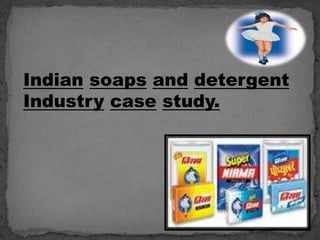
Indian soaps and detergent
Industry case study.
content
Introduction
Profile of the Nirma company
Theory of marketing mix(4ps)
Products of Nirma
Failure of Nirma
SWOT analysis of Nirma
Road of success
Conclusion
Introduction
• Started as a one- product on-man outfit in 1969
by a chemist Karsanbhi Patel
•The new yellow powder detergent was at Rs
3.50 per kg at a time when HLL’s Surf was
priced at Rs 15.
•The company’s mission to provide,
“Better Product, Better Value, Better
Living.” Contributed a great deal to its
Success.
Company profile
Date of establishment :-1980
Revenue :- 452.788(USD in millions)
Market Cap :- 40689.7843933(Rs million)
Management Details :- Chairperson-Ks Patel, MD-Hiren k Patel,
Directors –AP Sarwan ,Chinubbai.
 Business operation :-Household and personal products.
Background :-Nirma a having a turnover of Rs2500Crore started its
journey as one –man operation by Dr.Karsanbhai Patel. He was a science
graduate and worked as junior chemist in a government laboratory- He
manufactured detergent at the backyard of his house. Later selling them
door to door soon it got well placed in the consumer community and the
company was in corporate in1980.
Financials :- Total income Rs 22942.9million(year ending mar2013 Net
profit Rs 1738.7million.
 “Marketing mix ” is a general phrase used to describe the
different kinds of choices organization have make in the
whole process of bringing a product or service to market.
The 4ps is one way-probably the best-know way-of defining
the marketing mix, and was first expressed in 1960.
 The marketing mix and the 4ps of marketing are often
used as synonyms for each other. In fact, they are not
necessarily the same thing.
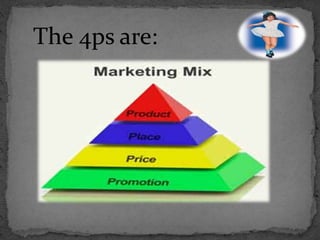
The 4ps are:
Products of Nirma
1)Soap
• Nirma Bath soap
• Nirma sandal
2) Detergent
• Nirma washing powder
• Detergent cake
3)Salt
• Nirma suddh namak
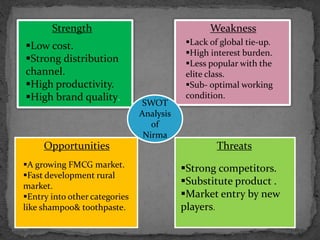
Strength
Low cost.
Strong distribution
channel.
High productivity.
High brand quality.
Weakness
Lack of global tie-up.
High interest burden.
Less popular with the
elite class.
Sub- optimal working
condition.
Opportunities Threats
A growing FMCG market.
Fast development rural
market.
Entry into other categories
like shampoo& toothpaste.
Strong competitors.
Substitute product .
Market entry by new
players.
SWOT
Analysis
of
Nirma
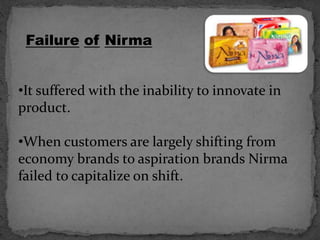
Failure of Nirma
•It suffered with the inability to innovate in
product.
•When customers are largely shifting from
economy brands to aspiration brands Nirma
failed to capitalize on shift.
Road of success
• Process of product was labor intensive this
gave employment to large no of people.
• It focused on cost reduction strategies.
• Speedy distribution channels parallel
market network.
Conclusion
The conclusion is that Nirma gave another meaning to
product Differentiation as It Showed how a low price can
gain Market share and make a big company to review its
Strategy. It showed that Marketing in not only meant for a
particular class of people but its all about how to make a
product affordable to every class people. Either he is upper
or lower class. Karsanbhi Patel Showed that price led
Strategy is key to success.
Indian saops and detergent industry( Nirma)

Indian saops and detergent industry( Nirma)

  • 1.
  • 2.
    Indian soaps anddetergent Industry case study.
  • 3.
    content Introduction Profile of theNirma company Theory of marketing mix(4ps) Products of Nirma Failure of Nirma SWOT analysis of Nirma Road of success Conclusion
  • 4.
    Introduction • Started asa one- product on-man outfit in 1969 by a chemist Karsanbhi Patel •The new yellow powder detergent was at Rs 3.50 per kg at a time when HLL’s Surf was priced at Rs 15. •The company’s mission to provide, “Better Product, Better Value, Better Living.” Contributed a great deal to its Success.
  • 5.
    Company profile Date ofestablishment :-1980 Revenue :- 452.788(USD in millions) Market Cap :- 40689.7843933(Rs million) Management Details :- Chairperson-Ks Patel, MD-Hiren k Patel, Directors –AP Sarwan ,Chinubbai.  Business operation :-Household and personal products. Background :-Nirma a having a turnover of Rs2500Crore started its journey as one –man operation by Dr.Karsanbhai Patel. He was a science graduate and worked as junior chemist in a government laboratory- He manufactured detergent at the backyard of his house. Later selling them door to door soon it got well placed in the consumer community and the company was in corporate in1980. Financials :- Total income Rs 22942.9million(year ending mar2013 Net profit Rs 1738.7million.
  • 6.
     “Marketing mix” is a general phrase used to describe the different kinds of choices organization have make in the whole process of bringing a product or service to market. The 4ps is one way-probably the best-know way-of defining the marketing mix, and was first expressed in 1960.  The marketing mix and the 4ps of marketing are often used as synonyms for each other. In fact, they are not necessarily the same thing.
  • 7.
  • 8.
    Products of Nirma 1)Soap •Nirma Bath soap • Nirma sandal 2) Detergent • Nirma washing powder • Detergent cake 3)Salt • Nirma suddh namak
  • 9.
    Strength Low cost. Strong distribution channel. Highproductivity. High brand quality. Weakness Lack of global tie-up. High interest burden. Less popular with the elite class. Sub- optimal working condition. Opportunities Threats A growing FMCG market. Fast development rural market. Entry into other categories like shampoo& toothpaste. Strong competitors. Substitute product . Market entry by new players. SWOT Analysis of Nirma
  • 10.
    Failure of Nirma •Itsuffered with the inability to innovate in product. •When customers are largely shifting from economy brands to aspiration brands Nirma failed to capitalize on shift.
  • 11.
    Road of success •Process of product was labor intensive this gave employment to large no of people. • It focused on cost reduction strategies. • Speedy distribution channels parallel market network.
  • 12.
    Conclusion The conclusion isthat Nirma gave another meaning to product Differentiation as It Showed how a low price can gain Market share and make a big company to review its Strategy. It showed that Marketing in not only meant for a particular class of people but its all about how to make a product affordable to every class people. Either he is upper or lower class. Karsanbhi Patel Showed that price led Strategy is key to success.