Visit https://testbankmall.com to download the full version and
explore more testbank or solutions manual
Marketing Grewal 4th Edition Solutions Manual
_____ Click the link below to download _____
https://testbankmall.com/product/marketing-grewal-4th-
edition-solutions-manual/
Explore and download more testbank or solutions manual at testbankmall.com
Here are some recommended products that we believe you will be
interested in. You can click the link to download.
M Marketing Grewal 4th Edition Test Bank
https://testbankmall.com/product/m-marketing-grewal-4th-edition-test-
bank/
Marketing 6th Edition Grewal Test Bank
https://testbankmall.com/product/marketing-6th-edition-grewal-test-
bank/
M Marketing 5th Edition Grewal Test Bank
https://testbankmall.com/product/m-marketing-5th-edition-grewal-test-
bank/
M Marketing Grewal 3rd Edition Test Bank
https://testbankmall.com/product/m-marketing-grewal-3rd-edition-test-
bank/
Test Bank for Marketing, 2nd Edition: Dhruv Grewal
https://testbankmall.com/product/test-bank-for-marketing-2nd-edition-
dhruv-grewal/
Test Bank for Marketing, 8th Edition, Dhruv Grewal Michael
Levy
https://testbankmall.com/product/test-bank-for-marketing-8th-edition-
dhruv-grewal-michael-levy/
Test Bank for M: Marketing, 7th Edition, Dhruv Grewal,
Michael Levy
https://testbankmall.com/product/test-bank-for-m-marketing-7th-
edition-dhruv-grewal-michael-levy/
Test Bank for Marketing, 5th Edition, Dhruv Grewal,
Michael Levy Shirley Lichti
https://testbankmall.com/product/test-bank-for-marketing-5th-edition-
dhruv-grewal-michael-levy-shirley-lichti/
Test Bank for Marketing, 6th Edition, Dhruv Grewal,
Michael Levy, ISBN: 9781259709074
https://testbankmall.com/product/test-bank-for-marketing-6th-edition-
dhruv-grewal-michael-levy-isbn-9781259709074/
Chapter 2 - Developing Marketing Strategies and a Marketing Plan
2-2
Copyright © 2015 McGraw-Hill Education. All rights reserved. No reproduction or distribution without the prior written consent of
McGraw-Hill Education.
CHAPTER OVERVIEW (“SUMMING UP”)
Define a marketing strategy.
A marketing strategy identifies (1) a firm’s target markets(s), (2) a related marketing mix
(four Ps), and (3) the bases on which the firm plans to build a sustainable competitive
Chapter 2 - Developing Marketing Strategies and a Marketing Plan
2-3
Copyright © 2015 McGraw-Hill Education. All rights reserved. No reproduction or distribution without the prior written consent of
McGraw-Hill Education.
advantage. Firms use four macro strategies to build their sustainable competitive advantage.
Customer excellence focuses on retaining loyal customers and excellent customer service.
Operational excellence is achieved through efficient operations and excellent supply chain
and human resource management. Product excellence entails having products with high
perceived value and effective branding and positioning. Finally, locational excellence
entails having a good physical location and Internet presence.
Describe the elements of a marketing plan.
A marketing plan is composed of an analysis of the current marketing situation, its
objectives, the strategy for the four Ps, and appropriate financial statements. A marketing
plan represents the output of a three-phase process: planning, implementation, and
control. The planning phase requires managers to define the firm’s mission and vision
and assess the firm’s current situation. It helps answer the questions, “What business are
we in now, and what do we intend to be in the future?” In the second phase,
implementation, the firm specifies, in more operational terms, how it plans to implement
its mission and vision. Specifically, to which customer groups does it wish to direct its
marketing efforts, and how does it use its marketing mix to provide good value? Finally,
in the control phase, the firm must evaluate its performance using appropriate metrics to
determine what worked, what didn’t, and how performance can be improved in the
future.
Analyze a marketing situation using SWOT analysis.
SWOT stands for strengths, weaknesses, opportunities, and threats. A SWOT analysis
occurs during the second step in the strategic planning process, the situation analysis. By
analyzing what the firm is good at (its strengths), where it could improve (its
weaknesses), where in the marketplace it might excel (its opportunities), and what is
happening in the marketplace that could harm the firm (its threats), managers can assess
their firm’s situation accurately and plan its strategy accordingly.
Describe how a firm chooses which consumer group(s) to pursue with its marketing
efforts.
Once a firm identifies different marketing opportunities, it must determine which are the
best to pursue. To accomplish this task, marketers go through a segmentation, targeting,
and positioning (STP) process. Firms segment various markets by dividing the total market
into those groups of customers with different needs, wants, or characteristics who therefore
might appreciate products or services geared especially toward them. After identifying the
different segments, the firm goes after, or targets, certain groups on the basis of the firm’s
perceived ability to satisfy the needs of those groups better than competitors and do so
profitably. To complete the STP process, firms position their products or services according
to the marketing mix variables so that target customers have a clear, distinctive, and
desirable understanding of what the product or service does or represents relative to
competing products or services.
Chapter 2 - Developing Marketing Strategies and a Marketing Plan
2-4
Copyright © 2015 McGraw-Hill Education. All rights reserved. No reproduction or distribution without the prior written consent of
McGraw-Hill Education.
Outline the implementation of the marketing mix as a means to increase customer value.
The marketing mix consists of the four Ps—product, price, promotion, and place—and each
P contributes to customer value. To provide value, the firm must offer a mix of products
and services at prices their target markets will view as indicating good value. Thus, firms
make trade-offs between the first two Ps, product and price, to give customers the
best value. The third P, promotion, informs customers and helps them form a positive
image about the firm and its products and services. The last P, place, adds value by
getting the appropriate products and services to customers when they want them and in the
quantities they need.
Summarize portfolio analysis and its use to evaluate marketing performance.
Portfolio analysis is a management tool used to evaluate the firm’s various products and
businesses— its portfolio—and allocate resources according to which products are
expected to be the most profitable for the firm in the future. A popular portfolio analysis
tool developed by the Boston Consulting Group classifies all products into four
categories. The first, stars, are in high-growth markets and have high market shares. The
second, cash cows, are in low-growth markets but have high market share. These
products generate excess resources that can be spun off to products that need them. The
third category, question marks, are in high-growth markets but have relatively low market
shares. These products often use the excess resources generated by the cash cows. The final
category, dogs, are in low-growth markets and have relatively low market shares. These
products are often phased out.
Describe how firms grow their business.
Firms use four basic growth strategies: market penetration, market development, product
development, and diversification. A market penetration strategy directs the firm’s efforts
toward existing customers and uses the present marketing mix. In other words, it attempts
to get current customers to buy more. In a market development strategy, the firm uses its
current marketing mix to appeal to new market segments, as might occur in international
expansion. A product development growth strategy involves offering a new product or
service to the firm’s current target market. Finally, a diversification strategy takes place
when a firm introduces a new product or service to a new customer segment. Sometimes
a diversification strategy relates to the firm’s current business, such as when a women’s
clothing manufacturer starts making and selling men’s clothes, but a more risky strategy
is when a firm diversifies into a completely unrelated business.
EXTENDED CHAPTER OUTLINE WITH TEACHING TIPS
I. WHAT IS A MARKETING STRATEGY?
Chapter 2 - Developing Marketing Strategies and a Marketing Plan
2-5
Copyright © 2015 McGraw-Hill Education. All rights reserved. No reproduction or distribution without the prior written consent of
McGraw-Hill Education.
A. Customer excellence (PPT slide 2-5)
1. Retaining Loyal Customers
2. Customer Service
B. Operational excellence (PPT slide 2-6)
C. Product Excellence (PPT slide 2-8)
D. Locational Excellence (PPT slide 2-9)
E. Multiple Sources of Advantage
Check Yourself: Several questions are offered for students to check their understanding
of core concepts. (PPT slide 2-11)
1. What are the various components of a marketing strategy?
Answer: A marketing strategy includes a firm’s target market(s), a related
marketing mix, and the bases upon which the firm plans to build a sustainable
competitive advantage.
2. List the four macro strategies that can help a firm develop a sustainable
competitive advantage.
Answer: The four microstrategies that can help a firm develop a sustainable
competitive advantage include customer excellence, operational excellence, product
excellence, and locational excellence.
II. THE MARKETING PLAN (PPT slide 2-12)
A. Step 1: Define the business mission. (PPT slide 2-14)
B. Step 2. Conduct a situation analysis using SWOT. (PPT slide 2-16)
C. Step 3: Identify and evaluate opportunities using STP (segmentation,
targeting, and positioning). (PPT slide 2-17, 18)
1. Segmentation
2. Targeting
3. Positioning
D. Step 4: Implement the marketing mix and allocate resources. (PPT slide 2-20)
1. Product and Value Creation (PPT slide 2-21)
2. Price and Value Capture (PPT slide 2-22)
3. Place and Value Delivery ((PPT slide 2-23)
Chapter 2 - Developing Marketing Strategies and a Marketing Plan
2-6
Copyright © 2015 McGraw-Hill Education. All rights reserved. No reproduction or distribution without the prior written consent of
McGraw-Hill Education.
4. Promotion and Value Communication (PPT slide 2-24)
E. Step 5: Evaluate performance using marketing metrics. (PPT slide 2-25)
1. Who is Accountable for Performance?
2. Performance Objectives and Metrics
3. Financial Performance Metrics
4. Portfolio Analysis
a) Stars
b) Cash Cows
c) Questions Marks
d) Dogs
F. Strategic planning is not sequential.
Check Yourself: Several questions are offered for students to check their understanding
of core concepts. (PPT slide 2-27)
1. What are the five steps in creating a marketing plan?
Answer: The five steps in creating a marketing plan are defining a business
mission and objectives, evaluating a situation analysis, identifying opportunities,
implementing a marketing mix, and evaluating performance using marketing
matrix.
2. What tool helps a marketer conduct a situation analysis?
Answer: A SWOT analysis helps a marketer conduct a situation analysis.
3. What is STP?
Answer: STP is Segmentation, Targeting, and Positioning.
4. What do the four quadrants of the portfolio analysis represent?
Answer: Stars, Cash Cows, Question Marks, Dogs.
III.GROWTH STRATEGIES (PPT slide 2-28)
A. Market penetration (PPT slide 2-29)
B. Market development and the case for global expansion (PPT slide 2-30)
C. Product Development (PPT slide 2-31)
D. Diversification (PPT slide 2-33)
Check Yourself: Several questions are offered for students to check their understanding
of core concepts. (PPT slide 2-34)
Chapter 2 - Developing Marketing Strategies and a Marketing Plan
2-7
Copyright © 2015 McGraw-Hill Education. All rights reserved. No reproduction or distribution without the prior written consent of
McGraw-Hill Education.
1. What are the four growth strategies?
Answer: They are market penetration strategy, market development strategy,
product development strategy, and diversification strategy.
2. What type of strategy is growing the business from existing customers?
Answer: The type of strategy that grows a business from existing customers is
market penetration strategy.
3. Which strategy is the riskiest?
Answer: The diversification strategy is the riskiest, because unrelated
diversifications do not capitalize on either core strengths associated with markets
or with products.
POWERPOINT SLIDES WITH TEACHING NOTES
Power Point Slide Teaching Notes
2-1: Developing Marketing Strategies and a
Marketing Plan
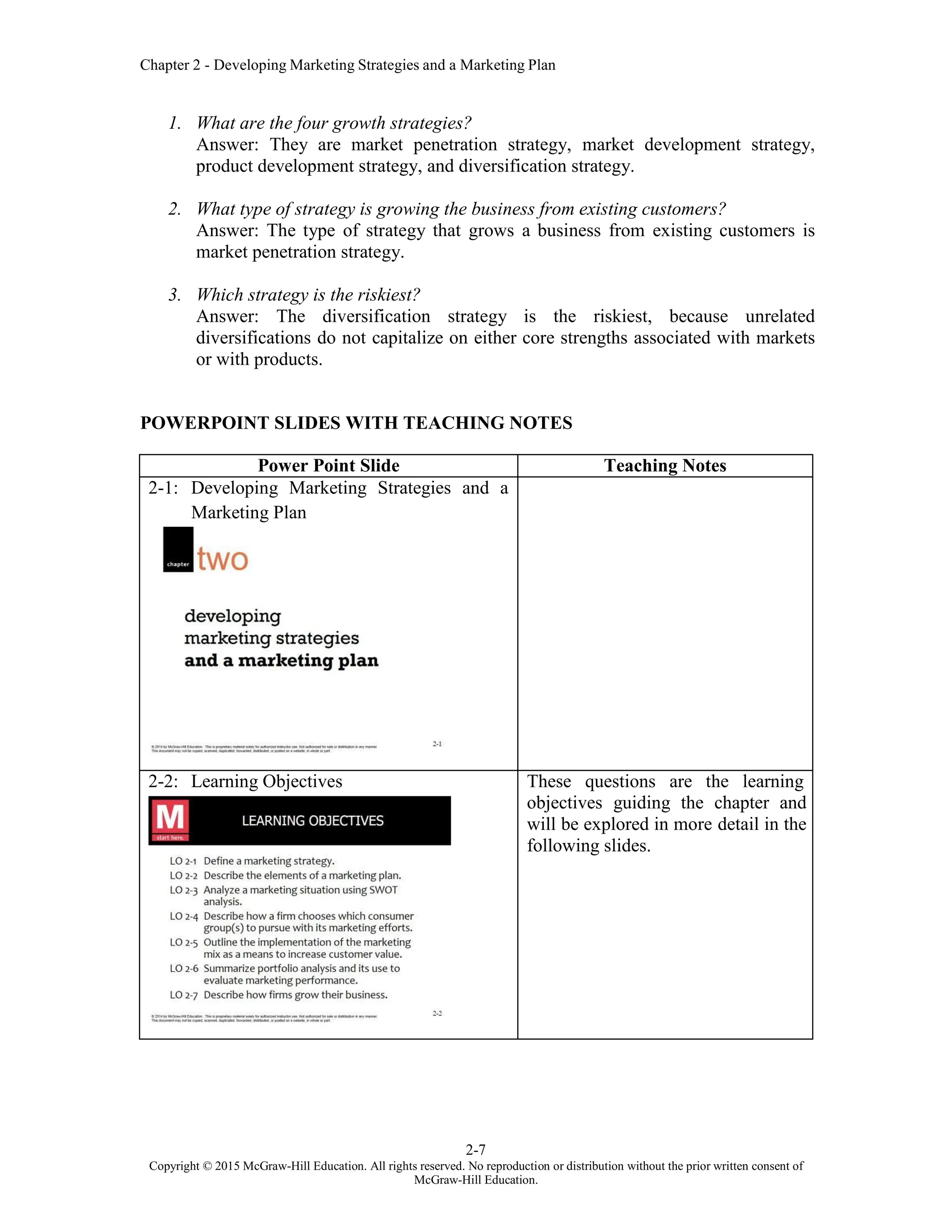
2-2: Learning Objectives These questions are the learning
objectives guiding the chapter and
will be explored in more detail in the
following slides.
Chapter 2 - Developing Marketing Strategies and a Marketing Plan
2-7
Copyright © 2015 McGraw-Hill Education. All rights reserved. No reproduction or distribution without the prior written consent of
McGraw-Hill Education.
2-3: Nike Students will most likely be familiar
with Nike products.
Ask Students to comment on any
commercials they can recall and the
company itself. Students will start
to mention many topics in the
chapter including target markets,
marketing mix and sustainable
competitive advantage.
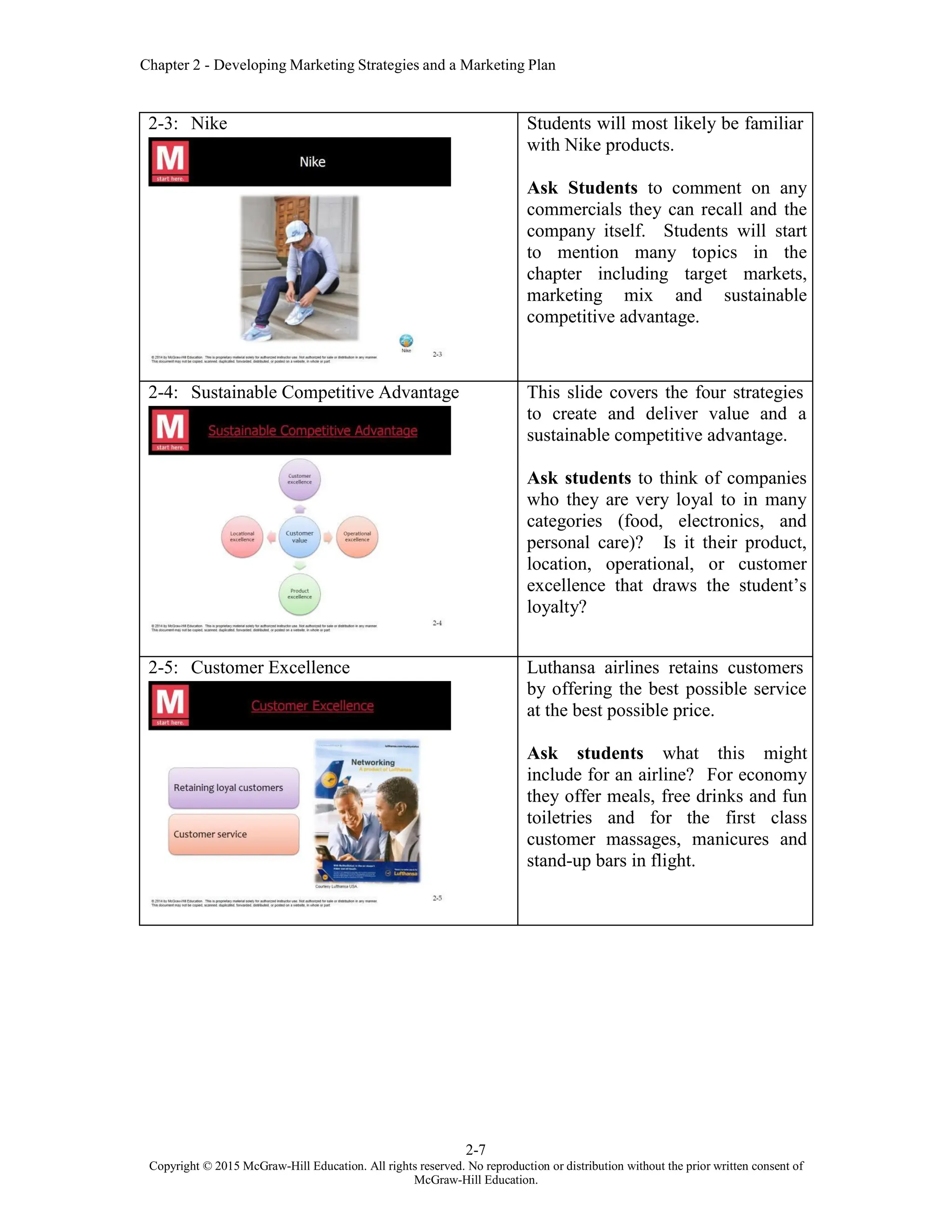
2-4: Sustainable Competitive Advantage This slide covers the four strategies
to create and deliver value and a
sustainable competitive advantage.
Ask students to think of companies
who they are very loyal to in many
categories (food, electronics, and
personal care)? Is it their product,
location, operational, or customer
excellence that draws the student’s
loyalty?
2-5: Customer Excellence Luthansa airlines retains customers
by offering the best possible service
at the best possible price.
Ask students what this might
include for an airline? For economy
they offer meals, free drinks and fun
toiletries and for the first class
customer massages, manicures and
stand-up bars in flight.
Chapter 2 - Developing Marketing Strategies and a Marketing Plan
2-8
Copyright © 2015 McGraw-Hill Education. All rights reserved. No reproduction or distribution without the prior written consent of
McGraw-Hill Education.
2-6: Operational Excellence The text highlights how firms can
use the various elements of the
marketing mix to achieve a
competitive advantage.
In recent years, firms such as Wal-
Mart have achieved competitive
advantage by utilizing operational
excellence.
That is, by controlling price and how
products are delivered to their
stores, they have been able to offer
customers low prices on a wide
array of goods.
This is made possible through the
use of efficient operations and
excellent relationships with
suppliers.
2-7: New Balance – Can America Compete? Marketing the “Made in America”
concept. This clip features the New
Balance brand. The clip focuses on
the value found in U.S. made brands
and evaluating the cost vs. time
factor.
Note: Please make sure that the
video file is located in the same folder
as the PowerPoint slides.
2-8: Product Excellence Ask students how this is an
example of product excellence.
Students might say it is product
excellence because of the high
quality of the product.
Point out the fact that expensive
should NOT be confused with the fact
that the product has a clear and
distinctive brand image and that it is
clearly positioned.
Chapter 2 - Developing Marketing Strategies and a Marketing Plan
2-9
Copyright © 2015 McGraw-Hill Education. All rights reserved. No reproduction or distribution without the prior written consent of
McGraw-Hill Education.
2-9: Locational Excellence A competitive advantage based on
location is sustainable because it is
not easily duplicated.
2-10: What Competitive Advantage? Ask students which of the four
value choices is Singapore Airlines
using?
Singapore Airlines is using customer
excellence to create and deliver
value and to develop sustainable
competitive advantages.
2-11: Check Yourself 1. Identifies a firm’s target market,
related marketing mix — their four Ps
— and the bases upon which the firm
plans to build a sustainable
competitive advantage.
2. Customer excellence, operational
excellence, product excellence,
locational excellence.
Chapter 2 - Developing Marketing Strategies and a Marketing Plan
2-10
Copyright © 2015 McGraw-Hill Education. All rights reserved. No reproduction or distribution without the prior written consent of
McGraw-Hill Education.
2-12: The Marketing Plan Explain to students that the
marketing plan should be a written
plan yet many companies do not write
it down.
Ask students why companies tend
to not write down marketing plans.
The most likely answer is that they
don’t take the time or haven’t
organized the strategy.
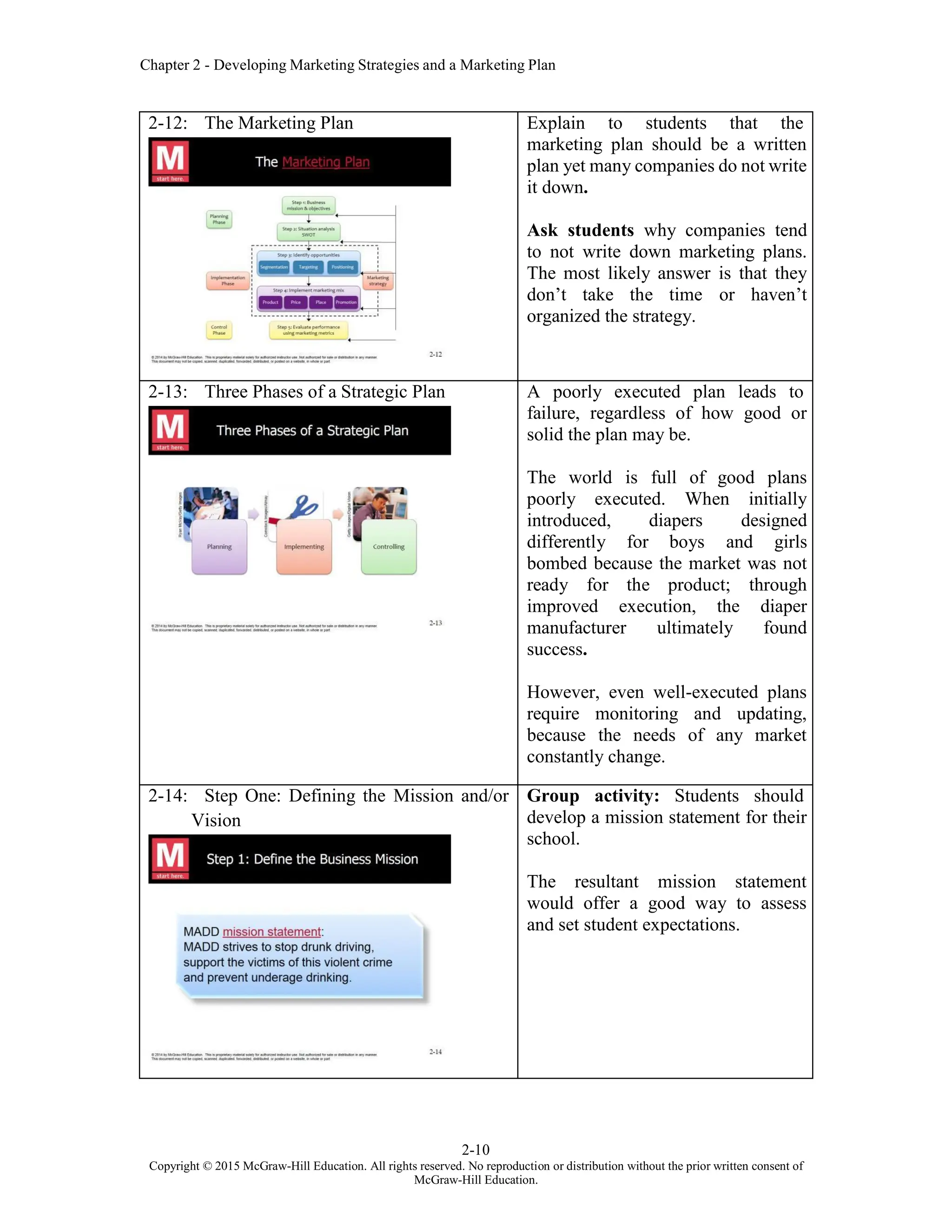
2-13: Three Phases of a Strategic Plan A poorly executed plan leads to
failure, regardless of how good or
solid the plan may be.
The world is full of good plans
poorly executed. When initially
introduced, diapers designed
differently for boys and girls
bombed because the market was not
ready for the product; through
improved execution, the diaper
manufacturer ultimately found
success.
However, even well-executed plans
require monitoring and updating,
because the needs of any market
constantly change.
2-14: Step One: Defining the Mission and/or
Vision
Group activity: Students should
develop a mission statement for their
school.
The resultant mission statement
would offer a good way to assess
and set student expectations.
Chapter 2 - Developing Marketing Strategies and a Marketing Plan
2-11
Copyright © 2015 McGraw-Hill Education. All rights reserved. No reproduction or distribution without the prior written consent of
McGraw-Hill Education.
2-15: MADD Promotion Notice how MADD works to
translate its Mission Statement into
action through its promotion efforts
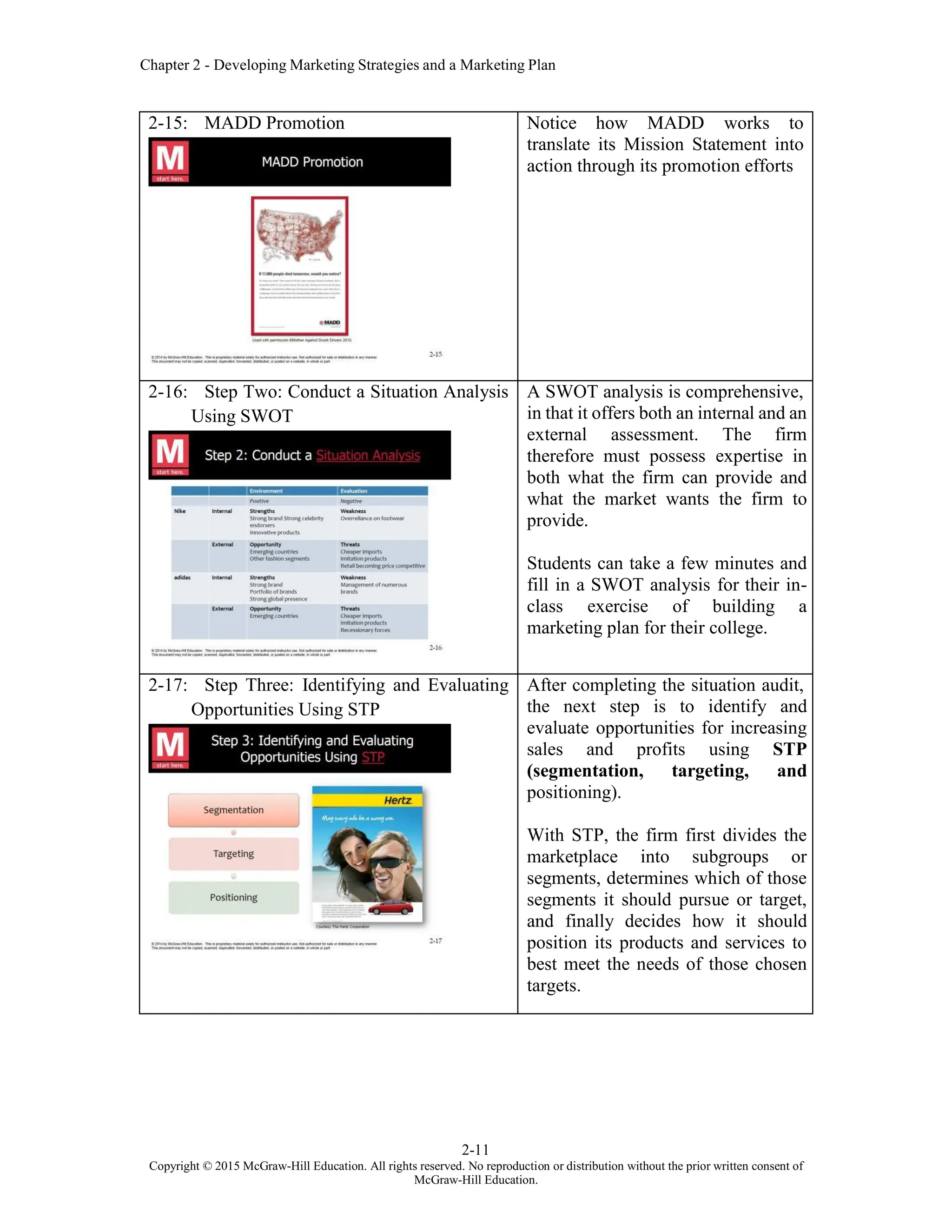
2-16: Step Two: Conduct a Situation Analysis
Using SWOT
A SWOT analysis is comprehensive,
in that it offers both an internal and an
external assessment. The firm
therefore must possess expertise in
both what the firm can provide and
what the market wants the firm to
provide.
Students can take a few minutes and
fill in a SWOT analysis for their in-
class exercise of building a
marketing plan for their college.
2-17: Step Three: Identifying and Evaluating
Opportunities Using STP
After completing the situation audit,
the next step is to identify and
evaluate opportunities for increasing
sales and profits using STP
(segmentation, targeting, and
positioning).
With STP, the firm first divides the
marketplace into subgroups or
segments, determines which of those
segments it should pursue or target,
and finally decides how it should
position its products and services to
best meet the needs of those chosen
targets.
Chapter 2 - Developing Marketing Strategies and a Marketing Plan
2-12
Copyright © 2015 McGraw-Hill Education. All rights reserved. No reproduction or distribution without the prior written consent of
McGraw-Hill Education.
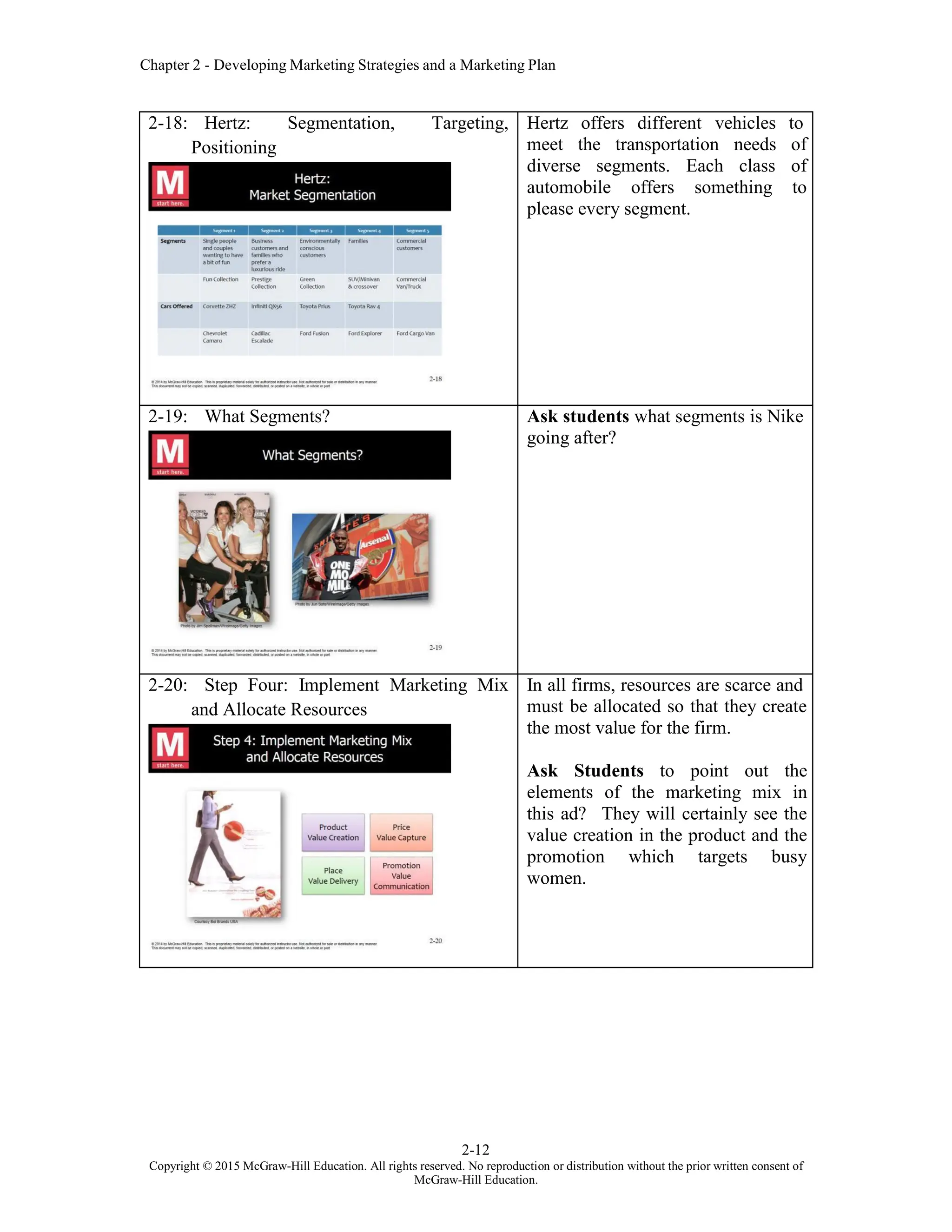
2-18: Hertz: Segmentation, Targeting,
Positioning
Hertz offers different vehicles to
meet the transportation needs of
diverse segments. Each class of
automobile offers something to
please every segment.
2-19: What Segments? Ask students what segments is Nike
going after?
2-20: Step Four: Implement Marketing Mix
and Allocate Resources
In all firms, resources are scarce and
must be allocated so that they create
the most value for the firm.
Ask Students to point out the
elements of the marketing mix in
this ad? They will certainly see the
value creation in the product and the
promotion which targets busy
women.
Chapter 2 - Developing Marketing Strategies and a Marketing Plan
2-13
Copyright © 2015 McGraw-Hill Education. All rights reserved. No reproduction or distribution without the prior written consent of
McGraw-Hill Education.
2-21: Product and Value Capture Because the key to the success of
any marketing program is the
creation of value, firms attempt to
develop products and services that
customers perceive as valuable
enough to buy.
2-22: Price and Value Capture These will be covered in the pricing
chapters later in the book. It is
worth spending some time on Value-
based pricing.
Show students two differently priced
products from the same category and
ask students which one they view
as better value and why?
For example, an Apple iPod vs. a
Microsoft Zune player. Or
alternatively Aquafina vs. Perrier.
Also explain that in this course,
more discussion of value will be
done throughout the semester.
Chapter 2 - Developing Marketing Strategies and a Marketing Plan
2-14
Copyright © 2015 McGraw-Hill Education. All rights reserved. No reproduction or distribution without the prior written consent of
McGraw-Hill Education.
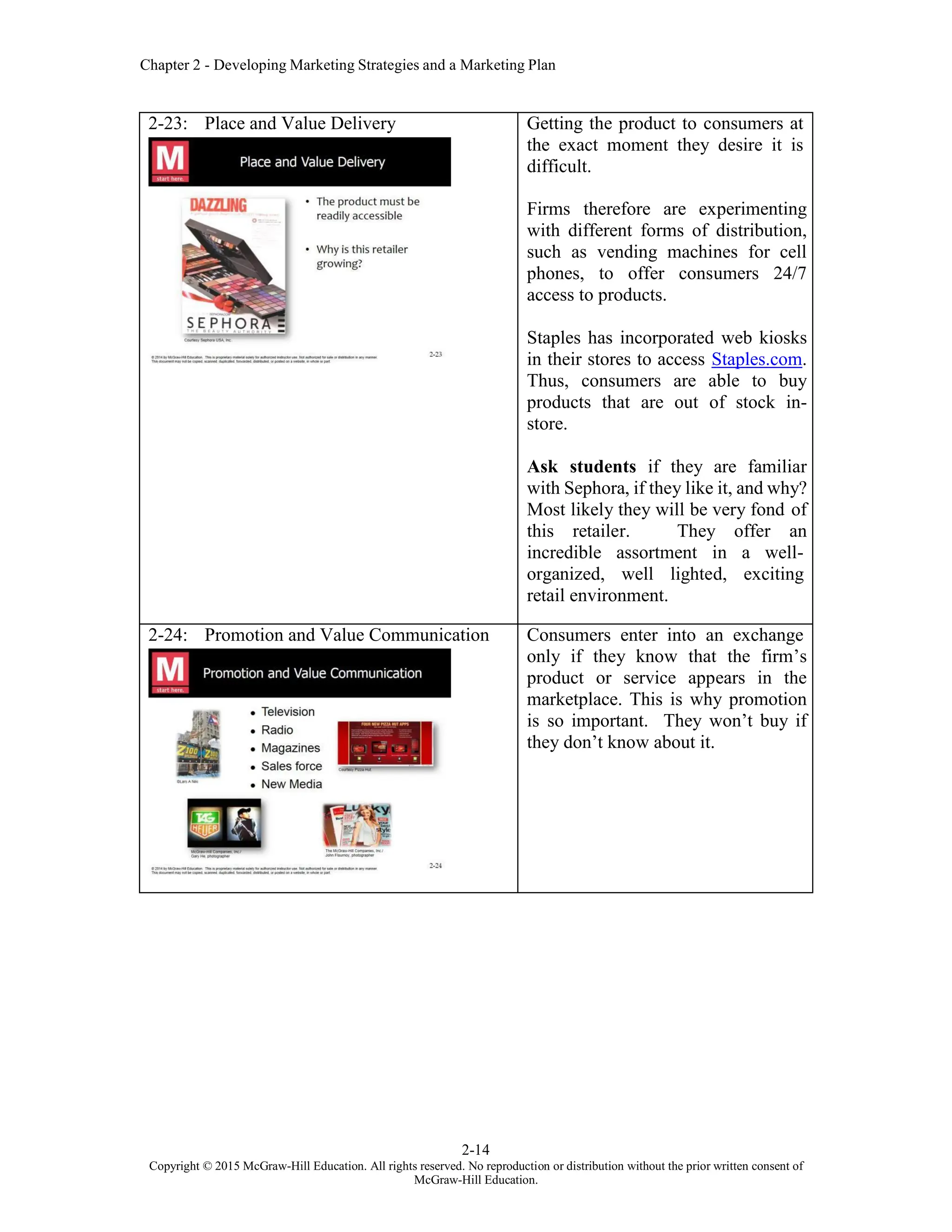
2-23: Place and Value Delivery Getting the product to consumers at
the exact moment they desire it is
difficult.
Firms therefore are experimenting
with different forms of distribution,
such as vending machines for cell
phones, to offer consumers 24/7
access to products.
Staples has incorporated web kiosks
in their stores to access Staples.com.
Thus, consumers are able to buy
products that are out of stock in-
store.
Ask students if they are familiar
with Sephora, if they like it, and why?
Most likely they will be very fond of
this retailer. They offer an
incredible assortment in a well-
organized, well lighted, exciting
retail environment.
2-24: Promotion and Value Communication Consumers enter into an exchange
only if they know that the firm’s
product or service appears in the
marketplace. This is why promotion
is so important. They won’t buy if
they don’t know about it.
Chapter 2 - Developing Marketing Strategies and a Marketing Plan
2-15
Copyright © 2015 McGraw-Hill Education. All rights reserved. No reproduction or distribution without the prior written consent of
McGraw-Hill Education.
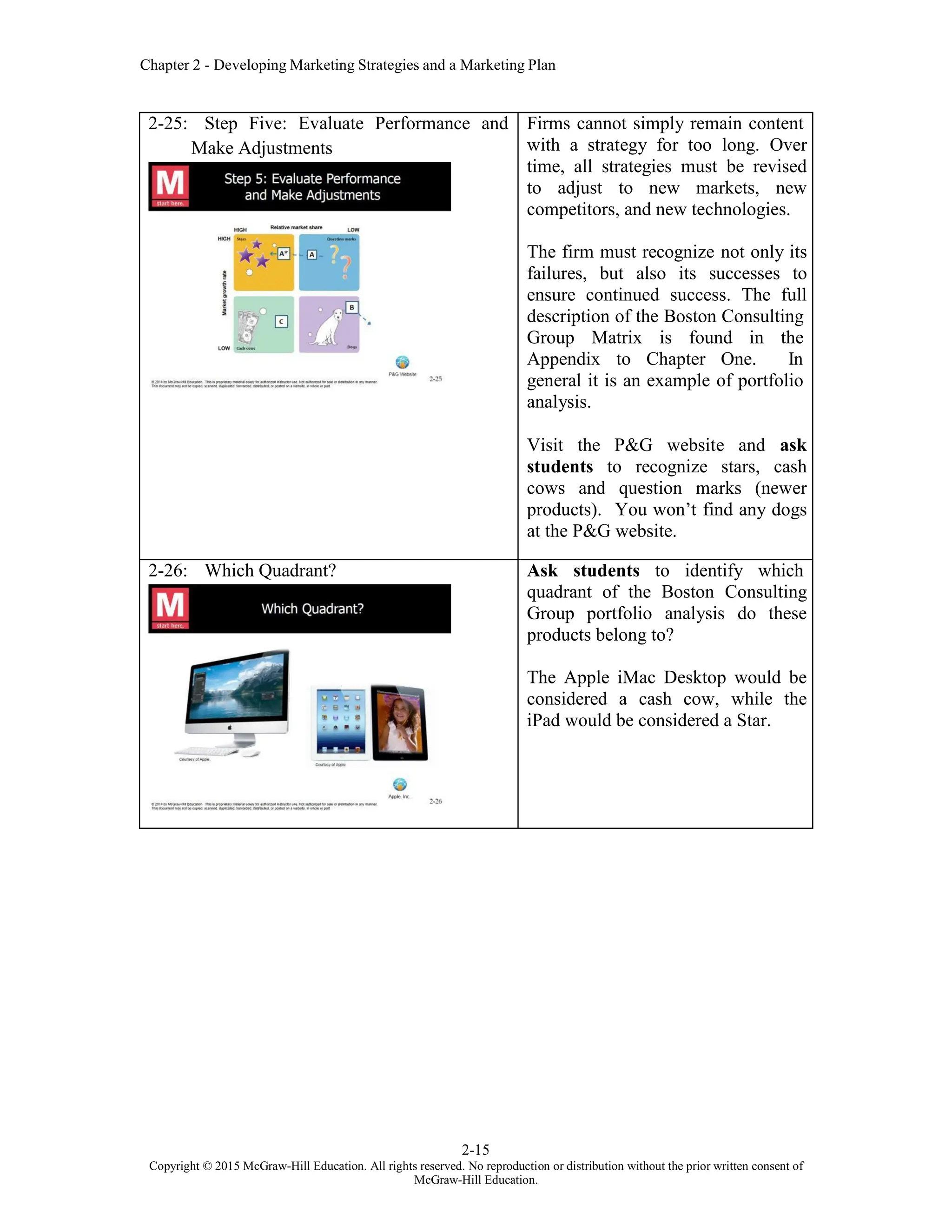
2-25: Step Five: Evaluate Performance and
Make Adjustments
Firms cannot simply remain content
with a strategy for too long. Over
time, all strategies must be revised
to adjust to new markets, new
competitors, and new technologies.
The firm must recognize not only its
failures, but also its successes to
ensure continued success. The full
description of the Boston Consulting
Group Matrix is found in the
Appendix to Chapter One. In
general it is an example of portfolio
analysis.
Visit the P&G website and ask
students to recognize stars, cash
cows and question marks (newer
products). You won’t find any dogs
at the P&G website.
2-26: Which Quadrant? Ask students to identify which
quadrant of the Boston Consulting
Group portfolio analysis do these
products belong to?
The Apple iMac Desktop would be
considered a cash cow, while the
iPad would be considered a Star.
Chapter 2 - Developing Marketing Strategies and a Marketing Plan
2-16
Copyright © 2015 McGraw-Hill Education. All rights reserved. No reproduction or distribution without the prior written consent of
McGraw-Hill Education.
2-27: Check Yourself 1. Business mission and objectives,
situation analysis and SWOT,
identify opportunities,
implement marketing mix,
evaluate performance using
marketing metrics.
2. SWOT analysis (strengths,
weaknesses, opportunities,
threats)
3. Segmentation, Targeting,
Positioning
4. Stars, Cash Cows, Question
Marks, Dogs
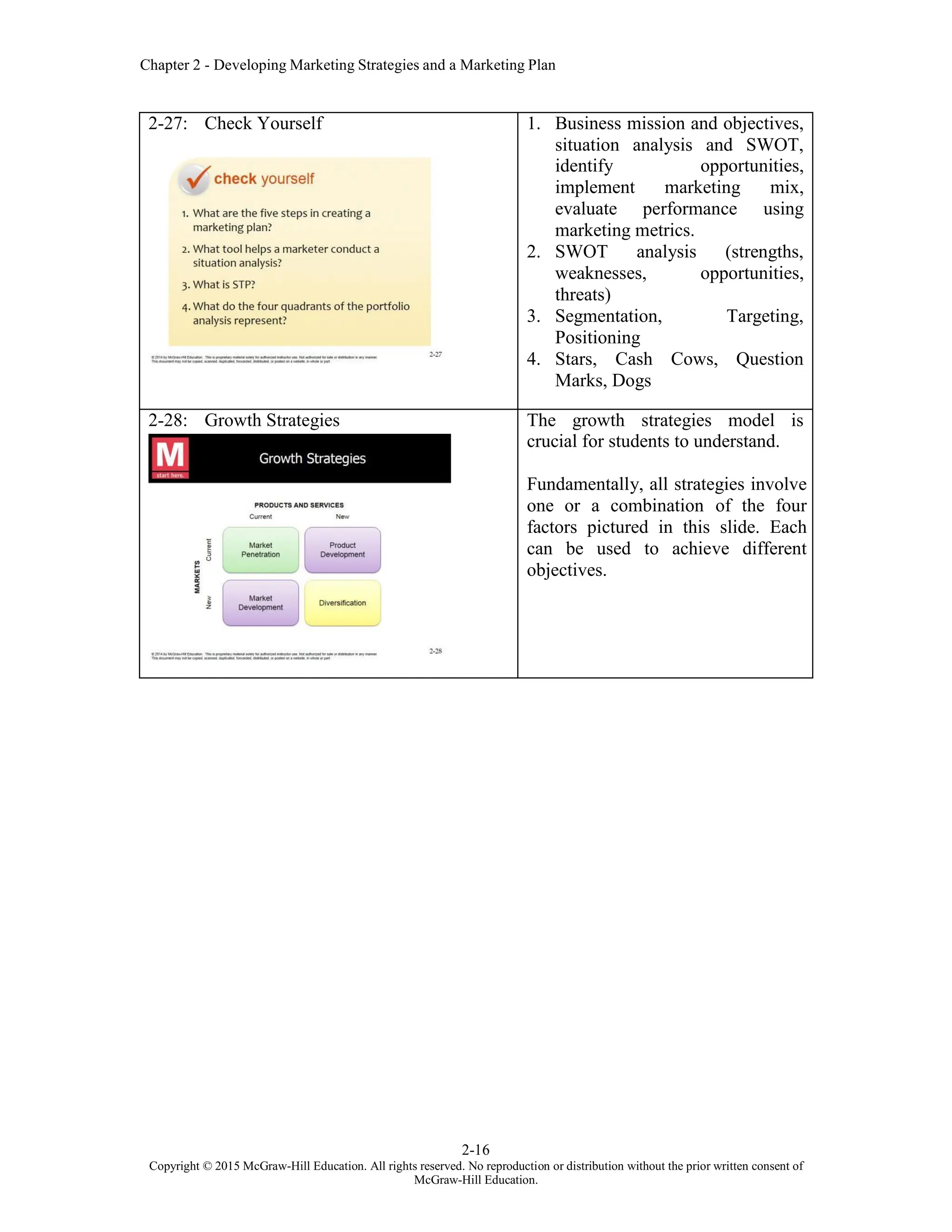
2-28: Growth Strategies The growth strategies model is
crucial for students to understand.
Fundamentally, all strategies involve
one or a combination of the four
factors pictured in this slide. Each
can be used to achieve different
objectives.
Chapter 2 - Developing Marketing Strategies and a Marketing Plan
2-17
Copyright © 2015 McGraw-Hill Education. All rights reserved. No reproduction or distribution without the prior written consent of
McGraw-Hill Education.
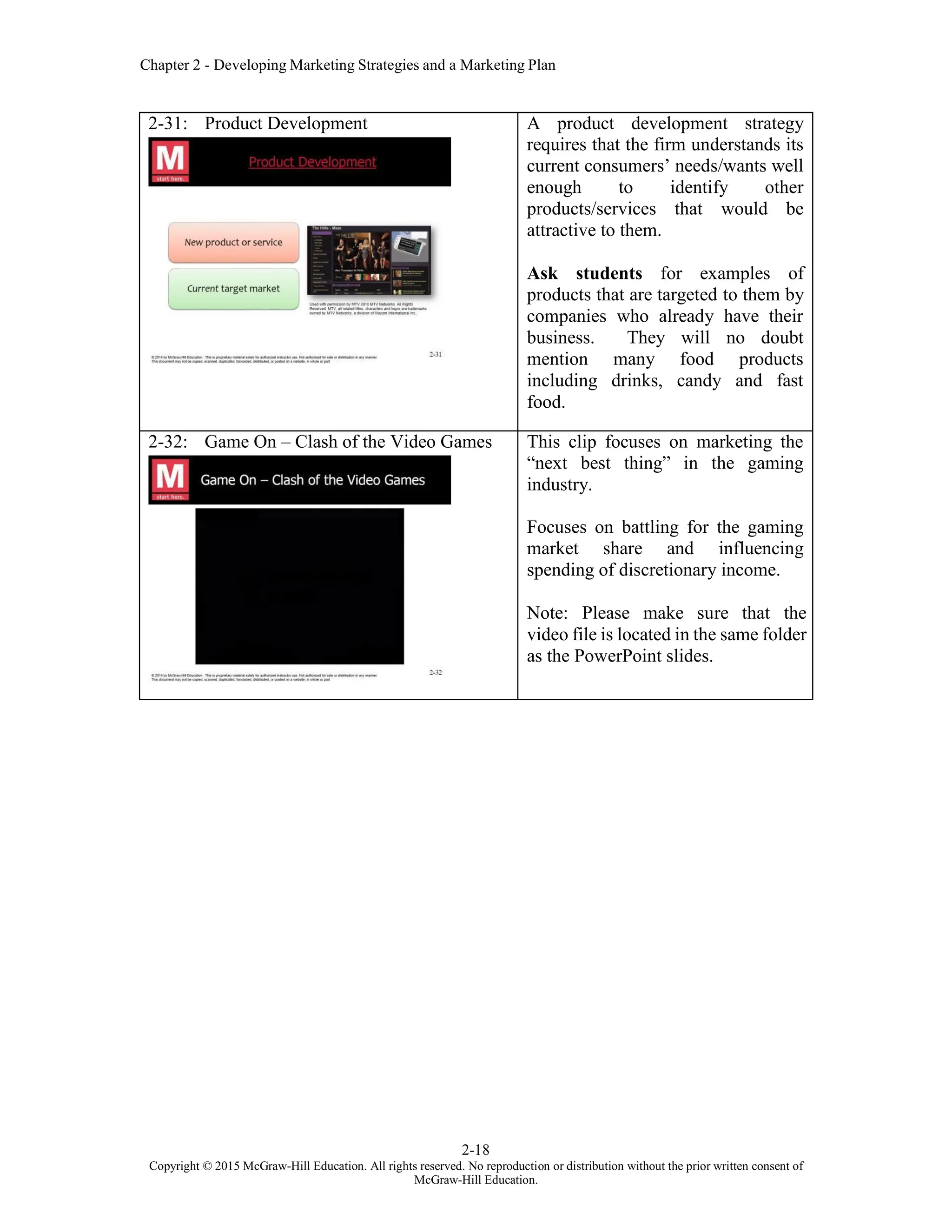
2-29: Market Penetration Sales encourage current users to
consume more of the current product
mix, but they also bring new
customers to the business.
Many strategies can be used to get
current consumers to consume more
of your product.
The web link is for a YouTube ad
where Heinz asked customers to
make videos and submit for the uses
of Heinz.
This is one of many ads that were
submitted. (Reminder - always
check YouTube links before class).
Group activity: Ask students to
brainstorm ways in which firms can
get current consumers to consume
more.
Example solutions might include
coupons, loyalty cards, or serving
size changes.
2-30: Market Development Strategy This might include targeting
growing ethnic groups in the U.S. or
global expansion, which is a popular
way for many firms to improve their
profitability.
Ask international students, if you
have them in your class, what types of
products and brands are entering their
markets?
Chapter 2 - Developing Marketing Strategies and a Marketing Plan
2-18
Copyright © 2015 McGraw-Hill Education. All rights reserved. No reproduction or distribution without the prior written consent of
McGraw-Hill Education.
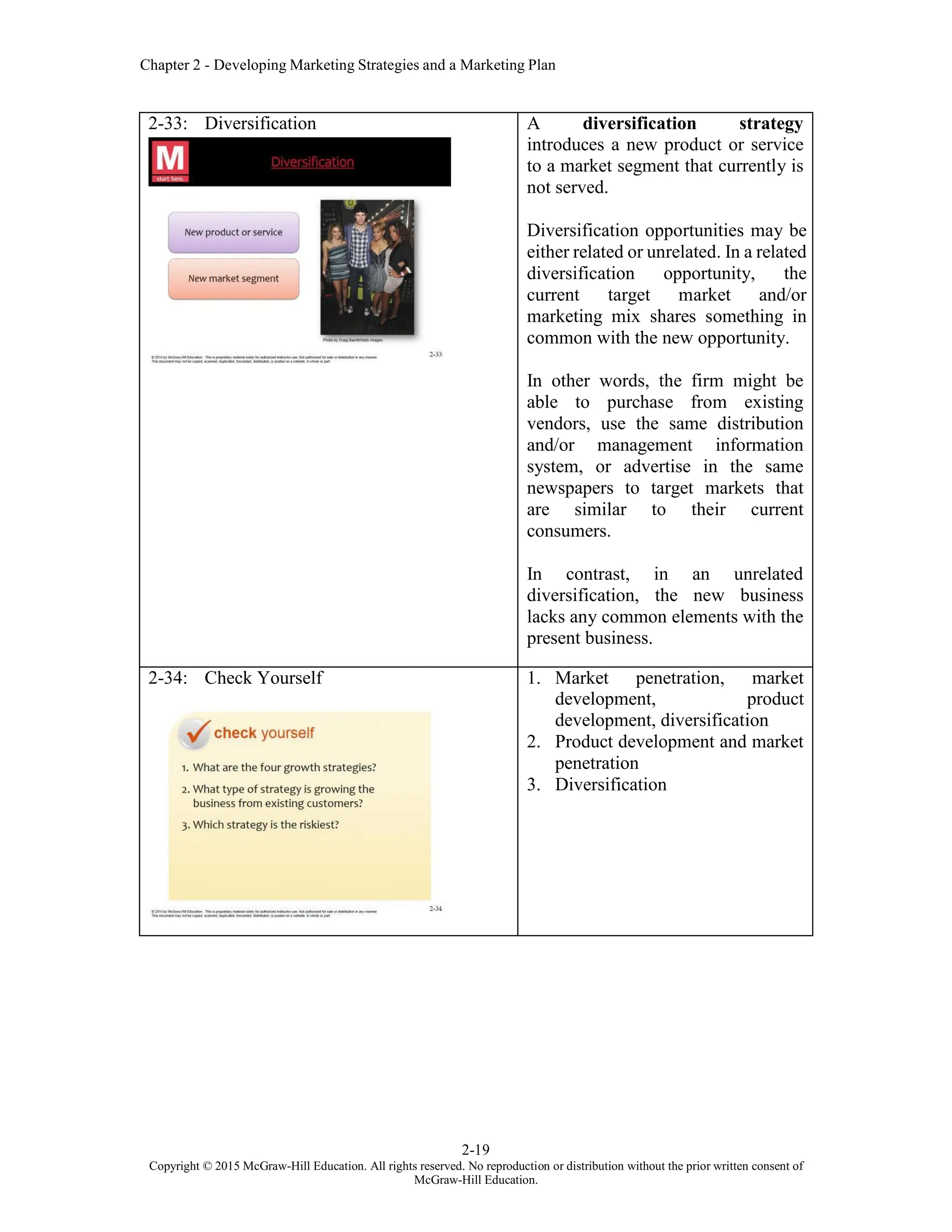
2-31: Product Development A product development strategy
requires that the firm understands its
current consumers’ needs/wants well
enough to identify other
products/services that would be
attractive to them.
Ask students for examples of
products that are targeted to them by
companies who already have their
business. They will no doubt
mention many food products
including drinks, candy and fast
food.
2-32: Game On – Clash of the Video Games This clip focuses on marketing the
“next best thing” in the gaming
industry.
Focuses on battling for the gaming
market share and influencing
spending of discretionary income.
Note: Please make sure that the
video file is located in the same folder
as the PowerPoint slides.
Chapter 2 - Developing Marketing Strategies and a Marketing Plan
2-19
Copyright © 2015 McGraw-Hill Education. All rights reserved. No reproduction or distribution without the prior written consent of
McGraw-Hill Education.
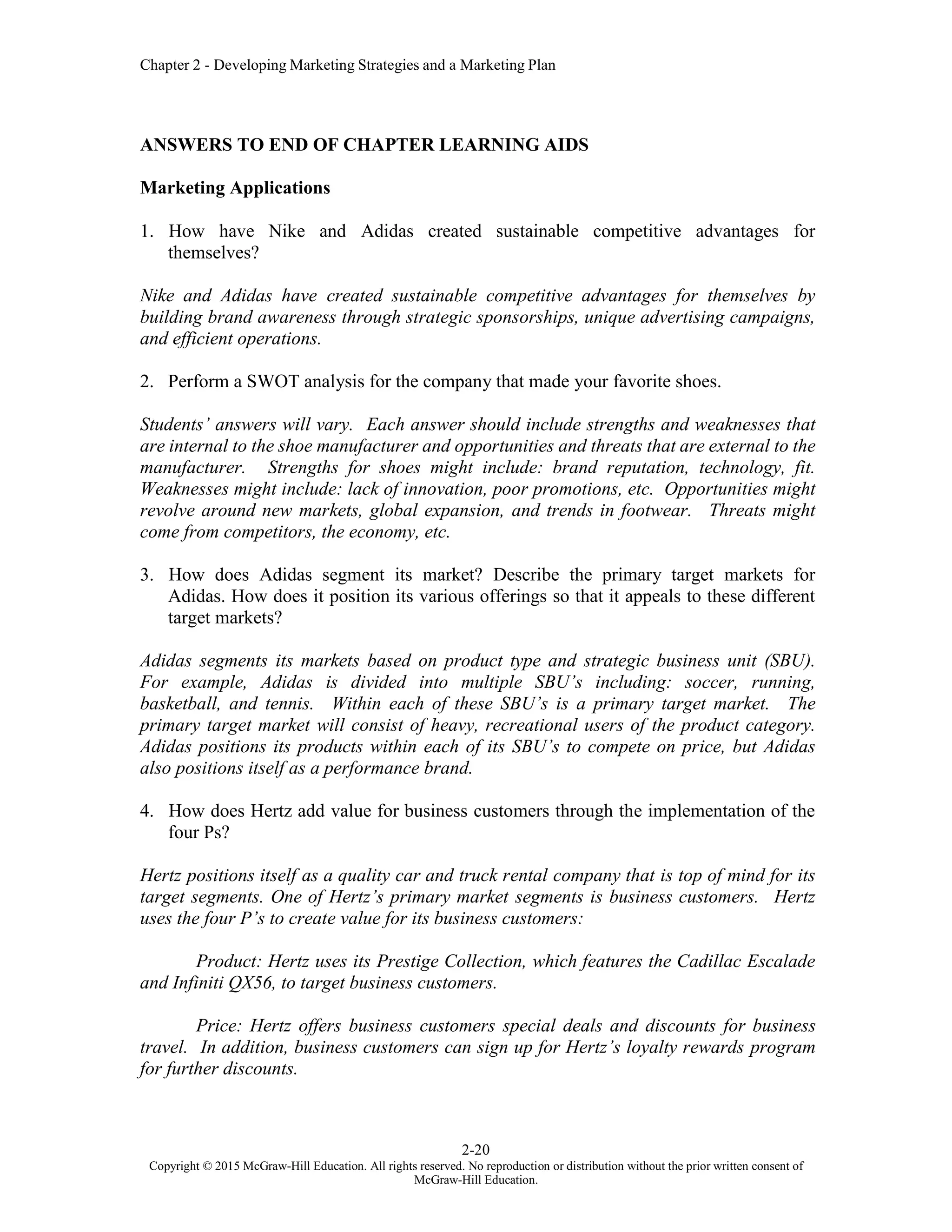
2-33: Diversification A diversification strategy
introduces a new product or service
to a market segment that currently is
not served.
Diversification opportunities may be
either related or unrelated. In a related
diversification opportunity, the
current target market and/or
marketing mix shares something in
common with the new opportunity.
In other words, the firm might be
able to purchase from existing
vendors, use the same distribution
and/or management information
system, or advertise in the same
newspapers to target markets that
are similar to their current
consumers.
In contrast, in an unrelated
diversification, the new business
lacks any common elements with the
present business.
2-34: Check Yourself 1. Market penetration, market
development, product
development, diversification
2.
3.
Product development and market
penetration
Diversification
Chapter 2 - Developing Marketing Strategies and a Marketing Plan
2-20
Copyright © 2015 McGraw-Hill Education. All rights reserved. No reproduction or distribution without the prior written consent of
McGraw-Hill Education.
ANSWERS TO END OF CHAPTER LEARNING AIDS
Marketing Applications
1. How have Nike and Adidas created sustainable competitive advantages for
themselves?
Nike and Adidas have created sustainable competitive advantages for themselves by
building brand awareness through strategic sponsorships, unique advertising campaigns,
and efficient operations.
2. Perform a SWOT analysis for the company that made your favorite shoes.
Students’ answers will vary. Each answer should include strengths and weaknesses that
are internal to the shoe manufacturer and opportunities and threats that are external to the
manufacturer. Strengths for shoes might include: brand reputation, technology, fit.
Weaknesses might include: lack of innovation, poor promotions, etc. Opportunities might
revolve around new markets, global expansion, and trends in footwear. Threats might
come from competitors, the economy, etc.
3. How does Adidas segment its market? Describe the primary target markets for
Adidas. How does it position its various offerings so that it appeals to these different
target markets?
Adidas segments its markets based on product type and strategic business unit (SBU).
For example, Adidas is divided into multiple SBU’s including: soccer, running,
basketball, and tennis. Within each of these SBU’s is a primary target market. The
primary target market will consist of heavy, recreational users of the product category.
Adidas positions its products within each of its SBU’s to compete on price, but Adidas
also positions itself as a performance brand.
4. How does Hertz add value for business customers through the implementation of the
four Ps?
Hertz positions itself as a quality car and truck rental company that is top of mind for its
target segments. One of Hertz’s primary market segments is business customers. Hertz
uses the four P’s to create value for its business customers:
Product: Hertz uses its Prestige Collection, which features the Cadillac Escalade
and Infiniti QX56, to target business customers.
Price: Hertz offers business customers special deals and discounts for business
travel. In addition, business customers can sign up for Hertz’s loyalty rewards program
for further discounts.
Chapter 2 - Developing Marketing Strategies and a Marketing Plan
2-21
Copyright © 2015 McGraw-Hill Education. All rights reserved. No reproduction or distribution without the prior written consent of
McGraw-Hill Education.
Promotion: Hertz uses marketing communications to tell their business
customers that Hertz will help them enjoy their journey and reduce their travel time.
Place: Hertz makes it easy for business customers to rent cars on business travel.
Business customers are allowed to go through a separate line, or often bypass the lines
altogether, to be on their way faster.
5. Of the four growth strategies described in the chapter, which is the most risky? Which
is the easiest to implement? Why?
Of the four growth strategies, diversification is the most risky because it involves significant
reallocation of resources. Diversification requires firms to invest in both new products
and new markets. Market penetration is probably the easiest to implement because it
requires initiatives to get more of your current customers to purchase more of your current
products. Programs that offer sales, discounts, two-for-one, or BOGO specials can assist
in a market penetration strategy.
6. Choose three companies. You believe the first builds customer value through product
excellence, the second through operational excellence, and the third through customer
excellence. Justify your answer.
Customer excellence is achieved when a firm develops value-based strategies for
retaining loyal customers and provides outstanding customer service. Students may
provide examples of local firms or larger firms such as Nordstrom’s, Amazon.com,
Zappos.com, and Ritz Carlton. Firms that have a competitive advantage through product
excellence have products with high perceived value and effective branding and positioning.
Students might choose companies like Coca-Cola, Nike, and Apple. Operational excellence
occurs through efficient operations and excellent supply chain and human resource
management. Companies with operational excellence include Dell, Toyota, and Walmart.
Students should justify their answers.
7. You are on the job market and have received offers from three very different firms.
Develop a marketing plan to help market yourself to prospective employers.
Answers will vary based upon the three companies the student would select. The student
should include details in each of the following areas:
1. Executive summary.
2. Company overview.
3. Objectives or goals.
4. Situation analysis.
5. Market/product/customer analysis.
6. Marketing strategy.
7. Financial projections.
8. Implementation plan.
9. Evaluation and control metrics.
Chapter 2 - Developing Marketing Strategies and a Marketing Plan
2-22
Copyright © 2015 McGraw-Hill Education. All rights reserved. No reproduction or distribution without the prior written consent of
McGraw-Hill Education.
Quiz Yourself
1. Suppose Macy’s announced it would severely cut back its inventory levels. For
clothing manufacturers supplying Macy’s this would represent a(n):
a. weakness.
b. opportunity.
c. situational selling problem.
d. threat.
e. strategic business promotion efficiency.
This would be a threat for Macy’s suppliers because it could mean a decrease in their
business. If Macy’s chooses to cut back inventory levels, which means it will order fewer
products from its suppliers. For manufacturers that supply Macy’s, this is a threat due to
potential loss in overall sales.
2. Carla, a manager of a local bookstore, in response to increased competition from
devices such as the Kindle book reader, has been directed by her regional marketing
manager to cut prices on seasonal items, run an ad in the local paper, and tell
distributors to reduce deliveries for the next month. Which stage of the strategic
marketing planning process is Carla engaged in?
a. Evaluate performance.
b. Define the business mission.
c. Situation analysis.
d. Implement marketing mix and resources.
e. Identify and evaluate opportunities.
Carla is implementing the different components of the marketing mix (the four P’s) by
cutting prices (price), running an ad in the local paper (promotion), and reducing
deliveries for the next month (place).
Net Savvy
1. The mission statement for Quaker Oats cites its origins, “inspired by the power and
wholesome goodness of the amazing oat.” Frito-Lay looks a little more to the present,
citing its mission “To be the world’s favorite snack and always within arm’s reach.”
These different perspectives also reflect the quite different positioning adopted by
each company. Visit the websites of each and review the descriptions of the company,
its mission, and its values. Now consider what it means when you learn that both brands
are owned by PepsiCo. What is PepsiCo’s mission statement? Do you believe these
two disparate mission statements reflect what the firms do and who they are portrayed
in the media? Justify your answer.
Chapter 2 - Developing Marketing Strategies and a Marketing Plan
2-23
Copyright © 2015 McGraw-Hill Education. All rights reserved. No reproduction or distribution without the prior written consent of
McGraw-Hill Education.
PepsiCo’s mission statement is, “Our mission is to be the world's premier consumer
products company focused on convenient foods and beverages. We seek to produce
financial rewards to investors as we provide opportunities for growth and enrichment to
our employees, our business partners and the communities in which we operate. And in
everything we do, we strive for honesty, fairness and integrity.”
Students should discuss the difference between the two mission statements and how they
relate to PepsiCo’s mission statement. How do both Frito Lay and Quaker Oats live up
to PepsiCo’s mission statement? Are they aligned or misaligned?
2. More and more firms seem to be entering the dating service industry. Visit
www.eharmony.com and tour its website to find the types of activities and methods
such companies use to help match compatible couples. Then visit www.match.com
and do the same. What are the similarities and differences of these two online dating
services? Pick one and perform a SWOT analysis for it.
Students can apply what they have learned to a novel service area they might not have
considered before. To obtain an understanding of how a company like eHarmony
attempts to match singles, students must consider what factors affect online dating services
in the guise of a SWOT analysis.
Strengths  At-home convenience factor
 Multiple matching criteria
 Low client risk
Weaknesses  No guarantee that matches will be good or
safe
 Requires client subscription to enable
communication between matches
Opportunities  Use matching criteria for couples to
provide inexpensive counseling
 International expansion
Threats  Many no-charge opportunities for singles
to meet, online or off
 Potential for sexual predators to use the
service negatively
Case Study: The Netflix Rollercoaster
1. Explain Netflix’s marketing strategy. Can it sustain its competitive advantage? Why
or why not?
Netflix competes in the video rental market by using the Internet for customer orders and
the mail system for disc delivery. Netflix also offers customers the option of immediate
Chapter 2 - Developing Marketing Strategies and a Marketing Plan
2-24
Copyright © 2015 McGraw-Hill Education. All rights reserved. No reproduction or distribution without the prior written consent of
McGraw-Hill Education.
online streaming of movies and television shows. Its pricing strategy is to allow
customers to choose a flat rate monthly subscription fee for video rentals or instant
streaming. Netflix competitive advantage is that it owns no brick-and-mortar stores and
therefore has a cost advantage over some competitors like Blockbuster. It faces tough
competition from the cable, satellite, and telcos. Netflix has faced some challenges in
previous years because of changes it made to its pricing strategy. Netflix is struggling to
maintain its current competitive advantage in the marketplace.
2. How has their strategic change and rapid reversal affected their customers? Do
you believe this situation is short-term public relations nightmare or a long-term
reversal of fortune?
Customers were confused by Netflix’s recent price change and rebranding strategy.
Some customers defected to other companies like Hulu and Blockbuster. However,
Netflix was able to retain many of its current customers. The new policy might make it
more difficult to attract more new customers. Students should explain whether or not
they believe this situation will have a short-term or long-term impact on customers.
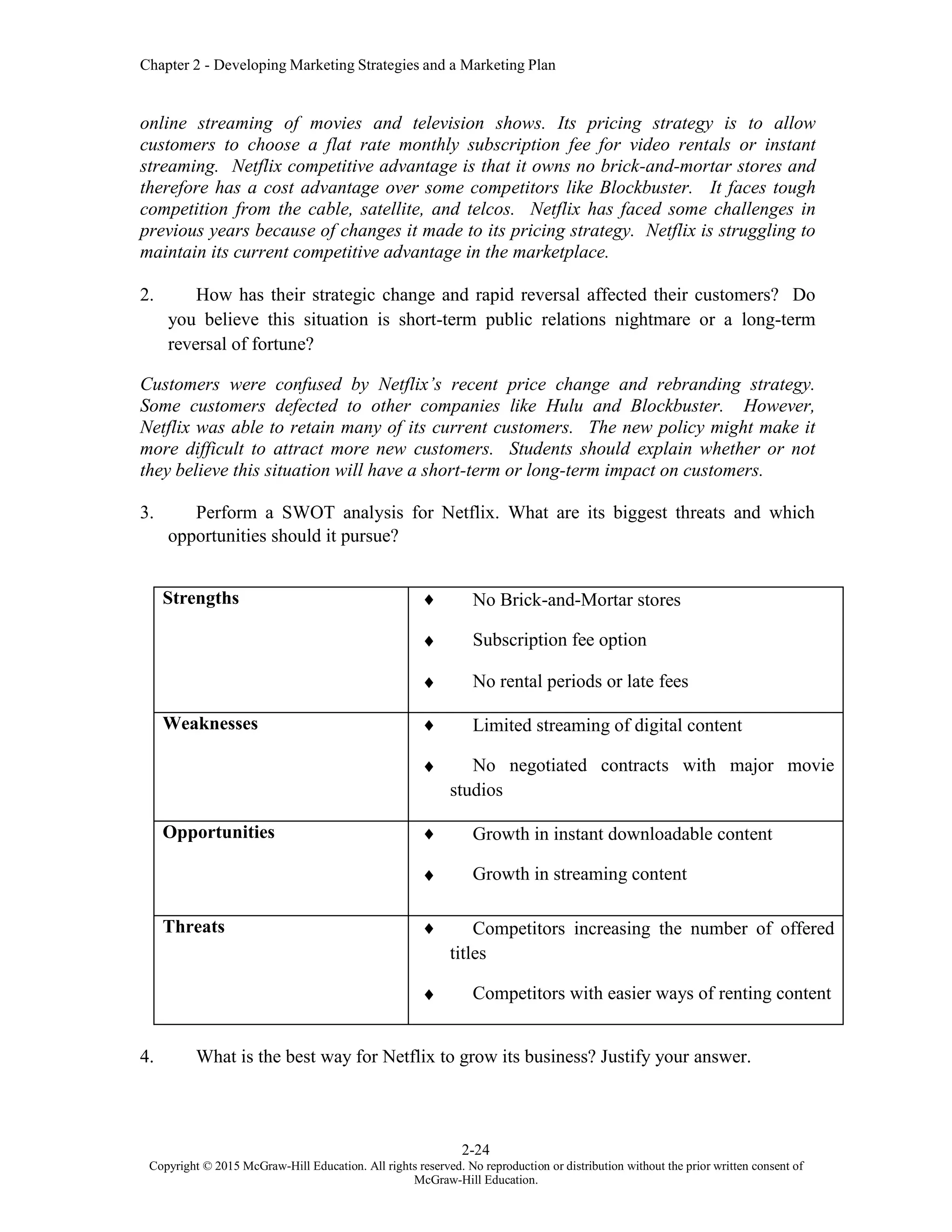
3. Perform a SWOT analysis for Netflix. What are its biggest threats and which
opportunities should it pursue?
Strengths  No Brick-and-Mortar stores
 Subscription fee option
 No rental periods or late fees
Weaknesses  Limited streaming of digital content
 No negotiated contracts with major movie
studios
Opportunities  Growth in instant downloadable content
 Growth in streaming content
Threats  Competitors increasing the number of offered
titles
 Competitors with easier ways of renting content
4. What is the best way for Netflix to grow its business? Justify your answer.
Chapter 2 - Developing Marketing Strategies and a Marketing Plan
2-25
Copyright © 2015 McGraw-Hill Education. All rights reserved. No reproduction or distribution without the prior written consent of
McGraw-Hill Education.
The greatest potential for growth is occurring with digital media. Netflix must develop
its capabilities to distribute digital content via multiple delivery options.
ADDITIONAL TEACHING TIPS
In this chapter, the goal is to introduce students to an overview of the marketing plan, the
concept of customer value, and the utility of the SWOT matrix. It is important to teach
students that the importance of the marketing plan is to communicate the value
proposition to consumers and to provide direction on how that will be achieved.
The utility of the marketing plan must be conveyed throughout the course. Teach
students that the marketing plan is a subset of the business plan that forms the
foundational strategy of business. Students come to realize the importance of the
marketing plan when the instructor frequently makes connection to its purpose not only
on the day the concept is taught but also throughout the course.
Customer value is a difficult concept for students to grasp. Instructors may want to ask
students to write down something they find of value and what aspects lead to creating
that value. The instructor can then ask what they would trade for that value. It is
important that instructors communicate that value is more than monetary worth and can’t
easily be measured. As a result, marketers must conduct target market research in order
to create the value proposition of their marketing strategy.
The SWOT matrix may be easily demonstrated by dividing your class into groups and
having each group contribute one item to each of the four quadrants using the college
they are attending (common ground for all students) or a major chain food (such as
McDonald’s) so that all students are familiar with strengths, weaknesses, opportunities, and
threats that may apply. Students can work as a group and then each group may put their
items on the white boar to form a collective classroom SWOT. Instructors should then
make the link that the opportunities and strengths should filter into the marketing message
delivered in advertising campaigns and other marketing tools. Online tip: Instructors may
want to divide their class by last name A-E Strengths, F-J Weaknesses, and so forth to
answer a discussion board question using the same concept. Students could then complete
an individual SWOT as an assignment. Another option would be to use the same concepts
and integrate it as an online team assignment where each team forms their respective
completed SWOT.
Remember to review the Newsletter for Instructors and its accompanied PowerPoint
presentation, which integrates examples and discussion from the newsletter. Each
newsletter contains over ten article abstracts on hot topics, plus a selection of current
commercials and videos for you to use with your class. The newsletter also includes a
guide that explains where the articles, commercials, and videos best fit in your Marketing
course.
Exploring the Variety of Random
Documents with Different Content
Milke street (places not far from Bassinges hall), the advowson of
the church at Bassinges hall, with sundry liberties and privileges.
This man was afterwards mayor in the year 1251, the 36th of Henry
III.; moreover, Thomas Bassing was one of the sheriffs 1269; Robert
Bassing, sheriff, 1279; and William Bassing was sheriff 1308, etc.;
for more of the Bassings in this city I need not note, only I read of
this family of Bassinges in Cambridgeshire,[218] called Bassing at the
bourn, and more shortly Bassing bourn, and gave arms, as is afore
showed, and was painted about this old hall. But this family is worn
out, and hath left the name to the place where they dwelt. Thus
much for this Bassings hall.
Now how Blakewell hall took that name is another question; for
which I read that Thomas Bakewell dwelt in this house in the 36th of
Edward III.; and that in the 20th of Richard II., the said king, for the
sum of fifty pounds, which the mayor and commonalty had paid into
the hanaper, granted licence so much as was in him to John Frosh,
William Parker, and Stephen Spilman (citizens and mercers), that
they, the said messuage called Bakewell hall, and one garden, with
the appurtenances, in the parish of St. Michael of Bassings haugh,
and of St. Laurence in the Jurie of London, and one messuage, two
shops, and one garden, in the said parish of St. Michael, which they
held of the king in burghage, might give and assign to the mayor
and commonalty for ever. This Bakewell hall, thus established, hath
been long since employed as a weekly market-place for all sorts of
woollen cloths, broad and narrow, brought from all parts of this
realm, there to be sold. In the 21st of Richard II., R. Whittington,
mayor, and in the 22nd, Drengh Barringtine being mayor, it was
decreed that no foreigner or stranger should sell any woollen cloth
but in the Bakewell hall, upon pain of forfeiture thereof.
This house of late years growing ruinous, and in danger of falling,
Richard May, merchant-tailor, at his decease gave towards the new
building of the outward part thereof three hundred pounds, upon
condition that the same should be performed within three years
after his decease; whereupon the old Bakewell hall was taken down,
and in the month of February next following, the foundation of a
new, strong, and beautiful storehouse being laid, the work thereof
was so diligently applied, that within the space of ten months after,
to the charges of two thousand five hundred pounds, the same was
finished in the year 1588.
Next beyond this house be placed divers fair houses for merchants
and others, till ye come to the back gate of Guildhall, which gate and
part of the building within the same is of this ward. Some small
distance beyond this gate the coopers have their common hall. Then
is the parish church of St. Michaell, called St. Michaell at Bassings
hall, a proper church lately re-edified or new built, whereto John
Barton, mercer, and Agnes his wife, were great benefactors, as
appeareth by his mark placed throughout the whole roof of the choir
and middle aisle of the church: he deceased in the year 1460, and
was buried in the choir, with this epitaph:
“John Barton lyeth vnder here,
Sometimes of London, citizen and mercer,
And Ienet his wife, with their progenie,
Beene turned to earth as ye may see:
Friends free what so ye bee,
Pray for vs we you pray,
As you see vs in this degree,
So shall you be another day.”
Frances Cooke, John Martin, Edward Bromflit, esquire, of
Warwickshire, 1460; Richard Barnes, Sir Roger Roe, Roger Velden,
1479; Sir James Yarford, mercer, mayor, deceased 1526, buried
under a fair tomb with his lady in a special chapel by him built on
the north side of the choir; Sir John Gresham, mercer, mayor,
deceased 1554; Sir John Ailife, chirurgeon, then a grocer, one of the
sheriffs 1548; Nicholas Bakhurst, one of the sheriffs 1577; Wolston
Dixi, skinner, mayor, 1585, etc. Thus have you noted one parish
church of St. Michaell, Bakewell hall, a market-place for woollen
cloths; the Masons’ hall, Weavers’ hall, Cordellers’ hall, and Coopers’
hall. And thus I end this ward, which hath an alderman, his deputy,
for common council four, constables two, scavengers two, for the
wardmote inquest seventeen, and a beadle. It is taxed to the fifteen
in London at seven pounds, and likewise in the Exchequer at seven
pounds.
CRIPPLESGATE WARD
The next ward is called of Cripplesgate, and consisteth of divers
streets and lanes, lying as well without the gate and wall of the city
as within: first within the wall, on the east part thereof, towards the
north, it runneth to the west side of Bassings hall ward, and towards
the south it joineth to the ward of Cheape. It beginneth at the west
end of St. Laurence church in the Jurie, on the north side, and
runneth west to a pump, where sometime was a well with two
buckets, at the south corner of Aldermanburie street; which street
runneth down north to Gayspurre lane, and so to London wall, which
street and lane are wholly on both sides of this ward, and so be
some few houses on both the sides from Gayspurre lane, by and
against the wall of the city, east to the grates made for the water-
course of the channels, and west to Cripplesgate. Now on the south
side, from over against the west end of St. Laurence church to the
pump, and then by Milke street south unto Cheape, which Milke
street is wholly on both the sides of Cripplegate ward, as also
without the south end of Milke street, a part of West Cheape, to wit,
from the Standard to the Cross, is all of Cripplegate ward. Then
down Great Wood street, which is wholly of this ward on both the
sides thereof; so is Little Wood street, which runneth down to
Cripplegate.
Out of this Wood street be divers lanes; namely, on the east side is
Lad lane, which runneth east to Milke street corner; down lower in
Wood street is Love lane, which lieth by the south side of St. Alban’s
church in Wood street, and runneth down to the Conduit in
Aldermanburie street. Lower down in Wood street is Addle street,
out of the which runneth Phillip lane down to London wall. These be
the lanes on the east side.
On the west side of Wood street is Huggen lane, by the south side of
St. Michael’s church, and goeth through to Guthuruns lane. Then
lower is Maiden lane, which runneth west to the north end of
Gutherons lane, and up the said lane on the east side thereof, till
against Kery lane, and back again: then the said Maiden lane, on the
north side, goeth up to Staining lane, and up a part thereof, on the
east side, to the farthest north part of Haberdashers’ hall, and back
again to Wood street; and there lower down to Silver street, which is
of this ward, till ye come to the east end of St. Olave’s church, on
the south side, and to Munkes well street on the north side; then
down the said Munkes well street on the east side thereof, and so to
Cripplegate, do make the bounds of this ward within the walls.
Without Cripplegate, Fore street runneth thwart before the gate,
from against the north side of St. Giles church, along to More lane
end, and to a Postern lane end, that runneth betwixt the town ditch
on the south, and certain gardens on the north, almost to Moregate;
at the east of which lane is a pot-maker’s house, which house, with
all other the gardens, houses, and alleys, on that side the
Morefields, till ye come to a bridge and cow-house near unto
Fensburie court, is all of Cripplegate ward; then to turn back again
through the said Postern lane to More lane, which More lane, with all
the alleys and buildings there, is of this ward; after that is Grub
street, more than half thereof to the straitening of the street; next is
Whitecrosse street, up to the end of Bech lane, and then Redcrosse
street wholly, with a part of Golding lane, even to the posts there
placed, as a bounder.
Then is Bech lane before spoken of, on the east side of the Red
Crosse and the Barbican street, more than half thereof toward
Aldersgate street; and so have you all the bounds of Cripplegate
ward without the walls.
Now for antiquities and ornaments in this ward to be noted: I find
first, at the meeting of the corners of the Old Jurie, Milke street, Lad
lane, and Aldermanburie, there was of old time a fair well with two
buckets, of late years converted to a pump. How Aldermanbury
street took that name many fables have been bruited, all which I
overpass as not worthy the counting; but to be short, I say, this
street took the name of Alderman’s burie (which is to say a court),
there kept in their bery, or court, but now called the Guildhall; which
hall of old time stood on the east side of the same street, not far
from the west end of Guildhall, now used. Touching the antiquity of
this old Alderman’s burie or court, I have not read other than that
Richard Renery, one of the sheriffs of London in the 1st of Richard I.,
which was in the year of Christ 1189, gave to the church of St. Mary
at Osney, by Oxford, certain ground and rents in Aldermanbery of
London, as appeareth by the register of that church, as is also
entered into the hoistinges of the Guildhall in London. This old bery
court or hall continued, and the courts of the mayor and aldermen
were continually holden there, until the new bery court, or Guildhall
that now is, was built and finished; which hall was first begun to be
founded in the year 1411, and was not fully finished in twenty years
after. I myself have seen the ruins of the old court hall in
Aldermanbery street, which of late hath been employed as a
carpenter’s yard, etc.
In this Aldermanbery street be divers fair houses on both the sides,
meet for merchants or men of worship, and in the midst thereof is a
fair conduit, made at the charges of William Eastfield, sometime
mayor, who took order as well for water to be conveyed from
Teyborne, and for the building of this Conduit, not far distant from
his dwelling-house, as also for a Standard of sweet water, to be
erected in Fleet street, all which was done by his executors, as in
another place I have showed.
Then is the parish church of St. Mary Aldermanbury, a fair church,
with a churchyard, and cloister adjoining; in the which cloister is
hanged and fastened a shank-bone of a man (as is said), very great,
and larger by three inches and a half than that which hangeth in St.
Lawrence church in the Jury, for it is in length twenty-eight inches
and a half of assise, but not so hard and steele-like as the other, for
the same is light, and somewhat pory and spongy. This bone is said
to be found amongst the bones of men removed from the charnel-
house of Powles, or rather from the cloister of Powles church; of
both which reports I doubt, for that the late Reyne Wolfe, stationer
(who paid for the carriage of those bones from the charnel to the
Morefields), told me of some thousands of carrie loads and more to
be conveyed, whereof he wondered, but never told me of any such
bone in either place to be found; neither would the same have been
easily gotten from him if he had heard thereof, except he had
reserved the like for himself, being the greatest preserver of
antiquities in those parts for his time.[219] True it is, that this bone
(from whence soever it came) being of a man (as the form
showeth), must needs be monstrous, and more than after the
proportion of five shank-bones of any man now living amongst us.
There lie buried in this church—Simon Winchcombe, esquire, 1391;
Robert Combarton, 1422; John Wheatley, mercer, 1428; Sir William
Estfild, knight of the bath, mayor 1438, a great benefactor to that
church, under a fair monument: he also built their steeple, changed
their old bells into five tuneable bells, and gave one hundred pounds
to other works of that church. Moreover, he caused the Conduit in
Aldermanbury, which he had begun, to be performed at his charges,
and water to be conveyed by pipes of lead from Tyborne to Fleet
street, as I have said: and also from High Berie to the parish of St.
Giles without Cripplegate, where the inhabitants of those parts
incastellated the same in sufficient cisterns. John Midleton, mercer,
mayor 1472; John Tomes, draper, 1486; William Bucke, tailor, 1501;
Sir William Browne, mayor 1507; Dame Margaret Jeninges, wife to
Stephen Jeninges, mayor 1515; a widow named Starkey, sometime
wife to Modie; Raffe Woodcock, grocer, one of the sheriffs 1586;
Dame Mary Gresham, wife to Sir John Gresham, 1538; Thomas
Godfrey, remembrancer of the office of the first fruits, 1577.
Beneath this church have ye Gay spur lane, which runneth down to
London wall, as is afore showed. In this lane, at the north end
thereof, was of old time a house of nuns; which house being in great
decay, William Elsing, mercer, in the year of Christ 1329, the 3rd of
Edward III., began in place thereof the foundation of an hospital for
sustentation of one hundred blind men; towards the erection
whereof he gave his two houses in the parishes of St. Alphage, and
our Blessed Lady in Aldermanbury, near Cripplegate.[220] This house
was after called a priory, or hospital, of St. Mary the Virgin, founded
in the year 1332 by W. Elsing, for canons regular; the which William
became the first prior there. Robert Elsing, son to the said William,
gave to the hospital twelve pounds by the year, for the finding of
three priests: he also gave one hundred shillings towards the
inclosing of the new churchyard without Aldgate, and one hundred
shillings to the inclosing of the new churchyard without Aldersgate;
to Thomas Elsing, his son, eighty pounds, the rest of his goods to be
sold and given to the poor. This house, valued £193 15s. 5d., was
surrendered the eleventh of May, the 22nd of Henry VIII.
The monuments that were in this church defaced:—Thomas Cheney,
son to William Cheney; Thomas, John, and William Cheney; John
Northampton, draper, mayor 1381; Edmond Hungerford; Henry
Frowike; Joan, daughter to Sir William Cheney, wife to William
Stoke; Robert Eldarbroke, esquire, 1460; Dame Joan Ratcliffe;
William Fowler; William Kingstone; Thomas Swineley, and Helen his
wife, etc. The principal aisle of this church towards the north was
pulled down, and a frame of four houses set up in place: the other
part, from the steeple upward, was converted into a parish church of
St. Alphage; and the parish church which stood near unto the wall of
the city by Cripplesgate was pulled down, the plot thereof made a
carpenter’s yard, with saw-pits. The hospital itself, the prior and
canons’ house, with other lodgings, were made a dwelling-house;
the churchyard is a garden plot, and a fair gallery on the cloister; the
lodgings for the poor are translated into stabling for horses.
In the year 1541, Sir John Williams, master of the king’s jewels,
dwelling in this house on Christmas even at night, about seven of
the clock, a great fire began in the gallery thereof, which burned so
sore, that the flame firing the whole house, and consuming it, was
seen all the city over, and was hardly quenched, whereby many of
the king’s jewels were burnt, and more embezzled (as was said).
[221] Sir Rowland Heyward, mayor, dwelt in this Spittle, and was
buried there 1593; Richard Lee, alias Clarenciaux king of arms, 1597.
Now to return to Milk street, so called of milk sold there,[222] there
be many fair houses for wealthy merchants and other; amongst the
which I read, that Gregory Rokesley, chief assay master of the king’s
mints, and mayor of London in the year 1275, dwelt in this Milk
street, in a house belonging to the priory of Lewes in Sussex,
whereof he was tenant at will, paying twenty shillings by the year,
without[223] other charge: such were the rents of those times.
In this Milke street is a small parish church of St. Marie Magdalen,
which hath of late years been repaired. William Browne, mayor
1513, gave to this church forty pounds, and was buried there;
Thomas Exmew, mayor 1528, gave forty pounds, and was buried
there; so was John Milford, one of the sheriffs, 1375; John Olney,
mayor 1475; Richard Rawson, one of the sheriffs 1476; Henry
Kelsey; Sir John Browne, mayor 1497; Thomas Muschampe, one of
the sheriffs 1463; Sir William Cantilo, knight, mercer, 1462; Henry
Cantlow, mercer, merchant of the Staple, who built a chapel, and
was buried there 1495; John West, alderman, 1517; John Machell,
alderman, 1558; Thomas Skinner, clothworker, mayor 1596.
Then next is Wood street, by what reason so called I know not. True
it is, that of old time, according to a decree made in the reign of
Richard I., the houses in London were built of stone for defence of
fire; which kind of building was used for two hundred years or more,
but of later time for the winning of ground taken down, and houses
of timber set up in place. It seemeth therefore that this street hath
been of the latter building, all of timber (for not one house of stone
hath been known there), and therefore called Wood street;
otherwise it might take the name of some builder or owner thereof.
Thomas Wood, one of the sheriffs in the year 1491, dwelt there; he
was an especial benefactor towards the building of St. Peter’s church
at Wood street end; he also built the beautiful front of houses in
Cheape over against Wood street end, which is called Goldsmiths’
row, garnished with the likeness of woodmen; his predecessors
might be the first builders, owners, and namers of this street after
their own name.
On the east side of this street is one of the prison houses pertaining
to the sheriffs of London, and is called the Compter in Wood street,
which was prepared to be a prison house in the year 1555; and on
the eve of St. Michael the Archangel, the prisoners that lay in the
Compter in Bread street were removed to this Compter in Wood
street. Beneath this Compter is Lad lane, or Ladle lane, for so I find
it of record in the parish of St. Michaell Wood street; and beneath
that is Love lane, so called of wantons.
By this lane is the parish church of St. Alban, which hath the
monuments of Sir Richard Illingworth, baron of the exchequer;
Thomas Chatworth, grocer, mayor 1443; John Woodcocke, mayor
1405; John Collet, and Alice his wife; Ralph Thomas; Ralph and
Richard, sons of Ralph Illingworth, which was son to Sir Richard
Illingworth, baron of the exchequer; Thomas, son of Sir Thomas
Fitzwilliams; Thomas Halton, mercer, mayor 1450; Thomas Ostrich,
haberdasher, 1483; Richard Swetenham, esquire; and William
Dunthorne, town-clerk of London, with this epitaph:
“Fœlix prima dies postquam mortalibus ævi
Cesserit, hic morbus subit, atque repente senectus
Tum mors, qua nostrum Dunthorn cecidisse Wilelmum.
Haud cuiquam latuisse reor, dignissimus (inquam),
Artibus hic Doctor, nec non celeberrimus hujus,
Clericus Urbis erat, primus, nullique secundus,
Moribus, ingenio, studio, nil dixeris illi,
Quin dederit natura boni, pius ipse modestus,
Longanimus, solers, patiens, super omnia gratus,
Quique sub immensas curas variosque labores,
Anxius atteritur vitæ, dum carpserit auras,
Hoc tetro in tumulo, compostus pace quiescit.”
Simon Morsted; Thomas Pikehurst, esquire; Richard Take; Robert
Ashcombe; Thomas Lovet, esquire, sheriff of Northamptonshire
1491; John Spare; Katheren, daughter to Sir Thomas Mirley, knight;
[224] William Linchdale, mercer, 1392; John Penie, mercer, 1450;
John Thomas, mercer, 1485; Christopher Hawse, mercer, one of the
sheriffs 1503; William Skarborough, vintner; Simon de Berching; Sir
John Cheke, knight, schoolmaster to King Edward VI., deceased
1557; do lie here.
Then is Adle street, the reason of which name I know not, for at this
present it is replenished with fair buildings on both sides; amongst
the which there was sometime the Pinners’ hall, but that company
being decayed, it is now the Plaisterers’ hall.
Not far from thence is the Brewers’ hall, a fair house, which
company of Brewers was incorporated by King Henry VI., in the 16th
of his reign, confirmed by the name of St. Mary and St. Thomas the
Martyr, the 19th of Edward IV.
From the West end of this Adle street, Little Wood street runneth
down to Cripplesgate: and somewhat east from the Sun tavern,
against the wall of the city, is the Curriers’ hall.
Now, on the west side of Wood street, have ye Huggen lane, so
called of one Hugan that of old time dwelt there: he was called
Hugan in the lane, as I have read in the 34th of Edward I. This lane
runneth down by the south side of St. Michael’s church in Wood
street, and so growing very narrow by means of late encroachments
to Guthuron’s lane.
The parish church of St. Michael in Wood street is a proper thing,
and lately well repaired. John Ive, parson of this church, John
Forster, goldsmith, and Peter Fikelden, tailor, gave two messuages,
and two shops, with solars, cellars, and other edifices, in the same
parish and street, and in Ladle lane, to the reparations of the
church, chancel, and other works of charity, the 16th of Richard II.
The monuments here be of William Bambrough, the son of Henry
Bambrough of Skardborough, 1392; William Turner, waxchandler,
1400; John Peke, goldsmith, 1441; William Taverner, girdler, 1454;
William Mancer, ironmonger, 1465; John Nash, 1466, with an
epitaph; John Allen, timbermonger, 1441; Robert Draper, 1500; John
Lamberde, draper, alderman, one of the sheriffs of London, who
deceased 1554, and was father to[225] William Lambarde, esquire,
well known by sundry learned books that he hath published; John
Medley, chamberlain of London; John Marsh, esquire, mercer, and
common sergeant of London, etc. There is also (but without any
outward monument) the head of James, the fourth king of Scots of
that name, slain at Flodden field, and buried here by this occasion:
After the battle the body of the said king being found, was enclosed
in lead, and conveyed from thence to London, and so to the
monastery of Shene in Surrey, where it remained for a time, in what
order I am not certain; but since the dissolution of that house, in the
reign of Edward VI., Henry Grey, Duke of Suffolk, being lodged, and
keeping house there, I have been shown the same body so lapped in
lead, close to the head and body, thrown into a waste room amongst
the old timber, lead, and other rubble. Since the which time
workmen there, for their foolish pleasure, hewed off his head; and
Launcelot Young,[226] master glazier to her majesty, feeling a sweet
savour to come from thence, and seeing the same dried from all
moisture, and yet the form remaining, with the hair of the head, and
beard red, brought it to London to his house in Wood street, where
for a time he kept it for the sweetness, but in the end caused the
sexton of that church to bury it amongst other bones taken out of
their charnel, etc.
I read in divers records of a house in Wood street, then called Black
hall, but no man at this day can tell thereof.
On the north side of this St. Michael’s church is Mayden lane, now so
called, but of old time Ingene lane, or Ing lane. In this lane the
Waxchandlers have their common hall, on the south side thereof;
and the Haberdashers have their like hall on the north side, at
Stayning lane end. This company of the Haberdashers, or Hurrers, of
old time so called, were incorporated a brotherhood of St. Katherine,
the 26th of Henry VI., and so confirmed by Henry VII., the 17th of
his reign, the Cappers and Hat merchants, or Hurrers, being one
company of Haberdashers.
Down lower in Wood street is Silver street (I think of silversmiths
dwelling there), in which be divers fair houses.
And on the north side thereof is Monkeswell street, so called of a
well at the north end thereof, where the Abbot of Garendon had a
house, or cell, called St. James in the wall by Cripplesgate, and
certain monks of their house were the chaplains there, wherefore
the well (belonging to that cell, or hermitage) was called Monks’
well, and the street, of the well, Monkswell street.
The east side of this street, down against London wall, and the
south side thereof to Cripplesgate, be of Cripplesgate ward, as is
afore shown. In this street, by the corner of Monkswell street, is the
Bowyers’ hall. On the east side of Monkswell street be proper alms
houses, twelve in number founded by Sir Ambrose Nicholas, salter,
mayor 1575, wherein be placed twelve poor and aged people rent
free, having each of them seven pence the week, and once the year,
each of them five sacks of charcoal, and one quarter of a hundred
fagots, of his gift, for ever.
Then, in Little Wood street be seven proper chambers in an alley on
the west side, founded for seven poor people therein to dwell rent
free, by Henry Barton, skinner, mayor 1416. Thus much for the
monuments of this ward within the walls.
Now, without the postern of Cripplesgate, first is the parish church
of St. Giles, a very fair and large church, lately repaired, after that
the same was burnt in the year 1545, the 37th of Henry VIII., by
which mischance the monuments of the dead in this church are very
few: notwithstanding I have read of these following:—Alice, William,
and John, wife and sons to T. Clarell; Agnes, daughter to Thomas
Niter, gentleman; William Atwell; Felix, daughter to Sir Thomas
Gisors, and wife to Thomas Travars; Thomas Mason, esquire;
Edmond Wartar, esquire; Joan, wife to John Chamberlaine, esquire,
daughter to Roger Lewkner; William Fryer; John Hamberger, esquire;
Hugh Moresbye; Gilbert Prince, alderman; Oliver Cherley, gentleman;
Sir John Wright or Writhesley, alias Garter king-at-arms; Joan, wife
to Thomas Writhesley, Garter, daughter and heir to William Hal,
esquire; John Writhesley, the younger, son to Sir John Writhesley
and Alianor; Alianor, second wife to John Writhesley, daughter and
heir to Thomas Arnold, sister and heir to Richard Arnold, esquire;
John, her son and heir; Margaret, with her daughter; John Brigget;
Thomas Ruston, gentleman; John Talbot, esquire, and Katheren his
wife; Thomas Warfle, and Isabel his wife; Thomas Lucie, gentleman,
1447; Ralph Rochford, knight, 1409; Edmond Watar, esquire;
Elizabeth, wife to Richard Barnes, sister and heir to Richard
Malgrave, esquire, of Essex; Richard Gowre, and John Gowre,
esquires; John Baronie, of Millain, 1546; Sir Henry Grey, knight, son
and heir to George Grey, Earl of Kent, 1562; Reginald Grey, Earl of
Kent; Richard Choppin, tallowchandler, one of the sheriffs 1530;
John Hamber, esquire, 1573; Thomas Hanley, alias Clarenciaux king-
at-arms; Thomas Busby, cooper, who gave the Queen’s Head tavern
to the relief of the poor in the parish, 1575; John Whelar, goldsmith,
1575; Richard Bolene, 1563; William Bolene, 1575; W. Bolene,
physician, 1587; Robert Crowley, vicar there—all these four under
one old stone in the choir; the learned John Foxe, writer of the Acts
and Monuments of the English Church, 1587; the skilful Robert
Glover, alias Sommerset herald, 1588.
There was in this church of old time a fraternity, or brotherhood, of
Our Blessed Lady, or Corpus Christi, and St. Giles, founded by John
Belancer, in the reign of Edward III., the 35th year of his reign.
Some small distance from the east end of this church is a water
conduit, brought in pipes of lead from Highbery, by John Middleton,
one of the executors to Sir William Eastfield, and of his goods; the
inhabitants adjoining castellated it of their own cost and charges
about the year 1483.
There was also a bosse of clear water in the wall of the churchyard,
made at the charges of Richard Whitington, sometimes mayor, and
was like to that of Bilinsgate: of late the same was turned into an
evil pump, and so is clean decayed.
There was also a fair pool of clear water near unto the parsonage,
on the west side thereof, which was filled up in the reign of Henry
VI., the spring was coped in, and arched over with hard stone, and
stairs of stone to go down to the spring on the bank of the town
ditch: and this was also done of the goods, and by the executors of
Richard Whitington.
In White Crosse street King Henry V. built one fair house, and
founded there a brotherhood of St. Giles, to be kept, which house
had sometime been an hospital of the French order, by the name of
St. Giles without Cripplesgate, in the reign of Edward I., the king
having the jurisdiction, and appointing a custos thereof for the
precinct of the parish of St. Giles, etc. patent Richard II., the 15th
year; which hospital being suppressed, the lands were given to the
brotherhood for the relief of the poor.
One alley of divers tenements over against the north wall of St.
Giles’ churchyard, was appointed to be alms houses for the poor,
wherein they dwelt rent free, and otherwise were relieved; but the
said brotherhood was suppressed by Henry VIII.; since which time
Sir John Gresham, mayor, purchased the lands, and gave part
thereof to the maintenance of a free school which he had founded at
Holt, a market town in Norfolk.
In Red Cross street, on the west side from St. Giles’ churchyard up
to the said cross, be many fair houses built outward, with divers
alleys turning into a large plot of ground, called the Jews’ Garden, as
being the only place appointed them in England, wherein to bury
their dead, till the year 1177, the 24th of Henry II., that it was
permitted to them (after long suit to the king and parliament at
Oxford) to have a special place assigned them in every quarter
where they dwelt. This plot of ground remained to the said Jews till
the time of their final banishment out of England, and is now turned
into fair garden plots and summer-houses for pleasure.
On the east side of this Red Cross street be also divers fair houses,
up to the cross. And there is Beech lane, peradventure so called of
Nicholas de la Beech, lieutenant of the Tower of London, put out of
that office in the 13th of Edward III. This lane stretcheth from the
Red Cross street to White Cross street, replenished, not with beech
trees, but with beautiful houses of stone, brick, and timber. Amongst
the which was of old time a great house, pertaining to the Abbot of
Ramsey, for his lodging when he repaired to the city: it is now called
Drewry house, of Sir Drewe Drewrie, a worshipful owner thereof.
On the north side of this Beech lane, towards White Cross street, the
Drapers of London have lately built eight alms houses of brick and
timber, for eight poor widows of their own company, whom they
have placed there rent free, according to the gift of Lady Askew,
widow to Sir Christopher Askew, sometime draper, and mayor 1533.
Then in Golding lane, Richard Gallard of Islington, esquire, citizen
and painter-stainer of London, founded thirteen alms houses for so
many poor people placed in them rent free; he gave to the poor of
the same alms houses two pence the piece weekly, and a load of
charcoal amongst them yearly for ever: he left fair lands about
Islington to maintain his foundation. Thomas Hayes, sometime
chamberlain of London, in the latter time of Henry VIII., married
Elizabeth, his daughter and heir; which Hayes and Elizabeth had a
daughter named Elizabeth, married to John Ironmonger, of London,
mercer, who now hath the order of the alms people.
On the west side of the Red Cross is a street, called the Barbican,
because sometime there stood, on the north side thereof, a burgh-
kenin, or watch-tower, of the city, called in some language a
barbican, as a bikening is called a beacon; this burgh-kenning, by
the name of the Manor of Base court, was given by Edward III. to
Robert Ufford, Earl of Suffolk, and was lately appertaining to
Peregrine Bartie, Lord Willoughby of Ersby.
Next adjoining to this is one other great house, called Garter house,
sometime built by Sir Thomas Writhe, or Writhesley, knight, alias
Garter principal king-of-arms, second son of Sir John Writhe, knight,
alias Garter, and was uncle to the first Thomas, Earl of Southampton,
knight of the Garter, and chancellor of England; he built this house,
and in the top thereof a chapel, which is dedicated by the name of
St. Trinitatis in Alto.
Thus much for that part of Cripplegate ward without the wall,
whereof more shall be spoken in the suburb of that part. This ward
hath an alderman, and his deputy, within the gate, common council
eight, constables nine, scavengers twelve, for wardmote inquest
fifteen, and a beadle. Without the gate it hath also a deputy,
common council two, constables four, scavengers four, wardmote
inquest seventeen, and a beadle. It is taxed in London to the fifteen
at forty pound.[227]
ALDERSGATE WARD
The next is Aldersgate ward, taking name of that north gate of the
city. This ward also consisteth of divers streets and lanes, lying as
well within the gate and wall as without. And first to speak of that
part within the gate, thus it is.
The east part thereof joineth unto the west part of Cripplegate ward
in Engain lane, or Maiden lane. It beginneth on the north side of that
lane, at Stayning lane end, and runneth up from the Haberdashers’
hall to St. Mary Staining church, and by the church, east, winding
almost to Wood street; and west through Oate lane, and then by the
south side of Bacon house in Noble street, back again by Lilipot lane,
which is also of that ward, to Maiden lane, and so on that north side
west to St. John Zacharies church, and to Foster lane.
Now on the south side of Engain or Maiden lane is the west side of
Guthuruns lane to Kery lane, and Kery lane itself (which is of this
ward), and back again into Engain lane, by the north side of the
Goldsmiths’ hall to Foster lane: and this is the east wing of this
ward. Then is Foster lane almost wholly of this ward, beginneth in
the south toward Cheap, on the east side by the north side of St.
Foster’s church, and runneth down north-west by the west end of
Engain lane, by Lilipot lane and Oate lane to Noble street, and
through that by Shelly house (of old time so called, as belonging to
the Shelleys); Sir Thomas Shelley, knight, was owner thereof in the
1st of Henry IV. It is now called Bacon house, because the same was
new built by Sir Nicholas Bacon, lord keeper of the great seal. Down
on that side, by Sergeant Fleetwood’s house, recorder of London,
who also new built it, to St. Olave’s church in Silver street, which is
by the north-west end of this Noble street.
Then again in Foster lane this ward beginneth on the west side
thereof, over against the south-west corner of St. Foster’s church,
and runneth down by St. Leonard’s church, by Pope lane end, and
by St. Ann’s lane end, which lane is also of this ward, north to the
stone wall by the wall of the city, over against Bacon house, which
stone wall, and so down north to Cripplegate on that side, is of
Faringdon ward.
Then have ye the main street of this ward, which is called St.
Martin’s lane, including St. Martin, on the east side thereof, and so
down on both the sides to Aldersgate. And these be the bounds of
this ward within the wall and gate.
Without the gate the main street called Aldersgate street runneth up
north on the east side to the west end of Howndes ditch, or
Barbican street; a part of which street is also of this ward. And on
the west side to Long lane, a part whereof is likewise of this ward.
Beyond the which Aldersgate street is Goswell street up to the bars.
And on this west side of Aldersgate street, by St. Buttolph’s church is
Briton street, which runneth west to a pump, and then north to the
gate which entereth the churchyard, sometime pertaining to the
priory of St. Bartholomew on the east side; and on the west side
towards St. Bartholomew’s Spittle, to a pair of posts there fixed. And
these be the bounds of this Aldersgate ward without.
The antiquities be these, first in Stayning lane, of old time so called,
as may be supposed, of painter-stainers dwelling there.
On the east side thereof, adjoining to the Haberdashers’ hall, be ten
alms houses, pertaining to the Haberdashers, wherein be placed ten
alms people of that company, every of them having eight pence the
piece every Friday for ever, by the gift of Thomas Huntlow,
haberdasher, one of the sheriffs in the year 1539. More, Sir George
Baron gave them ten pounds by the year for ever.
Then is the small parish church of St. Mary, called Stayning, because
it standeth at the north end of Stayning lane. In the which church,
being but newly built, there remains no monument worth the noting.
Then is Engain lane, or Mayden lane, and at the north-west corner
thereof the parish church of St. John Zachary; a fair church, with the
monuments well preserved, of Thomas Lichfield, who founded a
chantry there in the 14th of Edward II.; of Sir Nicholas Twiford,
goldsmith, mayor 1388, and Dame Margery his wife, of whose goods
the church was made and new built, with a tomb for them, and
others of their race, 1390; Drugo Barentine, mayor 1398; he gave
fair lands to the Goldsmiths; he dwelt right against the Goldsmiths’
hall; between the which hall and his dwelling house he built a gallery
thwarting the street, whereby he might go from one to the other; he
was buried in this church, and Christian his wife, 1427; John Adis,
goldsmith, 1400, and Margaret his wife; John Francis, goldsmith,
mayor 1400, and Elizabeth his wife, 1450; I. Sutton, goldsmith, one
of the sheriffs 1413; Bartholomew Seman, goldbeater, master of the
king’s mints within the Tower of London and the town of Calice,
1430;[228], John Hewet, esquire, 1500; William Breakespere,
goldsmith, 1461; Christopher Eliot, goldsmith, 1505; Bartholomew
Reade, goldsmith, mayor 1502, was buried in the Charterhouse, and
gave to this, his parish church, one hundred pounds; his wife was
buried here with a fair monument, her picture in habit of a widow;
Thomas Keyton Lorimar, 1522; William Potken, esquire, 1537; John
Cornish, with an epitaph, 1470; Robert Fenruther, goldsmith, one of
the sheriffs in the year 1512.
On the east side of this Foster lane, at Engain lane end, is the
Goldsmiths’ hall, a proper house, but not large; and, therefore, to
say that Bartholomew Read, goldsmith, mayor in the year 1502, kept
such a feast in this hall, as some have fabuled,[229] is far incredible,
and altogether impossible, considering the smallness of the hall, and
number of the guests, which, as they say, were more than a
hundred persons of great estate. For the messes and dishes of
meats to them served, the paled park in the same hall furnished
with fruitful trees, beasts of venery, and other circumstances of that
pretended feast, well weighed, Westminster hall would hardly have
sufficed; and, therefore, I will overpass it, and note somewhat of
principal goldsmiths.
First I read, that Leofstane, goldsmith, was provost of this city in the
reign of Henry I. Also, that Henry Fitz Alewin Fitz Leafstane,
goldsmith, was mayor of London in the 1st of Richard I., and
continued mayor twenty-four years. Also that Gregory Rocksly, chief
say-master of all the king’s mints within England, (and therefore by
my conjecture) a goldsmith, was mayor in the 3rd of Edward I., and
continued mayor seven years together. Then, William Faringdon,
goldsmith, alderman of Faringdon ward, one of the sheriffs 1281, the
9th of Edward I., who was a goldsmith, as appeareth in record, as
shall be shown in Faringdon ward. Then Nicholas Faringdon his son,
goldsmith, alderman of Faringdon ward, four times mayor in the
reign of Edward II., etc. For the rest of latter time are more
manifestly known, and therefore I leave them. The men of this
mystery were incorporated or confirmed in the 16th of Richard II.
Then at the north end of Noble street is the parish church of St.
Olave in Silver street, a small thing, and without any noteworthy
monuments.
On the west side of Foster lane is the small parish church of St.
Leonard’s, for them of St. Martin’s le Grand. A number of tenements
being lately built in place of the great collegiate church of St. Martin,
that parish is mightily increased. In this church remain these
monuments. First, without the church is graven in stone on the east
end, John Brokeitwell, an especial re-edifier, or new builder thereof.
In the choir, graven in brass, Robert Purfet, grocer, 1507; Robert
Trapis, goldsmith, 1526, with this epitaph:—
“When the bels be merily roong,
And the masse devoutly sung,
And the meat merily eaten,
Then shall Robert Trips, his wives
And children be forgotten.”
Then in Pope lane, so called of one Pope that was owner thereof, on
the north side of the parish church of St. Anne in the Willows, so
called, I know not upon what occasion, but some say of willows
growing thereabouts; but now there is no such void place for willows
to grow, more than the churchyard, wherein do grow some high ash
trees.
This church, by casualty of fire in the year 1548, was burnt, so far as
it was combustible, but since being newly repaired, there remain a
few monuments of antiquity: of Thomas Beckhenton, clerk of the
pipe, was buried there 1499; Raph Caldwell, gentleman, of Grays
inn, 1527; John Lord Sheffelde; John Herenden, mercer, esquire,
1572, these verses on an old stone:—[230]
Qu an Tris di c vul stra
os guis ti ro um nere uit
h san Chris mi T mu la
William Gregory, skinner, mayor of London in the year 1451, was
there buried, and founded a chantry, but no monument of him
remaineth.
Then in St. Martin’s lane was of old time a fair and large college of a
dean and secular canons or priests, and was called St. Martin’s le
Grand, founded by Ingelricus and Edwardus his brother, in the year
of Christ 1056, and confirmed by William the Conqueror, as
appeareth by his charter dated 1068. This college claimed great
privileges of sanctuary and otherwise, as appeareth in a book,
written by a notary of that house about the year 1442, the 19th of
Henry VI., wherein, amongst other things, is set down and declared,
that on the 1st of September, in the year aforesaid, a soldier,
prisoner in Newgate, as he was led by an officer towards the
Guildhall of London, there came out of Panyer alley five of his
fellowship, and took him from the officer, brought him into sanctuary
at the west door of St. Martin’s church, and took grithe of that place;
but the same day Philip Malpas and Rob. Marshall, then sheriffs of
London, with many other, entered the said church, and forcibly took
out with them the said five men thither fled, led them fettered to the
Compter, and from thence, chained by the necks, to Newgate; of
which violent taking the dean and chapter in large manner
complained to the king, and required him, as their patron, to defend
their privileges, like as his predecessors had done, etc. All which
complaint and suit the citizens by their counsel, Markam, sergeant at
the law, John Carpenter, late common clerk of the city, and other,
learnedly answered, offering to prove that the said place of St.
Martin had no such immunity or liberty as was pretended; namely,
Carpenter offered to lose his livelihood, if that church had more
immunity than the least church in London. Notwithstanding, after
long debating of this controversy, by the king’s commandment, and
assent of his council in the starred chamber, the chancellor and
treasurer sent a writ unto the sheriffs of London, charging them to
bring the said five persons with the cause of their taking and
withholding afore the king in his Chancery, on the vigil of Allhallows.
On which day the said sheriffs, with the recorder and counsel of the
city, brought and delivered them accordingly, afore the said lords;
whereas the chancellor, after he had declared the king’s
commandment, sent them to St. Martin’s, there to abide freely, as in
a place having franchises, whiles them liked, etc.
Thus much out of that book have I noted concerning the privilege of
that place challenged in these days, since the which time, to wit, in
the year 1457, the 36th of the said Henry VI., an ordinance was
made by the king and his council concerning the said sanctuary men
in St. Martin’s le Grand, whereof the articles are set down in the
book of K., within the chamber of the Guildhall, in the lease 299.
This college was surrendered to King Edward VI., the 2nd of his
reign, in the year of Christ 1548; and the same year the college
church being pulled down, in the east part thereof a large wine
tavern was built, and with all down to the west, and throughout the
whole precinct of that college, many other houses were built and
highly prized, letten to strangers born, and other such, as there
claimed benefit of privileges granted to the canons serving God day
and night (for so be the words in the charter of William the
Conqueror), which may hardly be wrested to artificers, buyers and
sellers, otherwise than is mentioned in the 21st of St. Matthew’s
Gospel.
Lower down on the west side of St. Martin’s lane, in the parish of St.
Anne, almost by Aldersgate, is one great house, commonly called
Northumberland house; it belonged to H. Percy. King Henry IV., in
the 7th of his reign, gave this house, with the tenements thereunto
appertaining, to Queen Jane his wife, and then it was called her
Wardrobe: it is now a printing house.
Without Aldersgate, on the east side of Aldersgate street, is the
Cooks’ hall; which Cooks (or Pastelars) were admitted to be a
company, and to have a master and wardens, in the 22nd of Edward
IV. From thence along into Houndsditch, or Barbican street, be many
fair houses. On the west side also be the like fair buildings till ye
come to Long lane, and so to Goswell street.
In Briton street, which took that name of the dukes of Brittany
lodging there, is one proper parish church of St. Buttolph, in which
church was sometime a brotherhood of St. Fabian and Sebastian,
founded in the year 1377, the 51st of Edward III., and confirmed by
Henry IV., in the 6th of his reign. Then Henry VI., in the 24th of his
reign, to the honour of the Trinity, gave license to Dame Joan Astley,
sometime his nurse, to R. Cawod and T. Smith, to found the same a
fraternity, perpetually to have a master and two custoses, with
brethren and sisters, etc. This brotherhood was endowed with lands
more than thirty pounds by the year, and was suppressed by Edward
VI. There lie buried, John de Bath, weaver, 1390; Philip at Vine,
capper, 1396; Benet Gerard, brewer, 1403; Thomas Bilsington
founded a chantry there, and gave to that church a house, called the
Helmet upon Cornhill; John Bradmore, chirurgeon, Margaret and
Katheren his wives, 1411; John Michaell, sergeant-at-arms, 1415;
Allen Bret, carpenter, 1425; Robert Malton, 1426; John Trigilion,
brewer, 1417; John Mason, brewer, 1431; Rob. Cawood, clerk of the
pipe in the king’s exchequer, 1466; Ri. Emmessey; John Walpole; I.
Hartshorne, esquire, servant to the king, 1400, and other of that
family, great benefactors to that church; W. Marrow, grocer, mayor,
and Katherine his wife, were buried there about 1468. The Lady Ann
Packington, widow, late wife to Jo. Packinton, knight, chirographer of
the court of the common pleas; she founded alms houses near unto
the White Fryers’ church in Fleet street: the Clothworkers in London
have oversight thereof.
And thus an end of this ward; which hath an alderman, his deputy,
common councillors five, constables eight, scavengers nine, for the
wardmote inquest fourteen, and a beadle. It is taxed to the fifteen in
London seven pounds, and[231] in the exchequer six pounds
nineteen shillings.
FARINGDON WARD INFRA, OR
WITHIN
On the south side of Aldersgate ward lieth Faringdon ward, called
infra or within, for a difference from another ward of that name,
which lieth without the walls of the city, and is therefore called
Faringdon extra. These two wards of old time were but one, and had
also but one alderman, till the 17th of Richard II., at which time the
said ward, for the greatness thereof, was divided into twain, and by
parliament ordered to have two aldermen, and so it continueth till
this day. The whole great ward of Farindon, both infra and extra,
took name of W. Farindon, goldsmith, alderman of that ward, and
one of the sheriffs of London in the year 1281, the 9th of Edward I.
He purchased the Aldermanry of this ward, as by the abstract of
deeds, which I have read thereof, may appear.
“Thomas de Arderne, son and heir to Sir Ralph Arderne, knight,
granted to Ralph le Feure, citizen of London, one of the sheriffs in
the year 1277, all the aldermanry, with the appurtenances within the
city of London, and the suburbs of the same between Ludgate and
Newgate, and also without the same gates: which aldermanry,
Ankerinus de Averne held during his life, by the grant of the said
Thomas de Arderna, to have and to hold to the said Ralph, and to
his heirs, freely without all challenge, yielding therefore yearly to the
said Thomas and his heirs one clove[232] or slip of gilliflowers, at the
feast of Easter, for all secular service and customs, with warranty
unto the said Ralph le Fevre and his heirs, against all people,
Christians and Jews, in consideration of twenty marks, which the
said Ralph le Fevre did give beforehand, in name of a gersum[233] or
fine, to the said Thomas, etc., dated the 5th of Edward I. Witness,
G. de Rokesley, maior; R. Arrar, one of the shiriffes; H. Wales, P. le
Taylor, T. de Basing, I. Horne, N. Blackthorn, aldermen of London.”
After this, John le Fevre, son and heir to the said Ralph le Fevre,
granted to William Farindon, citizen and goldsmith of London, and to
his heirs, the said aldermanry, with the appurtenances, for the
service thereunto belonging, in the 7th of Edward I., in the year of
Christ 1279. This aldermanry descended to Nicholas Farindon, son to
the said William, and to his heirs; which Nicholas Farindon, also a
goldsmith, was four times mayor, and lived many years after; for I
have read divers deeds, whereunto he was a witness, dated the year
1360: he made his testament 1361, which was fifty-three years after
his first being mayor, and was buried in St. Peter’s church in Cheape.
So this ward continued under the government of William Faringdon
the father, and Nicholas his son, by the space of eighty-two years,
and retaineth their name until this present day.
This ward of Faringdon within the walls is bounded thus: Beginning
in the east, at the great cross in Westcheape, from whence it
runneth west. On the north side from the parish church of St. Peter,
which is at the south-west corner of Wood street, on to Guthurun’s
lane, and down that lane to Hugon lane on the east side, and to
Kery lane on the west.
Then again into Cheape and to Foster lane, and down that lane on
the east side, to the north side of St. Foster’s church, and on the
west, till over against the south-west corner of the said church, from
whence down Foster lane and Noble street is all of Aldersgate street
ward, till ye come to the stone wall, in the west side of Noble street,
as is afore showed. Which said wall, down to Nevil’s inn or Windsor
house, and down Monkes well street, on that west side, then by
London wall to Cripplegate, and the west side of that same gate is
all of Faringdon ward.
Then back again into Cheape, and from Foster lane end to St.
Martin’s lane end, and from thence through St. Nicholas shambles,
by Penticost lane and Butchers’ alley, and by Stinking lane through
Newgate market to Newgate; all which is the north side of Faringdon
ward.
On the south, from against the said great cross in Cheape west to
Fridayes street, and down that street on the east side, till over
against the north-east corner of St. Mathew’s church; and on the
west side, till the south corner of the said church.
Then again along Cheape to the old Exchange, and down that lane
(on the east side) to the parish church of St. Augustine, which
church, and one house next adjoining in Watheling street, be of this
ward, and on the west side of this lane, to the east arch or gate by
St. Augustine’s church, which entereth the south churchyard of St.
Paules, which arch or gate was built by Nicholas Faringdon about the
year 1361, and within that gate, on the said north side, to the gate
that entereth the north churchyard, and all the north churchyard is
of this Faringdon ward.
Then again into Cheape, and from the north end of the Old
Exchange, west by the north gate of Paules churchyard, by Pater
noster row, by the two lanes out of Paules church, and to a sign of
the Golden Lion, which is some twelve houses short of Ave Mary
lane; the west side of which lane is of this ward.
Then at the south end of Ave Mary lane is Creed lane; the west side
whereof is also of this ward.
Now betwixt the south end of Ave Mary lane and the north end of
Creede lane, is the coming out of Paules churchyard on the east, and
the high street called Bowier row to Ludgate on the west, which way
to Ludgate is of this ward. On the north side whereof is St. Martin’s
church, and on the south side a turning into the Blacke friars.
Now to turn up again to the north end of Ave Mary lane, there is a
short lane which runneth west some small distance, and is there
closed up with a gate into a great house: and this is called Amen
lane.
Then on the north side of Pater noster row, beginning at the Conduit
over against the Old Exchange lane end, and going west by St.
Michael’s church; at the west end of which church is a small passage
through towards the north: and beyond this church some small
distance is another passage, which is called Paniar alley, and cometh
out against St. Martin’s lane end.
Then further west in Pater noster row is Ivie lane, which runneth
north to the west end of St. Nicholas shambles; and then west Pater
noster row, till over against the Golden Lion, where the ward endeth
for that street.
Then about some dozen houses (which is of Baynard’s castle ward)
to Warwick lane end; which Warwick lane stretcheth north to the
high street of Newgate market. And the west side of Warwick lane is
of this Faringdon ward; for the east side of Warwick lane, of Ave
Marie lane, and of Creede lane, with the west end of Pater noster
row, are all of Baynardes castle ward.
Yet to begin again at the said Conduit by the Old Exchange, on the
north side thereof is a large street that runneth up to Newgate, as is
aforesaid. The first part, or south side whereof, from the Conduit to
the shambles, is called Bladder street. Then on the back side of the
shambles be divers slaughter-houses, and such like, pertaining to
the shambles; and this is called Mount Godard street. Then is the
shambles itself, and then Newgate market; and so the whole street,
on both sides up to Newgate, is of this ward; and thus it is wholly
bounded.
Monuments in this ward be these: First, the great cross in
Westcheape street, but in the ward of Faringdon; the which cross
was first erected in that place by Edward I., as before is showed in
Westcheape street.
At the south-west corner of Wood street is the parish church of St.
Peter the Apostle by the said cross, a proper church lately new built.
John Sha, goldsmith, mayor, deceased 1508, appointed by his
testament the said church and steeple to be newly built of his goods,
with a flat roof; notwithstanding, Thomas Wood, goldsmith, one of
the sheriffs 1491, is accounted principal benefactor, because the roof
of the middle aisle is supported by images of woodmen. I find to
have been buried in this church—Nicholas Farendon, mayor; Richard
Hadley, grocer, 1592; John Palmer, fishmonger, 1500; William Rus,
goldsmith, sheriff 1429; T. Atkins, esquire, 1400; John Butler, sheriff
1420;[234] Henry Warley, alderman 1524; Sir John Monday,
goldsmith, mayor, deceased 1537; Augustine Hinde, cloth-worker,
one of the sheriffs in the year 1550, whose monument doth yet
remain, the others be gone; Sir Alexander Auenon, mayor 1570.
The long shop, or shed, incroaching on the high street before this
church wall was licensed to be made in the year 1401, yielding to
the chamber of London thirty shillings and four pence yearly for the
time, but since thirteen shillings and four pence. Also the same shop
was letten by the parish for three pounds at the most many years
since.
Then is Guthurun’s lane, so called of Guthurun, sometime owner
thereof. The inhabitants of this lane of old time were goldbeaters, as
doth appear by records in the Exchequer; for the Easterling money
was appointed to be made of fine silver, such as men made into foil,
and was commonly called silver of Guthurun’s lane, etc. The
Embroiderers’ hall is in this lane. John Throwstone, embroiderer,
then goldsmith, sheriff, deceased 1519, gave forty pounds towards
the purchase of this hall. Hugon lane on the east side, and Kery lane
(called of one Kery) on the west.
Then in the high street on the same north side is the Saddlers’ hall,
and then Fauster lane (so called) of St. Fauster’s, a fair church lately
new built. Henry Coote, goldsmith, one of the sheriffs, deceased
1509, built St. Dunston’s chapel there. John Throwstone, one of the
sheriffs, gave to the building thereof one hundred pounds by his
testament. John Browne, sergeant painter, alderman, deceased
1532, was a great benefactor, and was there buried. William Trist,
cellarer to the king, 1425, John Standelfe,[235] goldsmiths, lie buried
there; Richard Galder, 1544; Agnes, wife to William Milborne,
chamberlain of London, 1500, etc.
Then down Foster lane and Noble street, both of Aldersgate street
ward, till ye come to the stone wall which incloseth a garden plot
before the wall of the city, on the west side of Noble street, and is of
this Faringdon ward. This garden-plot, containing ninety-five ells in
length, nine ells and a half in breadth, was by Adam de Burie,
mayor, the alderman, and citizens of London, letten to John de
Nevill, Lord of Raby, Radulph and Thomas his sons, for sixty years,
paying 6s. 8d. the year, dated the 48th of Edward III., having in a
seal pendant on the one side, the figure of a walled city and of St.
Paul, a sword in his right hand, and in the left a banner; three
leopards about that seal, on the same side, written, Sigillum
Baronium Londoniarum. On the other side, the like figure of a city, a
bishop sitting on an arch; the inscription, Me : que : te : peperi : ne
: Cesses : Thoma : tueri. Thus much for the barons of London, their
common seal at that time. At the north end of this garden-plot is
one great house built of stone and timber, now called the Lord
Windsor’s house, of old time belonging to the Nevils; as in the 19th
of Richard II. it was found by inquisition of a jury, that Elizabeth
Nevil died, seised of a great messuage in the parish of St. Olave, in
Monk’s well street in London, holden of the king in free burgage,
which she held of the gift of John Nevell of Raby her husband, and
that John Latimer was next son and heir to the said Elizabeth.
In this west side is the Barbers-Chirurgeons’ hall. This company was
incorporated by means of Thomas Morestede, esquire, one of the
sheriffs of London 1436, chirurgeon to the kings of England, Henry
IV., V., and VI.: he deceased 1450. Then Jaques Fries, physician to
Edward IV., and William Hobbs, physician and chirurgeon for the
same king’s body, continuing the suit the full time of twenty years,
Edward IV., in the 2nd of his reign, and Richard, Duke of Gloucester,
became founders of the same corporation in the name of St. Cosme
and St. Damiane. The first assembly of that craft was Roger Strippe,
W. Hobbs, T. Goddard, and Richard Kent; since the which time they
built their hall in that street, etc.
At the north corner of this street, on the same side, was sometime
an hermitage, or chapel of St. James, called in the wall, near
Cripplegate: it belonged to the abbey and convent of Garadon, as
appeareth by a record, the 27th of Edward I., and also the 16th of
Edward III. William de Lions was hermit there, and the abbot and
convent of Geredon found two chaplains, Cistercian monks of their
house, in this hermitage; one of them for Aymor de Valence, Earl of
Pembroke, and Mary de Saint Paule, his countess.
Of these monks, and of a well pertaining to them, the street took
that name, and is called Monks’ well street. This hermitage, with the
appurtenances, was in the reign of Edward VI. purchased from the
said king by William Lambe, one of the gentlemen of the king’s
chapel, citizen and cloth-worker of London: he deceased in the year
1577, and then gave it to the clothworkers of London, with other
tenements, to the value of fifty pounds the year, to the intent they
shall hire a minister to say divine service there, etc.
Again to the high street of Cheape, from Fauster lane end to St.
Martin’s, and by that lane to the shambles or flesh-market, on the
north side whereof is Penticost lane, containing divers slaughter-
houses for the butchers.
Then was there of old time a proper parish church of St. Nicholas,
whereof the said flesh-market took the name, and was called St.
Nicholas’ shambles. This church, with the tenements and ornaments,
was by Henry VIII. given to the mayor and commonalty of the city,
towards the maintenance of the new parish church then to be
erected in the late dissolved church of the Grey Friars; so was this
church dissolved and pulled down. In place whereof, and of the
churchyard, many fair houses are now built in a court with a well, in
the midst whereof the church stood.
Then is Stinking lane, so called, or Chick lane, at the east end of the
Grey Friars church, and there is the Butchers’ hall.
In the 3rd of Richard II. motion was made that no butcher should
kill no flesh within London, but at Knightsbridge, or such like
distance of place from the walls of the city.


Quickly download Marketing Grewal 4th Edition Solutions Manual in PDF with every chapter.

  • 1.
    Visit https://testbankmall.com todownload the full version and explore more testbank or solutions manual Marketing Grewal 4th Edition Solutions Manual _____ Click the link below to download _____ https://testbankmall.com/product/marketing-grewal-4th- edition-solutions-manual/ Explore and download more testbank or solutions manual at testbankmall.com
  • 2.
    Here are somerecommended products that we believe you will be interested in. You can click the link to download. M Marketing Grewal 4th Edition Test Bank https://testbankmall.com/product/m-marketing-grewal-4th-edition-test- bank/ Marketing 6th Edition Grewal Test Bank https://testbankmall.com/product/marketing-6th-edition-grewal-test- bank/ M Marketing 5th Edition Grewal Test Bank https://testbankmall.com/product/m-marketing-5th-edition-grewal-test- bank/ M Marketing Grewal 3rd Edition Test Bank https://testbankmall.com/product/m-marketing-grewal-3rd-edition-test- bank/
  • 3.
    Test Bank forMarketing, 2nd Edition: Dhruv Grewal https://testbankmall.com/product/test-bank-for-marketing-2nd-edition- dhruv-grewal/ Test Bank for Marketing, 8th Edition, Dhruv Grewal Michael Levy https://testbankmall.com/product/test-bank-for-marketing-8th-edition- dhruv-grewal-michael-levy/ Test Bank for M: Marketing, 7th Edition, Dhruv Grewal, Michael Levy https://testbankmall.com/product/test-bank-for-m-marketing-7th- edition-dhruv-grewal-michael-levy/ Test Bank for Marketing, 5th Edition, Dhruv Grewal, Michael Levy Shirley Lichti https://testbankmall.com/product/test-bank-for-marketing-5th-edition- dhruv-grewal-michael-levy-shirley-lichti/ Test Bank for Marketing, 6th Edition, Dhruv Grewal, Michael Levy, ISBN: 9781259709074 https://testbankmall.com/product/test-bank-for-marketing-6th-edition- dhruv-grewal-michael-levy-isbn-9781259709074/
  • 5.
    Chapter 2 -Developing Marketing Strategies and a Marketing Plan 2-2 Copyright © 2015 McGraw-Hill Education. All rights reserved. No reproduction or distribution without the prior written consent of McGraw-Hill Education. CHAPTER OVERVIEW (“SUMMING UP”) Define a marketing strategy. A marketing strategy identifies (1) a firm’s target markets(s), (2) a related marketing mix (four Ps), and (3) the bases on which the firm plans to build a sustainable competitive
  • 6.
    Chapter 2 -Developing Marketing Strategies and a Marketing Plan 2-3 Copyright © 2015 McGraw-Hill Education. All rights reserved. No reproduction or distribution without the prior written consent of McGraw-Hill Education. advantage. Firms use four macro strategies to build their sustainable competitive advantage. Customer excellence focuses on retaining loyal customers and excellent customer service. Operational excellence is achieved through efficient operations and excellent supply chain and human resource management. Product excellence entails having products with high perceived value and effective branding and positioning. Finally, locational excellence entails having a good physical location and Internet presence. Describe the elements of a marketing plan. A marketing plan is composed of an analysis of the current marketing situation, its objectives, the strategy for the four Ps, and appropriate financial statements. A marketing plan represents the output of a three-phase process: planning, implementation, and control. The planning phase requires managers to define the firm’s mission and vision and assess the firm’s current situation. It helps answer the questions, “What business are we in now, and what do we intend to be in the future?” In the second phase, implementation, the firm specifies, in more operational terms, how it plans to implement its mission and vision. Specifically, to which customer groups does it wish to direct its marketing efforts, and how does it use its marketing mix to provide good value? Finally, in the control phase, the firm must evaluate its performance using appropriate metrics to determine what worked, what didn’t, and how performance can be improved in the future. Analyze a marketing situation using SWOT analysis. SWOT stands for strengths, weaknesses, opportunities, and threats. A SWOT analysis occurs during the second step in the strategic planning process, the situation analysis. By analyzing what the firm is good at (its strengths), where it could improve (its weaknesses), where in the marketplace it might excel (its opportunities), and what is happening in the marketplace that could harm the firm (its threats), managers can assess their firm’s situation accurately and plan its strategy accordingly. Describe how a firm chooses which consumer group(s) to pursue with its marketing efforts. Once a firm identifies different marketing opportunities, it must determine which are the best to pursue. To accomplish this task, marketers go through a segmentation, targeting, and positioning (STP) process. Firms segment various markets by dividing the total market into those groups of customers with different needs, wants, or characteristics who therefore might appreciate products or services geared especially toward them. After identifying the different segments, the firm goes after, or targets, certain groups on the basis of the firm’s perceived ability to satisfy the needs of those groups better than competitors and do so profitably. To complete the STP process, firms position their products or services according to the marketing mix variables so that target customers have a clear, distinctive, and desirable understanding of what the product or service does or represents relative to competing products or services.
  • 7.
    Chapter 2 -Developing Marketing Strategies and a Marketing Plan 2-4 Copyright © 2015 McGraw-Hill Education. All rights reserved. No reproduction or distribution without the prior written consent of McGraw-Hill Education. Outline the implementation of the marketing mix as a means to increase customer value. The marketing mix consists of the four Ps—product, price, promotion, and place—and each P contributes to customer value. To provide value, the firm must offer a mix of products and services at prices their target markets will view as indicating good value. Thus, firms make trade-offs between the first two Ps, product and price, to give customers the best value. The third P, promotion, informs customers and helps them form a positive image about the firm and its products and services. The last P, place, adds value by getting the appropriate products and services to customers when they want them and in the quantities they need. Summarize portfolio analysis and its use to evaluate marketing performance. Portfolio analysis is a management tool used to evaluate the firm’s various products and businesses— its portfolio—and allocate resources according to which products are expected to be the most profitable for the firm in the future. A popular portfolio analysis tool developed by the Boston Consulting Group classifies all products into four categories. The first, stars, are in high-growth markets and have high market shares. The second, cash cows, are in low-growth markets but have high market share. These products generate excess resources that can be spun off to products that need them. The third category, question marks, are in high-growth markets but have relatively low market shares. These products often use the excess resources generated by the cash cows. The final category, dogs, are in low-growth markets and have relatively low market shares. These products are often phased out. Describe how firms grow their business. Firms use four basic growth strategies: market penetration, market development, product development, and diversification. A market penetration strategy directs the firm’s efforts toward existing customers and uses the present marketing mix. In other words, it attempts to get current customers to buy more. In a market development strategy, the firm uses its current marketing mix to appeal to new market segments, as might occur in international expansion. A product development growth strategy involves offering a new product or service to the firm’s current target market. Finally, a diversification strategy takes place when a firm introduces a new product or service to a new customer segment. Sometimes a diversification strategy relates to the firm’s current business, such as when a women’s clothing manufacturer starts making and selling men’s clothes, but a more risky strategy is when a firm diversifies into a completely unrelated business. EXTENDED CHAPTER OUTLINE WITH TEACHING TIPS I. WHAT IS A MARKETING STRATEGY?
  • 8.
    Chapter 2 -Developing Marketing Strategies and a Marketing Plan 2-5 Copyright © 2015 McGraw-Hill Education. All rights reserved. No reproduction or distribution without the prior written consent of McGraw-Hill Education. A. Customer excellence (PPT slide 2-5) 1. Retaining Loyal Customers 2. Customer Service B. Operational excellence (PPT slide 2-6) C. Product Excellence (PPT slide 2-8) D. Locational Excellence (PPT slide 2-9) E. Multiple Sources of Advantage Check Yourself: Several questions are offered for students to check their understanding of core concepts. (PPT slide 2-11) 1. What are the various components of a marketing strategy? Answer: A marketing strategy includes a firm’s target market(s), a related marketing mix, and the bases upon which the firm plans to build a sustainable competitive advantage. 2. List the four macro strategies that can help a firm develop a sustainable competitive advantage. Answer: The four microstrategies that can help a firm develop a sustainable competitive advantage include customer excellence, operational excellence, product excellence, and locational excellence. II. THE MARKETING PLAN (PPT slide 2-12) A. Step 1: Define the business mission. (PPT slide 2-14) B. Step 2. Conduct a situation analysis using SWOT. (PPT slide 2-16) C. Step 3: Identify and evaluate opportunities using STP (segmentation, targeting, and positioning). (PPT slide 2-17, 18) 1. Segmentation 2. Targeting 3. Positioning D. Step 4: Implement the marketing mix and allocate resources. (PPT slide 2-20) 1. Product and Value Creation (PPT slide 2-21) 2. Price and Value Capture (PPT slide 2-22) 3. Place and Value Delivery ((PPT slide 2-23)
  • 9.
    Chapter 2 -Developing Marketing Strategies and a Marketing Plan 2-6 Copyright © 2015 McGraw-Hill Education. All rights reserved. No reproduction or distribution without the prior written consent of McGraw-Hill Education. 4. Promotion and Value Communication (PPT slide 2-24) E. Step 5: Evaluate performance using marketing metrics. (PPT slide 2-25) 1. Who is Accountable for Performance? 2. Performance Objectives and Metrics 3. Financial Performance Metrics 4. Portfolio Analysis a) Stars b) Cash Cows c) Questions Marks d) Dogs F. Strategic planning is not sequential. Check Yourself: Several questions are offered for students to check their understanding of core concepts. (PPT slide 2-27) 1. What are the five steps in creating a marketing plan? Answer: The five steps in creating a marketing plan are defining a business mission and objectives, evaluating a situation analysis, identifying opportunities, implementing a marketing mix, and evaluating performance using marketing matrix. 2. What tool helps a marketer conduct a situation analysis? Answer: A SWOT analysis helps a marketer conduct a situation analysis. 3. What is STP? Answer: STP is Segmentation, Targeting, and Positioning. 4. What do the four quadrants of the portfolio analysis represent? Answer: Stars, Cash Cows, Question Marks, Dogs. III.GROWTH STRATEGIES (PPT slide 2-28) A. Market penetration (PPT slide 2-29) B. Market development and the case for global expansion (PPT slide 2-30) C. Product Development (PPT slide 2-31) D. Diversification (PPT slide 2-33) Check Yourself: Several questions are offered for students to check their understanding of core concepts. (PPT slide 2-34)
  • 10.
    Chapter 2 -Developing Marketing Strategies and a Marketing Plan 2-7 Copyright © 2015 McGraw-Hill Education. All rights reserved. No reproduction or distribution without the prior written consent of McGraw-Hill Education. 1. What are the four growth strategies? Answer: They are market penetration strategy, market development strategy, product development strategy, and diversification strategy. 2. What type of strategy is growing the business from existing customers? Answer: The type of strategy that grows a business from existing customers is market penetration strategy. 3. Which strategy is the riskiest? Answer: The diversification strategy is the riskiest, because unrelated diversifications do not capitalize on either core strengths associated with markets or with products. POWERPOINT SLIDES WITH TEACHING NOTES Power Point Slide Teaching Notes 2-1: Developing Marketing Strategies and a Marketing Plan 2-2: Learning Objectives These questions are the learning objectives guiding the chapter and will be explored in more detail in the following slides.
  • 11.
    Chapter 2 -Developing Marketing Strategies and a Marketing Plan 2-7 Copyright © 2015 McGraw-Hill Education. All rights reserved. No reproduction or distribution without the prior written consent of McGraw-Hill Education. 2-3: Nike Students will most likely be familiar with Nike products. Ask Students to comment on any commercials they can recall and the company itself. Students will start to mention many topics in the chapter including target markets, marketing mix and sustainable competitive advantage. 2-4: Sustainable Competitive Advantage This slide covers the four strategies to create and deliver value and a sustainable competitive advantage. Ask students to think of companies who they are very loyal to in many categories (food, electronics, and personal care)? Is it their product, location, operational, or customer excellence that draws the student’s loyalty? 2-5: Customer Excellence Luthansa airlines retains customers by offering the best possible service at the best possible price. Ask students what this might include for an airline? For economy they offer meals, free drinks and fun toiletries and for the first class customer massages, manicures and stand-up bars in flight.
  • 12.
    Chapter 2 -Developing Marketing Strategies and a Marketing Plan 2-8 Copyright © 2015 McGraw-Hill Education. All rights reserved. No reproduction or distribution without the prior written consent of McGraw-Hill Education. 2-6: Operational Excellence The text highlights how firms can use the various elements of the marketing mix to achieve a competitive advantage. In recent years, firms such as Wal- Mart have achieved competitive advantage by utilizing operational excellence. That is, by controlling price and how products are delivered to their stores, they have been able to offer customers low prices on a wide array of goods. This is made possible through the use of efficient operations and excellent relationships with suppliers. 2-7: New Balance – Can America Compete? Marketing the “Made in America” concept. This clip features the New Balance brand. The clip focuses on the value found in U.S. made brands and evaluating the cost vs. time factor. Note: Please make sure that the video file is located in the same folder as the PowerPoint slides. 2-8: Product Excellence Ask students how this is an example of product excellence. Students might say it is product excellence because of the high quality of the product. Point out the fact that expensive should NOT be confused with the fact that the product has a clear and distinctive brand image and that it is clearly positioned.
  • 13.
    Chapter 2 -Developing Marketing Strategies and a Marketing Plan 2-9 Copyright © 2015 McGraw-Hill Education. All rights reserved. No reproduction or distribution without the prior written consent of McGraw-Hill Education. 2-9: Locational Excellence A competitive advantage based on location is sustainable because it is not easily duplicated. 2-10: What Competitive Advantage? Ask students which of the four value choices is Singapore Airlines using? Singapore Airlines is using customer excellence to create and deliver value and to develop sustainable competitive advantages. 2-11: Check Yourself 1. Identifies a firm’s target market, related marketing mix — their four Ps — and the bases upon which the firm plans to build a sustainable competitive advantage. 2. Customer excellence, operational excellence, product excellence, locational excellence.
  • 14.
    Chapter 2 -Developing Marketing Strategies and a Marketing Plan 2-10 Copyright © 2015 McGraw-Hill Education. All rights reserved. No reproduction or distribution without the prior written consent of McGraw-Hill Education. 2-12: The Marketing Plan Explain to students that the marketing plan should be a written plan yet many companies do not write it down. Ask students why companies tend to not write down marketing plans. The most likely answer is that they don’t take the time or haven’t organized the strategy. 2-13: Three Phases of a Strategic Plan A poorly executed plan leads to failure, regardless of how good or solid the plan may be. The world is full of good plans poorly executed. When initially introduced, diapers designed differently for boys and girls bombed because the market was not ready for the product; through improved execution, the diaper manufacturer ultimately found success. However, even well-executed plans require monitoring and updating, because the needs of any market constantly change. 2-14: Step One: Defining the Mission and/or Vision Group activity: Students should develop a mission statement for their school. The resultant mission statement would offer a good way to assess and set student expectations.
  • 15.
    Chapter 2 -Developing Marketing Strategies and a Marketing Plan 2-11 Copyright © 2015 McGraw-Hill Education. All rights reserved. No reproduction or distribution without the prior written consent of McGraw-Hill Education. 2-15: MADD Promotion Notice how MADD works to translate its Mission Statement into action through its promotion efforts 2-16: Step Two: Conduct a Situation Analysis Using SWOT A SWOT analysis is comprehensive, in that it offers both an internal and an external assessment. The firm therefore must possess expertise in both what the firm can provide and what the market wants the firm to provide. Students can take a few minutes and fill in a SWOT analysis for their in- class exercise of building a marketing plan for their college. 2-17: Step Three: Identifying and Evaluating Opportunities Using STP After completing the situation audit, the next step is to identify and evaluate opportunities for increasing sales and profits using STP (segmentation, targeting, and positioning). With STP, the firm first divides the marketplace into subgroups or segments, determines which of those segments it should pursue or target, and finally decides how it should position its products and services to best meet the needs of those chosen targets.
  • 16.
    Chapter 2 -Developing Marketing Strategies and a Marketing Plan 2-12 Copyright © 2015 McGraw-Hill Education. All rights reserved. No reproduction or distribution without the prior written consent of McGraw-Hill Education. 2-18: Hertz: Segmentation, Targeting, Positioning Hertz offers different vehicles to meet the transportation needs of diverse segments. Each class of automobile offers something to please every segment. 2-19: What Segments? Ask students what segments is Nike going after? 2-20: Step Four: Implement Marketing Mix and Allocate Resources In all firms, resources are scarce and must be allocated so that they create the most value for the firm. Ask Students to point out the elements of the marketing mix in this ad? They will certainly see the value creation in the product and the promotion which targets busy women.
  • 17.
    Chapter 2 -Developing Marketing Strategies and a Marketing Plan 2-13 Copyright © 2015 McGraw-Hill Education. All rights reserved. No reproduction or distribution without the prior written consent of McGraw-Hill Education. 2-21: Product and Value Capture Because the key to the success of any marketing program is the creation of value, firms attempt to develop products and services that customers perceive as valuable enough to buy. 2-22: Price and Value Capture These will be covered in the pricing chapters later in the book. It is worth spending some time on Value- based pricing. Show students two differently priced products from the same category and ask students which one they view as better value and why? For example, an Apple iPod vs. a Microsoft Zune player. Or alternatively Aquafina vs. Perrier. Also explain that in this course, more discussion of value will be done throughout the semester.
  • 18.
    Chapter 2 -Developing Marketing Strategies and a Marketing Plan 2-14 Copyright © 2015 McGraw-Hill Education. All rights reserved. No reproduction or distribution without the prior written consent of McGraw-Hill Education. 2-23: Place and Value Delivery Getting the product to consumers at the exact moment they desire it is difficult. Firms therefore are experimenting with different forms of distribution, such as vending machines for cell phones, to offer consumers 24/7 access to products. Staples has incorporated web kiosks in their stores to access Staples.com. Thus, consumers are able to buy products that are out of stock in- store. Ask students if they are familiar with Sephora, if they like it, and why? Most likely they will be very fond of this retailer. They offer an incredible assortment in a well- organized, well lighted, exciting retail environment. 2-24: Promotion and Value Communication Consumers enter into an exchange only if they know that the firm’s product or service appears in the marketplace. This is why promotion is so important. They won’t buy if they don’t know about it.
  • 19.
    Chapter 2 -Developing Marketing Strategies and a Marketing Plan 2-15 Copyright © 2015 McGraw-Hill Education. All rights reserved. No reproduction or distribution without the prior written consent of McGraw-Hill Education. 2-25: Step Five: Evaluate Performance and Make Adjustments Firms cannot simply remain content with a strategy for too long. Over time, all strategies must be revised to adjust to new markets, new competitors, and new technologies. The firm must recognize not only its failures, but also its successes to ensure continued success. The full description of the Boston Consulting Group Matrix is found in the Appendix to Chapter One. In general it is an example of portfolio analysis. Visit the P&G website and ask students to recognize stars, cash cows and question marks (newer products). You won’t find any dogs at the P&G website. 2-26: Which Quadrant? Ask students to identify which quadrant of the Boston Consulting Group portfolio analysis do these products belong to? The Apple iMac Desktop would be considered a cash cow, while the iPad would be considered a Star.
  • 20.
    Chapter 2 -Developing Marketing Strategies and a Marketing Plan 2-16 Copyright © 2015 McGraw-Hill Education. All rights reserved. No reproduction or distribution without the prior written consent of McGraw-Hill Education. 2-27: Check Yourself 1. Business mission and objectives, situation analysis and SWOT, identify opportunities, implement marketing mix, evaluate performance using marketing metrics. 2. SWOT analysis (strengths, weaknesses, opportunities, threats) 3. Segmentation, Targeting, Positioning 4. Stars, Cash Cows, Question Marks, Dogs 2-28: Growth Strategies The growth strategies model is crucial for students to understand. Fundamentally, all strategies involve one or a combination of the four factors pictured in this slide. Each can be used to achieve different objectives.
  • 21.
    Chapter 2 -Developing Marketing Strategies and a Marketing Plan 2-17 Copyright © 2015 McGraw-Hill Education. All rights reserved. No reproduction or distribution without the prior written consent of McGraw-Hill Education. 2-29: Market Penetration Sales encourage current users to consume more of the current product mix, but they also bring new customers to the business. Many strategies can be used to get current consumers to consume more of your product. The web link is for a YouTube ad where Heinz asked customers to make videos and submit for the uses of Heinz. This is one of many ads that were submitted. (Reminder - always check YouTube links before class). Group activity: Ask students to brainstorm ways in which firms can get current consumers to consume more. Example solutions might include coupons, loyalty cards, or serving size changes. 2-30: Market Development Strategy This might include targeting growing ethnic groups in the U.S. or global expansion, which is a popular way for many firms to improve their profitability. Ask international students, if you have them in your class, what types of products and brands are entering their markets?
  • 22.
    Chapter 2 -Developing Marketing Strategies and a Marketing Plan 2-18 Copyright © 2015 McGraw-Hill Education. All rights reserved. No reproduction or distribution without the prior written consent of McGraw-Hill Education. 2-31: Product Development A product development strategy requires that the firm understands its current consumers’ needs/wants well enough to identify other products/services that would be attractive to them. Ask students for examples of products that are targeted to them by companies who already have their business. They will no doubt mention many food products including drinks, candy and fast food. 2-32: Game On – Clash of the Video Games This clip focuses on marketing the “next best thing” in the gaming industry. Focuses on battling for the gaming market share and influencing spending of discretionary income. Note: Please make sure that the video file is located in the same folder as the PowerPoint slides.
  • 23.
    Chapter 2 -Developing Marketing Strategies and a Marketing Plan 2-19 Copyright © 2015 McGraw-Hill Education. All rights reserved. No reproduction or distribution without the prior written consent of McGraw-Hill Education. 2-33: Diversification A diversification strategy introduces a new product or service to a market segment that currently is not served. Diversification opportunities may be either related or unrelated. In a related diversification opportunity, the current target market and/or marketing mix shares something in common with the new opportunity. In other words, the firm might be able to purchase from existing vendors, use the same distribution and/or management information system, or advertise in the same newspapers to target markets that are similar to their current consumers. In contrast, in an unrelated diversification, the new business lacks any common elements with the present business. 2-34: Check Yourself 1. Market penetration, market development, product development, diversification 2. 3. Product development and market penetration Diversification
  • 24.
    Chapter 2 -Developing Marketing Strategies and a Marketing Plan 2-20 Copyright © 2015 McGraw-Hill Education. All rights reserved. No reproduction or distribution without the prior written consent of McGraw-Hill Education. ANSWERS TO END OF CHAPTER LEARNING AIDS Marketing Applications 1. How have Nike and Adidas created sustainable competitive advantages for themselves? Nike and Adidas have created sustainable competitive advantages for themselves by building brand awareness through strategic sponsorships, unique advertising campaigns, and efficient operations. 2. Perform a SWOT analysis for the company that made your favorite shoes. Students’ answers will vary. Each answer should include strengths and weaknesses that are internal to the shoe manufacturer and opportunities and threats that are external to the manufacturer. Strengths for shoes might include: brand reputation, technology, fit. Weaknesses might include: lack of innovation, poor promotions, etc. Opportunities might revolve around new markets, global expansion, and trends in footwear. Threats might come from competitors, the economy, etc. 3. How does Adidas segment its market? Describe the primary target markets for Adidas. How does it position its various offerings so that it appeals to these different target markets? Adidas segments its markets based on product type and strategic business unit (SBU). For example, Adidas is divided into multiple SBU’s including: soccer, running, basketball, and tennis. Within each of these SBU’s is a primary target market. The primary target market will consist of heavy, recreational users of the product category. Adidas positions its products within each of its SBU’s to compete on price, but Adidas also positions itself as a performance brand. 4. How does Hertz add value for business customers through the implementation of the four Ps? Hertz positions itself as a quality car and truck rental company that is top of mind for its target segments. One of Hertz’s primary market segments is business customers. Hertz uses the four P’s to create value for its business customers: Product: Hertz uses its Prestige Collection, which features the Cadillac Escalade and Infiniti QX56, to target business customers. Price: Hertz offers business customers special deals and discounts for business travel. In addition, business customers can sign up for Hertz’s loyalty rewards program for further discounts.
  • 25.
    Chapter 2 -Developing Marketing Strategies and a Marketing Plan 2-21 Copyright © 2015 McGraw-Hill Education. All rights reserved. No reproduction or distribution without the prior written consent of McGraw-Hill Education. Promotion: Hertz uses marketing communications to tell their business customers that Hertz will help them enjoy their journey and reduce their travel time. Place: Hertz makes it easy for business customers to rent cars on business travel. Business customers are allowed to go through a separate line, or often bypass the lines altogether, to be on their way faster. 5. Of the four growth strategies described in the chapter, which is the most risky? Which is the easiest to implement? Why? Of the four growth strategies, diversification is the most risky because it involves significant reallocation of resources. Diversification requires firms to invest in both new products and new markets. Market penetration is probably the easiest to implement because it requires initiatives to get more of your current customers to purchase more of your current products. Programs that offer sales, discounts, two-for-one, or BOGO specials can assist in a market penetration strategy. 6. Choose three companies. You believe the first builds customer value through product excellence, the second through operational excellence, and the third through customer excellence. Justify your answer. Customer excellence is achieved when a firm develops value-based strategies for retaining loyal customers and provides outstanding customer service. Students may provide examples of local firms or larger firms such as Nordstrom’s, Amazon.com, Zappos.com, and Ritz Carlton. Firms that have a competitive advantage through product excellence have products with high perceived value and effective branding and positioning. Students might choose companies like Coca-Cola, Nike, and Apple. Operational excellence occurs through efficient operations and excellent supply chain and human resource management. Companies with operational excellence include Dell, Toyota, and Walmart. Students should justify their answers. 7. You are on the job market and have received offers from three very different firms. Develop a marketing plan to help market yourself to prospective employers. Answers will vary based upon the three companies the student would select. The student should include details in each of the following areas: 1. Executive summary. 2. Company overview. 3. Objectives or goals. 4. Situation analysis. 5. Market/product/customer analysis. 6. Marketing strategy. 7. Financial projections. 8. Implementation plan. 9. Evaluation and control metrics.
  • 26.
    Chapter 2 -Developing Marketing Strategies and a Marketing Plan 2-22 Copyright © 2015 McGraw-Hill Education. All rights reserved. No reproduction or distribution without the prior written consent of McGraw-Hill Education. Quiz Yourself 1. Suppose Macy’s announced it would severely cut back its inventory levels. For clothing manufacturers supplying Macy’s this would represent a(n): a. weakness. b. opportunity. c. situational selling problem. d. threat. e. strategic business promotion efficiency. This would be a threat for Macy’s suppliers because it could mean a decrease in their business. If Macy’s chooses to cut back inventory levels, which means it will order fewer products from its suppliers. For manufacturers that supply Macy’s, this is a threat due to potential loss in overall sales. 2. Carla, a manager of a local bookstore, in response to increased competition from devices such as the Kindle book reader, has been directed by her regional marketing manager to cut prices on seasonal items, run an ad in the local paper, and tell distributors to reduce deliveries for the next month. Which stage of the strategic marketing planning process is Carla engaged in? a. Evaluate performance. b. Define the business mission. c. Situation analysis. d. Implement marketing mix and resources. e. Identify and evaluate opportunities. Carla is implementing the different components of the marketing mix (the four P’s) by cutting prices (price), running an ad in the local paper (promotion), and reducing deliveries for the next month (place). Net Savvy 1. The mission statement for Quaker Oats cites its origins, “inspired by the power and wholesome goodness of the amazing oat.” Frito-Lay looks a little more to the present, citing its mission “To be the world’s favorite snack and always within arm’s reach.” These different perspectives also reflect the quite different positioning adopted by each company. Visit the websites of each and review the descriptions of the company, its mission, and its values. Now consider what it means when you learn that both brands are owned by PepsiCo. What is PepsiCo’s mission statement? Do you believe these two disparate mission statements reflect what the firms do and who they are portrayed in the media? Justify your answer.
  • 27.
    Chapter 2 -Developing Marketing Strategies and a Marketing Plan 2-23 Copyright © 2015 McGraw-Hill Education. All rights reserved. No reproduction or distribution without the prior written consent of McGraw-Hill Education. PepsiCo’s mission statement is, “Our mission is to be the world's premier consumer products company focused on convenient foods and beverages. We seek to produce financial rewards to investors as we provide opportunities for growth and enrichment to our employees, our business partners and the communities in which we operate. And in everything we do, we strive for honesty, fairness and integrity.” Students should discuss the difference between the two mission statements and how they relate to PepsiCo’s mission statement. How do both Frito Lay and Quaker Oats live up to PepsiCo’s mission statement? Are they aligned or misaligned? 2. More and more firms seem to be entering the dating service industry. Visit www.eharmony.com and tour its website to find the types of activities and methods such companies use to help match compatible couples. Then visit www.match.com and do the same. What are the similarities and differences of these two online dating services? Pick one and perform a SWOT analysis for it. Students can apply what they have learned to a novel service area they might not have considered before. To obtain an understanding of how a company like eHarmony attempts to match singles, students must consider what factors affect online dating services in the guise of a SWOT analysis. Strengths  At-home convenience factor  Multiple matching criteria  Low client risk Weaknesses  No guarantee that matches will be good or safe  Requires client subscription to enable communication between matches Opportunities  Use matching criteria for couples to provide inexpensive counseling  International expansion Threats  Many no-charge opportunities for singles to meet, online or off  Potential for sexual predators to use the service negatively Case Study: The Netflix Rollercoaster 1. Explain Netflix’s marketing strategy. Can it sustain its competitive advantage? Why or why not? Netflix competes in the video rental market by using the Internet for customer orders and the mail system for disc delivery. Netflix also offers customers the option of immediate
  • 28.
    Chapter 2 -Developing Marketing Strategies and a Marketing Plan 2-24 Copyright © 2015 McGraw-Hill Education. All rights reserved. No reproduction or distribution without the prior written consent of McGraw-Hill Education. online streaming of movies and television shows. Its pricing strategy is to allow customers to choose a flat rate monthly subscription fee for video rentals or instant streaming. Netflix competitive advantage is that it owns no brick-and-mortar stores and therefore has a cost advantage over some competitors like Blockbuster. It faces tough competition from the cable, satellite, and telcos. Netflix has faced some challenges in previous years because of changes it made to its pricing strategy. Netflix is struggling to maintain its current competitive advantage in the marketplace. 2. How has their strategic change and rapid reversal affected their customers? Do you believe this situation is short-term public relations nightmare or a long-term reversal of fortune? Customers were confused by Netflix’s recent price change and rebranding strategy. Some customers defected to other companies like Hulu and Blockbuster. However, Netflix was able to retain many of its current customers. The new policy might make it more difficult to attract more new customers. Students should explain whether or not they believe this situation will have a short-term or long-term impact on customers. 3. Perform a SWOT analysis for Netflix. What are its biggest threats and which opportunities should it pursue? Strengths  No Brick-and-Mortar stores  Subscription fee option  No rental periods or late fees Weaknesses  Limited streaming of digital content  No negotiated contracts with major movie studios Opportunities  Growth in instant downloadable content  Growth in streaming content Threats  Competitors increasing the number of offered titles  Competitors with easier ways of renting content 4. What is the best way for Netflix to grow its business? Justify your answer.
  • 29.
    Chapter 2 -Developing Marketing Strategies and a Marketing Plan 2-25 Copyright © 2015 McGraw-Hill Education. All rights reserved. No reproduction or distribution without the prior written consent of McGraw-Hill Education. The greatest potential for growth is occurring with digital media. Netflix must develop its capabilities to distribute digital content via multiple delivery options. ADDITIONAL TEACHING TIPS In this chapter, the goal is to introduce students to an overview of the marketing plan, the concept of customer value, and the utility of the SWOT matrix. It is important to teach students that the importance of the marketing plan is to communicate the value proposition to consumers and to provide direction on how that will be achieved. The utility of the marketing plan must be conveyed throughout the course. Teach students that the marketing plan is a subset of the business plan that forms the foundational strategy of business. Students come to realize the importance of the marketing plan when the instructor frequently makes connection to its purpose not only on the day the concept is taught but also throughout the course. Customer value is a difficult concept for students to grasp. Instructors may want to ask students to write down something they find of value and what aspects lead to creating that value. The instructor can then ask what they would trade for that value. It is important that instructors communicate that value is more than monetary worth and can’t easily be measured. As a result, marketers must conduct target market research in order to create the value proposition of their marketing strategy. The SWOT matrix may be easily demonstrated by dividing your class into groups and having each group contribute one item to each of the four quadrants using the college they are attending (common ground for all students) or a major chain food (such as McDonald’s) so that all students are familiar with strengths, weaknesses, opportunities, and threats that may apply. Students can work as a group and then each group may put their items on the white boar to form a collective classroom SWOT. Instructors should then make the link that the opportunities and strengths should filter into the marketing message delivered in advertising campaigns and other marketing tools. Online tip: Instructors may want to divide their class by last name A-E Strengths, F-J Weaknesses, and so forth to answer a discussion board question using the same concept. Students could then complete an individual SWOT as an assignment. Another option would be to use the same concepts and integrate it as an online team assignment where each team forms their respective completed SWOT. Remember to review the Newsletter for Instructors and its accompanied PowerPoint presentation, which integrates examples and discussion from the newsletter. Each newsletter contains over ten article abstracts on hot topics, plus a selection of current commercials and videos for you to use with your class. The newsletter also includes a guide that explains where the articles, commercials, and videos best fit in your Marketing course.
  • 30.
    Exploring the Varietyof Random Documents with Different Content
  • 31.
    Milke street (placesnot far from Bassinges hall), the advowson of the church at Bassinges hall, with sundry liberties and privileges. This man was afterwards mayor in the year 1251, the 36th of Henry III.; moreover, Thomas Bassing was one of the sheriffs 1269; Robert Bassing, sheriff, 1279; and William Bassing was sheriff 1308, etc.; for more of the Bassings in this city I need not note, only I read of this family of Bassinges in Cambridgeshire,[218] called Bassing at the bourn, and more shortly Bassing bourn, and gave arms, as is afore showed, and was painted about this old hall. But this family is worn out, and hath left the name to the place where they dwelt. Thus much for this Bassings hall. Now how Blakewell hall took that name is another question; for which I read that Thomas Bakewell dwelt in this house in the 36th of Edward III.; and that in the 20th of Richard II., the said king, for the sum of fifty pounds, which the mayor and commonalty had paid into the hanaper, granted licence so much as was in him to John Frosh, William Parker, and Stephen Spilman (citizens and mercers), that they, the said messuage called Bakewell hall, and one garden, with the appurtenances, in the parish of St. Michael of Bassings haugh, and of St. Laurence in the Jurie of London, and one messuage, two shops, and one garden, in the said parish of St. Michael, which they held of the king in burghage, might give and assign to the mayor and commonalty for ever. This Bakewell hall, thus established, hath been long since employed as a weekly market-place for all sorts of woollen cloths, broad and narrow, brought from all parts of this realm, there to be sold. In the 21st of Richard II., R. Whittington, mayor, and in the 22nd, Drengh Barringtine being mayor, it was decreed that no foreigner or stranger should sell any woollen cloth but in the Bakewell hall, upon pain of forfeiture thereof. This house of late years growing ruinous, and in danger of falling, Richard May, merchant-tailor, at his decease gave towards the new building of the outward part thereof three hundred pounds, upon condition that the same should be performed within three years after his decease; whereupon the old Bakewell hall was taken down,
  • 32.
    and in themonth of February next following, the foundation of a new, strong, and beautiful storehouse being laid, the work thereof was so diligently applied, that within the space of ten months after, to the charges of two thousand five hundred pounds, the same was finished in the year 1588. Next beyond this house be placed divers fair houses for merchants and others, till ye come to the back gate of Guildhall, which gate and part of the building within the same is of this ward. Some small distance beyond this gate the coopers have their common hall. Then is the parish church of St. Michaell, called St. Michaell at Bassings hall, a proper church lately re-edified or new built, whereto John Barton, mercer, and Agnes his wife, were great benefactors, as appeareth by his mark placed throughout the whole roof of the choir and middle aisle of the church: he deceased in the year 1460, and was buried in the choir, with this epitaph: “John Barton lyeth vnder here, Sometimes of London, citizen and mercer, And Ienet his wife, with their progenie, Beene turned to earth as ye may see: Friends free what so ye bee, Pray for vs we you pray, As you see vs in this degree, So shall you be another day.” Frances Cooke, John Martin, Edward Bromflit, esquire, of Warwickshire, 1460; Richard Barnes, Sir Roger Roe, Roger Velden, 1479; Sir James Yarford, mercer, mayor, deceased 1526, buried under a fair tomb with his lady in a special chapel by him built on the north side of the choir; Sir John Gresham, mercer, mayor, deceased 1554; Sir John Ailife, chirurgeon, then a grocer, one of the sheriffs 1548; Nicholas Bakhurst, one of the sheriffs 1577; Wolston Dixi, skinner, mayor, 1585, etc. Thus have you noted one parish church of St. Michaell, Bakewell hall, a market-place for woollen cloths; the Masons’ hall, Weavers’ hall, Cordellers’ hall, and Coopers’
  • 33.
    hall. And thusI end this ward, which hath an alderman, his deputy, for common council four, constables two, scavengers two, for the wardmote inquest seventeen, and a beadle. It is taxed to the fifteen in London at seven pounds, and likewise in the Exchequer at seven pounds.
  • 34.
    CRIPPLESGATE WARD The nextward is called of Cripplesgate, and consisteth of divers streets and lanes, lying as well without the gate and wall of the city as within: first within the wall, on the east part thereof, towards the north, it runneth to the west side of Bassings hall ward, and towards the south it joineth to the ward of Cheape. It beginneth at the west end of St. Laurence church in the Jurie, on the north side, and runneth west to a pump, where sometime was a well with two buckets, at the south corner of Aldermanburie street; which street runneth down north to Gayspurre lane, and so to London wall, which street and lane are wholly on both sides of this ward, and so be some few houses on both the sides from Gayspurre lane, by and against the wall of the city, east to the grates made for the water- course of the channels, and west to Cripplesgate. Now on the south side, from over against the west end of St. Laurence church to the pump, and then by Milke street south unto Cheape, which Milke street is wholly on both the sides of Cripplegate ward, as also without the south end of Milke street, a part of West Cheape, to wit, from the Standard to the Cross, is all of Cripplegate ward. Then down Great Wood street, which is wholly of this ward on both the sides thereof; so is Little Wood street, which runneth down to Cripplegate. Out of this Wood street be divers lanes; namely, on the east side is Lad lane, which runneth east to Milke street corner; down lower in Wood street is Love lane, which lieth by the south side of St. Alban’s church in Wood street, and runneth down to the Conduit in Aldermanburie street. Lower down in Wood street is Addle street, out of the which runneth Phillip lane down to London wall. These be the lanes on the east side.
  • 35.
    On the westside of Wood street is Huggen lane, by the south side of St. Michael’s church, and goeth through to Guthuruns lane. Then lower is Maiden lane, which runneth west to the north end of Gutherons lane, and up the said lane on the east side thereof, till against Kery lane, and back again: then the said Maiden lane, on the north side, goeth up to Staining lane, and up a part thereof, on the east side, to the farthest north part of Haberdashers’ hall, and back again to Wood street; and there lower down to Silver street, which is of this ward, till ye come to the east end of St. Olave’s church, on the south side, and to Munkes well street on the north side; then down the said Munkes well street on the east side thereof, and so to Cripplegate, do make the bounds of this ward within the walls. Without Cripplegate, Fore street runneth thwart before the gate, from against the north side of St. Giles church, along to More lane end, and to a Postern lane end, that runneth betwixt the town ditch on the south, and certain gardens on the north, almost to Moregate; at the east of which lane is a pot-maker’s house, which house, with all other the gardens, houses, and alleys, on that side the Morefields, till ye come to a bridge and cow-house near unto Fensburie court, is all of Cripplegate ward; then to turn back again through the said Postern lane to More lane, which More lane, with all the alleys and buildings there, is of this ward; after that is Grub street, more than half thereof to the straitening of the street; next is Whitecrosse street, up to the end of Bech lane, and then Redcrosse street wholly, with a part of Golding lane, even to the posts there placed, as a bounder. Then is Bech lane before spoken of, on the east side of the Red Crosse and the Barbican street, more than half thereof toward Aldersgate street; and so have you all the bounds of Cripplegate ward without the walls. Now for antiquities and ornaments in this ward to be noted: I find first, at the meeting of the corners of the Old Jurie, Milke street, Lad lane, and Aldermanburie, there was of old time a fair well with two buckets, of late years converted to a pump. How Aldermanbury
  • 36.
    street took thatname many fables have been bruited, all which I overpass as not worthy the counting; but to be short, I say, this street took the name of Alderman’s burie (which is to say a court), there kept in their bery, or court, but now called the Guildhall; which hall of old time stood on the east side of the same street, not far from the west end of Guildhall, now used. Touching the antiquity of this old Alderman’s burie or court, I have not read other than that Richard Renery, one of the sheriffs of London in the 1st of Richard I., which was in the year of Christ 1189, gave to the church of St. Mary at Osney, by Oxford, certain ground and rents in Aldermanbery of London, as appeareth by the register of that church, as is also entered into the hoistinges of the Guildhall in London. This old bery court or hall continued, and the courts of the mayor and aldermen were continually holden there, until the new bery court, or Guildhall that now is, was built and finished; which hall was first begun to be founded in the year 1411, and was not fully finished in twenty years after. I myself have seen the ruins of the old court hall in Aldermanbery street, which of late hath been employed as a carpenter’s yard, etc. In this Aldermanbery street be divers fair houses on both the sides, meet for merchants or men of worship, and in the midst thereof is a fair conduit, made at the charges of William Eastfield, sometime mayor, who took order as well for water to be conveyed from Teyborne, and for the building of this Conduit, not far distant from his dwelling-house, as also for a Standard of sweet water, to be erected in Fleet street, all which was done by his executors, as in another place I have showed. Then is the parish church of St. Mary Aldermanbury, a fair church, with a churchyard, and cloister adjoining; in the which cloister is hanged and fastened a shank-bone of a man (as is said), very great, and larger by three inches and a half than that which hangeth in St. Lawrence church in the Jury, for it is in length twenty-eight inches and a half of assise, but not so hard and steele-like as the other, for the same is light, and somewhat pory and spongy. This bone is said to be found amongst the bones of men removed from the charnel-
  • 37.
    house of Powles,or rather from the cloister of Powles church; of both which reports I doubt, for that the late Reyne Wolfe, stationer (who paid for the carriage of those bones from the charnel to the Morefields), told me of some thousands of carrie loads and more to be conveyed, whereof he wondered, but never told me of any such bone in either place to be found; neither would the same have been easily gotten from him if he had heard thereof, except he had reserved the like for himself, being the greatest preserver of antiquities in those parts for his time.[219] True it is, that this bone (from whence soever it came) being of a man (as the form showeth), must needs be monstrous, and more than after the proportion of five shank-bones of any man now living amongst us. There lie buried in this church—Simon Winchcombe, esquire, 1391; Robert Combarton, 1422; John Wheatley, mercer, 1428; Sir William Estfild, knight of the bath, mayor 1438, a great benefactor to that church, under a fair monument: he also built their steeple, changed their old bells into five tuneable bells, and gave one hundred pounds to other works of that church. Moreover, he caused the Conduit in Aldermanbury, which he had begun, to be performed at his charges, and water to be conveyed by pipes of lead from Tyborne to Fleet street, as I have said: and also from High Berie to the parish of St. Giles without Cripplegate, where the inhabitants of those parts incastellated the same in sufficient cisterns. John Midleton, mercer, mayor 1472; John Tomes, draper, 1486; William Bucke, tailor, 1501; Sir William Browne, mayor 1507; Dame Margaret Jeninges, wife to Stephen Jeninges, mayor 1515; a widow named Starkey, sometime wife to Modie; Raffe Woodcock, grocer, one of the sheriffs 1586; Dame Mary Gresham, wife to Sir John Gresham, 1538; Thomas Godfrey, remembrancer of the office of the first fruits, 1577. Beneath this church have ye Gay spur lane, which runneth down to London wall, as is afore showed. In this lane, at the north end thereof, was of old time a house of nuns; which house being in great decay, William Elsing, mercer, in the year of Christ 1329, the 3rd of Edward III., began in place thereof the foundation of an hospital for
  • 38.
    sustentation of onehundred blind men; towards the erection whereof he gave his two houses in the parishes of St. Alphage, and our Blessed Lady in Aldermanbury, near Cripplegate.[220] This house was after called a priory, or hospital, of St. Mary the Virgin, founded in the year 1332 by W. Elsing, for canons regular; the which William became the first prior there. Robert Elsing, son to the said William, gave to the hospital twelve pounds by the year, for the finding of three priests: he also gave one hundred shillings towards the inclosing of the new churchyard without Aldgate, and one hundred shillings to the inclosing of the new churchyard without Aldersgate; to Thomas Elsing, his son, eighty pounds, the rest of his goods to be sold and given to the poor. This house, valued £193 15s. 5d., was surrendered the eleventh of May, the 22nd of Henry VIII. The monuments that were in this church defaced:—Thomas Cheney, son to William Cheney; Thomas, John, and William Cheney; John Northampton, draper, mayor 1381; Edmond Hungerford; Henry Frowike; Joan, daughter to Sir William Cheney, wife to William Stoke; Robert Eldarbroke, esquire, 1460; Dame Joan Ratcliffe; William Fowler; William Kingstone; Thomas Swineley, and Helen his wife, etc. The principal aisle of this church towards the north was pulled down, and a frame of four houses set up in place: the other part, from the steeple upward, was converted into a parish church of St. Alphage; and the parish church which stood near unto the wall of the city by Cripplesgate was pulled down, the plot thereof made a carpenter’s yard, with saw-pits. The hospital itself, the prior and canons’ house, with other lodgings, were made a dwelling-house; the churchyard is a garden plot, and a fair gallery on the cloister; the lodgings for the poor are translated into stabling for horses. In the year 1541, Sir John Williams, master of the king’s jewels, dwelling in this house on Christmas even at night, about seven of the clock, a great fire began in the gallery thereof, which burned so sore, that the flame firing the whole house, and consuming it, was seen all the city over, and was hardly quenched, whereby many of the king’s jewels were burnt, and more embezzled (as was said).
  • 39.
    [221] Sir RowlandHeyward, mayor, dwelt in this Spittle, and was buried there 1593; Richard Lee, alias Clarenciaux king of arms, 1597. Now to return to Milk street, so called of milk sold there,[222] there be many fair houses for wealthy merchants and other; amongst the which I read, that Gregory Rokesley, chief assay master of the king’s mints, and mayor of London in the year 1275, dwelt in this Milk street, in a house belonging to the priory of Lewes in Sussex, whereof he was tenant at will, paying twenty shillings by the year, without[223] other charge: such were the rents of those times. In this Milke street is a small parish church of St. Marie Magdalen, which hath of late years been repaired. William Browne, mayor 1513, gave to this church forty pounds, and was buried there; Thomas Exmew, mayor 1528, gave forty pounds, and was buried there; so was John Milford, one of the sheriffs, 1375; John Olney, mayor 1475; Richard Rawson, one of the sheriffs 1476; Henry Kelsey; Sir John Browne, mayor 1497; Thomas Muschampe, one of the sheriffs 1463; Sir William Cantilo, knight, mercer, 1462; Henry Cantlow, mercer, merchant of the Staple, who built a chapel, and was buried there 1495; John West, alderman, 1517; John Machell, alderman, 1558; Thomas Skinner, clothworker, mayor 1596. Then next is Wood street, by what reason so called I know not. True it is, that of old time, according to a decree made in the reign of Richard I., the houses in London were built of stone for defence of fire; which kind of building was used for two hundred years or more, but of later time for the winning of ground taken down, and houses of timber set up in place. It seemeth therefore that this street hath been of the latter building, all of timber (for not one house of stone hath been known there), and therefore called Wood street; otherwise it might take the name of some builder or owner thereof. Thomas Wood, one of the sheriffs in the year 1491, dwelt there; he was an especial benefactor towards the building of St. Peter’s church at Wood street end; he also built the beautiful front of houses in Cheape over against Wood street end, which is called Goldsmiths’
  • 40.
    row, garnished withthe likeness of woodmen; his predecessors might be the first builders, owners, and namers of this street after their own name. On the east side of this street is one of the prison houses pertaining to the sheriffs of London, and is called the Compter in Wood street, which was prepared to be a prison house in the year 1555; and on the eve of St. Michael the Archangel, the prisoners that lay in the Compter in Bread street were removed to this Compter in Wood street. Beneath this Compter is Lad lane, or Ladle lane, for so I find it of record in the parish of St. Michaell Wood street; and beneath that is Love lane, so called of wantons. By this lane is the parish church of St. Alban, which hath the monuments of Sir Richard Illingworth, baron of the exchequer; Thomas Chatworth, grocer, mayor 1443; John Woodcocke, mayor 1405; John Collet, and Alice his wife; Ralph Thomas; Ralph and Richard, sons of Ralph Illingworth, which was son to Sir Richard Illingworth, baron of the exchequer; Thomas, son of Sir Thomas Fitzwilliams; Thomas Halton, mercer, mayor 1450; Thomas Ostrich, haberdasher, 1483; Richard Swetenham, esquire; and William Dunthorne, town-clerk of London, with this epitaph: “Fœlix prima dies postquam mortalibus ævi Cesserit, hic morbus subit, atque repente senectus Tum mors, qua nostrum Dunthorn cecidisse Wilelmum. Haud cuiquam latuisse reor, dignissimus (inquam), Artibus hic Doctor, nec non celeberrimus hujus, Clericus Urbis erat, primus, nullique secundus, Moribus, ingenio, studio, nil dixeris illi, Quin dederit natura boni, pius ipse modestus, Longanimus, solers, patiens, super omnia gratus, Quique sub immensas curas variosque labores, Anxius atteritur vitæ, dum carpserit auras, Hoc tetro in tumulo, compostus pace quiescit.”
  • 41.
    Simon Morsted; ThomasPikehurst, esquire; Richard Take; Robert Ashcombe; Thomas Lovet, esquire, sheriff of Northamptonshire 1491; John Spare; Katheren, daughter to Sir Thomas Mirley, knight; [224] William Linchdale, mercer, 1392; John Penie, mercer, 1450; John Thomas, mercer, 1485; Christopher Hawse, mercer, one of the sheriffs 1503; William Skarborough, vintner; Simon de Berching; Sir John Cheke, knight, schoolmaster to King Edward VI., deceased 1557; do lie here. Then is Adle street, the reason of which name I know not, for at this present it is replenished with fair buildings on both sides; amongst the which there was sometime the Pinners’ hall, but that company being decayed, it is now the Plaisterers’ hall. Not far from thence is the Brewers’ hall, a fair house, which company of Brewers was incorporated by King Henry VI., in the 16th of his reign, confirmed by the name of St. Mary and St. Thomas the Martyr, the 19th of Edward IV. From the West end of this Adle street, Little Wood street runneth down to Cripplesgate: and somewhat east from the Sun tavern, against the wall of the city, is the Curriers’ hall. Now, on the west side of Wood street, have ye Huggen lane, so called of one Hugan that of old time dwelt there: he was called Hugan in the lane, as I have read in the 34th of Edward I. This lane runneth down by the south side of St. Michael’s church in Wood street, and so growing very narrow by means of late encroachments to Guthuron’s lane. The parish church of St. Michael in Wood street is a proper thing, and lately well repaired. John Ive, parson of this church, John Forster, goldsmith, and Peter Fikelden, tailor, gave two messuages, and two shops, with solars, cellars, and other edifices, in the same parish and street, and in Ladle lane, to the reparations of the church, chancel, and other works of charity, the 16th of Richard II. The monuments here be of William Bambrough, the son of Henry Bambrough of Skardborough, 1392; William Turner, waxchandler,
  • 42.
    1400; John Peke,goldsmith, 1441; William Taverner, girdler, 1454; William Mancer, ironmonger, 1465; John Nash, 1466, with an epitaph; John Allen, timbermonger, 1441; Robert Draper, 1500; John Lamberde, draper, alderman, one of the sheriffs of London, who deceased 1554, and was father to[225] William Lambarde, esquire, well known by sundry learned books that he hath published; John Medley, chamberlain of London; John Marsh, esquire, mercer, and common sergeant of London, etc. There is also (but without any outward monument) the head of James, the fourth king of Scots of that name, slain at Flodden field, and buried here by this occasion: After the battle the body of the said king being found, was enclosed in lead, and conveyed from thence to London, and so to the monastery of Shene in Surrey, where it remained for a time, in what order I am not certain; but since the dissolution of that house, in the reign of Edward VI., Henry Grey, Duke of Suffolk, being lodged, and keeping house there, I have been shown the same body so lapped in lead, close to the head and body, thrown into a waste room amongst the old timber, lead, and other rubble. Since the which time workmen there, for their foolish pleasure, hewed off his head; and Launcelot Young,[226] master glazier to her majesty, feeling a sweet savour to come from thence, and seeing the same dried from all moisture, and yet the form remaining, with the hair of the head, and beard red, brought it to London to his house in Wood street, where for a time he kept it for the sweetness, but in the end caused the sexton of that church to bury it amongst other bones taken out of their charnel, etc. I read in divers records of a house in Wood street, then called Black hall, but no man at this day can tell thereof. On the north side of this St. Michael’s church is Mayden lane, now so called, but of old time Ingene lane, or Ing lane. In this lane the Waxchandlers have their common hall, on the south side thereof; and the Haberdashers have their like hall on the north side, at Stayning lane end. This company of the Haberdashers, or Hurrers, of old time so called, were incorporated a brotherhood of St. Katherine,
  • 43.
    the 26th ofHenry VI., and so confirmed by Henry VII., the 17th of his reign, the Cappers and Hat merchants, or Hurrers, being one company of Haberdashers. Down lower in Wood street is Silver street (I think of silversmiths dwelling there), in which be divers fair houses. And on the north side thereof is Monkeswell street, so called of a well at the north end thereof, where the Abbot of Garendon had a house, or cell, called St. James in the wall by Cripplesgate, and certain monks of their house were the chaplains there, wherefore the well (belonging to that cell, or hermitage) was called Monks’ well, and the street, of the well, Monkswell street. The east side of this street, down against London wall, and the south side thereof to Cripplesgate, be of Cripplesgate ward, as is afore shown. In this street, by the corner of Monkswell street, is the Bowyers’ hall. On the east side of Monkswell street be proper alms houses, twelve in number founded by Sir Ambrose Nicholas, salter, mayor 1575, wherein be placed twelve poor and aged people rent free, having each of them seven pence the week, and once the year, each of them five sacks of charcoal, and one quarter of a hundred fagots, of his gift, for ever. Then, in Little Wood street be seven proper chambers in an alley on the west side, founded for seven poor people therein to dwell rent free, by Henry Barton, skinner, mayor 1416. Thus much for the monuments of this ward within the walls. Now, without the postern of Cripplesgate, first is the parish church of St. Giles, a very fair and large church, lately repaired, after that the same was burnt in the year 1545, the 37th of Henry VIII., by which mischance the monuments of the dead in this church are very few: notwithstanding I have read of these following:—Alice, William, and John, wife and sons to T. Clarell; Agnes, daughter to Thomas Niter, gentleman; William Atwell; Felix, daughter to Sir Thomas Gisors, and wife to Thomas Travars; Thomas Mason, esquire; Edmond Wartar, esquire; Joan, wife to John Chamberlaine, esquire,
  • 44.
    daughter to RogerLewkner; William Fryer; John Hamberger, esquire; Hugh Moresbye; Gilbert Prince, alderman; Oliver Cherley, gentleman; Sir John Wright or Writhesley, alias Garter king-at-arms; Joan, wife to Thomas Writhesley, Garter, daughter and heir to William Hal, esquire; John Writhesley, the younger, son to Sir John Writhesley and Alianor; Alianor, second wife to John Writhesley, daughter and heir to Thomas Arnold, sister and heir to Richard Arnold, esquire; John, her son and heir; Margaret, with her daughter; John Brigget; Thomas Ruston, gentleman; John Talbot, esquire, and Katheren his wife; Thomas Warfle, and Isabel his wife; Thomas Lucie, gentleman, 1447; Ralph Rochford, knight, 1409; Edmond Watar, esquire; Elizabeth, wife to Richard Barnes, sister and heir to Richard Malgrave, esquire, of Essex; Richard Gowre, and John Gowre, esquires; John Baronie, of Millain, 1546; Sir Henry Grey, knight, son and heir to George Grey, Earl of Kent, 1562; Reginald Grey, Earl of Kent; Richard Choppin, tallowchandler, one of the sheriffs 1530; John Hamber, esquire, 1573; Thomas Hanley, alias Clarenciaux king- at-arms; Thomas Busby, cooper, who gave the Queen’s Head tavern to the relief of the poor in the parish, 1575; John Whelar, goldsmith, 1575; Richard Bolene, 1563; William Bolene, 1575; W. Bolene, physician, 1587; Robert Crowley, vicar there—all these four under one old stone in the choir; the learned John Foxe, writer of the Acts and Monuments of the English Church, 1587; the skilful Robert Glover, alias Sommerset herald, 1588. There was in this church of old time a fraternity, or brotherhood, of Our Blessed Lady, or Corpus Christi, and St. Giles, founded by John Belancer, in the reign of Edward III., the 35th year of his reign. Some small distance from the east end of this church is a water conduit, brought in pipes of lead from Highbery, by John Middleton, one of the executors to Sir William Eastfield, and of his goods; the inhabitants adjoining castellated it of their own cost and charges about the year 1483. There was also a bosse of clear water in the wall of the churchyard, made at the charges of Richard Whitington, sometimes mayor, and
  • 45.
    was like tothat of Bilinsgate: of late the same was turned into an evil pump, and so is clean decayed. There was also a fair pool of clear water near unto the parsonage, on the west side thereof, which was filled up in the reign of Henry VI., the spring was coped in, and arched over with hard stone, and stairs of stone to go down to the spring on the bank of the town ditch: and this was also done of the goods, and by the executors of Richard Whitington. In White Crosse street King Henry V. built one fair house, and founded there a brotherhood of St. Giles, to be kept, which house had sometime been an hospital of the French order, by the name of St. Giles without Cripplesgate, in the reign of Edward I., the king having the jurisdiction, and appointing a custos thereof for the precinct of the parish of St. Giles, etc. patent Richard II., the 15th year; which hospital being suppressed, the lands were given to the brotherhood for the relief of the poor. One alley of divers tenements over against the north wall of St. Giles’ churchyard, was appointed to be alms houses for the poor, wherein they dwelt rent free, and otherwise were relieved; but the said brotherhood was suppressed by Henry VIII.; since which time Sir John Gresham, mayor, purchased the lands, and gave part thereof to the maintenance of a free school which he had founded at Holt, a market town in Norfolk. In Red Cross street, on the west side from St. Giles’ churchyard up to the said cross, be many fair houses built outward, with divers alleys turning into a large plot of ground, called the Jews’ Garden, as being the only place appointed them in England, wherein to bury their dead, till the year 1177, the 24th of Henry II., that it was permitted to them (after long suit to the king and parliament at Oxford) to have a special place assigned them in every quarter where they dwelt. This plot of ground remained to the said Jews till the time of their final banishment out of England, and is now turned into fair garden plots and summer-houses for pleasure.
  • 46.
    On the eastside of this Red Cross street be also divers fair houses, up to the cross. And there is Beech lane, peradventure so called of Nicholas de la Beech, lieutenant of the Tower of London, put out of that office in the 13th of Edward III. This lane stretcheth from the Red Cross street to White Cross street, replenished, not with beech trees, but with beautiful houses of stone, brick, and timber. Amongst the which was of old time a great house, pertaining to the Abbot of Ramsey, for his lodging when he repaired to the city: it is now called Drewry house, of Sir Drewe Drewrie, a worshipful owner thereof. On the north side of this Beech lane, towards White Cross street, the Drapers of London have lately built eight alms houses of brick and timber, for eight poor widows of their own company, whom they have placed there rent free, according to the gift of Lady Askew, widow to Sir Christopher Askew, sometime draper, and mayor 1533. Then in Golding lane, Richard Gallard of Islington, esquire, citizen and painter-stainer of London, founded thirteen alms houses for so many poor people placed in them rent free; he gave to the poor of the same alms houses two pence the piece weekly, and a load of charcoal amongst them yearly for ever: he left fair lands about Islington to maintain his foundation. Thomas Hayes, sometime chamberlain of London, in the latter time of Henry VIII., married Elizabeth, his daughter and heir; which Hayes and Elizabeth had a daughter named Elizabeth, married to John Ironmonger, of London, mercer, who now hath the order of the alms people. On the west side of the Red Cross is a street, called the Barbican, because sometime there stood, on the north side thereof, a burgh- kenin, or watch-tower, of the city, called in some language a barbican, as a bikening is called a beacon; this burgh-kenning, by the name of the Manor of Base court, was given by Edward III. to Robert Ufford, Earl of Suffolk, and was lately appertaining to Peregrine Bartie, Lord Willoughby of Ersby. Next adjoining to this is one other great house, called Garter house, sometime built by Sir Thomas Writhe, or Writhesley, knight, alias Garter principal king-of-arms, second son of Sir John Writhe, knight,
  • 47.
    alias Garter, andwas uncle to the first Thomas, Earl of Southampton, knight of the Garter, and chancellor of England; he built this house, and in the top thereof a chapel, which is dedicated by the name of St. Trinitatis in Alto. Thus much for that part of Cripplegate ward without the wall, whereof more shall be spoken in the suburb of that part. This ward hath an alderman, and his deputy, within the gate, common council eight, constables nine, scavengers twelve, for wardmote inquest fifteen, and a beadle. Without the gate it hath also a deputy, common council two, constables four, scavengers four, wardmote inquest seventeen, and a beadle. It is taxed in London to the fifteen at forty pound.[227]
  • 48.
    ALDERSGATE WARD The nextis Aldersgate ward, taking name of that north gate of the city. This ward also consisteth of divers streets and lanes, lying as well within the gate and wall as without. And first to speak of that part within the gate, thus it is. The east part thereof joineth unto the west part of Cripplegate ward in Engain lane, or Maiden lane. It beginneth on the north side of that lane, at Stayning lane end, and runneth up from the Haberdashers’ hall to St. Mary Staining church, and by the church, east, winding almost to Wood street; and west through Oate lane, and then by the south side of Bacon house in Noble street, back again by Lilipot lane, which is also of that ward, to Maiden lane, and so on that north side west to St. John Zacharies church, and to Foster lane. Now on the south side of Engain or Maiden lane is the west side of Guthuruns lane to Kery lane, and Kery lane itself (which is of this ward), and back again into Engain lane, by the north side of the Goldsmiths’ hall to Foster lane: and this is the east wing of this ward. Then is Foster lane almost wholly of this ward, beginneth in the south toward Cheap, on the east side by the north side of St. Foster’s church, and runneth down north-west by the west end of Engain lane, by Lilipot lane and Oate lane to Noble street, and through that by Shelly house (of old time so called, as belonging to the Shelleys); Sir Thomas Shelley, knight, was owner thereof in the 1st of Henry IV. It is now called Bacon house, because the same was new built by Sir Nicholas Bacon, lord keeper of the great seal. Down on that side, by Sergeant Fleetwood’s house, recorder of London, who also new built it, to St. Olave’s church in Silver street, which is by the north-west end of this Noble street.
  • 49.
    Then again inFoster lane this ward beginneth on the west side thereof, over against the south-west corner of St. Foster’s church, and runneth down by St. Leonard’s church, by Pope lane end, and by St. Ann’s lane end, which lane is also of this ward, north to the stone wall by the wall of the city, over against Bacon house, which stone wall, and so down north to Cripplegate on that side, is of Faringdon ward. Then have ye the main street of this ward, which is called St. Martin’s lane, including St. Martin, on the east side thereof, and so down on both the sides to Aldersgate. And these be the bounds of this ward within the wall and gate. Without the gate the main street called Aldersgate street runneth up north on the east side to the west end of Howndes ditch, or Barbican street; a part of which street is also of this ward. And on the west side to Long lane, a part whereof is likewise of this ward. Beyond the which Aldersgate street is Goswell street up to the bars. And on this west side of Aldersgate street, by St. Buttolph’s church is Briton street, which runneth west to a pump, and then north to the gate which entereth the churchyard, sometime pertaining to the priory of St. Bartholomew on the east side; and on the west side towards St. Bartholomew’s Spittle, to a pair of posts there fixed. And these be the bounds of this Aldersgate ward without. The antiquities be these, first in Stayning lane, of old time so called, as may be supposed, of painter-stainers dwelling there. On the east side thereof, adjoining to the Haberdashers’ hall, be ten alms houses, pertaining to the Haberdashers, wherein be placed ten alms people of that company, every of them having eight pence the piece every Friday for ever, by the gift of Thomas Huntlow, haberdasher, one of the sheriffs in the year 1539. More, Sir George Baron gave them ten pounds by the year for ever. Then is the small parish church of St. Mary, called Stayning, because it standeth at the north end of Stayning lane. In the which church, being but newly built, there remains no monument worth the noting.
  • 50.
    Then is Engainlane, or Mayden lane, and at the north-west corner thereof the parish church of St. John Zachary; a fair church, with the monuments well preserved, of Thomas Lichfield, who founded a chantry there in the 14th of Edward II.; of Sir Nicholas Twiford, goldsmith, mayor 1388, and Dame Margery his wife, of whose goods the church was made and new built, with a tomb for them, and others of their race, 1390; Drugo Barentine, mayor 1398; he gave fair lands to the Goldsmiths; he dwelt right against the Goldsmiths’ hall; between the which hall and his dwelling house he built a gallery thwarting the street, whereby he might go from one to the other; he was buried in this church, and Christian his wife, 1427; John Adis, goldsmith, 1400, and Margaret his wife; John Francis, goldsmith, mayor 1400, and Elizabeth his wife, 1450; I. Sutton, goldsmith, one of the sheriffs 1413; Bartholomew Seman, goldbeater, master of the king’s mints within the Tower of London and the town of Calice, 1430;[228], John Hewet, esquire, 1500; William Breakespere, goldsmith, 1461; Christopher Eliot, goldsmith, 1505; Bartholomew Reade, goldsmith, mayor 1502, was buried in the Charterhouse, and gave to this, his parish church, one hundred pounds; his wife was buried here with a fair monument, her picture in habit of a widow; Thomas Keyton Lorimar, 1522; William Potken, esquire, 1537; John Cornish, with an epitaph, 1470; Robert Fenruther, goldsmith, one of the sheriffs in the year 1512. On the east side of this Foster lane, at Engain lane end, is the Goldsmiths’ hall, a proper house, but not large; and, therefore, to say that Bartholomew Read, goldsmith, mayor in the year 1502, kept such a feast in this hall, as some have fabuled,[229] is far incredible, and altogether impossible, considering the smallness of the hall, and number of the guests, which, as they say, were more than a hundred persons of great estate. For the messes and dishes of meats to them served, the paled park in the same hall furnished with fruitful trees, beasts of venery, and other circumstances of that pretended feast, well weighed, Westminster hall would hardly have sufficed; and, therefore, I will overpass it, and note somewhat of principal goldsmiths.
  • 51.
    First I read,that Leofstane, goldsmith, was provost of this city in the reign of Henry I. Also, that Henry Fitz Alewin Fitz Leafstane, goldsmith, was mayor of London in the 1st of Richard I., and continued mayor twenty-four years. Also that Gregory Rocksly, chief say-master of all the king’s mints within England, (and therefore by my conjecture) a goldsmith, was mayor in the 3rd of Edward I., and continued mayor seven years together. Then, William Faringdon, goldsmith, alderman of Faringdon ward, one of the sheriffs 1281, the 9th of Edward I., who was a goldsmith, as appeareth in record, as shall be shown in Faringdon ward. Then Nicholas Faringdon his son, goldsmith, alderman of Faringdon ward, four times mayor in the reign of Edward II., etc. For the rest of latter time are more manifestly known, and therefore I leave them. The men of this mystery were incorporated or confirmed in the 16th of Richard II. Then at the north end of Noble street is the parish church of St. Olave in Silver street, a small thing, and without any noteworthy monuments. On the west side of Foster lane is the small parish church of St. Leonard’s, for them of St. Martin’s le Grand. A number of tenements being lately built in place of the great collegiate church of St. Martin, that parish is mightily increased. In this church remain these monuments. First, without the church is graven in stone on the east end, John Brokeitwell, an especial re-edifier, or new builder thereof. In the choir, graven in brass, Robert Purfet, grocer, 1507; Robert Trapis, goldsmith, 1526, with this epitaph:—
  • 52.
    “When the belsbe merily roong, And the masse devoutly sung, And the meat merily eaten, Then shall Robert Trips, his wives And children be forgotten.” Then in Pope lane, so called of one Pope that was owner thereof, on the north side of the parish church of St. Anne in the Willows, so called, I know not upon what occasion, but some say of willows growing thereabouts; but now there is no such void place for willows to grow, more than the churchyard, wherein do grow some high ash trees. This church, by casualty of fire in the year 1548, was burnt, so far as it was combustible, but since being newly repaired, there remain a few monuments of antiquity: of Thomas Beckhenton, clerk of the pipe, was buried there 1499; Raph Caldwell, gentleman, of Grays inn, 1527; John Lord Sheffelde; John Herenden, mercer, esquire, 1572, these verses on an old stone:—[230] Qu an Tris di c vul stra os guis ti ro um nere uit h san Chris mi T mu la William Gregory, skinner, mayor of London in the year 1451, was there buried, and founded a chantry, but no monument of him remaineth. Then in St. Martin’s lane was of old time a fair and large college of a dean and secular canons or priests, and was called St. Martin’s le Grand, founded by Ingelricus and Edwardus his brother, in the year of Christ 1056, and confirmed by William the Conqueror, as appeareth by his charter dated 1068. This college claimed great privileges of sanctuary and otherwise, as appeareth in a book, written by a notary of that house about the year 1442, the 19th of Henry VI., wherein, amongst other things, is set down and declared,
  • 53.
    that on the1st of September, in the year aforesaid, a soldier, prisoner in Newgate, as he was led by an officer towards the Guildhall of London, there came out of Panyer alley five of his fellowship, and took him from the officer, brought him into sanctuary at the west door of St. Martin’s church, and took grithe of that place; but the same day Philip Malpas and Rob. Marshall, then sheriffs of London, with many other, entered the said church, and forcibly took out with them the said five men thither fled, led them fettered to the Compter, and from thence, chained by the necks, to Newgate; of which violent taking the dean and chapter in large manner complained to the king, and required him, as their patron, to defend their privileges, like as his predecessors had done, etc. All which complaint and suit the citizens by their counsel, Markam, sergeant at the law, John Carpenter, late common clerk of the city, and other, learnedly answered, offering to prove that the said place of St. Martin had no such immunity or liberty as was pretended; namely, Carpenter offered to lose his livelihood, if that church had more immunity than the least church in London. Notwithstanding, after long debating of this controversy, by the king’s commandment, and assent of his council in the starred chamber, the chancellor and treasurer sent a writ unto the sheriffs of London, charging them to bring the said five persons with the cause of their taking and withholding afore the king in his Chancery, on the vigil of Allhallows. On which day the said sheriffs, with the recorder and counsel of the city, brought and delivered them accordingly, afore the said lords; whereas the chancellor, after he had declared the king’s commandment, sent them to St. Martin’s, there to abide freely, as in a place having franchises, whiles them liked, etc. Thus much out of that book have I noted concerning the privilege of that place challenged in these days, since the which time, to wit, in the year 1457, the 36th of the said Henry VI., an ordinance was made by the king and his council concerning the said sanctuary men in St. Martin’s le Grand, whereof the articles are set down in the book of K., within the chamber of the Guildhall, in the lease 299.
  • 54.
    This college wassurrendered to King Edward VI., the 2nd of his reign, in the year of Christ 1548; and the same year the college church being pulled down, in the east part thereof a large wine tavern was built, and with all down to the west, and throughout the whole precinct of that college, many other houses were built and highly prized, letten to strangers born, and other such, as there claimed benefit of privileges granted to the canons serving God day and night (for so be the words in the charter of William the Conqueror), which may hardly be wrested to artificers, buyers and sellers, otherwise than is mentioned in the 21st of St. Matthew’s Gospel. Lower down on the west side of St. Martin’s lane, in the parish of St. Anne, almost by Aldersgate, is one great house, commonly called Northumberland house; it belonged to H. Percy. King Henry IV., in the 7th of his reign, gave this house, with the tenements thereunto appertaining, to Queen Jane his wife, and then it was called her Wardrobe: it is now a printing house. Without Aldersgate, on the east side of Aldersgate street, is the Cooks’ hall; which Cooks (or Pastelars) were admitted to be a company, and to have a master and wardens, in the 22nd of Edward IV. From thence along into Houndsditch, or Barbican street, be many fair houses. On the west side also be the like fair buildings till ye come to Long lane, and so to Goswell street. In Briton street, which took that name of the dukes of Brittany lodging there, is one proper parish church of St. Buttolph, in which church was sometime a brotherhood of St. Fabian and Sebastian, founded in the year 1377, the 51st of Edward III., and confirmed by Henry IV., in the 6th of his reign. Then Henry VI., in the 24th of his reign, to the honour of the Trinity, gave license to Dame Joan Astley, sometime his nurse, to R. Cawod and T. Smith, to found the same a fraternity, perpetually to have a master and two custoses, with brethren and sisters, etc. This brotherhood was endowed with lands more than thirty pounds by the year, and was suppressed by Edward VI. There lie buried, John de Bath, weaver, 1390; Philip at Vine,
  • 55.
    capper, 1396; BenetGerard, brewer, 1403; Thomas Bilsington founded a chantry there, and gave to that church a house, called the Helmet upon Cornhill; John Bradmore, chirurgeon, Margaret and Katheren his wives, 1411; John Michaell, sergeant-at-arms, 1415; Allen Bret, carpenter, 1425; Robert Malton, 1426; John Trigilion, brewer, 1417; John Mason, brewer, 1431; Rob. Cawood, clerk of the pipe in the king’s exchequer, 1466; Ri. Emmessey; John Walpole; I. Hartshorne, esquire, servant to the king, 1400, and other of that family, great benefactors to that church; W. Marrow, grocer, mayor, and Katherine his wife, were buried there about 1468. The Lady Ann Packington, widow, late wife to Jo. Packinton, knight, chirographer of the court of the common pleas; she founded alms houses near unto the White Fryers’ church in Fleet street: the Clothworkers in London have oversight thereof. And thus an end of this ward; which hath an alderman, his deputy, common councillors five, constables eight, scavengers nine, for the wardmote inquest fourteen, and a beadle. It is taxed to the fifteen in London seven pounds, and[231] in the exchequer six pounds nineteen shillings.
  • 56.
    FARINGDON WARD INFRA,OR WITHIN On the south side of Aldersgate ward lieth Faringdon ward, called infra or within, for a difference from another ward of that name, which lieth without the walls of the city, and is therefore called Faringdon extra. These two wards of old time were but one, and had also but one alderman, till the 17th of Richard II., at which time the said ward, for the greatness thereof, was divided into twain, and by parliament ordered to have two aldermen, and so it continueth till this day. The whole great ward of Farindon, both infra and extra, took name of W. Farindon, goldsmith, alderman of that ward, and one of the sheriffs of London in the year 1281, the 9th of Edward I. He purchased the Aldermanry of this ward, as by the abstract of deeds, which I have read thereof, may appear. “Thomas de Arderne, son and heir to Sir Ralph Arderne, knight, granted to Ralph le Feure, citizen of London, one of the sheriffs in the year 1277, all the aldermanry, with the appurtenances within the city of London, and the suburbs of the same between Ludgate and Newgate, and also without the same gates: which aldermanry, Ankerinus de Averne held during his life, by the grant of the said Thomas de Arderna, to have and to hold to the said Ralph, and to his heirs, freely without all challenge, yielding therefore yearly to the said Thomas and his heirs one clove[232] or slip of gilliflowers, at the feast of Easter, for all secular service and customs, with warranty unto the said Ralph le Fevre and his heirs, against all people, Christians and Jews, in consideration of twenty marks, which the said Ralph le Fevre did give beforehand, in name of a gersum[233] or fine, to the said Thomas, etc., dated the 5th of Edward I. Witness,
  • 57.
    G. de Rokesley,maior; R. Arrar, one of the shiriffes; H. Wales, P. le Taylor, T. de Basing, I. Horne, N. Blackthorn, aldermen of London.” After this, John le Fevre, son and heir to the said Ralph le Fevre, granted to William Farindon, citizen and goldsmith of London, and to his heirs, the said aldermanry, with the appurtenances, for the service thereunto belonging, in the 7th of Edward I., in the year of Christ 1279. This aldermanry descended to Nicholas Farindon, son to the said William, and to his heirs; which Nicholas Farindon, also a goldsmith, was four times mayor, and lived many years after; for I have read divers deeds, whereunto he was a witness, dated the year 1360: he made his testament 1361, which was fifty-three years after his first being mayor, and was buried in St. Peter’s church in Cheape. So this ward continued under the government of William Faringdon the father, and Nicholas his son, by the space of eighty-two years, and retaineth their name until this present day. This ward of Faringdon within the walls is bounded thus: Beginning in the east, at the great cross in Westcheape, from whence it runneth west. On the north side from the parish church of St. Peter, which is at the south-west corner of Wood street, on to Guthurun’s lane, and down that lane to Hugon lane on the east side, and to Kery lane on the west. Then again into Cheape and to Foster lane, and down that lane on the east side, to the north side of St. Foster’s church, and on the west, till over against the south-west corner of the said church, from whence down Foster lane and Noble street is all of Aldersgate street ward, till ye come to the stone wall, in the west side of Noble street, as is afore showed. Which said wall, down to Nevil’s inn or Windsor house, and down Monkes well street, on that west side, then by London wall to Cripplegate, and the west side of that same gate is all of Faringdon ward. Then back again into Cheape, and from Foster lane end to St. Martin’s lane end, and from thence through St. Nicholas shambles, by Penticost lane and Butchers’ alley, and by Stinking lane through
  • 58.
    Newgate market toNewgate; all which is the north side of Faringdon ward. On the south, from against the said great cross in Cheape west to Fridayes street, and down that street on the east side, till over against the north-east corner of St. Mathew’s church; and on the west side, till the south corner of the said church. Then again along Cheape to the old Exchange, and down that lane (on the east side) to the parish church of St. Augustine, which church, and one house next adjoining in Watheling street, be of this ward, and on the west side of this lane, to the east arch or gate by St. Augustine’s church, which entereth the south churchyard of St. Paules, which arch or gate was built by Nicholas Faringdon about the year 1361, and within that gate, on the said north side, to the gate that entereth the north churchyard, and all the north churchyard is of this Faringdon ward. Then again into Cheape, and from the north end of the Old Exchange, west by the north gate of Paules churchyard, by Pater noster row, by the two lanes out of Paules church, and to a sign of the Golden Lion, which is some twelve houses short of Ave Mary lane; the west side of which lane is of this ward. Then at the south end of Ave Mary lane is Creed lane; the west side whereof is also of this ward. Now betwixt the south end of Ave Mary lane and the north end of Creede lane, is the coming out of Paules churchyard on the east, and the high street called Bowier row to Ludgate on the west, which way to Ludgate is of this ward. On the north side whereof is St. Martin’s church, and on the south side a turning into the Blacke friars. Now to turn up again to the north end of Ave Mary lane, there is a short lane which runneth west some small distance, and is there closed up with a gate into a great house: and this is called Amen lane. Then on the north side of Pater noster row, beginning at the Conduit over against the Old Exchange lane end, and going west by St.
  • 59.
    Michael’s church; atthe west end of which church is a small passage through towards the north: and beyond this church some small distance is another passage, which is called Paniar alley, and cometh out against St. Martin’s lane end. Then further west in Pater noster row is Ivie lane, which runneth north to the west end of St. Nicholas shambles; and then west Pater noster row, till over against the Golden Lion, where the ward endeth for that street. Then about some dozen houses (which is of Baynard’s castle ward) to Warwick lane end; which Warwick lane stretcheth north to the high street of Newgate market. And the west side of Warwick lane is of this Faringdon ward; for the east side of Warwick lane, of Ave Marie lane, and of Creede lane, with the west end of Pater noster row, are all of Baynardes castle ward. Yet to begin again at the said Conduit by the Old Exchange, on the north side thereof is a large street that runneth up to Newgate, as is aforesaid. The first part, or south side whereof, from the Conduit to the shambles, is called Bladder street. Then on the back side of the shambles be divers slaughter-houses, and such like, pertaining to the shambles; and this is called Mount Godard street. Then is the shambles itself, and then Newgate market; and so the whole street, on both sides up to Newgate, is of this ward; and thus it is wholly bounded. Monuments in this ward be these: First, the great cross in Westcheape street, but in the ward of Faringdon; the which cross was first erected in that place by Edward I., as before is showed in Westcheape street. At the south-west corner of Wood street is the parish church of St. Peter the Apostle by the said cross, a proper church lately new built. John Sha, goldsmith, mayor, deceased 1508, appointed by his testament the said church and steeple to be newly built of his goods, with a flat roof; notwithstanding, Thomas Wood, goldsmith, one of the sheriffs 1491, is accounted principal benefactor, because the roof
  • 60.
    of the middleaisle is supported by images of woodmen. I find to have been buried in this church—Nicholas Farendon, mayor; Richard Hadley, grocer, 1592; John Palmer, fishmonger, 1500; William Rus, goldsmith, sheriff 1429; T. Atkins, esquire, 1400; John Butler, sheriff 1420;[234] Henry Warley, alderman 1524; Sir John Monday, goldsmith, mayor, deceased 1537; Augustine Hinde, cloth-worker, one of the sheriffs in the year 1550, whose monument doth yet remain, the others be gone; Sir Alexander Auenon, mayor 1570. The long shop, or shed, incroaching on the high street before this church wall was licensed to be made in the year 1401, yielding to the chamber of London thirty shillings and four pence yearly for the time, but since thirteen shillings and four pence. Also the same shop was letten by the parish for three pounds at the most many years since. Then is Guthurun’s lane, so called of Guthurun, sometime owner thereof. The inhabitants of this lane of old time were goldbeaters, as doth appear by records in the Exchequer; for the Easterling money was appointed to be made of fine silver, such as men made into foil, and was commonly called silver of Guthurun’s lane, etc. The Embroiderers’ hall is in this lane. John Throwstone, embroiderer, then goldsmith, sheriff, deceased 1519, gave forty pounds towards the purchase of this hall. Hugon lane on the east side, and Kery lane (called of one Kery) on the west. Then in the high street on the same north side is the Saddlers’ hall, and then Fauster lane (so called) of St. Fauster’s, a fair church lately new built. Henry Coote, goldsmith, one of the sheriffs, deceased 1509, built St. Dunston’s chapel there. John Throwstone, one of the sheriffs, gave to the building thereof one hundred pounds by his testament. John Browne, sergeant painter, alderman, deceased 1532, was a great benefactor, and was there buried. William Trist, cellarer to the king, 1425, John Standelfe,[235] goldsmiths, lie buried there; Richard Galder, 1544; Agnes, wife to William Milborne, chamberlain of London, 1500, etc.
  • 61.
    Then down Fosterlane and Noble street, both of Aldersgate street ward, till ye come to the stone wall which incloseth a garden plot before the wall of the city, on the west side of Noble street, and is of this Faringdon ward. This garden-plot, containing ninety-five ells in length, nine ells and a half in breadth, was by Adam de Burie, mayor, the alderman, and citizens of London, letten to John de Nevill, Lord of Raby, Radulph and Thomas his sons, for sixty years, paying 6s. 8d. the year, dated the 48th of Edward III., having in a seal pendant on the one side, the figure of a walled city and of St. Paul, a sword in his right hand, and in the left a banner; three leopards about that seal, on the same side, written, Sigillum Baronium Londoniarum. On the other side, the like figure of a city, a bishop sitting on an arch; the inscription, Me : que : te : peperi : ne : Cesses : Thoma : tueri. Thus much for the barons of London, their common seal at that time. At the north end of this garden-plot is one great house built of stone and timber, now called the Lord Windsor’s house, of old time belonging to the Nevils; as in the 19th of Richard II. it was found by inquisition of a jury, that Elizabeth Nevil died, seised of a great messuage in the parish of St. Olave, in Monk’s well street in London, holden of the king in free burgage, which she held of the gift of John Nevell of Raby her husband, and that John Latimer was next son and heir to the said Elizabeth. In this west side is the Barbers-Chirurgeons’ hall. This company was incorporated by means of Thomas Morestede, esquire, one of the sheriffs of London 1436, chirurgeon to the kings of England, Henry IV., V., and VI.: he deceased 1450. Then Jaques Fries, physician to Edward IV., and William Hobbs, physician and chirurgeon for the same king’s body, continuing the suit the full time of twenty years, Edward IV., in the 2nd of his reign, and Richard, Duke of Gloucester, became founders of the same corporation in the name of St. Cosme and St. Damiane. The first assembly of that craft was Roger Strippe, W. Hobbs, T. Goddard, and Richard Kent; since the which time they built their hall in that street, etc. At the north corner of this street, on the same side, was sometime an hermitage, or chapel of St. James, called in the wall, near
  • 62.
    Cripplegate: it belongedto the abbey and convent of Garadon, as appeareth by a record, the 27th of Edward I., and also the 16th of Edward III. William de Lions was hermit there, and the abbot and convent of Geredon found two chaplains, Cistercian monks of their house, in this hermitage; one of them for Aymor de Valence, Earl of Pembroke, and Mary de Saint Paule, his countess. Of these monks, and of a well pertaining to them, the street took that name, and is called Monks’ well street. This hermitage, with the appurtenances, was in the reign of Edward VI. purchased from the said king by William Lambe, one of the gentlemen of the king’s chapel, citizen and cloth-worker of London: he deceased in the year 1577, and then gave it to the clothworkers of London, with other tenements, to the value of fifty pounds the year, to the intent they shall hire a minister to say divine service there, etc. Again to the high street of Cheape, from Fauster lane end to St. Martin’s, and by that lane to the shambles or flesh-market, on the north side whereof is Penticost lane, containing divers slaughter- houses for the butchers. Then was there of old time a proper parish church of St. Nicholas, whereof the said flesh-market took the name, and was called St. Nicholas’ shambles. This church, with the tenements and ornaments, was by Henry VIII. given to the mayor and commonalty of the city, towards the maintenance of the new parish church then to be erected in the late dissolved church of the Grey Friars; so was this church dissolved and pulled down. In place whereof, and of the churchyard, many fair houses are now built in a court with a well, in the midst whereof the church stood. Then is Stinking lane, so called, or Chick lane, at the east end of the Grey Friars church, and there is the Butchers’ hall. In the 3rd of Richard II. motion was made that no butcher should kill no flesh within London, but at Knightsbridge, or such like distance of place from the walls of the city.