CONTENT 
Introduction 
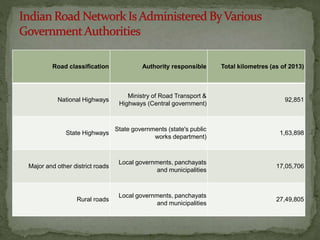
Indian Road Network is Administered 
by various Government authorities 
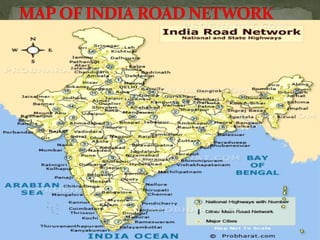
Map Of India Road Network 
Classification Of Roads 
National Highways In India(NH) 
Expressways In India 
State Highways In India (SH) 
Rural And Urban Roads 
Major District Roads 
Conclusion
 India has the second largest road network in the world. 
 3.314 million kms of roadways spread across the length and 
breadth of the country. 
 The roads are primarily made of bitumen, with some 
Indian National Highways having concrete roads. 
 The concept of expressway roads is also catching up in 
India, and the Mumbai-Pune expressway and Delhi 
Gurgaon expressway are the finest examples.
 The first evidence of road development in the Indian 
subcontinent can be traced back to approximately 4000 BC 
from the ancient cities of Harappa and Mohenjo-Daro of 
the Indus Valley Civilization
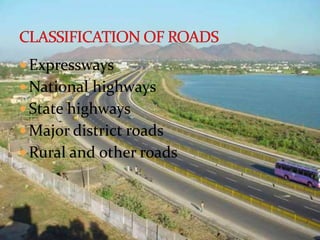
Expressways 
National highways 
 State highways 
Major district roads 
Rural and other roads
Road classification Authority responsible Total kilometres (as of 2013) 
National Highways 
Ministry of Road Transport & 
Highways (Central government) 
92,851 
State Highways 
State governments (state's public 
works department) 
1,63,898 
Major and other district roads 
Local governments, panchayats 
and municipalities 
17,05,706 
Rural roads 
Local governments, panchayats 
and municipalities 
27,49,805
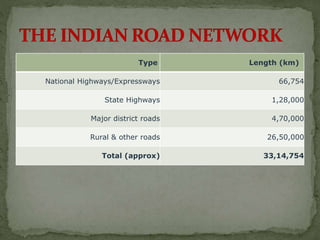
Type Length (km) 
National Highways/Expressways 66,754 
State Highways 1,28,000 
Major district roads 4,70,000 
Rural & other roads 26,50,000 
Total (approx) 33,14,754
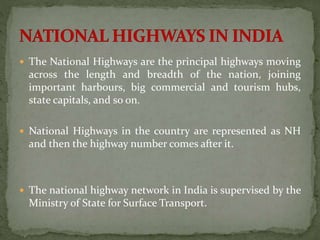
 The National Highways are the principal highways moving 
across the length and breadth of the nation, joining 
important harbours, big commercial and tourism hubs, 
state capitals, and so on. 
 National Highways in the country are represented as NH 
and then the highway number comes after it. 
 The national highway network in India is supervised by the 
Ministry of State for Surface Transport.
 The public works departments of various states 
look after the state roads and state highways. 
 The state and union governments have common 
responsibilities for constructing thoroughfares and 
sustaining the roadways in the country.
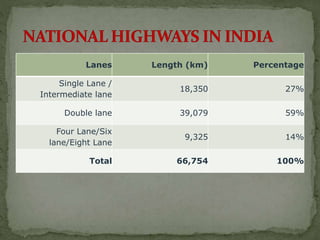
Lanes Length (km) Percentage 
Single Lane / 
Intermediate lane 
18,350 27% 
Double lane 39,079 59% 
Four Lane/Six 
lane/Eight Lane 
9,325 14% 
Total 66,754 100%
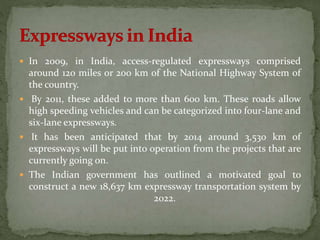
 In 2009, in India, access-regulated expressways comprised 
around 120 miles or 200 km of the National Highway System of 
the country. 
 By 2011, these added to more than 600 km. These roads allow 
high speeding vehicles and can be categorized into four-lane and 
six-lane expressways. 
 It has been anticipated that by 2014 around 3,530 km of 
expressways will be put into operation from the projects that are 
currently going on. 
 The Indian government has outlined a motivated goal to 
construct a new 18,637 km expressway transportation system by 
2022.
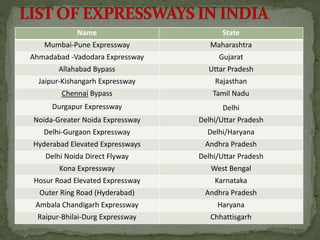
Name State 
Mumbai-Pune Expressway Maharashtra 
Ahmadabad -Vadodara Expressway Gujarat 
Allahabad Bypass Uttar Pradesh 
Jaipur-Kishangarh Expressway Rajasthan 
Chennai Bypass Tamil Nadu 
Durgapur Expressway Delhi 
Noida-Greater Noida Expressway Delhi/Uttar Pradesh 
Delhi-Gurgaon Expressway Delhi/Haryana 
Hyderabad Elevated Expressways Andhra Pradesh 
Delhi Noida Direct Flyway Delhi/Uttar Pradesh 
Kona Expressway West Bengal 
Hosur Road Elevated Expressway Karnataka 
Outer Ring Road (Hyderabad) Andhra Pradesh 
Ambala Chandigarh Expressway Haryana 
Raipur-Bhilai-Durg Expressway Chhattisgarh
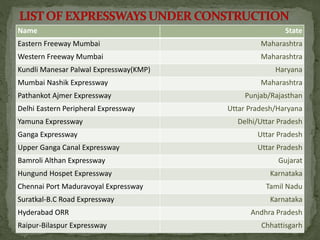
Name State 
Eastern Freeway Mumbai Maharashtra 
Western Freeway Mumbai Maharashtra 
Kundli Manesar Palwal Expressway(KMP) Haryana 
Mumbai Nashik Expressway Maharashtra 
Pathankot Ajmer Expressway Punjab/Rajasthan 
Delhi Eastern Peripheral Expressway Uttar Pradesh/Haryana 
Yamuna Expressway Delhi/Uttar Pradesh 
Ganga Expressway Uttar Pradesh 
Upper Ganga Canal Expressway Uttar Pradesh 
Bamroli Althan Expressway Gujarat 
Hungund Hospet Expressway Karnataka 
Chennai Port Maduravoyal Expressway Tamil Nadu 
Suratkal-B.C Road Expressway Karnataka 
Hyderabad ORR Andhra Pradesh 
Raipur-Bilaspur Expressway Chhattisgarh
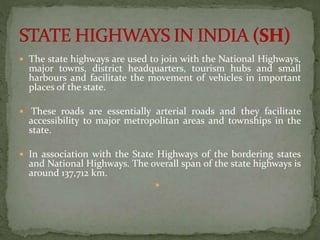
 The state highways are used to join with the National Highways, 
major towns, district headquarters, tourism hubs and small 
harbours and facilitate the movement of vehicles in important 
places of the state. 
 These roads are essentially arterial roads and they facilitate 
accessibility to major metropolitan areas and townships in the 
state. 
 In association with the State Highways of the bordering states 
and National Highways. The overall span of the state highways is 
around 137,712 km. 

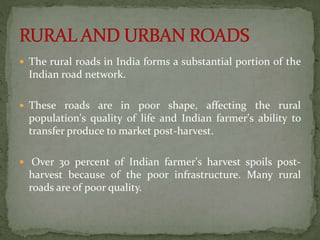
 The rural roads in India forms a substantial portion of the 
Indian road network. 
 These roads are in poor shape, affecting the rural 
population's quality of life and Indian farmer's ability to 
transfer produce to market post-harvest. 
 Over 30 percent of Indian farmer's harvest spoils post-harvest 
because of the poor infrastructure. Many rural 
roads are of poor quality.
Kilometers 
as of May 2013 
Kilometers 
under construction in 2013 
Total rural roads 3.1 million 0.1 million 
Unpaved rural roads 1.9 million 
Paved, maintained rural roads 728,871 53,634 
New rural roads 322,900 82,743
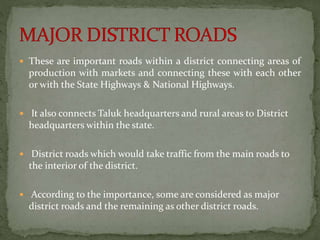
 These are important roads within a district connecting areas of 
production with markets and connecting these with each other 
or with the State Highways & National Highways. 
 It also connects Taluk headquarters and rural areas to District 
headquarters within the state. 
 District roads which would take traffic from the main roads to 
the interior of the district. 
 According to the importance, some are considered as major 
district roads and the remaining as other district roads.
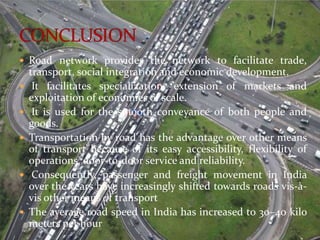
 Road network provides the network to facilitate trade, 
transport, social integration and economic development. 
 It facilitates specialization, extension of markets and 
exploitation of economies of scale. 
 It is used for the smooth conveyance of both people and 
goods. 
 Transportation by road has the advantage over other means 
of transport because of its easy accessibility, flexibility of 
operations, door-to-door service and reliability. 
 Consequently, passenger and freight movement in India 
over the years have increasingly shifted towards roads vis-à-vis 
other means of transport 
 The average road speed in India has increased to 30–40 kilo 
meters per hour
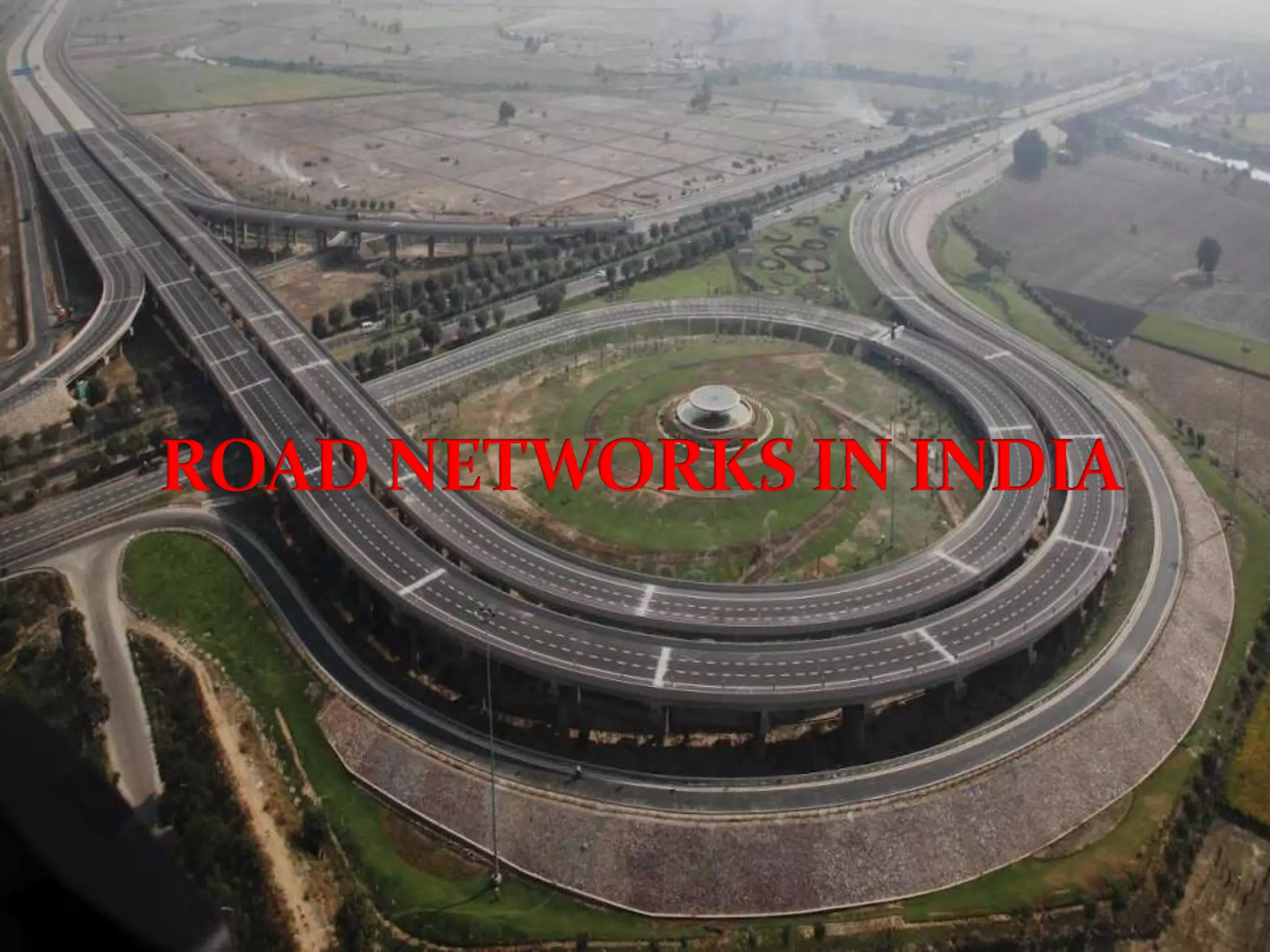
Road networks in india

Road networks in india

  • 2.
    CONTENT Introduction IndianRoad Network is Administered by various Government authorities Map Of India Road Network Classification Of Roads National Highways In India(NH) Expressways In India State Highways In India (SH) Rural And Urban Roads Major District Roads Conclusion
  • 3.
     India hasthe second largest road network in the world.  3.314 million kms of roadways spread across the length and breadth of the country.  The roads are primarily made of bitumen, with some Indian National Highways having concrete roads.  The concept of expressway roads is also catching up in India, and the Mumbai-Pune expressway and Delhi Gurgaon expressway are the finest examples.
  • 4.
     The firstevidence of road development in the Indian subcontinent can be traced back to approximately 4000 BC from the ancient cities of Harappa and Mohenjo-Daro of the Indus Valley Civilization
  • 5.
    Expressways National highways  State highways Major district roads Rural and other roads
  • 6.
    Road classification Authorityresponsible Total kilometres (as of 2013) National Highways Ministry of Road Transport & Highways (Central government) 92,851 State Highways State governments (state's public works department) 1,63,898 Major and other district roads Local governments, panchayats and municipalities 17,05,706 Rural roads Local governments, panchayats and municipalities 27,49,805
  • 8.
    Type Length (km) National Highways/Expressways 66,754 State Highways 1,28,000 Major district roads 4,70,000 Rural & other roads 26,50,000 Total (approx) 33,14,754
  • 9.
     The NationalHighways are the principal highways moving across the length and breadth of the nation, joining important harbours, big commercial and tourism hubs, state capitals, and so on.  National Highways in the country are represented as NH and then the highway number comes after it.  The national highway network in India is supervised by the Ministry of State for Surface Transport.
  • 10.
     The publicworks departments of various states look after the state roads and state highways.  The state and union governments have common responsibilities for constructing thoroughfares and sustaining the roadways in the country.
  • 11.
    Lanes Length (km)Percentage Single Lane / Intermediate lane 18,350 27% Double lane 39,079 59% Four Lane/Six lane/Eight Lane 9,325 14% Total 66,754 100%
  • 12.
     In 2009,in India, access-regulated expressways comprised around 120 miles or 200 km of the National Highway System of the country.  By 2011, these added to more than 600 km. These roads allow high speeding vehicles and can be categorized into four-lane and six-lane expressways.  It has been anticipated that by 2014 around 3,530 km of expressways will be put into operation from the projects that are currently going on.  The Indian government has outlined a motivated goal to construct a new 18,637 km expressway transportation system by 2022.
  • 13.
    Name State Mumbai-PuneExpressway Maharashtra Ahmadabad -Vadodara Expressway Gujarat Allahabad Bypass Uttar Pradesh Jaipur-Kishangarh Expressway Rajasthan Chennai Bypass Tamil Nadu Durgapur Expressway Delhi Noida-Greater Noida Expressway Delhi/Uttar Pradesh Delhi-Gurgaon Expressway Delhi/Haryana Hyderabad Elevated Expressways Andhra Pradesh Delhi Noida Direct Flyway Delhi/Uttar Pradesh Kona Expressway West Bengal Hosur Road Elevated Expressway Karnataka Outer Ring Road (Hyderabad) Andhra Pradesh Ambala Chandigarh Expressway Haryana Raipur-Bhilai-Durg Expressway Chhattisgarh
  • 14.
    Name State EasternFreeway Mumbai Maharashtra Western Freeway Mumbai Maharashtra Kundli Manesar Palwal Expressway(KMP) Haryana Mumbai Nashik Expressway Maharashtra Pathankot Ajmer Expressway Punjab/Rajasthan Delhi Eastern Peripheral Expressway Uttar Pradesh/Haryana Yamuna Expressway Delhi/Uttar Pradesh Ganga Expressway Uttar Pradesh Upper Ganga Canal Expressway Uttar Pradesh Bamroli Althan Expressway Gujarat Hungund Hospet Expressway Karnataka Chennai Port Maduravoyal Expressway Tamil Nadu Suratkal-B.C Road Expressway Karnataka Hyderabad ORR Andhra Pradesh Raipur-Bilaspur Expressway Chhattisgarh
  • 15.
     The statehighways are used to join with the National Highways, major towns, district headquarters, tourism hubs and small harbours and facilitate the movement of vehicles in important places of the state.  These roads are essentially arterial roads and they facilitate accessibility to major metropolitan areas and townships in the state.  In association with the State Highways of the bordering states and National Highways. The overall span of the state highways is around 137,712 km. 
  • 16.
     The ruralroads in India forms a substantial portion of the Indian road network.  These roads are in poor shape, affecting the rural population's quality of life and Indian farmer's ability to transfer produce to market post-harvest.  Over 30 percent of Indian farmer's harvest spoils post-harvest because of the poor infrastructure. Many rural roads are of poor quality.
  • 17.
    Kilometers as ofMay 2013 Kilometers under construction in 2013 Total rural roads 3.1 million 0.1 million Unpaved rural roads 1.9 million Paved, maintained rural roads 728,871 53,634 New rural roads 322,900 82,743
  • 18.
     These areimportant roads within a district connecting areas of production with markets and connecting these with each other or with the State Highways & National Highways.  It also connects Taluk headquarters and rural areas to District headquarters within the state.  District roads which would take traffic from the main roads to the interior of the district.  According to the importance, some are considered as major district roads and the remaining as other district roads.
  • 19.
     Road networkprovides the network to facilitate trade, transport, social integration and economic development.  It facilitates specialization, extension of markets and exploitation of economies of scale.  It is used for the smooth conveyance of both people and goods.  Transportation by road has the advantage over other means of transport because of its easy accessibility, flexibility of operations, door-to-door service and reliability.  Consequently, passenger and freight movement in India over the years have increasingly shifted towards roads vis-à-vis other means of transport  The average road speed in India has increased to 30–40 kilo meters per hour