Submitted to:-
Submitted by:-
Dhruv Agarwal
(12eeu014)
Ashu Gautam ma’am
About The Company…..
• Power System Operation Corporation Ltd (POSOCO) is a
wholly owned subsidiary of Power Grid Corporation of
India Ltd. POSOCO operates the Five Regional Load
Despatch Centres (RLDC) and the National Load Despatch
Centre (NLDC).
• RLDCs are responsible for carrying out real time operations
for grid control and despatch of electricity within the
region through secure and economic operation of the
regional grid in accordance with the Grid Standards and
the Grid Code.
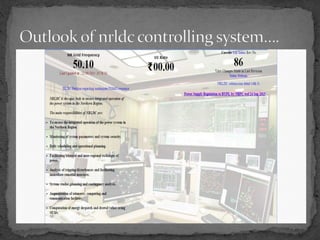
 To ensure the integrated operations of the power
system in northern region.
 Montoring of system parameters and system security.
 Daily scheduling and operational planning.
 Analysis of tripping/disturbances and facilitating
immediate remidial measures.
 System studies,planning and contigncy analysis.
 Computation of energy despatch and drawl values
using sems.
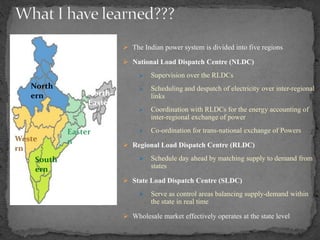
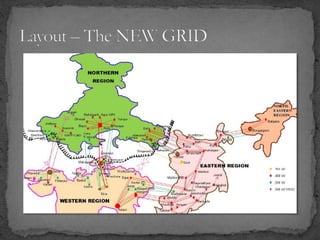
 The Indian power system is divided into five regions
 National Load Dispatch Centre (NLDC)
 Supervision over the RLDCs
 Scheduling and despatch of electricity over inter-regional
links
 Coordination with RLDCs for the energy accounting of
inter-regional exchange of power
 Co-ordination for trans-national exchange of Powers
 Regional Load Dispatch Centre (RLDC)
 Schedule day ahead by matching supply to demand from
states
 State Load Dispatch Centre (SLDC)
 Serve as control areas balancing supply-demand within
the state in real time
 Wholesale market effectively operates at the state level
Nort
hern
West
ern
Sout
hern
Easte
rn
Nort
h-
Easte
rn
North
ern
Weste
rn
South
ern
Easter
n
North-
Easter
n
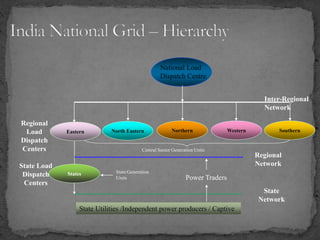
Regional
Load
Dispatch
Centers
Eastern
National Load
Dispatch Centre
North Eastern Northern Western Southern
States
Central Sector Generation Units
Power Traders
State
Network
Regional
Network
Inter-Regional
Network
State Utilities /Independent power producers / Captive
State Load
Dispatch
Centers
State Generation
Units
Load curves
SLDC 2
SLDC 1
RLDC
Currently State
Electricity Boards
(SEBs) operate as
SLDCs
Load curves
Central
Generating
Stations (CGS)
State
Generation
Stations
Inter-state open access
Customers (Power
Exchange/ Bilateral
Contracts)
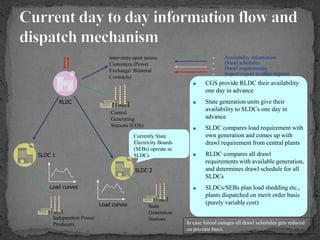
■ CGS provide RLDC their availability
one day in advance
■ State generation units give their
availability to SLDCs one day in
advance
■ SLDC compares load requirement with
own generation and comes up with
drawl requirement from central plants
■ RLDC compares all drawl
requirements with available generation,
and determines drawl schedule for all
SLDCs
■ SLDCs/SEBs plan load shedding etc.,
plants dispatched on merit order basis
(purely variable cost)
In case forced outages all drawl schedules gets reduced
on pro-rate basis.
■ Import/export to other regions
■ Availability information
■ Drawl schedules
■ Drawl requirements
Independent Power
Producers
 The power generating stations are hooked onto an
interconnected network of transmission lines and
substations.
 These generating stations supply electricity through these
transmission lines.
 The companies responsible for distribution take the power
coming through these lines and forward it to the
consumers.
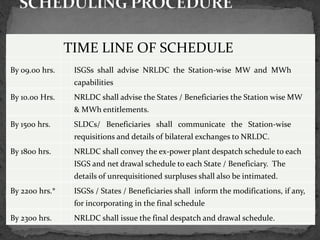
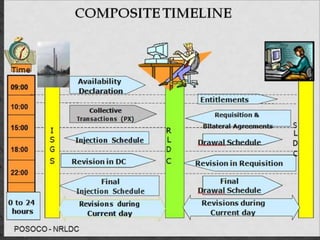
TIME LINE OF SCHEDULE
By 09.00 hrs. ISGSs shall advise NRLDC the Station-wise MW and MWh
capabilities
By 10.00 Hrs. NRLDC shall advise the States / Beneficiaries the Station wise MW
& MWh entitlements.
By 1500 hrs. SLDCs/ Beneficiaries shall communicate the Station-wise
requisitions and details of bilateral exchanges to NRLDC.
By 1800 hrs. NRLDC shall convey the ex-power plant despatch schedule to each
ISGS and net drawal schedule to each State / Beneficiary. The
details of unrequisitioned surpluses shall also be intimated.
By 2200 hrs.* ISGSs / States / Beneficiaries shall inform the modifications, if any,
for incorporating in the final schedule
By 2300 hrs. NRLDC shall issue the final despatch and drawal schedule.

0
100
200
300
400
500
600
700
800
900
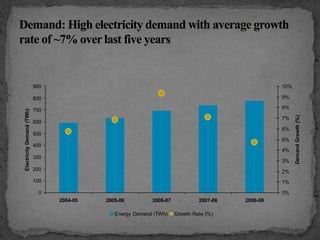
2004-05 2005-06 2006-07 2007-08 2008-09
ElectricityDemand(TWh)
0%
1%
2%
3%
4%
5%
6%
7%
8%
9%
10%
DemandGrowth(%)
Energy Demand (TWh) Growth Rate (%)
0
10,000
20,000
30,000
40,000
50,000
60,000
70,000
80,000
90,000
Target
Acheivement
Target
Acheivement
Target
Acheivement
Target
Acheivement*
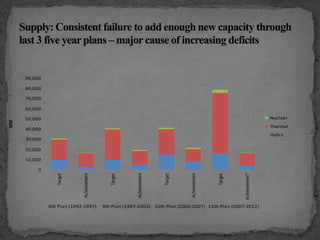
8th Plan (1992-1997) 9th Plan (1997-2002) 10th Plan (2002-2007) 11th Plan (2007-2012)
MW
Nuclear
Thermal
Hydro
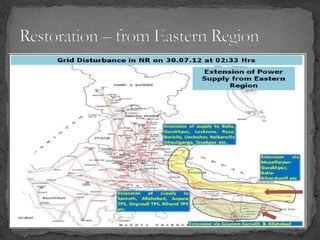
 Grids collapse due to two basic reasons:
 One is the failure of the equipment, like it happened a decade ago in
2002 when the northern grid collapsed
 The second trigger is power suppliers drawing excessive power from
the grid which results in the balance of power generation and supply
goes haywire with a cascading effect
 There are various reasons why an excessive withdrawal of power happens:
 Weather phenomenon and change in sudden climate is one reason
 Unreliable demand forecasting, etc.
 Northern states of India, like Uttar Pradesh, Punjab, Haryana and Jammu
Kashmir, have been found to be habitual violators
 Presence of heavy industries and fast growing cities has necessitated
the need for more power. But the production has not been able to cope
up with the required distribution.
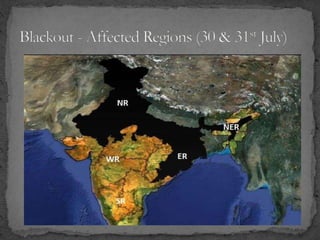
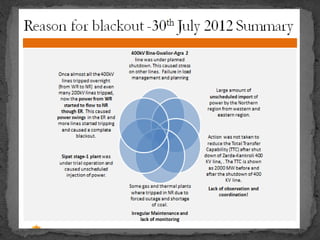
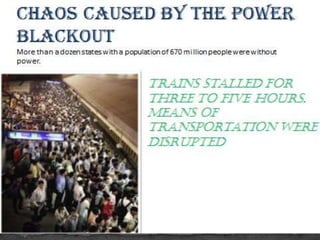
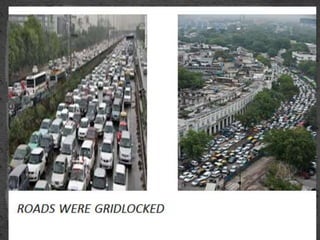
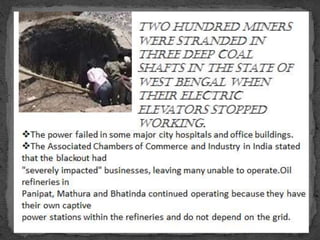
 The July 2012 India blackout was the largest power
outage in India, occurring as two separate
 events on 30 and 31 July 2012. The outage affected
over 620 million people, about 9% of
 the world population. An estimated 32 giga watts of
generating capacity was taken offline in the outage.
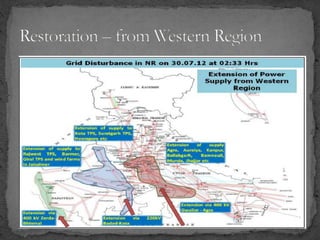
 The Black out happened exactly at time – 2.33am . This
affected 8 states and 1 U.T (Rajasthan, Haryana, New
Delhi, J&K, Punjab, U.P, Himachal Pradesh, Uttrakhand
and Chandigarh
Power system operation corporation ltd (posoco)

Power system operation corporation ltd (posoco)

  • 1.
    Submitted to:- Submitted by:- DhruvAgarwal (12eeu014) Ashu Gautam ma’am
  • 2.
    About The Company….. •Power System Operation Corporation Ltd (POSOCO) is a wholly owned subsidiary of Power Grid Corporation of India Ltd. POSOCO operates the Five Regional Load Despatch Centres (RLDC) and the National Load Despatch Centre (NLDC). • RLDCs are responsible for carrying out real time operations for grid control and despatch of electricity within the region through secure and economic operation of the regional grid in accordance with the Grid Standards and the Grid Code.
  • 3.
     To ensurethe integrated operations of the power system in northern region.  Montoring of system parameters and system security.  Daily scheduling and operational planning.  Analysis of tripping/disturbances and facilitating immediate remidial measures.  System studies,planning and contigncy analysis.  Computation of energy despatch and drawl values using sems.
  • 7.
     The Indianpower system is divided into five regions  National Load Dispatch Centre (NLDC)  Supervision over the RLDCs  Scheduling and despatch of electricity over inter-regional links  Coordination with RLDCs for the energy accounting of inter-regional exchange of power  Co-ordination for trans-national exchange of Powers  Regional Load Dispatch Centre (RLDC)  Schedule day ahead by matching supply to demand from states  State Load Dispatch Centre (SLDC)  Serve as control areas balancing supply-demand within the state in real time  Wholesale market effectively operates at the state level Nort hern West ern Sout hern Easte rn Nort h- Easte rn North ern Weste rn South ern Easter n North- Easter n
  • 8.
    Regional Load Dispatch Centers Eastern National Load Dispatch Centre NorthEastern Northern Western Southern States Central Sector Generation Units Power Traders State Network Regional Network Inter-Regional Network State Utilities /Independent power producers / Captive State Load Dispatch Centers State Generation Units
  • 9.
    Load curves SLDC 2 SLDC1 RLDC Currently State Electricity Boards (SEBs) operate as SLDCs Load curves Central Generating Stations (CGS) State Generation Stations Inter-state open access Customers (Power Exchange/ Bilateral Contracts) ■ CGS provide RLDC their availability one day in advance ■ State generation units give their availability to SLDCs one day in advance ■ SLDC compares load requirement with own generation and comes up with drawl requirement from central plants ■ RLDC compares all drawl requirements with available generation, and determines drawl schedule for all SLDCs ■ SLDCs/SEBs plan load shedding etc., plants dispatched on merit order basis (purely variable cost) In case forced outages all drawl schedules gets reduced on pro-rate basis. ■ Import/export to other regions ■ Availability information ■ Drawl schedules ■ Drawl requirements Independent Power Producers
  • 11.
     The powergenerating stations are hooked onto an interconnected network of transmission lines and substations.  These generating stations supply electricity through these transmission lines.  The companies responsible for distribution take the power coming through these lines and forward it to the consumers.
  • 12.
    TIME LINE OFSCHEDULE By 09.00 hrs. ISGSs shall advise NRLDC the Station-wise MW and MWh capabilities By 10.00 Hrs. NRLDC shall advise the States / Beneficiaries the Station wise MW & MWh entitlements. By 1500 hrs. SLDCs/ Beneficiaries shall communicate the Station-wise requisitions and details of bilateral exchanges to NRLDC. By 1800 hrs. NRLDC shall convey the ex-power plant despatch schedule to each ISGS and net drawal schedule to each State / Beneficiary. The details of unrequisitioned surpluses shall also be intimated. By 2200 hrs.* ISGSs / States / Beneficiaries shall inform the modifications, if any, for incorporating in the final schedule By 2300 hrs. NRLDC shall issue the final despatch and drawal schedule.
  • 13.
  • 14.
    0 100 200 300 400 500 600 700 800 900 2004-05 2005-06 2006-072007-08 2008-09 ElectricityDemand(TWh) 0% 1% 2% 3% 4% 5% 6% 7% 8% 9% 10% DemandGrowth(%) Energy Demand (TWh) Growth Rate (%)
  • 15.
  • 16.
     Grids collapsedue to two basic reasons:  One is the failure of the equipment, like it happened a decade ago in 2002 when the northern grid collapsed  The second trigger is power suppliers drawing excessive power from the grid which results in the balance of power generation and supply goes haywire with a cascading effect  There are various reasons why an excessive withdrawal of power happens:  Weather phenomenon and change in sudden climate is one reason  Unreliable demand forecasting, etc.  Northern states of India, like Uttar Pradesh, Punjab, Haryana and Jammu Kashmir, have been found to be habitual violators  Presence of heavy industries and fast growing cities has necessitated the need for more power. But the production has not been able to cope up with the required distribution.
  • 18.
     The July2012 India blackout was the largest power outage in India, occurring as two separate  events on 30 and 31 July 2012. The outage affected over 620 million people, about 9% of  the world population. An estimated 32 giga watts of generating capacity was taken offline in the outage.  The Black out happened exactly at time – 2.33am . This affected 8 states and 1 U.T (Rajasthan, Haryana, New Delhi, J&K, Punjab, U.P, Himachal Pradesh, Uttrakhand and Chandigarh