RESTRUCTURING AND DEREGULATION OF
INDIAN POWER SECTOR
PRESENTED BY-
ANKUR MAHESHWARI
M.TECH
NIT HAMIRPUR
Contents
• Power generation in India at a glance.
• Power map of India.
• Distribution system of India .
• Different electricity acts of India .
• Main events of 2003 electricity act.
• Main features of electricity act 2003.
• Restructuring of Orissa , Delhi and Andhra Pradesh.
• Problems in Indian Power Sector.
• References
• Conclusion
Introduction about India
India is the largest democratic country in the world.
India is the seventh-largest country in terms of total geographical
area (3,287,263 sq.km) which is 2.4 % of world total area.
India is the second-most populous country in the world (over
1.27billion) after china.
Largest state in terms of area is Rajasthan( 3,42,239 sq.km) and in
terms of population is U.P ( 215,608,813)
Total installed capacity is 3,30,861 MW (as on 31/03/2018),
which is world’s third largest.
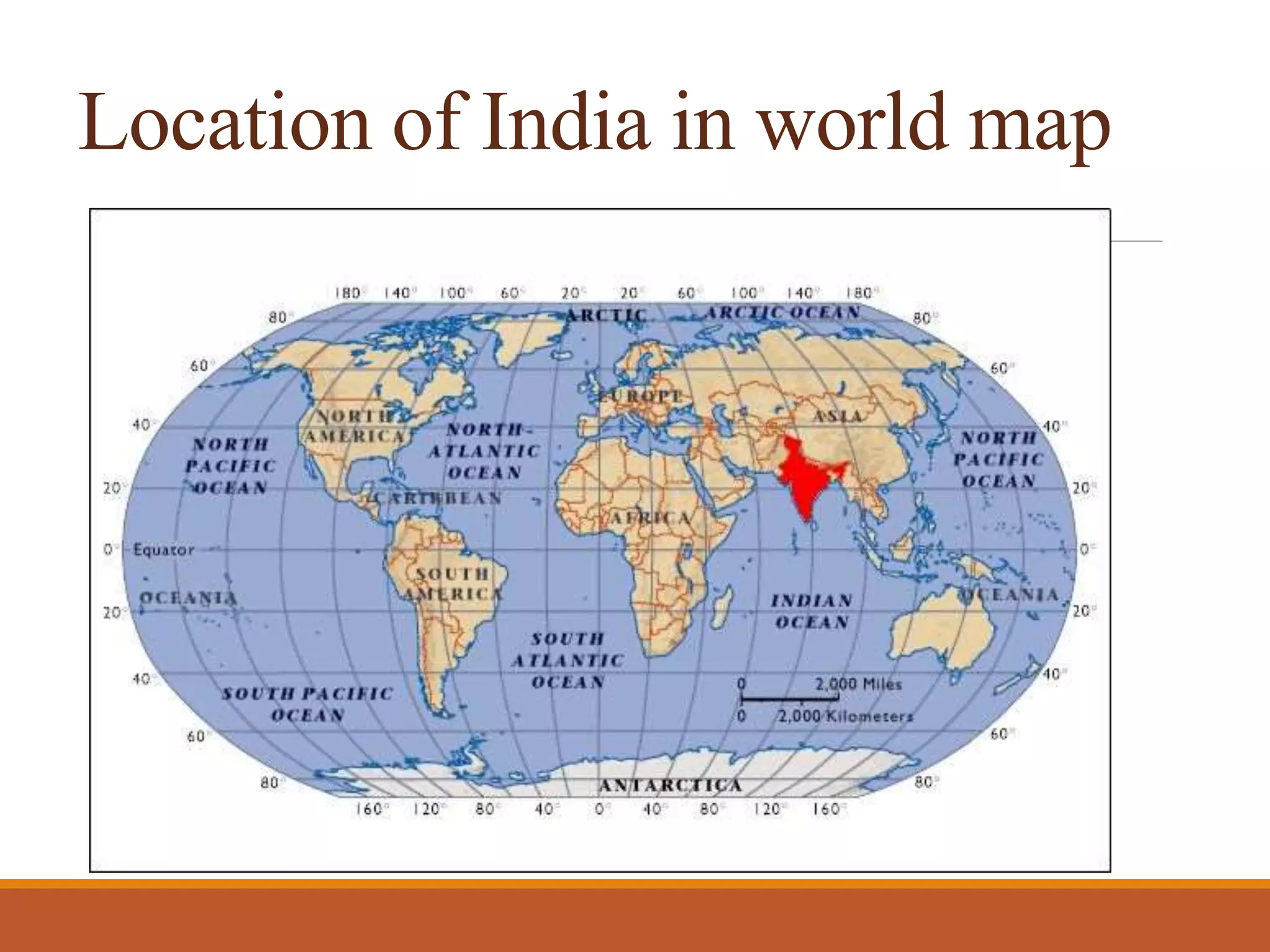
Location of India in world map
MAP OF INDIA
HISTORY
The first demonstration of electric light in Calcutta was conducted
on 24 July 1879 by P W Fleury & Co.
On 7 January 1897, Kilburn & Co secured the Calcutta electric
lighting licence as agents of the Indian Electric Co, which was
registered in London on 15 January 1897.
A month later, the company was renamed the Calcutta Electric
Supply Corporation. The control of the company was transferred
from London to Calcutta in 1970.
Motivated by the success of electricity in Calcutta, power was
thereafter introduced in Bombay.
History Cont……….
Mumbai saw electric lighting demonstration for the first
time in 1882 at Crawford Market and Bombay Electric
Supply & Tramways Company (BEST) set up a generating
station in 1905 to provide electricity for the tramway.
The first hydroelectric installation in India was installed near
a tea estate at Sidrapong for the Darjeeling Municipality in
1897.
The first electric streetlight in Asia was lit on 5 August 1905
in Bangalore.
The first electric train ran between Bombay's Victoria
Terminus and Kurla on 3, February 1925.
History Cont……….
On 18 August 2015, Cochin International
Airport became the world's first fully solar
powered airport with the inauguration of a
dedicated solar plant.
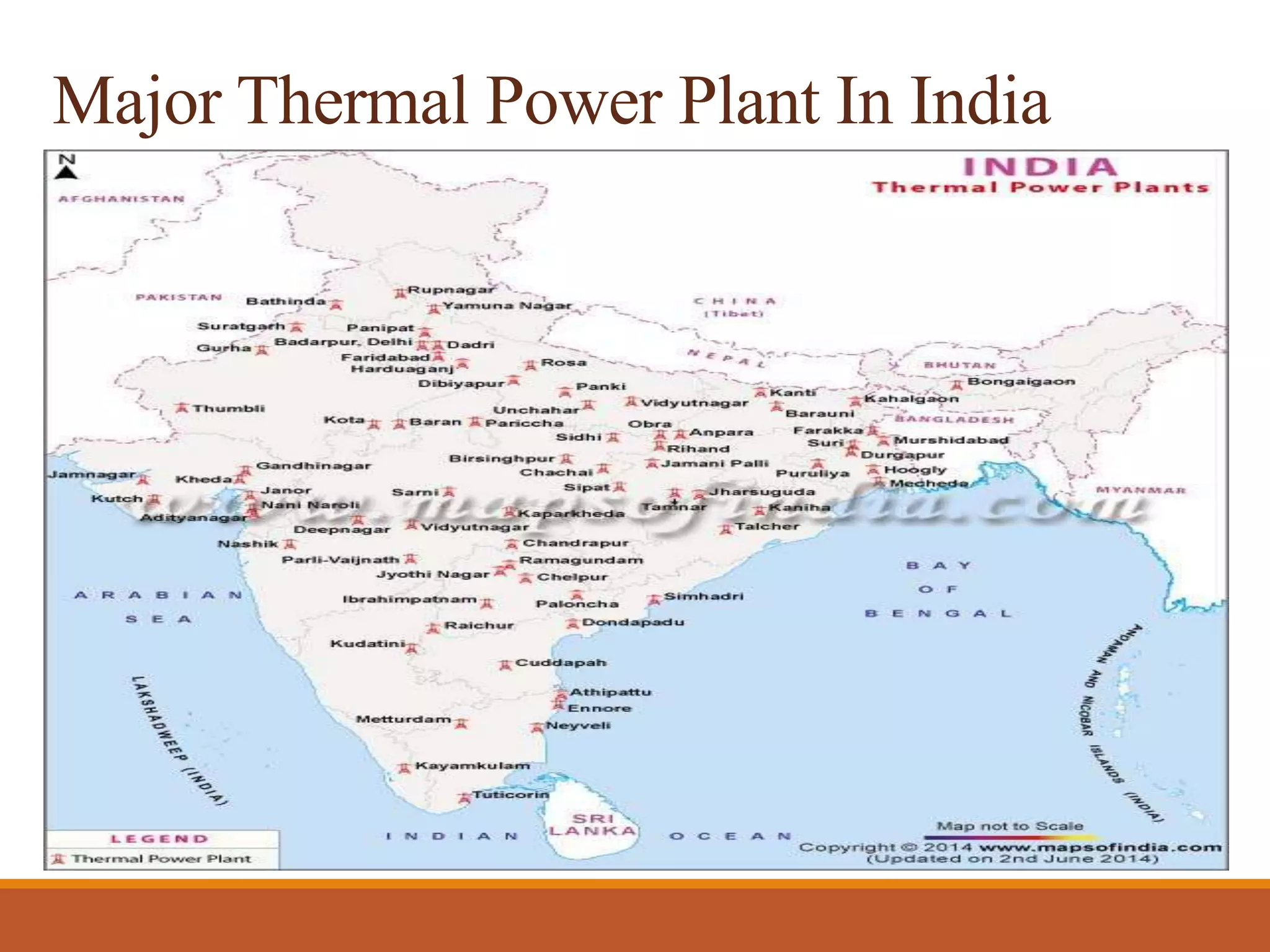
Major Thermal Power Plant In India
Major Hydro Power Plant In India
Major Nuclear Power Plant In India
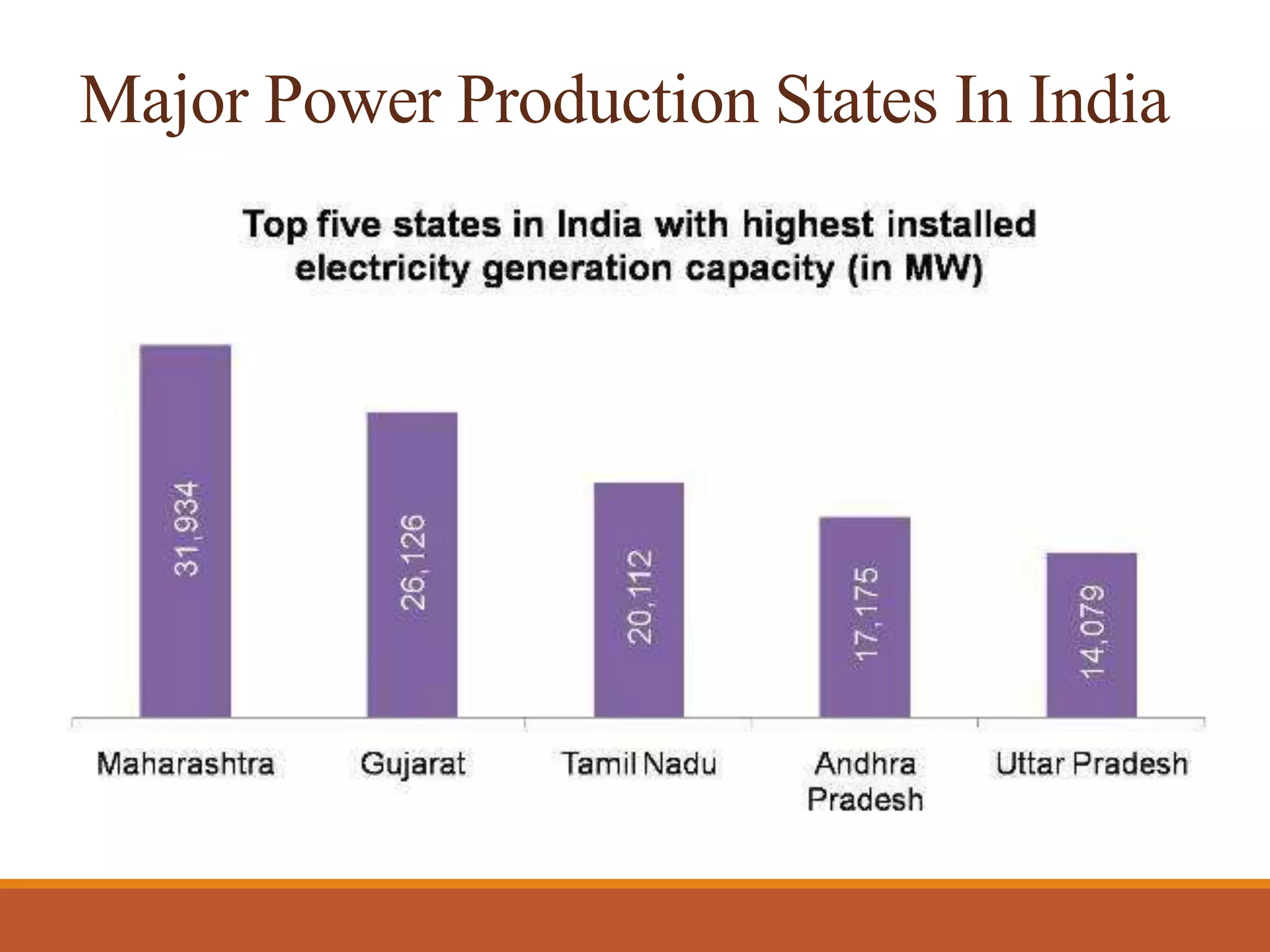
Major Power Production States In India
Top Five States in India with Highest
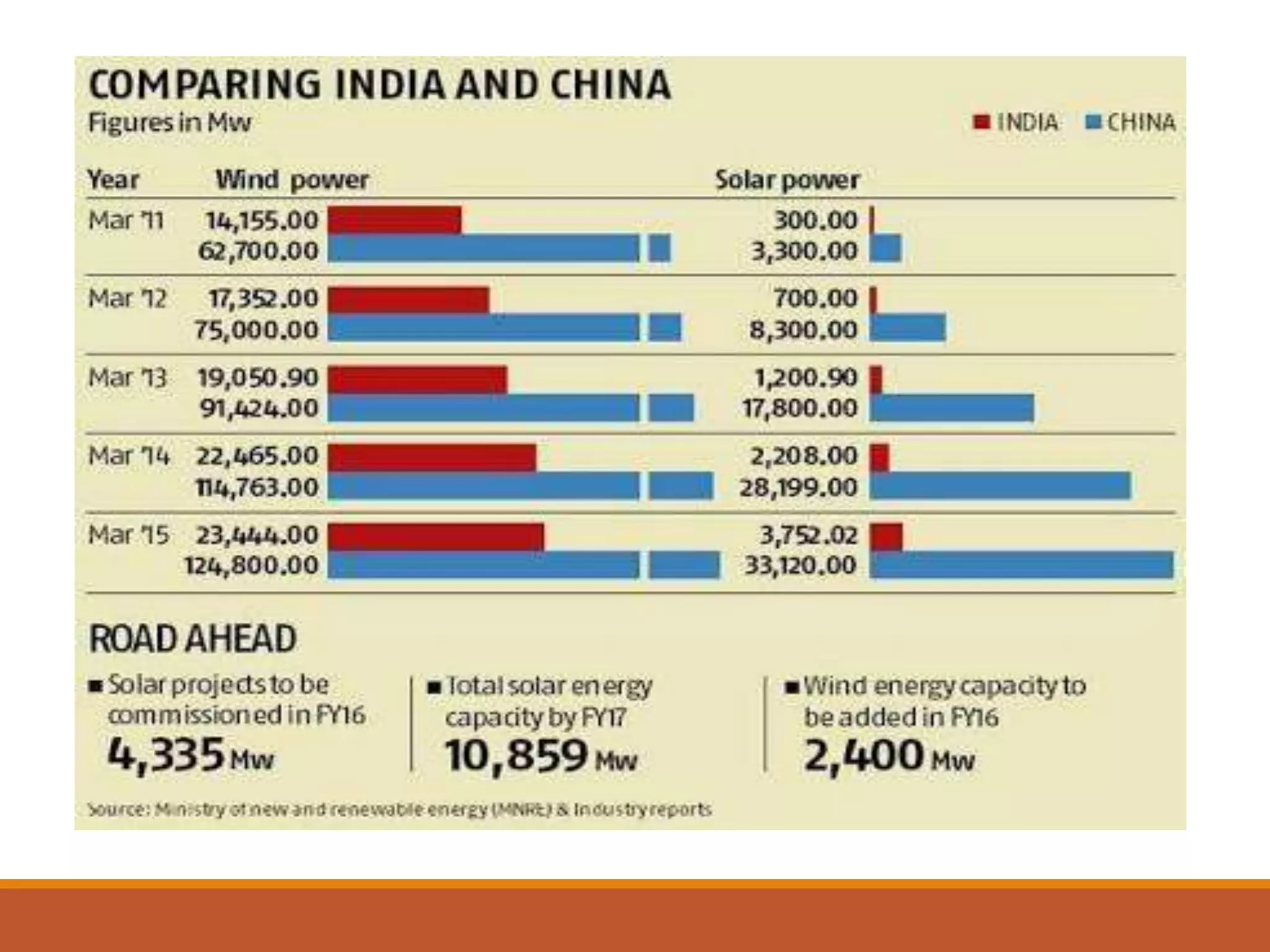
Renewable Energy Capacity
Indian Energy Mix
Renewable energy jumped to 16% of India's energy
mix. The country’s total installed generation
capacity is 3,30,861 MW with renewables
accounting for 50,745 MW of it.
Currently, on an average, the country is adding
1,000 Mw of solar power annually.
The Union ministry of new & renewable energy
pegs the annual growth of solar power at 15,000
Mw.
Indian Power Sector at a Glance
Continued…….
Projected Future Demand
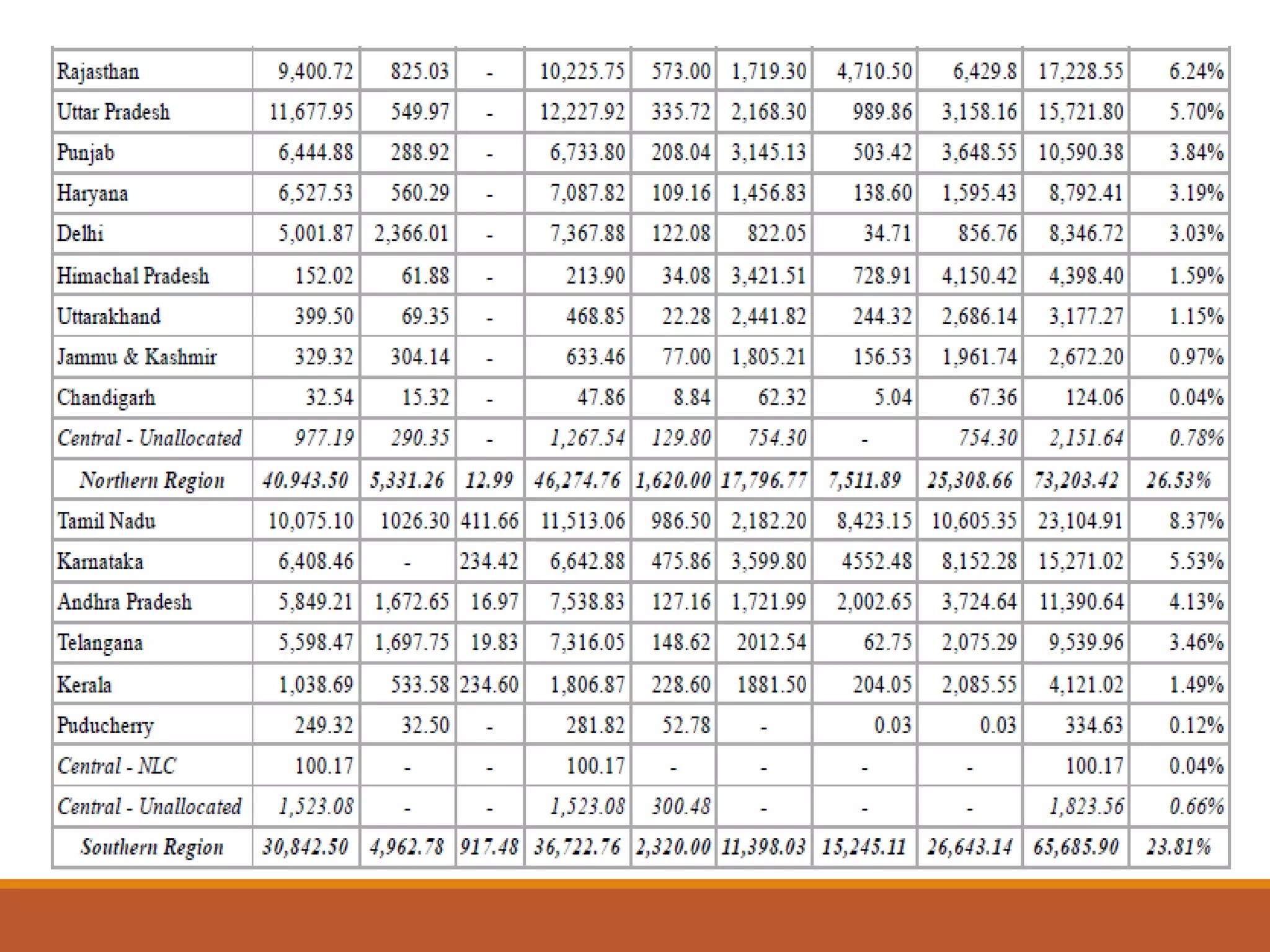
State Wise All India Installed Capacity
State Wise Pricing Of Power Sector in 12th
five year plan
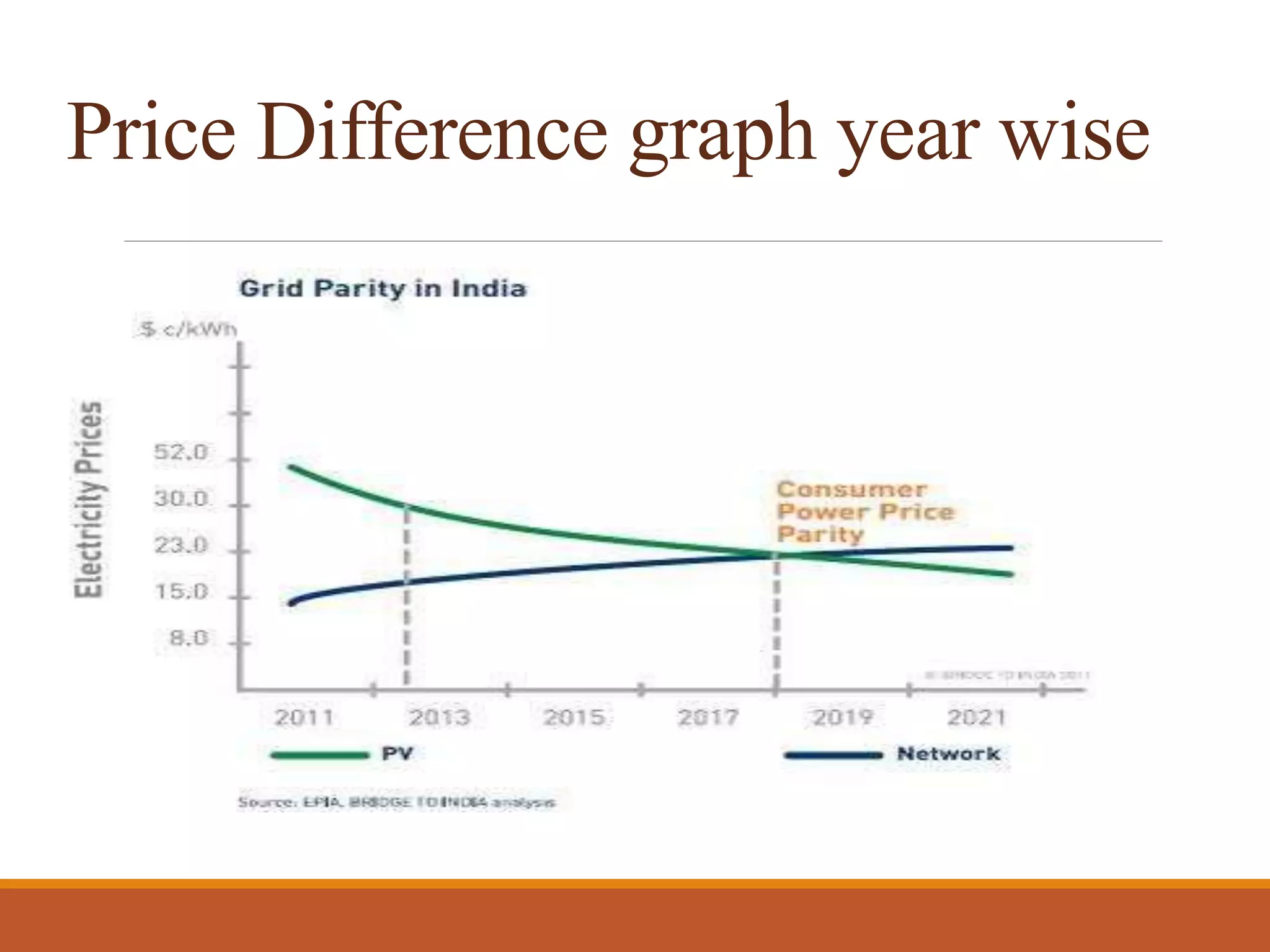
Price Difference graph year wise
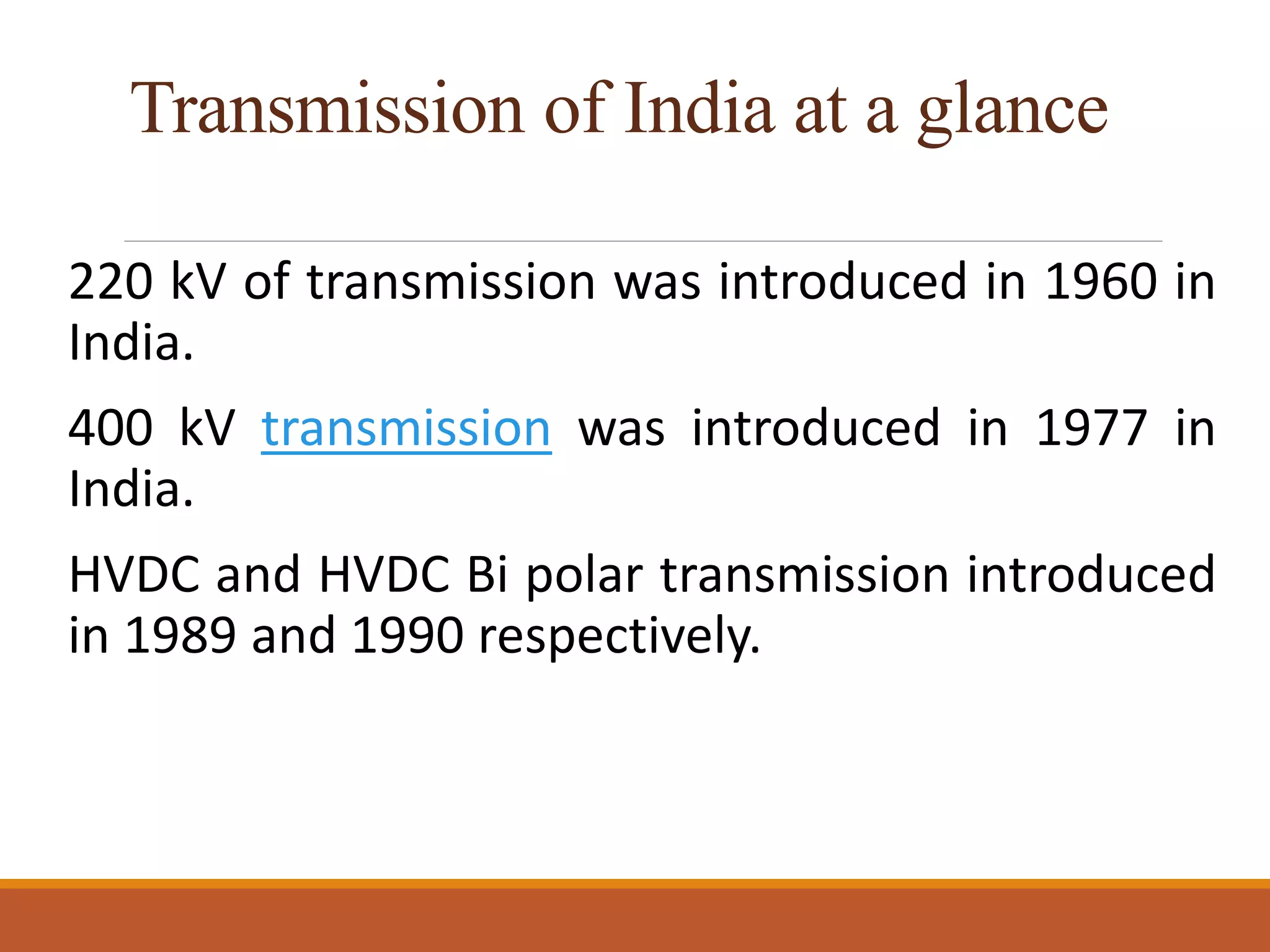
Transmission of India at a glance
220 kV of transmission was introduced in 1960 in
India.
400 kV transmission was introduced in 1977 in
India.
HVDC and HVDC Bi polar transmission introduced
in 1989 and 1990 respectively.
Transmission system at a glance
Power Grid Corporation of India Limited (POWERGRID, a 'Navratna'
Company operating under Ministry of Power, is engaged in power
transmission business with the responsibility for planning,
implementation, operation and maintenance of inter-State
transmission system and operation of National & Regional Power
Grids.
POWERGRID is a listed Company, with 57.90% holding of
Government of India and balance by Institutional Investors &
public.
POWERGRID has been implementing various transmission projects
for generation capacity addition under central sector, Ultra Mega
Power Projects (UMPPs), Independent Power Producers (IPPs) and
other projects.
Transmission continued……
POWERGRID has taken leadership initiative for
development of Smart Grid technology in the country
integrating all segments in power supply chain.
In Distribution system, POWERGRID jointly with Govt. of
Pondicherry has developed a Consumer-utility interactive
Pilot Smart Grid/ City project in Pondicherry through open
collaboration with more than 70 organizations &
academic institutions.
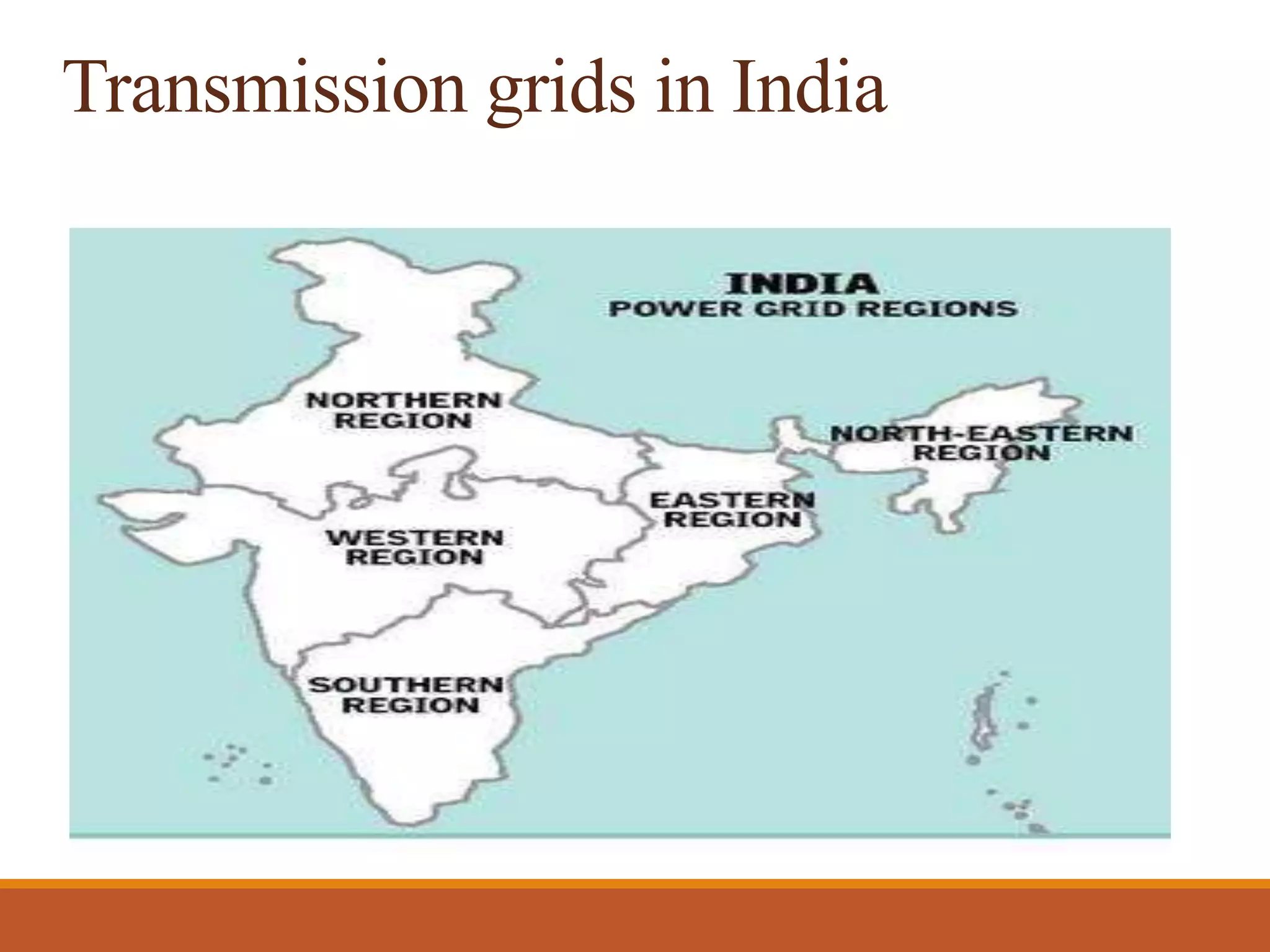
Transmission grids in India
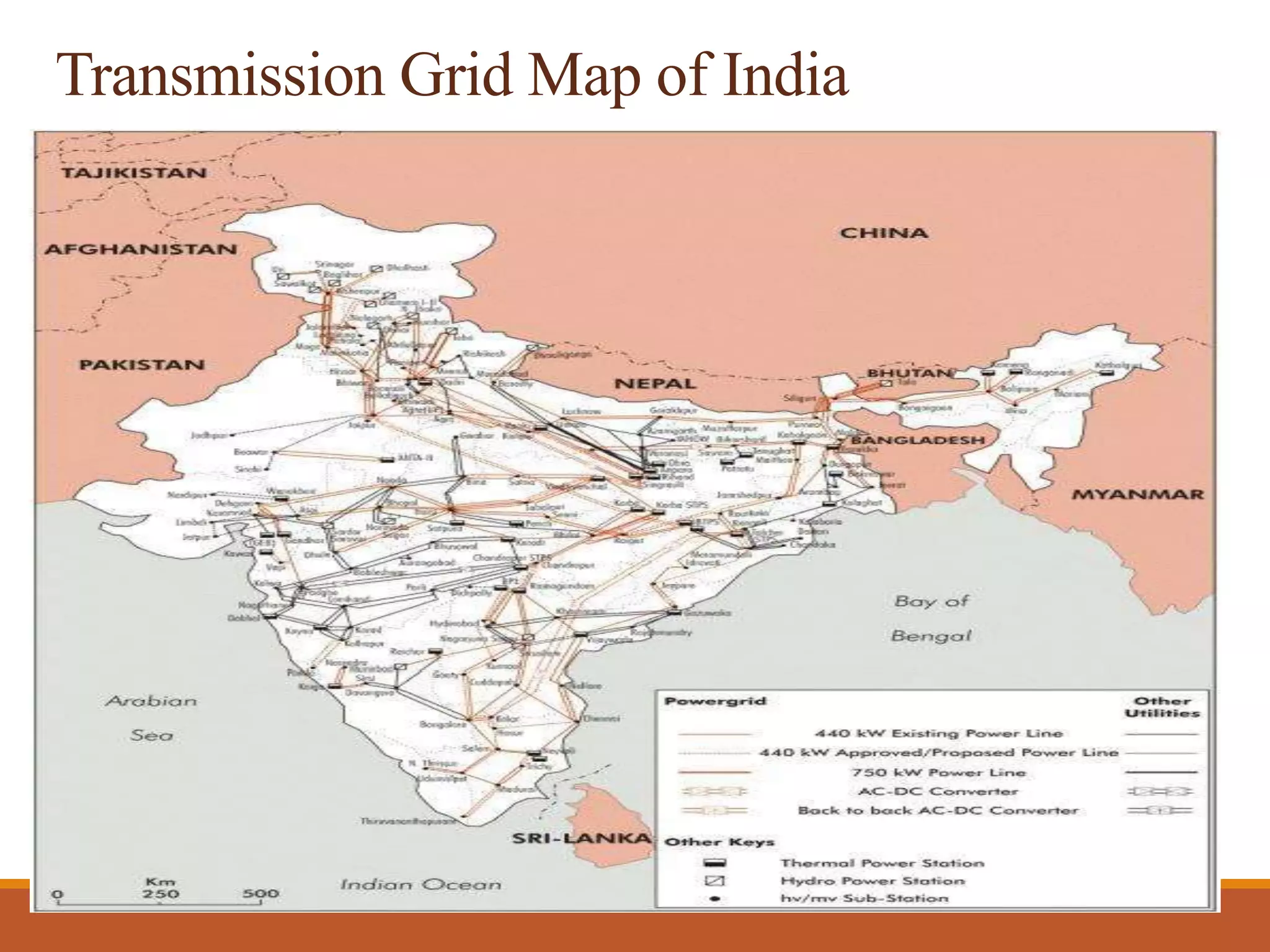
Transmission Grid Map of India
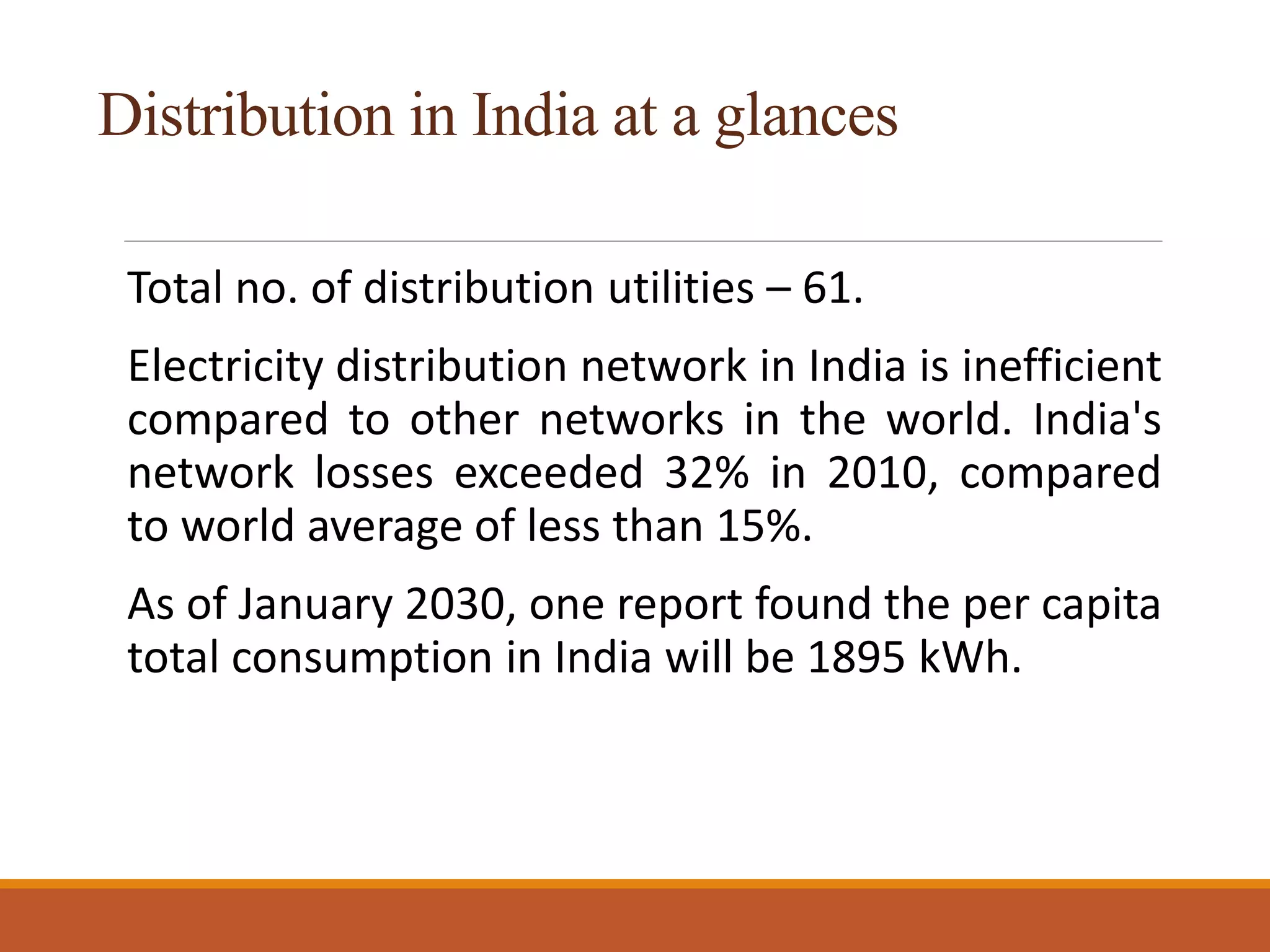
Distribution in India at a glances
Total no. of distribution utilities – 61.
Electricity distribution network in India is inefficient
compared to other networks in the world. India's
network losses exceeded 32% in 2010, compared
to world average of less than 15%.
As of January 2030, one report found the per capita
total consumption in India will be 1895 kWh.
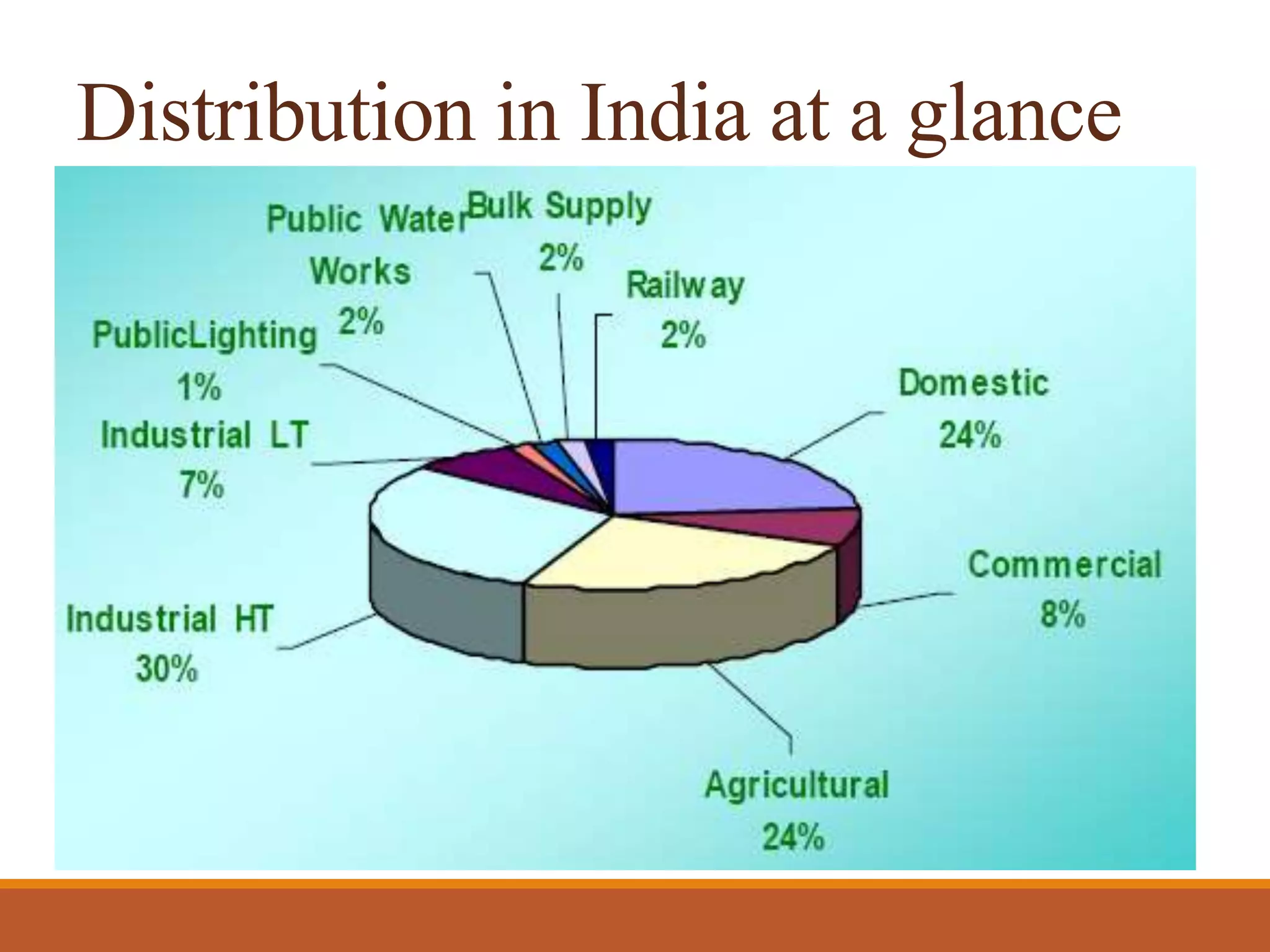
Distribution in India at a glance
Company Business description
• Power Finance Corporation Limited (PFC) is an NBFC engaged in financing and development activities within
the Indian power sector
• Major products and services include project term loans, lease financing, direct discounting of bills, short-term
loans and consultancy services
• Adani Power is one of India’s largest private thermal power producers, with total capacity of 4,620 MW; the
company aims to generate 20,000 MW of power by 2020
• The company is building one of the world’s largest single-location thermal power plants in Mundra, Gujarat
• Power Grid Corporation of India Limited (PGCIL) is the single largest transmission utility in India; it is
responsible for planning, co-ordination, supervision and control over inter-state transmission systems
• Damodar Valley Corporation is engaged in power generation, distribution and transmission of electric power,
irrigation and flood control
• SJVN Limited is the second largest hydro power company in India
• The company plans to diversify into wind power projects soon
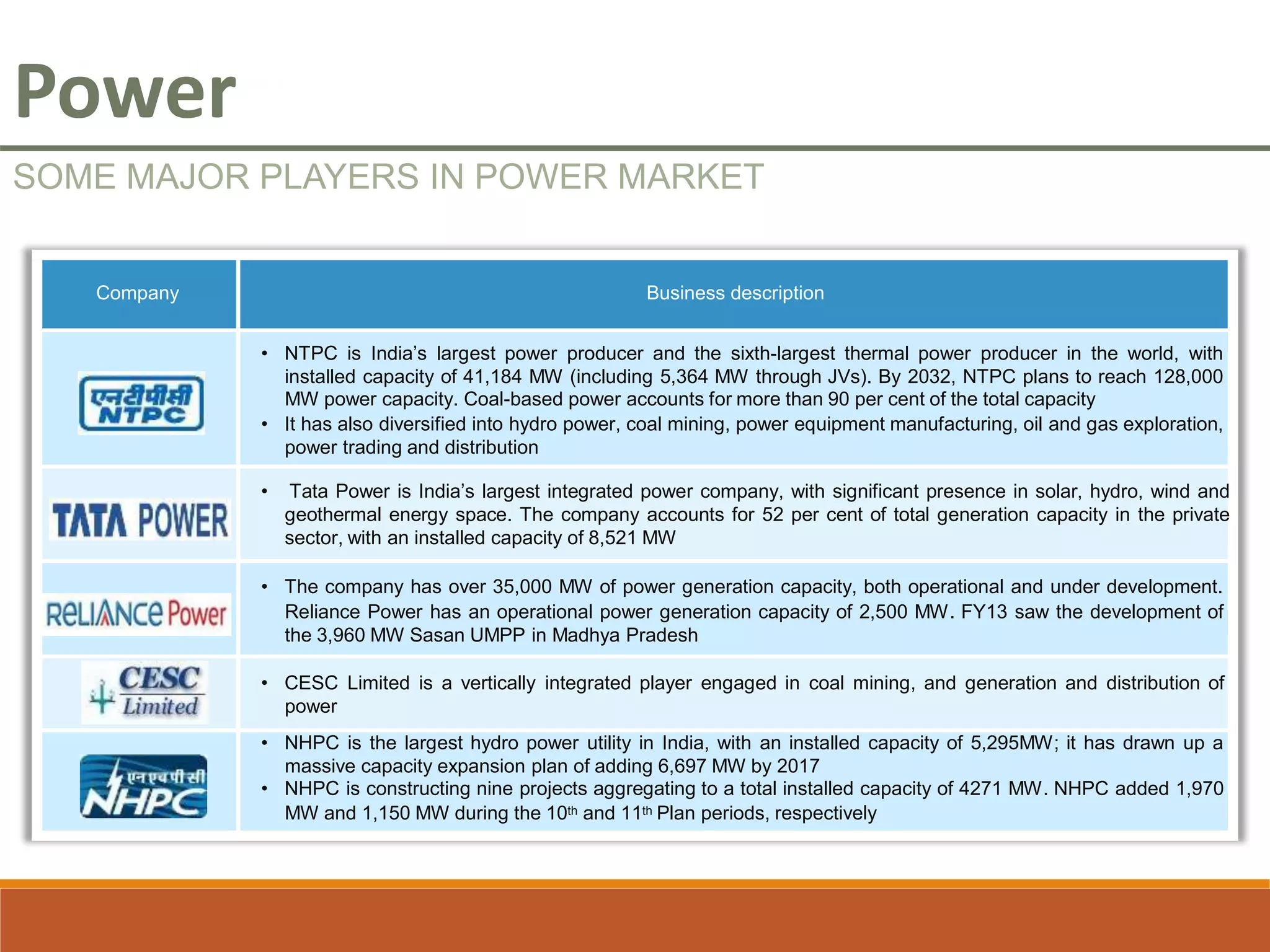
Power
SOME MAJOR PLAYERS IN POWER MARKET
Company Business description
• NTPC is India’s largest power producer and the sixth-largest thermal power producer in the world, with
installed capacity of 41,184 MW (including 5,364 MW through JVs). By 2032, NTPC plans to reach 128,000
MW power capacity. Coal-based power accounts for more than 90 per cent of the total capacity
• It has also diversified into hydro power, coal mining, power equipment manufacturing, oil and gas exploration,
power trading and distribution
• Tata Power is India’s largest integrated power company, with significant presence in solar, hydro, wind and
geothermal energy space. The company accounts for 52 per cent of total generation capacity in the private
sector, with an installed capacity of 8,521 MW
• The company has over 35,000 MW of power generation capacity, both operational and under development.
Reliance Power has an operational power generation capacity of 2,500 MW. FY13 saw the development of
the 3,960 MW Sasan UMPP in Madhya Pradesh
• CESC Limited is a vertically integrated player engaged in coal mining, and generation and distribution of
power
• NHPC is the largest hydro power utility in India, with an installed capacity of 5,295MW; it has drawn up a
massive capacity expansion plan of adding 6,697 MW by 2017
• NHPC is constructing nine projects aggregating to a total installed capacity of 4271 MW. NHPC added 1,970
MW and 1,150 MW during the 10th and 11th Plan periods, respectively
Power
SOME MAJOR PLAYERS IN POWER MARKET
Private utilities for distribution in India
• Reliance energy limited (about 6 million consumers)
•Calcutta Electricity Supply company (about 2.5 million
consumer)
•Tata power company (about 2 million consumers)
•Ahmedabad electricity supply company (about 1.3 million
consumers)
•Torrent power ltd.
Basic restructured power system
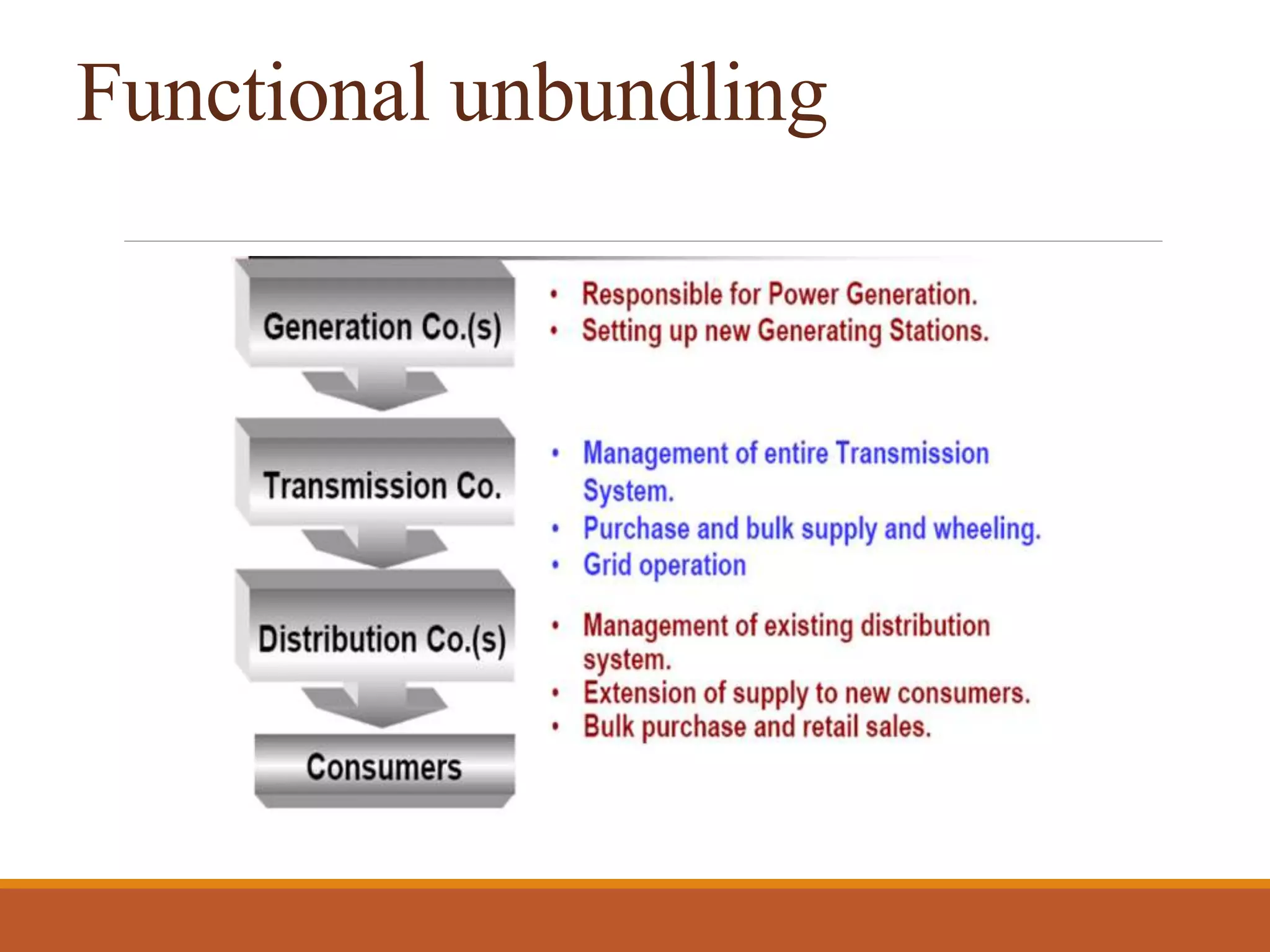
Functional unbundling
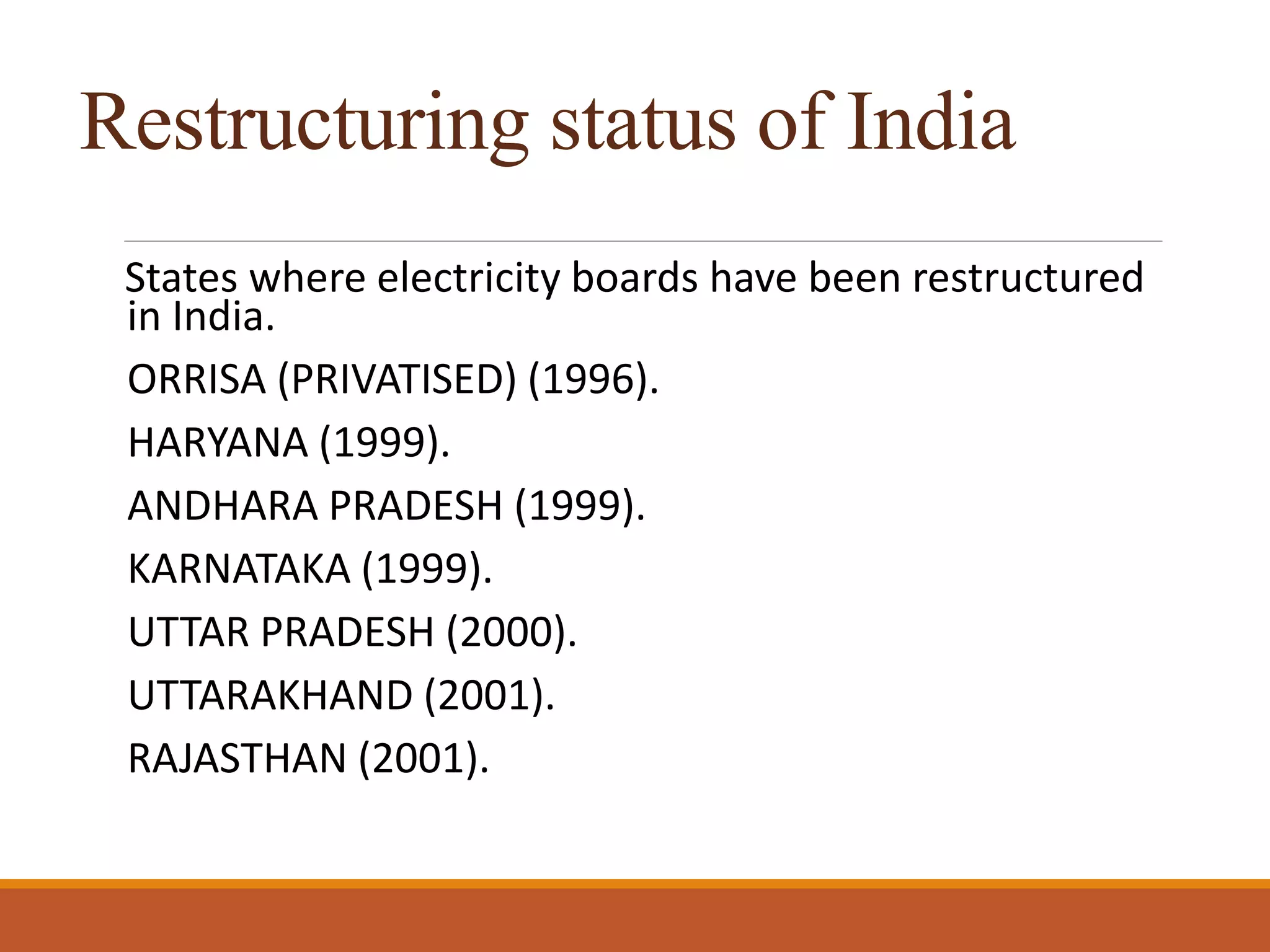
Restructuring status of India
States where electricity boards have been restructured
in India.
ORRISA (PRIVATISED) (1996).
HARYANA (1999).
ANDHARA PRADESH (1999).
KARNATAKA (1999).
UTTAR PRADESH (2000).
UTTARAKHAND (2001).
RAJASTHAN (2001).
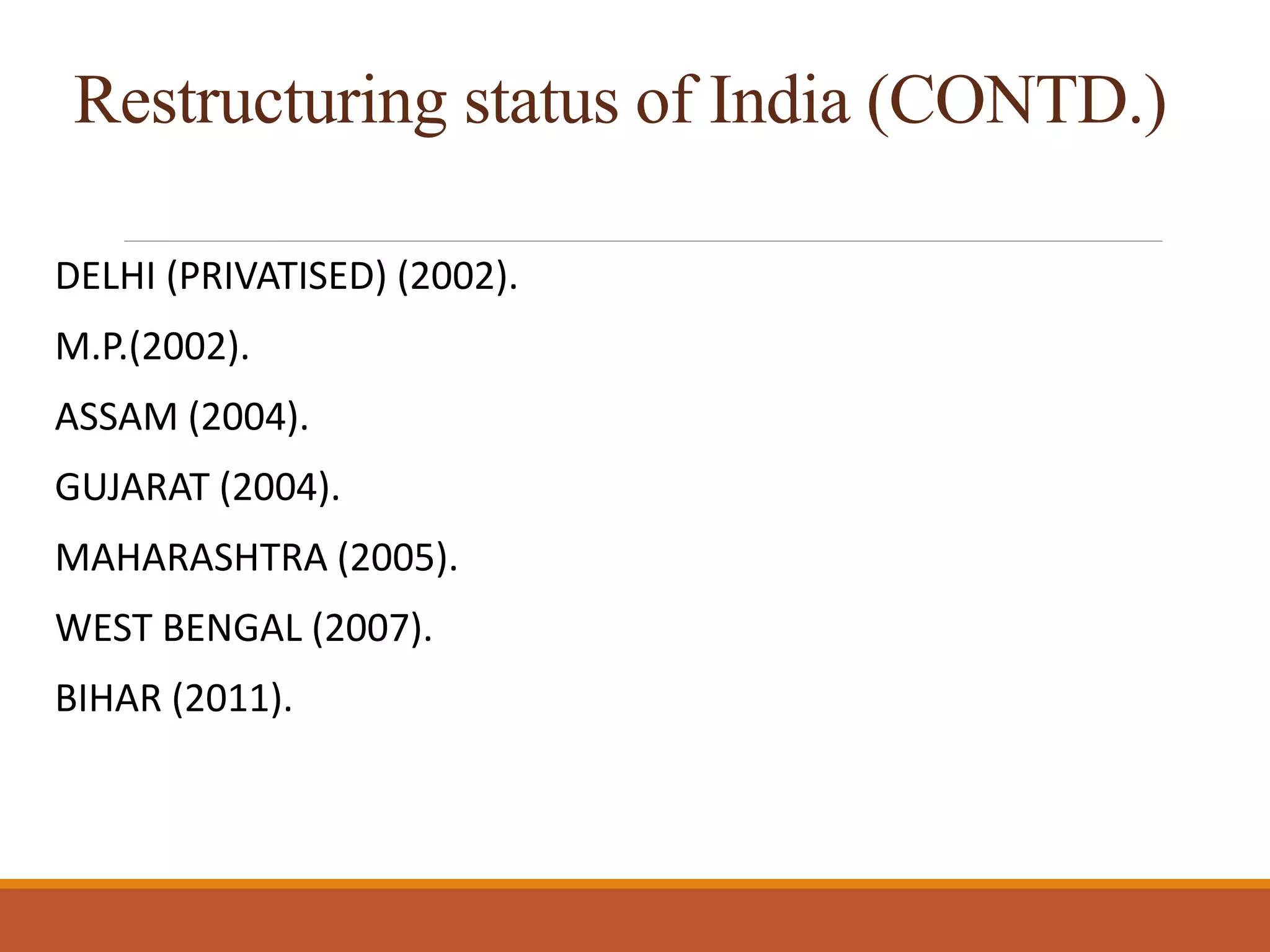
Restructuring status of India (CONTD.)
DELHI (PRIVATISED) (2002).
M.P.(2002).
ASSAM (2004).
GUJARAT (2004).
MAHARASHTRA (2005).
WEST BENGAL (2007).
BIHAR (2011).
Electricity acts in India
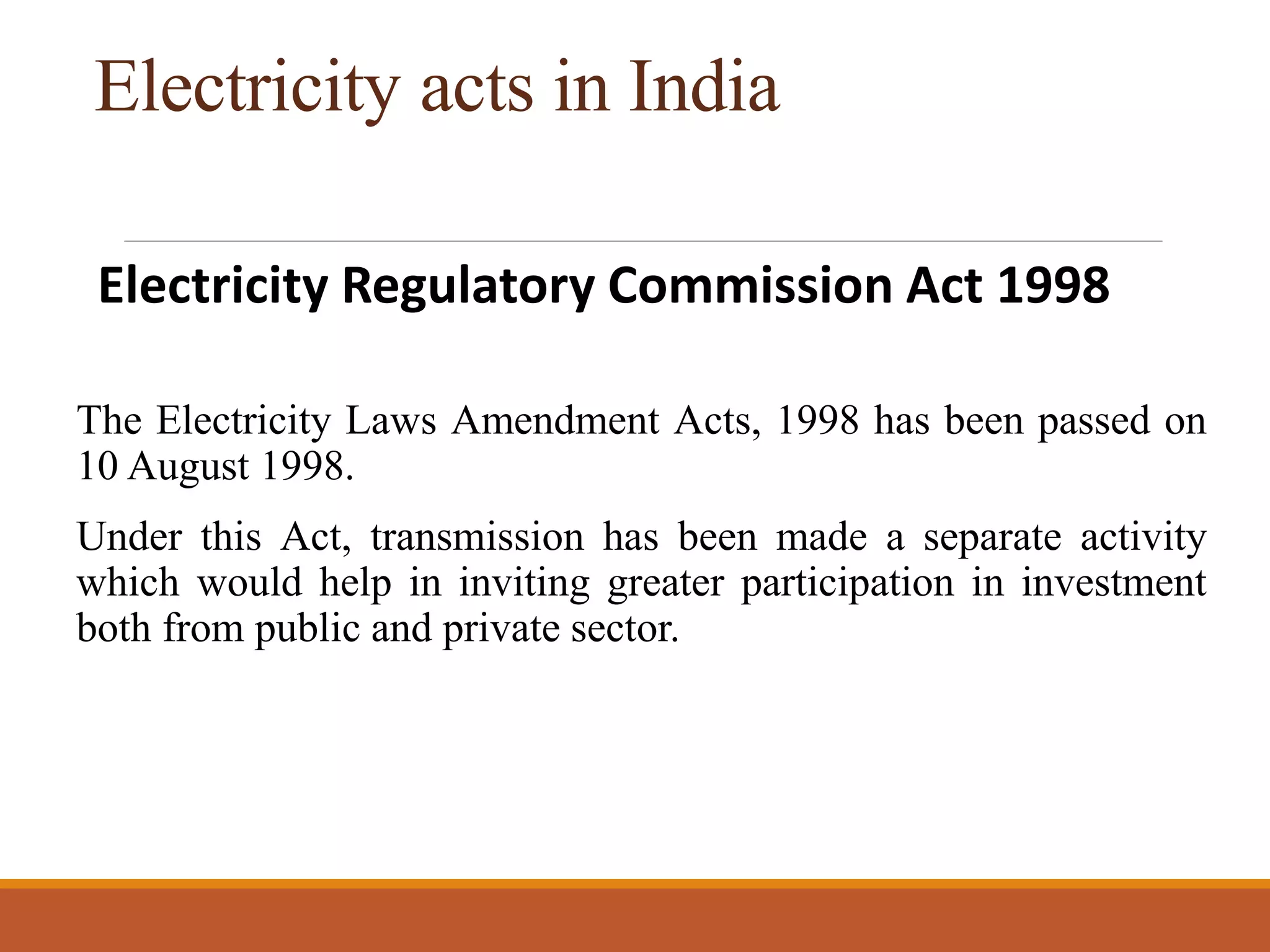
The Electricity Laws Amendment Acts, 1998 has been passed on
10 August 1998.
Under this Act, transmission has been made a separate activity
which would help in inviting greater participation in investment
both from public and private sector.
Electricity Regulatory Commission Act 1998
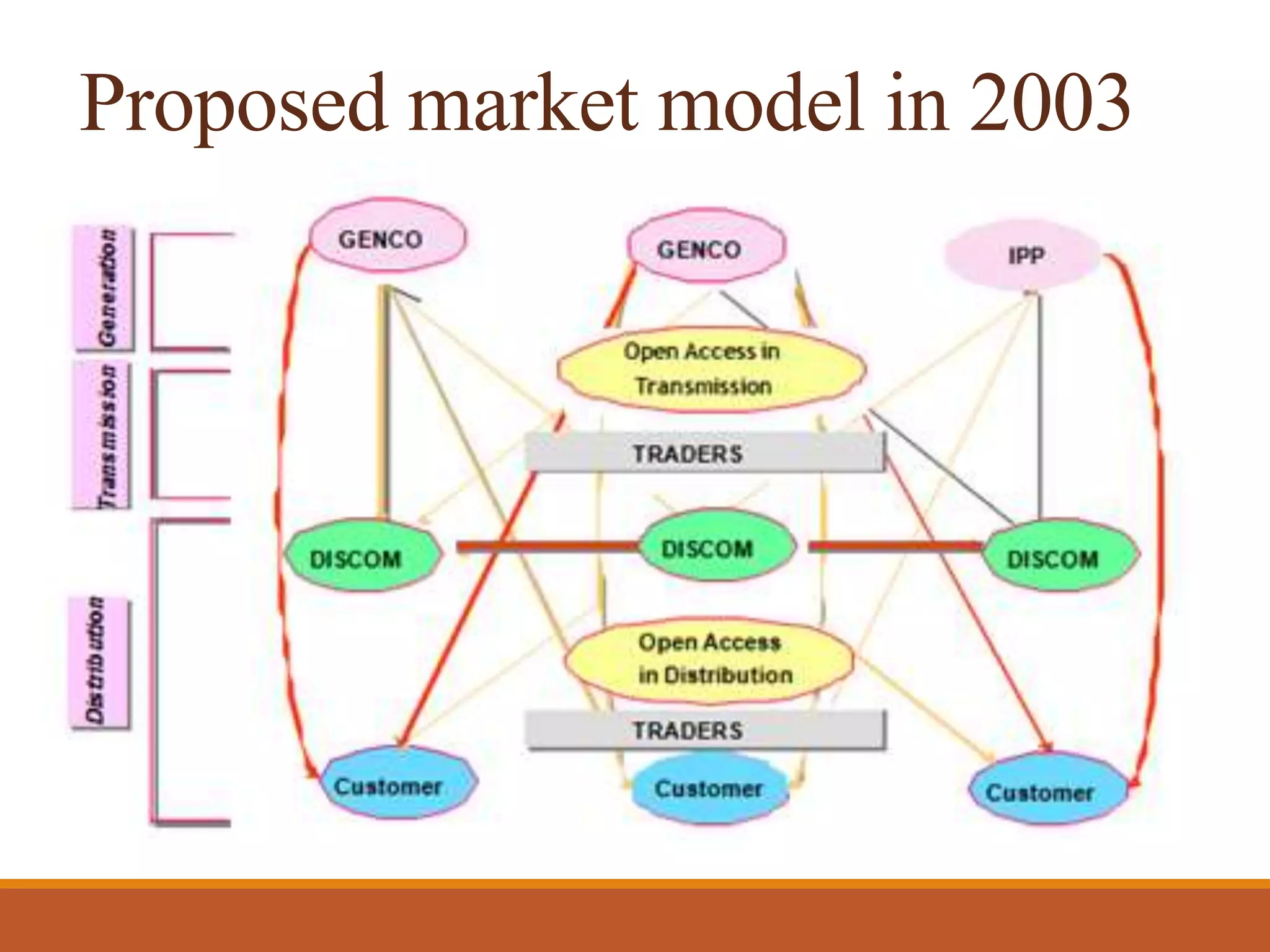
The Electricity Act, 2003
The objective of this act is to accelerate the power sector
reforms.
Unbundling of SEBs.
Setting up of Regulatory Mechanism.
Increasing Private Sector Participation in Transmission.
Increasing Privatization of Distribution.
Existing market model
Proposed market model in 2003
Current Indian Power Market Structure
Proposed National Power Market Structure
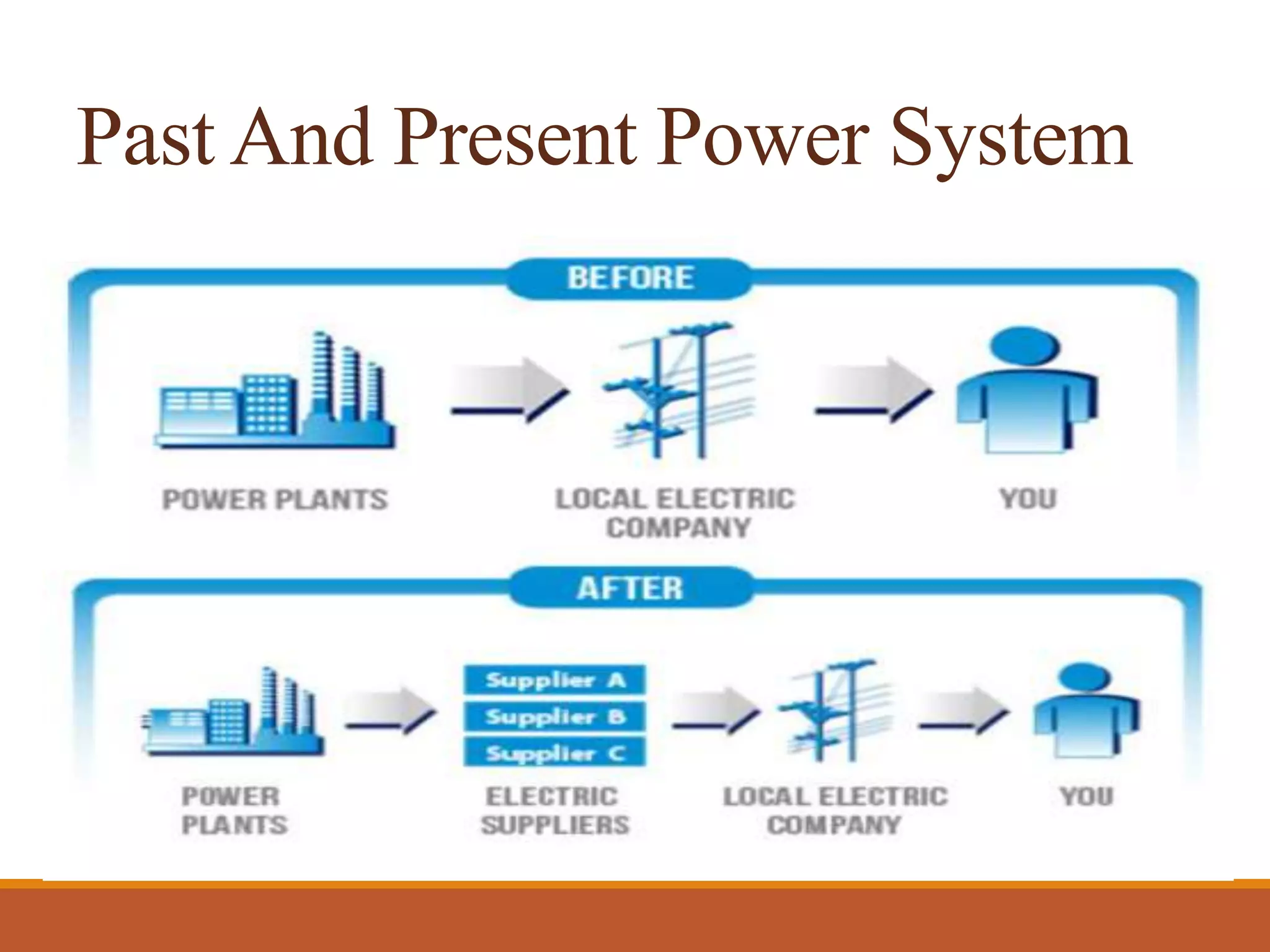
Past And Present Power System
Competing Models for Restructuring
The Orissa Model
After the state Electricity Reform Act became effective in April
1996. immediately, the Orissa State Electricity Board is partially
unbundled into three separate entities: Orissa Hydro Power
Corporation (OHPC – for hydro generation), Orissa Power
Generation Corporation (OPGC – for thermal generation) and
Grid Corporation of Orissa (GRIDCO – for transmission and
distribution).
Generation is first privatized.
Delhi - Model
Typical single buyer model
1 Genco (Indraprastha Power Co.)
1 monopoly Transco (Delhi Transco)
3 distribution companies (2 – BSES &1 – TPC)
(1)- BRPL(BSES RAJDHANI POWER LIMITED)
(2)- BYPL(BSES YAMUNA POWER LIMITED)
TPC – Tata Power Company
ANDHRA PRADESH
State Reforms Act came into force w.e.f. 1-2-1999.
APSEB unbundled into Andhra Pradesh Generation
Company Ltd. (APGENCO) and Andhra Pradesh
Transmission Company Ltd. (APTRANSCO for
transmission and distribution).
U.P. Delivery Model
Problems in Indian Power Sector
Inadequate last mile connectivity.
No access to electricity.
Intra day load and demand.
Coal supply.
Poor pipeline connectivity and infrastructure.
Cont….
Hydro electric power projects.
Theft of power.
Lack of clean and reliable energy sources.
Average transmission , distribution and consumer level losses.
Risk Management.
Lack of Pricing Mechanism.
CONCLUSION
Several state electricity boards are being unbundled into
three distinct corporations namely Generation,
Transmission and distribution.
The distribution system are being horizontally broken down
into manageable Discos with separate accountability and
privatized for better efficiency in metering, billing and
revenue collection.
The system operation functions at the regional/national
level can be with central transmission utility, while state
transmission utilities may manage load dispatch centers in
line with TSO
REFERENCES
http://www.powermin.nic.in/indian_electricity_scenario/introduction.htm
http://www.powermin.nic.in/JSP_SERVLETS/internal.jsp
http://www.powermin.nic.in/indian_electricity_scenario/power_for_all_target.h
tm
http://www.ccsindia.org/ccsindia/Electricity/delhi_conceptual_issues.htm
http://www.kpmg.com/Global/en/IssuesAndInsights/ArticlesPublications/Docum
ents/Indian%20Power%20Sector%20-%20Rising%20up%20the%20Curve.pdf
http://www.sari-
energy.org/publications/rep/executivetrip7/restructuringdistributionsector.pdf
http://planningcommission.gov.in/reports/genrep/seb/ar_seb01.pdf
http://delhigovt.nic.in/power.asp
Restructuring and deregulation of INDIAN POWER SECTOR

Restructuring and deregulation of INDIAN POWER SECTOR

  • 1.
    RESTRUCTURING AND DEREGULATIONOF INDIAN POWER SECTOR PRESENTED BY- ANKUR MAHESHWARI M.TECH NIT HAMIRPUR
  • 2.
    Contents • Power generationin India at a glance. • Power map of India. • Distribution system of India . • Different electricity acts of India . • Main events of 2003 electricity act. • Main features of electricity act 2003. • Restructuring of Orissa , Delhi and Andhra Pradesh. • Problems in Indian Power Sector. • References • Conclusion
  • 3.
    Introduction about India Indiais the largest democratic country in the world. India is the seventh-largest country in terms of total geographical area (3,287,263 sq.km) which is 2.4 % of world total area. India is the second-most populous country in the world (over 1.27billion) after china. Largest state in terms of area is Rajasthan( 3,42,239 sq.km) and in terms of population is U.P ( 215,608,813) Total installed capacity is 3,30,861 MW (as on 31/03/2018), which is world’s third largest.
  • 4.
    Location of Indiain world map
  • 5.
  • 6.
    HISTORY The first demonstrationof electric light in Calcutta was conducted on 24 July 1879 by P W Fleury & Co. On 7 January 1897, Kilburn & Co secured the Calcutta electric lighting licence as agents of the Indian Electric Co, which was registered in London on 15 January 1897. A month later, the company was renamed the Calcutta Electric Supply Corporation. The control of the company was transferred from London to Calcutta in 1970. Motivated by the success of electricity in Calcutta, power was thereafter introduced in Bombay.
  • 7.
    History Cont………. Mumbai sawelectric lighting demonstration for the first time in 1882 at Crawford Market and Bombay Electric Supply & Tramways Company (BEST) set up a generating station in 1905 to provide electricity for the tramway. The first hydroelectric installation in India was installed near a tea estate at Sidrapong for the Darjeeling Municipality in 1897. The first electric streetlight in Asia was lit on 5 August 1905 in Bangalore. The first electric train ran between Bombay's Victoria Terminus and Kurla on 3, February 1925.
  • 8.
    History Cont………. On 18August 2015, Cochin International Airport became the world's first fully solar powered airport with the inauguration of a dedicated solar plant.
  • 9.
    Major Thermal PowerPlant In India
  • 10.
    Major Hydro PowerPlant In India
  • 11.
    Major Nuclear PowerPlant In India
  • 12.
    Major Power ProductionStates In India
  • 13.
    Top Five Statesin India with Highest Renewable Energy Capacity
  • 15.
    Indian Energy Mix Renewableenergy jumped to 16% of India's energy mix. The country’s total installed generation capacity is 3,30,861 MW with renewables accounting for 50,745 MW of it. Currently, on an average, the country is adding 1,000 Mw of solar power annually. The Union ministry of new & renewable energy pegs the annual growth of solar power at 15,000 Mw.
  • 18.
  • 19.
  • 20.
  • 21.
    State Wise AllIndia Installed Capacity
  • 24.
    State Wise PricingOf Power Sector in 12th five year plan
  • 25.
  • 26.
    Transmission of Indiaat a glance 220 kV of transmission was introduced in 1960 in India. 400 kV transmission was introduced in 1977 in India. HVDC and HVDC Bi polar transmission introduced in 1989 and 1990 respectively.
  • 27.
    Transmission system ata glance Power Grid Corporation of India Limited (POWERGRID, a 'Navratna' Company operating under Ministry of Power, is engaged in power transmission business with the responsibility for planning, implementation, operation and maintenance of inter-State transmission system and operation of National & Regional Power Grids. POWERGRID is a listed Company, with 57.90% holding of Government of India and balance by Institutional Investors & public. POWERGRID has been implementing various transmission projects for generation capacity addition under central sector, Ultra Mega Power Projects (UMPPs), Independent Power Producers (IPPs) and other projects.
  • 28.
    Transmission continued…… POWERGRID hastaken leadership initiative for development of Smart Grid technology in the country integrating all segments in power supply chain. In Distribution system, POWERGRID jointly with Govt. of Pondicherry has developed a Consumer-utility interactive Pilot Smart Grid/ City project in Pondicherry through open collaboration with more than 70 organizations & academic institutions.
  • 29.
  • 30.
  • 31.
    Distribution in Indiaat a glances Total no. of distribution utilities – 61. Electricity distribution network in India is inefficient compared to other networks in the world. India's network losses exceeded 32% in 2010, compared to world average of less than 15%. As of January 2030, one report found the per capita total consumption in India will be 1895 kWh.
  • 32.
  • 35.
    Company Business description •Power Finance Corporation Limited (PFC) is an NBFC engaged in financing and development activities within the Indian power sector • Major products and services include project term loans, lease financing, direct discounting of bills, short-term loans and consultancy services • Adani Power is one of India’s largest private thermal power producers, with total capacity of 4,620 MW; the company aims to generate 20,000 MW of power by 2020 • The company is building one of the world’s largest single-location thermal power plants in Mundra, Gujarat • Power Grid Corporation of India Limited (PGCIL) is the single largest transmission utility in India; it is responsible for planning, co-ordination, supervision and control over inter-state transmission systems • Damodar Valley Corporation is engaged in power generation, distribution and transmission of electric power, irrigation and flood control • SJVN Limited is the second largest hydro power company in India • The company plans to diversify into wind power projects soon Power SOME MAJOR PLAYERS IN POWER MARKET
  • 36.
    Company Business description •NTPC is India’s largest power producer and the sixth-largest thermal power producer in the world, with installed capacity of 41,184 MW (including 5,364 MW through JVs). By 2032, NTPC plans to reach 128,000 MW power capacity. Coal-based power accounts for more than 90 per cent of the total capacity • It has also diversified into hydro power, coal mining, power equipment manufacturing, oil and gas exploration, power trading and distribution • Tata Power is India’s largest integrated power company, with significant presence in solar, hydro, wind and geothermal energy space. The company accounts for 52 per cent of total generation capacity in the private sector, with an installed capacity of 8,521 MW • The company has over 35,000 MW of power generation capacity, both operational and under development. Reliance Power has an operational power generation capacity of 2,500 MW. FY13 saw the development of the 3,960 MW Sasan UMPP in Madhya Pradesh • CESC Limited is a vertically integrated player engaged in coal mining, and generation and distribution of power • NHPC is the largest hydro power utility in India, with an installed capacity of 5,295MW; it has drawn up a massive capacity expansion plan of adding 6,697 MW by 2017 • NHPC is constructing nine projects aggregating to a total installed capacity of 4271 MW. NHPC added 1,970 MW and 1,150 MW during the 10th and 11th Plan periods, respectively Power SOME MAJOR PLAYERS IN POWER MARKET
  • 37.
    Private utilities fordistribution in India • Reliance energy limited (about 6 million consumers) •Calcutta Electricity Supply company (about 2.5 million consumer) •Tata power company (about 2 million consumers) •Ahmedabad electricity supply company (about 1.3 million consumers) •Torrent power ltd.
  • 38.
  • 39.
  • 40.
    Restructuring status ofIndia States where electricity boards have been restructured in India. ORRISA (PRIVATISED) (1996). HARYANA (1999). ANDHARA PRADESH (1999). KARNATAKA (1999). UTTAR PRADESH (2000). UTTARAKHAND (2001). RAJASTHAN (2001).
  • 41.
    Restructuring status ofIndia (CONTD.) DELHI (PRIVATISED) (2002). M.P.(2002). ASSAM (2004). GUJARAT (2004). MAHARASHTRA (2005). WEST BENGAL (2007). BIHAR (2011).
  • 42.
    Electricity acts inIndia The Electricity Laws Amendment Acts, 1998 has been passed on 10 August 1998. Under this Act, transmission has been made a separate activity which would help in inviting greater participation in investment both from public and private sector. Electricity Regulatory Commission Act 1998
  • 43.
    The Electricity Act,2003 The objective of this act is to accelerate the power sector reforms. Unbundling of SEBs. Setting up of Regulatory Mechanism. Increasing Private Sector Participation in Transmission. Increasing Privatization of Distribution.
  • 44.
  • 45.
  • 46.
    Current Indian PowerMarket Structure
  • 47.
    Proposed National PowerMarket Structure
  • 48.
    Past And PresentPower System
  • 49.
    Competing Models forRestructuring The Orissa Model After the state Electricity Reform Act became effective in April 1996. immediately, the Orissa State Electricity Board is partially unbundled into three separate entities: Orissa Hydro Power Corporation (OHPC – for hydro generation), Orissa Power Generation Corporation (OPGC – for thermal generation) and Grid Corporation of Orissa (GRIDCO – for transmission and distribution). Generation is first privatized.
  • 50.
    Delhi - Model Typicalsingle buyer model 1 Genco (Indraprastha Power Co.) 1 monopoly Transco (Delhi Transco) 3 distribution companies (2 – BSES &1 – TPC) (1)- BRPL(BSES RAJDHANI POWER LIMITED) (2)- BYPL(BSES YAMUNA POWER LIMITED) TPC – Tata Power Company
  • 51.
    ANDHRA PRADESH State ReformsAct came into force w.e.f. 1-2-1999. APSEB unbundled into Andhra Pradesh Generation Company Ltd. (APGENCO) and Andhra Pradesh Transmission Company Ltd. (APTRANSCO for transmission and distribution).
  • 52.
  • 53.
    Problems in IndianPower Sector Inadequate last mile connectivity. No access to electricity. Intra day load and demand. Coal supply. Poor pipeline connectivity and infrastructure.
  • 54.
    Cont…. Hydro electric powerprojects. Theft of power. Lack of clean and reliable energy sources. Average transmission , distribution and consumer level losses. Risk Management. Lack of Pricing Mechanism.
  • 55.
    CONCLUSION Several state electricityboards are being unbundled into three distinct corporations namely Generation, Transmission and distribution. The distribution system are being horizontally broken down into manageable Discos with separate accountability and privatized for better efficiency in metering, billing and revenue collection. The system operation functions at the regional/national level can be with central transmission utility, while state transmission utilities may manage load dispatch centers in line with TSO
  • 56.