


Dr. R.PRICILA
ASSISTANT PROFESSOR OF HISTORY
HOLY CROSS COLLEGE (AUTONOMOUS)
TIRUCHIRAPPALLI
DR.PRICILA
DR.PRICILA
DR.PRICILA
DR.PRICILA
The learner will be able to
Understand the causes of Indian
Nationalism and its effects.
Discuss the origin and growth of
Indian National Congress.
Evaluate the emergence of Gandhi in
Indian National Movement
DR.PRICILA
Nationalism and its Effects
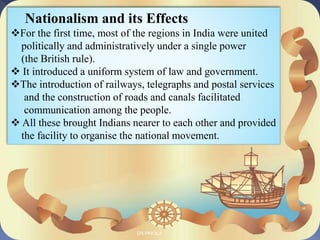
For the first time, most of the regions in India were united
politically and administratively under a single power
(the British rule).
 It introduced a uniform system of law and government.
The introduction of railways, telegraphs and postal services
and the construction of roads and canals facilitated
communication among the people.
 All these brought Indians nearer to each other and provided
the facility to organise the national movement.
DR.PRICILA
•The English language played an important role in the
growth of nationalism in the country.
•The English educated Indians, who led the national
movement, developed Indian nationalism and organised
it.
•Western education facilitated the concepts of
liberty, equality, freedom and sowed the
seeds of nationalism.
•The Indian Press, both English and vernacular, created a
national consciousness among the people.
DR.PRICILA
•The leaders of various organisations
like the Brahmo Samaj, Ramakrishna
Mission, Arya Samaj, and
Theosophical Society created a great
impact on nationalism.
DR.PRICILA
The Indian National Congress (1885)
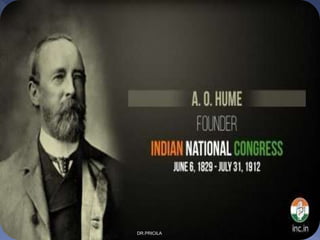
 Allan Octavian Hume, a retired civil servant in the
British Government took the initiative to form an all-
India organization.
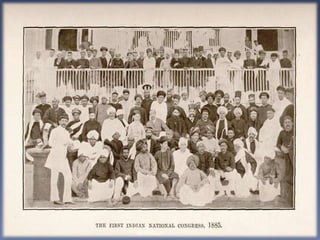
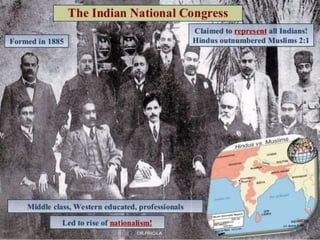
 Thus, the Indian National Congress was founded and its
first session was held at Bombay in 1885. W.C.
Banerjee was its first president.
 It was attended by 72 delegates from all over India.
DR.PRICILA
DR.PRICILA
DR.PRICILA
Persons attending the session belonged to
different religious faiths.
They discussed the problems of all the Indians
irrespective of their religion, caste, language
and regions.
Thus Indian National Congress was an all-
India secular movement embracing every
section of Indian society.
The second session was held in Calcutta in
1886 and the third in Madras in 1887.
DR.PRICILA
DR.PRICILA
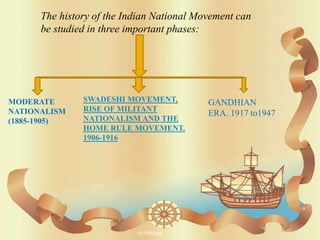
The history of the Indian National Movement can
be studied in three important phases:
MODERATE
NATIONALISM
(1885-1905)
SWADESHI MOVEMENT,
RISE OF MILITANT
NATIONALISM AND THE
HOME RULE MOVEMENT.
1906-1916
GANDHIAN
ERA. 1917 to1947
DR.PRICILA
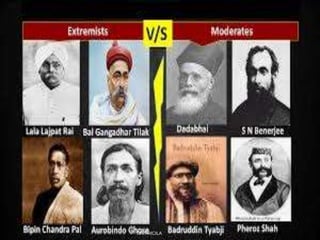
•The leading figures during the first phase of the National
Movement were A.O. Hume, W.C. Banerjee, Surendra Nath
Banerjee, Dadabhai Naoroji, Feroze Shah Mehta,
Gopalakrishna Gokhale, Pandit Madan Mohan Malaviya,
Badruddin Tyabji, Justice Ranade and G. Subramanya
Aiyar.
•Surendranath Banerjee was called the Indian Burke.
•He firmly opposed the Partition of Bengal.
•He founded the Indian Association (1876) to agitate for
political reforms.
•He had convened the Indian National Conference (1883)
which merged with the Indian National Congress in l886.
DR.PRICILA
• Expansion and reform of legislative councils.
• Greater opportunities for Indians in higher posts by
holding the ICS examination simultaneously in England
and in India.
• Separation of the judiciary from the executive.
• More powers for the local bodies.
• Reduction of land revenue and protection of peasants from
unjust landlords.
•Abolition of salt tax and sugar duty.
•Reduction of spending on army.
•Freedom of speech and expression and freedom to form
associations
Main Demands of Moderates
DR.PRICILA
DR.PRICILA
DR.PRICILA

INDIAN NATIONAL MOVEMENT

  • 1.
    Dr. R.PRICILA ASSISTANT PROFESSOROF HISTORY HOLY CROSS COLLEGE (AUTONOMOUS) TIRUCHIRAPPALLI DR.PRICILA
  • 2.
  • 3.
  • 4.
  • 5.
    The learner willbe able to Understand the causes of Indian Nationalism and its effects. Discuss the origin and growth of Indian National Congress. Evaluate the emergence of Gandhi in Indian National Movement DR.PRICILA
  • 6.
    Nationalism and itsEffects For the first time, most of the regions in India were united politically and administratively under a single power (the British rule).  It introduced a uniform system of law and government. The introduction of railways, telegraphs and postal services and the construction of roads and canals facilitated communication among the people.  All these brought Indians nearer to each other and provided the facility to organise the national movement. DR.PRICILA
  • 7.
    •The English languageplayed an important role in the growth of nationalism in the country. •The English educated Indians, who led the national movement, developed Indian nationalism and organised it. •Western education facilitated the concepts of liberty, equality, freedom and sowed the seeds of nationalism. •The Indian Press, both English and vernacular, created a national consciousness among the people. DR.PRICILA
  • 8.
    •The leaders ofvarious organisations like the Brahmo Samaj, Ramakrishna Mission, Arya Samaj, and Theosophical Society created a great impact on nationalism. DR.PRICILA
  • 9.
    The Indian NationalCongress (1885)  Allan Octavian Hume, a retired civil servant in the British Government took the initiative to form an all- India organization.  Thus, the Indian National Congress was founded and its first session was held at Bombay in 1885. W.C. Banerjee was its first president.  It was attended by 72 delegates from all over India. DR.PRICILA
  • 10.
  • 11.
  • 12.
    Persons attending thesession belonged to different religious faiths. They discussed the problems of all the Indians irrespective of their religion, caste, language and regions. Thus Indian National Congress was an all- India secular movement embracing every section of Indian society. The second session was held in Calcutta in 1886 and the third in Madras in 1887. DR.PRICILA
  • 13.
  • 14.
    The history ofthe Indian National Movement can be studied in three important phases: MODERATE NATIONALISM (1885-1905) SWADESHI MOVEMENT, RISE OF MILITANT NATIONALISM AND THE HOME RULE MOVEMENT. 1906-1916 GANDHIAN ERA. 1917 to1947 DR.PRICILA
  • 15.
    •The leading figuresduring the first phase of the National Movement were A.O. Hume, W.C. Banerjee, Surendra Nath Banerjee, Dadabhai Naoroji, Feroze Shah Mehta, Gopalakrishna Gokhale, Pandit Madan Mohan Malaviya, Badruddin Tyabji, Justice Ranade and G. Subramanya Aiyar. •Surendranath Banerjee was called the Indian Burke. •He firmly opposed the Partition of Bengal. •He founded the Indian Association (1876) to agitate for political reforms. •He had convened the Indian National Conference (1883) which merged with the Indian National Congress in l886. DR.PRICILA
  • 16.
    • Expansion andreform of legislative councils. • Greater opportunities for Indians in higher posts by holding the ICS examination simultaneously in England and in India. • Separation of the judiciary from the executive. • More powers for the local bodies. • Reduction of land revenue and protection of peasants from unjust landlords. •Abolition of salt tax and sugar duty. •Reduction of spending on army. •Freedom of speech and expression and freedom to form associations Main Demands of Moderates DR.PRICILA
  • 17.
  • 18.