Birth of IndianNational
movement
The rule of East India company ended with Queen Victoria proclamation of November 1,
1858,the power of governance now came into the hands of the British government in
1858.
The resentment surfaced in the form of different rebellions and subsequently later on give
rise to the birth of Indian National movement.
Many political associations were formed to express the problems of Indians. But they
were restricted to some parts of India.
3.
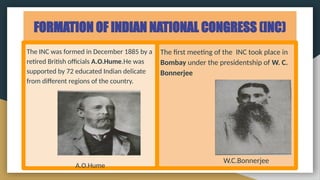
FORMATION OF INDIANNATIONAL CONGRESS (INC)
The INC was formed in December 1885 by a
retired British officials A.O.Hume.He was
supported by 72 educated Indian delicate
from different regions of the country.
A.O.Hume
The first meeting of the INC took place in
Bombay under the presidentship of W. C.
Bonnerjee
W.C.Bonnerjee
4.
Moderates
(1885 -1905)
Demands
● Haverepresentative institutions(welfare
of the people)
● Create provincial legislative councils in
all provinces
● Recruit Indians for higher positions in
the administration.
● Hold Civil Services Examination in India
● Ensure the growth of Indian industries
and handicrafts
● Stop the drain of wealth to Britain
● End the exploitation of Indian resources
and people
The moderates had complete faith
in the British. They adopted
moderate ways to pursue their
goals.
They believed in ideas rather than
action. They have followed a policy
of 3Ps—prayer, petition and protest
5.
The prominent Moderateleaders
were Gopal Krishna Gokhale,
Dadabhai Naoroji, Surendra Nath
Banerjee, Pheroz Shah Mehta,
Mahadev Govind Ranade,
Badruddin Tyabji and others.
6.
Radicals
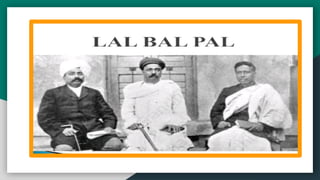
Aurobindo Ghosh, LalaLajpat Rai, Bal Gangadhar Tilak and
Bipin Chandra Pal (Lal ,Bal, Pal) emerged as new leaders
and were known as radicals.
● They did not believe in appeals
● They believed in actions—protests, hartals and
slogans.
● They propagated Indian culture and Hinduism
8.
Difference between Moderateand
Radicals
● Moderates believed in ideas
● They had complete faith in British
They adopted moderate ways to
pursue their goals.
● They have followed a policy of 3Ps
—prayer, petition and protest
protest
● Gopal Krishna Gokhale, Dadabhai
Naoroji, Surendra Nath Banerjee,
Pheroze Shah Mehta, Mahadev
Govind Ranade, Badruddin tyabji
were the prominent leaders
● Radicals believed in actions.
● They believed in actions—protests,
hartals and slogans.
● Tools for achieving Swaraj by the
radicals
Swadeshi
Boycott
National education
● Aurobindo Ghosh, Lala Lajpat Rai, Bal
Gangadhar Tilak and Bipin Chandra
Pal (Lal ,Bal, Pal) were the prominent
leaders
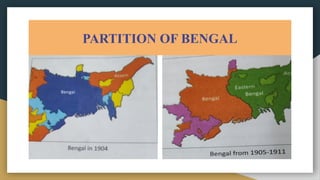
Lord Curzon issuedan order in July 1905
to Partition Bengal.
Official reason given by Britishers—difficult to
govern and collect revenue from a big province
People know—Britishers wanted to divide the
Indians and rule.
Therefore, there were protests against the partition.
The day was observed as the Day of Mourning.
Tools for achieving Swaraj by the radicals
● Swadeshi
● Boycott
● National education
The radical group among the Congress
encouraged:
● Love for Swadeshi goods
● Participation in mass rallies to
Boycott foreign goods
● Boycott of government
services ,schools and colleges
● Surrender of titles conferred by
the British
11.
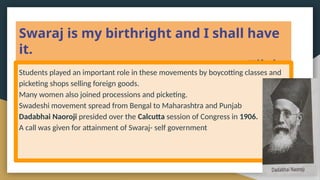
Swaraj is mybirthright and I shall have
it.
Tilak
Students played an important role in these movements by boycotting classes and
picketing shops selling foreign goods.
Many women also joined processions and picketing.
Swadeshi movement spread from Bengal to Maharashtra and Punjab
Dadabhai Naoroji presided over the Calcutta session of Congress in 1906.
A call was given for attainment of Swaraj- self government
12.
The differences betweenthe Moderates
and Radicals came to head during the
Surat session in 1907. There was a split
in the party and the two groups parted
ways. The Moderates was led by Gopal
Krishna Gokhale and Pheroz Shah
Mehta. The Radicals were led by Lal, Bal
and Pal .They were referred to as the
extremist by the British
13.
LUCKNOW PACT OF1916
● The moderates and radicals reunited to strengthen
the national movement after 9 years.
● They signed a joint pact at Lucknow with Muslim
League.
● The jointly demanded self rule for India.
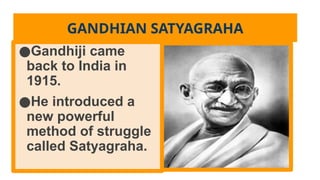
WHAT IS THEIDEA OF SATYAGRAHA?
●Satyagraha literally means holding on to truth or truth force.
●Satyagraha— demand for truth.
● It was a non-violent struggle introduced by Gandhiji in the Indian National
Movement.
●It persuades the opponent to understand the truth.
●If the cause was true and if the fight was against injustice then physical force was
not necessary to fight the oppressor.
●He propagated tolerance, brotherhood, non-violence(ahimsa) and simple living
●Hunger strike, peaceful demonstrations, strike, hartal and non cooperation with the
government are some methods of Satyagraha
16.
Gandhiji realised thatsocial reforms were necessary
for a truly National struggle.
Established Sabarmati Ashram in Gujarat where
people of all castes and religious were welcomed.
His first movement was in support of peasants.
By 1919 Gandhiji had become the most popular leader
of India. He launched many powerful mass
movements.
17.
FIRST THREE SATYAGRAHAMOVEMENTS
ORGANISED BY GANDHIJI IN INDIA
● Champaran Movement [1916]: It was a movement of workers
in the indigo plantations of the Champaran district of Bihar. It
was against the oppressive plantation system.
● Kheda Movement[1917]: Crop failure and plague epidemic
made the life of the farmers miserable in the Kheda district of
Gujarat. So, they started a movement under Gandhiji’s
leadership with the demand for a reduction in land revenue.
● Mill workers Movement: Low wages and poor working
conditions forced the mill workers of Ahmedabad to start a
movement under Gandhiji’s leadership in 1918.
18.
Rowlatt Act[1919]
● ThisAct gave the government the power to imprison
any person without any trial for a period of two years.
●Aim of this act was to destroy the national movement
by imprisoning the national workers.
●It was a black law because it was against basic
human rights.
19.
WHAT CIRCUMSTANCES LEDTO THE JALLIANWALA BAGH
MASSACRE?
●On 13 April 1919, a public meeting was organized at Jallianwala Bagh
in Amritsar to protest against the arrests of two prominent congress
leaders of Punjab— Dr. Satya Pal and Saiffudin Kitchlew.
● Many villagers who came to attend a fair were also present in the
park.
● General Dyer reached the meeting place along with the British
troops. He ordered the troops to fire. The firing lasted for nearly 10
minutes.
●More than thousand people were killed and many were wounded. This
20.
The message carestunned the whole
country. The government imposed
martial law in Punjab. Under martial
law, people were tortured, newspapers
were banned and mails were censored.
21.
WHAT WAS THEKHILAFAT MOVEMENT?
HOW DID IT BECOME A PART OF THE NATIONAL
MOVEMENT?
●It was a movement organized by Muhammad Ali and Shaukat Ali [Ali
brothers].
●The aim of this movement was to protest against the injustice done to
Turkey by Britain after the First World War.
●The Turkish Sultan had the title of Caliph. The muslims considered
him as their spiritual leader. Gandhiji saw this as an opportunity to
bring Muslims under the umbrella of a unified national movement.
●At the Calcutta session of the Congress in September 1920, he
convinced other leaders of the need to start a non-cooperation
movement in support of Khilafat as well as for swaraj.
●So, many muslims joined this movement.
22.
THE NON-COOPERATION MOVEMENT(1920-
22)
Mahatma Gandhi said,
‘the British rule was established and survived in India with
the cooperation of Indians. If Indians refused to co-operate,
British rule would collapse and Swaraj would come.’
The Congress session at Nagpur in December 1920 rectified
Gandhiji’s call for Non Cooperation—not to cooperate with
the government.
23.
Non-Cooperation was directedagainst the
injustice done by the British in Punjab and
Turkey.
It began with—
● Renouncing of titles and honours given by the British.
● Boycott of the legislatures.
● Boycott of schools and colleges by students and teachers.
● Opening of Jamia Milia at Aligarh and Kashi Vidya Peeth at
Banaras.
● Boycott of government offices and courts.
● Bonfires of foreign goods.
● Hartals and strikes all over the country.
24.
WITHDRAWAL OF THENON COOPERATION
MOVEMENT
●Gandhiji withdrew the Non Co operation Movement because:
●The movement became violent in some places. In February 1922,
in Chauri chaura (Uttar Pradesh) people turned violent and set fire
to a police station. Twenty two police men were killed in this
incident. Gandhiji was against violence.
●The movement slowed down in urban areas.
● He thought that it was necessary to trained the people in non
violent satyagraha.
25.
SIMON COMMISSION (1927)
TheSimon Commission was appointed and
came to India in February, 1928. It was
appointed to look in to the working of the
Government of India Act of 1919 and to
suggest further reforms in the system of
administration. The members of the
commission were all Englishmen and not a
single Indian was included in it. It led to
Simon go back agitation.
26.
● It wasa statutory commission set up by the British under Sir John Simon.
● It was asked to study the constitutional system in India and suggest
changes.
● Indians opposed the Simon Commission because:
● All the members of the commission were English men. There was no Indian
in it.
● It did not provide any hope of Swaraj to Indians.
Wherever the Simon commission went it was by courted by the Congress as
well as the Muslim break with black flags.
Lala Lajpat Rai was seriously injured while protesting in a police Lathi charge in
Lahore. He later succumbed to his injuries
27.
LAHORE SESSION (1929)
●TheCongress session was held at Lahore in 1929 under the Presidentship of
Jawaharlal Nehru. Following decision were taken
●The Congress declared Poorna Swaraj as its aim.
●It was decided to celebrate 26 January every year as Independence Day.The
constitution of India was completed on November 26, 1949 but it was
decided to adopt and enforce it on January 26, 1950 in the memory of
January 26, 1930.
●According to the constitution of India, since then, we celebrate January 26th
as the Republic Day every year.
●It was decided to start the Civil Disobedience Movement to win Poorna
Swaraj.
29.
CIVIL DISOBEDIENCE MOVEMENT(1930- 34)
●Gandhiji decided to inaugurate the Civil Disobedience
Movement by breaking the salt law.
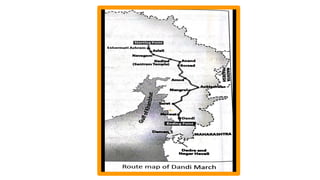
●Gandhiji and 78 of his followers started a march on foot
from Sabarmati Ashram to Dandi [Dandi March].
● On 6 April 1929, they reached Dandi. Gandhiji prepared
salt by using sea water, broke the salt law and inaugurated
the Movement.
●The government imposed heavy tax on salt. Moreover, the
production of salt was the monopoly of the government.
So the price of salt was very high. Therefore, Gandhiji
opposed the salt law.
31.
Salt Satyagraha wasan open challenge to the British
and the Civil Disobedience spread all over the
country.
It became the Second Mass Movement as:
School colleges and courts were boycotted.
Foreign goods were burnt.
Peasants refused to pay taxes.
Shops selling foreign goods were picketed.
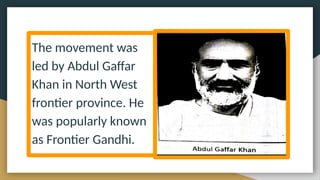
32.
The movement was
ledby Abdul Gaffar
Khan in North West
frontier province. He
was popularly known
as Frontier Gandhi.
33.
The British governmenttried to repress the
movement and restored to violence. Thousands of
protesters were arrested along with Gandhiji and
Jawaharlal Nehru.
A strong feeling of patriotism spread to all parts of
the country. A feeling of belonging to one nation
United the people living in different parts of India.
34.
In 1930 and,the government called two
Round Table Conferences. But they did
not solve any problem. The British refused
to grant dominion status to India and
Gandhiji resumed the Civil Disobedience
Movement which was later withdrawn in
1934.
35.
THE MAIN FEATURESOF THE CIVIL DISOBEDIENCE
MOVEMENT.
● Gandhiji led a march on foot from Sabarmati to Dandi. He broke the Salt Law at
Dandi and inaugurated the Movement.
● People broke salt law in many places. Foreign goods were boycotted. Liquor
shops were picketed. Government servants resigned their jobs. Forest laws were
broken. People refused to pay taxes. Leaders were arrested. Workers attacked
government offices.
● Gandhiji called off the movement on 5 March 1931 under the Gandhi-Irwin Pact.
He agreed to attend the Second Round Table Conference.
● It was restarted when Gandhiji returned from London. It was finally called off in
1934.
37.
Second World Warstarted in 1939. The British drug India
into the war. Anti British movement started in full swing.
In 1942, the British government sent the Cripps Mission
under Sir Stafford Cripps to enlist total cooperation of
Indian National Congress during the second World War,
but the mission failed as demands for complete
Independence and self government after the war were
rejected.
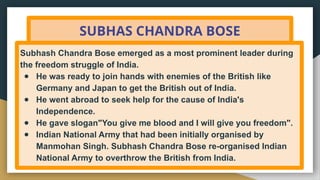
SUBHAS CHANDRA BOSE
SubhashChandra Bose emerged as a most prominent leader during
the freedom struggle of India.
● He was ready to join hands with enemies of the British like
Germany and Japan to get the British out of India.
● He went abroad to seek help for the cause of India's
Independence.
● He gave slogan"You give me blood and I will give you freedom".
● Indian National Army that had been initially organised by
Manmohan Singh. Subhash Chandra Bose re-organised Indian
National Army to overthrow the British from India.


![HISTORYProjectOutline class 10 of icse board education]](https://cdn.slidesharecdn.com/ss_thumbnails/historyprojectoutline10-240727055256-780bf30f-thumbnail.jpg?width=640&height=640&fit=bounds)


