WHAT WERE THEEFFECTS OF
BRITISH RULE BEFORE FREEDOM
MOVEMENT STARTED
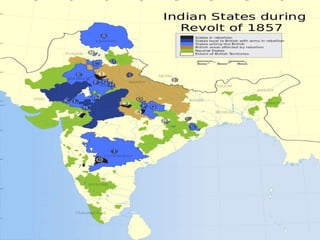
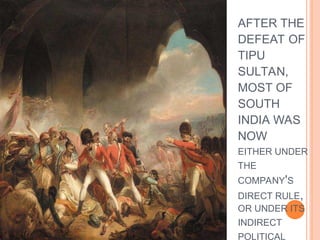
The British conquest of territories, and takeover of
kingdoms.
They have introduction of new laws and administrative
institutions.
Changes happened in the lives of peasants and tribals.
Educational changes in the nineteenth century – Modern
education was introduced.
Debates regarding the condition of women – Women
education, Abolition of Sati.
Challenges to the caste system – By the social reformers
The revolt of 1857 and its aftermath.
THE EMERGENCE OF
NATIONALISM
Within about a hundred years, the British
took control of almost every aspect of life in
India. Many Indians began to feel that the
British control had to end to make India the
country for Indians.
EARLY POLITICAL
ASSOCIATIONS
After1850, many political associations were formed.
Most of them were formed in the 1870s and 1880s. Most
of these associations were led by English-educated
professionals. Some of the important ones were; the
Poona Sarvajanik Sabha, the Indian Association, the
Madras Mahajan Sabha, the Bombay Presidency
Association.
The Indian National Congress was also formed during
this period. The naming conventions of these political
associations suggest that they wanted to take issues
which affected all the people of India; although many of
these associations functioned in specific parts of the
country.
Some of thereasons for dissatisfaction with British
rule in the 1870s and 1880s are as follows:
1.The Arms Act was passed in 1878. This Act disallowed
Indians from possessing arms.
2.The Vernacular Press Act was passed in 1878. This Act
empowered the government to confiscate the assets of
newspapers including their printing presses, if the
newspaper published anything “objectionable”.
3.The Arms Act was passed in 1878. This Act disallowed
Indians from possessing arms.
4.The government tried to introduce the Ilbert Bill in 1883.
The bill made provisions for trial of British or European
persons by Indians. Thus, the Ilbert Bill sought equality
between British and Indian judges in the country. But
the whites opposed the Bill and forced the government
to withdraw it.
10.
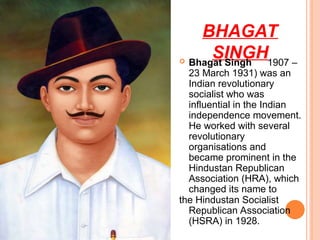
BHAGAT
SINGH
Bhagat Singh1907 –
23 March 1931) was an
Indian revolutionary
socialist who was
influential in the Indian
independence movement.
He worked with several
revolutionary
organisations and
became prominent in the
Hindustan Republican
Association (HRA), which
changed its name to
the Hindustan Socialist
Republican Association
(HSRA) in 1928.
11.
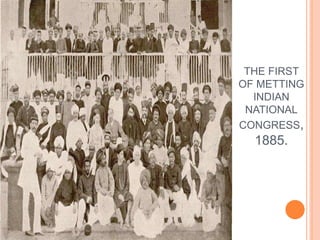
THE INDIAN NATIONALCONGRESS [INC]
The Indian National Congress was established in
1885 at Bombay. In its first meeting at Bombay, 72
delegates from all over the country were present.
The early leadership was mainly composed of
people from Bombay and Calcutta. Dadabhai
Naoroji, Pherozeshah Mehta, Badruddin Tyabji, W.
C. Bonneryji, Surendranath Banerji, Romesh
Chandra Dutt, S. Subramania Iyer, etc. were part
of the early leadership of Congress.
A NATION INTHE MAKING
In its first twenty years, the Congress was
“moderate” in its objectives and methods.
During this period, the main demand of
Congress was about getting a greater voice
for Indians in the government and
administration.
15.
SOME OF THEDEMANDS MADE BY THE
CONGRESS
DURING THIS PERIOD ARE AS FOLLOWS:
The Congress wanted better representation of
Indians in the Legislative Councils.
Introduction of the Legislative Council in those
provinces where none existed.
The Congress made a demand for civil service
examinations to be held in India also.
The Congress also demanded a separation of
judiciary and executive, the repeal of Arms Act
and freedom of speech and expression.
16.
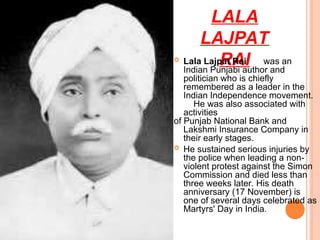
LALA
LAJPAT
RAI
Lala LajpatRai was an
Indian Punjabi author and
politician who is chiefly
remembered as a leader in the
Indian Independence movement.
He was also associated with
activities
of Punjab National Bank and
Lakshmi Insurance Company in
their early stages.
He sustained serious injuries by
the police when leading a non-
violent protest against the Simon
Commission and died less than
three weeks later. His death
anniversary (17 November) is
one of several days celebrated as
Martyrs' Day in India.
17.
ECONOMIC DEMANDS WHICHWERE
DURING THE EARLY YEARS OF THE
CONGRESS ARE AS FOLLOWS:
Reduction in revenue, cut in military expenditure and
more funds for irrigation.
The Congress also passed various resolutions on the
salt tax, treatment of Indian labourers abroad and the
suffering of forest dwellers.
These demands show that in spite of being a body of
the educated elite, the Congress also talked about
the common people.
The Moderate leaders wanted to create public
awareness about the unjust nature of British rule. In
order to do so, they published newspapers, wrote
articles and tried to show the bad effects of the British
rule.
FREEDOM IS OUR
BIRTHRIGHT
By the 1890s, many Indians began to question the
style of the Congress. New leaders emerged who
began to explore more radical objectives and
methods. Bepin Chandra Pal, Bal Gangadhar Tilak
and Lala Lajpat Rai were among the radical
leaders.
They criticized the Moderates for their “policy of
prayers”. They argued that people should not
believe on the so called good intentions of the
government and must fight for swaraj. Tilak raised
the famous slogan, “Freedom is my birthright and I
shall have it”.
20.
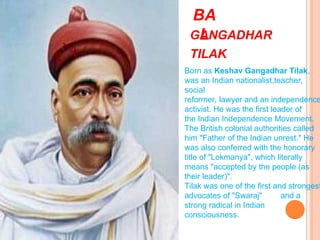
BA
L
GANGADHAR
TILAK
Born as KeshavGangadhar Tilak,
was an Indian nationalist,teacher,
social
reformer, lawyer and an independence
activist. He was the first leader of
the Indian Independence Movement.
The British colonial authorities called
him "Father of the Indian unrest." He
was also conferred with the honorary
title of "Lokmanya", which literally
means "accepted by the people (as
their leader)".
Tilak was one of the first and strongest
advocates of "Swaraj" and a
strong radical in Indian
consciousness.
21.
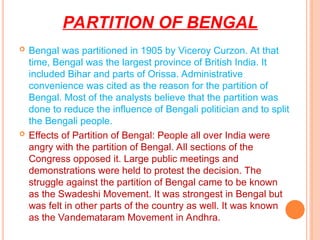
PARTITION OF BENGAL
Bengal was partitioned in 1905 by Viceroy Curzon. At that
time, Bengal was the largest province of British India. It
included Bihar and parts of Orissa. Administrative
convenience was cited as the reason for the partition of
Bengal. Most of the analysts believe that the partition was
done to reduce the influence of Bengali politician and to split
the Bengali people.
Effects of Partition of Bengal: People all over India were
angry with the partition of Bengal. All sections of the
Congress opposed it. Large public meetings and
demonstrations were held to protest the decision. The
struggle against the partition of Bengal came to be known
as the Swadeshi Movement. It was strongest in Bengal but
was felt in other parts of the country as well. It was known
as the Vandemataram Movement in Andhra.
22.
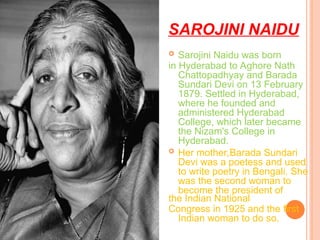
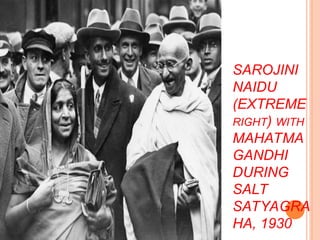
SAROJINI NAIDU
SarojiniNaidu was born
in Hyderabad to Aghore Nath
Chattopadhyay and Barada
Sundari Devi on 13 February
1879. Settled in Hyderabad,
where he founded and
administered Hyderabad
College, which later became
the Nizam's College in
Hyderabad.
Her mother,Barada Sundari
Devi was a poetess and used
to write poetry in Bengali. She
was the second woman to
become the president of
the Indian National
Congress in 1925 and the first
Indian woman to do so.
23.
MAIN AIMS OFSWADESHI
MOVEMENT
Oppose the British rule.
Encourage the ideas of self-help, swadeshi enterprise.
Encourage national education and use of Indian
languages.
24.
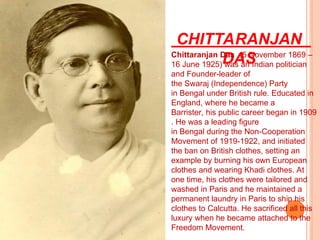
CHITTARANJAN
DAS
Chittaranjan Das (5November 1869 –
16 June 1925) was an Indian politician
and Founder-leader of
the Swaraj (Independence) Party
in Bengal under British rule. Educated in
England, where he became a
Barrister, his public career began in 1909
. He was a leading figure
in Bengal during the Non-Cooperation
Movement of 1919-1922, and initiated
the ban on British clothes, setting an
example by burning his own European
clothes and wearing Khadi clothes. At
one time, his clothes were tailored and
washed in Paris and he maintained a
permanent laundry in Paris to ship his
clothes to Calcutta. He sacrificed all this
luxury when he became attached to the
Freedom Movement.
25.
The radicalsadvocated mass mobilization and boycott of British
institutions and goods. Some leaders also suggested the use of
revolutionary violence to overthrow British rule.
Muslim League: The All India Muslim League was formed at Dacca
in 1906; by a group of Muslim landlords and nawabs. The League
supported the partition of Bengal. Some seats in the council were
reserved for the Muslims. The League wanted the representatives
for those seats to be elected by Muslim voters. This demand was
willingly conceded by the government in 1909.
Split in Congress: There was a split in the Congress in 1907. The
Moderates were opposed to the use of any kind of violence. After the
split, the Congress came to be dominated by the Moderates.
However, the two groups reunited in December 1915. In 1916, the
Congress and the Muslim League signed the historic Lucknow Pact.
They decided to work together for representative government in the
country.
THE GROWTH OFMASS
NATIONALIS
The First World War changed the economic and political
situation in India. There was a sharp price rise which
increased the problems of the common people.
The business groups reaped huge profits because the war
increased the demand for all kinds of goods. Reduced
imports meant that the new demand was being met by the
Indian business houses. The business groups now began to
demand more opportunities for development.
Many people from the villages were forced to serve in the
British army during the war. Exposure to the alien lands
helped them in understanding the exploitation being done by
the colonial powers in other parts of the world.
The Russian Revolution took place in 197. News about
peasants’ and workers’ struggle and ideas of socialism also
reached to the nationalists in India.
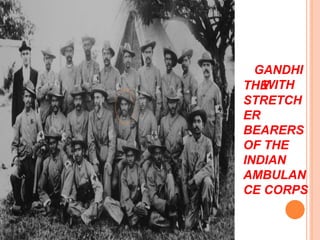
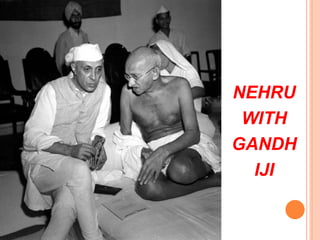
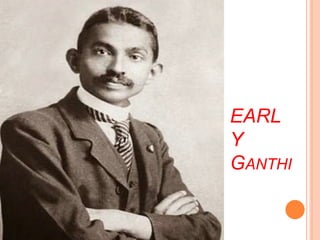
THE ADVENT OFMAHATMA
GANDHI
Mahatma Gandhi returned from South Africa in
1915. Because of his movements against racial
restrictions in South Africa, he had already become
a respected leader.
Mahatma Gandhi first wanted to understand the
people, their needs and overall situation in India.
Hence, he spent his first year in India in travelling
throughout the country.
His earliest participation in local movements was in
Champaran, Kheda and Ahmadabad.
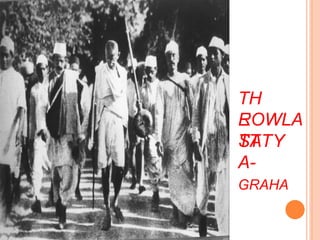
THE ROWLATT SATYAGRAHA
The Rowlatt Act was passed in 1919. The Act curbed
the freedom of expression and strengthened police
powers. Gandhiji gave a call for a satyagraha against
the Rowlatt Act. He asked the people to observe 6 April
1919 as the day of non-violent opposition to this Act.
Satyagraha Sabhas were set up to launch the
movement.
The Rowlatt Satyagraha became the first all-India
struggle against the British government. However, it was
mainly restricted to the cities. Many demonstrations and
hartals took place in the country. The government used
brutal measures to suppress the revolt. The Jalianwala
Bagh massacre was one example of such brutal
measures. Rabindranath Tagore renounced his
knighthood in protest of Jalianwala Bagh incident.
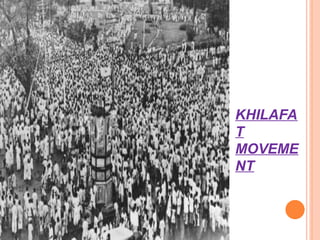
KHILAFAT AGITATION AND
THENON- COOPERATION
MOVEMENT
After the First World War, a harsh treaty was imposed
on the Turkish Khalifa. The leaders of the Khilafat
Agitation; Mohammad Ali and Shaukat Ali wanted to
associate with the Non-Cooperation Movement. The
Muslims wanted the Khalifa to retain control over Muslim
sacred places in the erstwhile Ottoman Empire. Gandhiji
supported the Khilafat Movement.
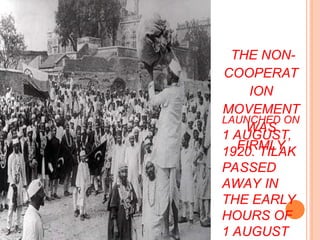
The Non-Cooperation Movement gained momentum
through 1921-22. Thousands of students left schools
and colleges to join the movement. Many eminent
professionals gave up their profession to join the
movement. Bonfires of foreign cloths were burnt. The
boycott of foreign cloths resulted in imports falling
drastically between 1920 and 1922.
PEOPLE’S INITIATIVES
TheNon-Cooperation Movement remained non-violent at most of
the places. But some people interpreted the message of Mahatma
Gandhi in their own ways; mostly to suit their local grievances.
The Patidar peasants of Kheda (Gujarat) organized non-violent
campaigns against the high land revenue demand.
Liquor shops were picketed in coastal Andhra and interior Tamil
Nadu.
The tribals and poor peasants in Guntur district (Andhra Pradesh)
staged a number of forest satyagrahas; to protest against the new
forest laws.
The Khilafat-Non-Cooperation Movement gave enormous support
in Sind and Bengal.
In Punjab, the Akali agitation of the Sikhs demanded to remove the
corrupt mahants from gurdwaras.
In Assam, the tea garden labourers demanded a big hike in their
wages. They shouted the slogan, “Gandhi Maharaj ki jai”. In many
folk songs of Assam; Gandhiji was referred to as “Gandhi Raja”.
THE HAPPENINGS OF1922-1929
Chauri Chaura: In February 1922, a police station in Chauri Chaura was
set on fire by a crowd. The peasants were retaliating against police firing
on peaceful demonstration. Twenty two policemen were killed in the
Chauri Chaura incident. Saddened by this incident, Mahatma Gandhi
called off the Non-Cooperation Movement.
After that, Gandhiji’s followers wanted to take on constructive work in the
rural areas to increase the base for the Congress. On the other hand,
some leaders wanted to fight elections to the councils. They wanted to
enter the government so that they could influence certain policies. The
Gandhians worked in villages during the mid-1920s and could be able to
extend their support base. This proved very useful during the Civil
Disobedience movement.
The Rashtriya Swayamsevak Sangh (RSS) and the Communist Party of
India were formed during the mid-1920s. The revolutionary leader
Bahgat Singh was also active in this period.
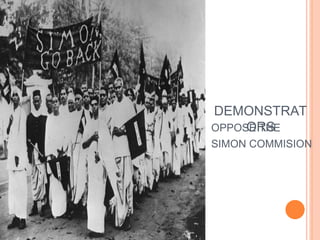
Simon Commission: The British government decided to send a
commission in 1927 to decide on India’s political future. This was headed
by Lord Simon but it had no Indian representative. Absence of an Indian
in the Commission infuriated the political groups in India.
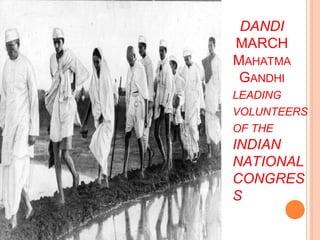
THE MARCH TO
DANDI
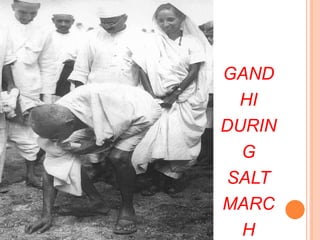
The salt law gave a monopoly right to the state on the manufacture and
sale of salt. Mahatma Gandhi and other nationalist leaders argued that
salt was an essential item of our food and hence it was wrong to impose
a tax on salt. Moreover, the issue of salt affected all; the rich and poor;
alike. Gandhiji declared that he would lead a march to break the salt
law. Gandhiji and his followers marched from Sabarmati to Dandi to
break the salt law. Gandhiji picked up a handful of salt to symbolically
protest the salt tax.
The salt movement attracted supporters from all walks of life; including
the peasants, tribals and women. The government tried to crush the
movement by taking brutal actions. Thousands were sent to jail. Most of
the eminent leaders were arrested.
The Government of India Act of 1935 prescribed provincial autonomy.
Elections to provincial legislatures were held in 1937. The Congress
formed governments in 7 out of 11 provinces.
The Second World War broke out in 1939. The Congress leaders were
critical of Hitler and hence they decided to support the British in the war.
But they wanted independence of India after the war; in return of this
gesture. However, the British did not agree with this demand. The
Congress ministries resigned in protest.
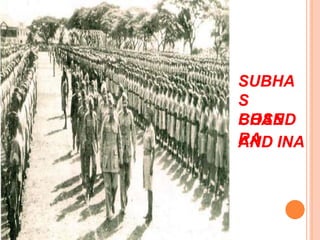
INDIAN NATIONAL ARMY[INC]
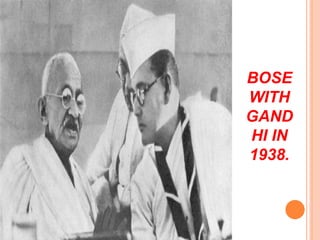
The entry of India into the war was strongly opposed by Subhas
Chandra Bose, who had been elected President of the Congress in
1938 and 1939, but later resigned due to differences in opinion with
Gandhi. However, he remained a member of the Congress throughout
his life. Bose then founded the All India Forward Bloc. In 1940, a year
after war broke out, the British had put Bose under house arrest in
Calcutta. However, he escaped and made his way
through Afghanistan to Nazi Germany to seek Hitler and
Mussolini's help for raising an army to fight the British.
The Free India Legion comprising Erwin Rommel's Indian POWs was
formed. However, in light of Germany's changing fortunes, a German
land invasion of India became untenable and Hitler advised Bose to
go to Japan and arranged for a submarine. Bose was ferried to
Japanese Southeast Asia .Its aim was to reach India as a fighting
force that would build on public resentment to inspire revolts among
Indian soldiers to defeat the British raj.
The INAwas to see action against the allies,
including the British Indian Army, in the forests of
Arakan, Burma and in Assam, laying siege on
Imphal and Kohima with the Japanese 15th Army.
During the war, the Andaman and
Nicobar islands were captured by the Japanese and
handed over by them to the INA.
The INA failed owing to disrupted logistics, poor
supplies from the Japanese, and lack of training. It
surrendered unconditionally to the British in
Singapore in 1945. Bose, however, attempted to
escape to Japanese-held Manchuria in an attempt
to escape to the Soviet Union, marking the end of
the entire Azad Hind movement.
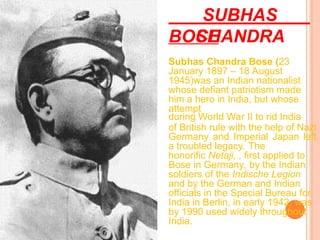
44.
SUBHAS
CHANDRA
BOSE
Subhas Chandra Bose(23
January 1897 – 18 August
1945)was an Indian nationalist
whose defiant patriotism made
him a hero in India, but whose
attempt
during World War II to rid India
of British rule with the help of Nazi
Germany and Imperial Japan left
a troubled legacy. The
honorific Netaji, , first applied to
Bose in Germany, by the Indian
soldiers of the Indische Legion
and by the German and Indian
officials in the Special Bureau for
India in Berlin, in early 1942, was
by 1990 used widely throughout
India.
45.
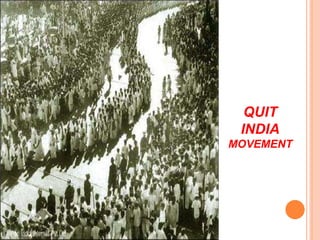
QUIT INDIA ANDLATER
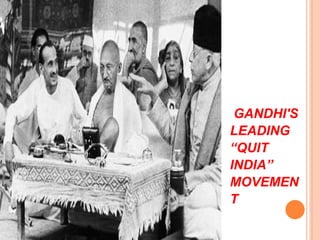
Mahatma Gandhi decided to begin a new phase of
movement against the British; while the Second
World War was going on. Gandhiji urged the people
to “DO OR DIE”. Gandhiji and several other leaders
were arrested. Nevertheless, the movement spread.
Peasants and youths participated in the movement
in large numbers. Symbols of state authority were
attacked all over the country. Telephone lines were
cut off. People set up their own governments in
many areas.
The British responded with severe repression. By
the end of 1943, over 90,000 people were arrested
and around 1,000 were killed in police firing. But the
Raj had to finally concede the ground.
TOWARDS INDEPENDENCE AND
PARTITION
Demand for Separate Nation: In the 1940, the Muslim League
moved a resolution to demand “Independent States” for the
Muslims in the north-western and eastern areas of the country.
From the late 1930s, the League began to visualize the Muslims
as a separate nation from the Hindus. This notion escalated the
tension between some Hindu and Muslim groups in the 1920s
and 1930s. Furthermore, the results of the provincial elections of
1937 apparently convinced the League that Muslims were a
minority.
The League feared the Muslims would have play second fiddle
in any democratic structure in the future. The Congress’
rejection to form a joint Congress-League government in the
United Provinces in 1937 further annoyed the League.
The Congress somehow failed in mobilizing the Muslims in the
1930s. This allowed the League to widen its support base. At
the end of the war in 1945, the British facilitated negotiations
between the Congress, the League and themselves for the
independence of India. The League persisted with its demand
for Pakistan.
Cabinet Mission:In March 1946, a three-member Cabinet
Mission was sent to Delhi to suggest suitable framework
for independent India. The Mission suggested a loose
confederation; with some autonomy for Muslim-majority
areas. But the Congress and the Muslim League could
not agree to specific details of the proposal.
After the failure of the Cabinet Mission, the Muslim
League decided on mass agitation for winning its
Pakistan demand. It announced 16 August 1946 as
“Direct Action Day”. Riots broke out in Calcutta on this
day. The riot lasted for several days in which thousands
of people were killed. The violence spread to different
parts of north India; by March 1947.
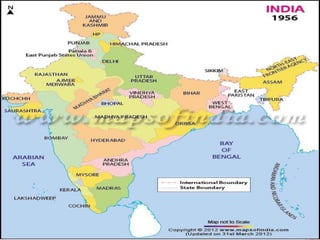
Finally, partition turned into a reality and two new nations;
India and Pakistan were born.
51.
WHAT WE HAVEUNDERSTOOD [SUMMARY]
By the 1850s, Indians from all walks of life were beginning to realize
their loss of identity and wanted to end the British rule.
In the 1870s and 1880s the dissatisfaction was intensified with new
laws imposed by the British. The Arms Act of 1878 was passed that
stopped Indians from owning arms. This was followed by the
Vernacular Press Act, which allowed the British to confiscate the assets
of any newspaper that wrote against them. The final straw came when
the British opposed the Ilbert Bill, which allowed Europeans to be tried
by Indians in court.
This led to the setting up of organizations like the Indian National
Congress, the Indian Association, the Bombay Presidency Association
and the Poona Sarvajanik Sabha. The Indian National Congress was
formed in December 1885.
The Congress, in its initial years, adopted a moderate outlook in its
demands. It demanded more Indians in high positions in the
government, the abolishment of the Arms Act, the separation of the
executive from the judiciary, and the freedom of speech and expression
for the Indians.
o The Congresspassed resolutions on issues like forest laws,
the salt tax, and the welfare of Indian labourers working
abroad.
o By the 1890s, the moderate rationale of the Congress was
questioned by many radically thinking Indians like Lala Lajpat
Rai, Bal Gangadhar Tilak and Bipin Chandra Pal. These
leaders believed in self-reliance rather waiting for the British
government to understand the needs of the Indians.
In 1905, the British partitioned Bengal which enraged Indians
leading to the Swadeshi Movement. It advocated national
education, self-help, Swadeshi enterprise and the use of
Indian languages. The partition of Bengal was supported by
the All India Muslim League, an organization formed in
Dacca, in 1906.
o The Congress split in 1907, and was now led by the
moderates, while the radical group led by Tilak worked
separately. In 1915, both the groups united again and signed
the historic Lucknow Pact in 1916 with the All India Muslim
League.
54.
MESSAGE FROM
AUTHOR
Hopeyou all like my power point
presentation. This ppt is done for you by -
ARJUN.P
CLASS :8C
SCHOOL :KENDRIYA VIDYALAYA SAP
Email ID :
arjunpratheeptvm@gmail.co




![HISTORYProjectOutline class 10 of icse board education]](https://cdn.slidesharecdn.com/ss_thumbnails/historyprojectoutline10-240727055256-780bf30f-thumbnail.jpg?width=640&height=640&fit=bounds)


