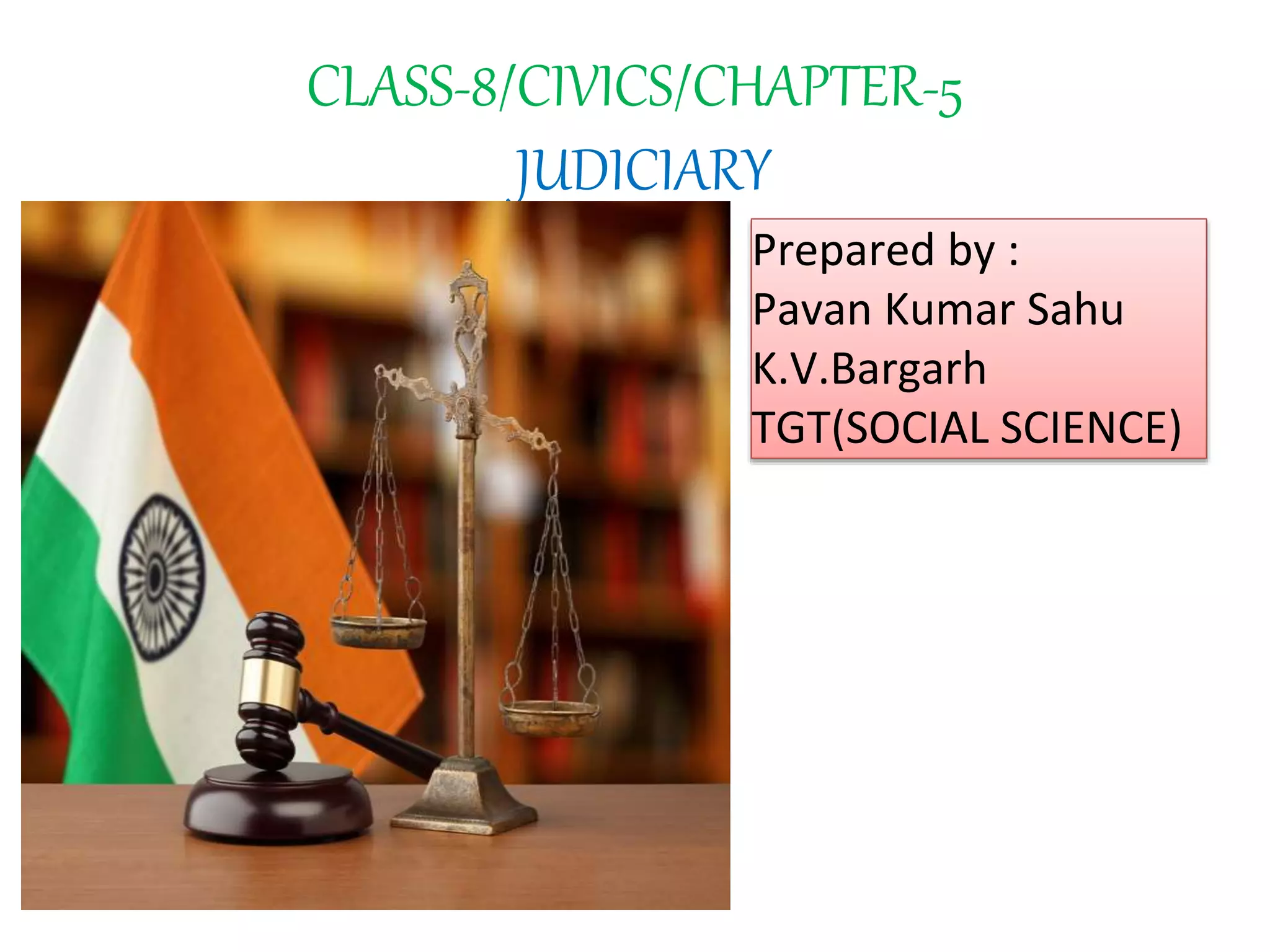
CLASS-8/CIVICS/CHAPTER-5
JUDICIARY
Prepared by :
Pavan Kumar Sahu
K.V.Bargarh
TGT(SOCIAL SCIENCE)
Introduction
• In India we have a rule of law
• It means that laws apply equally to all persons and
that a certain set of fixed procedures need to be
followed when a law is violated.
• To enforce this law, we have a judicial system that
consists of mechanism of courts that a citizen can
approach when a law is violated.
• As an organ of the State the Judiciary plays a
crucial role in the functioning of India's
democracy.
• It can play this role only because it is
independent.
2
What is the Role of Judiciary....
• Courts take decisions on a very large no
of issues.
• They can decide that no teacher can beat
a student, or about the sharing of river
waters between states, or they can punish
people for particular crimes.
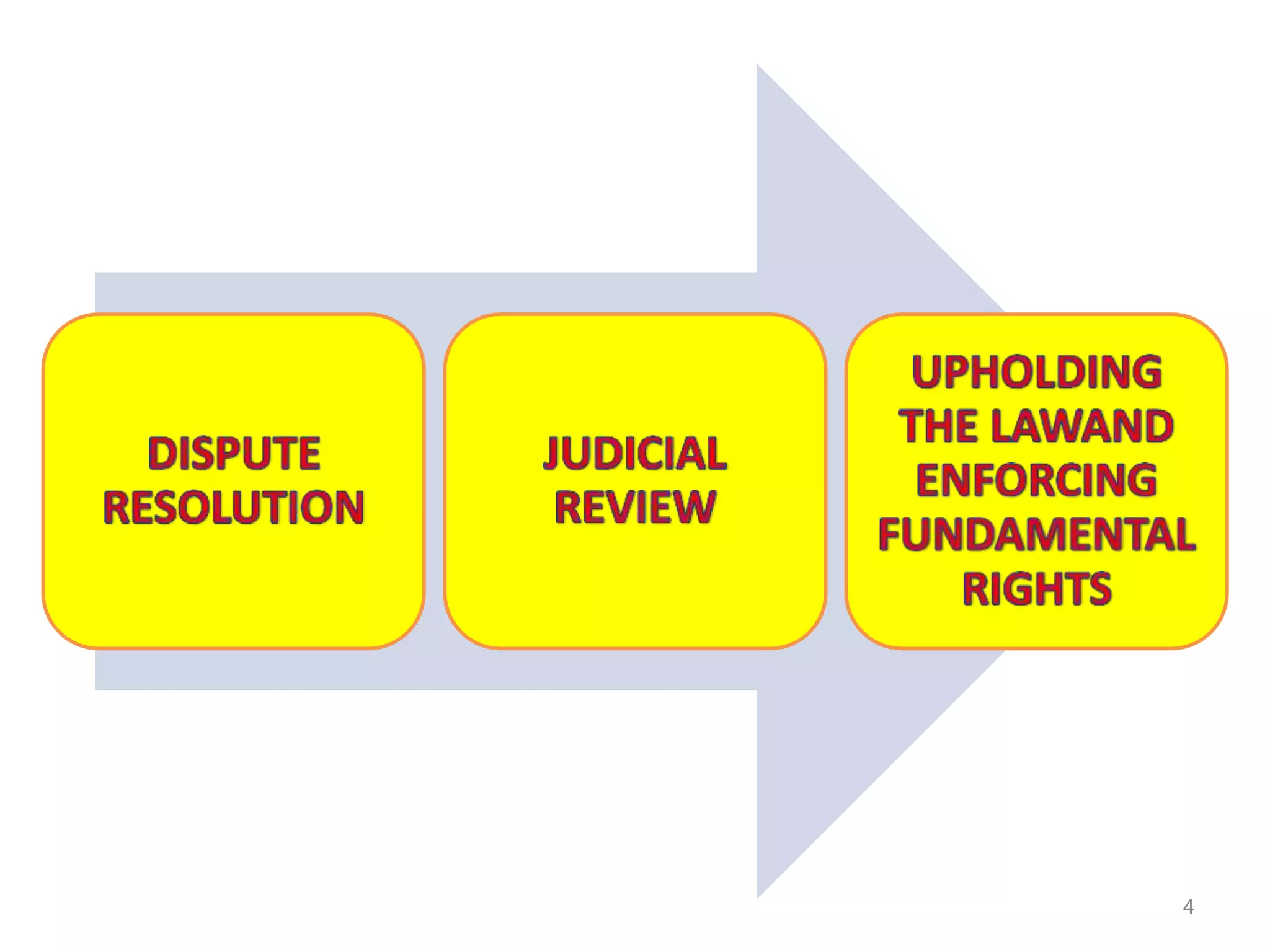
• The work of the judiciary can be divided
into the following.
3
4
• The judicial system provides a
resolving
citizens,
mechanism
disputes
between
for
between
citizens and the
government, between two states
governments and between the
centre and the state
governments. 5
• As the final interpreter of the
Constitution, the judiciary also has
the power to
particular laws
strike down
passed by the
Parliament if it believes that these
are a violation of the basic
structure of the Constitution. This
is called JUDICIALREVIEW.
6
• Every Indian citizen can
approach the Supreme Court
or he High
believe
Fundamental
Court
that
rights
if they
their
have
been violated.
7
• The Indian Constitution protects the
citizens against the influence of the rich and
powerful people by providing for the
independence of Judiciary.
• This is done by the ‘Separation of Powers’.
• It means that the other branches of the state
like the Legislature and the Executive –
cannot interfere in the work of the
Judiciary.
• The courts are not under the government
8
• The courts are not under the Government
and do no act on their behalf.
• The Supreme Court and the High Court
Judges as appointed with very little
of
interference from other branches
government.
• Once appointed it is very difficult to remove
a judge.
• It is the independence of the judiciary that
allows the courts to play a central role in
ensuring that there is no misuse of power by
the LEGISLATURE and the EXECUTIVE. 9
• It also plays a crucial role in protecting the
fundamental Rights of citizens because
anyone can approach the courts it they
believe that their rights have been violated.
10
THE STRUCTURE OF COURT IN INDIA
• There are different levels of courts in India.
• There are several courts at the lower level while
there is only one at the APEX level.
• The courts that most people interact with are what
are called SUBORDINATE or DISTRICT
COURTS.
• These are usually at the district or Tehsil level or in
towns and they hear many kinds of cases.
• Each state is divided into districts that are
Presided over bhy a DISTRICT JUDGE.
12
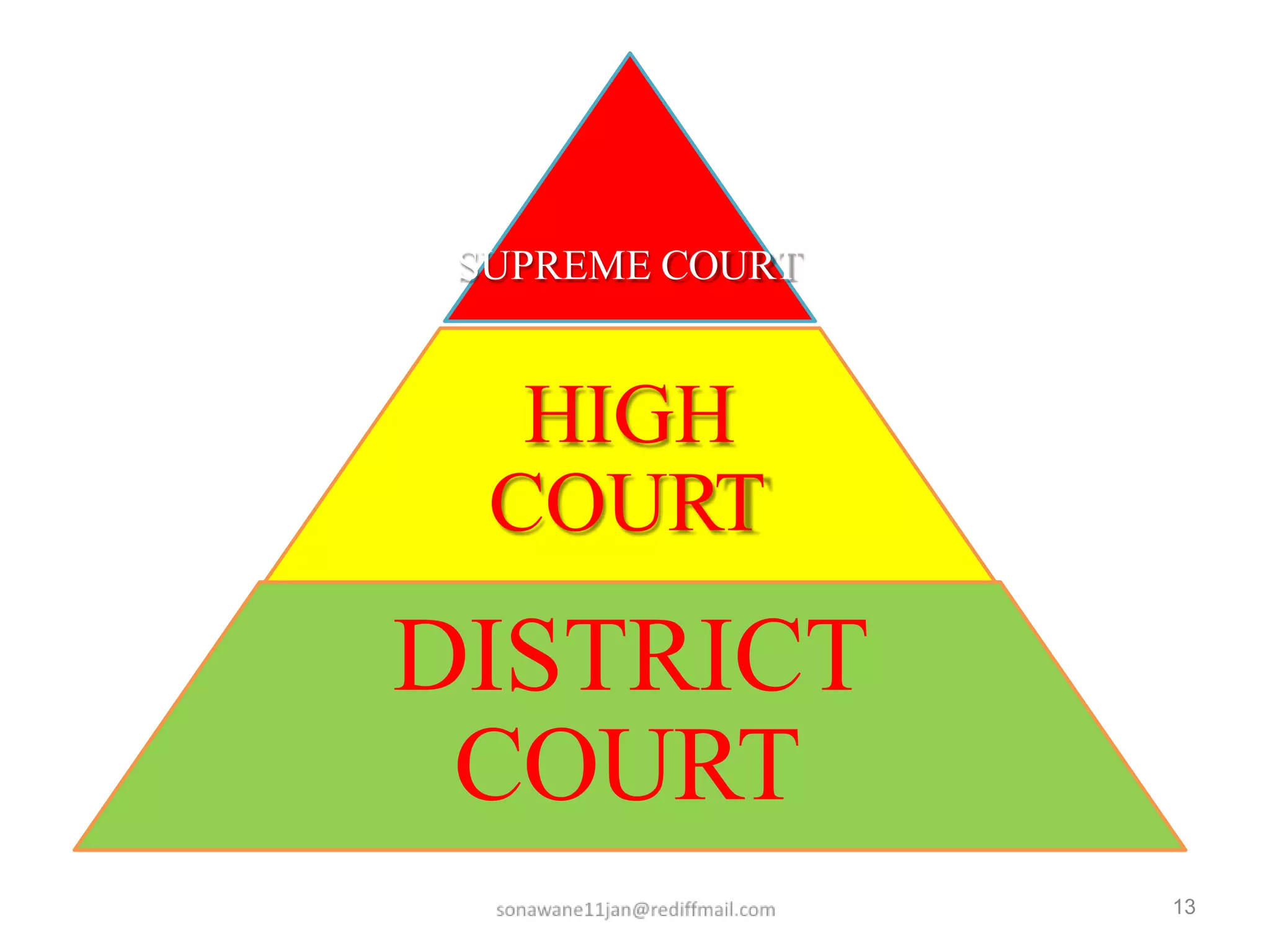
SUPREME COURT
HIGH
COURT
DISTRICT
COURT
13
• In India we have a integrated judicial
system, meaning the decisions made by
the higher courts are binding on the
lower courts.
• Another way is through the appellate
system that exists in India.
• This means that a person can appeal to
a higher court it they believe that the
judgment passed by the lower court is
not just.
14
There are two different
branches of legal system in
India .
1. Criminal Law
2. Civil Law
15
• Criminal law deals with conducts or acts
that the law defines as offences. For
example. Theft harassing a woman to bring
more dowry, murder.
• It usually begin with the lodging of an FIR
(First Information Report) with the police
who investigate the crime after which a case
is filed in the court.
• If found guilty, the accused can be sent to
jail and also fined
16
• Civil law deals with any harm or injury to
rights of individuals. For example, disputes
relating to the sale of land, purchase of goods,
rent matters, divorce cases.
• A petition has to be filed before the relevant
court by the affected party only. In a rent
matter either the landlord to tenant can file a
case.
• The court gives the specific relief asked for.
For instance, in a case between a landlord
and a tenant, a court can order the flat to be
cated and pens
d
ona
iw
n
ang
e11ja
r
n@
ere
n
dift
fma
t
il.o
combe paid. 17
• In principle, all citizens of India can
access the courts in this country.
• This implies that every citizen has a
right to justice through the courts.
• The courts play a very significant role in
protecting our fundamental right, if any
citizen believes that their rights are
being violated, then they can approach
the court for justice to be done.
18
• While the courts are available for all,
in reality access to courts have always
been difficult for a vast majority of the
poor in India.
• Legal procedures involve a lot of
money and paperwork as well as take a
lot of time. For a poor person who
cannot read and whose family depends
on daily wage, the idea of going to
court to get justice often seems remote.
19
• In response to the situation in India the
Supreme Court in the early 1980’s devised a
mechanism of Public Interest Litigation of PIL
to increase access to justice.
• It allowed any individual or organization to
file a PIL in the HIGH COURT or the
SUPREME COURT on behalf of those whose
rights were being violated.
• The legal process was greatly simplified and
even a letter or telegram addressed to the
Supreme Court or the High Court could be
treated as a PIL.
20
• In the early years, PIL was used to secure
justice on a large number of issues such
as rescuing bonded labourers from
inhuman work conditions ; and securing
the release of prisioners in Bihar who had
been kept in jail even after their
punishment term was complete.
• The mid-day meal that children now
receive in government and government
aided schools is because of PIL.
21
• For the common person, access to courts is
access to justice. The courts exercise a crucial
role in interpreting the Fundamental Rights of
citizens.
• There are also court judgments that people
believe work against the best interests of the
common person.
• For example - the activists who work on issues
concerning the right to shelter and housing for
the poor believe that the recent court
judgments on EVICTIONS are a far cry from
earlier judgment. 22
• The recent judgments tend to view the slum
dwellers as an encroacher in the city, earlier
judgments like the 1985 Olga Tellis vs
Mumbai Muncipal Corporation had tried to
protect the livelihoods of slum dwellers.
• Another issues that affects the common
persons access to justice is the inordinately
long years that court takes to hear a case.
JUSTICE DENIED’ is often used
The phrase ‘JUSTICE DELAYED IS
to
characterise this extended time period that
court take.
23
• However, inspite of this there is no denying
fact that the judiciary has played a crucial
role in democratic India, serving as a check
on the powers of the executive and the
legislature as well as in protecting the
fundamental Rights of citizens.
• The members of the Constituent Assembly
had quite correctly envisioned a system of
courts with an independent judiciary as a
key feature of our democracy.
24
• In a speech made on 26th November 2007,
Chief Justice of India K. G.
the former
Balakrishnan noted that. “The Indian
judiciary consists of one Supreme Court
with 26 Judges, 21 High Courts with a
sanctioned strength of 725 Judges ( working
strength of 597 as on 1st March 2007) and
14,477 subordinate Courts/Judges (working
strength of 11,767 as on December 2006)
25
26

CLASS 8 JUDICIARY.pptx

  • 1.
    CLASS-8/CIVICS/CHAPTER-5 JUDICIARY Prepared by : PavanKumar Sahu K.V.Bargarh TGT(SOCIAL SCIENCE)
  • 2.
    Introduction • In Indiawe have a rule of law • It means that laws apply equally to all persons and that a certain set of fixed procedures need to be followed when a law is violated. • To enforce this law, we have a judicial system that consists of mechanism of courts that a citizen can approach when a law is violated. • As an organ of the State the Judiciary plays a crucial role in the functioning of India's democracy. • It can play this role only because it is independent. 2
  • 3.
    What is theRole of Judiciary.... • Courts take decisions on a very large no of issues. • They can decide that no teacher can beat a student, or about the sharing of river waters between states, or they can punish people for particular crimes. • The work of the judiciary can be divided into the following. 3
  • 4.
  • 5.
    • The judicialsystem provides a resolving citizens, mechanism disputes between for between citizens and the government, between two states governments and between the centre and the state governments. 5
  • 6.
    • As thefinal interpreter of the Constitution, the judiciary also has the power to particular laws strike down passed by the Parliament if it believes that these are a violation of the basic structure of the Constitution. This is called JUDICIALREVIEW. 6
  • 7.
    • Every Indiancitizen can approach the Supreme Court or he High believe Fundamental Court that rights if they their have been violated. 7
  • 8.
    • The IndianConstitution protects the citizens against the influence of the rich and powerful people by providing for the independence of Judiciary. • This is done by the ‘Separation of Powers’. • It means that the other branches of the state like the Legislature and the Executive – cannot interfere in the work of the Judiciary. • The courts are not under the government 8
  • 9.
    • The courtsare not under the Government and do no act on their behalf. • The Supreme Court and the High Court Judges as appointed with very little of interference from other branches government. • Once appointed it is very difficult to remove a judge. • It is the independence of the judiciary that allows the courts to play a central role in ensuring that there is no misuse of power by the LEGISLATURE and the EXECUTIVE. 9
  • 10.
    • It alsoplays a crucial role in protecting the fundamental Rights of citizens because anyone can approach the courts it they believe that their rights have been violated. 10
  • 11.
    THE STRUCTURE OFCOURT IN INDIA • There are different levels of courts in India. • There are several courts at the lower level while there is only one at the APEX level. • The courts that most people interact with are what are called SUBORDINATE or DISTRICT COURTS. • These are usually at the district or Tehsil level or in towns and they hear many kinds of cases. • Each state is divided into districts that are Presided over bhy a DISTRICT JUDGE.
  • 12.
  • 13.
  • 14.
    • In Indiawe have a integrated judicial system, meaning the decisions made by the higher courts are binding on the lower courts. • Another way is through the appellate system that exists in India. • This means that a person can appeal to a higher court it they believe that the judgment passed by the lower court is not just. 14
  • 15.
    There are twodifferent branches of legal system in India . 1. Criminal Law 2. Civil Law 15
  • 16.
    • Criminal lawdeals with conducts or acts that the law defines as offences. For example. Theft harassing a woman to bring more dowry, murder. • It usually begin with the lodging of an FIR (First Information Report) with the police who investigate the crime after which a case is filed in the court. • If found guilty, the accused can be sent to jail and also fined 16
  • 17.
    • Civil lawdeals with any harm or injury to rights of individuals. For example, disputes relating to the sale of land, purchase of goods, rent matters, divorce cases. • A petition has to be filed before the relevant court by the affected party only. In a rent matter either the landlord to tenant can file a case. • The court gives the specific relief asked for. For instance, in a case between a landlord and a tenant, a court can order the flat to be cated and pens d ona iw n ang e11ja r n@ ere n dift fma t il.o combe paid. 17
  • 18.
    • In principle,all citizens of India can access the courts in this country. • This implies that every citizen has a right to justice through the courts. • The courts play a very significant role in protecting our fundamental right, if any citizen believes that their rights are being violated, then they can approach the court for justice to be done. 18
  • 19.
    • While thecourts are available for all, in reality access to courts have always been difficult for a vast majority of the poor in India. • Legal procedures involve a lot of money and paperwork as well as take a lot of time. For a poor person who cannot read and whose family depends on daily wage, the idea of going to court to get justice often seems remote. 19
  • 20.
    • In responseto the situation in India the Supreme Court in the early 1980’s devised a mechanism of Public Interest Litigation of PIL to increase access to justice. • It allowed any individual or organization to file a PIL in the HIGH COURT or the SUPREME COURT on behalf of those whose rights were being violated. • The legal process was greatly simplified and even a letter or telegram addressed to the Supreme Court or the High Court could be treated as a PIL. 20
  • 21.
    • In theearly years, PIL was used to secure justice on a large number of issues such as rescuing bonded labourers from inhuman work conditions ; and securing the release of prisioners in Bihar who had been kept in jail even after their punishment term was complete. • The mid-day meal that children now receive in government and government aided schools is because of PIL. 21
  • 22.
    • For thecommon person, access to courts is access to justice. The courts exercise a crucial role in interpreting the Fundamental Rights of citizens. • There are also court judgments that people believe work against the best interests of the common person. • For example - the activists who work on issues concerning the right to shelter and housing for the poor believe that the recent court judgments on EVICTIONS are a far cry from earlier judgment. 22
  • 23.
    • The recentjudgments tend to view the slum dwellers as an encroacher in the city, earlier judgments like the 1985 Olga Tellis vs Mumbai Muncipal Corporation had tried to protect the livelihoods of slum dwellers. • Another issues that affects the common persons access to justice is the inordinately long years that court takes to hear a case. JUSTICE DENIED’ is often used The phrase ‘JUSTICE DELAYED IS to characterise this extended time period that court take. 23
  • 24.
    • However, inspiteof this there is no denying fact that the judiciary has played a crucial role in democratic India, serving as a check on the powers of the executive and the legislature as well as in protecting the fundamental Rights of citizens. • The members of the Constituent Assembly had quite correctly envisioned a system of courts with an independent judiciary as a key feature of our democracy. 24
  • 25.
    • In aspeech made on 26th November 2007, Chief Justice of India K. G. the former Balakrishnan noted that. “The Indian judiciary consists of one Supreme Court with 26 Judges, 21 High Courts with a sanctioned strength of 725 Judges ( working strength of 597 as on 1st March 2007) and 14,477 subordinate Courts/Judges (working strength of 11,767 as on December 2006) 25
  • 26.