Chartered in 1600, the English East India Company eventually transformed England's Asian
trade into an extensive colonial empire. Initially, the company struggled to establish itself in
India, creating small outposts such as this port at Fort Saint George in Madras. Within 150
years, the company had developed into a major military and political force in India, defeating
other European trading companies and uniting much of India under British rule.
Introduction
 The English East India Company came to India to trade
in Indian goods. Slowly it occupied our Nation and the
pattern of trade changed over the decades.
The British East India Company established
British rule in India.
 In the late eighteenth century the Company was buying
goods in India and exporting them to England and
Europe. It made huge profits through trade.
 During this period of time there was a great industrial
revolution all over the world.
 There was tremendous growth in the textile and iron and
steel industries.
 Mechanised production of cotton textiles made Britain
the foremost industrial nation in the nineteenth century.
 The steady growth of the iron and steel industry in
British gave it the distinction of being the ‘work-shop of
the world’.
 British industrialists began to see India as a vast market
for their industrial products.
 Soon goods manufactured in Britain began to flood
India.
 The influx of British goods on the India soil had a
tremendous impact on Indian crafts and industries.
Indian Textiles and the World Market
 India was the world’s largest producer of cotton
textiles; before the British conquered Bengal.
 Indian textiles were well known for its fine quality
and exquisite craftsmanship.
 They were exported to South-east Asian countries
like Java, Sumatra and Penang and West and Central
Asia.
 With the advent of the English East India Company,
European trading companies began buying Indian
textiles for sale in Europe.
 The craftsmanship of Indian weavers is preserved in
many words. These words which are still in use today
weave a wonder story about the history of Indian
textiles.
History of Indian Textiles through ‘Words’
 Fine cotton made in India was exported to Mosul
in present - day Iraq by Arab merchants.
European traders purchased this cotton and
were impressed by the fine quality and called it
“muslin”.
 When the Portuguese first came to India in
search of spices they landed in Calicut on the
Kerala coast in south-west India. The cotton
textiles which they took back to Europe, along
with the spices, came to be called “calico”.
 There are many other words such as muslin and
calico which reveal the reputation of Indian
textiles in Western markets.
 In the year 1730 the English East India Company
ordered 5,89,000 pieces of cloth of 98 varieties of
cotton and silk cloths.
a few varieties of cloth that were produced during that time
 Chintz
 Cossaes
 Bandanna
 Kasimbazar
 Patna
 Calcutta
 Orissa
 Charpoore
The name of the place of origin was sometimes given to the
cloth.
Chintz Bandanna
Indian Textiles in European Markets
 Indian textiles became very popular in
many European countries. This made wool
and silk makers in England protest against
the import of Indian cotton textiles.
 In 1720, the British government banned the
use of printed cotton textiles in England.
The law was called ‘Calico Act’.
 At this time textile industries had just
begun to develop in England.
 The English textile producers found it difficult to
compete with the Indian textiles. Hence they
prevented the entry of Indian textiles into England.
 The English textile producers started printing
Indian designs on white muslin or plain
unbleached Indian cloth.
 To over come the stiff competition from Indian
textiles in the European market, the English
weavers invented new machines to make cloth
cheaper.
 In 1764, the spinning jenny was invented by John
Kaye which increased the productivity of the
traditional spindles.
Spinning Jenny
 The spinning jenny is a multi-
spool spinning wheel. The
device dramatically reduced
the amount of work needed to
produce yarn. A single worker
was able to work eight or more
spools at once.
 In 1786, the invention of the
steam engine by Richard
Arkwright revolutionised
cotton textile weaving.
Richard Arkwright
 Arkwright's achievement was to combine
power, machinery, semi-skilled labor, and a
new raw material (cotton) to create mass
production.
 Cloth could now be woven cheaply and in
immense quantities.
 However, Indian textiles continued to
dominate world trade till the end of the
eighteenth century.
 The Dutch, the French and the English
trading companies made huge profits from
textile trade.
 These companies purchased cotton and silk
textiles in India and paid for it in silver.
When the English East India Company gained
political power in Bengal, it stopped paying
for it with precious metals.
 The company collected revenues from
peasants and zamindars used this revenue to
buy Indian textiles
1. New Delhi
2. Panipat
3. Ludhiana
4. Amritsar
5. Jaipur
6. Jodhpur
7. Bhilwara
8. Ahmedabad
9. Surat
10. Mumbai
11. Ichalkaranji
12. Bangalore
13.Cannanore
14.Cochin
15. Coimbatore
16. Madurai
17. Tirupur
18. Karur
19.Erode
20. Salem
21. Chennai
22. Hyderabad
23. Narsapur
24. Calcutta
Indian Weavers
 Weavers specialised in weaving.
 They passed their skills from one
generation to the next.
 Some of the weaver’s community in India
were …
 The tanti weavers of Bengal
 The julahas or momin weavers of north
India,
 Sale and kaikollar and devangs of south
India
The Art of Weaving
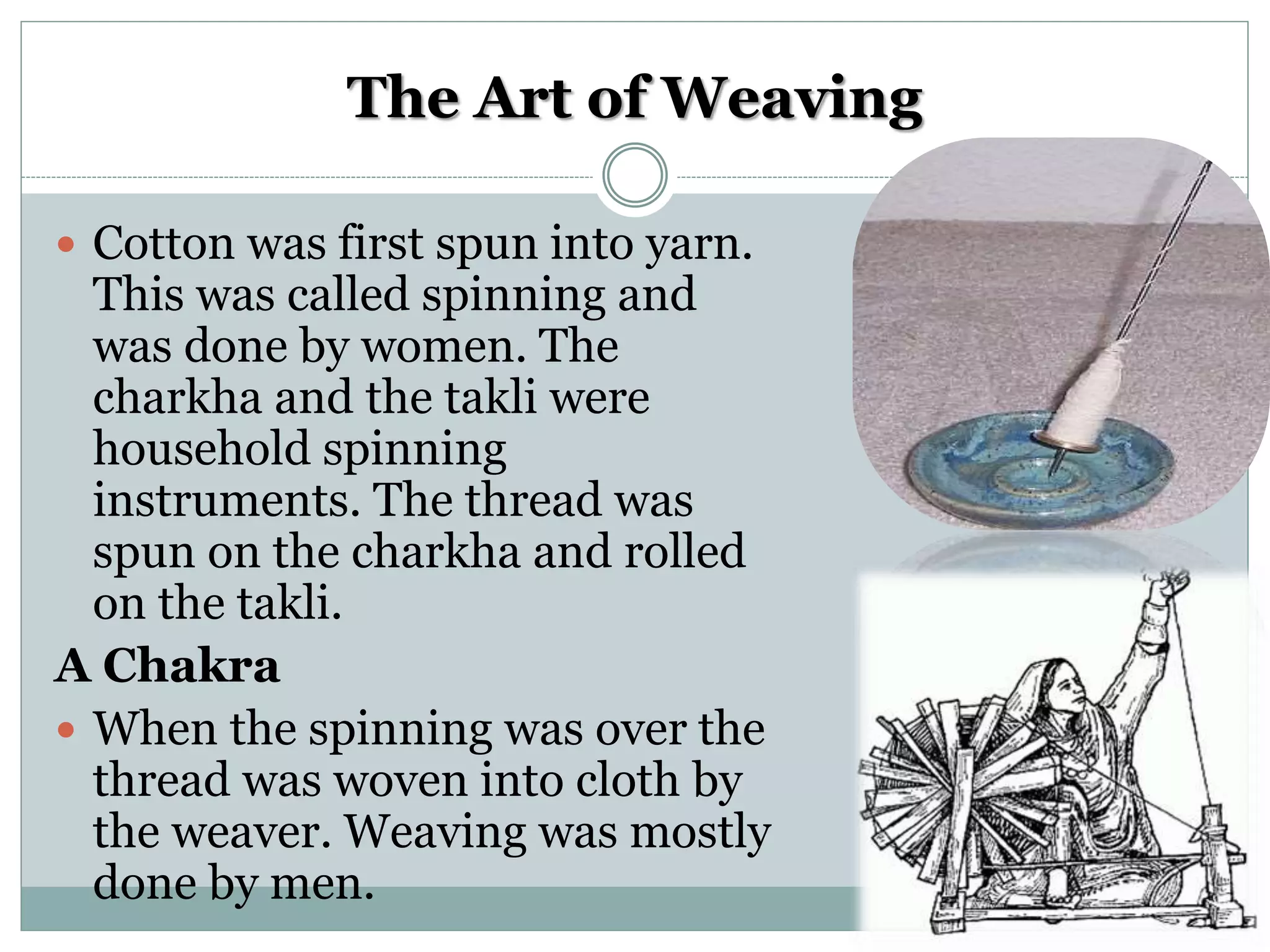
 Cotton was first spun into yarn.
This was called spinning and
was done by women. The
charkha and the takli were
household spinning
instruments. The thread was
spun on the charkha and rolled
on the takli.
A Chakra
 When the spinning was over the
thread was woven into cloth by
the weaver. Weaving was mostly
done by men.
Indian Weaver
 For coloured textiles,
the thread was dyed
by the dyer, known as
rangrez.
 For printed cloth the
weavers needed the
help of specialist block
printers known as
chhipigars.
 Handloom industry
provided livelihood
for millions of
Indians. Block Printers
The decline of Indian textiles
 The development of cotton industries in Britain
affected textile producers in India in several ways.
 Indian textiles now had to compete with British
textiles in the European and American markets.
 Exporting textiles to England became increasingly
difficult as very high duties were imposed on Indian
textiles imported into Britain.
 In the beginning of the nineteenth century, English-
made cotton textiles were preferred to Indian goods.
 Indian textiles lost their market in Africa, America
and Europe.
 Thousands of weavers in India did not have any
work.
 Bengal weavers were the worst hit.
 English and European companies stopped
buying Indian goods.
 During the 1830s British cotton cloth flooded
Indian markets.
 In the 1880s two-thirds of all the cotton clothes
worn by Indians were made of cloth produced in
Britain.
 This affected the entire textile industry in India.
 Thousands of rural women lost their lobs.
Ray of Hope
 Indian weaver knew the art of
weaving intricate designs. This was
not possible in weaving machines that
produced cloth in England. There was
a great demand for the intricately
woven cloth by the rich and middle-
class in India.
Intricate Designs Woven in Cloth
 Indians had another advantage also.
They produced a very coarse variety
of cloth that was cheap and was used
by the poor people in India. There
was a constant demand for this
variety of cloth also.
Coarse Variety of Cloth
 Sholapur in western India and Madurai in South India
emerged as important new centres of weaving in the
late nineteenth century.
 During the national movement, Mahatma Gandhi
urged people to boycott imported textiles and use
hand-spun and hand-woven cloth.
 Khadi gradually became a symbol of nationalism.
 The charkha came to represent India, and it was put at
the centre of the tricolour flag of the Indian National
Congress adopted in 1931.
Flag of the Indian National Congress
 Many weavers who lost
their livelihood became
agricultural labourers.
 Some migrated to cities
in search of work, and
others went out of the
country to work in
plantations in Africa and
South America.
 Some of these handloom
weavers also found work
in the new cotton mills
that were established in
Bombay, Ahmedabad,
Sholapur, Nagpur and
Kanpur.
Mushrooming of Cotton Mills
 From the early nineteenth century raw cotton
was exported from the Bombay port to China and
England.
 In 1854 the first cotton mill in India was set up as
a Spinning mill in Bombay. By 1900, over 84
mills started operating in Bombay. Many of these
were established by Parsi and Gujarati
businessmen who had made their money
through trade with China.
 In 1861 the first mill in Ahmedabad was started.
 In 1862 the first mill in Kanpur was started.
 Growth of cotton mills led to a demand for labour.
Thousands of poor peasants, artisans and agricultural
labourers moved to the cities to work in the mills.
 The textile mills faced some problems initially
 The mills found it difficult to compete with the cheap
textiles imported from Britain.
 In most countries, governments supported
industrialisation by imposing heavy duties on imports.
 The first major boost in the development of cotton
factory production in India was during the First World
War. During this time textile imports from Britain
declined and Indian factories were called upon to
produce cloth for military supplies.
Mumbai Textile Mills
Textile Mill Rollers
The Sword of Tipu Sultan and Wootz Stee
 Tipu Sultan ruled Mysore till 1799. He fought four wars with
the British and died fighting with his sword in his hand.
Tipu’s swords are now part of valuable collections in
museums in England.
The Sword that was found next to Tipu Sultan's Body
after his Death . Tipu Sultan’s Swords
 The swords were special as they were incredibly hard and the
sharp edge could easily rip through the opponent’s armour.
 This quality of the sword came from a special type of high
carbon steel called Wootz. Wootz was produced all over south
India. Wootz steel when made into swords produced a very
sharp edge with a flowing water pattern.
 This pattern came from very small carbon crystals embedded
in the iron.
Making of Tipu Sultan’s Swords
 Francis Buchanan toured through Mysore in 1800, a year
after Tipu Sultan’s death. He has written about the technique
used to prepare the swords.
 Wootz steel was produced in many hundreds of smelting
furnaces in Mysore.
 In these furnaces, iron was mixed with charcoal and put
inside small clay pots.
 Through an intricate control of temperatures the smelters
produced steel ingots that were used for sword making.
 Wootz is an anglicised version of the Kannada word ukku, Telugu
hukku and Tamil and Malayalam urukku – meaning steel.
 Indian Wootz steel fascinated European scientists.
 Michael Faraday, who discovered electricity and electromagnetism,
spent four years studying the properties of Indian Wootz.
 However, the Wootz steel making process, which was so widely
known in south India, was completely lost by the mid-nineteenth
century as the swords and armour making industry died with the
conquest of India by the British.
 Imports of iron and steel from England replaced the iron and steel
produced by craftspeople in India.
Abandoned Furnaces in Villages
 As the British establish political power in India the
production of Wootz steel stopped and iron smelting
furnaces were abandoned.
 Reasons for the Decline of Iron Smelting
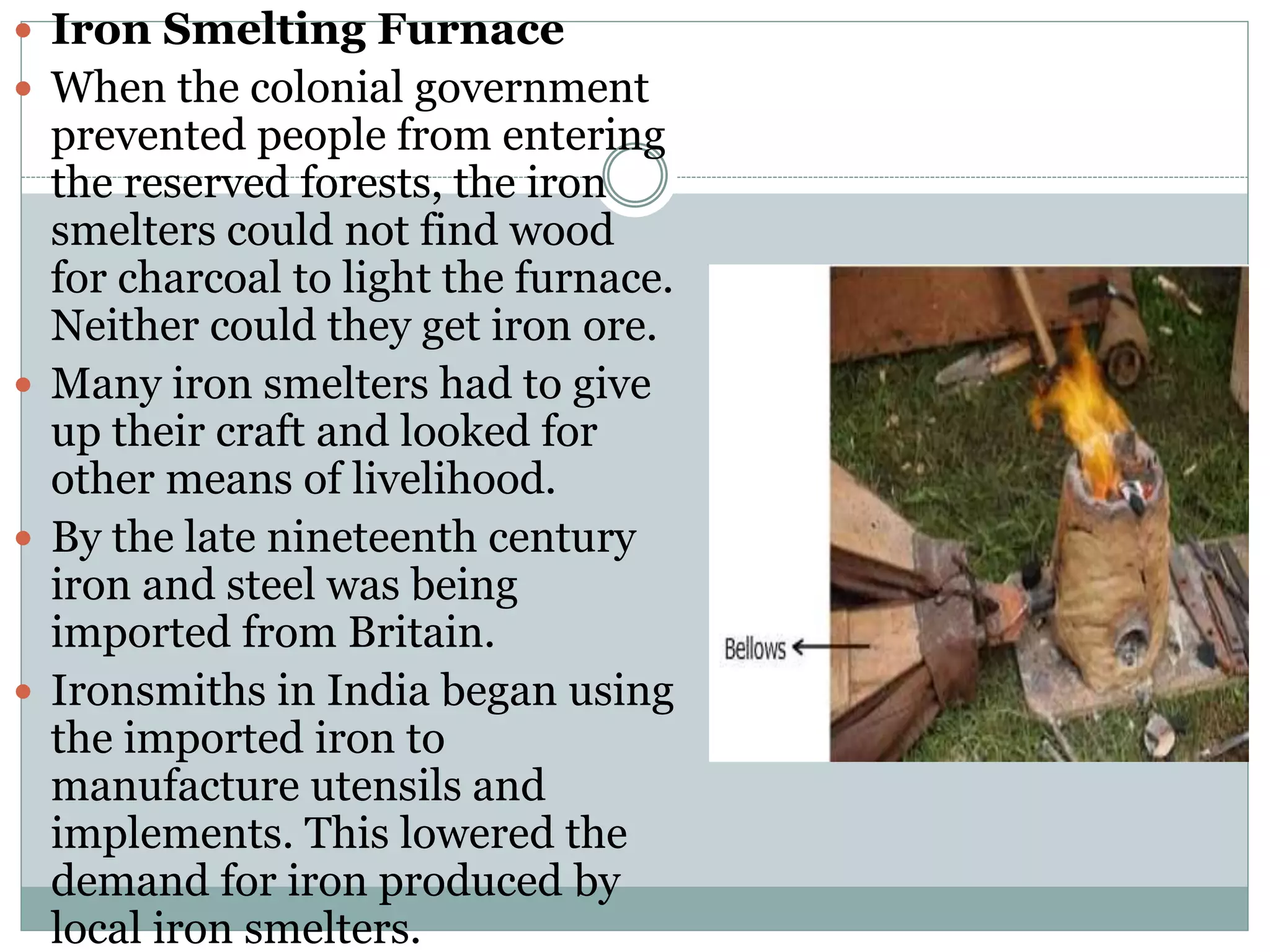
 The furnaces were most often built of clay and sun-dried
bricks. The smelting was done by men while women
worked the bellows, pumping air that kept the charcoal
burning.
 Iron Smelting Furnace
 When the colonial government
prevented people from entering
the reserved forests, the iron
smelters could not find wood
for charcoal to light the furnace.
Neither could they get iron ore.
 Many iron smelters had to give
up their craft and looked for
other means of livelihood.
 By the late nineteenth century
iron and steel was being
imported from Britain.
 Ironsmiths in India began using
the imported iron to
manufacture utensils and
implements. This lowered the
demand for iron produced by
local iron smelters.
Iron and Steel Factories come up in India
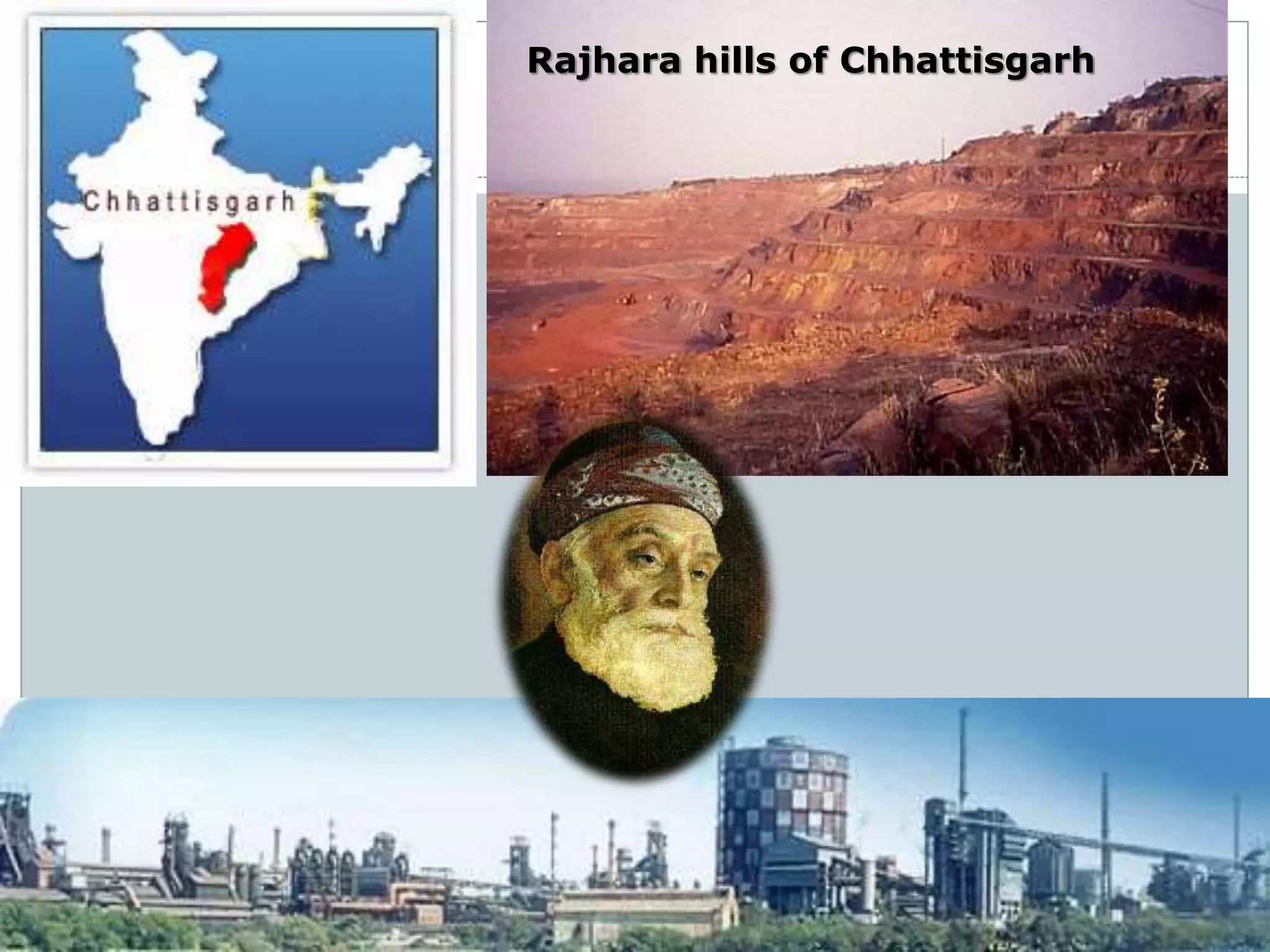
 In the year 1904 American geologist Charles Weld and Dorabji Tata
discovered iron ore in the Rajhara hills of Chhattisgarh. The Agaria
community were native inhabitants of this region.
 Chhattisgarh
 Rajhara Hills had one of the finest ores in the world.
 The Tatas were not able to start their Iron and steel factory near the
Rajhara Hills as the region was very dry. The steel factory needed plenty
of water.
 A few years later a large area of forest was cleared on the banks of the
river Subarnarekha to set up the factory. The industrial township was
named Jamshedpur after Dorabji Tata’s father Jamsetji Tata.
Jamsetji Tata
 The Tata Iron and Steel Company (TISCO) that came up in Jamshedpur began
producing steel in 1912.
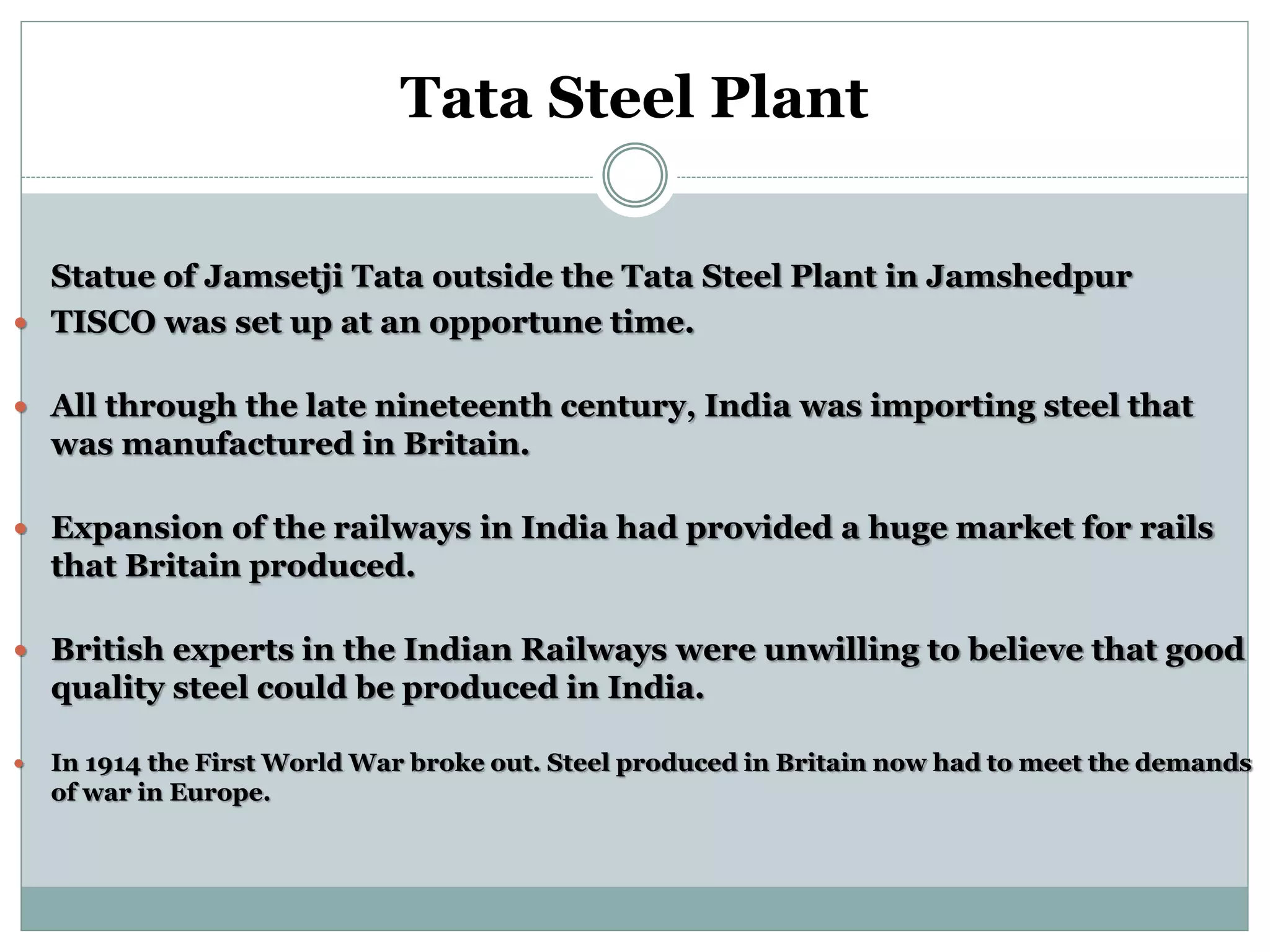
Tata Steel Plant
Statue of Jamsetji Tata outside the Tata Steel Plant in Jamshedpur
 TISCO was set up at an opportune time.
 All through the late nineteenth century, India was importing steel that
was manufactured in Britain.
 Expansion of the railways in India had provided a huge market for rails
that Britain produced.
 British experts in the Indian Railways were unwilling to believe that good
quality steel could be produced in India.
 In 1914 the First World War broke out. Steel produced in Britain now had to meet the demands
of war in Europe.
 Imports of British steel into India declined dramatically and the Indian
Railways turned to TISCO for supply of rails.
 As the war dragged on for several years, TISCO had to produce shells and
carriage wheels for the war.
 By 1919 the colonial government was buying 90 per cent of the steel
manufactured by TISCO.
 Soon TISCO became the biggest steel industry within the British Empire.
 The iron and steel and cotton textiles industries expanded only when
British imports into India declined and the market for Indian industrial
goods increased. This took place during the First World War and after.
 As the independence movement gathered strength the industrial class
became stronger.
 The British government struggled to maintain its control over India. It
had to give in to the many demands of the rising Indians in the last
decades of its colonial rule.
Rajhara hills of Chhattisgarh

chapter 7 history Part 2 Weavers , iron smelters and factory owners

  • 2.
    Chartered in 1600,the English East India Company eventually transformed England's Asian trade into an extensive colonial empire. Initially, the company struggled to establish itself in India, creating small outposts such as this port at Fort Saint George in Madras. Within 150 years, the company had developed into a major military and political force in India, defeating other European trading companies and uniting much of India under British rule.
  • 3.
    Introduction  The EnglishEast India Company came to India to trade in Indian goods. Slowly it occupied our Nation and the pattern of trade changed over the decades. The British East India Company established British rule in India.  In the late eighteenth century the Company was buying goods in India and exporting them to England and Europe. It made huge profits through trade.  During this period of time there was a great industrial revolution all over the world.  There was tremendous growth in the textile and iron and steel industries.
  • 4.
     Mechanised productionof cotton textiles made Britain the foremost industrial nation in the nineteenth century.  The steady growth of the iron and steel industry in British gave it the distinction of being the ‘work-shop of the world’.  British industrialists began to see India as a vast market for their industrial products.  Soon goods manufactured in Britain began to flood India.  The influx of British goods on the India soil had a tremendous impact on Indian crafts and industries.
  • 6.
    Indian Textiles andthe World Market  India was the world’s largest producer of cotton textiles; before the British conquered Bengal.  Indian textiles were well known for its fine quality and exquisite craftsmanship.  They were exported to South-east Asian countries like Java, Sumatra and Penang and West and Central Asia.  With the advent of the English East India Company, European trading companies began buying Indian textiles for sale in Europe.  The craftsmanship of Indian weavers is preserved in many words. These words which are still in use today weave a wonder story about the history of Indian textiles.
  • 8.
    History of IndianTextiles through ‘Words’  Fine cotton made in India was exported to Mosul in present - day Iraq by Arab merchants. European traders purchased this cotton and were impressed by the fine quality and called it “muslin”.  When the Portuguese first came to India in search of spices they landed in Calicut on the Kerala coast in south-west India. The cotton textiles which they took back to Europe, along with the spices, came to be called “calico”.  There are many other words such as muslin and calico which reveal the reputation of Indian textiles in Western markets.
  • 9.
     In theyear 1730 the English East India Company ordered 5,89,000 pieces of cloth of 98 varieties of cotton and silk cloths. a few varieties of cloth that were produced during that time  Chintz  Cossaes  Bandanna  Kasimbazar  Patna  Calcutta  Orissa  Charpoore The name of the place of origin was sometimes given to the cloth. Chintz Bandanna
  • 10.
    Indian Textiles inEuropean Markets  Indian textiles became very popular in many European countries. This made wool and silk makers in England protest against the import of Indian cotton textiles.  In 1720, the British government banned the use of printed cotton textiles in England. The law was called ‘Calico Act’.  At this time textile industries had just begun to develop in England.
  • 11.
     The Englishtextile producers found it difficult to compete with the Indian textiles. Hence they prevented the entry of Indian textiles into England.  The English textile producers started printing Indian designs on white muslin or plain unbleached Indian cloth.  To over come the stiff competition from Indian textiles in the European market, the English weavers invented new machines to make cloth cheaper.  In 1764, the spinning jenny was invented by John Kaye which increased the productivity of the traditional spindles.
  • 12.
    Spinning Jenny  Thespinning jenny is a multi- spool spinning wheel. The device dramatically reduced the amount of work needed to produce yarn. A single worker was able to work eight or more spools at once.  In 1786, the invention of the steam engine by Richard Arkwright revolutionised cotton textile weaving.
  • 13.
    Richard Arkwright  Arkwright'sachievement was to combine power, machinery, semi-skilled labor, and a new raw material (cotton) to create mass production.  Cloth could now be woven cheaply and in immense quantities.  However, Indian textiles continued to dominate world trade till the end of the eighteenth century.  The Dutch, the French and the English trading companies made huge profits from textile trade.  These companies purchased cotton and silk textiles in India and paid for it in silver. When the English East India Company gained political power in Bengal, it stopped paying for it with precious metals.  The company collected revenues from peasants and zamindars used this revenue to buy Indian textiles
  • 14.
    1. New Delhi 2.Panipat 3. Ludhiana 4. Amritsar 5. Jaipur 6. Jodhpur 7. Bhilwara 8. Ahmedabad 9. Surat 10. Mumbai 11. Ichalkaranji 12. Bangalore 13.Cannanore 14.Cochin 15. Coimbatore 16. Madurai 17. Tirupur 18. Karur 19.Erode 20. Salem 21. Chennai 22. Hyderabad 23. Narsapur 24. Calcutta
  • 15.
    Indian Weavers  Weaversspecialised in weaving.  They passed their skills from one generation to the next.  Some of the weaver’s community in India were …  The tanti weavers of Bengal  The julahas or momin weavers of north India,  Sale and kaikollar and devangs of south India
  • 16.
    The Art ofWeaving  Cotton was first spun into yarn. This was called spinning and was done by women. The charkha and the takli were household spinning instruments. The thread was spun on the charkha and rolled on the takli. A Chakra  When the spinning was over the thread was woven into cloth by the weaver. Weaving was mostly done by men.
  • 17.
    Indian Weaver  Forcoloured textiles, the thread was dyed by the dyer, known as rangrez.  For printed cloth the weavers needed the help of specialist block printers known as chhipigars.  Handloom industry provided livelihood for millions of Indians. Block Printers
  • 18.
    The decline ofIndian textiles  The development of cotton industries in Britain affected textile producers in India in several ways.  Indian textiles now had to compete with British textiles in the European and American markets.  Exporting textiles to England became increasingly difficult as very high duties were imposed on Indian textiles imported into Britain.  In the beginning of the nineteenth century, English- made cotton textiles were preferred to Indian goods.  Indian textiles lost their market in Africa, America and Europe.
  • 19.
     Thousands ofweavers in India did not have any work.  Bengal weavers were the worst hit.  English and European companies stopped buying Indian goods.  During the 1830s British cotton cloth flooded Indian markets.  In the 1880s two-thirds of all the cotton clothes worn by Indians were made of cloth produced in Britain.  This affected the entire textile industry in India.  Thousands of rural women lost their lobs.
  • 20.
    Ray of Hope Indian weaver knew the art of weaving intricate designs. This was not possible in weaving machines that produced cloth in England. There was a great demand for the intricately woven cloth by the rich and middle- class in India. Intricate Designs Woven in Cloth  Indians had another advantage also. They produced a very coarse variety of cloth that was cheap and was used by the poor people in India. There was a constant demand for this variety of cloth also.
  • 21.
    Coarse Variety ofCloth  Sholapur in western India and Madurai in South India emerged as important new centres of weaving in the late nineteenth century.  During the national movement, Mahatma Gandhi urged people to boycott imported textiles and use hand-spun and hand-woven cloth.  Khadi gradually became a symbol of nationalism.  The charkha came to represent India, and it was put at the centre of the tricolour flag of the Indian National Congress adopted in 1931.
  • 22.
    Flag of theIndian National Congress  Many weavers who lost their livelihood became agricultural labourers.  Some migrated to cities in search of work, and others went out of the country to work in plantations in Africa and South America.  Some of these handloom weavers also found work in the new cotton mills that were established in Bombay, Ahmedabad, Sholapur, Nagpur and Kanpur.
  • 23.
    Mushrooming of CottonMills  From the early nineteenth century raw cotton was exported from the Bombay port to China and England.  In 1854 the first cotton mill in India was set up as a Spinning mill in Bombay. By 1900, over 84 mills started operating in Bombay. Many of these were established by Parsi and Gujarati businessmen who had made their money through trade with China.  In 1861 the first mill in Ahmedabad was started.  In 1862 the first mill in Kanpur was started.
  • 24.
     Growth ofcotton mills led to a demand for labour. Thousands of poor peasants, artisans and agricultural labourers moved to the cities to work in the mills.  The textile mills faced some problems initially  The mills found it difficult to compete with the cheap textiles imported from Britain.  In most countries, governments supported industrialisation by imposing heavy duties on imports.  The first major boost in the development of cotton factory production in India was during the First World War. During this time textile imports from Britain declined and Indian factories were called upon to produce cloth for military supplies.
  • 25.
  • 26.
    The Sword ofTipu Sultan and Wootz Stee  Tipu Sultan ruled Mysore till 1799. He fought four wars with the British and died fighting with his sword in his hand. Tipu’s swords are now part of valuable collections in museums in England. The Sword that was found next to Tipu Sultan's Body after his Death . Tipu Sultan’s Swords  The swords were special as they were incredibly hard and the sharp edge could easily rip through the opponent’s armour.  This quality of the sword came from a special type of high carbon steel called Wootz. Wootz was produced all over south India. Wootz steel when made into swords produced a very sharp edge with a flowing water pattern.  This pattern came from very small carbon crystals embedded in the iron.
  • 27.
    Making of TipuSultan’s Swords  Francis Buchanan toured through Mysore in 1800, a year after Tipu Sultan’s death. He has written about the technique used to prepare the swords.  Wootz steel was produced in many hundreds of smelting furnaces in Mysore.  In these furnaces, iron was mixed with charcoal and put inside small clay pots.  Through an intricate control of temperatures the smelters produced steel ingots that were used for sword making.
  • 28.
     Wootz isan anglicised version of the Kannada word ukku, Telugu hukku and Tamil and Malayalam urukku – meaning steel.  Indian Wootz steel fascinated European scientists.  Michael Faraday, who discovered electricity and electromagnetism, spent four years studying the properties of Indian Wootz.  However, the Wootz steel making process, which was so widely known in south India, was completely lost by the mid-nineteenth century as the swords and armour making industry died with the conquest of India by the British.  Imports of iron and steel from England replaced the iron and steel produced by craftspeople in India.
  • 30.
    Abandoned Furnaces inVillages  As the British establish political power in India the production of Wootz steel stopped and iron smelting furnaces were abandoned.  Reasons for the Decline of Iron Smelting  The furnaces were most often built of clay and sun-dried bricks. The smelting was done by men while women worked the bellows, pumping air that kept the charcoal burning.
  • 31.
     Iron SmeltingFurnace  When the colonial government prevented people from entering the reserved forests, the iron smelters could not find wood for charcoal to light the furnace. Neither could they get iron ore.  Many iron smelters had to give up their craft and looked for other means of livelihood.  By the late nineteenth century iron and steel was being imported from Britain.  Ironsmiths in India began using the imported iron to manufacture utensils and implements. This lowered the demand for iron produced by local iron smelters.
  • 32.
    Iron and SteelFactories come up in India  In the year 1904 American geologist Charles Weld and Dorabji Tata discovered iron ore in the Rajhara hills of Chhattisgarh. The Agaria community were native inhabitants of this region.  Chhattisgarh  Rajhara Hills had one of the finest ores in the world.  The Tatas were not able to start their Iron and steel factory near the Rajhara Hills as the region was very dry. The steel factory needed plenty of water.  A few years later a large area of forest was cleared on the banks of the river Subarnarekha to set up the factory. The industrial township was named Jamshedpur after Dorabji Tata’s father Jamsetji Tata. Jamsetji Tata  The Tata Iron and Steel Company (TISCO) that came up in Jamshedpur began producing steel in 1912.
  • 33.
    Tata Steel Plant Statueof Jamsetji Tata outside the Tata Steel Plant in Jamshedpur  TISCO was set up at an opportune time.  All through the late nineteenth century, India was importing steel that was manufactured in Britain.  Expansion of the railways in India had provided a huge market for rails that Britain produced.  British experts in the Indian Railways were unwilling to believe that good quality steel could be produced in India.  In 1914 the First World War broke out. Steel produced in Britain now had to meet the demands of war in Europe.
  • 34.
     Imports ofBritish steel into India declined dramatically and the Indian Railways turned to TISCO for supply of rails.  As the war dragged on for several years, TISCO had to produce shells and carriage wheels for the war.  By 1919 the colonial government was buying 90 per cent of the steel manufactured by TISCO.  Soon TISCO became the biggest steel industry within the British Empire.  The iron and steel and cotton textiles industries expanded only when British imports into India declined and the market for Indian industrial goods increased. This took place during the First World War and after.  As the independence movement gathered strength the industrial class became stronger.  The British government struggled to maintain its control over India. It had to give in to the many demands of the rising Indians in the last decades of its colonial rule.
  • 35.
    Rajhara hills ofChhattisgarh