International Financial
Reporting Standards
(IFRS)
Sub: Financial Reporting and Analysis
Course : B.COM (H)
Semester : VI
Teacher: Beenu
Learning Outcomes
• Introduction to IFRS
• IND -AS/Converged IFRS
• Benefits of Adopting IFRS
• Challenges of Adopting IFRS
• Difference between GAAP & IFRS
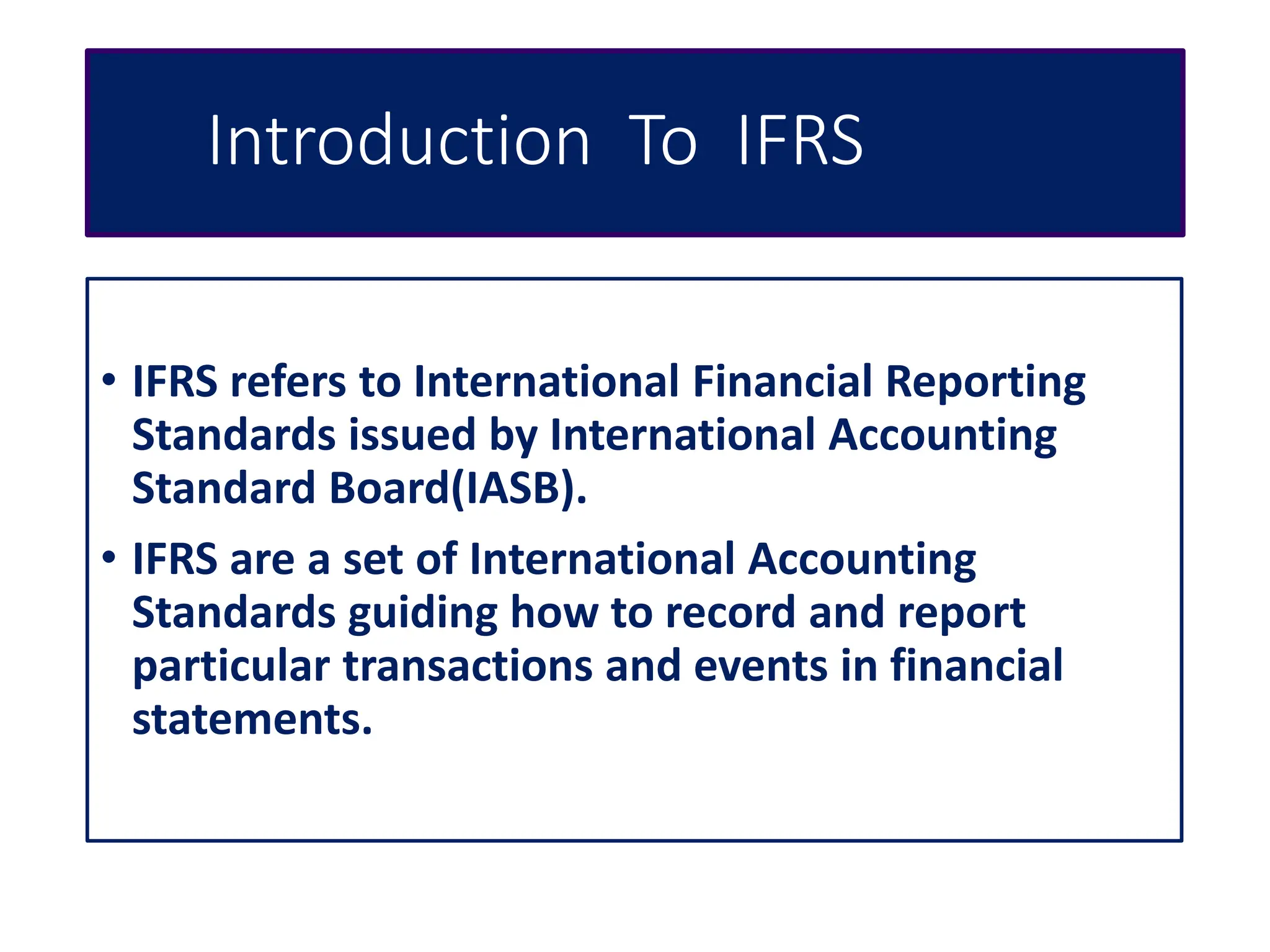
Introduction To IFRS
• IFRS refers to International Financial Reporting
Standards issued by International Accounting
Standard Board(IASB).
• IFRS are a set of International Accounting
Standards guiding how to record and report
particular transactions and events in financial
statements.
IND -AS/Converged IFRS
• In India ,IFRS has been adopted and made
mandatory w.e.f. April 1,2016
• IND -AS refers to Indian version of IFRS.
• India has decided to converge with IFRS instead
of adopting it in its original form.
Benefits of Adopting IFRS
• Financial Statements as per global standards.
• Multiple reporting can be avoided.
• Improve cross- border investment.
• High quality and easy comparison,of financial
statements.
• Transparency in reporting of financial statements.
• Higher level of Consistency.
Benefits of Adopting IFRS
• Benchmarking will become easy.
• High Standards of financial disclosure.
• Raise reputation and relationship of Indian
corporate world with international financial
community.
• Enhance performance of economy at large.
• Easy in raising capital from outside the country at
low cost.
Challenges of Adopting IFRS
• Increased cost of adoption.
• Lack of Skilled resources.
• Difficulty in completing the changed regulatory
requirements.
• Multi-regulatory nature of country.
• Challenges for small and medium accounting
firms.
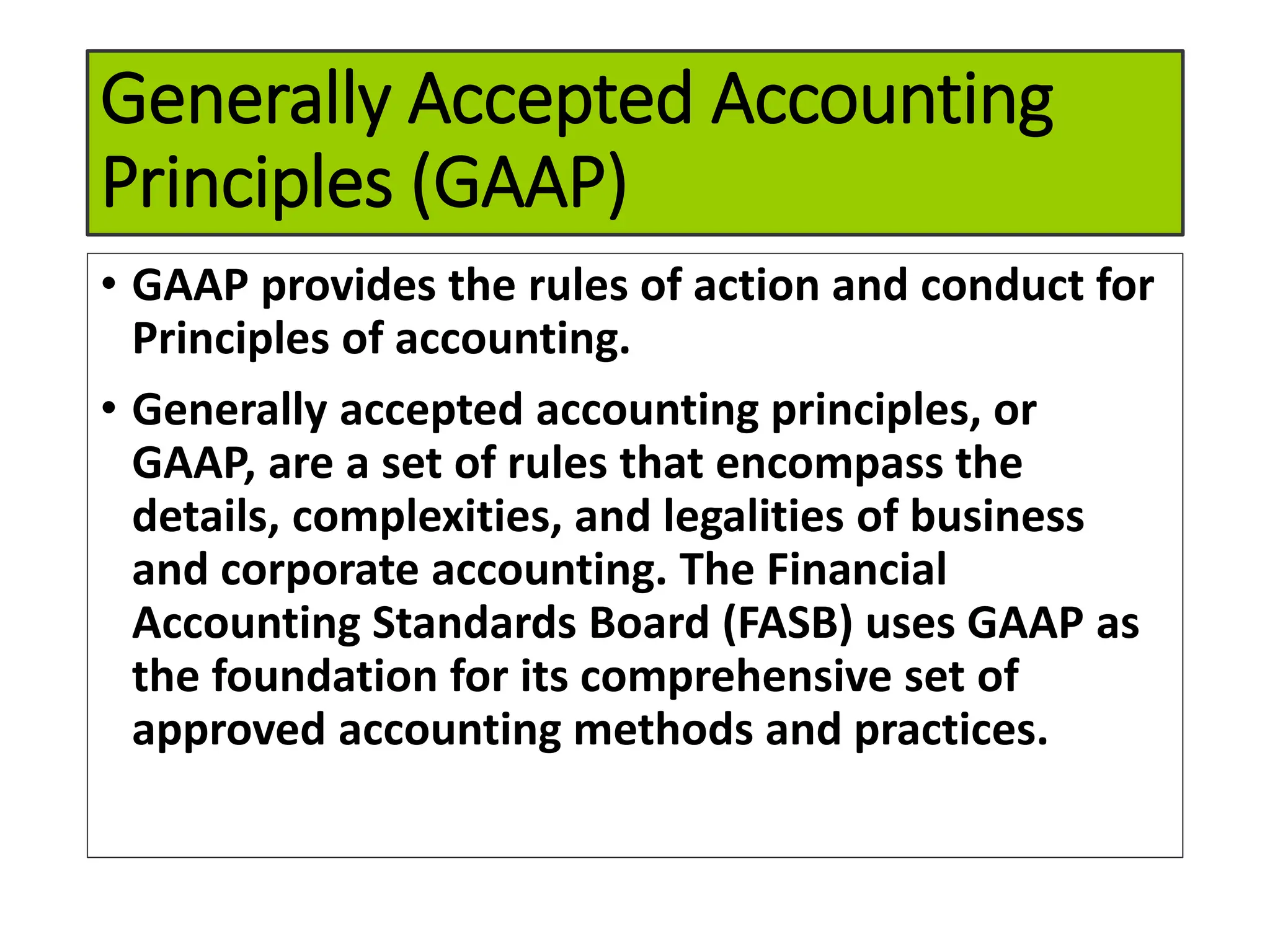
Generally Accepted Accounting
Principles (GAAP)
• GAAP provides the rules of action and conduct for
Principles of accounting.
• Generally accepted accounting principles, or
GAAP, are a set of rules that encompass the
details, complexities, and legalities of business
and corporate accounting. The Financial
Accounting Standards Board (FASB) uses GAAP as
the foundation for its comprehensive set of
approved accounting methods and practices.
Difference between GAAP & IFRS
GAAP
• GAAP are in the
nature of "Rules" to
be followed in
preparation of
financial statements.
• FASB is the authority
responsible for
developing GAAP.
IFRS
• IFRS are in the nature
of "Principles" to be
followed in
preparation of
financial statements.
• International
Accounting Standard
Board deveops the
IFRS
Basis:
Nature
Issuing
Authority
• Three
methods used
ie.LIFO,FIFO
and weighted
Average.
• GAAP, the
research is
more focused
on the
literature
• Only FIFO and
weighted
Average
method can be
used.
• IFRS, the
review of the
facts pattern is
more thorough.
Inventory
Valuation
Methodology
Difference between GAAP & IFRS
The End...
• Financial Reporting and Analysis,Dr.
Priyanka Ostwal,Dr Sakshi Sharma
•
• Financial Reporting and Analysis by Meenu
Gupta,Hersheen Kaur,Rekha Gupta.
•
•

Financial Reporting- IFRS PPT FOR B.COM H

  • 1.
    International Financial Reporting Standards (IFRS) Sub:Financial Reporting and Analysis Course : B.COM (H) Semester : VI Teacher: Beenu
  • 2.
    Learning Outcomes • Introductionto IFRS • IND -AS/Converged IFRS • Benefits of Adopting IFRS • Challenges of Adopting IFRS • Difference between GAAP & IFRS
  • 3.
    Introduction To IFRS •IFRS refers to International Financial Reporting Standards issued by International Accounting Standard Board(IASB). • IFRS are a set of International Accounting Standards guiding how to record and report particular transactions and events in financial statements.
  • 4.
    IND -AS/Converged IFRS •In India ,IFRS has been adopted and made mandatory w.e.f. April 1,2016 • IND -AS refers to Indian version of IFRS. • India has decided to converge with IFRS instead of adopting it in its original form.
  • 5.
    Benefits of AdoptingIFRS • Financial Statements as per global standards. • Multiple reporting can be avoided. • Improve cross- border investment. • High quality and easy comparison,of financial statements. • Transparency in reporting of financial statements. • Higher level of Consistency.
  • 6.
    Benefits of AdoptingIFRS • Benchmarking will become easy. • High Standards of financial disclosure. • Raise reputation and relationship of Indian corporate world with international financial community. • Enhance performance of economy at large. • Easy in raising capital from outside the country at low cost.
  • 7.
    Challenges of AdoptingIFRS • Increased cost of adoption. • Lack of Skilled resources. • Difficulty in completing the changed regulatory requirements. • Multi-regulatory nature of country. • Challenges for small and medium accounting firms.
  • 8.
    Generally Accepted Accounting Principles(GAAP) • GAAP provides the rules of action and conduct for Principles of accounting. • Generally accepted accounting principles, or GAAP, are a set of rules that encompass the details, complexities, and legalities of business and corporate accounting. The Financial Accounting Standards Board (FASB) uses GAAP as the foundation for its comprehensive set of approved accounting methods and practices.
  • 9.
    Difference between GAAP& IFRS GAAP • GAAP are in the nature of "Rules" to be followed in preparation of financial statements. • FASB is the authority responsible for developing GAAP. IFRS • IFRS are in the nature of "Principles" to be followed in preparation of financial statements. • International Accounting Standard Board deveops the IFRS Basis: Nature Issuing Authority
  • 10.
    • Three methods used ie.LIFO,FIFO andweighted Average. • GAAP, the research is more focused on the literature • Only FIFO and weighted Average method can be used. • IFRS, the review of the facts pattern is more thorough. Inventory Valuation Methodology Difference between GAAP & IFRS
  • 11.
    The End... • FinancialReporting and Analysis,Dr. Priyanka Ostwal,Dr Sakshi Sharma • • Financial Reporting and Analysis by Meenu Gupta,Hersheen Kaur,Rekha Gupta. • •