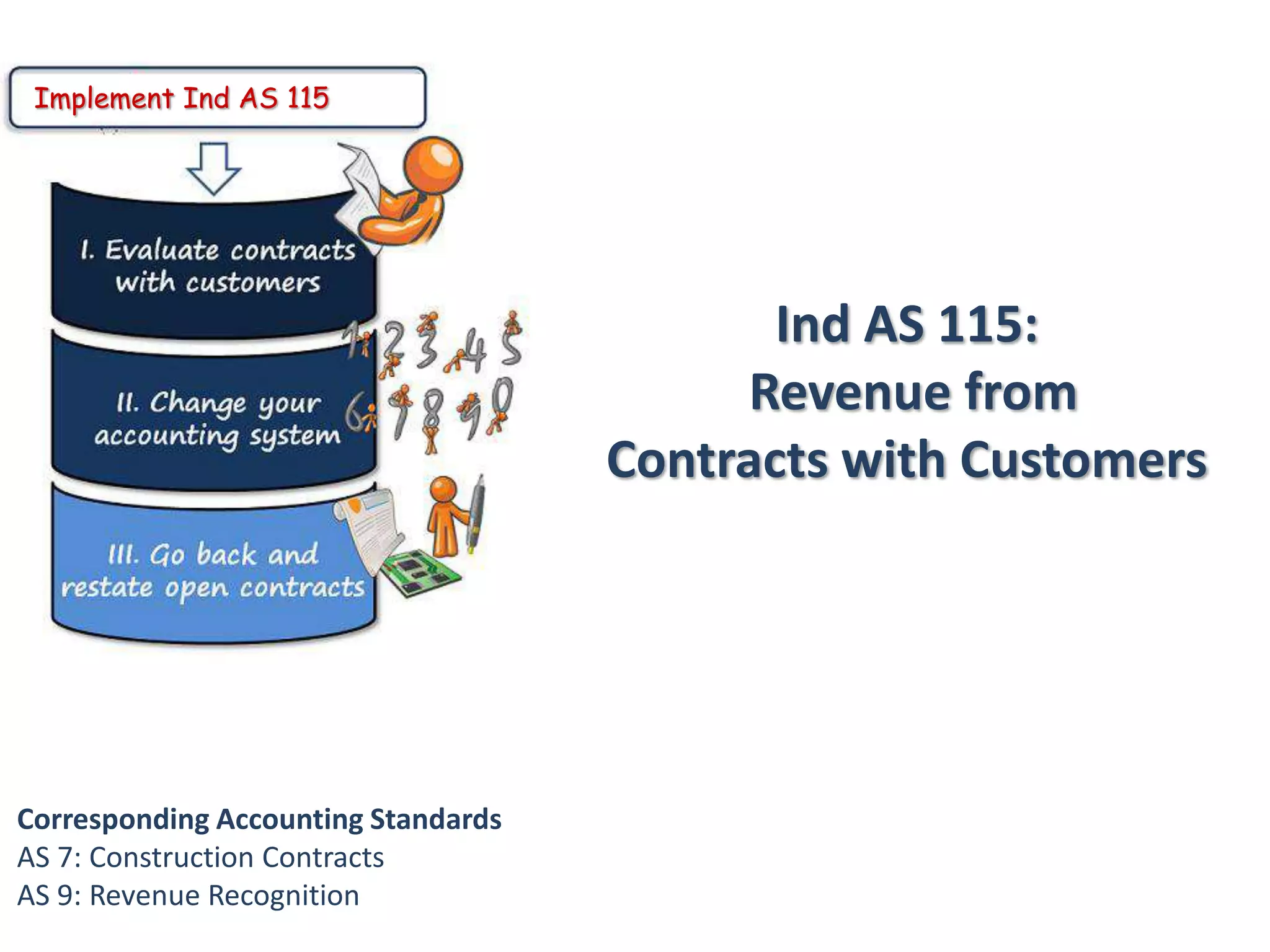
Ind AS 115:
Revenue from
Contracts with Customers
Corresponding Accounting Standards
AS 7: Construction Contracts
AS 9: Revenue Recognition
Implement Ind AS 115
Overview to Ind AS 115 Revenue from customers
Indian Accounting Standard 115, “Revenue from Customers” is the converged version of Ind AS
11, ”Construction Contracts” and Ind AS 18, “Revenue” which is on the lines of a similar convergence by the
IASB (International Accounting Standard Board) of the IAS 11 and IAS 18.
While under the former regime of Accounting Standards, the scope of Revenue was covered by 2 ASs, viz.
AS 9, “Revenue Recognition” and AS 7, “Construction Contracts”, the Ind AS lays down consolidated
guidelines for accounting, measurement and recognition for revenue from both Construction Contracts and
other businesses (except those specifically excluded through Para 5 Ind AS 115).
Ind AS 115 contains principles for determination of the principles of measurement of revenue and the
timing of revenue recognition.
The standard would significantly change how an entity recognizes its revenue from customers and will also
result in a significant increase in the volume of disclosures related to revenue.
Applicability of Ind AS 115 and its deferment
The Ind AS 115, “Revenue from Customers”, is a carve out of the IFRS 15, “Revenue from Contract with
Customers” issued by the IASB.
Technology and telecom companies are largely going be impacted with this standard, i.e. mainly those
companies which currently bundle their services together. Due to the requirement of the 5 step model,
revenue recognition will now be more scientific and transparent.
Although, the MCA notification (on applicability of Ind AS to various class of companies) does not rule out
its implementation as per the roadmap, the IFRS 15 in itself is set to be implemented from 2017 onwards
only. Also, as per a recent article published in the Economic Times, India is likely to defer the adoption of
Ind AS 115 as more consultation is needed with the industry to clarify the requirements and to give
examples to help implementation.
In such a situation India may adopt the Ind AS 18, “Revenue” and Ind AS 11, “Construction Contracts” for
the interim period.
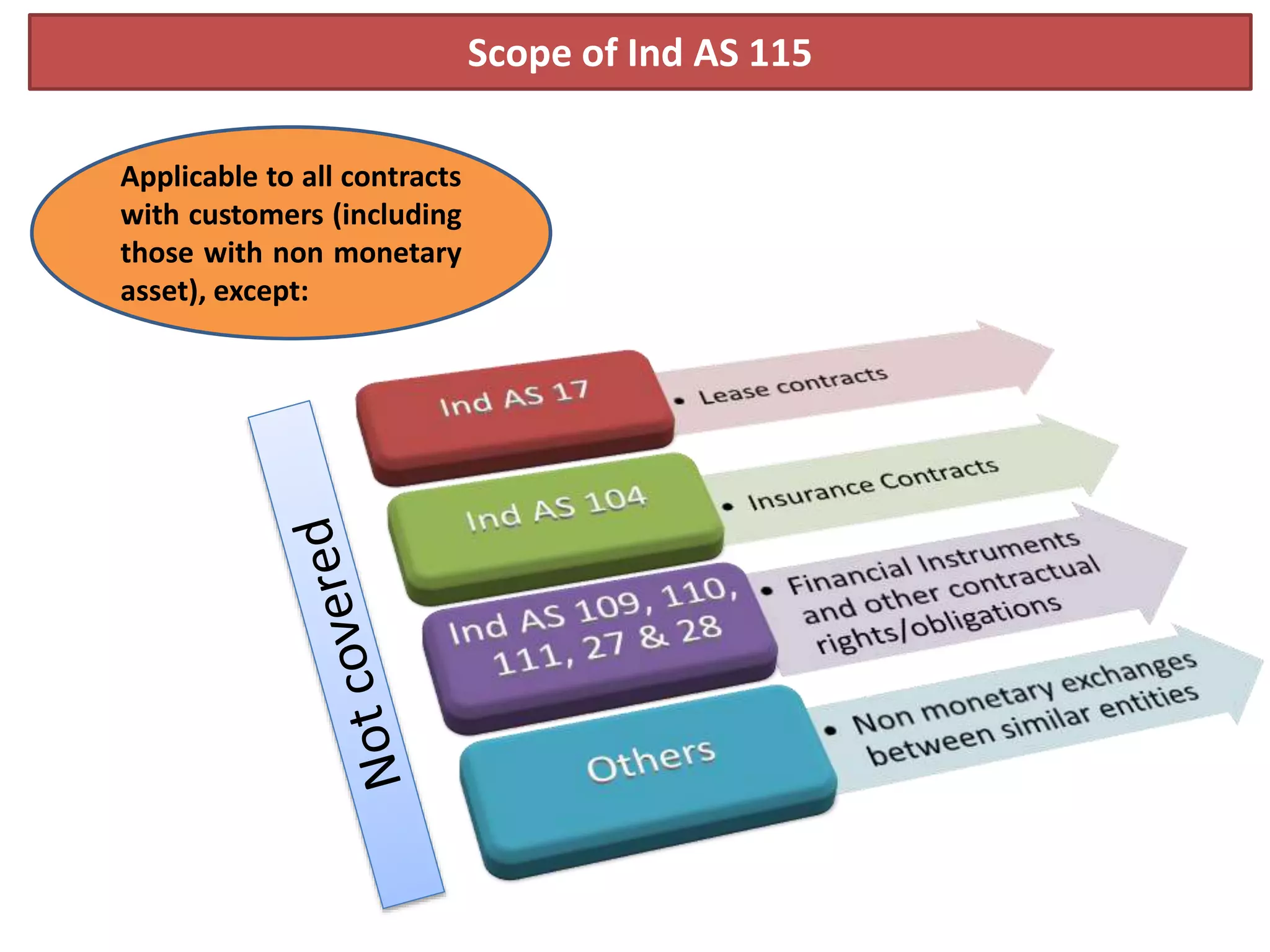
Scope of Ind AS 115
Applicable to all contracts
with customers (including
those with non monetary
asset), except:
Definitions
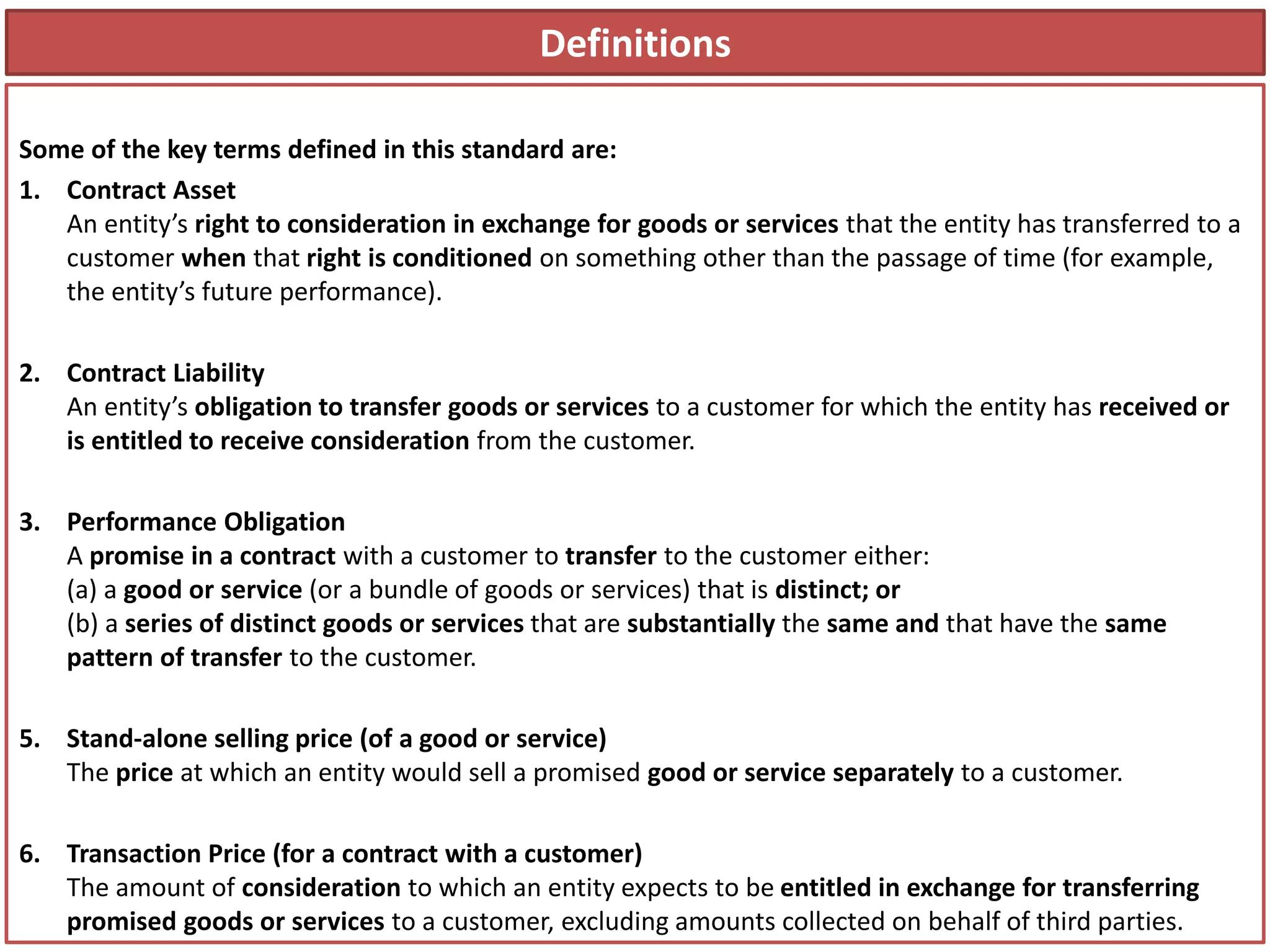
Some of the key terms defined in this standard are:
1. Contract Asset
An entity’s right to consideration in exchange for goods or services that the entity has transferred to a
customer when that right is conditioned on something other than the passage of time (for example,
the entity’s future performance).
2. Contract Liability
An entity’s obligation to transfer goods or services to a customer for which the entity has received or
is entitled to receive consideration from the customer.
3. Performance Obligation
A promise in a contract with a customer to transfer to the customer either:
(a) a good or service (or a bundle of goods or services) that is distinct; or
(b) a series of distinct goods or services that are substantially the same and that have the same
pattern of transfer to the customer.
5. Stand-alone selling price (of a good or service)
The price at which an entity would sell a promised good or service separately to a customer.
6. Transaction Price (for a contract with a customer)
The amount of consideration to which an entity expects to be entitled in exchange for transferring
promised goods or services to a customer, excluding amounts collected on behalf of third parties.
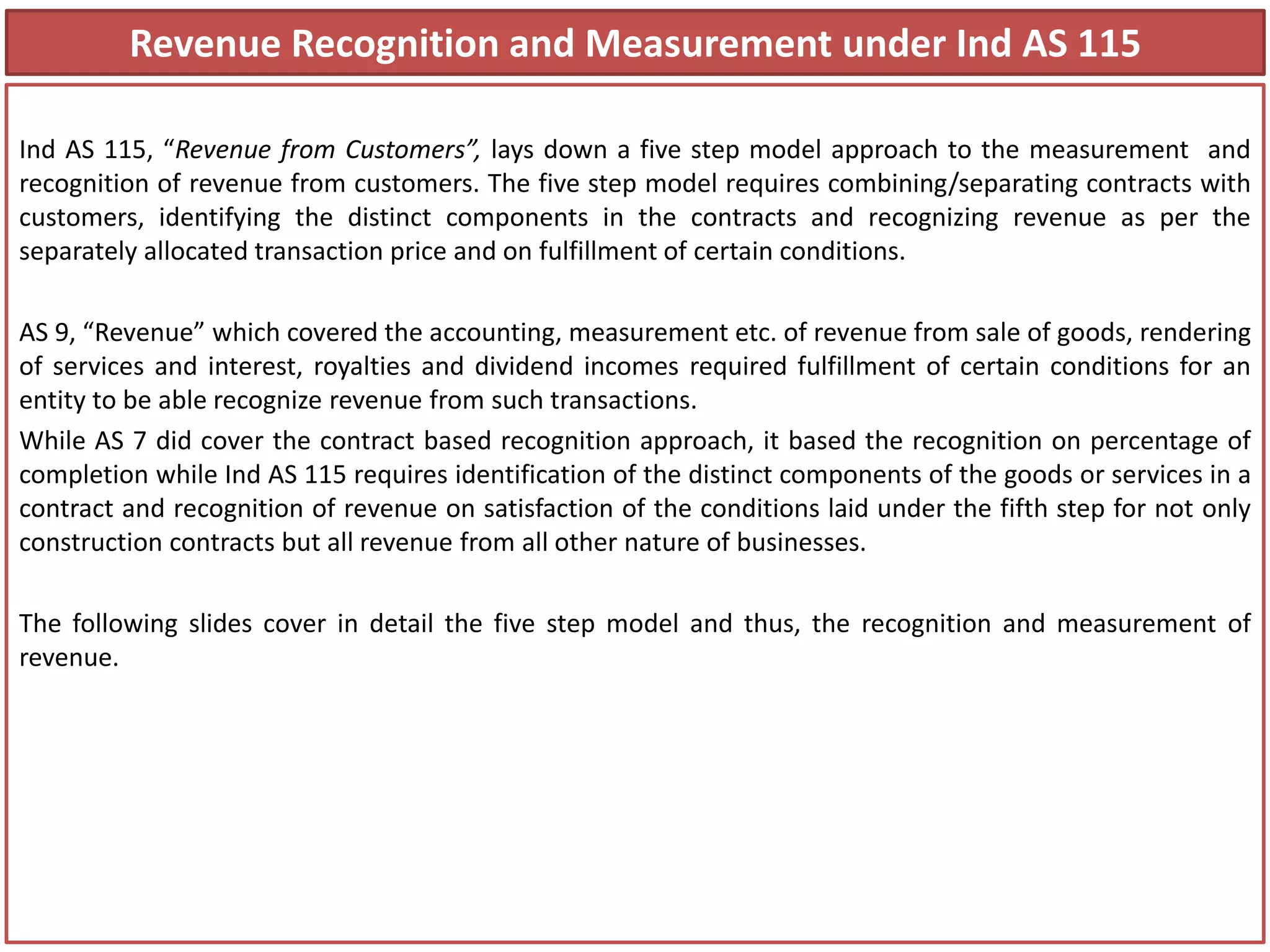
Revenue Recognition and Measurement under Ind AS 115
Ind AS 115, “Revenue from Customers”, lays down a five step model approach to the measurement and
recognition of revenue from customers. The five step model requires combining/separating contracts with
customers, identifying the distinct components in the contracts and recognizing revenue as per the
separately allocated transaction price and on fulfillment of certain conditions.
AS 9, “Revenue” which covered the accounting, measurement etc. of revenue from sale of goods, rendering
of services and interest, royalties and dividend incomes required fulfillment of certain conditions for an
entity to be able recognize revenue from such transactions.
While AS 7 did cover the contract based recognition approach, it based the recognition on percentage of
completion while Ind AS 115 requires identification of the distinct components of the goods or services in a
contract and recognition of revenue on satisfaction of the conditions laid under the fifth step for not only
construction contracts but all revenue from all other nature of businesses.
The following slides cover in detail the five step model and thus, the recognition and measurement of
revenue.
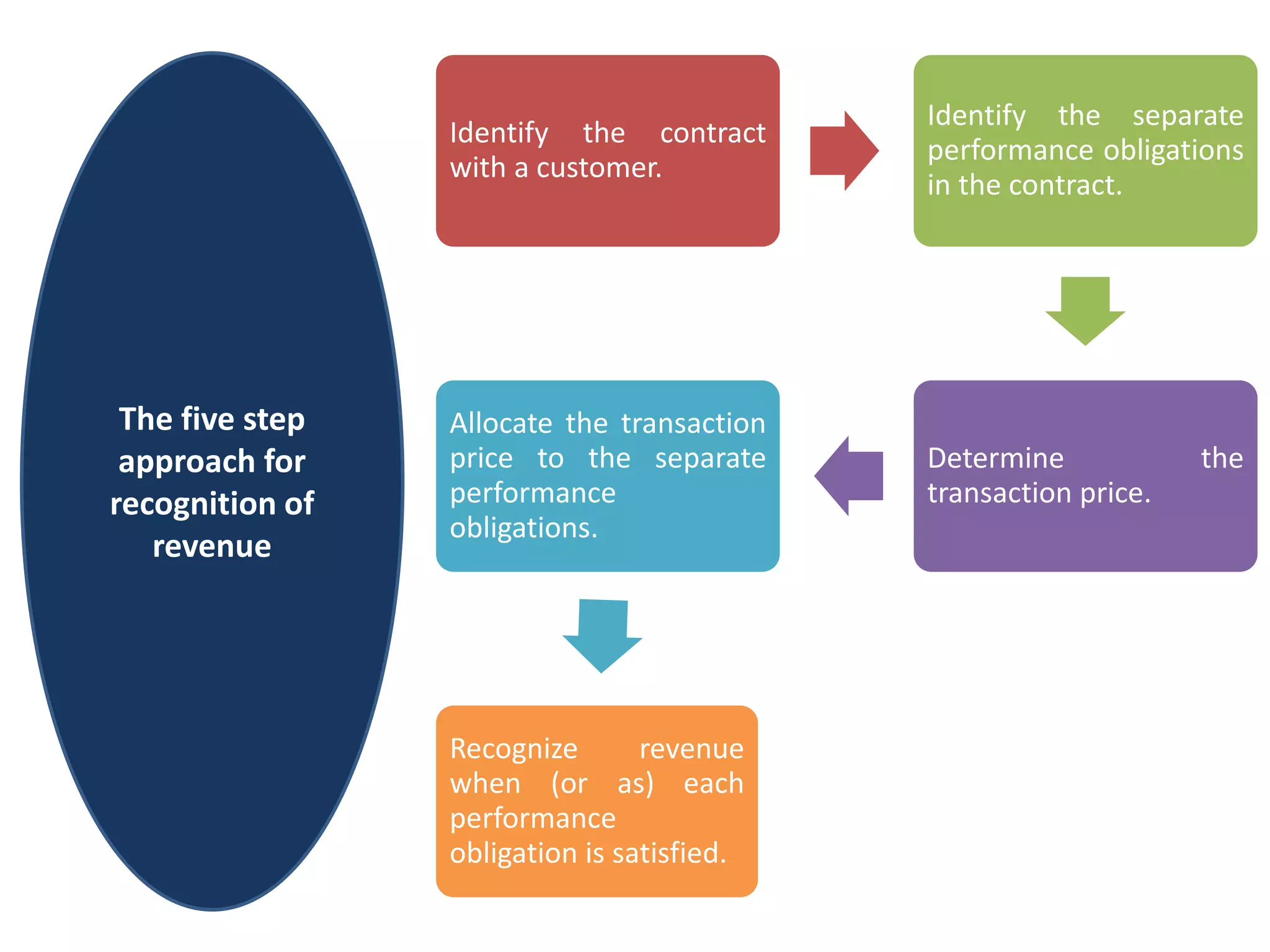
Identify the contract
with a customer.
Identify the separate
performance obligations
in the contract.
Determine the
transaction price.
Allocate the transaction
price to the separate
performance
obligations.
Recognize revenue
when (or as) each
performance
obligation is satisfied.
The five step
approach for
recognition of
revenue
The Ind AS approach to Revenue from Customers
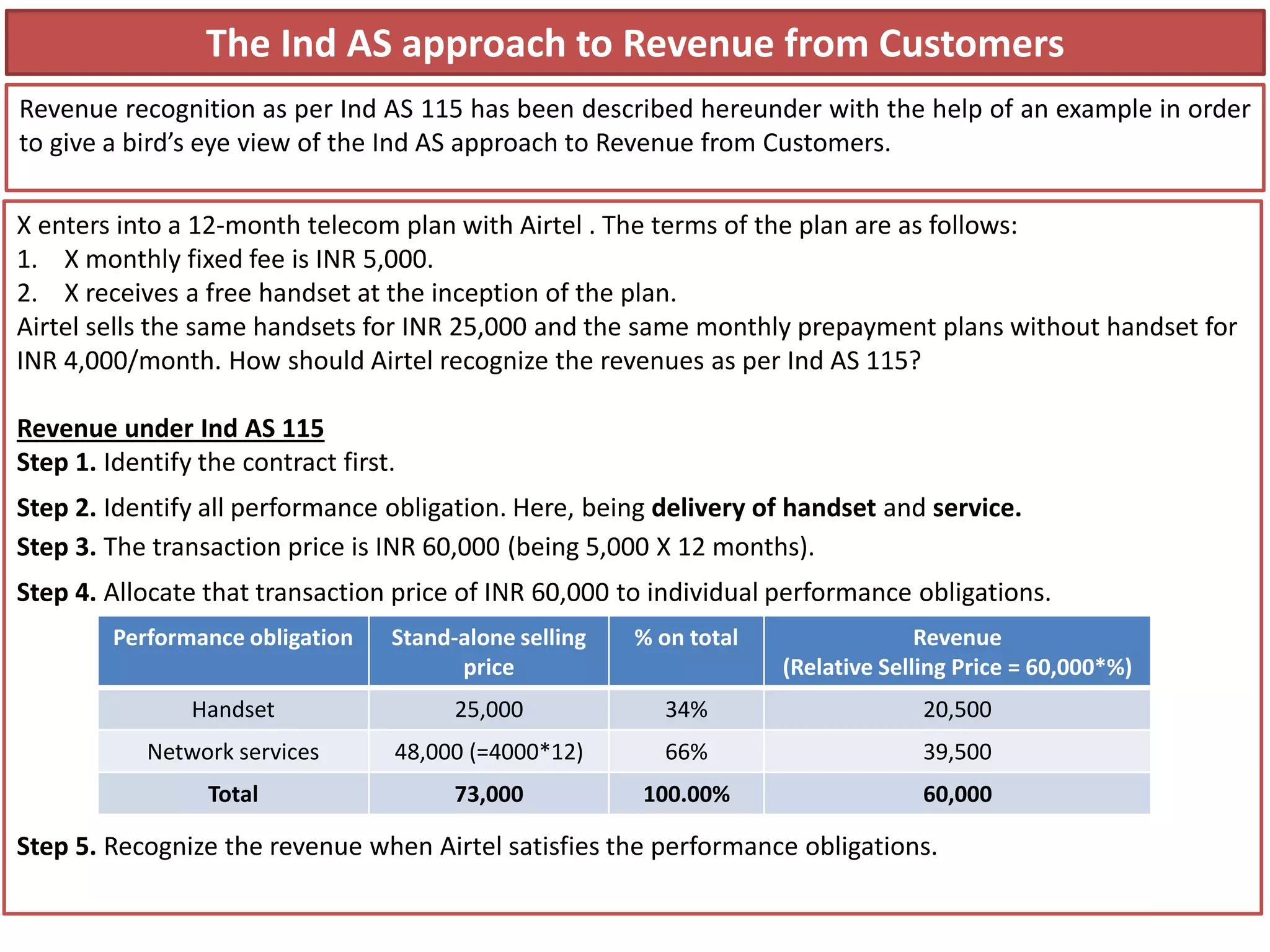
Revenue recognition as per Ind AS 115 has been described hereunder with the help of an example in order
to give a bird’s eye view of the Ind AS approach to Revenue from Customers.
X enters into a 12-month telecom plan with Airtel . The terms of the plan are as follows:
1. X monthly fixed fee is INR 5,000.
2. X receives a free handset at the inception of the plan.
Airtel sells the same handsets for INR 25,000 and the same monthly prepayment plans without handset for
INR 4,000/month. How should Airtel recognize the revenues as per Ind AS 115?
Revenue under Ind AS 115
Step 1. Identify the contract first.
Step 2. Identify all performance obligation. Here, being delivery of handset and service.
Step 3. The transaction price is INR 60,000 (being 5,000 X 12 months).
Step 4. Allocate that transaction price of INR 60,000 to individual performance obligations.
Step 5. Recognize the revenue when Airtel satisfies the performance obligations.
Performance obligation Stand-alone selling
price
% on total Revenue
(Relative Selling Price = 60,000*%)
Handset 25,000 34% 20,500
Network services 48,000 (=4000*12) 66% 39,500
Total 73,000 100.00% 60,000
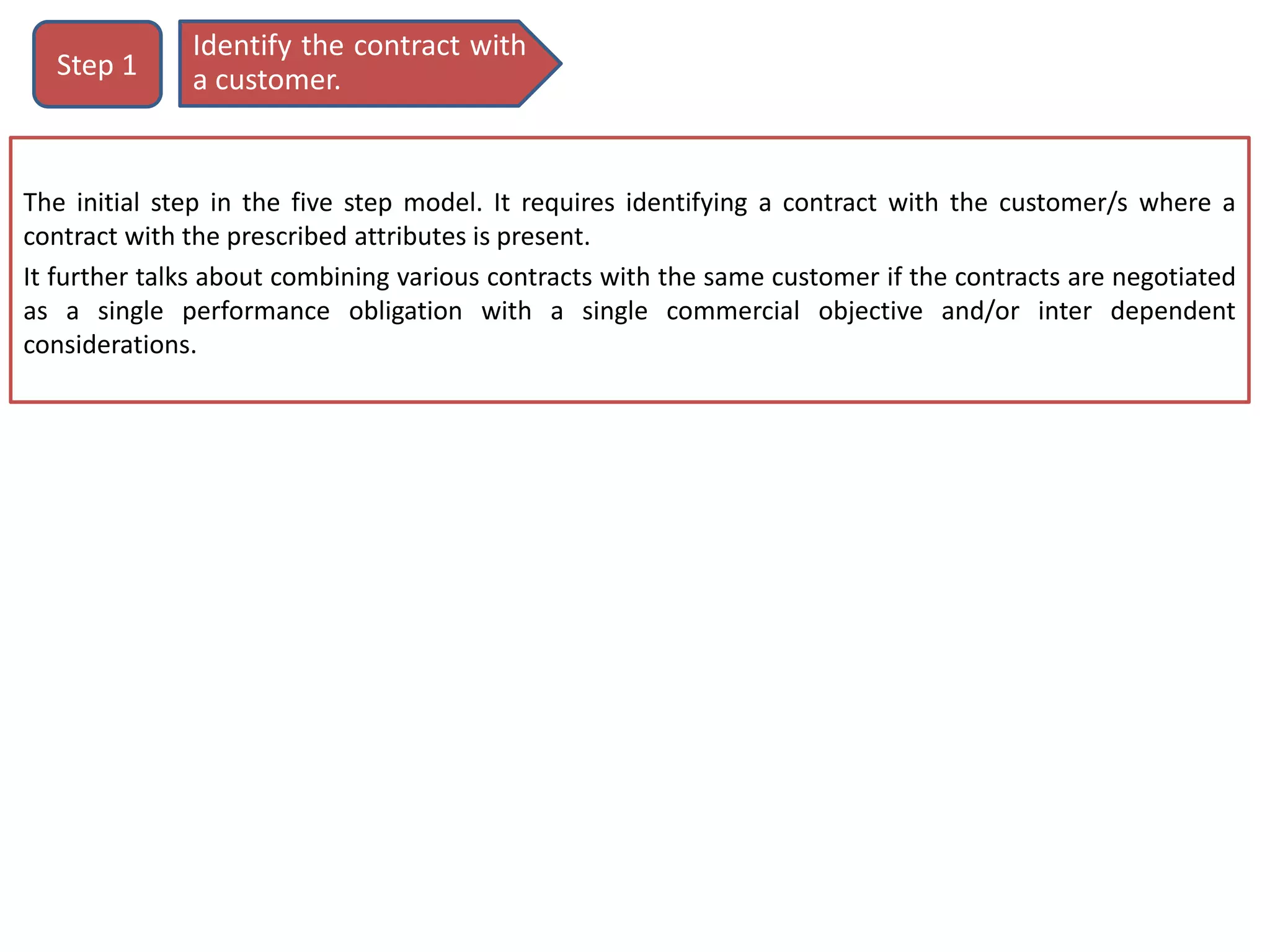
Identify the contract with
a customer.Step 1
The initial step in the five step model. It requires identifying a contract with the customer/s where a
contract with the prescribed attributes is present.
It further talks about combining various contracts with the same customer if the contracts are negotiated
as a single performance obligation with a single commercial objective and/or inter dependent
considerations.
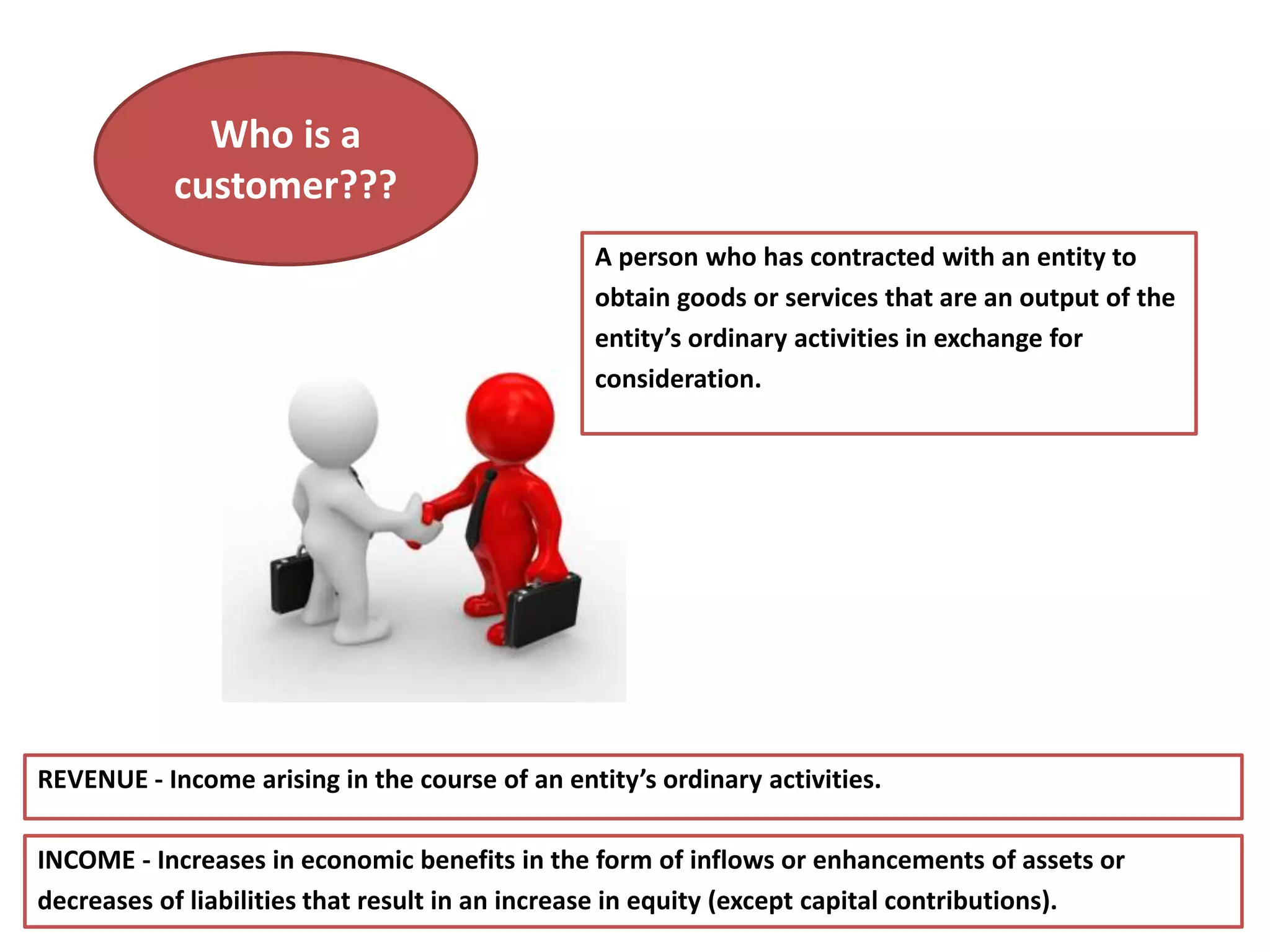
Who is a
customer???
A person who has contracted with an entity to
obtain goods or services that are an output of the
entity’s ordinary activities in exchange for
consideration.
REVENUE - Income arising in the course of an entity’s ordinary activities.
INCOME - Increases in economic benefits in the form of inflows or enhancements of assets or
decreases of liabilities that result in an increase in equity (except capital contributions).
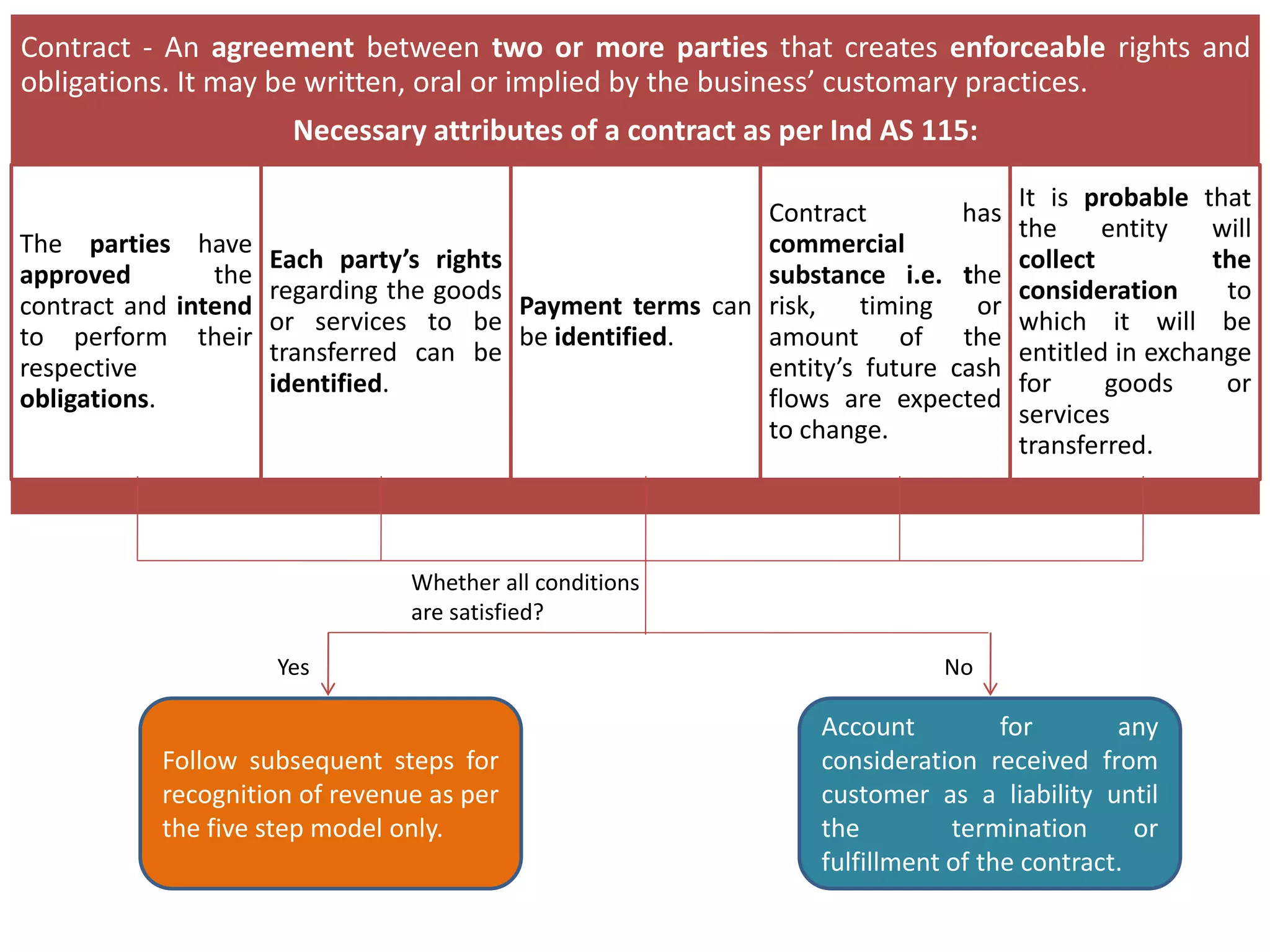
Contract - An agreement between two or more parties that creates enforceable rights and
obligations. It may be written, oral or implied by the business’ customary practices.
Necessary attributes of a contract as per Ind AS 115:
The parties have
approved the
contract and intend
to perform their
respective
obligations.
Each party’s rights
regarding the goods
or services to be
transferred can be
identified.
Payment terms can
be identified.
Contract has
commercial
substance i.e. the
risk, timing or
amount of the
entity’s future cash
flows are expected
to change.
It is probable that
the entity will
collect the
consideration to
which it will be
entitled in exchange
for goods or
services
transferred.
Whether all conditions
are satisfied?
Yes No
Account for any
consideration received from
customer as a liability until
the termination or
fulfillment of the contract.
Follow subsequent steps for
recognition of revenue as per
the five step model only.
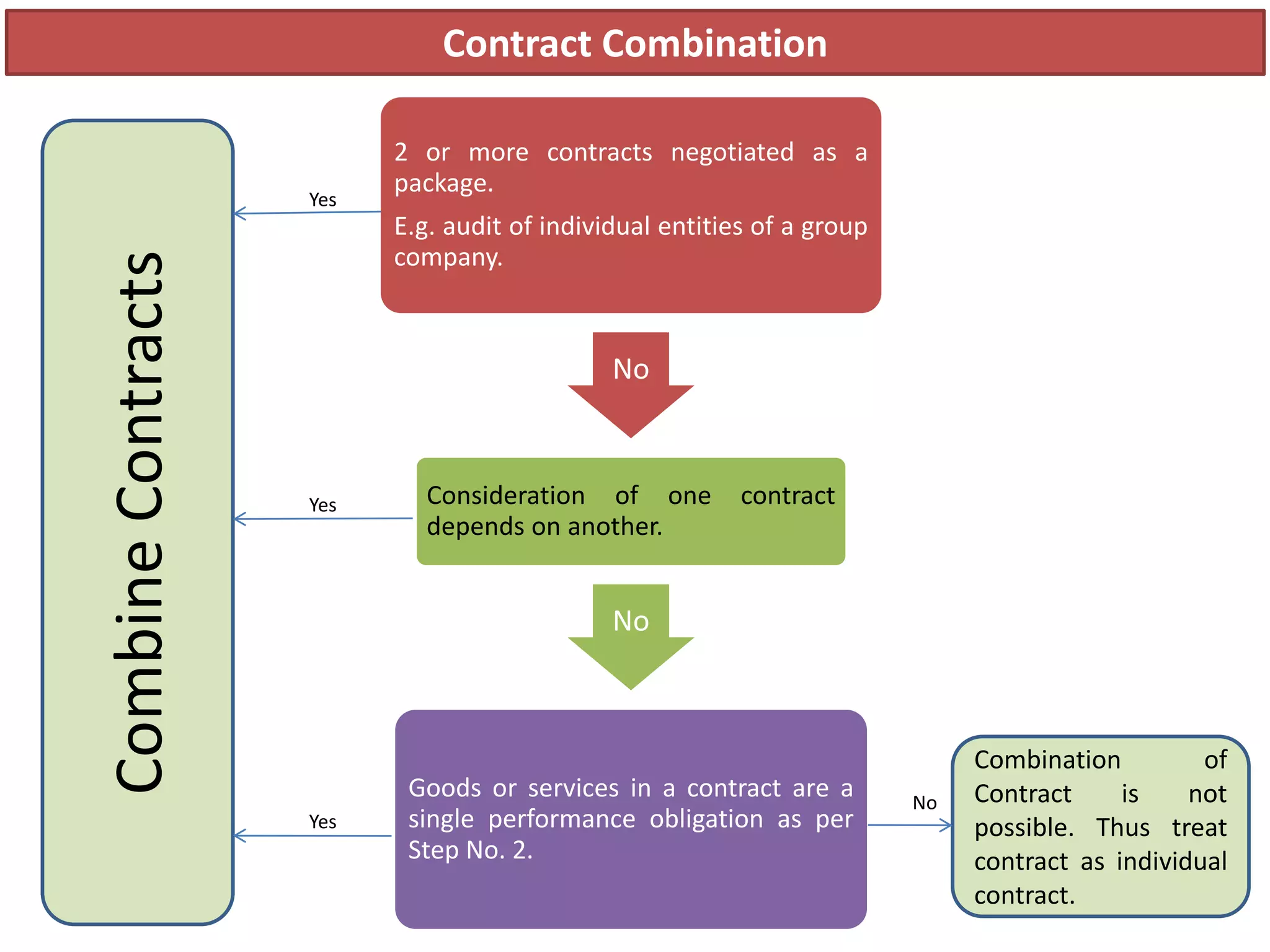
Contract Combination
2 or more contracts negotiated as a
package.
E.g. audit of individual entities of a group
company.
No
Consideration of one contract
depends on another.
No
Goods or services in a contract are a
single performance obligation as per
Step No. 2.
CombineContracts
Combination of
Contract is not
possible. Thus treat
contract as individual
contract.
Yes
Yes
Yes
No
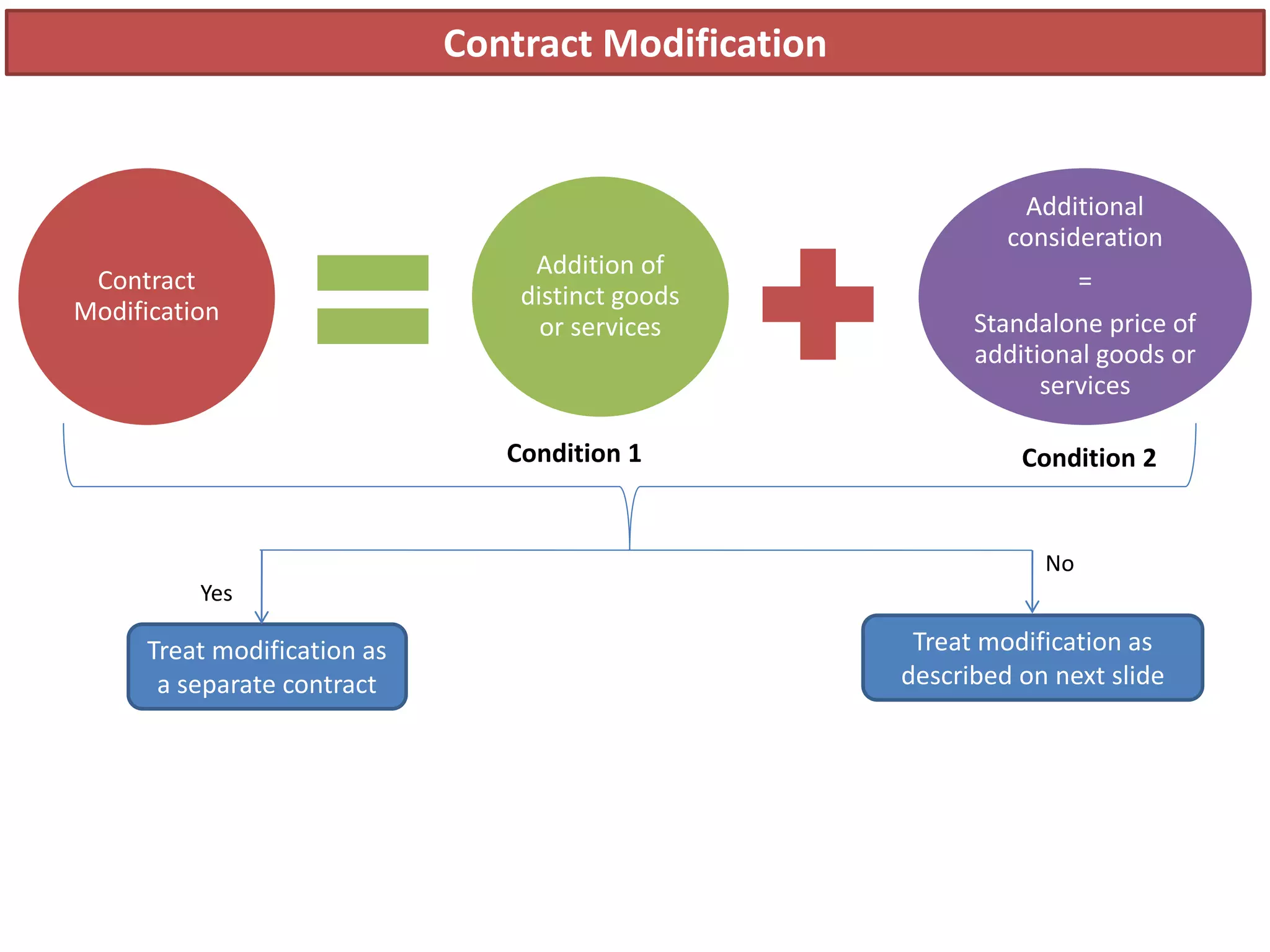
Contract
Modification
Addition of
distinct goods
or services
Additional
consideration
=
Standalone price of
additional goods or
services
Contract Modification
Treat modification as
a separate contract
Yes
No
Condition 1 Condition 2
Treat modification as
described on next slide
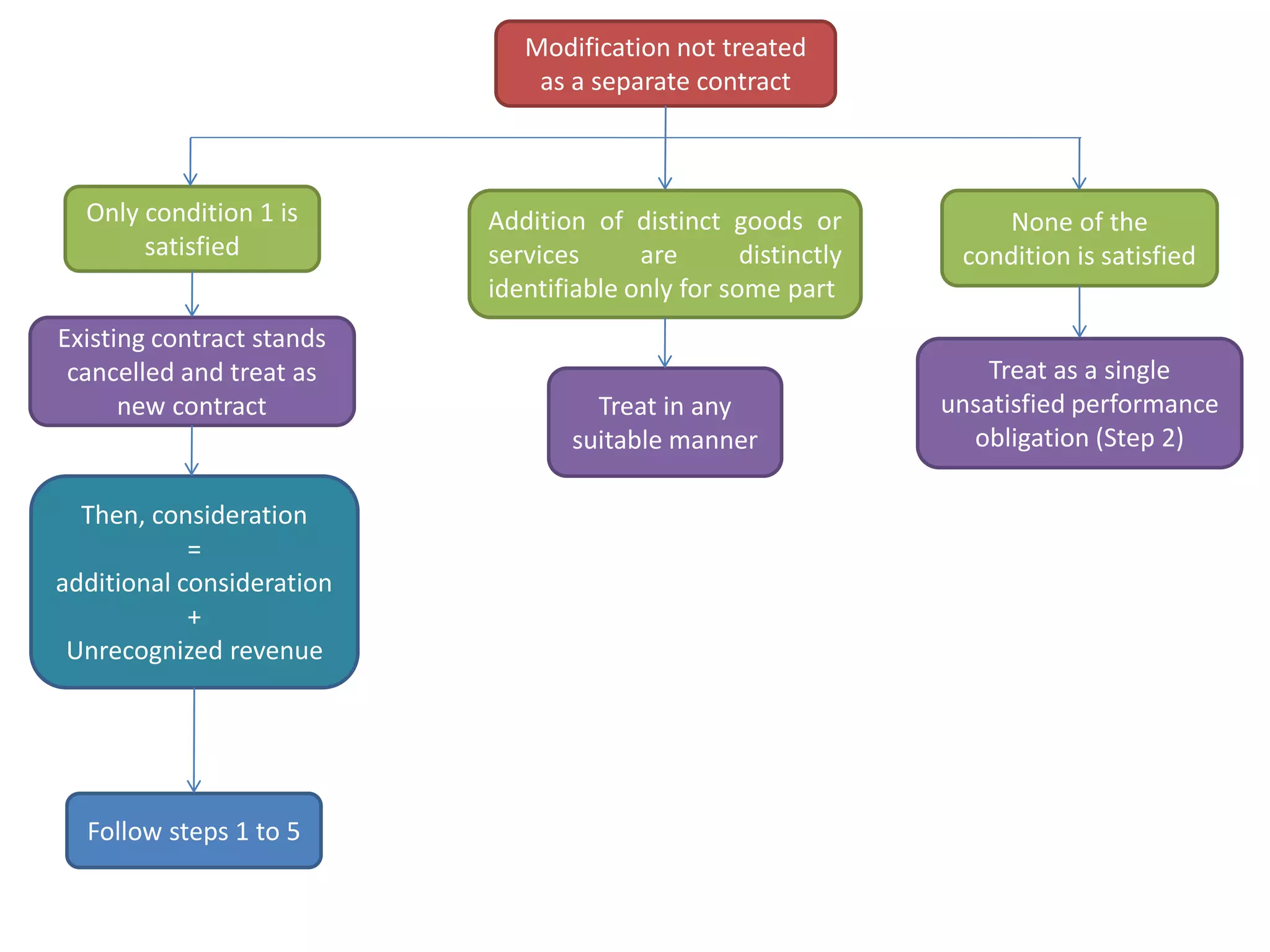
Only condition 1 is
satisfied
Existing contract stands
cancelled and treat as
new contract
Then, consideration
=
additional consideration
+
Unrecognized revenue
Follow steps 1 to 5
Modification not treated
as a separate contract
Addition of distinct goods or
services are distinctly
identifiable only for some part
Treat in any
suitable manner
None of the
condition is satisfied
Treat as a single
unsatisfied performance
obligation (Step 2)
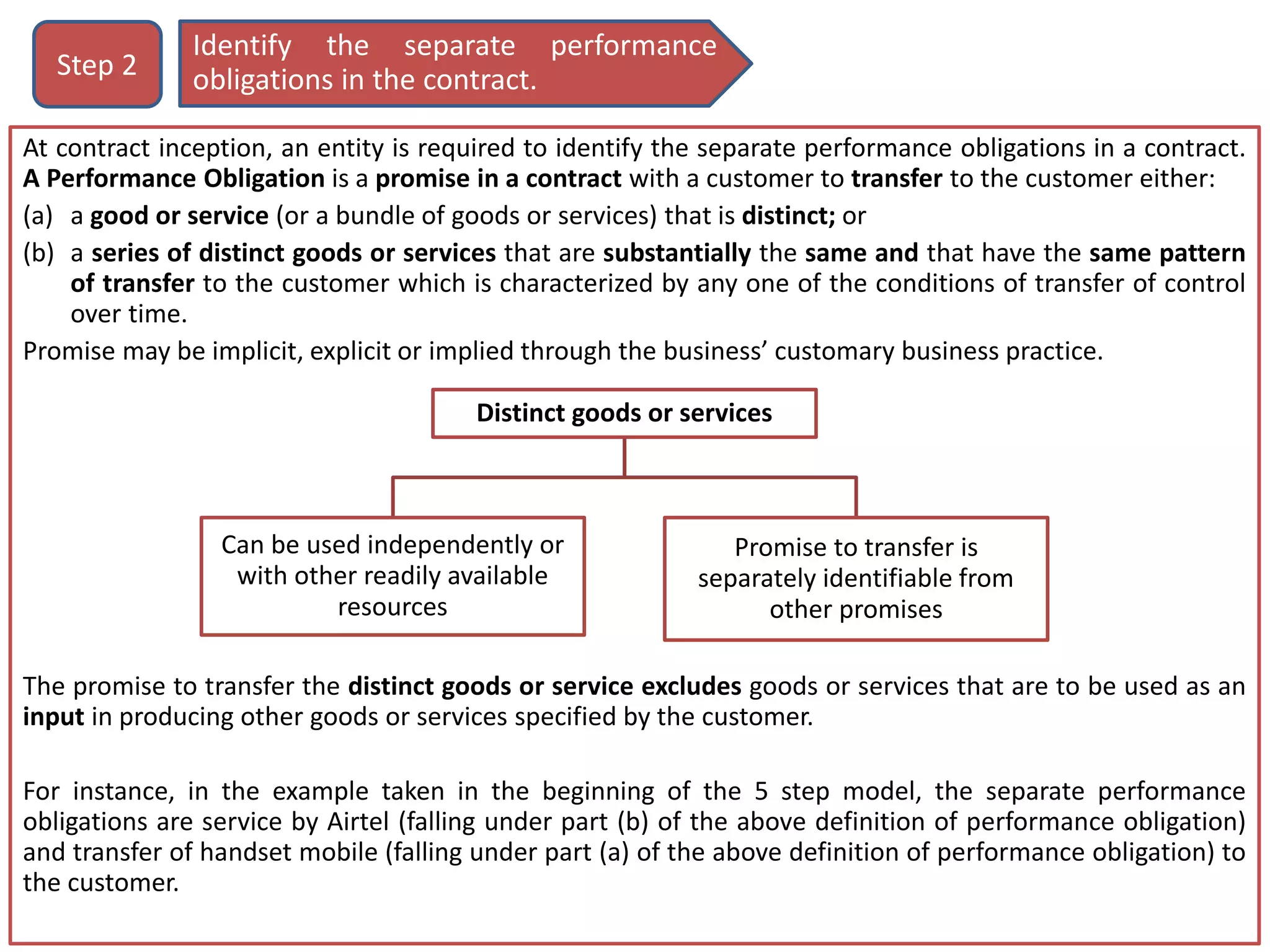
At contract inception, an entity is required to identify the separate performance obligations in a contract.
A Performance Obligation is a promise in a contract with a customer to transfer to the customer either:
(a) a good or service (or a bundle of goods or services) that is distinct; or
(b) a series of distinct goods or services that are substantially the same and that have the same pattern
of transfer to the customer which is characterized by any one of the conditions of transfer of control
over time.
Promise may be implicit, explicit or implied through the business’ customary business practice.
The promise to transfer the distinct goods or service excludes goods or services that are to be used as an
input in producing other goods or services specified by the customer.
For instance, in the example taken in the beginning of the 5 step model, the separate performance
obligations are service by Airtel (falling under part (b) of the above definition of performance obligation)
and transfer of handset mobile (falling under part (a) of the above definition of performance obligation) to
the customer.
Identify the separate performance
obligations in the contract.Step 2
Distinct goods or services
Can be used independently or
with other readily available
resources
Promise to transfer is
separately identifiable from
other promises
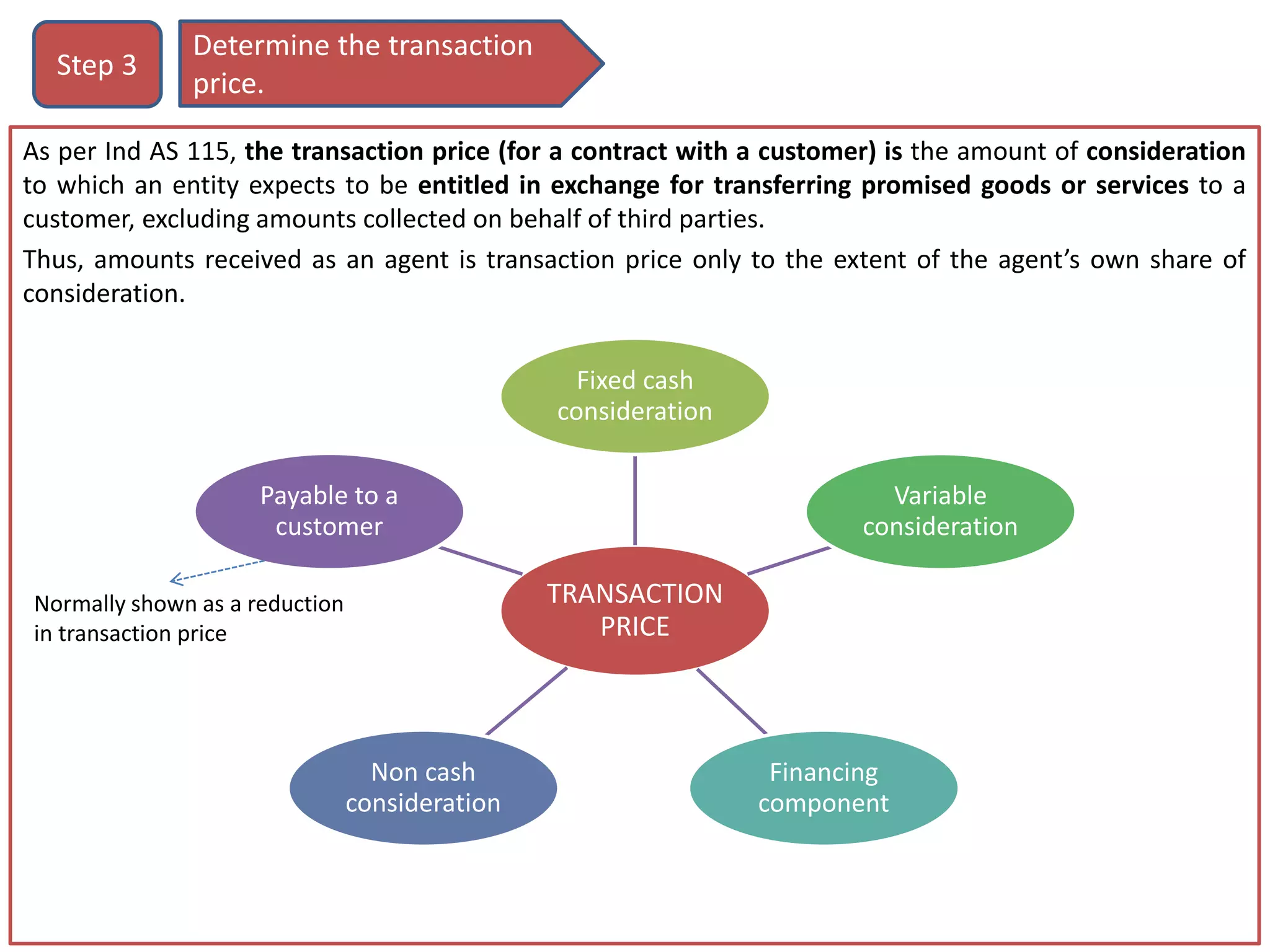
As per Ind AS 115, the transaction price (for a contract with a customer) is the amount of consideration
to which an entity expects to be entitled in exchange for transferring promised goods or services to a
customer, excluding amounts collected on behalf of third parties.
Thus, amounts received as an agent is transaction price only to the extent of the agent’s own share of
consideration.
Determine the transaction
price.
Step 3
TRANSACTION
PRICE
Fixed cash
consideration
Variable
consideration
Financing
component
Non cash
consideration
Payable to a
customer
Normally shown as a reduction
in transaction price
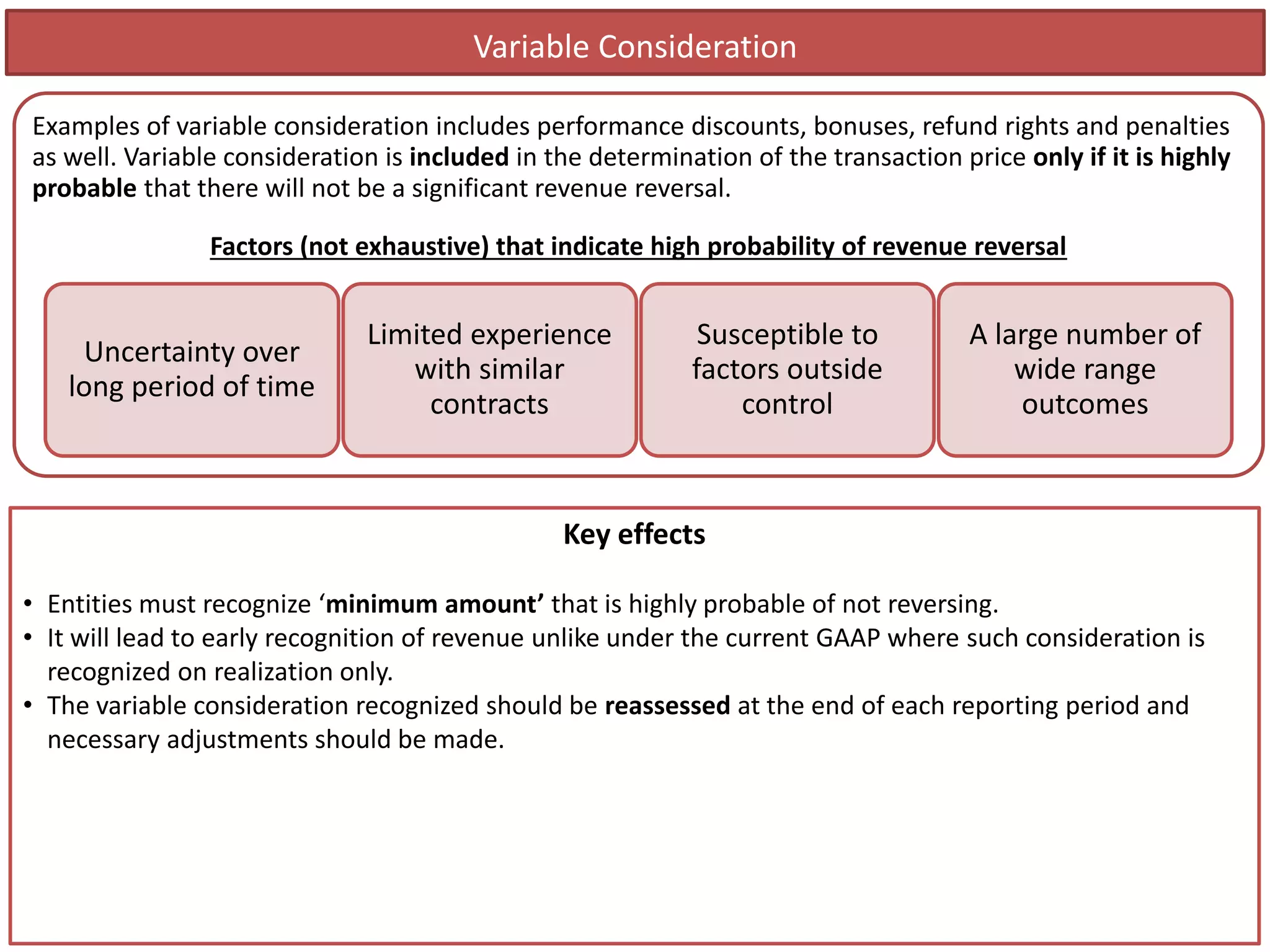
Examples of variable consideration includes performance discounts, bonuses, refund rights and penalties
as well. Variable consideration is included in the determination of the transaction price only if it is highly
probable that there will not be a significant revenue reversal.
Factors (not exhaustive) that indicate high probability of revenue reversal
Uncertainty over
long period of time
Limited experience
with similar
contracts
Susceptible to
factors outside
control
A large number of
wide range
outcomes
Variable Consideration
Key effects
• Entities must recognize ‘minimum amount’ that is highly probable of not reversing.
• It will lead to early recognition of revenue unlike under the current GAAP where such consideration is
recognized on realization only.
• The variable consideration recognized should be reassessed at the end of each reporting period and
necessary adjustments should be made.
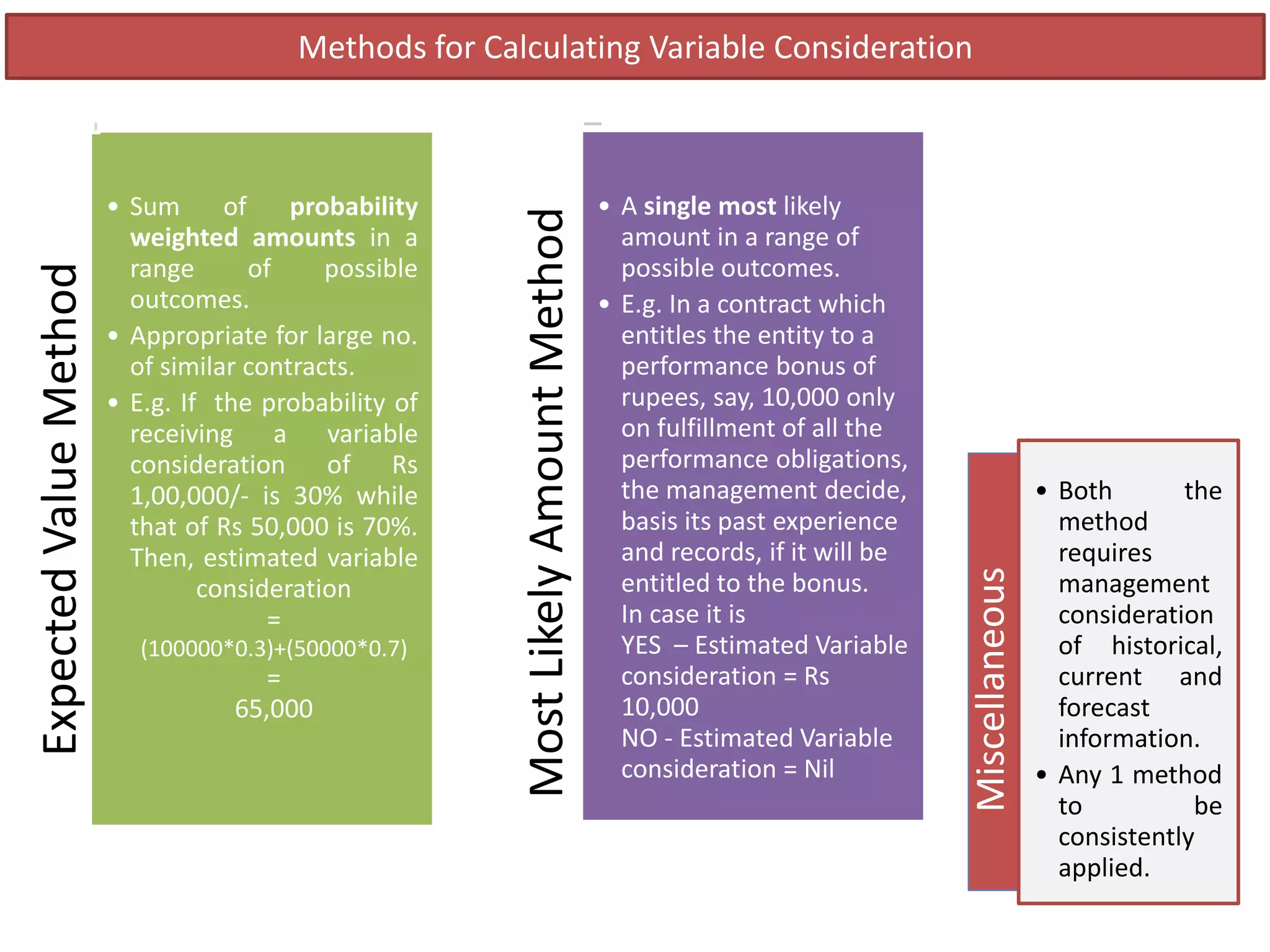
ExpectedValueMethod
• Sum of probability
weighted amounts in a
range of possible
outcomes.
• Appropriate for large no.
of similar contracts.
• E.g. If the probability of
receiving a variable
consideration of Rs
1,00,000/- is 30% while
that of Rs 50,000 is 70%.
Then, estimated variable
consideration
=
(100000*0.3)+(50000*0.7)
=
65,000
MostLikelyAmountMethod
• A single most likely
amount in a range of
possible outcomes.
• E.g. In a contract which
entitles the entity to a
performance bonus of
rupees, say, 10,000 only
on fulfillment of all the
performance obligations,
the management decide,
basis its past experience
and records, if it will be
entitled to the bonus.
In case it is
YES – Estimated Variable
consideration = Rs
10,000
NO - Estimated Variable
consideration = Nil
Methods for Calculating Variable Consideration
Miscellaneous
• Both the
method
requires
management
consideration
of historical,
current and
forecast
information.
• Any 1 method
to be
consistently
applied.
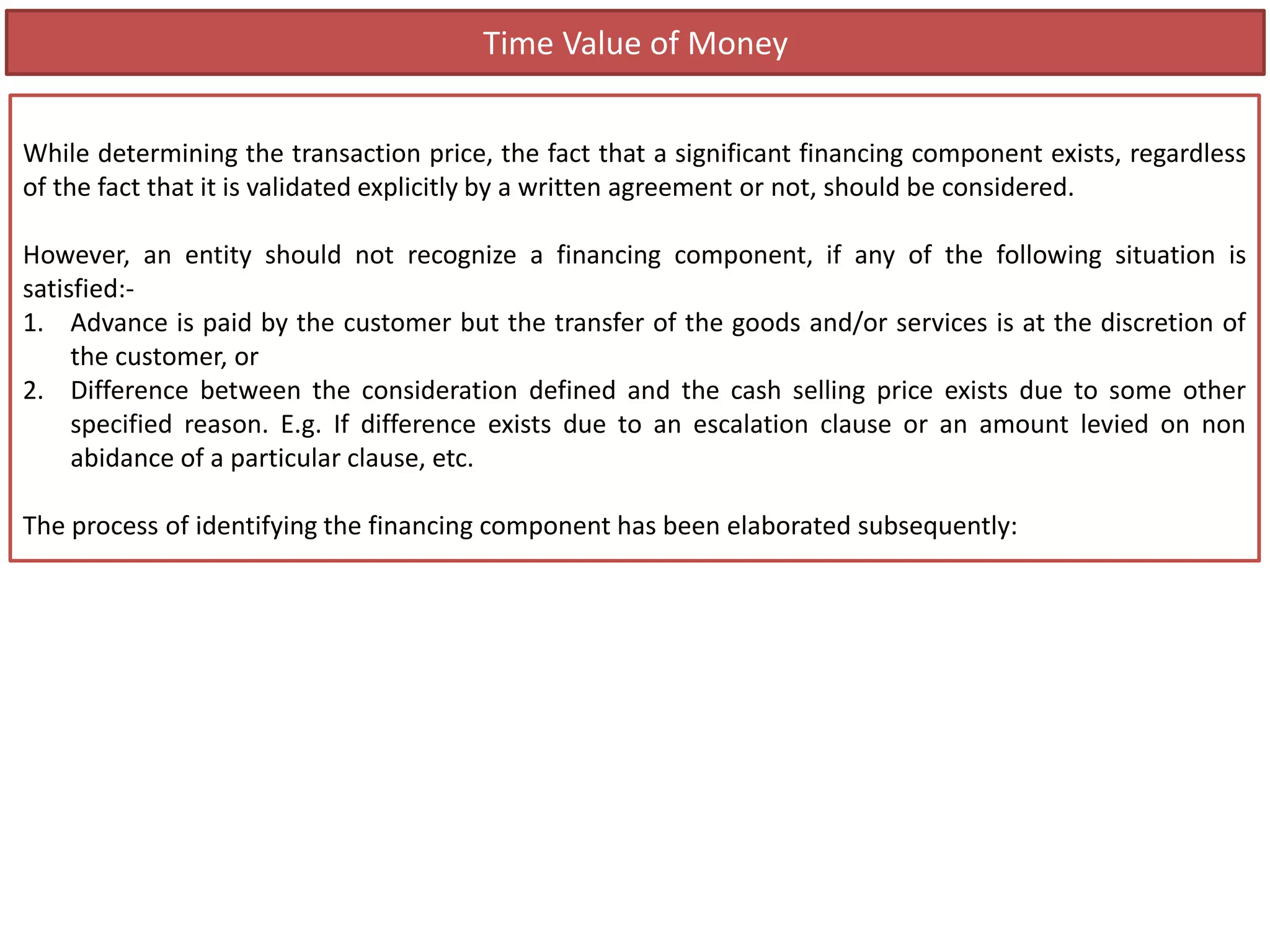
Time Value of Money
While determining the transaction price, the fact that a significant financing component exists, regardless
of the fact that it is validated explicitly by a written agreement or not, should be considered.
However, an entity should not recognize a financing component, if any of the following situation is
satisfied:-
1. Advance is paid by the customer but the transfer of the goods and/or services is at the discretion of
the customer, or
2. Difference between the consideration defined and the cash selling price exists due to some other
specified reason. E.g. If difference exists due to an escalation clause or an amount levied on non
abidance of a particular clause, etc.
The process of identifying the financing component has been elaborated subsequently:
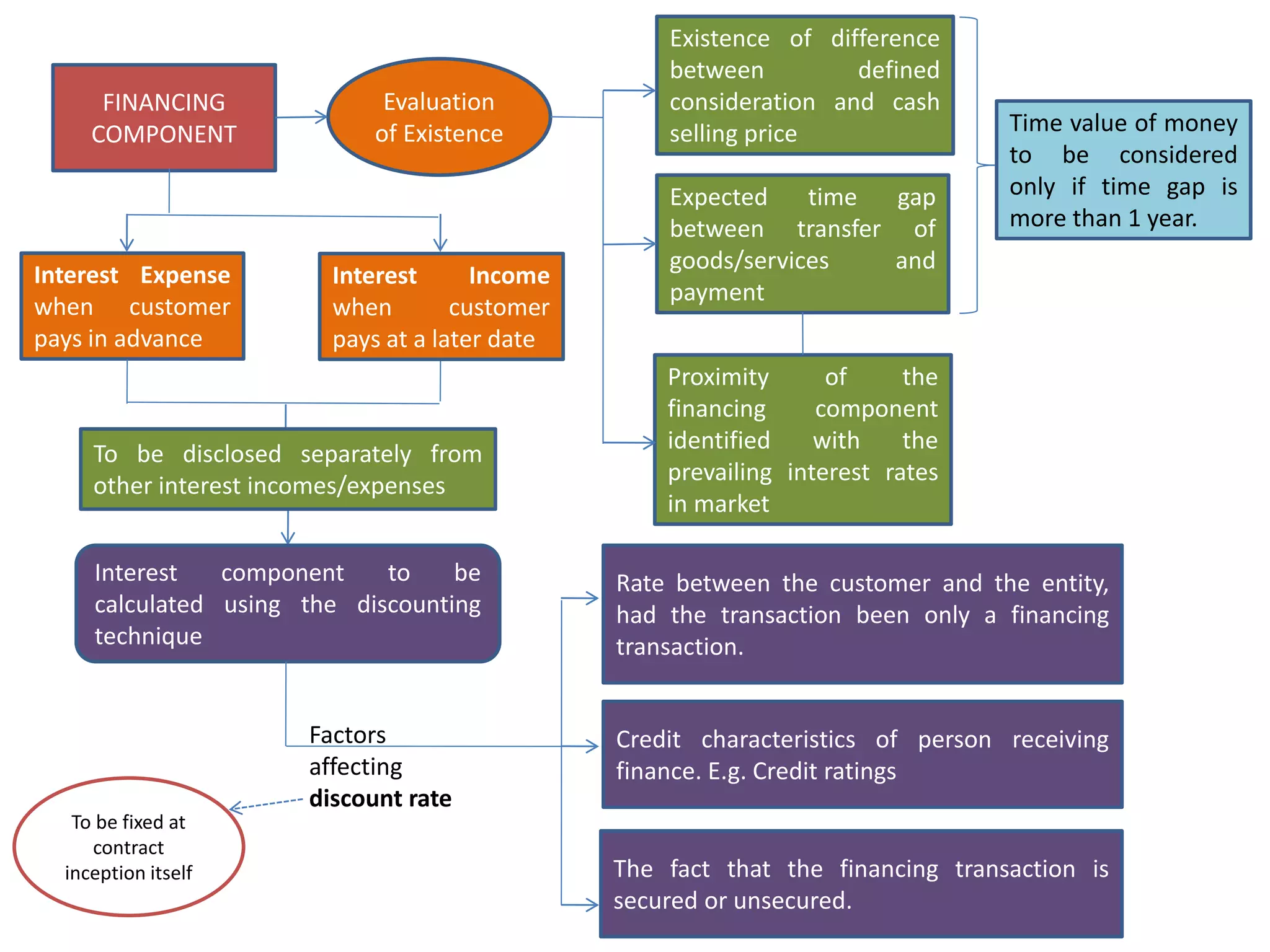
FINANCING
COMPONENT
Interest Expense
when customer
pays in advance
Rate between the customer and the entity,
had the transaction been only a financing
transaction.
Time value of money
to be considered
only if time gap is
more than 1 year.
Proximity of the
financing component
identified with the
prevailing interest rates
in market
Expected time gap
between transfer of
goods/services and
payment
Existence of difference
between defined
consideration and cash
selling price
Evaluation
of Existence
To be disclosed separately from
other interest incomes/expenses
Interest component to be
calculated using the discounting
technique
Factors
affecting
discount rate
Credit characteristics of person receiving
finance. E.g. Credit ratings
The fact that the financing transaction is
secured or unsecured.
Interest Income
when customer
pays at a later date
To be fixed at
contract
inception itself
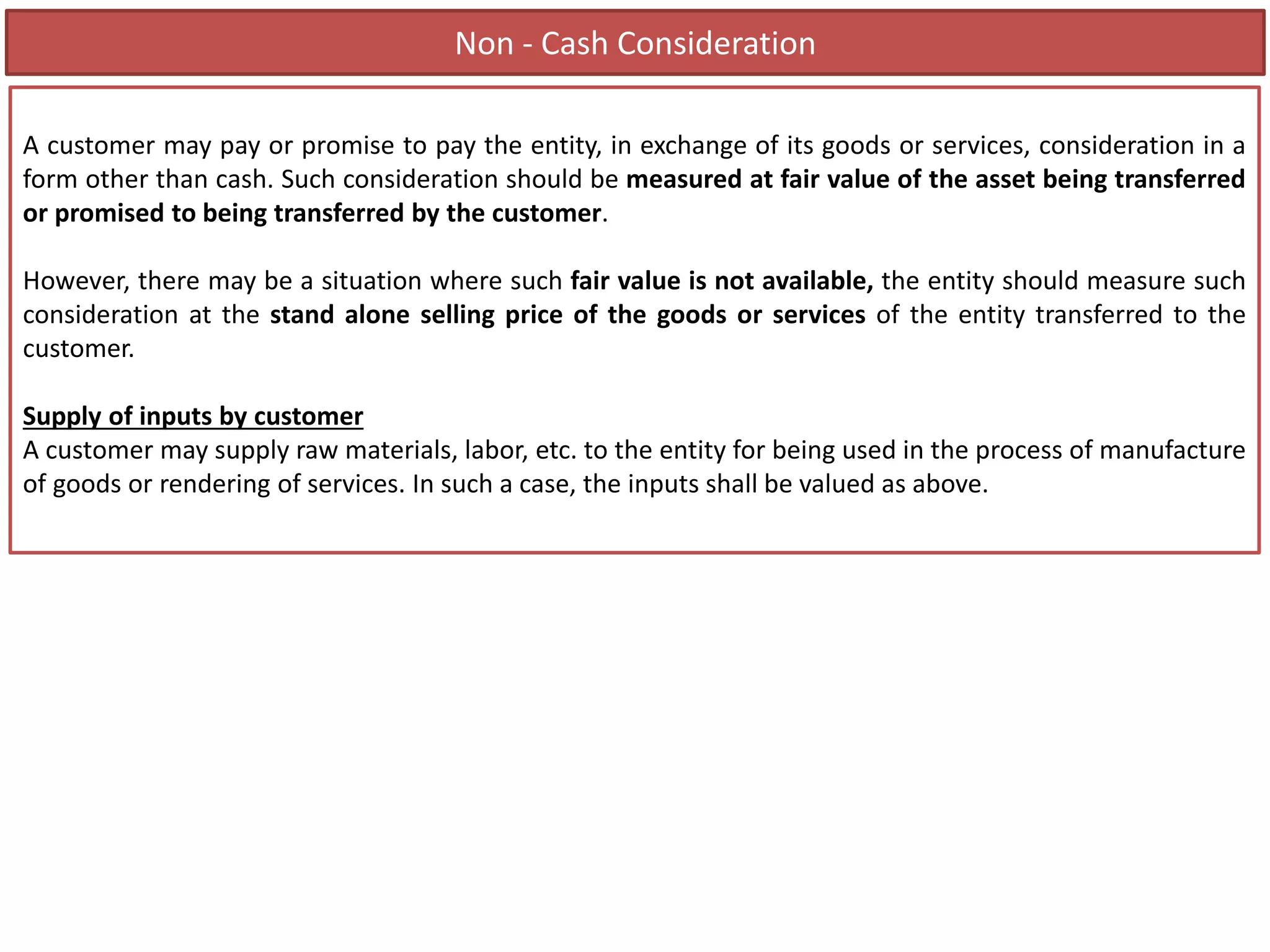
Non - Cash Consideration
A customer may pay or promise to pay the entity, in exchange of its goods or services, consideration in a
form other than cash. Such consideration should be measured at fair value of the asset being transferred
or promised to being transferred by the customer.
However, there may be a situation where such fair value is not available, the entity should measure such
consideration at the stand alone selling price of the goods or services of the entity transferred to the
customer.
Supply of inputs by customer
A customer may supply raw materials, labor, etc. to the entity for being used in the process of manufacture
of goods or rendering of services. In such a case, the inputs shall be valued as above.
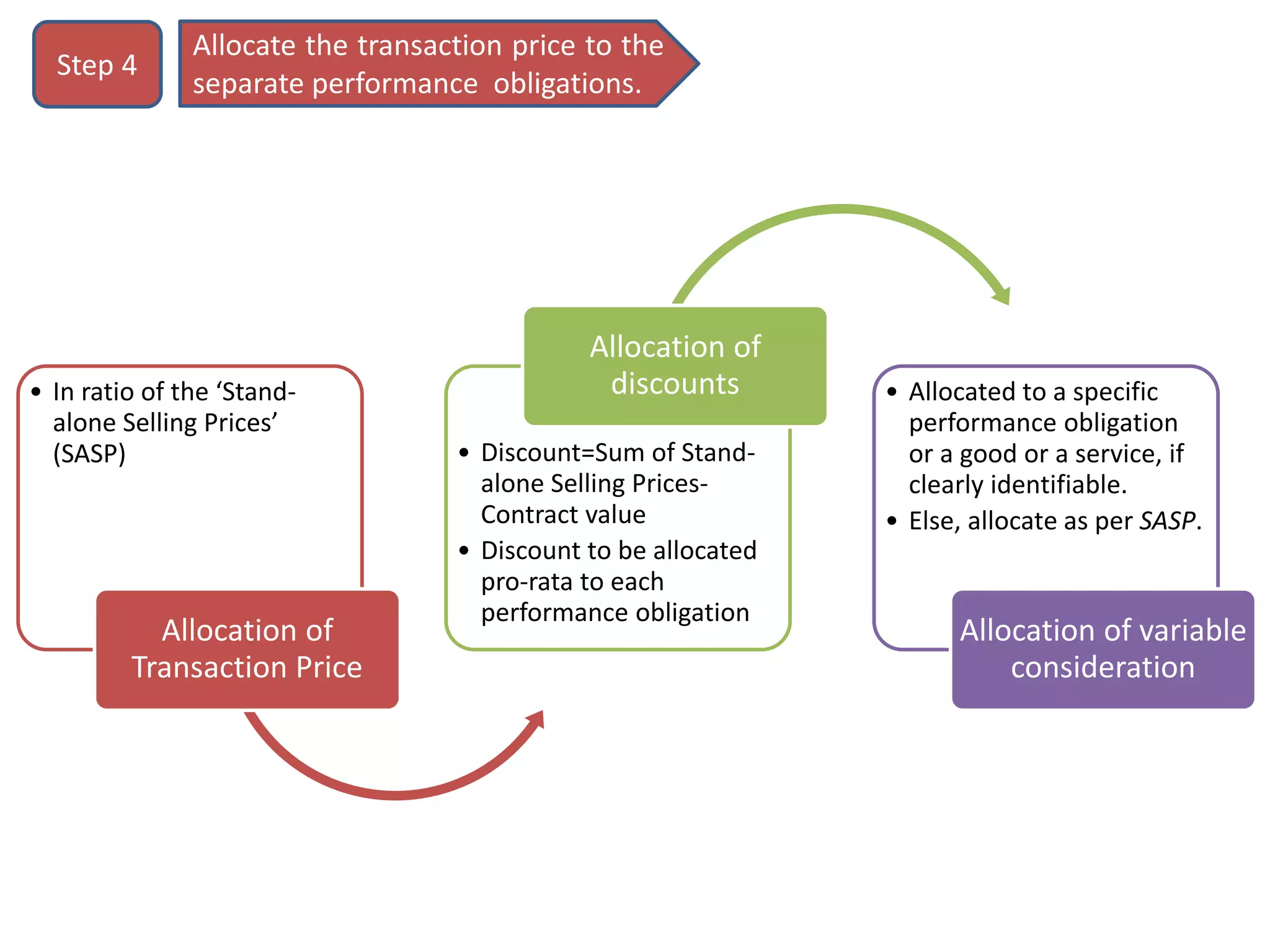
Allocate the transaction price to the
separate performance obligations.
Step 4
• In ratio of the ‘Stand-
alone Selling Prices’
(SASP)
Allocation of
Transaction Price
• Discount=Sum of Stand-
alone Selling Prices-
Contract value
• Discount to be allocated
pro-rata to each
performance obligation
Allocation of
discounts • Allocated to a specific
performance obligation
or a good or a service, if
clearly identifiable.
• Else, allocate as per SASP.
Allocation of variable
consideration
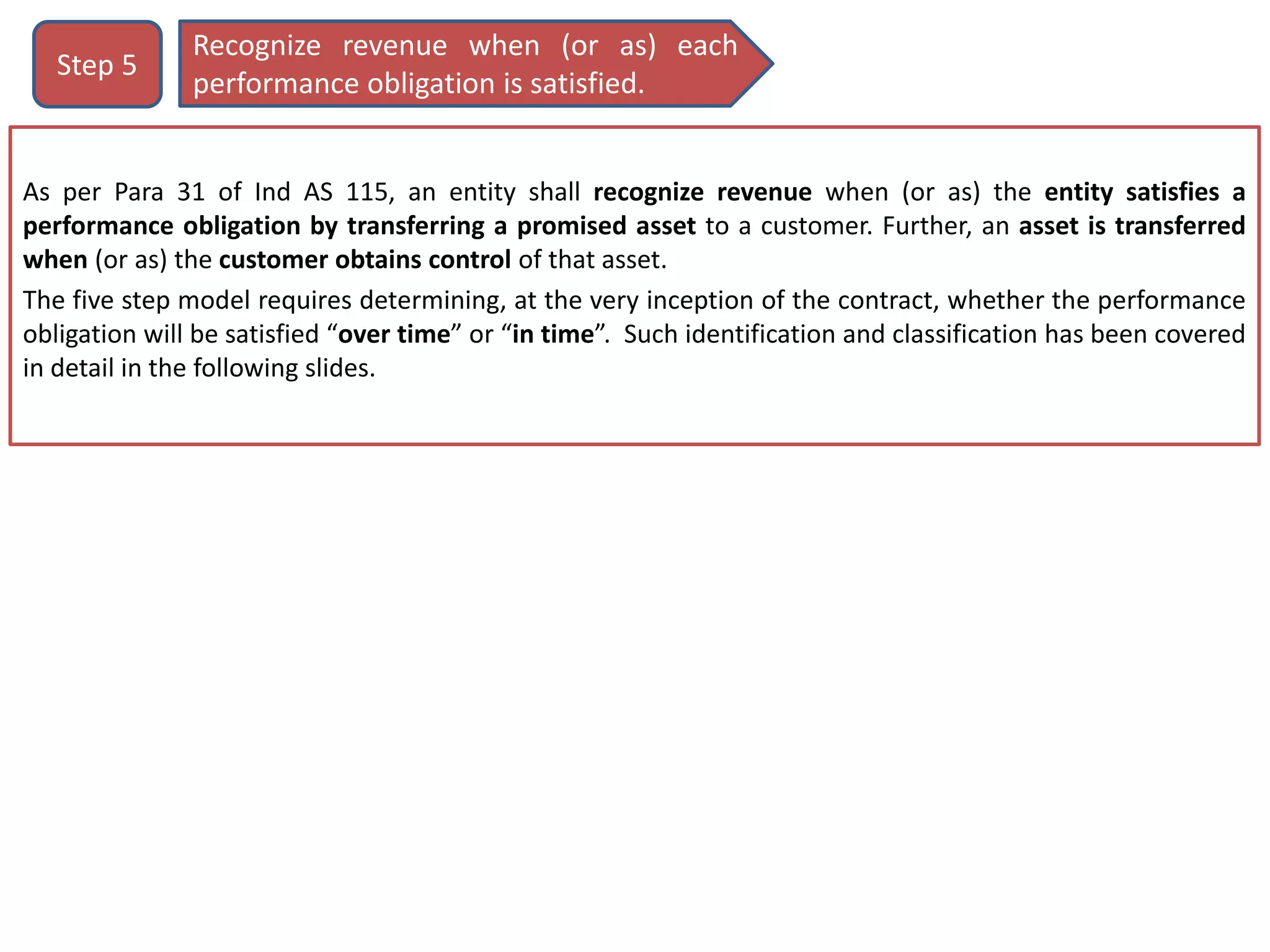
As per Para 31 of Ind AS 115, an entity shall recognize revenue when (or as) the entity satisfies a
performance obligation by transferring a promised asset to a customer. Further, an asset is transferred
when (or as) the customer obtains control of that asset.
The five step model requires determining, at the very inception of the contract, whether the performance
obligation will be satisfied “over time” or “in time”. Such identification and classification has been covered
in detail in the following slides.
Recognize revenue when (or as) each
performance obligation is satisfied.
Step 5
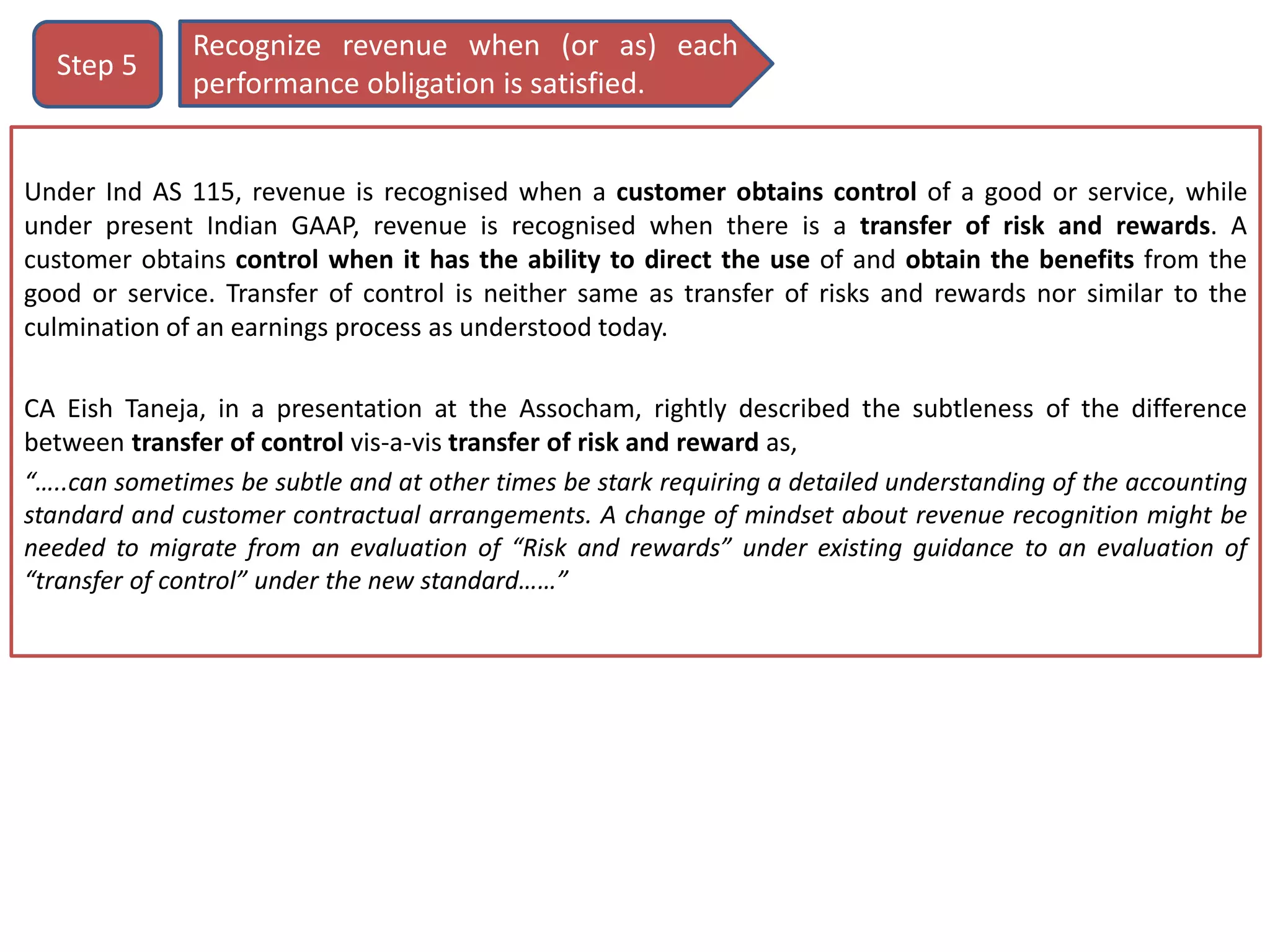
Under Ind AS 115, revenue is recognised when a customer obtains control of a good or service, while
under present Indian GAAP, revenue is recognised when there is a transfer of risk and rewards. A
customer obtains control when it has the ability to direct the use of and obtain the benefits from the
good or service. Transfer of control is neither same as transfer of risks and rewards nor similar to the
culmination of an earnings process as understood today.
CA Eish Taneja, in a presentation at the Assocham, rightly described the subtleness of the difference
between transfer of control vis-a-vis transfer of risk and reward as,
“…..can sometimes be subtle and at other times be stark requiring a detailed understanding of the accounting
standard and customer contractual arrangements. A change of mindset about revenue recognition might be
needed to migrate from an evaluation of “Risk and rewards” under existing guidance to an evaluation of
“transfer of control” under the new standard……”
Recognize revenue when (or as) each
performance obligation is satisfied.
Step 5
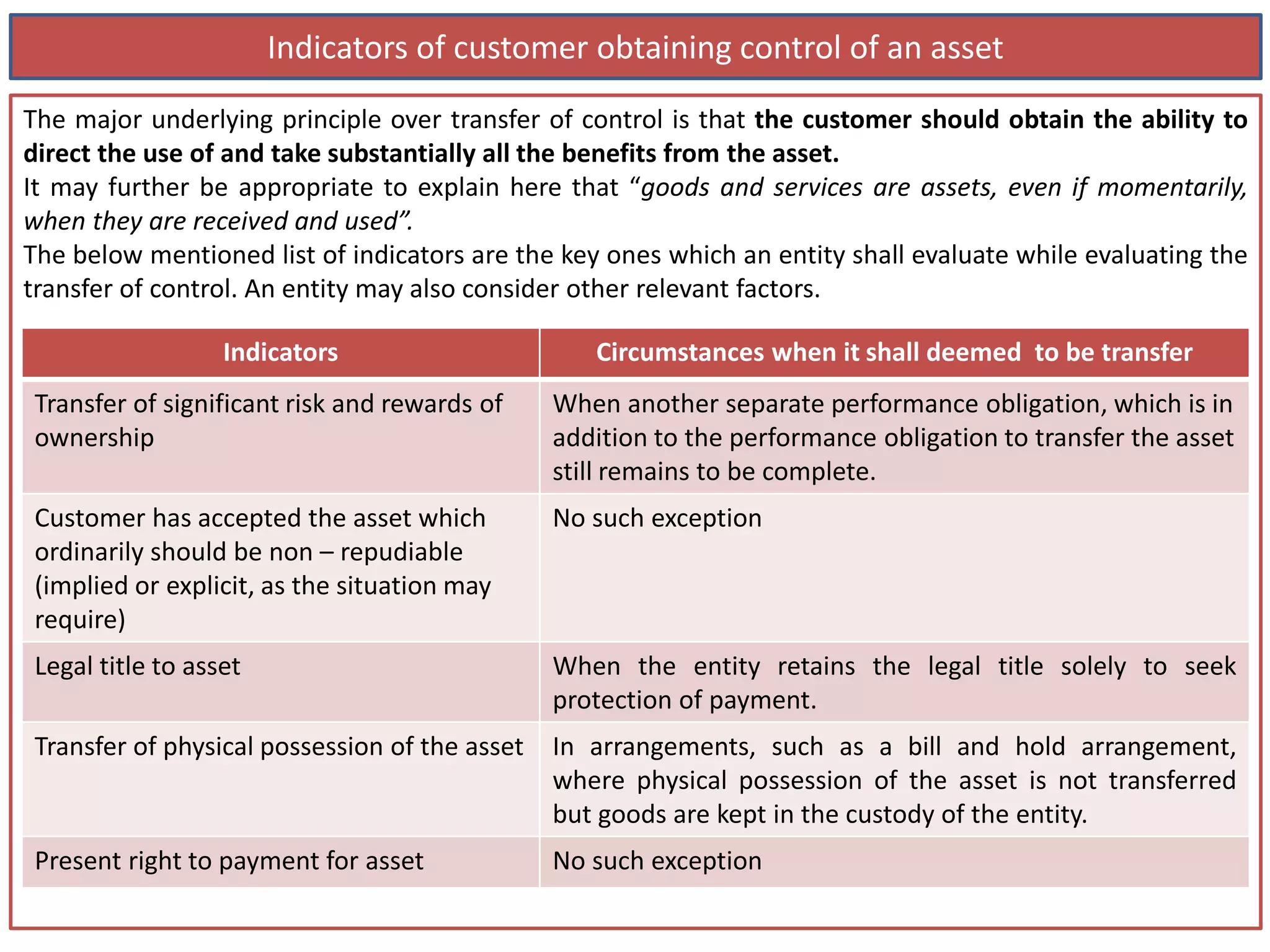
Indicators of customer obtaining control of an asset
The major underlying principle over transfer of control is that the customer should obtain the ability to
direct the use of and take substantially all the benefits from the asset.
It may further be appropriate to explain here that “goods and services are assets, even if momentarily,
when they are received and used”.
The below mentioned list of indicators are the key ones which an entity shall evaluate while evaluating the
transfer of control. An entity may also consider other relevant factors.
Indicators Circumstances when it shall deemed to be transfer
Transfer of significant risk and rewards of
ownership
When another separate performance obligation, which is in
addition to the performance obligation to transfer the asset
still remains to be complete.
Customer has accepted the asset which
ordinarily should be non – repudiable
(implied or explicit, as the situation may
require)
No such exception
Legal title to asset When the entity retains the legal title solely to seek
protection of payment.
Transfer of physical possession of the asset In arrangements, such as a bill and hold arrangement,
where physical possession of the asset is not transferred
but goods are kept in the custody of the entity.
Present right to payment for asset No such exception
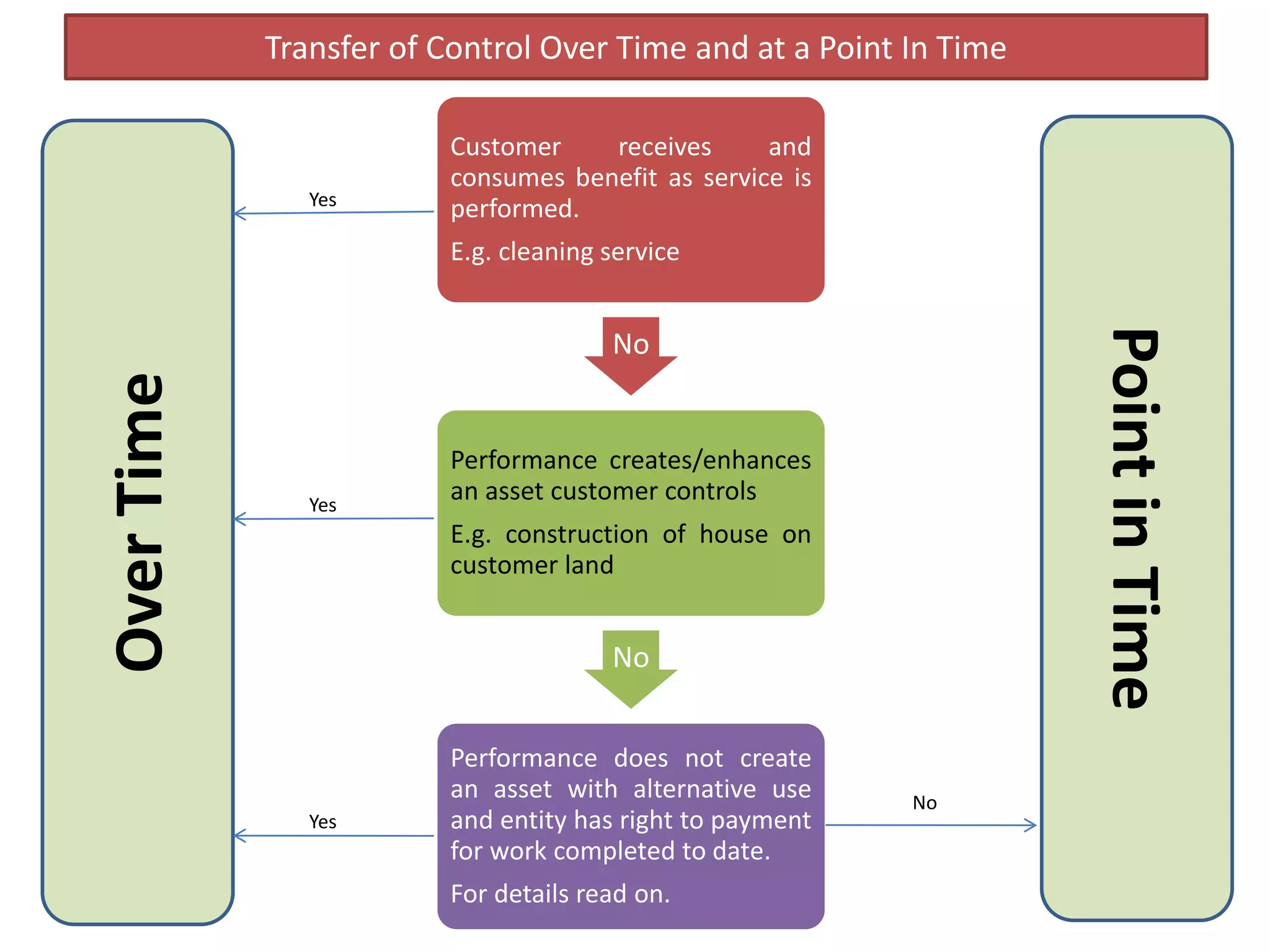
Customer receives and
consumes benefit as service is
performed.
E.g. cleaning service
No
Performance creates/enhances
an asset customer controls
E.g. construction of house on
customer land
No
Performance does not create
an asset with alternative use
and entity has right to payment
for work completed to date.
For details read on.
Transfer of Control Over Time and at a Point In Time
OverTime
PointinTime
Yes
Yes
Yes
No
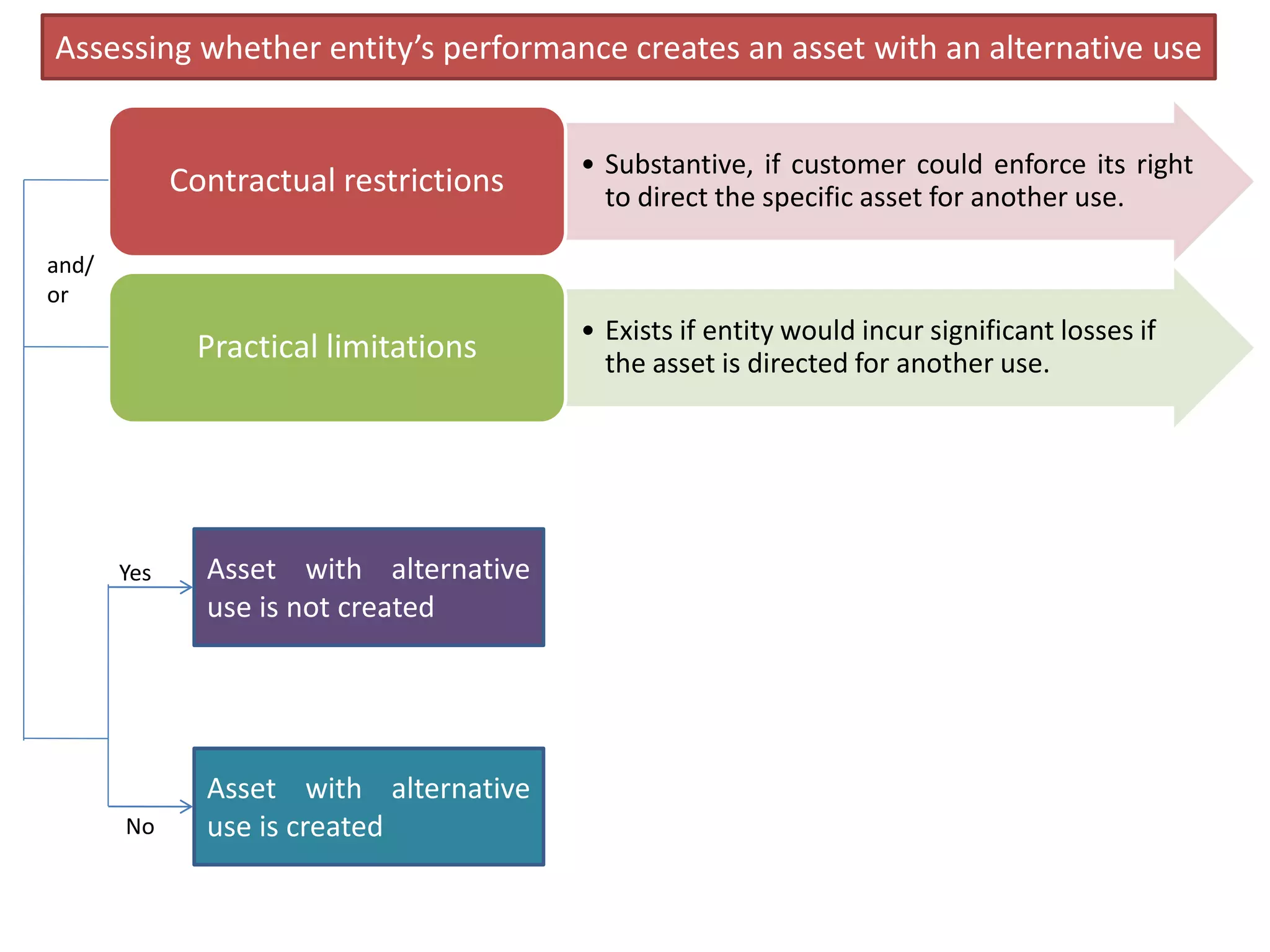
• Substantive, if customer could enforce its right
to direct the specific asset for another use.
Contractual restrictions
• Exists if entity would incur significant losses if
the asset is directed for another use.Practical limitations
Assessing whether entity’s performance creates an asset with an alternative use
Yes
No
Asset with alternative
use is not created
Asset with alternative
use is created
and/
or
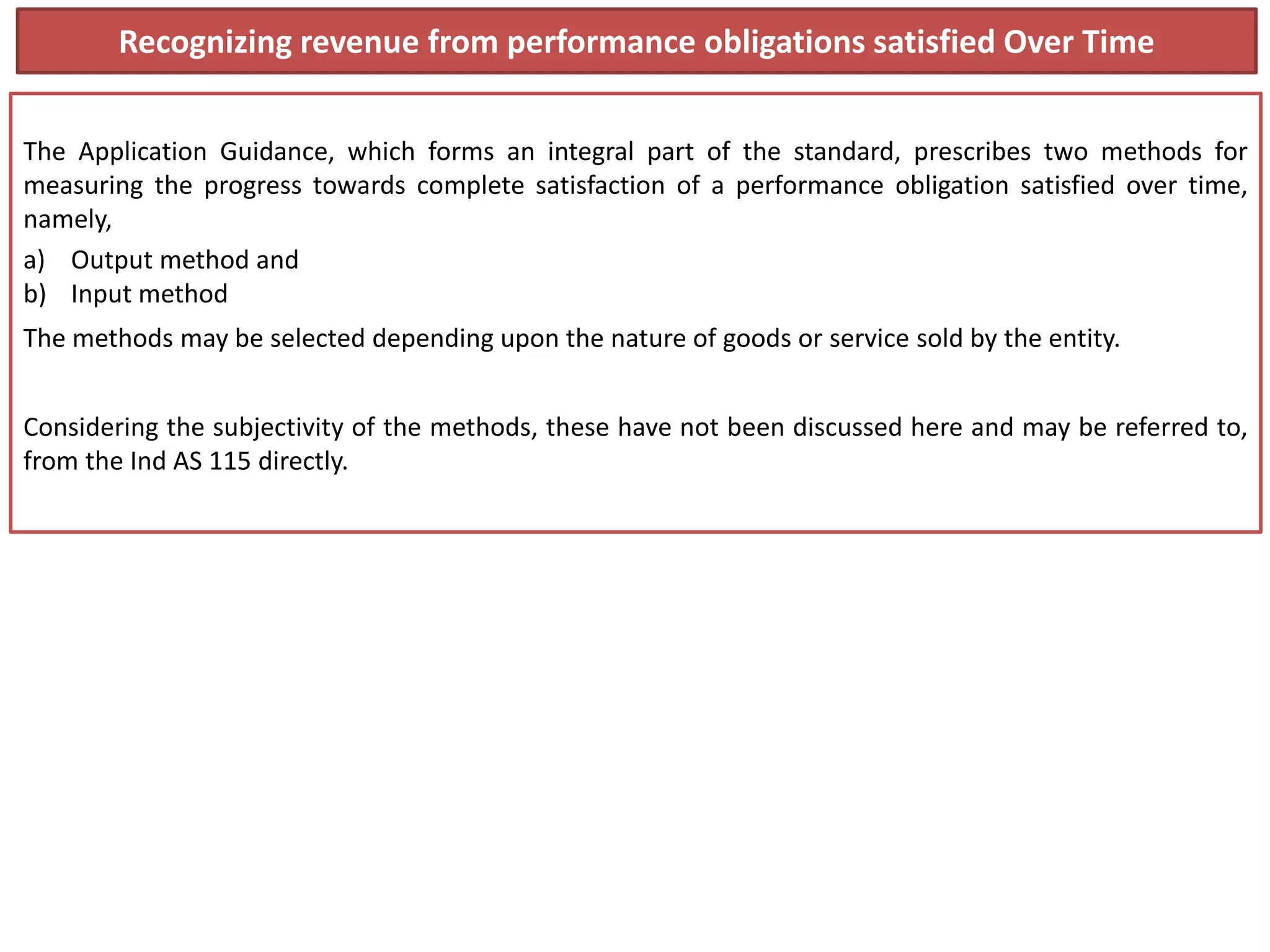
Recognizing revenue from performance obligations satisfied Over Time
The Application Guidance, which forms an integral part of the standard, prescribes two methods for
measuring the progress towards complete satisfaction of a performance obligation satisfied over time,
namely,
a) Output method and
b) Input method
The methods may be selected depending upon the nature of goods or service sold by the entity.
Considering the subjectivity of the methods, these have not been discussed here and may be referred to,
from the Ind AS 115 directly.
As promised earlier, this presentation is in continuation to my endeavor to disseminate, to
the least, what I posses on Ind AS to my happy readers.
I hope this be able to stand upto their expectations and serve their purpose.
Stay tuned for more.
Till then, Happy Reading to you !!
READ, LIKE AND SHARE!!!!
Prepared by: Nitish Aggarwal
For any feedbacks, suggestions, drop an e-mail @ nitishaggarwal7@gmail.com

Ind AS 115 Revenue from Contracts with Customers

  • 1.
    Ind AS 115: Revenuefrom Contracts with Customers Corresponding Accounting Standards AS 7: Construction Contracts AS 9: Revenue Recognition Implement Ind AS 115
  • 2.
    Overview to IndAS 115 Revenue from customers Indian Accounting Standard 115, “Revenue from Customers” is the converged version of Ind AS 11, ”Construction Contracts” and Ind AS 18, “Revenue” which is on the lines of a similar convergence by the IASB (International Accounting Standard Board) of the IAS 11 and IAS 18. While under the former regime of Accounting Standards, the scope of Revenue was covered by 2 ASs, viz. AS 9, “Revenue Recognition” and AS 7, “Construction Contracts”, the Ind AS lays down consolidated guidelines for accounting, measurement and recognition for revenue from both Construction Contracts and other businesses (except those specifically excluded through Para 5 Ind AS 115). Ind AS 115 contains principles for determination of the principles of measurement of revenue and the timing of revenue recognition. The standard would significantly change how an entity recognizes its revenue from customers and will also result in a significant increase in the volume of disclosures related to revenue.
  • 3.
    Applicability of IndAS 115 and its deferment The Ind AS 115, “Revenue from Customers”, is a carve out of the IFRS 15, “Revenue from Contract with Customers” issued by the IASB. Technology and telecom companies are largely going be impacted with this standard, i.e. mainly those companies which currently bundle their services together. Due to the requirement of the 5 step model, revenue recognition will now be more scientific and transparent. Although, the MCA notification (on applicability of Ind AS to various class of companies) does not rule out its implementation as per the roadmap, the IFRS 15 in itself is set to be implemented from 2017 onwards only. Also, as per a recent article published in the Economic Times, India is likely to defer the adoption of Ind AS 115 as more consultation is needed with the industry to clarify the requirements and to give examples to help implementation. In such a situation India may adopt the Ind AS 18, “Revenue” and Ind AS 11, “Construction Contracts” for the interim period.
  • 4.
    Scope of IndAS 115 Applicable to all contracts with customers (including those with non monetary asset), except:
  • 5.
    Definitions Some of thekey terms defined in this standard are: 1. Contract Asset An entity’s right to consideration in exchange for goods or services that the entity has transferred to a customer when that right is conditioned on something other than the passage of time (for example, the entity’s future performance). 2. Contract Liability An entity’s obligation to transfer goods or services to a customer for which the entity has received or is entitled to receive consideration from the customer. 3. Performance Obligation A promise in a contract with a customer to transfer to the customer either: (a) a good or service (or a bundle of goods or services) that is distinct; or (b) a series of distinct goods or services that are substantially the same and that have the same pattern of transfer to the customer. 5. Stand-alone selling price (of a good or service) The price at which an entity would sell a promised good or service separately to a customer. 6. Transaction Price (for a contract with a customer) The amount of consideration to which an entity expects to be entitled in exchange for transferring promised goods or services to a customer, excluding amounts collected on behalf of third parties.
  • 6.
    Revenue Recognition andMeasurement under Ind AS 115 Ind AS 115, “Revenue from Customers”, lays down a five step model approach to the measurement and recognition of revenue from customers. The five step model requires combining/separating contracts with customers, identifying the distinct components in the contracts and recognizing revenue as per the separately allocated transaction price and on fulfillment of certain conditions. AS 9, “Revenue” which covered the accounting, measurement etc. of revenue from sale of goods, rendering of services and interest, royalties and dividend incomes required fulfillment of certain conditions for an entity to be able recognize revenue from such transactions. While AS 7 did cover the contract based recognition approach, it based the recognition on percentage of completion while Ind AS 115 requires identification of the distinct components of the goods or services in a contract and recognition of revenue on satisfaction of the conditions laid under the fifth step for not only construction contracts but all revenue from all other nature of businesses. The following slides cover in detail the five step model and thus, the recognition and measurement of revenue.
  • 7.
    Identify the contract witha customer. Identify the separate performance obligations in the contract. Determine the transaction price. Allocate the transaction price to the separate performance obligations. Recognize revenue when (or as) each performance obligation is satisfied. The five step approach for recognition of revenue
  • 8.
    The Ind ASapproach to Revenue from Customers Revenue recognition as per Ind AS 115 has been described hereunder with the help of an example in order to give a bird’s eye view of the Ind AS approach to Revenue from Customers. X enters into a 12-month telecom plan with Airtel . The terms of the plan are as follows: 1. X monthly fixed fee is INR 5,000. 2. X receives a free handset at the inception of the plan. Airtel sells the same handsets for INR 25,000 and the same monthly prepayment plans without handset for INR 4,000/month. How should Airtel recognize the revenues as per Ind AS 115? Revenue under Ind AS 115 Step 1. Identify the contract first. Step 2. Identify all performance obligation. Here, being delivery of handset and service. Step 3. The transaction price is INR 60,000 (being 5,000 X 12 months). Step 4. Allocate that transaction price of INR 60,000 to individual performance obligations. Step 5. Recognize the revenue when Airtel satisfies the performance obligations. Performance obligation Stand-alone selling price % on total Revenue (Relative Selling Price = 60,000*%) Handset 25,000 34% 20,500 Network services 48,000 (=4000*12) 66% 39,500 Total 73,000 100.00% 60,000
  • 9.
    Identify the contractwith a customer.Step 1 The initial step in the five step model. It requires identifying a contract with the customer/s where a contract with the prescribed attributes is present. It further talks about combining various contracts with the same customer if the contracts are negotiated as a single performance obligation with a single commercial objective and/or inter dependent considerations.
  • 10.
    Who is a customer??? Aperson who has contracted with an entity to obtain goods or services that are an output of the entity’s ordinary activities in exchange for consideration. REVENUE - Income arising in the course of an entity’s ordinary activities. INCOME - Increases in economic benefits in the form of inflows or enhancements of assets or decreases of liabilities that result in an increase in equity (except capital contributions).
  • 11.
    Contract - Anagreement between two or more parties that creates enforceable rights and obligations. It may be written, oral or implied by the business’ customary practices. Necessary attributes of a contract as per Ind AS 115: The parties have approved the contract and intend to perform their respective obligations. Each party’s rights regarding the goods or services to be transferred can be identified. Payment terms can be identified. Contract has commercial substance i.e. the risk, timing or amount of the entity’s future cash flows are expected to change. It is probable that the entity will collect the consideration to which it will be entitled in exchange for goods or services transferred. Whether all conditions are satisfied? Yes No Account for any consideration received from customer as a liability until the termination or fulfillment of the contract. Follow subsequent steps for recognition of revenue as per the five step model only.
  • 12.
    Contract Combination 2 ormore contracts negotiated as a package. E.g. audit of individual entities of a group company. No Consideration of one contract depends on another. No Goods or services in a contract are a single performance obligation as per Step No. 2. CombineContracts Combination of Contract is not possible. Thus treat contract as individual contract. Yes Yes Yes No
  • 13.
    Contract Modification Addition of distinct goods orservices Additional consideration = Standalone price of additional goods or services Contract Modification Treat modification as a separate contract Yes No Condition 1 Condition 2 Treat modification as described on next slide
  • 14.
    Only condition 1is satisfied Existing contract stands cancelled and treat as new contract Then, consideration = additional consideration + Unrecognized revenue Follow steps 1 to 5 Modification not treated as a separate contract Addition of distinct goods or services are distinctly identifiable only for some part Treat in any suitable manner None of the condition is satisfied Treat as a single unsatisfied performance obligation (Step 2)
  • 15.
    At contract inception,an entity is required to identify the separate performance obligations in a contract. A Performance Obligation is a promise in a contract with a customer to transfer to the customer either: (a) a good or service (or a bundle of goods or services) that is distinct; or (b) a series of distinct goods or services that are substantially the same and that have the same pattern of transfer to the customer which is characterized by any one of the conditions of transfer of control over time. Promise may be implicit, explicit or implied through the business’ customary business practice. The promise to transfer the distinct goods or service excludes goods or services that are to be used as an input in producing other goods or services specified by the customer. For instance, in the example taken in the beginning of the 5 step model, the separate performance obligations are service by Airtel (falling under part (b) of the above definition of performance obligation) and transfer of handset mobile (falling under part (a) of the above definition of performance obligation) to the customer. Identify the separate performance obligations in the contract.Step 2 Distinct goods or services Can be used independently or with other readily available resources Promise to transfer is separately identifiable from other promises
  • 16.
    As per IndAS 115, the transaction price (for a contract with a customer) is the amount of consideration to which an entity expects to be entitled in exchange for transferring promised goods or services to a customer, excluding amounts collected on behalf of third parties. Thus, amounts received as an agent is transaction price only to the extent of the agent’s own share of consideration. Determine the transaction price. Step 3 TRANSACTION PRICE Fixed cash consideration Variable consideration Financing component Non cash consideration Payable to a customer Normally shown as a reduction in transaction price
  • 17.
    Examples of variableconsideration includes performance discounts, bonuses, refund rights and penalties as well. Variable consideration is included in the determination of the transaction price only if it is highly probable that there will not be a significant revenue reversal. Factors (not exhaustive) that indicate high probability of revenue reversal Uncertainty over long period of time Limited experience with similar contracts Susceptible to factors outside control A large number of wide range outcomes Variable Consideration Key effects • Entities must recognize ‘minimum amount’ that is highly probable of not reversing. • It will lead to early recognition of revenue unlike under the current GAAP where such consideration is recognized on realization only. • The variable consideration recognized should be reassessed at the end of each reporting period and necessary adjustments should be made.
  • 18.
    ExpectedValueMethod • Sum ofprobability weighted amounts in a range of possible outcomes. • Appropriate for large no. of similar contracts. • E.g. If the probability of receiving a variable consideration of Rs 1,00,000/- is 30% while that of Rs 50,000 is 70%. Then, estimated variable consideration = (100000*0.3)+(50000*0.7) = 65,000 MostLikelyAmountMethod • A single most likely amount in a range of possible outcomes. • E.g. In a contract which entitles the entity to a performance bonus of rupees, say, 10,000 only on fulfillment of all the performance obligations, the management decide, basis its past experience and records, if it will be entitled to the bonus. In case it is YES – Estimated Variable consideration = Rs 10,000 NO - Estimated Variable consideration = Nil Methods for Calculating Variable Consideration Miscellaneous • Both the method requires management consideration of historical, current and forecast information. • Any 1 method to be consistently applied.
  • 19.
    Time Value ofMoney While determining the transaction price, the fact that a significant financing component exists, regardless of the fact that it is validated explicitly by a written agreement or not, should be considered. However, an entity should not recognize a financing component, if any of the following situation is satisfied:- 1. Advance is paid by the customer but the transfer of the goods and/or services is at the discretion of the customer, or 2. Difference between the consideration defined and the cash selling price exists due to some other specified reason. E.g. If difference exists due to an escalation clause or an amount levied on non abidance of a particular clause, etc. The process of identifying the financing component has been elaborated subsequently:
  • 20.
    FINANCING COMPONENT Interest Expense when customer paysin advance Rate between the customer and the entity, had the transaction been only a financing transaction. Time value of money to be considered only if time gap is more than 1 year. Proximity of the financing component identified with the prevailing interest rates in market Expected time gap between transfer of goods/services and payment Existence of difference between defined consideration and cash selling price Evaluation of Existence To be disclosed separately from other interest incomes/expenses Interest component to be calculated using the discounting technique Factors affecting discount rate Credit characteristics of person receiving finance. E.g. Credit ratings The fact that the financing transaction is secured or unsecured. Interest Income when customer pays at a later date To be fixed at contract inception itself
  • 21.
    Non - CashConsideration A customer may pay or promise to pay the entity, in exchange of its goods or services, consideration in a form other than cash. Such consideration should be measured at fair value of the asset being transferred or promised to being transferred by the customer. However, there may be a situation where such fair value is not available, the entity should measure such consideration at the stand alone selling price of the goods or services of the entity transferred to the customer. Supply of inputs by customer A customer may supply raw materials, labor, etc. to the entity for being used in the process of manufacture of goods or rendering of services. In such a case, the inputs shall be valued as above.
  • 22.
    Allocate the transactionprice to the separate performance obligations. Step 4 • In ratio of the ‘Stand- alone Selling Prices’ (SASP) Allocation of Transaction Price • Discount=Sum of Stand- alone Selling Prices- Contract value • Discount to be allocated pro-rata to each performance obligation Allocation of discounts • Allocated to a specific performance obligation or a good or a service, if clearly identifiable. • Else, allocate as per SASP. Allocation of variable consideration
  • 23.
    As per Para31 of Ind AS 115, an entity shall recognize revenue when (or as) the entity satisfies a performance obligation by transferring a promised asset to a customer. Further, an asset is transferred when (or as) the customer obtains control of that asset. The five step model requires determining, at the very inception of the contract, whether the performance obligation will be satisfied “over time” or “in time”. Such identification and classification has been covered in detail in the following slides. Recognize revenue when (or as) each performance obligation is satisfied. Step 5
  • 24.
    Under Ind AS115, revenue is recognised when a customer obtains control of a good or service, while under present Indian GAAP, revenue is recognised when there is a transfer of risk and rewards. A customer obtains control when it has the ability to direct the use of and obtain the benefits from the good or service. Transfer of control is neither same as transfer of risks and rewards nor similar to the culmination of an earnings process as understood today. CA Eish Taneja, in a presentation at the Assocham, rightly described the subtleness of the difference between transfer of control vis-a-vis transfer of risk and reward as, “…..can sometimes be subtle and at other times be stark requiring a detailed understanding of the accounting standard and customer contractual arrangements. A change of mindset about revenue recognition might be needed to migrate from an evaluation of “Risk and rewards” under existing guidance to an evaluation of “transfer of control” under the new standard……” Recognize revenue when (or as) each performance obligation is satisfied. Step 5
  • 25.
    Indicators of customerobtaining control of an asset The major underlying principle over transfer of control is that the customer should obtain the ability to direct the use of and take substantially all the benefits from the asset. It may further be appropriate to explain here that “goods and services are assets, even if momentarily, when they are received and used”. The below mentioned list of indicators are the key ones which an entity shall evaluate while evaluating the transfer of control. An entity may also consider other relevant factors. Indicators Circumstances when it shall deemed to be transfer Transfer of significant risk and rewards of ownership When another separate performance obligation, which is in addition to the performance obligation to transfer the asset still remains to be complete. Customer has accepted the asset which ordinarily should be non – repudiable (implied or explicit, as the situation may require) No such exception Legal title to asset When the entity retains the legal title solely to seek protection of payment. Transfer of physical possession of the asset In arrangements, such as a bill and hold arrangement, where physical possession of the asset is not transferred but goods are kept in the custody of the entity. Present right to payment for asset No such exception
  • 26.
    Customer receives and consumesbenefit as service is performed. E.g. cleaning service No Performance creates/enhances an asset customer controls E.g. construction of house on customer land No Performance does not create an asset with alternative use and entity has right to payment for work completed to date. For details read on. Transfer of Control Over Time and at a Point In Time OverTime PointinTime Yes Yes Yes No
  • 27.
    • Substantive, ifcustomer could enforce its right to direct the specific asset for another use. Contractual restrictions • Exists if entity would incur significant losses if the asset is directed for another use.Practical limitations Assessing whether entity’s performance creates an asset with an alternative use Yes No Asset with alternative use is not created Asset with alternative use is created and/ or
  • 28.
    Recognizing revenue fromperformance obligations satisfied Over Time The Application Guidance, which forms an integral part of the standard, prescribes two methods for measuring the progress towards complete satisfaction of a performance obligation satisfied over time, namely, a) Output method and b) Input method The methods may be selected depending upon the nature of goods or service sold by the entity. Considering the subjectivity of the methods, these have not been discussed here and may be referred to, from the Ind AS 115 directly.
  • 29.
    As promised earlier,this presentation is in continuation to my endeavor to disseminate, to the least, what I posses on Ind AS to my happy readers. I hope this be able to stand upto their expectations and serve their purpose. Stay tuned for more. Till then, Happy Reading to you !! READ, LIKE AND SHARE!!!! Prepared by: Nitish Aggarwal For any feedbacks, suggestions, drop an e-mail @ nitishaggarwal7@gmail.com

Editor's Notes

  • #21 Discount rate – Factors: rate that would be reflected in a separate financing transaction between the entity and its customer at contract inception No change once rate is recognised