 Finance as a function is
 1:"To provide or raise the funds or capital
 2: "the branch of economics that studies the
management of money and other assets"
3: "the management of money and credit and
banking and investments"
 System: Set of complex and closely connected
or interlinked institutions, agents, practices,
markets, transactions, claims, and liabilities in
the economy
 Financial System: Money, Credit, Finance
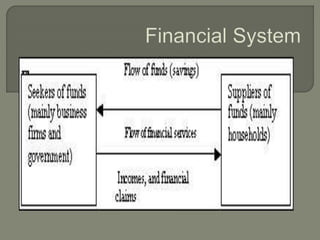
 A financial system functions as an intermediary
and facilitates the flow of funds from the areas of
surplus to the areas of the deficit.
Generally accepted as payment for goods
and services and repayment of debts
Functions of money:
Medium of Exchange
Unit of Account
Store of value
M1:Currency (coins and bills) and
checking account deposits
M2: Currency, checking account deposits
and savings account deposits
M3: M2 plus time deposits
M0: Currency plus deposits of banks and
other institutions at the central bank
Money Loaned
A method of paying for goods or services
at a later time, usually paying interest as
well as the original money
Activity by which claims to resources are
either assembled from those released by
domestic savings, obtained from abroad,
or specifically created usually as bank
deposits or notes and then placed in the
hands of investors.
Activity by which resources are actually
committed to production
Volume of capital formation: Intensity of
savings, finance and investment.
Conversion of savings to investment:
Transfer Process
Genesis of Financial System: Divorce
between savings and investment
Relationship between savings and
investment vary considerably among
economic units
Goldsmith’ designated categories of
economic units: Savings-surplus units
(Savings in excess of investments),
Economic Units (Investments exceed their
savings) and Neutral units (Savings equal
Financial innovation
Growth of technology
Rudimentary Finance
Direct Finance
Indirect Finance
Financial System of underdeveloped or
traditional economy
Per capita output low and declining
Absence of an array of financial assets/
instruments that would stimulate savings
Absence of an array of financial markets
that would allocate savings competitively
to investment
Improvement over rudimentary finance by
removing the obstacles to efficient capital
formation
Improved capital formation under direct
finance through: Financial assets/
instruments, Brokers/ Investment Bankers,
Secondary Markets/ Stock Exchanges
Financial instrument/ asset is a claim
against another economic unit and is held
as a store of value and for the return that is
expected.
Examples: Shares, Debentures, etc.
Financial assets stimulate capital formation
and speedy economic development
Find savers and bring them with economic
units needing funds
Brokerage function, Underwriting function
Provide savers with ability/ facility to
dispose of their investment portfolio and
realise cash to finance their current
consumption
Provide liquidity and marketability
 Flow of savings from savers to entrepreneurs
through intermediary financial institutions like
mutual funds, insurance companies, etc.
 Services offered by financial intermediaries:
 Convenience (Divisibility, Flexibility, Maturity)
 Lower risk
 Expert Management
 Economies of Scale
 Channelisation of savings (Encouraging,
Sponsoring, Discriminating between various
industries)
Functions
Saving Function
Liquidity Function
Payment Function
Risk Function
Policy Function
Public saving find their way into the hands
of those in production through the financial
system. Financial claims are issued in the
money and capital markets which promise
future income flows. The funds with the
producers result in production of goods
and services thereby increasing society
living standards.

The financial markets provide the investor
with the opportunity to liquidate
investments like stocks, bonds,
debentures, etc. whenever they need the
fund.
The financial system offers a very
convenient mode for payment of goods
and services. Cheque system, credit card
system etc are the easiest methods of
payments. The cost and time of
transactions are drastically reduced.
The financial markets provide protection
against life, health and income risks.
These are accomplished through the sale
of life and health insurance and property
insurance policies. The financial markets
provide immense opportunities for the
investor to hedge himself against or
reduce the possible risks involved in
various investments
The government intervenes in the financial
system to influence macroeconomic
variables like interest rates or inflation so if
country needs more money government
would cut rate of interest through various
financial instruments and if inflation is high
and too much money is there in the system
then government would increase rate of
interest.
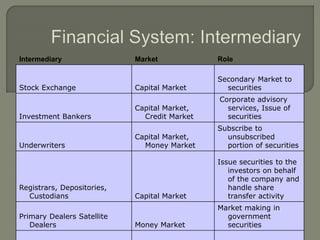
Intermediary Market Role
Stock Exchange Capital Market
Secondary Market to
securities
Investment Bankers
Capital Market,
Credit Market
Corporate advisory
services, Issue of
securities
Underwriters
Capital Market,
Money Market
Subscribe to
unsubscribed
portion of securities
Registrars, Depositories,
Custodians Capital Market
Issue securities to the
investors on behalf
of the company and
handle share
transfer activity
Primary Dealers Satellite
Dealers Money Market
Market making in
government
securities
Upto 1951
!951 to the mid-eighties
After early nineties
Defined as the market in which financial assets
are created or transferred.
These assets represent a claim to the payment of a
sum of money sometime in the future and/or
periodic payment in the form of interest or
dividend.
Classification
Money market
(Short term instrument)
Capital markets
(Long term instrument)
The most important distinction between the
two:
The difference in the period of maturity.
Main Function
To channelize savings into short term productive
investments like working capital .
Instruments in Money Market
Call money market
Treasury bills market
Markets for commercial paper
Certificate of deposits
Bills of Exchange
Money market mutual funds
Promissory Note
Part of the national money market
Day-to day surplus funds mainly of banks are traded
Short term in nature
Maturity of these loans vary from 1 to 15 days
Lent for 1 day: Call money
Lent for more than 1 day but less than 15 days: Notice
money
Convenient interest rate
Highly liquid loan repayable on demand
Unsecured Promissory note.
Issued by well known companies with strong and
high credit rating.
Sold directly by the issuers to investors or through
agents like merchant banks and security houses.
Flexible Maturity
Low interest rates with compared to banks.
Imparts a degree of financial stability to the system.
Referred as note payable in accounting
It is a contract detailing the terms of a promise
by one party (the maker) to pay a sum of money
to the other (the payee).
The obligation may arise from the repayment of
a loan or from another form of debt.
For example, in the sale of a business, the
purchase price might be a combination of an
immediate cash payment and one or more
promissory notes for the balance.
Defined as short term deposit by way of usance
promissory notes.
Greater flexibility to investors in the deployment of
surplus funds.
Permitted by the RBI to banks
Maturity of not less than 3 months and upto 1 year.
Transferable in nature
Free negotiability and limited flexibility
Invest primarily in money market instruments of
very high quality.
RBI and public financial institution can set it
either directly or through its existing subsidiaries.
MMMF
Open Ended
Close Ended
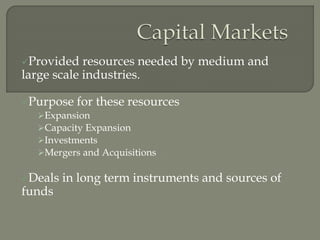
Provided resources needed by medium and
large scale industries.
Purpose for these resources
Expansion
Capacity Expansion
Investments
Mergers and Acquisitions
Deals in long term instruments and sources of
funds
Main Activity
Functioning as an institutional mechanism to
channelize funds from those who save to those
who needed for productive purpose.
Provides opportunities to various class of
individuals and entities.
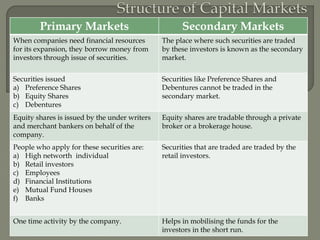
Primary Markets Secondary Markets
When companies need financial resources
for its expansion, they borrow money from
investors through issue of securities.
The place where such securities are traded
by these investors is known as the secondary
market.
Securities issued
a) Preference Shares
b) Equity Shares
c) Debentures
Securities like Preference Shares and
Debentures cannot be traded in the
secondary market.
Equity shares is issued by the under writers
and merchant bankers on behalf of the
company.
Equity shares are tradable through a private
broker or a brokerage house.
People who apply for these securities are:
a) High networth individual
b) Retail investors
c) Employees
d) Financial Institutions
e) Mutual Fund Houses
f) Banks
Securities that are traded are traded by the
retail investors.
One time activity by the company. Helps in mobilising the funds for the
investors in the short run.
1. Financial institutions
2. Financial Markets
3. Financial
Instruments/Assets/Securities
4. Financial Services.
Financial Markets
Foreign Exchange and
Eurocurrency market
Domestic and International Bond
Market
Domestic and International Stock
Markets
Derivatives Markets
Liquidity: The ease of capturing an asset’s
value
Reflects a market’s operational efficiency
Impacts a market’s informational and
allocational efficiency
 The inter bank foreign exchange market
for large transactions is the world’s most
liquid market
Maturity:
 Short-term: Money market
 Long-term: Capital market
Regulatory Jurisdiction:
 Single-country internal markets
 Multi-country external markets
Middlemen
 Intermediated through a commercial bank
 Non-intermediated or direct to the public, through
a broker or investor bank
Spot Market
Cash market with delivery in two
business days
Forward Market
Trade at a prearranged date and price
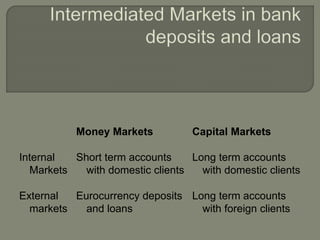
Money Markets Capital Markets
Internal
Markets
Short term accounts
with domestic clients
Long term accounts
with domestic clients
External
markets
Eurocurrency deposits
and loans
Long term accounts
with foreign clients
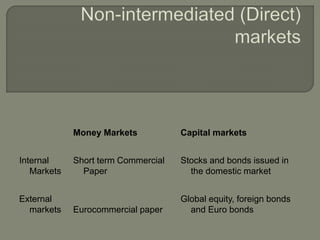
Money Markets Capital markets
Internal
Markets
Short term Commercial
Paper
Stocks and bonds issued in
the domestic market
External
markets Eurocommercial paper
Global equity, foreign bonds
and Euro bonds
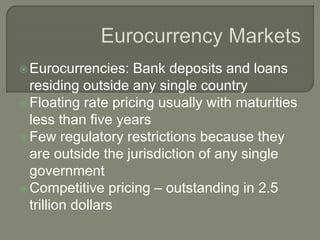
Eurocurrencies: Bank deposits and loans
residing outside any single country
Floating rate pricing usually with maturities
less than five years
Few regulatory restrictions because they
are outside the jurisdiction of any single
government
Competitive pricing – outstanding in 2.5
trillion dollars
Typically there are
No reserve requirement
No interest rate regulations or caps
No with holding taxes
No deposit insurance requirements
No credit allocation regulations
Less stringent disclosure requirements
Low interest rate risk: Interest rates tied to
a variable rate base such as the LIBOR
Low default risk: Traded between large
commercial banks, investment banks and
multinational corporations
Relatively short maturities: Typically less
than five years
Cross listing of shares: Increase demand
and enhance share price, Improves image
of the firm, Gets more customer and
investor base
Cross listing benefits the firm in improving
transparency and disclosure, reduces
opportunity for hostile takeover.
Dominant: 56 per cent
Domestic Bonds
Foreign Bonds
Euro Bonds: Samurai, Bull
dog, Yankee
USA dominant: 31 per cent
Forwards
Swaps
Options
Futures
 Indian-financial-system (1)

Indian-financial-system (1)

  • 1.
     Finance asa function is  1:"To provide or raise the funds or capital  2: "the branch of economics that studies the management of money and other assets" 3: "the management of money and credit and banking and investments"
  • 2.
     System: Setof complex and closely connected or interlinked institutions, agents, practices, markets, transactions, claims, and liabilities in the economy  Financial System: Money, Credit, Finance  A financial system functions as an intermediary and facilitates the flow of funds from the areas of surplus to the areas of the deficit.
  • 3.
    Generally accepted aspayment for goods and services and repayment of debts Functions of money: Medium of Exchange Unit of Account Store of value
  • 4.
    M1:Currency (coins andbills) and checking account deposits M2: Currency, checking account deposits and savings account deposits M3: M2 plus time deposits M0: Currency plus deposits of banks and other institutions at the central bank
  • 5.
    Money Loaned A methodof paying for goods or services at a later time, usually paying interest as well as the original money
  • 6.
    Activity by whichclaims to resources are either assembled from those released by domestic savings, obtained from abroad, or specifically created usually as bank deposits or notes and then placed in the hands of investors.
  • 7.
    Activity by whichresources are actually committed to production Volume of capital formation: Intensity of savings, finance and investment. Conversion of savings to investment: Transfer Process
  • 8.
    Genesis of FinancialSystem: Divorce between savings and investment Relationship between savings and investment vary considerably among economic units Goldsmith’ designated categories of economic units: Savings-surplus units (Savings in excess of investments), Economic Units (Investments exceed their savings) and Neutral units (Savings equal
  • 10.
    Financial innovation Growth oftechnology Rudimentary Finance Direct Finance Indirect Finance
  • 11.
    Financial System ofunderdeveloped or traditional economy Per capita output low and declining Absence of an array of financial assets/ instruments that would stimulate savings Absence of an array of financial markets that would allocate savings competitively to investment
  • 12.
    Improvement over rudimentaryfinance by removing the obstacles to efficient capital formation Improved capital formation under direct finance through: Financial assets/ instruments, Brokers/ Investment Bankers, Secondary Markets/ Stock Exchanges
  • 13.
    Financial instrument/ assetis a claim against another economic unit and is held as a store of value and for the return that is expected. Examples: Shares, Debentures, etc. Financial assets stimulate capital formation and speedy economic development
  • 14.
    Find savers andbring them with economic units needing funds Brokerage function, Underwriting function
  • 15.
    Provide savers withability/ facility to dispose of their investment portfolio and realise cash to finance their current consumption Provide liquidity and marketability
  • 16.
     Flow ofsavings from savers to entrepreneurs through intermediary financial institutions like mutual funds, insurance companies, etc.  Services offered by financial intermediaries:  Convenience (Divisibility, Flexibility, Maturity)  Lower risk  Expert Management  Economies of Scale  Channelisation of savings (Encouraging, Sponsoring, Discriminating between various industries)
  • 17.
    Functions Saving Function Liquidity Function PaymentFunction Risk Function Policy Function
  • 18.
    Public saving findtheir way into the hands of those in production through the financial system. Financial claims are issued in the money and capital markets which promise future income flows. The funds with the producers result in production of goods and services thereby increasing society living standards. 
  • 19.
    The financial marketsprovide the investor with the opportunity to liquidate investments like stocks, bonds, debentures, etc. whenever they need the fund.
  • 20.
    The financial systemoffers a very convenient mode for payment of goods and services. Cheque system, credit card system etc are the easiest methods of payments. The cost and time of transactions are drastically reduced.
  • 21.
    The financial marketsprovide protection against life, health and income risks. These are accomplished through the sale of life and health insurance and property insurance policies. The financial markets provide immense opportunities for the investor to hedge himself against or reduce the possible risks involved in various investments
  • 22.
    The government intervenesin the financial system to influence macroeconomic variables like interest rates or inflation so if country needs more money government would cut rate of interest through various financial instruments and if inflation is high and too much money is there in the system then government would increase rate of interest.
  • 24.
    Intermediary Market Role StockExchange Capital Market Secondary Market to securities Investment Bankers Capital Market, Credit Market Corporate advisory services, Issue of securities Underwriters Capital Market, Money Market Subscribe to unsubscribed portion of securities Registrars, Depositories, Custodians Capital Market Issue securities to the investors on behalf of the company and handle share transfer activity Primary Dealers Satellite Dealers Money Market Market making in government securities
  • 25.
    Upto 1951 !951 tothe mid-eighties After early nineties
  • 26.
    Defined as themarket in which financial assets are created or transferred. These assets represent a claim to the payment of a sum of money sometime in the future and/or periodic payment in the form of interest or dividend.
  • 27.
    Classification Money market (Short terminstrument) Capital markets (Long term instrument) The most important distinction between the two: The difference in the period of maturity.
  • 28.
    Main Function To channelizesavings into short term productive investments like working capital . Instruments in Money Market Call money market Treasury bills market Markets for commercial paper Certificate of deposits Bills of Exchange Money market mutual funds Promissory Note
  • 29.
    Part of thenational money market Day-to day surplus funds mainly of banks are traded Short term in nature Maturity of these loans vary from 1 to 15 days Lent for 1 day: Call money Lent for more than 1 day but less than 15 days: Notice money Convenient interest rate Highly liquid loan repayable on demand
  • 30.
    Unsecured Promissory note. Issuedby well known companies with strong and high credit rating. Sold directly by the issuers to investors or through agents like merchant banks and security houses. Flexible Maturity Low interest rates with compared to banks. Imparts a degree of financial stability to the system.
  • 31.
    Referred as notepayable in accounting It is a contract detailing the terms of a promise by one party (the maker) to pay a sum of money to the other (the payee). The obligation may arise from the repayment of a loan or from another form of debt. For example, in the sale of a business, the purchase price might be a combination of an immediate cash payment and one or more promissory notes for the balance.
  • 32.
    Defined as shortterm deposit by way of usance promissory notes. Greater flexibility to investors in the deployment of surplus funds. Permitted by the RBI to banks Maturity of not less than 3 months and upto 1 year. Transferable in nature Free negotiability and limited flexibility
  • 33.
    Invest primarily inmoney market instruments of very high quality. RBI and public financial institution can set it either directly or through its existing subsidiaries. MMMF Open Ended Close Ended
  • 34.
    Provided resources neededby medium and large scale industries. Purpose for these resources Expansion Capacity Expansion Investments Mergers and Acquisitions Deals in long term instruments and sources of funds
  • 35.
    Main Activity Functioning asan institutional mechanism to channelize funds from those who save to those who needed for productive purpose. Provides opportunities to various class of individuals and entities.
  • 36.
    Primary Markets SecondaryMarkets When companies need financial resources for its expansion, they borrow money from investors through issue of securities. The place where such securities are traded by these investors is known as the secondary market. Securities issued a) Preference Shares b) Equity Shares c) Debentures Securities like Preference Shares and Debentures cannot be traded in the secondary market. Equity shares is issued by the under writers and merchant bankers on behalf of the company. Equity shares are tradable through a private broker or a brokerage house. People who apply for these securities are: a) High networth individual b) Retail investors c) Employees d) Financial Institutions e) Mutual Fund Houses f) Banks Securities that are traded are traded by the retail investors. One time activity by the company. Helps in mobilising the funds for the investors in the short run.
  • 37.
    1. Financial institutions 2.Financial Markets 3. Financial Instruments/Assets/Securities 4. Financial Services.
  • 39.
    Financial Markets Foreign Exchangeand Eurocurrency market Domestic and International Bond Market Domestic and International Stock Markets Derivatives Markets
  • 40.
    Liquidity: The easeof capturing an asset’s value Reflects a market’s operational efficiency Impacts a market’s informational and allocational efficiency  The inter bank foreign exchange market for large transactions is the world’s most liquid market
  • 41.
    Maturity:  Short-term: Moneymarket  Long-term: Capital market Regulatory Jurisdiction:  Single-country internal markets  Multi-country external markets Middlemen  Intermediated through a commercial bank  Non-intermediated or direct to the public, through a broker or investor bank
  • 42.
    Spot Market Cash marketwith delivery in two business days Forward Market Trade at a prearranged date and price
  • 43.
    Money Markets CapitalMarkets Internal Markets Short term accounts with domestic clients Long term accounts with domestic clients External markets Eurocurrency deposits and loans Long term accounts with foreign clients
  • 44.
    Money Markets Capitalmarkets Internal Markets Short term Commercial Paper Stocks and bonds issued in the domestic market External markets Eurocommercial paper Global equity, foreign bonds and Euro bonds
  • 45.
    Eurocurrencies: Bank depositsand loans residing outside any single country Floating rate pricing usually with maturities less than five years Few regulatory restrictions because they are outside the jurisdiction of any single government Competitive pricing – outstanding in 2.5 trillion dollars
  • 46.
    Typically there are Noreserve requirement No interest rate regulations or caps No with holding taxes No deposit insurance requirements No credit allocation regulations Less stringent disclosure requirements
  • 47.
    Low interest raterisk: Interest rates tied to a variable rate base such as the LIBOR Low default risk: Traded between large commercial banks, investment banks and multinational corporations Relatively short maturities: Typically less than five years
  • 48.
    Cross listing ofshares: Increase demand and enhance share price, Improves image of the firm, Gets more customer and investor base Cross listing benefits the firm in improving transparency and disclosure, reduces opportunity for hostile takeover. Dominant: 56 per cent
  • 49.
    Domestic Bonds Foreign Bonds EuroBonds: Samurai, Bull dog, Yankee USA dominant: 31 per cent
  • 50.