GOVERNMENT SECURITIES
MARKET (GSM)
Prakyath
IInd M.Com
Poornaprajna Evening College
Poornaprajna Post –graduation Centre
Udupi
INTRODUCTION :
 A Government security is a tradable instrument issued
by the Central Government or the State Government. It
acknowledges the Government’s debt obligation. Such
securities are issued for short term or long term.
Government needs large amount to carry on its welfare
activities.
MEANING :
 A government security is a bond or other type
of debt obligation that is issued by a
government with a promise of repayment upon
the security's maturity date. Government
securities are usually considered low-risk
investments because they are backed by the
taxing power of a government.
OBJECTIVES/FEATURES OF GOVT. SECURITIES :
 Govt. securities are sovereign debt obligations
of govt. of India either central or any other
authority of govt.
 Govt. securities include central govt. & state
govt. securities, Treasury Bill & Govt.
guaranteed bonds.
 The terms of govt. securities range from 92
days to 30 years.
HOW ARE THE GOVT. SECURITIES ISSUED :
 Govt. securities are issued through auctions
conducted by the RBI. Auctions are conducted
on the electronic platform called the NDS-
Auction platform. Commercial Banks,
Scheduled Co-operative Banks, Primary
Dealers, Insurance Companies & Provident
Funds, who maintain finds accounts (Current
account) & Securities account (SGL account)
with RBI. Are the members of this electronic
platform.
38%
9%
0%
22%
1%
3%
0%
3%
1%
7%
12%
4%
Holder Profile in Central Govt. securities as on end Mar 2010
1. Commercial Banks
2. Bank- Primary Dealers
3. Non-Bank PDs
4. Insurance Companies
5. Mutual Funds
6. Co-operative Banks
7. Financial Institutions
8. Corporates
9. FIIs
10. Provident Funds
11. RBI
12. Others
TYPES OF GOVERNMENT SECURITIES :
 Treasury Bills or T-bills :
 issued on a discount basis.
 maturities up to 52 weeks and lesser than it.
 Treasury bills or T-bills, which are money market
instruments, are short term debt instruments issued by the
Government of India and are presently issued in three
tenors, namely, 91 day, 182 day and 364 day. Treasury
bills are zero coupon securities and pay no interest. They
are issued at a discount and redeemed at the face value at
maturity. For example, a 91 day Treasury bill of Rs.100/-
(face value) may be issued at say Rs. 98.20, that is, at a
discount of say, Rs.1.80 and would be redeemed at the
face value of Rs.100/-.
TYPES OF GOVERNMENT SECURITIES :
 Cash Management Bills (CMBs) :
 Government of India, in consultation with the Reserve Bank
of India, has decided to issue a new short-term instrument,
known as Cash Management Bills (CMBs), to meet the
temporary mismatches in the cash flow of the Government.
The CMBs have the generic character of T-bills but are
issued for maturities less than 91 days. Like T-bills, they
are also issued at a discount and redeemed at face value at
maturity. The tenure, notified amount and date of issue of
the CMBs depends upon the temporary cash requirement of
the Government.
TYPES OF GOVERNMENT SECURITIES :
 Treasury Notes :
 longer term than T-bills.
 from one to ten years.
 semiannual coupon payments.
 current owners are registered.
 issued in denominations of ₹.1000 or more.
 active secondary market.
TYPES OF GOVERNMENT SECURITIES :
 Treasury Bonds :
 maturities greater than ten years.
 denominations in ₹.1,000 or more .
 some have call provisions.
 Savings Bonds :
 nonmarketable and offered only to individuals.
 pure discount bonds.
 mature in 20 years with semiannual coupon payments.
TYPES OF GOVERNMENT SECURITIES :
 Dated Government Securities :
 Dated Government securities are long term securities and carry a
fixed or floating coupon (interest rate) which is paid on the face
value, payable at fixed time periods (usually half-yearly). The tenor of
dated securities can be up to 30 years.
 Zero Coupon Treasury Security Receipts or Coupon stripping :
 Treasury bonds are purchased and placed in trust with a custodian.
 sets of receipts issued for each coupon date.
 another set of receipts issued for certain maturity dates.
 Zero coupon means no interest.
 Issued at a discount price.
GSM- STRENGTHS (1)
 Large supply of securities
 Enabling creation of benchmark securities with sufficient
outstanding stock.
 Issuances across the yield curve.
 ‘State of the Art’ primary issuance process.
 Electronic bidding.
 Faster processing.
 Flexibility to dispose of securities on the same day.
 Well capitalized and efficient Primary Dealer
System
 100% of the notified amount underwritten
GSM-STRENGTHS (2)
 Sound Depository system
 Proprietary and custodial accounts
 Complete dematerialization
 ‘State of the Art’ market infrastructure
 Mandatory reporting –NDS
 Trading systems – NDS-OM (above 80 percent of trades)
 Real time price dissemination
 Clearing and settlement,
 Guaranteed settlement.
 Availability of instruments and processes
 Short sale
 ‘When Issued’
 STRIPS
 Security Financing
 Repo
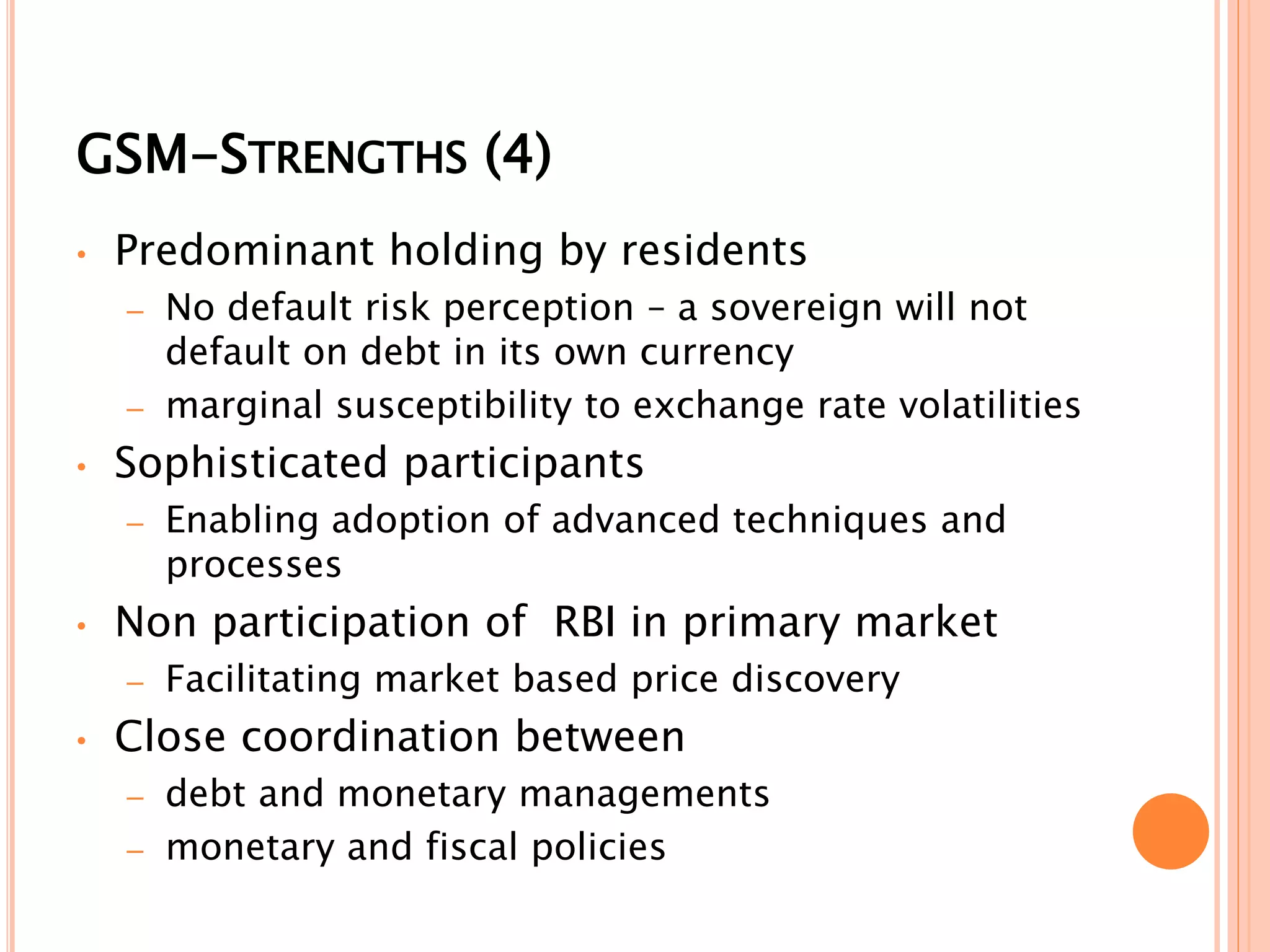
GSM-STRENGTHS (4)
• Predominant holding by residents
– No default risk perception – a sovereign will not
default on debt in its own currency
– marginal susceptibility to exchange rate volatilities
• Sophisticated participants
– Enabling adoption of advanced techniques and
processes
• Non participation of RBI in primary market
– Facilitating market based price discovery
• Close coordination between
– debt and monetary managements
– monetary and fiscal policies
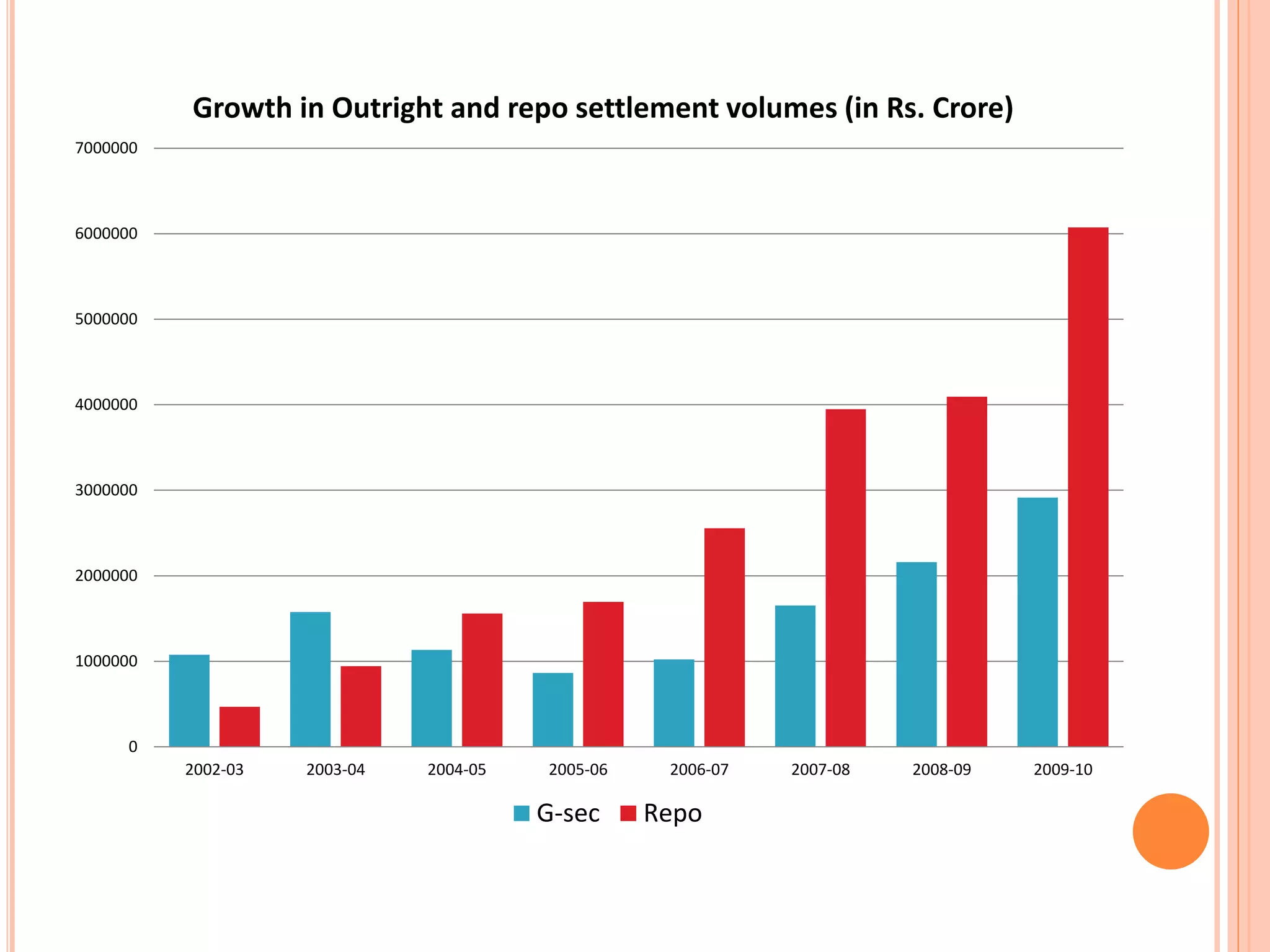
0
1000000
2000000
3000000
4000000
5000000
6000000
7000000
2002-03 2003-04 2004-05 2005-06 2006-07 2007-08 2008-09 2009-10
Growth in Outright and repo settlement volumes (in Rs. Crore)
G-sec Repo
GSM-WEAKNESSES (1)
• Fiscal dominance
– Supply outstripping demand
• Illiquidity
– HTM regime for SLR securities. Any alternative?
• Skewed investor base
– banks, Insurance Companies and RBI account for
sizeable portion of outstanding stock
• Active participants with similar IR exposures
– Herding.
GSM-WEAKNESSES (2)
• Absence of Term Money market
• Lack of retail interest
• Absence of market making
• Not much activity in
– Short selling
• Participants’ inertia – Lazy treasuries?
– Participants do not come in till liquidity improves
– Liquidity will not improve till participants come
– Chicken and Egg problem
GSM OPPORTUNITIES (1)
 Latecomer’s advantage - development can be
based on wider experience
 Tap latent investor base
 Nascent pension sector- a potential large investor
 Market G-secs as another investment product,
not as a mandated product
 Enhance liquidity
 Increase policy Scope.
GSM OPPORTUNITIES (2)
 Innovate and introduce new products
 To suit diverse investor interests
• Inflation Indexed Bonds
• Interest Rate Options
 Scope for calibrated increase in FII
participation
 Reduce the load on domestic investors and free
domestic resources
 To be considered in light of other implications-
interest rate and exchange rate volatility.
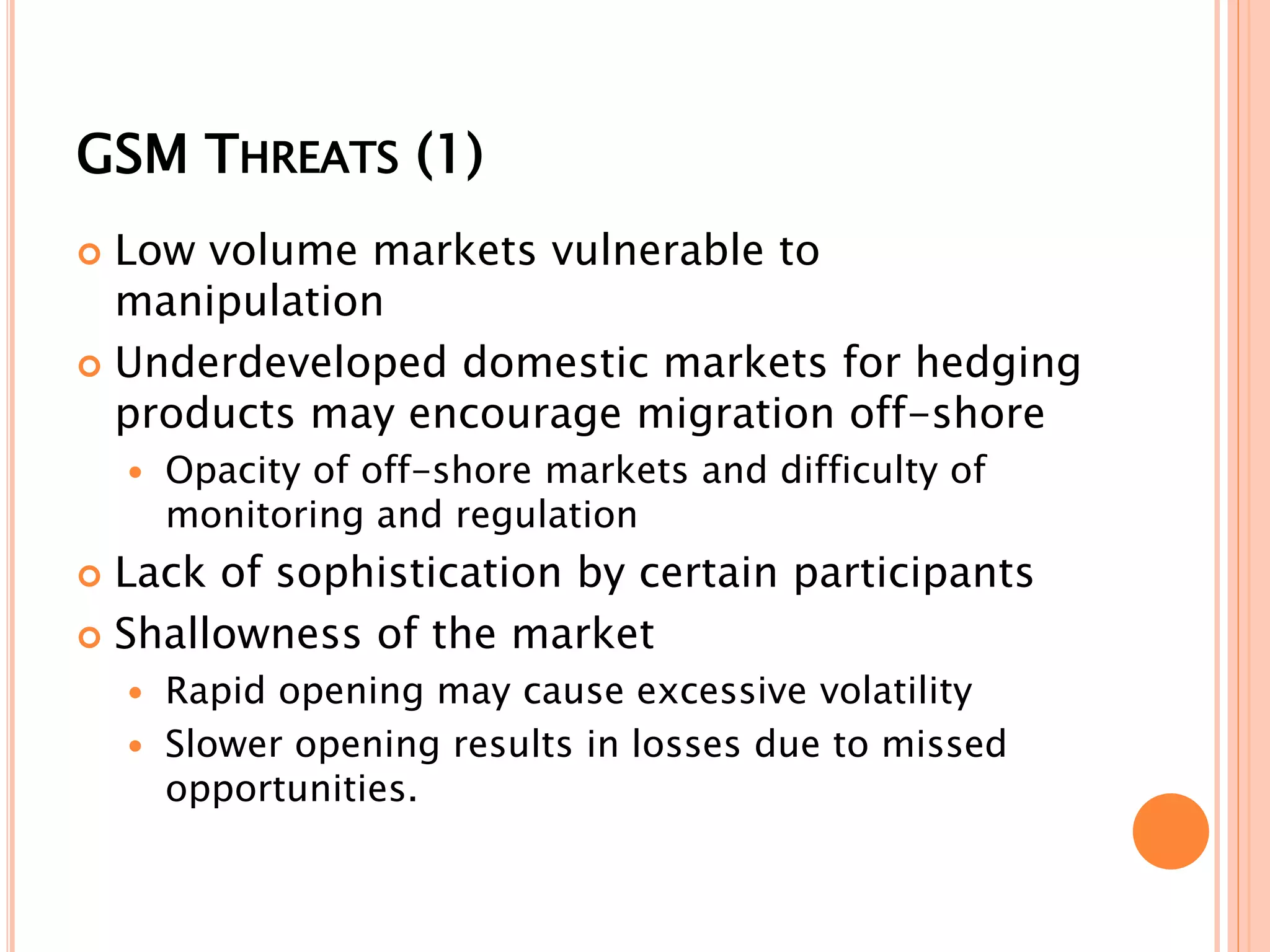
GSM THREATS (1)
 Low volume markets vulnerable to
manipulation
 Underdeveloped domestic markets for hedging
products may encourage migration off-shore
 Opacity of off-shore markets and difficulty of
monitoring and regulation
 Lack of sophistication by certain participants
 Shallowness of the market
 Rapid opening may cause excessive volatility
 Slower opening results in losses due to missed
opportunities.
GSM THREATS (2)
 Pressure for rapid opening of rupee debt
market to foreign participation
 Sovereign insulated from exchange risk
 But the market exposed to Interest Rate and
Exchange Rate volatility
 Migration to IFRS – implications for valuation
and recognition of P & L.
THANK YOU…
INVEST
MONEY OUT
OF SAVINGS
& GET
GAINED
MONEY
BACK.

Govt. securities market ppt

  • 2.
    GOVERNMENT SECURITIES MARKET (GSM) Prakyath IIndM.Com Poornaprajna Evening College Poornaprajna Post –graduation Centre Udupi
  • 3.
    INTRODUCTION :  AGovernment security is a tradable instrument issued by the Central Government or the State Government. It acknowledges the Government’s debt obligation. Such securities are issued for short term or long term. Government needs large amount to carry on its welfare activities.
  • 4.
    MEANING :  Agovernment security is a bond or other type of debt obligation that is issued by a government with a promise of repayment upon the security's maturity date. Government securities are usually considered low-risk investments because they are backed by the taxing power of a government.
  • 5.
    OBJECTIVES/FEATURES OF GOVT.SECURITIES :  Govt. securities are sovereign debt obligations of govt. of India either central or any other authority of govt.  Govt. securities include central govt. & state govt. securities, Treasury Bill & Govt. guaranteed bonds.  The terms of govt. securities range from 92 days to 30 years.
  • 6.
    HOW ARE THEGOVT. SECURITIES ISSUED :  Govt. securities are issued through auctions conducted by the RBI. Auctions are conducted on the electronic platform called the NDS- Auction platform. Commercial Banks, Scheduled Co-operative Banks, Primary Dealers, Insurance Companies & Provident Funds, who maintain finds accounts (Current account) & Securities account (SGL account) with RBI. Are the members of this electronic platform.
  • 7.
    38% 9% 0% 22% 1% 3% 0% 3% 1% 7% 12% 4% Holder Profile inCentral Govt. securities as on end Mar 2010 1. Commercial Banks 2. Bank- Primary Dealers 3. Non-Bank PDs 4. Insurance Companies 5. Mutual Funds 6. Co-operative Banks 7. Financial Institutions 8. Corporates 9. FIIs 10. Provident Funds 11. RBI 12. Others
  • 8.
    TYPES OF GOVERNMENTSECURITIES :  Treasury Bills or T-bills :  issued on a discount basis.  maturities up to 52 weeks and lesser than it.  Treasury bills or T-bills, which are money market instruments, are short term debt instruments issued by the Government of India and are presently issued in three tenors, namely, 91 day, 182 day and 364 day. Treasury bills are zero coupon securities and pay no interest. They are issued at a discount and redeemed at the face value at maturity. For example, a 91 day Treasury bill of Rs.100/- (face value) may be issued at say Rs. 98.20, that is, at a discount of say, Rs.1.80 and would be redeemed at the face value of Rs.100/-.
  • 9.
    TYPES OF GOVERNMENTSECURITIES :  Cash Management Bills (CMBs) :  Government of India, in consultation with the Reserve Bank of India, has decided to issue a new short-term instrument, known as Cash Management Bills (CMBs), to meet the temporary mismatches in the cash flow of the Government. The CMBs have the generic character of T-bills but are issued for maturities less than 91 days. Like T-bills, they are also issued at a discount and redeemed at face value at maturity. The tenure, notified amount and date of issue of the CMBs depends upon the temporary cash requirement of the Government.
  • 10.
    TYPES OF GOVERNMENTSECURITIES :  Treasury Notes :  longer term than T-bills.  from one to ten years.  semiannual coupon payments.  current owners are registered.  issued in denominations of ₹.1000 or more.  active secondary market.
  • 11.
    TYPES OF GOVERNMENTSECURITIES :  Treasury Bonds :  maturities greater than ten years.  denominations in ₹.1,000 or more .  some have call provisions.  Savings Bonds :  nonmarketable and offered only to individuals.  pure discount bonds.  mature in 20 years with semiannual coupon payments.
  • 12.
    TYPES OF GOVERNMENTSECURITIES :  Dated Government Securities :  Dated Government securities are long term securities and carry a fixed or floating coupon (interest rate) which is paid on the face value, payable at fixed time periods (usually half-yearly). The tenor of dated securities can be up to 30 years.  Zero Coupon Treasury Security Receipts or Coupon stripping :  Treasury bonds are purchased and placed in trust with a custodian.  sets of receipts issued for each coupon date.  another set of receipts issued for certain maturity dates.  Zero coupon means no interest.  Issued at a discount price.
  • 13.
    GSM- STRENGTHS (1) Large supply of securities  Enabling creation of benchmark securities with sufficient outstanding stock.  Issuances across the yield curve.  ‘State of the Art’ primary issuance process.  Electronic bidding.  Faster processing.  Flexibility to dispose of securities on the same day.  Well capitalized and efficient Primary Dealer System  100% of the notified amount underwritten
  • 14.
    GSM-STRENGTHS (2)  SoundDepository system  Proprietary and custodial accounts  Complete dematerialization  ‘State of the Art’ market infrastructure  Mandatory reporting –NDS  Trading systems – NDS-OM (above 80 percent of trades)  Real time price dissemination  Clearing and settlement,  Guaranteed settlement.  Availability of instruments and processes  Short sale  ‘When Issued’  STRIPS  Security Financing  Repo
  • 15.
    GSM-STRENGTHS (4) • Predominantholding by residents – No default risk perception – a sovereign will not default on debt in its own currency – marginal susceptibility to exchange rate volatilities • Sophisticated participants – Enabling adoption of advanced techniques and processes • Non participation of RBI in primary market – Facilitating market based price discovery • Close coordination between – debt and monetary managements – monetary and fiscal policies
  • 16.
    0 1000000 2000000 3000000 4000000 5000000 6000000 7000000 2002-03 2003-04 2004-052005-06 2006-07 2007-08 2008-09 2009-10 Growth in Outright and repo settlement volumes (in Rs. Crore) G-sec Repo
  • 17.
    GSM-WEAKNESSES (1) • Fiscaldominance – Supply outstripping demand • Illiquidity – HTM regime for SLR securities. Any alternative? • Skewed investor base – banks, Insurance Companies and RBI account for sizeable portion of outstanding stock • Active participants with similar IR exposures – Herding.
  • 18.
    GSM-WEAKNESSES (2) • Absenceof Term Money market • Lack of retail interest • Absence of market making • Not much activity in – Short selling • Participants’ inertia – Lazy treasuries? – Participants do not come in till liquidity improves – Liquidity will not improve till participants come – Chicken and Egg problem
  • 19.
    GSM OPPORTUNITIES (1) Latecomer’s advantage - development can be based on wider experience  Tap latent investor base  Nascent pension sector- a potential large investor  Market G-secs as another investment product, not as a mandated product  Enhance liquidity  Increase policy Scope.
  • 20.
    GSM OPPORTUNITIES (2) Innovate and introduce new products  To suit diverse investor interests • Inflation Indexed Bonds • Interest Rate Options  Scope for calibrated increase in FII participation  Reduce the load on domestic investors and free domestic resources  To be considered in light of other implications- interest rate and exchange rate volatility.
  • 21.
    GSM THREATS (1) Low volume markets vulnerable to manipulation  Underdeveloped domestic markets for hedging products may encourage migration off-shore  Opacity of off-shore markets and difficulty of monitoring and regulation  Lack of sophistication by certain participants  Shallowness of the market  Rapid opening may cause excessive volatility  Slower opening results in losses due to missed opportunities.
  • 22.
    GSM THREATS (2) Pressure for rapid opening of rupee debt market to foreign participation  Sovereign insulated from exchange risk  But the market exposed to Interest Rate and Exchange Rate volatility  Migration to IFRS – implications for valuation and recognition of P & L.
  • 23.
    THANK YOU… INVEST MONEY OUT OFSAVINGS & GET GAINED MONEY BACK.