






SUBMITTED TO SUBMITTED
BY
Prof. BASAVARAJ S M DILIP GOULI
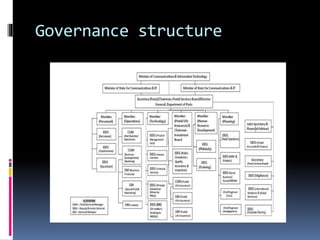
Governance structure
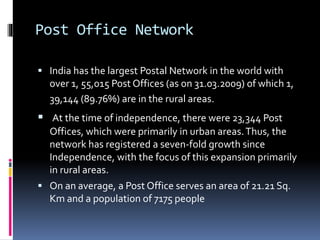
Post Office Network
 India has the largest Postal Network in the world with
over 1, 55,015 Post Offices (as on 31.03.2009) of which 1,
39,144 (89.76%) are in the rural areas.
 At the time of independence, there were 23,344 Post
Offices, which were primarily in urban areas.Thus, the
network has registered a seven-fold growth since
Independence, with the focus of this expansion primarily
in rural areas.
 On an average, a Post Office serves an area of 21.21 Sq.
Km and a population of 7175 people
Services
 Mail services
 Premium products
 Financial services
 Retail services
Mail Services
 Mail products
 Registration
 Parcel
 Insurance
 Value payable post
 International (SAL)
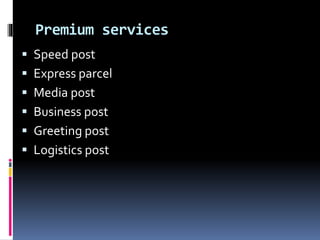
Premium services
 Speed post
 Express parcel
 Media post
 Business post
 Greeting post
 Logistics post
Financial services
 Post office saving schemes
 Postal life insurance
 Money remittance service
 Mutual funds
 Forex service
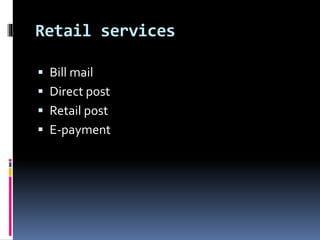
Retail services
 Bill mail
 Direct post
 Retail post
 E-payment
Potential Forces Impacting on
India Post
 Globalization
 Entry of private players
 Growth of telephony
 Focus on inclusive growth
 Higher delivery standards
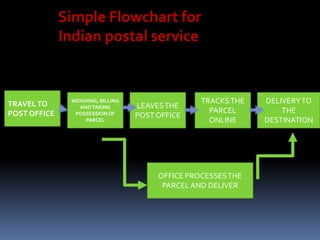
Simple Flowchart for
Indian postal service
TRAVELTO
POST OFFICE
WEIGHING, BILLING
ANDTAKING
POSSESSION OF
PARCEL
LEAVESTHE
POST OFFICE
TRACKSTHE
PARCEL
ONLINE
OFFICE PROCESSESTHE
PARCEL AND DELIVER
DELIVERYTO
THE
DESTINATION
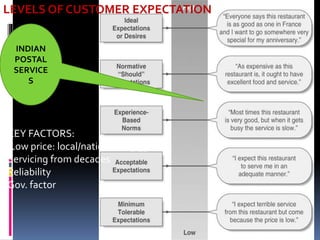
LEVELS OF CUSTOMER EXPECTATION
INDIAN
POSTAL
SERVICE
S
KEY FACTORS:
Low price: local/nation RS 15/35
Servicing from decades
Reliability
Gov. factor
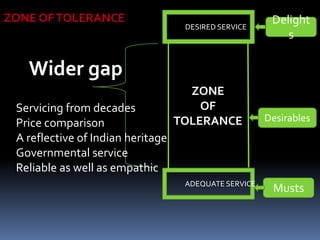
DESIRED SERVICE
ADEQUATE SERVICE
ZONE
OF
TOLERANCE
ZONE OFTOLERANCE
Wider gap
Servicing from decades
Price comparison
A reflective of Indian heritage
Governmental service
Reliable as well as empathic
Delight
s
Desirables
Musts
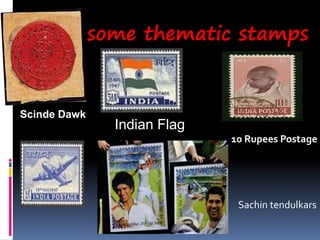
some thematic stamps
Scinde Dawk
10 Rupees Postage s
Indian Flag
Sachin tendulkars
SWOT
Strength
 Strong Network & Infrastructure
 Cost Effective
 Security / Safety with respect to deposits
 Efficient Manpower
 Vast business experience
 Established redressal machinery
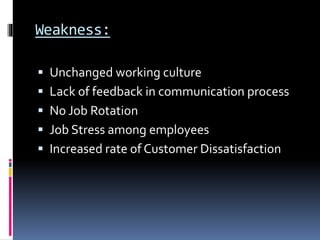
Weakness:
 Unchanged working culture
 Lack of feedback in communication process
 No Job Rotation
 Job Stress among employees
 Increased rate of Customer Dissatisfaction
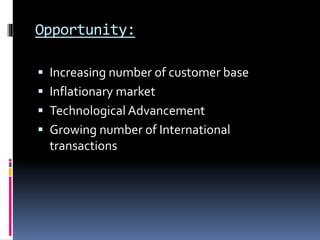
Opportunity:
 Increasing number of customer base
 Inflationary market
 Technological Advancement
 Growing number of International
transactions
Threat:
 Customer Dissatisfaction
 Increasing market share of competitors
 Internet Penetration
INDIA POST SERVICE MARKETING

INDIA POST SERVICE MARKETING

  • 1.
    SUBMITTED TO SUBMITTED BY Prof.BASAVARAJ S M DILIP GOULI
  • 3.
  • 4.
    Post Office Network India has the largest Postal Network in the world with over 1, 55,015 Post Offices (as on 31.03.2009) of which 1, 39,144 (89.76%) are in the rural areas.  At the time of independence, there were 23,344 Post Offices, which were primarily in urban areas.Thus, the network has registered a seven-fold growth since Independence, with the focus of this expansion primarily in rural areas.  On an average, a Post Office serves an area of 21.21 Sq. Km and a population of 7175 people
  • 5.
    Services  Mail services Premium products  Financial services  Retail services
  • 6.
    Mail Services  Mailproducts  Registration  Parcel  Insurance  Value payable post  International (SAL)
  • 7.
    Premium services  Speedpost  Express parcel  Media post  Business post  Greeting post  Logistics post
  • 8.
    Financial services  Postoffice saving schemes  Postal life insurance  Money remittance service  Mutual funds  Forex service
  • 9.
    Retail services  Billmail  Direct post  Retail post  E-payment
  • 10.
    Potential Forces Impactingon India Post  Globalization  Entry of private players  Growth of telephony  Focus on inclusive growth  Higher delivery standards
  • 11.
    Simple Flowchart for Indianpostal service TRAVELTO POST OFFICE WEIGHING, BILLING ANDTAKING POSSESSION OF PARCEL LEAVESTHE POST OFFICE TRACKSTHE PARCEL ONLINE OFFICE PROCESSESTHE PARCEL AND DELIVER DELIVERYTO THE DESTINATION
  • 12.
    LEVELS OF CUSTOMEREXPECTATION INDIAN POSTAL SERVICE S KEY FACTORS: Low price: local/nation RS 15/35 Servicing from decades Reliability Gov. factor
  • 13.
    DESIRED SERVICE ADEQUATE SERVICE ZONE OF TOLERANCE ZONEOFTOLERANCE Wider gap Servicing from decades Price comparison A reflective of Indian heritage Governmental service Reliable as well as empathic Delight s Desirables Musts
  • 14.
    some thematic stamps ScindeDawk 10 Rupees Postage s Indian Flag Sachin tendulkars
  • 15.
  • 16.
    Strength  Strong Network& Infrastructure  Cost Effective  Security / Safety with respect to deposits  Efficient Manpower  Vast business experience  Established redressal machinery
  • 17.
    Weakness:  Unchanged workingculture  Lack of feedback in communication process  No Job Rotation  Job Stress among employees  Increased rate of Customer Dissatisfaction
  • 18.
    Opportunity:  Increasing numberof customer base  Inflationary market  Technological Advancement  Growing number of International transactions
  • 19.
    Threat:  Customer Dissatisfaction Increasing market share of competitors  Internet Penetration

Editor's Notes

  • #13 In LEVELS OF CUSTOMER EXPECTATION we have KEY FACTORS: Low price: local/nation RS 15/35 effective1st oct 2012(http://www.indiapost.gov.in/SpeedPost.aspx) the professional 20/40- old data Servicing from decades people are well aware of what they will get Reliability: Never heard of errors in registry or speed post insurance Gov. factor
  • #14 Servicing from decade: accustomed people have faith. They trust speed post. Price comparison A reflective of indian heritage Governmental service
  • #15 Scinde Dawk was a very old postal system of runners that served the Indus Valley of Sindh, an area of present-day Pakistan. The term also refers to the first adhesive postage stamps in Asia,[1] the forerunners of the adhesive stamps used throughout India, Burma, the Straits Settlements and other areas controlled by theBritish East India Company.[2] The name derives from the words “Scinde”, the British spelling of the name of the province of Sindh, and “Dawk”, the anglicised spelling of the Hindustani word “Dak” or Post. The Scinde Dawk of 1852, the first postage stamp of India is a round red sealing wafer The 10 Rupees Postage stamp depicting Mahatma Gandhi issued by India in 1948 is one of India's most famous stamps.[1] A set of 100 of these stamps were overprinted with the word "Service" and provided only to the Governor General of India for his official use. This "Service" overprinted stamp is one of India's costliest and rarest stamps. This stamp was a part of the 1948 "Service" set which was auctioned for 38,000 Euros in the David Feldman auction sale on 5 October 2007.[2] In an auction on May 19 2011 at Geneva, David Feldman sold the 1948 10 Rupee Mahatma Gandhi stamp of India for a World Record price of EUR 144,000 (US$ 205,000); this also set the record for the most expensive modern stamp.[3] Indian Flag, the first stamp of independent India, released on 21 Nov 1947, was meant for foreign correspondence. The third stamp, showing aDouglas DC-4 aircraft, was meant for foreign airmail. 1854