Presented By:-
Ravi Sonkar
PRESENTATION ON INDIAN
POSTAL SERVICES
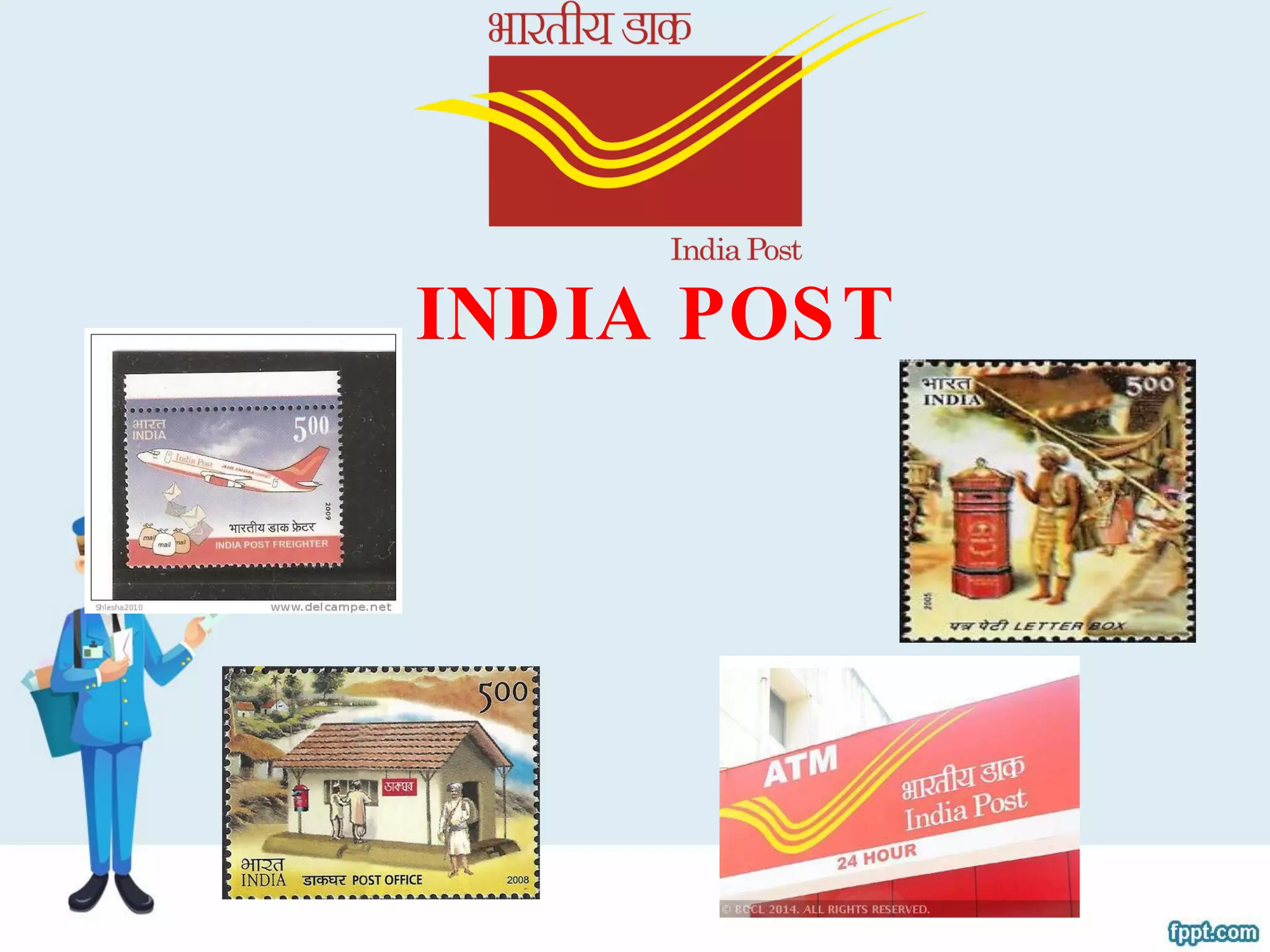
INDIA POST
INTRODUCTION
The first post office in India was
established by British East India company
in Bombay in 1764.
 Headquarter is situated in New Delhi.
No. of employees are 520191.
Vision and Mission
Vision.
 India Post's products and services will be the
customer's first choice.
 Mission.
 To sustain its position as the largest postal
network in the world touching the lives of every
citizen in the country.
 To provide mail parcel, money transfer, banking,
insurance and retail services with speed and
reliability.
Cont…
To provide services to the customers on
value-for-money basis.
To continue to deliver social security
services and to enable last mile
connectivity as a Government of India
platform.
About Post Office
For more than 150 years, (DoP) has been
the backbone of the country’s.
communication and has played a crucial
role in the country’s socio-economic
development.
Cont…..
 It touches the lives of Indian citizens in
many ways: delivering mails, accepting
deposits under Small Savings Schemes,
providing life insurance cover under (PLI)
and (RPLI) and providing retail services
like bill collection, sale of forms, etc.
Cont….
Key people Kavery Benerjee, Director
General and Secretary.
Slogan
Dak Seva Jan Seva
Cont…
On an average, a Post Office serves an area
of 21.22 Sq. Km and a population of 8221
people
India has largest number of post office in the
world.
India has the highest post office in the world
in Sikkim at a height of 15,500 feet (postal
code – 172114).
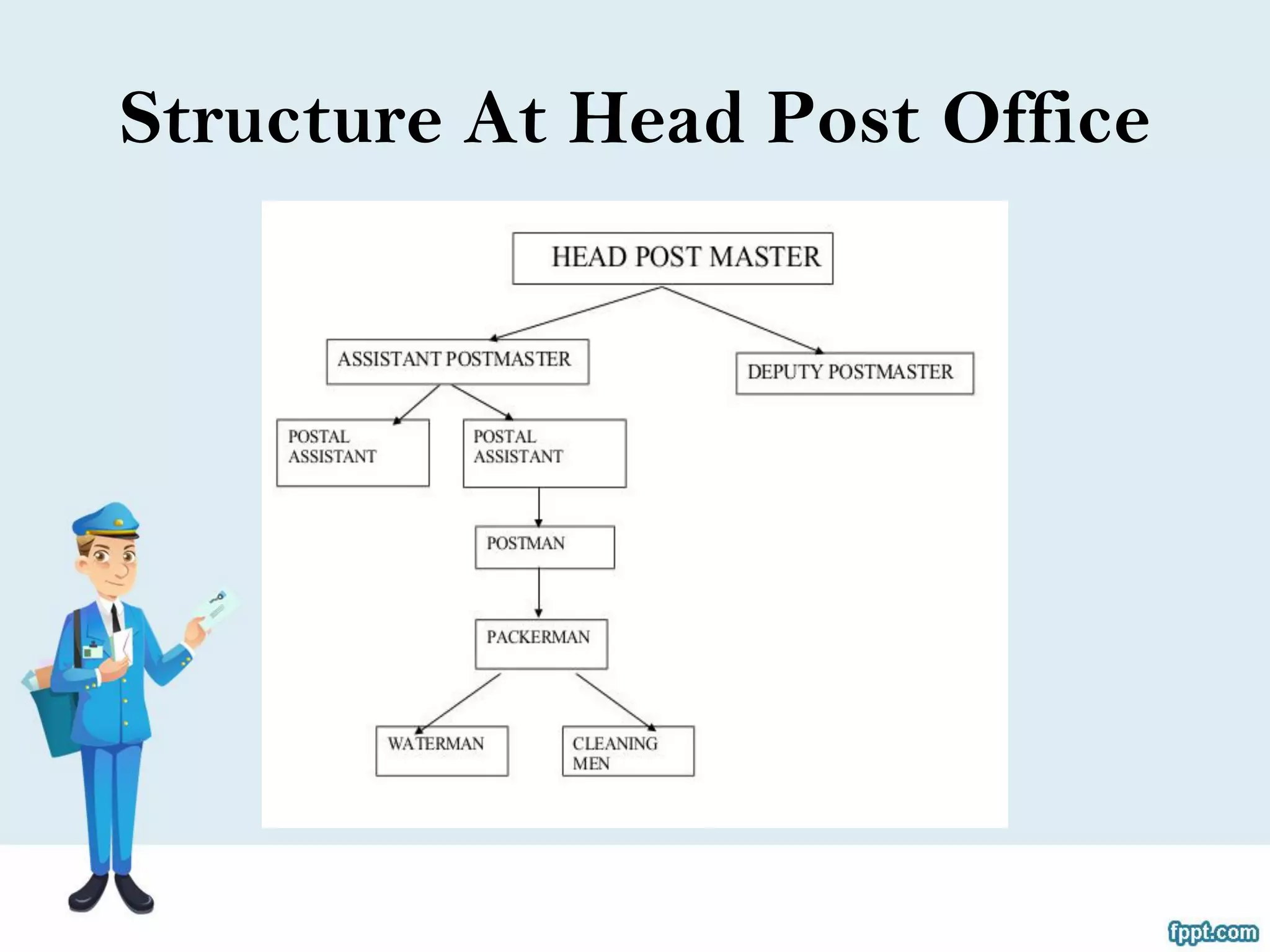
Structure At Head Post Office
History
The British Raj was instituted in 1858,
when the rule of the East India Company
was transferred to the Crown.
By 1861, there were 889 post offices
handling nearly 43 million letters and over
4.5 million newspapers annually.
Cont…
The first superintendent of the post office was
appointed in 1870 and based in Allahabad.
In 1876, British India became the first non-
founding member of the General Postal
Union.
The British Raj to expand and regulate Posts
and Telegraphs service.
Cont…
The Government Savings Bank Act 1873
passed by the legislature 28 January
1873, was enacted in 1881.
On 1 April 1882, Post Office Savings
Banks opened throughout India.
Cont…
In Madras Presidency, it was limited; in the
Bengal Presidency, no POSBs were
established in Calcutta or Howrah.
Postal life insurance began on 1 February
1884 .
the Posts & Telegraphs Department as
Government of India dispatch No. 299 dated
18 October 1882 to the Secretary of State.
Cont…
The Indian Wireless Telegraphy Act 1933
(17 of 1933).
The world's first official airmail flight took
place in India on 18 February 1911, a
journey of 18 kilometers (11 mi) lasting 27
minutes.
There are (approximately 6,000 letters and
cards) across the Ganges from Allahabad
to Naini.
Cont…
The Posts and Telegraphs Departments
merged in 1914, dividing on 1 January
1985.
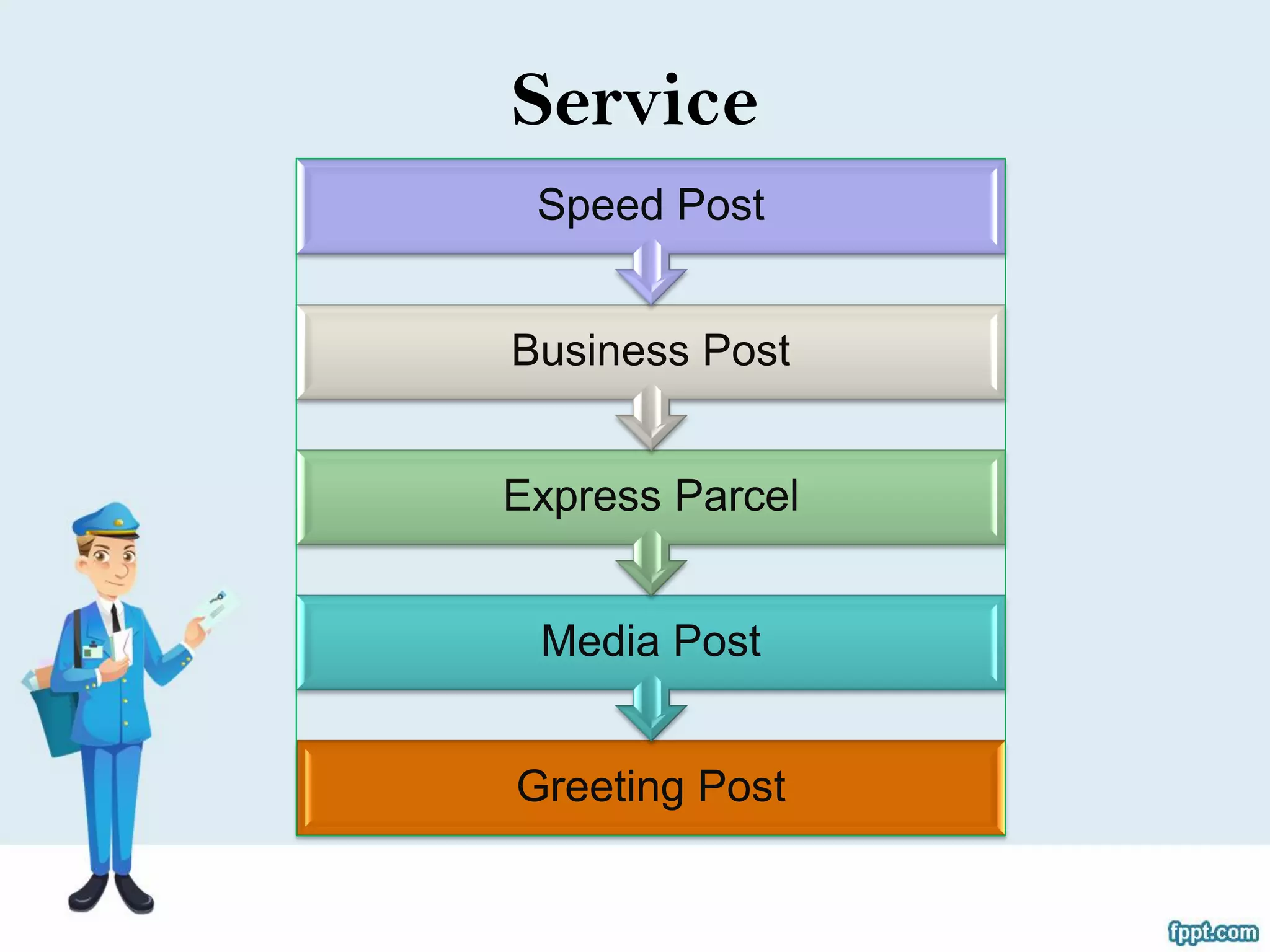
Service
Greeting Post
Media Post
Express Parcel
Business Post
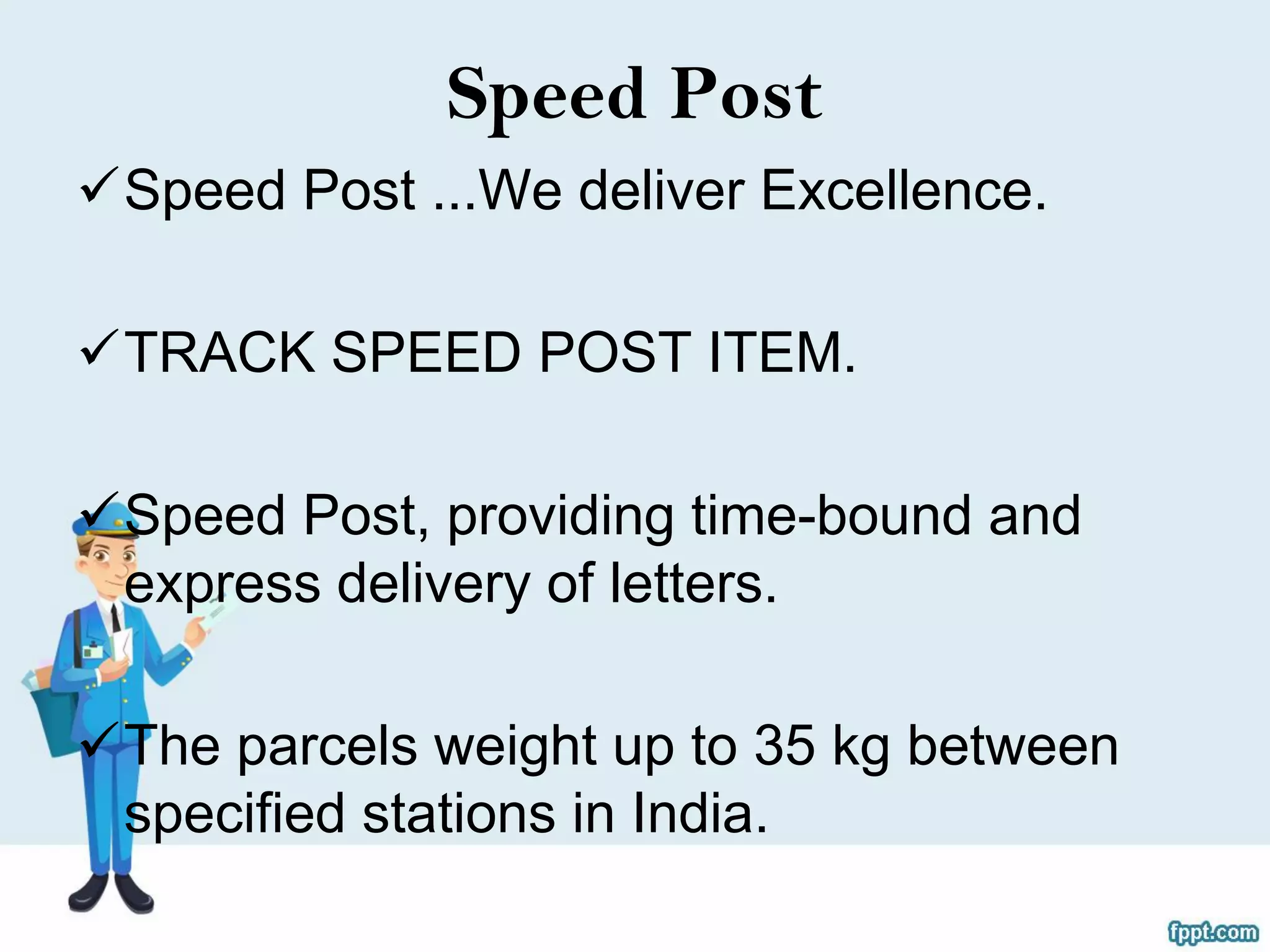
Speed Post
Speed Post
Speed Post ...We deliver Excellence.
TRACK SPEED POST ITEM.
Speed Post, providing time-bound and
express delivery of letters.
The parcels weight up to 35 kg between
specified stations in India.
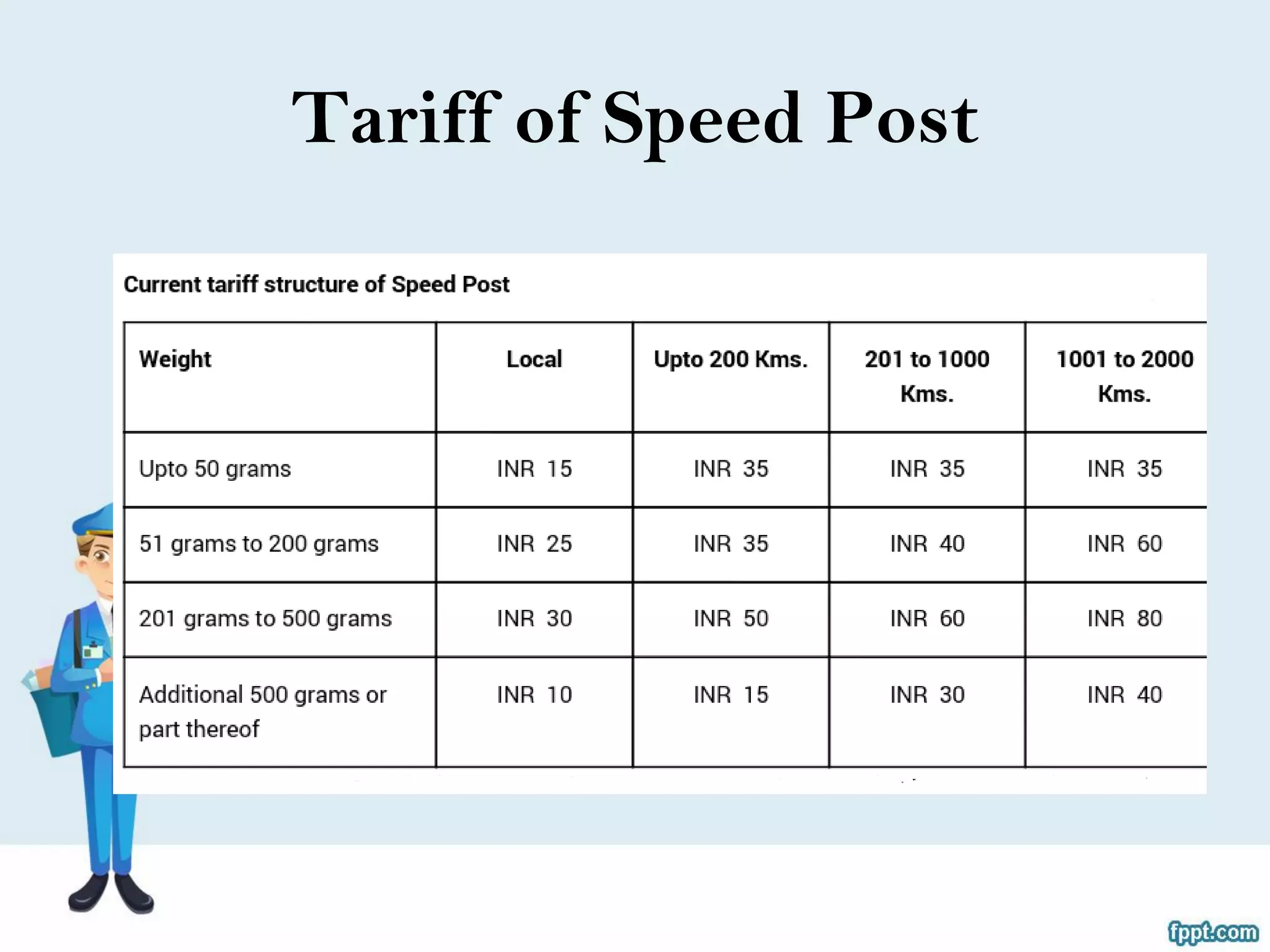
Tariff of Speed Post
Cont…
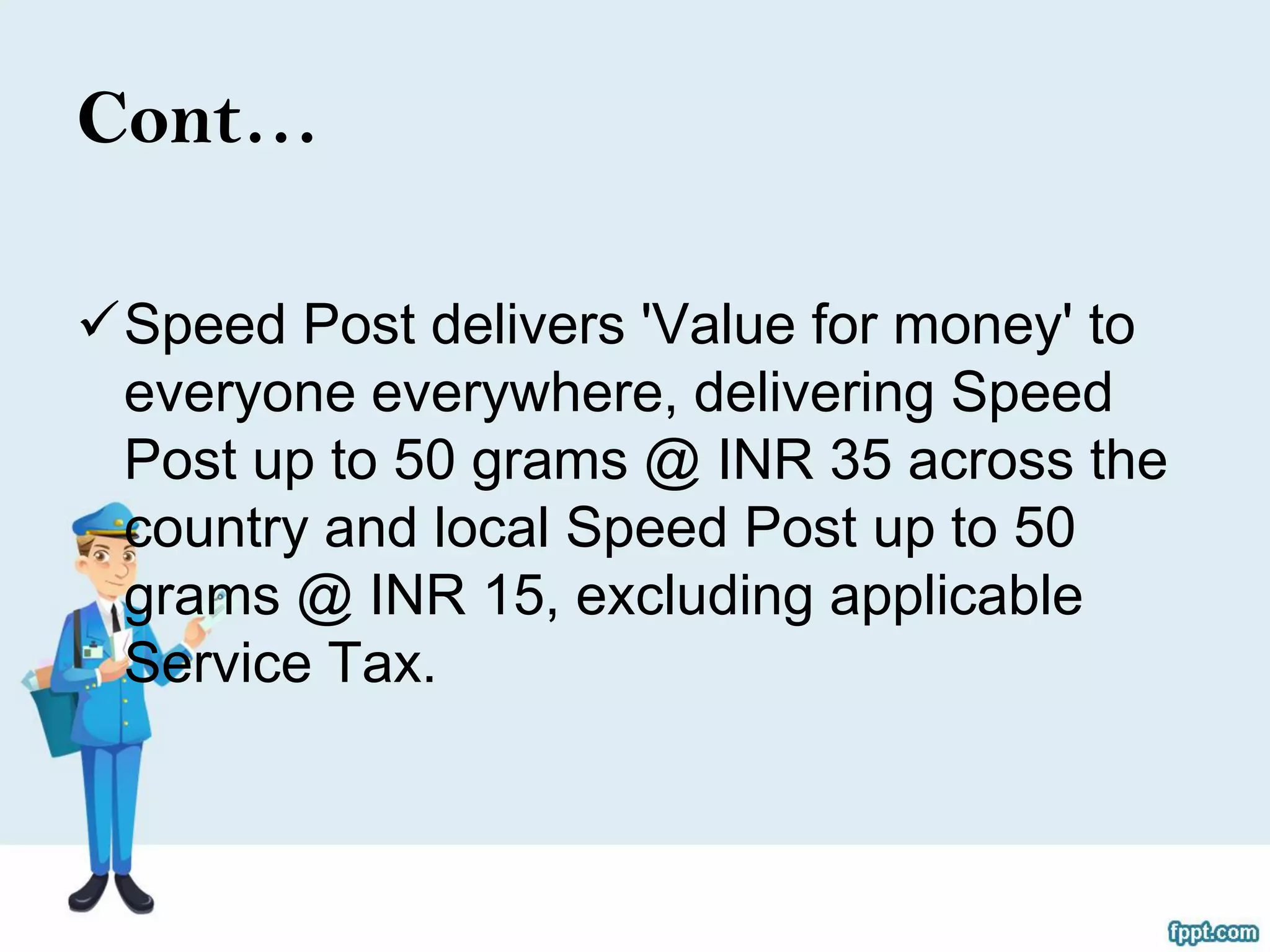
Speed Post delivers 'Value for money' to
everyone everywhere, delivering Speed
Post up to 50 grams @ INR 35 across the
country and local Speed Post up to 50
grams @ INR 15, excluding applicable
Service Tax.
Business Post
Business Post services will make your
task easy and convenient.
Business Post demonstrates our
responsiveness to market demands in
providing value additions to mail services,
with the best possible delivery at the
lowest possible price.
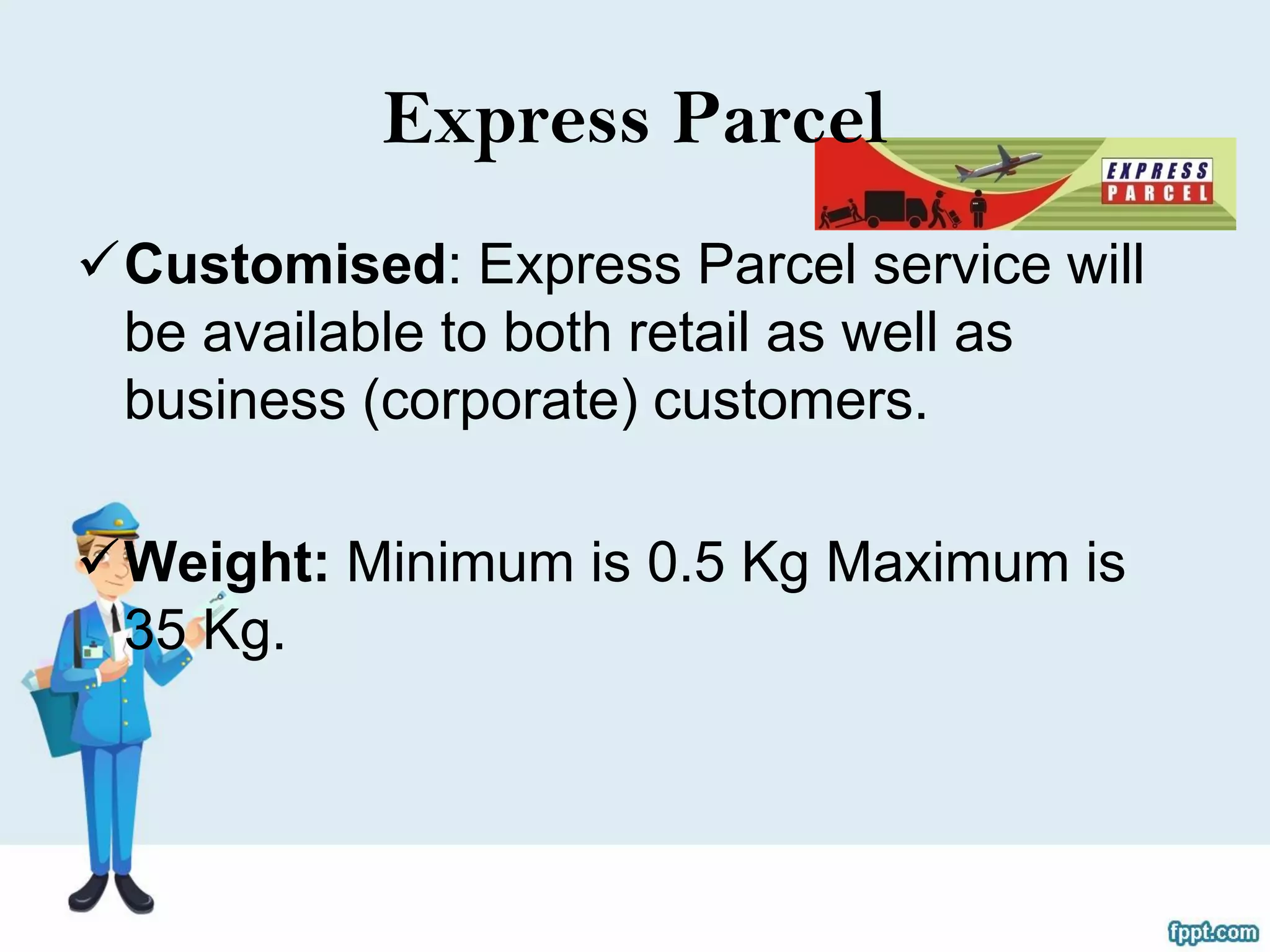
Express Parcel
Customised: Express Parcel service will
be available to both retail as well as
business (corporate) customers.
Weight: Minimum is 0.5 Kg Maximum is
35 Kg.
Cont…
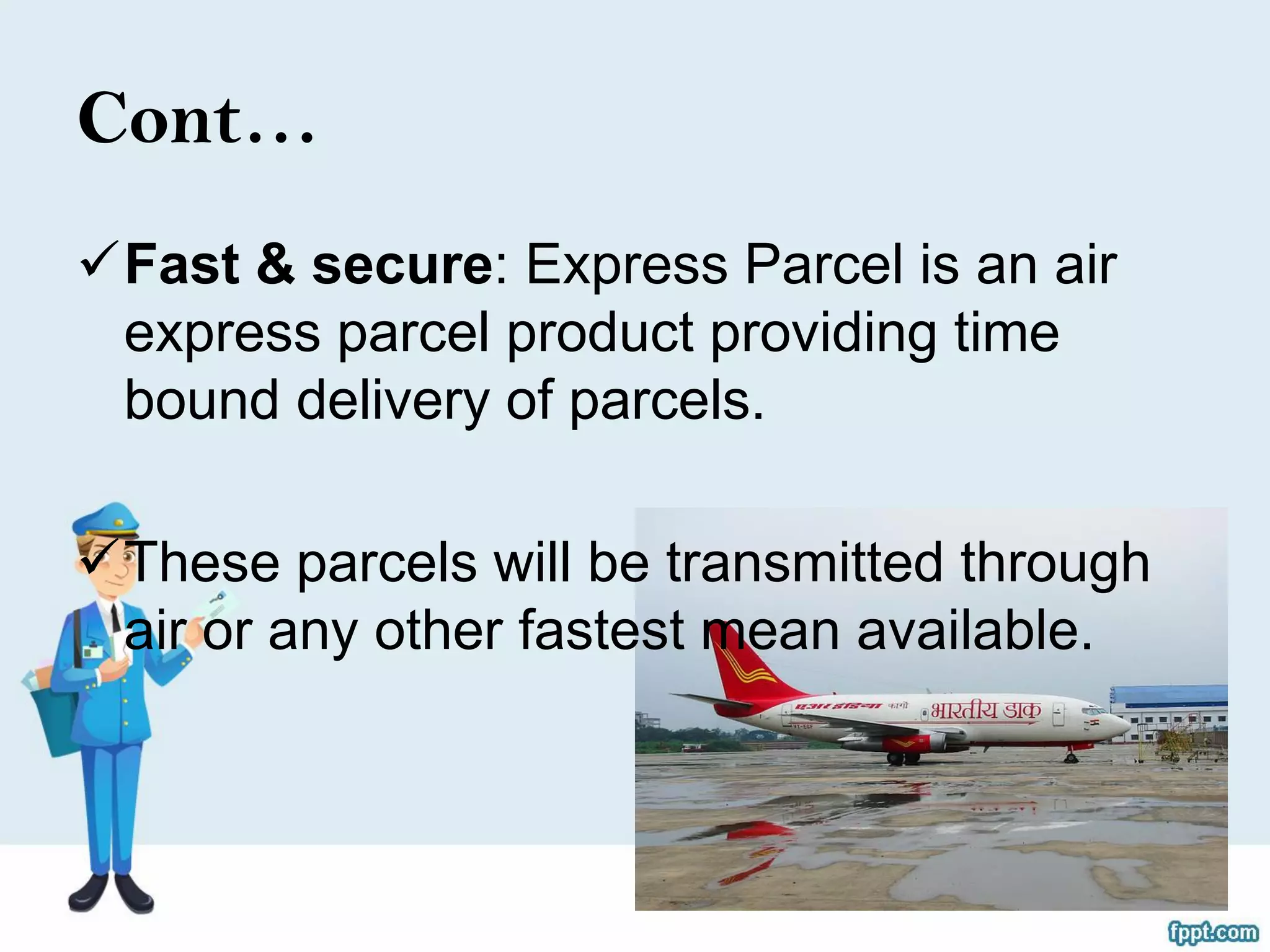
Fast & secure: Express Parcel is an air
express parcel product providing time
bound delivery of parcels.
These parcels will be transmitted through
air or any other fastest mean available.
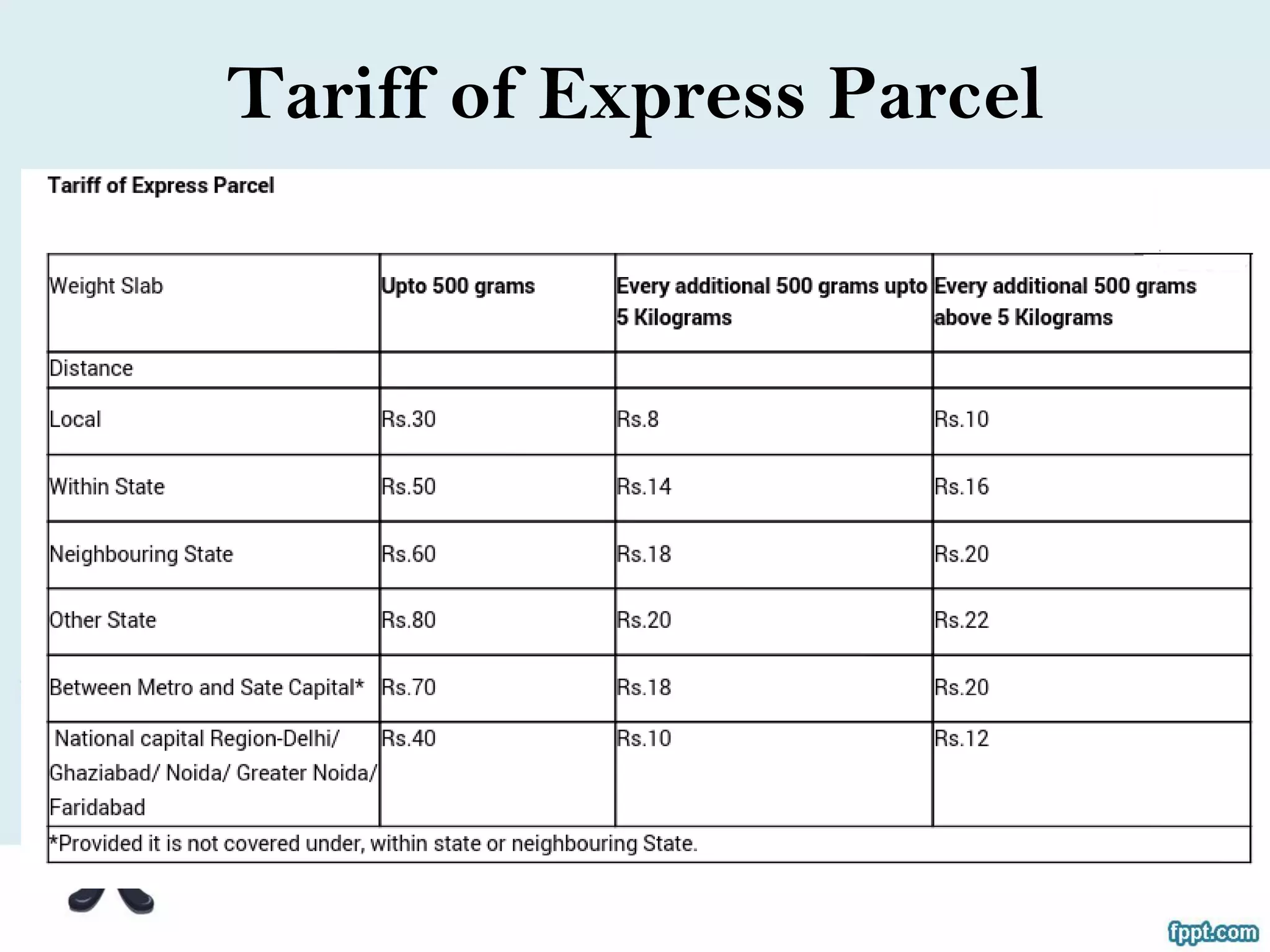
Tariff of Express Parcel
Media Post
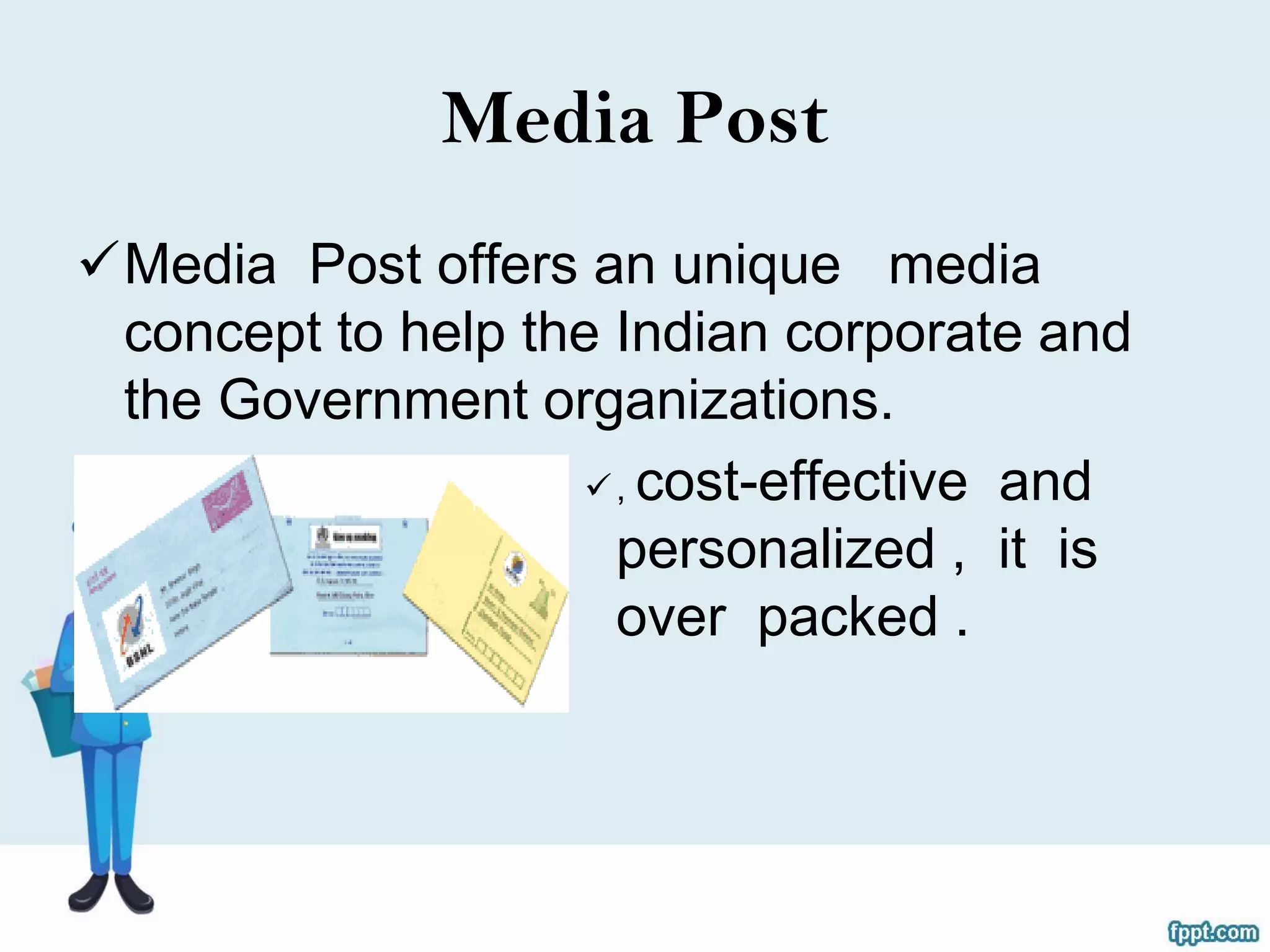
Media Post offers an unique media
concept to help the Indian corporate and
the Government organizations.
, cost-effective and
personalized , it is
over packed .
Cont…
 Absolutely no other media can match
the sheer expanse of India Post in
terms of volume and reach.
 Media Post - an innovative & effective
vehicle for Brand and Marketing.
Greeting Post
Innovative Product
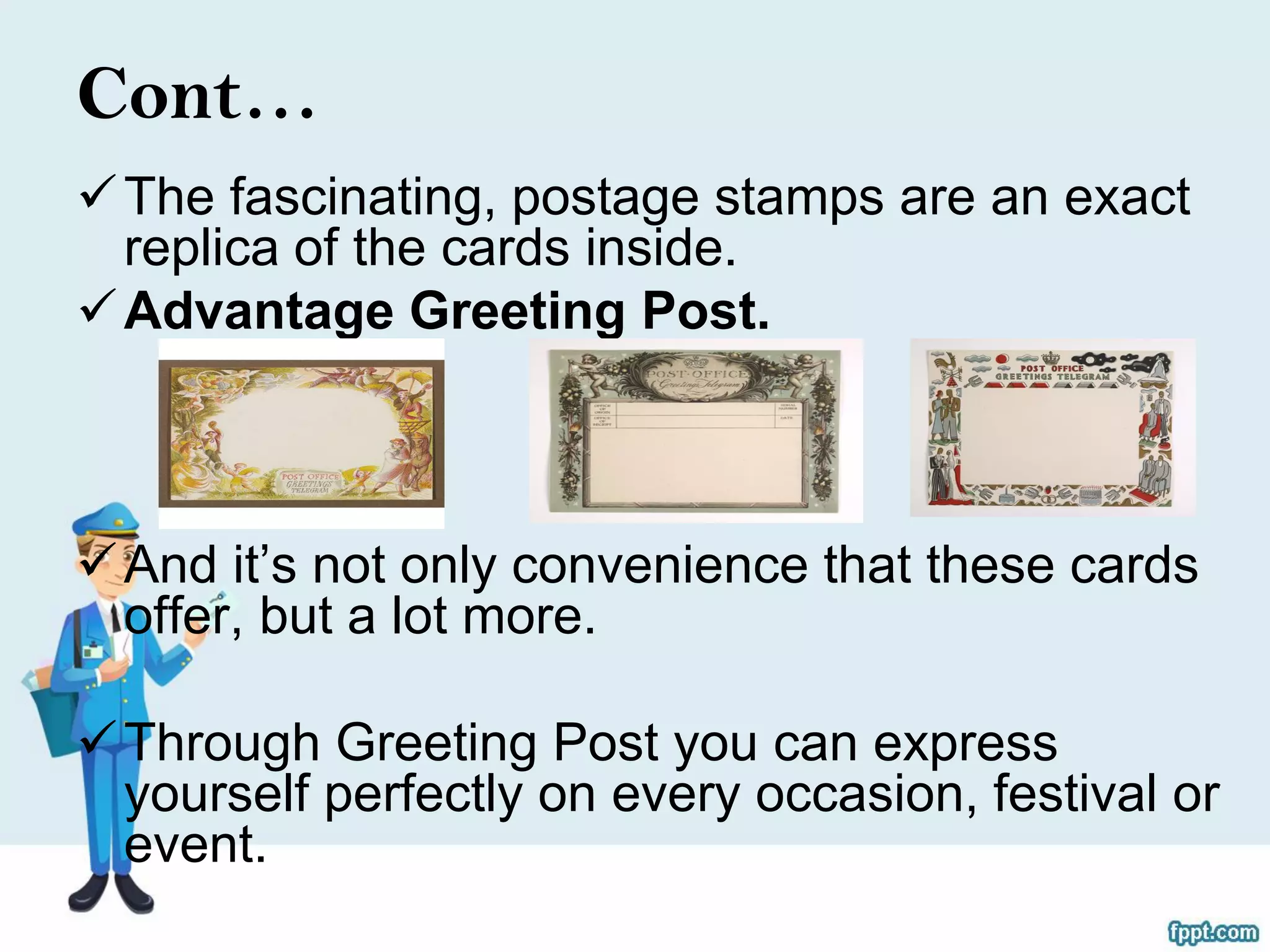
 Greeting Post ,a new range of delightful
greeting cards, brought to you by India
Post.
 These cards come ready with pre-paid
postage envelopes.
 a unique concept for the first time in India.
Cont…
The fascinating, postage stamps are an exact
replica of the cards inside.
Advantage Greeting Post.
And it’s not only convenience that these cards
offer, but a lot more.
Through Greeting Post you can express
yourself perfectly on every occasion, festival or
event.
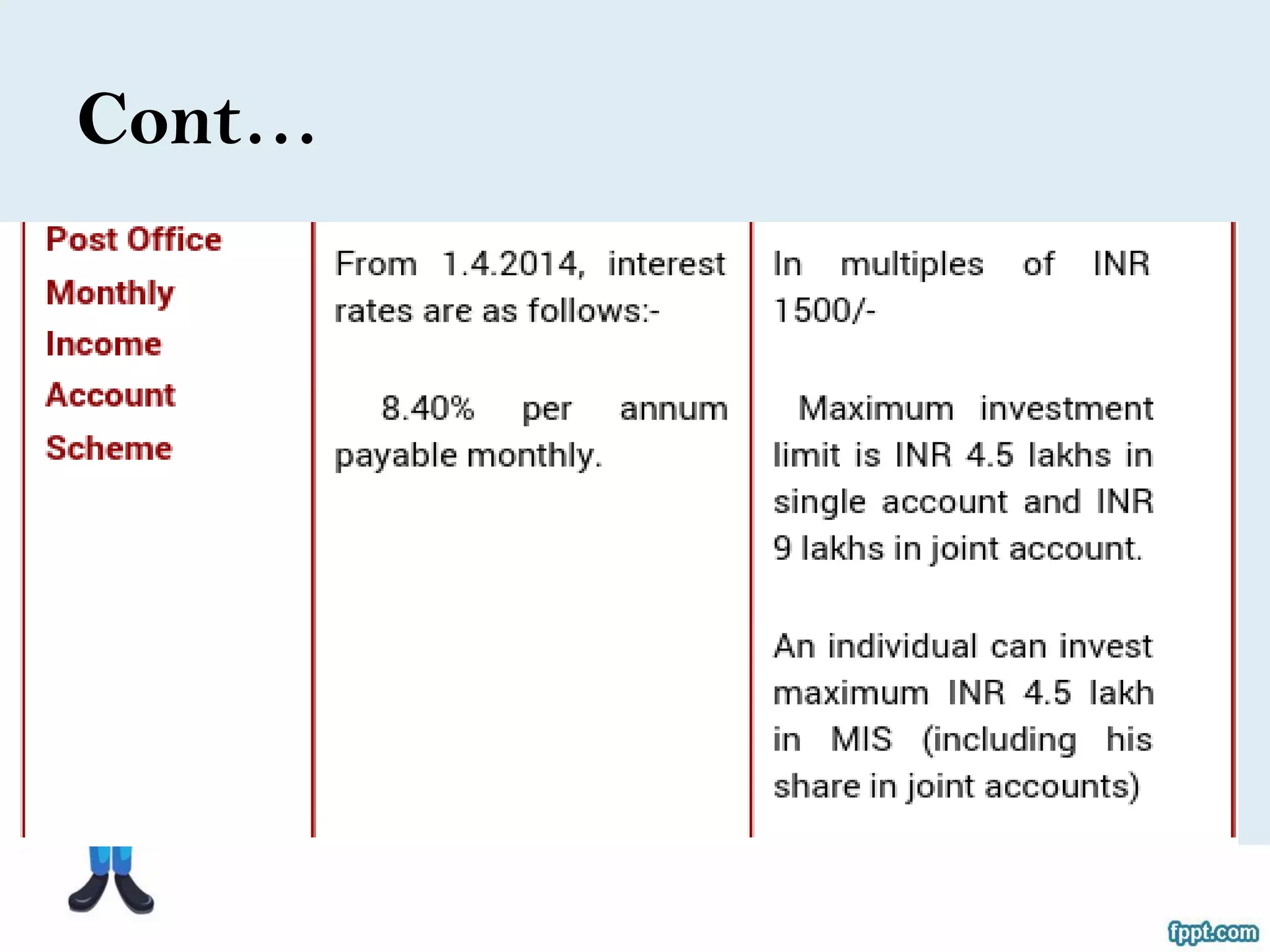
Schemes
Cont…
Cont…
Cont…
Post Office Network
India has the largest Postal Network in the
world with over 1, 54,882 Post Offices (as
on 31.03.2014) of which 1, 39,182
(89.86%) are in the rural areas.
 At the time of independence, there were
23,344 Post Offices, which were primarily
in urban areas.
Postage Stamps
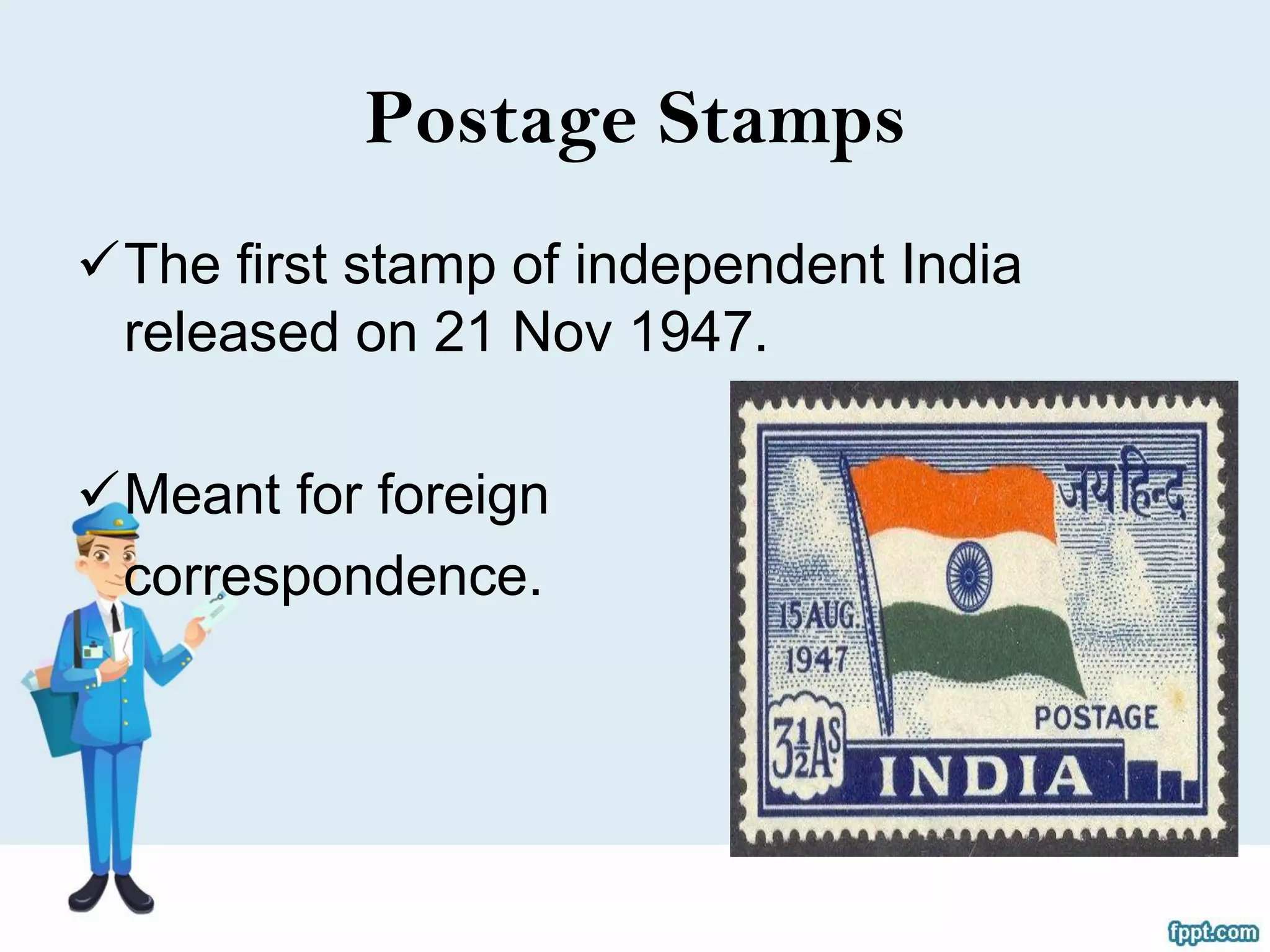
The first stamp of independent India
released on 21 Nov 1947.
Meant for foreign
correspondence.
Cont…
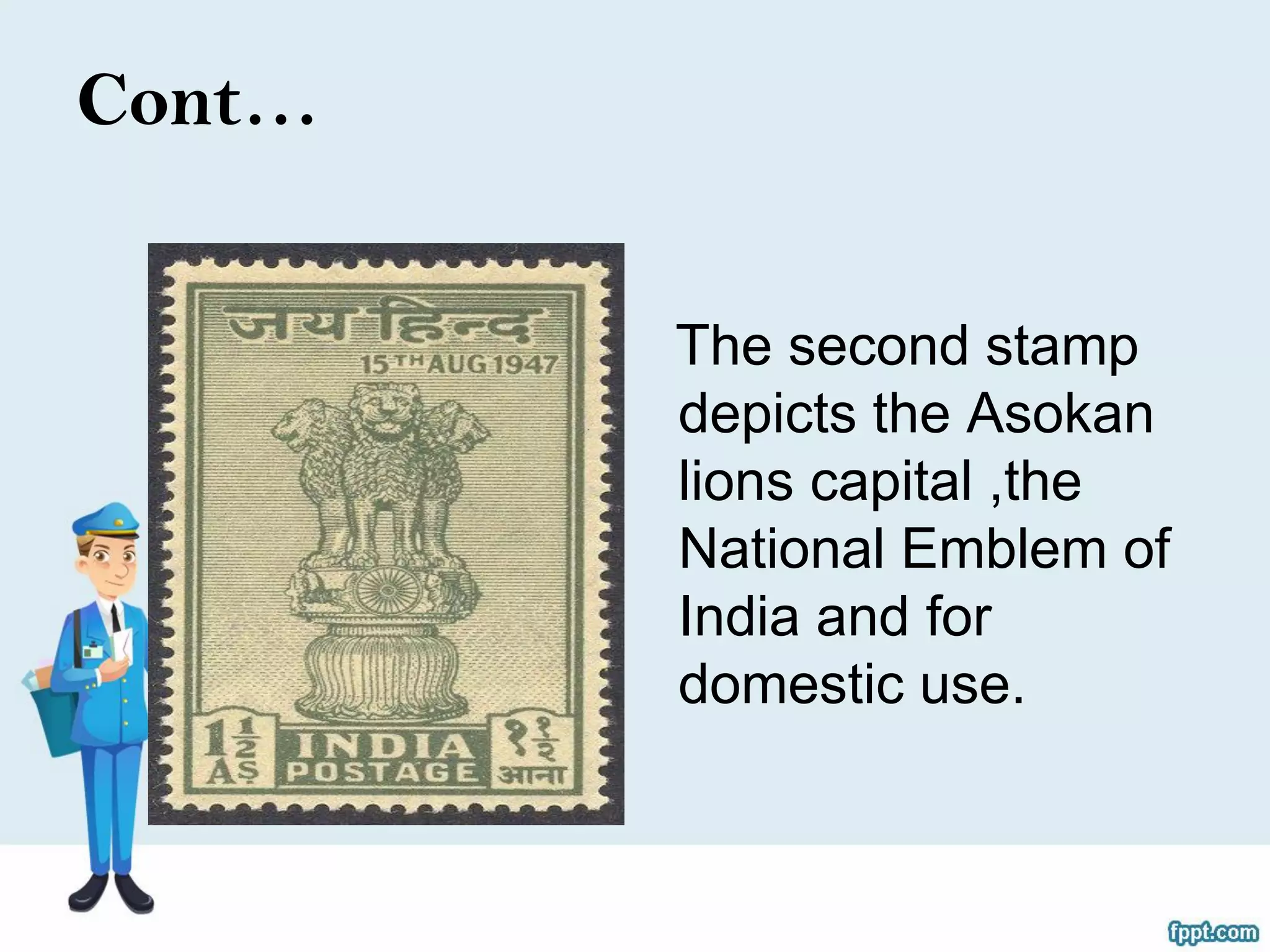
• The second stamp
depicts the Asokan
lions capital ,the
National Emblem of
India and for
domestic use.
Cont…
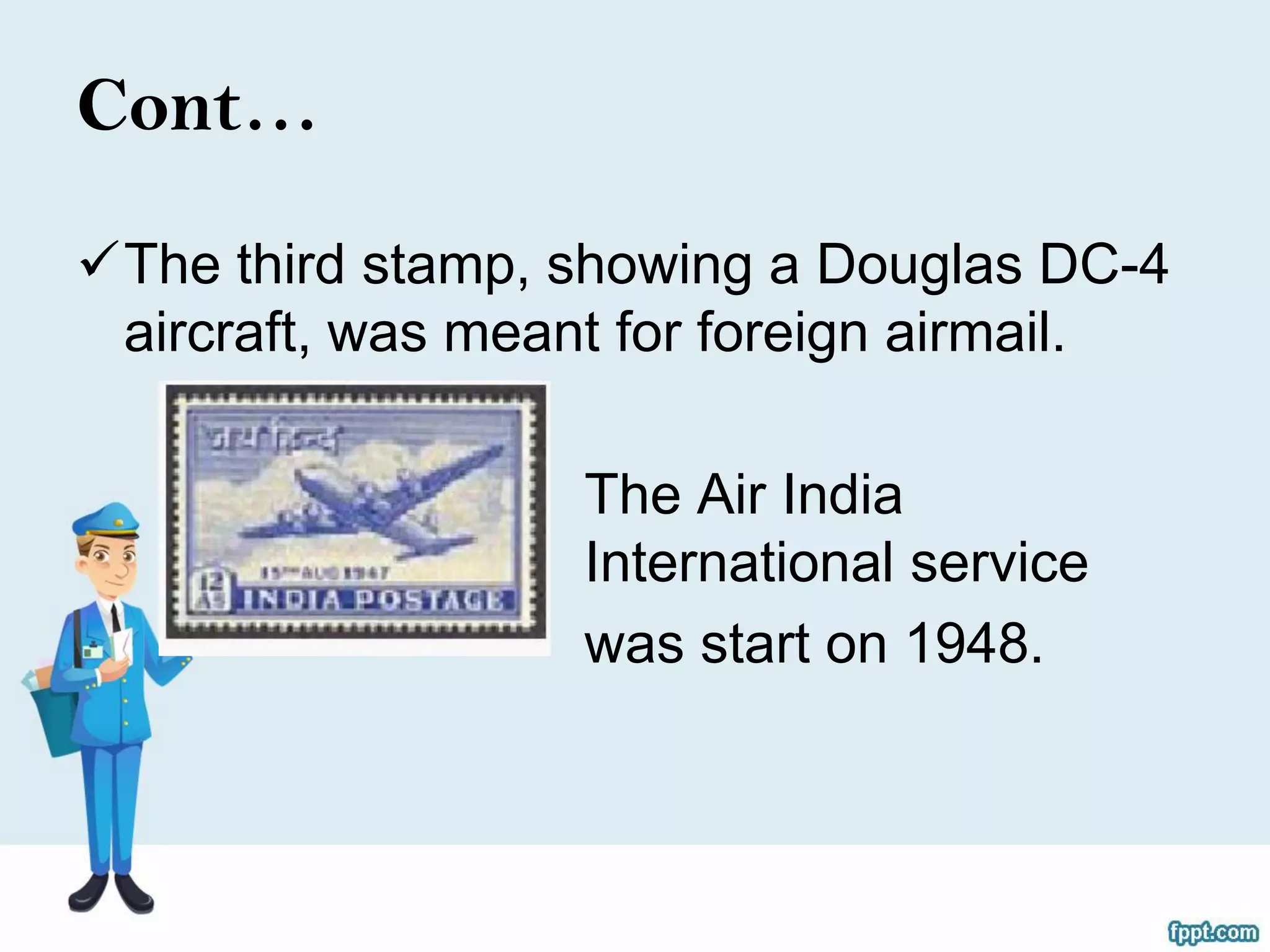
The third stamp, showing a Douglas DC-4
aircraft, was meant for foreign airmail.
The Air India
International service
was start on 1948.
Cont…
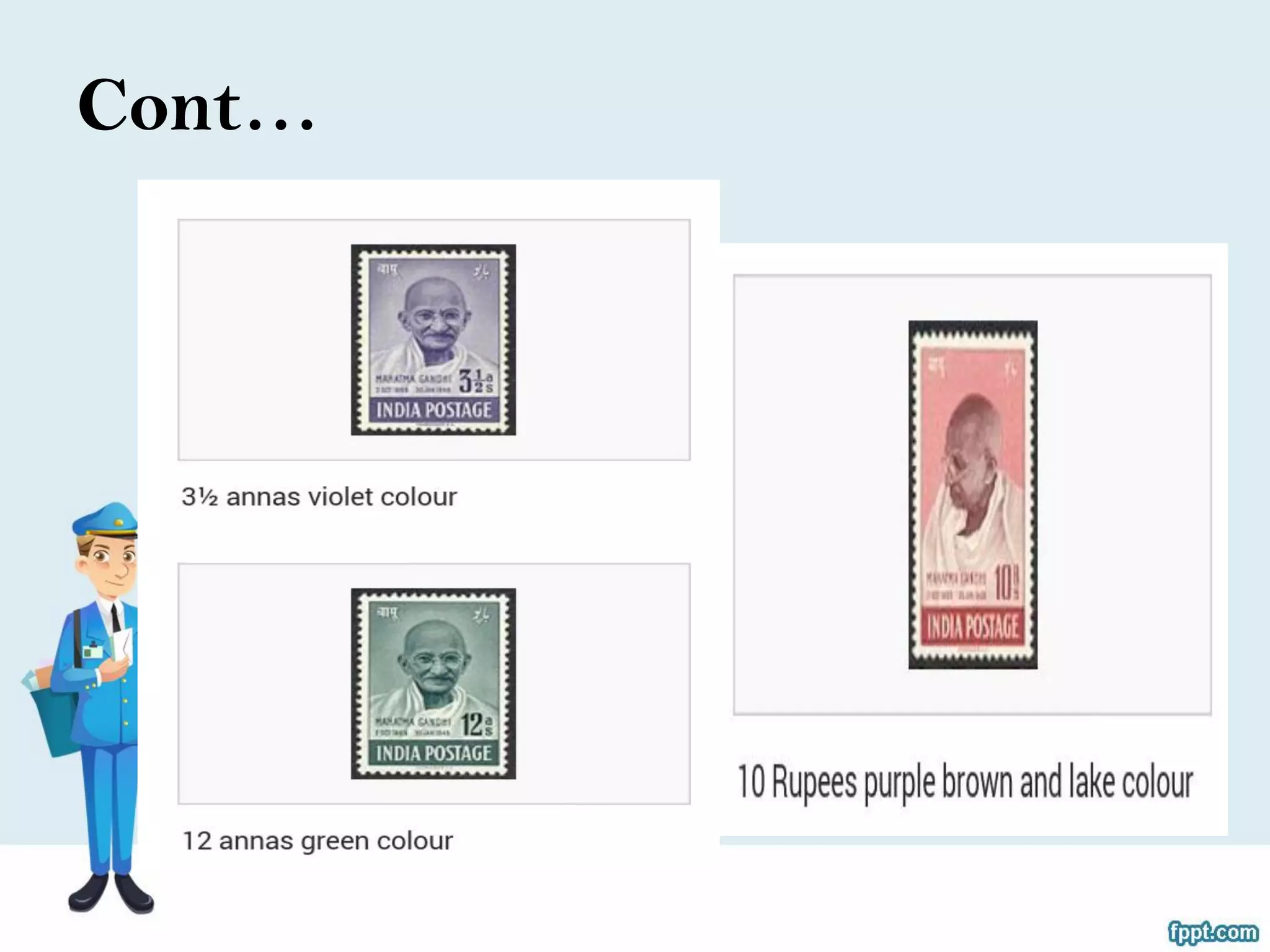
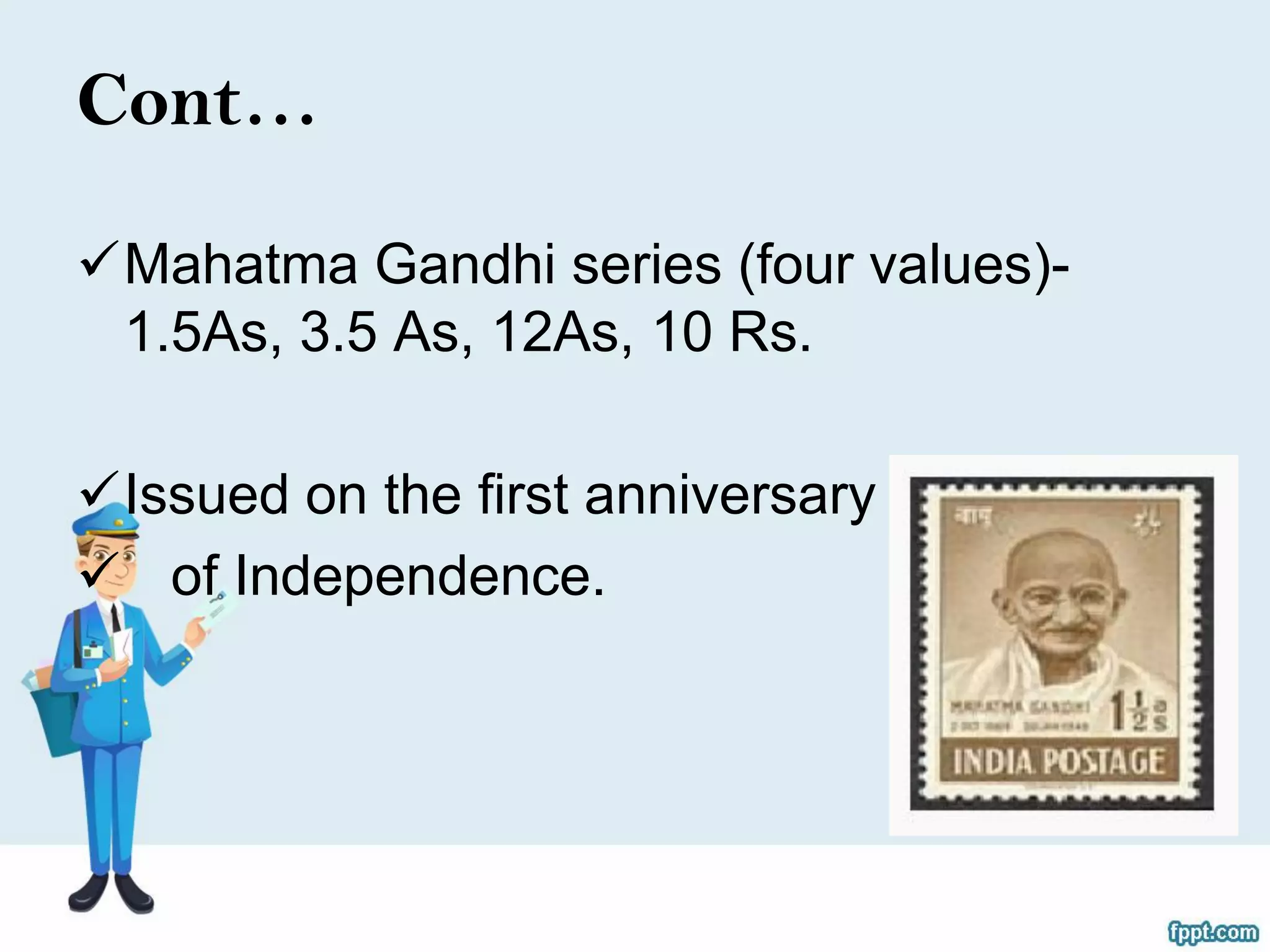
Mahatma Gandhi series (four values)-
1.5As, 3.5 As, 12As, 10 Rs.
Issued on the first anniversary
 of Independence.
Cont…
Cont…
Weakness
No advertises.
Not provide loan to consumers.
Unchanged working culture.
Lower rate of interest on deposits.
Conclusion
The Indian postal system needs
»Technological
»Social and Economic
»CHANGES
Presentation on indian postal system

Presentation on indian postal system

  • 1.
    Presented By:- Ravi Sonkar PRESENTATIONON INDIAN POSTAL SERVICES
  • 2.
  • 3.
    INTRODUCTION The first postoffice in India was established by British East India company in Bombay in 1764.  Headquarter is situated in New Delhi. No. of employees are 520191.
  • 4.
    Vision and Mission Vision. India Post's products and services will be the customer's first choice.  Mission.  To sustain its position as the largest postal network in the world touching the lives of every citizen in the country.  To provide mail parcel, money transfer, banking, insurance and retail services with speed and reliability.
  • 5.
    Cont… To provide servicesto the customers on value-for-money basis. To continue to deliver social security services and to enable last mile connectivity as a Government of India platform.
  • 6.
    About Post Office Formore than 150 years, (DoP) has been the backbone of the country’s. communication and has played a crucial role in the country’s socio-economic development.
  • 7.
    Cont…..  It touchesthe lives of Indian citizens in many ways: delivering mails, accepting deposits under Small Savings Schemes, providing life insurance cover under (PLI) and (RPLI) and providing retail services like bill collection, sale of forms, etc.
  • 8.
    Cont…. Key people KaveryBenerjee, Director General and Secretary. Slogan Dak Seva Jan Seva
  • 9.
    Cont… On an average,a Post Office serves an area of 21.22 Sq. Km and a population of 8221 people India has largest number of post office in the world. India has the highest post office in the world in Sikkim at a height of 15,500 feet (postal code – 172114).
  • 10.
    Structure At HeadPost Office
  • 11.
    History The British Rajwas instituted in 1858, when the rule of the East India Company was transferred to the Crown. By 1861, there were 889 post offices handling nearly 43 million letters and over 4.5 million newspapers annually.
  • 12.
    Cont… The first superintendentof the post office was appointed in 1870 and based in Allahabad. In 1876, British India became the first non- founding member of the General Postal Union. The British Raj to expand and regulate Posts and Telegraphs service.
  • 13.
    Cont… The Government SavingsBank Act 1873 passed by the legislature 28 January 1873, was enacted in 1881. On 1 April 1882, Post Office Savings Banks opened throughout India.
  • 14.
    Cont… In Madras Presidency,it was limited; in the Bengal Presidency, no POSBs were established in Calcutta or Howrah. Postal life insurance began on 1 February 1884 . the Posts & Telegraphs Department as Government of India dispatch No. 299 dated 18 October 1882 to the Secretary of State.
  • 15.
    Cont… The Indian WirelessTelegraphy Act 1933 (17 of 1933). The world's first official airmail flight took place in India on 18 February 1911, a journey of 18 kilometers (11 mi) lasting 27 minutes. There are (approximately 6,000 letters and cards) across the Ganges from Allahabad to Naini.
  • 16.
    Cont… The Posts andTelegraphs Departments merged in 1914, dividing on 1 January 1985.
  • 17.
    Service Greeting Post Media Post ExpressParcel Business Post Speed Post
  • 18.
    Speed Post Speed Post...We deliver Excellence. TRACK SPEED POST ITEM. Speed Post, providing time-bound and express delivery of letters. The parcels weight up to 35 kg between specified stations in India.
  • 19.
  • 20.
    Cont… Speed Post delivers'Value for money' to everyone everywhere, delivering Speed Post up to 50 grams @ INR 35 across the country and local Speed Post up to 50 grams @ INR 15, excluding applicable Service Tax.
  • 21.
    Business Post Business Postservices will make your task easy and convenient. Business Post demonstrates our responsiveness to market demands in providing value additions to mail services, with the best possible delivery at the lowest possible price.
  • 22.
    Express Parcel Customised: ExpressParcel service will be available to both retail as well as business (corporate) customers. Weight: Minimum is 0.5 Kg Maximum is 35 Kg.
  • 23.
    Cont… Fast & secure:Express Parcel is an air express parcel product providing time bound delivery of parcels. These parcels will be transmitted through air or any other fastest mean available.
  • 24.
  • 25.
    Media Post Media Postoffers an unique media concept to help the Indian corporate and the Government organizations. , cost-effective and personalized , it is over packed .
  • 26.
    Cont…  Absolutely noother media can match the sheer expanse of India Post in terms of volume and reach.  Media Post - an innovative & effective vehicle for Brand and Marketing.
  • 27.
    Greeting Post Innovative Product Greeting Post ,a new range of delightful greeting cards, brought to you by India Post.  These cards come ready with pre-paid postage envelopes.  a unique concept for the first time in India.
  • 28.
    Cont… The fascinating, postagestamps are an exact replica of the cards inside. Advantage Greeting Post. And it’s not only convenience that these cards offer, but a lot more. Through Greeting Post you can express yourself perfectly on every occasion, festival or event.
  • 29.
  • 30.
  • 31.
  • 32.
  • 33.
    Post Office Network Indiahas the largest Postal Network in the world with over 1, 54,882 Post Offices (as on 31.03.2014) of which 1, 39,182 (89.86%) are in the rural areas.  At the time of independence, there were 23,344 Post Offices, which were primarily in urban areas.
  • 34.
    Postage Stamps The firststamp of independent India released on 21 Nov 1947. Meant for foreign correspondence.
  • 35.
    Cont… • The secondstamp depicts the Asokan lions capital ,the National Emblem of India and for domestic use.
  • 36.
    Cont… The third stamp,showing a Douglas DC-4 aircraft, was meant for foreign airmail. The Air India International service was start on 1948.
  • 37.
    Cont… Mahatma Gandhi series(four values)- 1.5As, 3.5 As, 12As, 10 Rs. Issued on the first anniversary  of Independence.
  • 38.
  • 39.
  • 40.
    Weakness No advertises. Not provideloan to consumers. Unchanged working culture. Lower rate of interest on deposits.
  • 41.
    Conclusion The Indian postalsystem needs »Technological »Social and Economic »CHANGES