Inclusivity in HE
Version 692

Sarra Saffron Powell
University of Liverpool
Session outline
External contexts

Institutional responses/position

Approaches and practice/inclusive pedagogy
Inclusion
“At a time when prevailing neo-liberal policy aims to
position higher education as an economic venture and
students as customers, discourses of inclusion are vital.
Terms such as access, widening
participation, equity, equality and diversity, and lifelong
learning commonly feature in discourses of inclusion
related to higher education. The shifting meanings and
fluid uses of these terms serve as an indication of
the increasing tensions between neo-liberal economic
forces and the role of higher education in modern
society”
Widening Participation Conference 2012 - Discourses of Inclusion in Higher Education
• What institutional agendas and drivers impact
your practice?
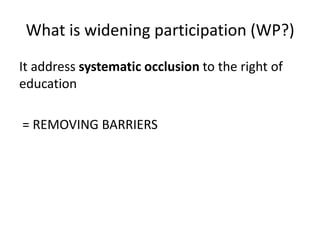
What is widening participation (WP?)
It address systematic occlusion to the right of
education
= REMOVING BARRIERS
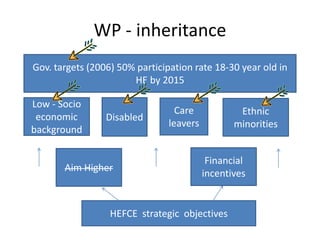
WP - inheritance
Gov. targets (2006) 50% participation rate 18-30 year old in
HE by 2015
Low - Socio
economic
background

Disabled

Aim Higher

Care
leavers

Ethnic
minorities

Financial
incentives

HEFCE strategic objectives
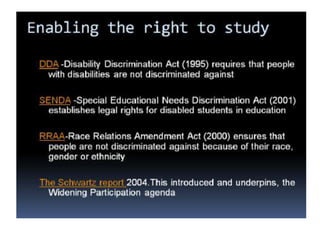
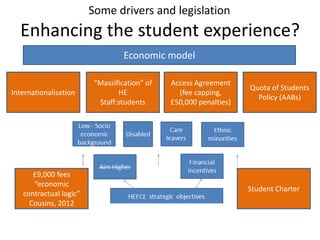
Some drivers and legislation

Enhancing the student experience?
Economic model

Internationalisation

£9,000 fees
“economic
contractual logic”
Cousins, 2012

“Massification” of
HE
Staff:students

Access Agreement
(fee capping,
£50,000 penalties)

Quota of Students
Policy (AABs)

Student Charter
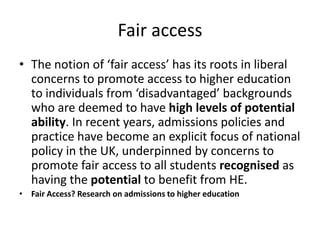
Fair access
• The notion of ‘fair access’ has its roots in liberal
concerns to promote access to higher education
to individuals from ‘disadvantaged’ backgrounds
who are deemed to have high levels of potential
ability. In recent years, admissions policies and
practice have become an explicit focus of national
policy in the UK, underpinned by concerns to
promote fair access to all students recognised as
having the potential to benefit from HE.
• Fair Access? Research on admissions to higher education
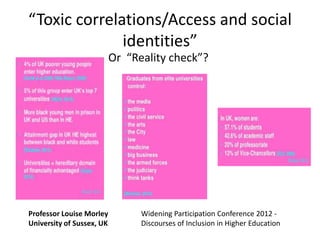
“Toxic correlations/Access and social
identities”
Or “Reality check”?

Professor Louise Morley
University of Sussex, UK

Widening Participation Conference 2012 Discourses of Inclusion in Higher Education
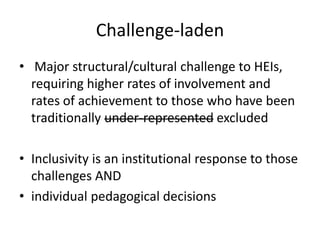
Challenge-laden
• Major structural/cultural challenge to HEIs,
requiring higher rates of involvement and
rates of achievement to those who have been
traditionally under-represented excluded
• Inclusivity is an institutional response to those
challenges AND
• individual pedagogical decisions
Barriers
•
•
•
•

Engagement (pre-admission)
Admissions procedure
Retention
Engagement in university culture ‘student
experience’
• Language
• Physical barriers
• Lit. indicates identity ‘simple sense of belonging’
– is key.
Institutional responses
• Russell group cf post-1992 HEIs = exceptionally
poor
• Russell group cf Russell group = exceptionally
good
• WP a key strategic aim
• High levels of resourcing
• HEA inclusive cultures programme – high levels of
commitment
• Go Higher access programme (revised, resourced)
• Policy auditing/implementation
• Student representation (LGoS)
• Student support infrastructure (student services)
• Student support learning skills development
(iLearn, workshops)
• Curriculum Review/design (diversifying
assessment, delivery, internationalising curricula)
• Teaching qualifications (improving teaching
practice)
• Induction Review (transition support)
• Peer mentoring system
• Faculty Skills Advisors
• Development of Digital Literacies/elearning
• ..more
Good practice
• Inclusive pedagogy = good practice
• takes a coherent approach which is anticipatory and
proactive
• has a strategy for delivering equal opportunities and
diversity policies
• involves the whole institution
• matches provision to student needs
• incorporates regular reflection, review and refinement
of strategies and methods that actively involve disabled
students.
• (www.open.ac.uk)
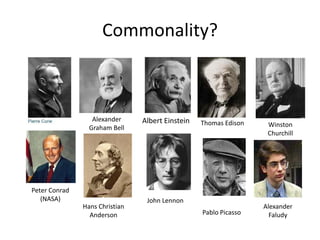
Commonality?

Alexander
Graham Bell

Peter Conrad
(NASA)
Hans Christian
Anderson

Albert Einstein

Thomas Edison

John Lennon
Pablo Picasso

Winston
Churchill

Alexander
Faludy
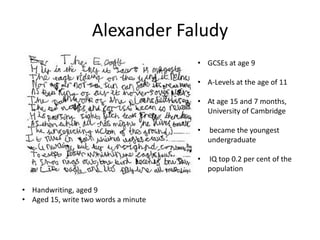
Alexander Faludy
• GCSEs at age 9
• A-Levels at the age of 11
• At age 15 and 7 months,
University of Cambridge
•
•

• Handwriting, aged 9
• Aged 15, write two words a minute

became the youngest
undergraduate
IQ top 0.2 per cent of the
population
In practice
•
•
•
•
•
•

Resource design (word, ed.pdf)
Visuals/text/auditory
Clarity (space/colour)
Learner styles/types of learner (multimodalities)
Delivery (diversify)
Curriculum/module design (think
barriers/opportunity to practice for assessment)
• Assessment and feedback (diversity/timeliness)
• Formative
• Group work (+peer assessment)
•
•
•
•
•

elearning/flexible delivery (+VITAL)
Developing digital literacies (multi modal)
clickers
Student engagement/choice (voice/feedback)
“Mindfulness” Language (academic speak/
novice-expert continuum)
• Expectation (motivation/confidence)
• Constructive alignment
• Transparency (communication)
Questions?

Institutional Lead in Inclusivity:
• sarrasaf@liv.ac.uk xt 41180
refs
Barnett R., (2000) University Knowledge in an Age of
Supercomplexity, Higher Education, 40, pp. 409-422
Brookfield, S., (1998) Critically Reflective Practice, The Journal
of Continuing Education in the Health Professions, 18, pp. 197255
Morley L., (2012) Widening Participation Conference 2012 Discourses of Inclusion in Higher Education
Gosling D., (2002) Models Of Peer Observation of Teaching,
Learning and Teaching Support Network Generic Centre,.
Further resources
•
•
•
•
•
•
•
•
•
•

Beyond Prejudice: Inclusive learning in practice from the Learning and Skills Development Agency
offers strategic and practical pointers for the provision of an inclusive learning environment.
DEMOS: Online Materials For Staff Disability Awareness (2002) is an online resource aimed at
academic staff, and examines the issues faced by disabled students in higher
education. Modification of examination and assessment arrangments are also discussed.
Engineering Subject Centre Guide to Working with Disabled Students (2nd Edition June 2005)
includes practical ideas and case studies.
Premia resource base awareness and development materials are for everyone involved in making
the research environment more accessible for disabled students.
SCIPS (Strategies for the Creation of Inclusive Programmes of Study) database provides information
to support academic staff in improving access to the curriculum for disabled students.
SENDA compliance in Higher Education: an audit and guidance tool to accessible practice within the
framework of teaching and learning 2002, including a useful section on assessment.
Teachability (2000) offers information and resources for academic staff to help in the provision of
an accessible curriculum.
Techdis has relevant resources and references, including a database of information and products to
assist disabled students and staff.
University of Bristol Access Unit provides fact sheets for supporting disabled students.
University of Wolverhampton - Learning, teaching and assessment: good practice guides for staff
teaching d/Deaf students in art, design and communication and in science and engineering.
Thanks

Inclusive pedagogy -

  • 1.
    Inclusivity in HE Version692 Sarra Saffron Powell University of Liverpool
  • 2.
    Session outline External contexts Institutionalresponses/position Approaches and practice/inclusive pedagogy
  • 3.
    Inclusion “At a timewhen prevailing neo-liberal policy aims to position higher education as an economic venture and students as customers, discourses of inclusion are vital. Terms such as access, widening participation, equity, equality and diversity, and lifelong learning commonly feature in discourses of inclusion related to higher education. The shifting meanings and fluid uses of these terms serve as an indication of the increasing tensions between neo-liberal economic forces and the role of higher education in modern society” Widening Participation Conference 2012 - Discourses of Inclusion in Higher Education
  • 4.
    • What institutionalagendas and drivers impact your practice?
  • 6.
    What is wideningparticipation (WP?) It address systematic occlusion to the right of education = REMOVING BARRIERS
  • 7.
    WP - inheritance Gov.targets (2006) 50% participation rate 18-30 year old in HE by 2015 Low - Socio economic background Disabled Aim Higher Care leavers Ethnic minorities Financial incentives HEFCE strategic objectives
  • 8.
    Some drivers andlegislation Enhancing the student experience? Economic model Internationalisation £9,000 fees “economic contractual logic” Cousins, 2012 “Massification” of HE Staff:students Access Agreement (fee capping, £50,000 penalties) Quota of Students Policy (AABs) Student Charter
  • 9.
    Fair access • Thenotion of ‘fair access’ has its roots in liberal concerns to promote access to higher education to individuals from ‘disadvantaged’ backgrounds who are deemed to have high levels of potential ability. In recent years, admissions policies and practice have become an explicit focus of national policy in the UK, underpinned by concerns to promote fair access to all students recognised as having the potential to benefit from HE. • Fair Access? Research on admissions to higher education
  • 10.
    “Toxic correlations/Access andsocial identities” Or “Reality check”? Professor Louise Morley University of Sussex, UK Widening Participation Conference 2012 Discourses of Inclusion in Higher Education
  • 11.
    Challenge-laden • Major structural/culturalchallenge to HEIs, requiring higher rates of involvement and rates of achievement to those who have been traditionally under-represented excluded • Inclusivity is an institutional response to those challenges AND • individual pedagogical decisions
  • 12.
    Barriers • • • • Engagement (pre-admission) Admissions procedure Retention Engagementin university culture ‘student experience’ • Language • Physical barriers • Lit. indicates identity ‘simple sense of belonging’ – is key.
  • 13.
    Institutional responses • Russellgroup cf post-1992 HEIs = exceptionally poor • Russell group cf Russell group = exceptionally good • WP a key strategic aim • High levels of resourcing • HEA inclusive cultures programme – high levels of commitment • Go Higher access programme (revised, resourced) • Policy auditing/implementation • Student representation (LGoS)
  • 14.
    • Student supportinfrastructure (student services) • Student support learning skills development (iLearn, workshops) • Curriculum Review/design (diversifying assessment, delivery, internationalising curricula) • Teaching qualifications (improving teaching practice) • Induction Review (transition support) • Peer mentoring system • Faculty Skills Advisors • Development of Digital Literacies/elearning • ..more
  • 15.
    Good practice • Inclusivepedagogy = good practice • takes a coherent approach which is anticipatory and proactive • has a strategy for delivering equal opportunities and diversity policies • involves the whole institution • matches provision to student needs • incorporates regular reflection, review and refinement of strategies and methods that actively involve disabled students. • (www.open.ac.uk)
  • 16.
    Commonality? Alexander Graham Bell Peter Conrad (NASA) HansChristian Anderson Albert Einstein Thomas Edison John Lennon Pablo Picasso Winston Churchill Alexander Faludy
  • 17.
    Alexander Faludy • GCSEsat age 9 • A-Levels at the age of 11 • At age 15 and 7 months, University of Cambridge • • • Handwriting, aged 9 • Aged 15, write two words a minute became the youngest undergraduate IQ top 0.2 per cent of the population
  • 18.
    In practice • • • • • • Resource design(word, ed.pdf) Visuals/text/auditory Clarity (space/colour) Learner styles/types of learner (multimodalities) Delivery (diversify) Curriculum/module design (think barriers/opportunity to practice for assessment) • Assessment and feedback (diversity/timeliness) • Formative • Group work (+peer assessment)
  • 19.
    • • • • • elearning/flexible delivery (+VITAL) Developingdigital literacies (multi modal) clickers Student engagement/choice (voice/feedback) “Mindfulness” Language (academic speak/ novice-expert continuum) • Expectation (motivation/confidence) • Constructive alignment • Transparency (communication)
  • 20.
    Questions? Institutional Lead inInclusivity: • sarrasaf@liv.ac.uk xt 41180
  • 21.
    refs Barnett R., (2000)University Knowledge in an Age of Supercomplexity, Higher Education, 40, pp. 409-422 Brookfield, S., (1998) Critically Reflective Practice, The Journal of Continuing Education in the Health Professions, 18, pp. 197255 Morley L., (2012) Widening Participation Conference 2012 Discourses of Inclusion in Higher Education Gosling D., (2002) Models Of Peer Observation of Teaching, Learning and Teaching Support Network Generic Centre,.
  • 22.
    Further resources • • • • • • • • • • Beyond Prejudice:Inclusive learning in practice from the Learning and Skills Development Agency offers strategic and practical pointers for the provision of an inclusive learning environment. DEMOS: Online Materials For Staff Disability Awareness (2002) is an online resource aimed at academic staff, and examines the issues faced by disabled students in higher education. Modification of examination and assessment arrangments are also discussed. Engineering Subject Centre Guide to Working with Disabled Students (2nd Edition June 2005) includes practical ideas and case studies. Premia resource base awareness and development materials are for everyone involved in making the research environment more accessible for disabled students. SCIPS (Strategies for the Creation of Inclusive Programmes of Study) database provides information to support academic staff in improving access to the curriculum for disabled students. SENDA compliance in Higher Education: an audit and guidance tool to accessible practice within the framework of teaching and learning 2002, including a useful section on assessment. Teachability (2000) offers information and resources for academic staff to help in the provision of an accessible curriculum. Techdis has relevant resources and references, including a database of information and products to assist disabled students and staff. University of Bristol Access Unit provides fact sheets for supporting disabled students. University of Wolverhampton - Learning, teaching and assessment: good practice guides for staff teaching d/Deaf students in art, design and communication and in science and engineering.
  • 23.

Editor's Notes

  • #3 Going to work towards a definition of inclusivity in the sessionProblematise these areas
  • #4 From the call for papers – here just to frame our discussion HE as economic venture/economic forces students as customers Role of HE in modern society – come back to this later
  • #5  to get the thinking bit going - 5 minutes – just off the top of your head
  • #6 Key legislation – you can read for yourselves. Legislation that ‘enables’ wp to occur
  • #7 Talk more about barriers shortly – but a more detailed look at wp first
  • #8 For this to work - prejudicial barriers assumptions need addressingReality = a bit more complex
  • #9 Increasing tensionsCouple of years more international students than home – XJTLUCoupled with notion of fair access?!
  • #10  compare to next slide “The intention” – but is problematic ‘humanist’ approach but the reality is more…
  • #11 Another view of fair access.‘The facts of the matter’The extent of the challengePoorer? Poor.
  • #12 Russell group greater challenge – traditional cohorts – post 1992 learning institutions are designed to engage WPHow you see HE and learning and teaching shapes your response to inclusivity
  • #13 Challenge of engaging low SEGs How you do that? Community engagement - ‘civic engagement’Primary/secondary school Admissions – huge problem – it really isn’t that effective for identifying those with potentail!School educational performance of those from low socio-economic backgrounds significantly lower =By degree classification performance significantly higherOnce we have them – how to keep them? Retention generally not a big problem at UoL but pockets (mature students), Gohigher attritionUniversity culture – challenging for WP students – international studentsInduction a very important part of that – reiewed
  • #14 Inclusivity is intrinsically bound up very closely with good teaching practice….Need for L&T rewards –etc promotions acknowledgementsCynically, lets remember £9000 per year per student – emphasis on the student experiences – fees – fines etcHow you see it is key – far more important
  • #15 How do you respond to the challenges – important
  • #17 2 minutes – who are they what do they have in common?Are these the kind of intellects we associate with dyslexia?1839 first test for dyslexia – hanschristianandersonAnyone know Alexander Faludy?
  • #18 We all make assumptions – they’re not always righttypically dyslexic - cognitive processing issues with written text but brilliant verbal ability and original innovative thinkingThe largest proportion of declared disability Back to WP
  • #19 Key areas to consider