Chapter 2 Concept of Inclusion
Definition of Inclusion in education/service
• Inclusive services at any level are quality provisions without discrimination or
partiality and meeting the diverse needs of people.
• Inclusion is a process of addressing and responding to the diversity of needs of
all persons through increasing participation in learning, employment, services,
cultures and communities, and reducing exclusion at all social contexts.
• It seeks to enable communities, systems and structures in all cultures and
contexts to combat discrimination, celebrate diversity, promote participation and
overcome barriers to learning and participation for all people.
This definition has the following components:
1. Concepts about learners
• Education is a fundamental human right for all people
• Learning begins at birth and continues throughout life
• All children have a right to education within their own community
• Everyone can learn, and any child can experience difficulties in learning
• All learners need their learning supported, child-focused teaching benefits all
children.
2. Concepts about the education system and schools
• It is broader than formal schooling
• It is flexible, responsive educational systems
• It creates enabling and welcoming educational environments
• It promotes school improvement – makes effective schools
• It involves whole school approach and collaboration between partners.
3. Concepts about diversity and discrimination
•It promotes combating discrimination and exclusionary pressures at any
social sectors
•It enables responding to/embracing diversity as a resource not as a problem
•It prepares learners for an inclusive society that respects and values difference
4. Concepts about processes to promote inclusion
•It helps to identifying and overcoming barriers to participation &
exclusionary pressures
•It increases real participation of all collaboration, partnership between all
stakeholders
• It promotes participatory methodology, action research, collaborative
enquiry and other related activities
5. Concepts about resources
• Promotes unlocking and fully using local resources redistributing
existing resources
• It helps to perceive people (children, parents, teachers, members of
marginalized groups, etc.) as key resources
• It helps to use appropriate resources and support within schools and
at local levels for the needs of different children, e.g. mother tongue
tuition, Braille, assistive devices.
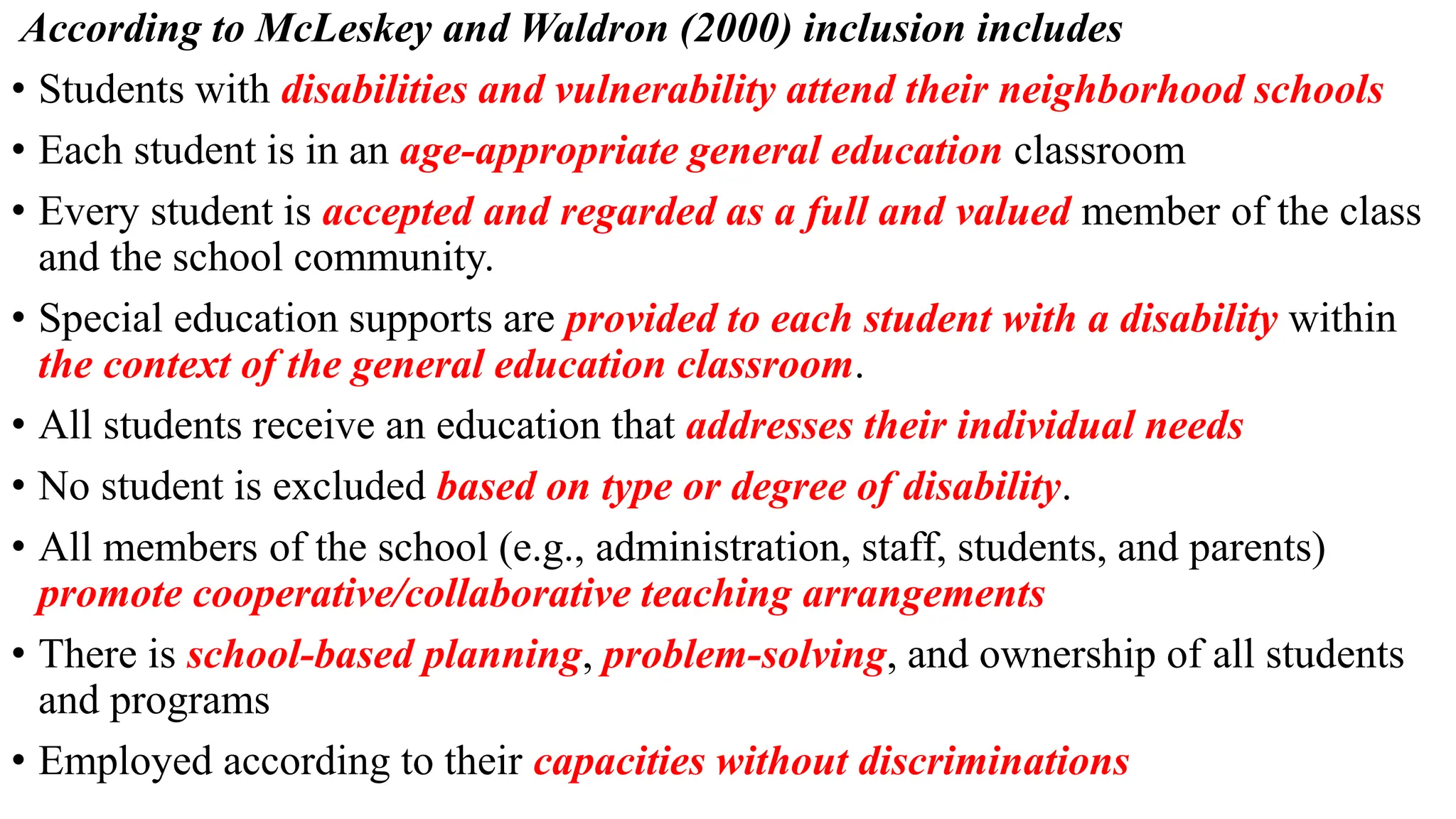
According to McLeskey and Waldron (2000) inclusion includes
• Students with disabilities and vulnerability attend their neighborhood schools
• Each student is in an age-appropriate general education classroom
• Every student is accepted and regarded as a full and valued member of the class
and the school community.
• Special education supports are provided to each student with a disability within
the context of the general education classroom.
• All students receive an education that addresses their individual needs
• No student is excluded based on type or degree of disability.
• All members of the school (e.g., administration, staff, students, and parents)
promote cooperative/collaborative teaching arrangements
• There is school-based planning, problem-solving, and ownership of all students
and programs
• Employed according to their capacities without discriminations
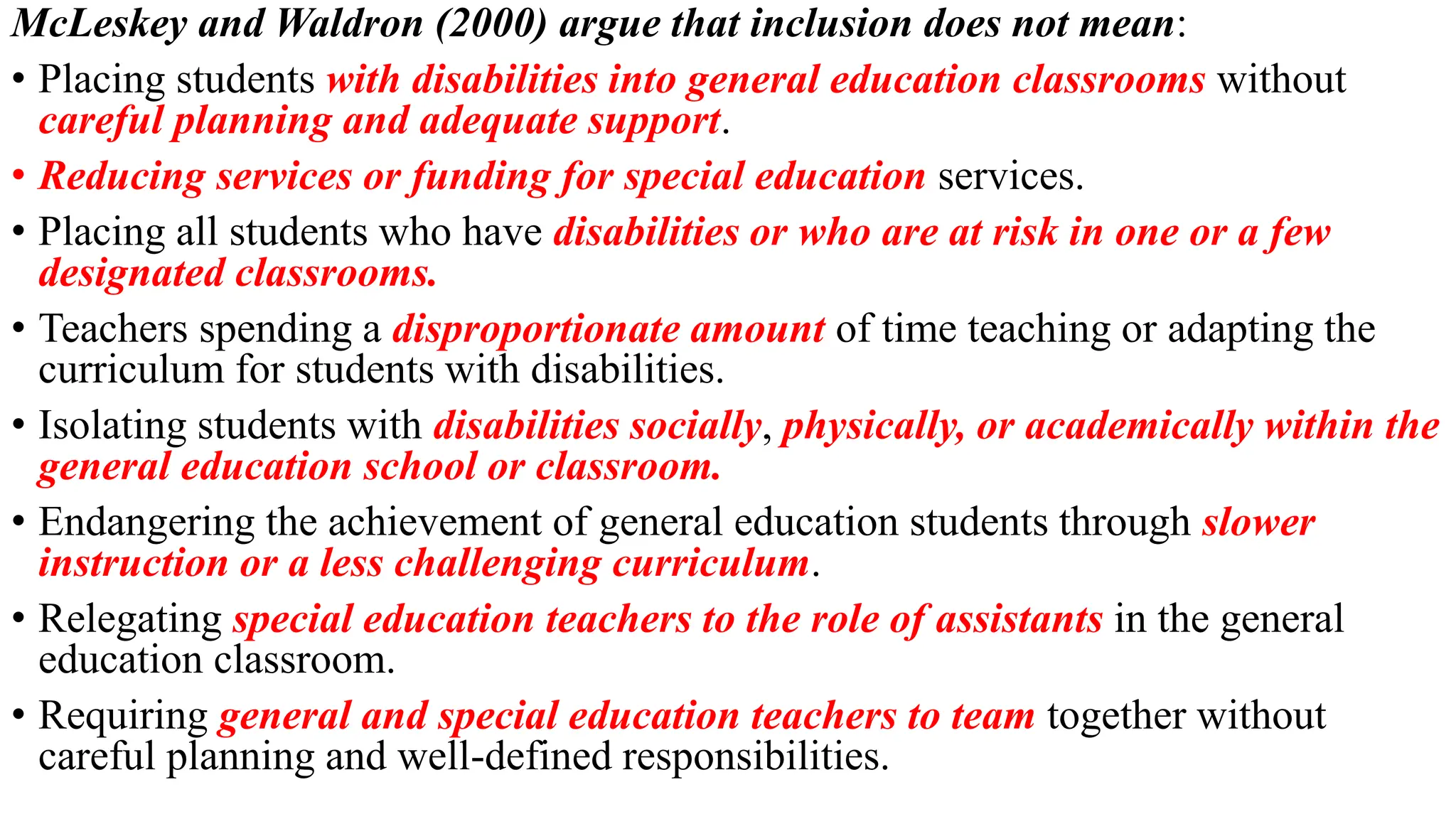
McLeskey and Waldron (2000) argue that inclusion does not mean:
• Placing students with disabilities into general education classrooms without
careful planning and adequate support.
• Reducing services or funding for special education services.
• Placing all students who have disabilities or who are at risk in one or a few
designated classrooms.
• Teachers spending a disproportionate amount of time teaching or adapting the
curriculum for students with disabilities.
• Isolating students with disabilities socially, physically, or academically within the
general education school or classroom.
• Endangering the achievement of general education students through slower
instruction or a less challenging curriculum.
• Relegating special education teachers to the role of assistants in the general
education classroom.
• Requiring general and special education teachers to team together without
careful planning and well-defined responsibilities.
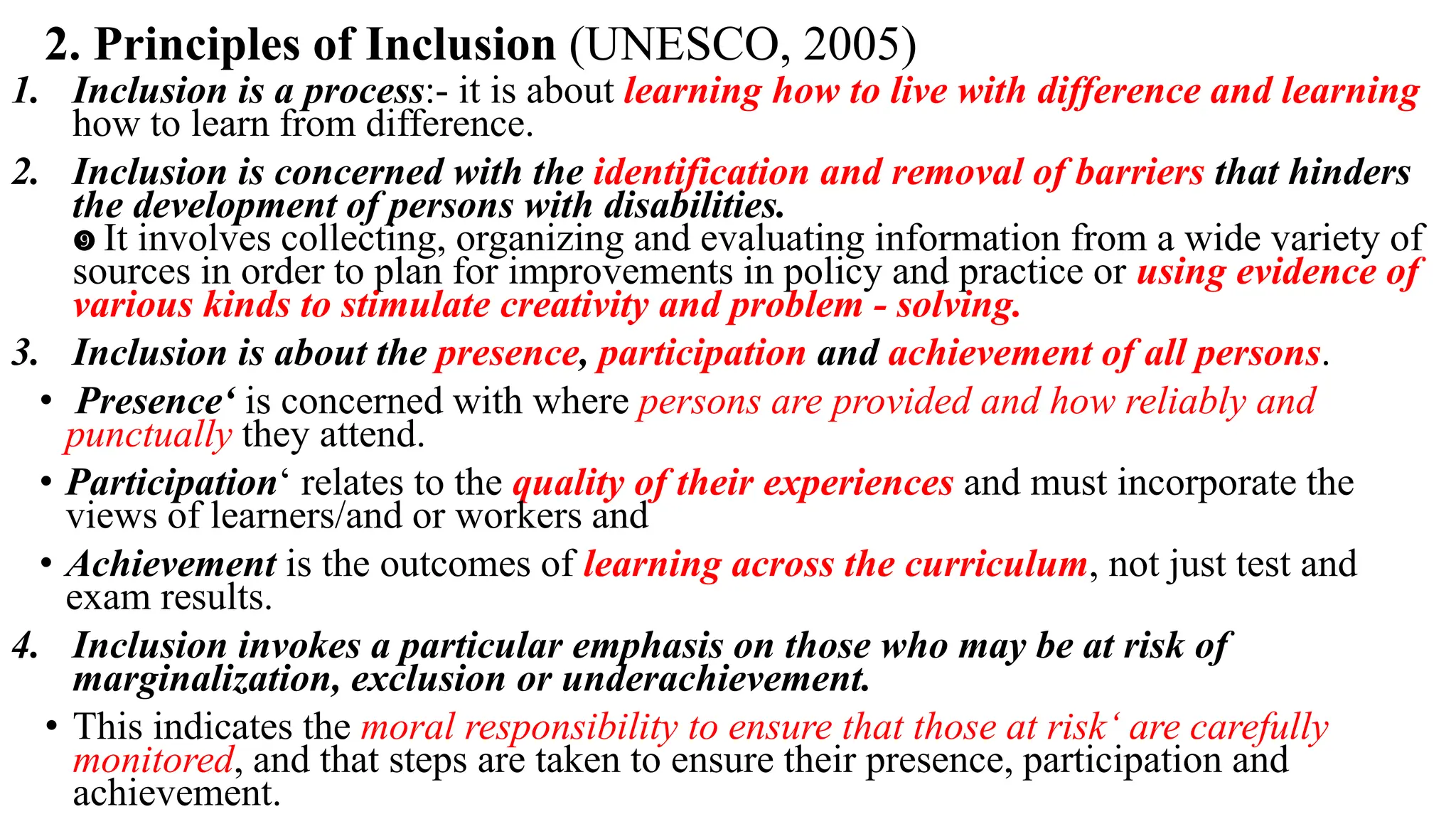
2. Principles of Inclusion (UNESCO, 2005)
1. Inclusion is a process:- it is about learning how to live with difference and learning
how to learn from difference.
2. Inclusion is concerned with the identification and removal of barriers that hinders
the development of persons with disabilities.
 It involves collecting, organizing and evaluating information from a wide variety of
sources in order to plan for improvements in policy and practice or using evidence of
various kinds to stimulate creativity and problem - solving.
3. Inclusion is about the presence, participation and achievement of all persons.
• Presence‘ is concerned with where persons are provided and how reliably and
punctually they attend.
• Participation‘ relates to the quality of their experiences and must incorporate the
views of learners/and or workers and
• Achievement is the outcomes of learning across the curriculum, not just test and
exam results.
4. Inclusion invokes a particular emphasis on those who may be at risk of
marginalization, exclusion or underachievement.
• This indicates the moral responsibility to ensure that those at risk‘ are carefully
monitored, and that steps are taken to ensure their presence, participation and
achievement.
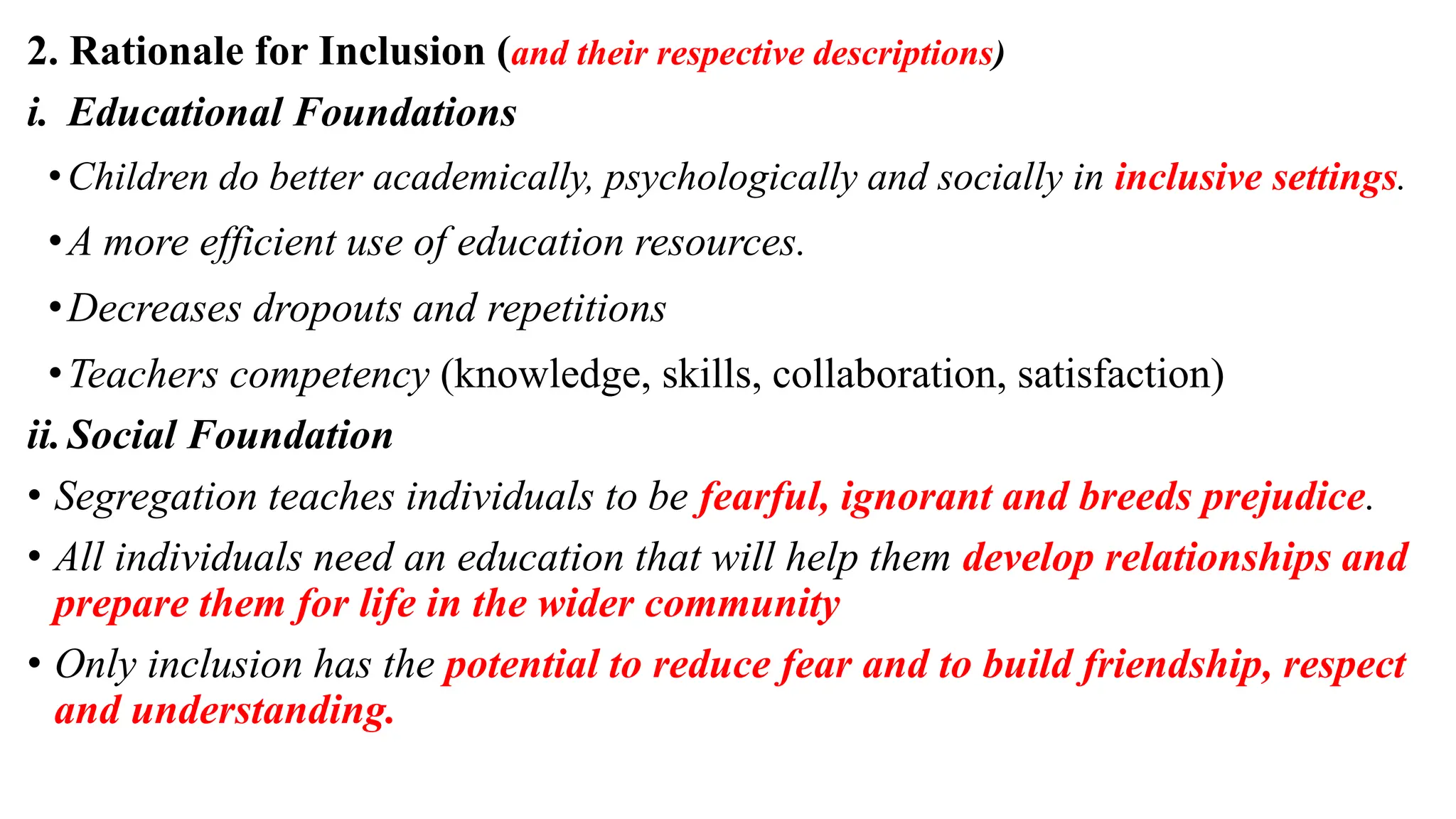
2. Rationale for Inclusion (and their respective descriptions)
i. Educational Foundations
•Children do better academically, psychologically and socially in inclusive settings.
•A more efficient use of education resources.
•Decreases dropouts and repetitions
•Teachers competency (knowledge, skills, collaboration, satisfaction)
ii.Social Foundation
• Segregation teaches individuals to be fearful, ignorant and breeds prejudice.
• All individuals need an education that will help them develop relationships and
prepare them for life in the wider community
• Only inclusion has the potential to reduce fear and to build friendship, respect
and understanding.
iii. Legal Foundations
• All individuals have the right to learn and live together.
• Human being shouldn‘t be devalued/discriminated against by being excluded or sent
away because of their disability.
• There are no legitimate reasons to separate children for their education
iv. Economic Foundation
• Inclusive education has economic benefit, both for individual and for society.
• Inclusive education is more cost-effective than the creation of special schools across the
country.
• Children with disabilities go to local schools
• Reduce wastage of repetition and dropout
• Children with disabilities live with their family use community infrastructure
• Better employment and job creation opportunities for people with disabilities
v. Foundations for Building Inclusive Society
•Formation of mutual understanding and appreciation of diversity
•Building up empathy, tolerance and cooperation
• Promotion of sustainable development
2.3. Factors that Influenced Development of Inclusion (Some of the major drivers include)
1. Communities:- pre-colonial and indigenous approaches to education and community-
based programs movement that favor inclusion of their community members.
2. Activists and advocates:- the combined voices of primary stakeholders – representatives of
groups of learners often excluded and marginalized from education
3. The quality education and school improvement movement:- the issues of quality, access
and inclusion are strongly linked, and contribute to the understanding and practice of
inclusive education as being the responsibility of education systems and schools.
4. Special educational needs movement:- the new thinking‘ of the special needs education
movement as demonstrated in the Salamanca Statement has been a positive influence on
inclusive education, enabling schools and systems to really respond to a wide range of diversity.
5. Involvement of International agencies:- the UN is a major influence on the development
of inclusive education policy and practice to speed progress towards the EFA goals.
6. Involvement of NGOs movements, networks and campaigns:- seek to bring policy and
practice together and involve all stakeholders based on different situations
7. Other factors:- the current world situation and practical experiences in education. The
current world situation presents challenges
Benefits of Inclusion (communities, families, teachers, and students)
1. Benefits for Students with Special Needs Education
In inclusive settings people will develop:
• Appropriate models of behavior.
• Improved friendships with the social environment
• Increased social initiations, interactions, relationships and networks
• Gain peer role models for academic, social and behavior skills
• Increased achievement of individualized educational program (IEP) goals
• Greater access to general curriculum
• Enhanced skill acquisition and generalization in their learning
• Improved academic achievement which leads to quality education services
• Attending inclusive schools increases the probability that students with SEN will continue
to participate in a variety of integrated settings throughout their lives (increased inclusion
in future environments that contribute building of inclusive society).
• Improved school staff collaboration to meet these students‘ needs and ability differences
• Increased parental participation to meet these students‘ needs and ability differences
• Enhanced families integration into the community
2. Benefits for persons without Special Needs Education
• Have a variety of opportunities for interacting with their age peers who experience SEN in
inclusive school settings.
• Serve as peer tutors during instructional activities
• Play the role of a special buddy/friend during lunch, in the bus or playground.
• Gain knowledge of a good deal about tolerance, individual difference, and human
exceptionality.
• Learn that students with seen have many positive characteristics and abilities.
• Have chance to learn about many of the human service profession such as special education,
speech therapy, physical therapy, recreation therapy, and vocational rehabilitation.
• Have increased appreciation, acceptance and respect of individual differences among human
beings that leads to increased understanding and acceptance of diversity
• Get greater opportunities to master activities by practicing and teaching others
• Have increased academic outcomes
• Have opportunity to learn to communicate, and deal effectively with a wide range of
individuals; this prepares them to fully participate in society when they are adults that make
them build an inclusive society
3. Benefits for Teachers
• They have more opportunities to learn new ways to teach different kinds of students.
• They gain new knowledge, such as the different ways children learn and can be taught.
• They develop more positive attitudes and approaches towards different people with
diverse needs.
• They have greater opportunities to explore new ideas by communicating more often with
others from within and outside their school
• They can encourage their students to be more interested, more creative and more attentive
• They can experience greater job satisfaction and a higher sense of accomplishment when
ALL children are succeeding in school to the best of their abilities.
• They get opportunities to exchange information about instructional activities and
teaching strategies, thus expanding the skills of both general and special educators
• They benefit from developing teamwork and collaborative problem-solving skills to
creatively address challenges regarding student learning
• Develop positive attitude that help them promoting the recognition and appreciation
that all students have strengths and are contributing members of the school community
as well as the society
4. Benefits for Family/parents
• Learn more about how their children are being educated in schools with their
peers in an inclusive environment
• Become personally involved and feel a greater sense of accomplishment in
helping their children to learn.
• Feel valued and consider themselves as equal partners in providing quality
learning opportunities for children.
• Learn how to deal better with their children at home by using techniques that
the teachers use in school.
• Find out ways to interact with others in the community, as well as to understand
and help solve each other‘s problems.
• Know that their children—and ALL children—are receiving a quality education.
• Experience positive attitude about themselves and their children by seeing their
children accepted by others, successful in the inclusive setting, and belonging to
the community where they live
5 Benefits for Society
 Inclusion goes beyond education and should involve consideration of
employment, recreation, health and living conditions.
 Involve transformations across all government and other agencies at all levels
of society.
• Introduction of students with disabilities and vulnerabilities into mainstream
schools bring in the students into local communities and neighborhoods and
helps break down barriers and prejudice that prevail in the society towards
persons with disability.
• Communities become more accepting of difference, and everyone benefits from
a friendlier, open environment that values and appreciates differences in
human beings.
• Meaningful participation in the economic, social, political and cultural life of
communities own cost effective non-segregated schooling system that services
both students with and without special needs education.
Ultimate Goal of Inclusion
• The goal of inclusive education is to create schools where everyone belongs
• By creating inclusive schools, in turn create welcoming place in the
community for everyone after their school year‘s end.
• Students educated together have a greater understanding of difference and
diversity.
• Students educated together have fewer fears about difference and disability.
• An inclusive school culture creates better long-term outcomes for all students.
• These students hold the promise of creating inclusive communities in the
future for all our children.
• These students will be the teachers, principals, doctors, lawyers, and
parents who build communities where everyone belongs.
In general, the ultimate goals of inclusiveness is to crate inclusive
society where;
 Inclusive society is a necessary precondition for inclusive growth.
 Inclusive society is a society which does not exclude or discriminate
against its citizens on the basis of disability, caste/status, race,
gender, family or community, a society which levels the playing field
for investment‘ and leaves no one behind.
 Inclusive growth which is equitable that offers equality of
opportunity to all as well as protection in market and employment
transitions results from inclusive society.
5. Features of Inclusive Environment
• Environment that embrace feel respected by and connected to one another.
• It welcomes all people, regardless of their disability and other vulnerabilities.
• It recognizes and uses their skills and strengthens their abilities.
• An inclusive service environment is respectful, supportive, and equalizing.
• It reaches out to and includes individuals with disabilities and vulnerabilities at all
levels — from first time participants to board members.
Major characteristics inclusive environment
 it ensures the respect and dignity of individuals with disabilities
 it meets current accessibility standards to the greatest extent possible to all
people with special needs
 provides accommodations willingly and proactively
 Persons with disabilities are welcomed and are valued for their contributions as
individuals.
Barriers to Inclusion
1. Problems related with societal values and beliefs- particularly the
community and policy makers negative attitude towards students with
disability and vulnerabilities.
2. Economic factors- this is mainly related with poverty of family,
community and society at large
3. Lack of taking measures to ensure conformity of implementation of
inclusion practice with policies
4. Lack of stakeholders taking responsibility in their cooperation as well as
collaboration for inclusion
5. Conservative traditions among the community members about inclusion
6. Lack of knowledge and skills among teachers regarding inclusive
education
7. Rigid curricula, teaching method and examination systems that do
not consider students with divers needs and ability differences.
8. Fragile democratic institutions that could not promote inclusion
9. Inadequate resources and inaccessibility of social and physical
environments
10.Large class sizes that make teachers and stakeholders meet students‘
diverse needs
11.Globalization and free market policy that make students engage in
fierce/violence completion, individualism and individuals‘ excellence
rather than teaching through cooperation, collaboration and group
excellence.
12.Using inclusive models that may be imported from other countries

Chapter 2 Inclusiveness best ppt must download.ppt

  • 1.
    Chapter 2 Conceptof Inclusion Definition of Inclusion in education/service • Inclusive services at any level are quality provisions without discrimination or partiality and meeting the diverse needs of people. • Inclusion is a process of addressing and responding to the diversity of needs of all persons through increasing participation in learning, employment, services, cultures and communities, and reducing exclusion at all social contexts. • It seeks to enable communities, systems and structures in all cultures and contexts to combat discrimination, celebrate diversity, promote participation and overcome barriers to learning and participation for all people.
  • 2.
    This definition hasthe following components: 1. Concepts about learners • Education is a fundamental human right for all people • Learning begins at birth and continues throughout life • All children have a right to education within their own community • Everyone can learn, and any child can experience difficulties in learning • All learners need their learning supported, child-focused teaching benefits all children. 2. Concepts about the education system and schools • It is broader than formal schooling • It is flexible, responsive educational systems • It creates enabling and welcoming educational environments • It promotes school improvement – makes effective schools • It involves whole school approach and collaboration between partners.
  • 3.
    3. Concepts aboutdiversity and discrimination •It promotes combating discrimination and exclusionary pressures at any social sectors •It enables responding to/embracing diversity as a resource not as a problem •It prepares learners for an inclusive society that respects and values difference 4. Concepts about processes to promote inclusion •It helps to identifying and overcoming barriers to participation & exclusionary pressures •It increases real participation of all collaboration, partnership between all stakeholders • It promotes participatory methodology, action research, collaborative enquiry and other related activities
  • 4.
    5. Concepts aboutresources • Promotes unlocking and fully using local resources redistributing existing resources • It helps to perceive people (children, parents, teachers, members of marginalized groups, etc.) as key resources • It helps to use appropriate resources and support within schools and at local levels for the needs of different children, e.g. mother tongue tuition, Braille, assistive devices.
  • 5.
    According to McLeskeyand Waldron (2000) inclusion includes • Students with disabilities and vulnerability attend their neighborhood schools • Each student is in an age-appropriate general education classroom • Every student is accepted and regarded as a full and valued member of the class and the school community. • Special education supports are provided to each student with a disability within the context of the general education classroom. • All students receive an education that addresses their individual needs • No student is excluded based on type or degree of disability. • All members of the school (e.g., administration, staff, students, and parents) promote cooperative/collaborative teaching arrangements • There is school-based planning, problem-solving, and ownership of all students and programs • Employed according to their capacities without discriminations
  • 6.
    McLeskey and Waldron(2000) argue that inclusion does not mean: • Placing students with disabilities into general education classrooms without careful planning and adequate support. • Reducing services or funding for special education services. • Placing all students who have disabilities or who are at risk in one or a few designated classrooms. • Teachers spending a disproportionate amount of time teaching or adapting the curriculum for students with disabilities. • Isolating students with disabilities socially, physically, or academically within the general education school or classroom. • Endangering the achievement of general education students through slower instruction or a less challenging curriculum. • Relegating special education teachers to the role of assistants in the general education classroom. • Requiring general and special education teachers to team together without careful planning and well-defined responsibilities.
  • 7.
    2. Principles ofInclusion (UNESCO, 2005) 1. Inclusion is a process:- it is about learning how to live with difference and learning how to learn from difference. 2. Inclusion is concerned with the identification and removal of barriers that hinders the development of persons with disabilities.  It involves collecting, organizing and evaluating information from a wide variety of sources in order to plan for improvements in policy and practice or using evidence of various kinds to stimulate creativity and problem - solving. 3. Inclusion is about the presence, participation and achievement of all persons. • Presence‘ is concerned with where persons are provided and how reliably and punctually they attend. • Participation‘ relates to the quality of their experiences and must incorporate the views of learners/and or workers and • Achievement is the outcomes of learning across the curriculum, not just test and exam results. 4. Inclusion invokes a particular emphasis on those who may be at risk of marginalization, exclusion or underachievement. • This indicates the moral responsibility to ensure that those at risk‘ are carefully monitored, and that steps are taken to ensure their presence, participation and achievement.
  • 8.
    2. Rationale forInclusion (and their respective descriptions) i. Educational Foundations •Children do better academically, psychologically and socially in inclusive settings. •A more efficient use of education resources. •Decreases dropouts and repetitions •Teachers competency (knowledge, skills, collaboration, satisfaction) ii.Social Foundation • Segregation teaches individuals to be fearful, ignorant and breeds prejudice. • All individuals need an education that will help them develop relationships and prepare them for life in the wider community • Only inclusion has the potential to reduce fear and to build friendship, respect and understanding.
  • 9.
    iii. Legal Foundations •All individuals have the right to learn and live together. • Human being shouldn‘t be devalued/discriminated against by being excluded or sent away because of their disability. • There are no legitimate reasons to separate children for their education iv. Economic Foundation • Inclusive education has economic benefit, both for individual and for society. • Inclusive education is more cost-effective than the creation of special schools across the country. • Children with disabilities go to local schools • Reduce wastage of repetition and dropout • Children with disabilities live with their family use community infrastructure • Better employment and job creation opportunities for people with disabilities v. Foundations for Building Inclusive Society •Formation of mutual understanding and appreciation of diversity •Building up empathy, tolerance and cooperation • Promotion of sustainable development
  • 10.
    2.3. Factors thatInfluenced Development of Inclusion (Some of the major drivers include) 1. Communities:- pre-colonial and indigenous approaches to education and community- based programs movement that favor inclusion of their community members. 2. Activists and advocates:- the combined voices of primary stakeholders – representatives of groups of learners often excluded and marginalized from education 3. The quality education and school improvement movement:- the issues of quality, access and inclusion are strongly linked, and contribute to the understanding and practice of inclusive education as being the responsibility of education systems and schools. 4. Special educational needs movement:- the new thinking‘ of the special needs education movement as demonstrated in the Salamanca Statement has been a positive influence on inclusive education, enabling schools and systems to really respond to a wide range of diversity. 5. Involvement of International agencies:- the UN is a major influence on the development of inclusive education policy and practice to speed progress towards the EFA goals. 6. Involvement of NGOs movements, networks and campaigns:- seek to bring policy and practice together and involve all stakeholders based on different situations 7. Other factors:- the current world situation and practical experiences in education. The current world situation presents challenges
  • 11.
    Benefits of Inclusion(communities, families, teachers, and students) 1. Benefits for Students with Special Needs Education In inclusive settings people will develop: • Appropriate models of behavior. • Improved friendships with the social environment • Increased social initiations, interactions, relationships and networks • Gain peer role models for academic, social and behavior skills • Increased achievement of individualized educational program (IEP) goals • Greater access to general curriculum • Enhanced skill acquisition and generalization in their learning • Improved academic achievement which leads to quality education services • Attending inclusive schools increases the probability that students with SEN will continue to participate in a variety of integrated settings throughout their lives (increased inclusion in future environments that contribute building of inclusive society). • Improved school staff collaboration to meet these students‘ needs and ability differences • Increased parental participation to meet these students‘ needs and ability differences • Enhanced families integration into the community
  • 12.
    2. Benefits forpersons without Special Needs Education • Have a variety of opportunities for interacting with their age peers who experience SEN in inclusive school settings. • Serve as peer tutors during instructional activities • Play the role of a special buddy/friend during lunch, in the bus or playground. • Gain knowledge of a good deal about tolerance, individual difference, and human exceptionality. • Learn that students with seen have many positive characteristics and abilities. • Have chance to learn about many of the human service profession such as special education, speech therapy, physical therapy, recreation therapy, and vocational rehabilitation. • Have increased appreciation, acceptance and respect of individual differences among human beings that leads to increased understanding and acceptance of diversity • Get greater opportunities to master activities by practicing and teaching others • Have increased academic outcomes • Have opportunity to learn to communicate, and deal effectively with a wide range of individuals; this prepares them to fully participate in society when they are adults that make them build an inclusive society
  • 13.
    3. Benefits forTeachers • They have more opportunities to learn new ways to teach different kinds of students. • They gain new knowledge, such as the different ways children learn and can be taught. • They develop more positive attitudes and approaches towards different people with diverse needs. • They have greater opportunities to explore new ideas by communicating more often with others from within and outside their school • They can encourage their students to be more interested, more creative and more attentive • They can experience greater job satisfaction and a higher sense of accomplishment when ALL children are succeeding in school to the best of their abilities. • They get opportunities to exchange information about instructional activities and teaching strategies, thus expanding the skills of both general and special educators • They benefit from developing teamwork and collaborative problem-solving skills to creatively address challenges regarding student learning • Develop positive attitude that help them promoting the recognition and appreciation that all students have strengths and are contributing members of the school community as well as the society
  • 14.
    4. Benefits forFamily/parents • Learn more about how their children are being educated in schools with their peers in an inclusive environment • Become personally involved and feel a greater sense of accomplishment in helping their children to learn. • Feel valued and consider themselves as equal partners in providing quality learning opportunities for children. • Learn how to deal better with their children at home by using techniques that the teachers use in school. • Find out ways to interact with others in the community, as well as to understand and help solve each other‘s problems. • Know that their children—and ALL children—are receiving a quality education. • Experience positive attitude about themselves and their children by seeing their children accepted by others, successful in the inclusive setting, and belonging to the community where they live
  • 15.
    5 Benefits forSociety  Inclusion goes beyond education and should involve consideration of employment, recreation, health and living conditions.  Involve transformations across all government and other agencies at all levels of society. • Introduction of students with disabilities and vulnerabilities into mainstream schools bring in the students into local communities and neighborhoods and helps break down barriers and prejudice that prevail in the society towards persons with disability. • Communities become more accepting of difference, and everyone benefits from a friendlier, open environment that values and appreciates differences in human beings. • Meaningful participation in the economic, social, political and cultural life of communities own cost effective non-segregated schooling system that services both students with and without special needs education.
  • 16.
    Ultimate Goal ofInclusion • The goal of inclusive education is to create schools where everyone belongs • By creating inclusive schools, in turn create welcoming place in the community for everyone after their school year‘s end. • Students educated together have a greater understanding of difference and diversity. • Students educated together have fewer fears about difference and disability. • An inclusive school culture creates better long-term outcomes for all students. • These students hold the promise of creating inclusive communities in the future for all our children. • These students will be the teachers, principals, doctors, lawyers, and parents who build communities where everyone belongs.
  • 17.
    In general, theultimate goals of inclusiveness is to crate inclusive society where;  Inclusive society is a necessary precondition for inclusive growth.  Inclusive society is a society which does not exclude or discriminate against its citizens on the basis of disability, caste/status, race, gender, family or community, a society which levels the playing field for investment‘ and leaves no one behind.  Inclusive growth which is equitable that offers equality of opportunity to all as well as protection in market and employment transitions results from inclusive society.
  • 18.
    5. Features ofInclusive Environment • Environment that embrace feel respected by and connected to one another. • It welcomes all people, regardless of their disability and other vulnerabilities. • It recognizes and uses their skills and strengthens their abilities. • An inclusive service environment is respectful, supportive, and equalizing. • It reaches out to and includes individuals with disabilities and vulnerabilities at all levels — from first time participants to board members. Major characteristics inclusive environment  it ensures the respect and dignity of individuals with disabilities  it meets current accessibility standards to the greatest extent possible to all people with special needs  provides accommodations willingly and proactively  Persons with disabilities are welcomed and are valued for their contributions as individuals.
  • 19.
    Barriers to Inclusion 1.Problems related with societal values and beliefs- particularly the community and policy makers negative attitude towards students with disability and vulnerabilities. 2. Economic factors- this is mainly related with poverty of family, community and society at large 3. Lack of taking measures to ensure conformity of implementation of inclusion practice with policies 4. Lack of stakeholders taking responsibility in their cooperation as well as collaboration for inclusion 5. Conservative traditions among the community members about inclusion 6. Lack of knowledge and skills among teachers regarding inclusive education
  • 20.
    7. Rigid curricula,teaching method and examination systems that do not consider students with divers needs and ability differences. 8. Fragile democratic institutions that could not promote inclusion 9. Inadequate resources and inaccessibility of social and physical environments 10.Large class sizes that make teachers and stakeholders meet students‘ diverse needs 11.Globalization and free market policy that make students engage in fierce/violence completion, individualism and individuals‘ excellence rather than teaching through cooperation, collaboration and group excellence. 12.Using inclusive models that may be imported from other countries