PRINCIPLES OF INCLUSION
AND NECESSARY RESOURCES
Adequate support and services.
Well designed individualized educational programes
Professional development for all teachers.
Sufficient time for plan,meet,create and evaluate the
students together.
Reduced class size
Professional skill development in cooperative learning,
peer tutoring, adaptive curriculum.
Collaboration between parents or guardians,teachers or
para educators,specialists
Sufficient funding
• Games
• Problem solving
• Sharing songs and
books
• Discussion
• Assign classroom jobs.
• Physical therapy
equipment
• Peer tutoring
• Focusing the strength.
• Classroom checklist
• Take breaks.
• Create area for children
to calm down
• Organize students desk
• Set ground rules
• Short term goals
• Multifaced curriculum
• Communication with
parents
• Seek supportfrom
regular teachers
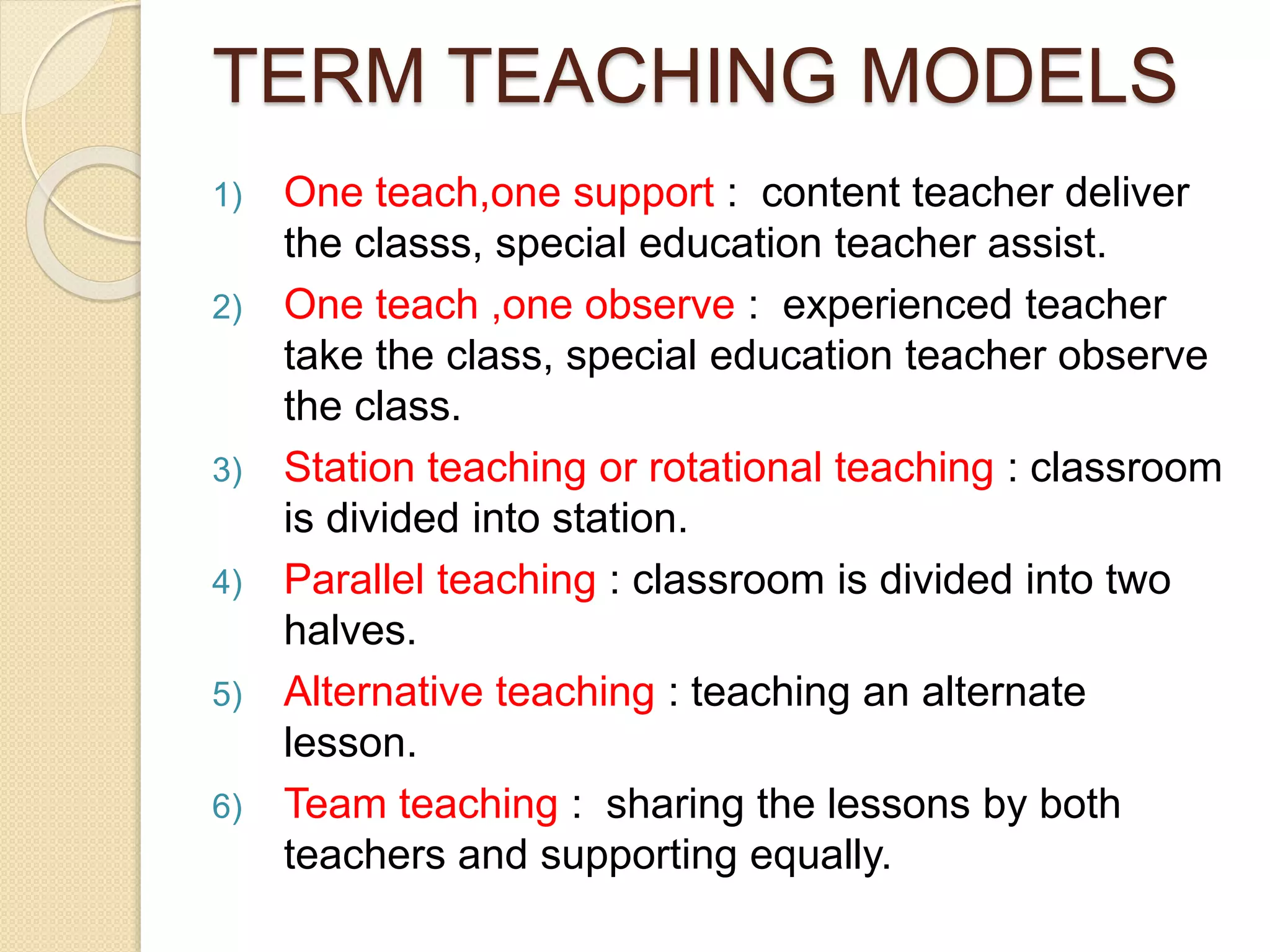
TERM TEACHING MODELS
1) One teach,one support : content teacher deliver
the classs, special education teacher assist.
2) One teach ,one observe : experienced teacher
take the class, special education teacher observe
the class.
3) Station teaching or rotational teaching : classroom
is divided into station.
4) Parallel teaching : classroom is divided into two
halves.
5) Alternative teaching : teaching an alternate
lesson.
6) Team teaching : sharing the lessons by both
teachers and supporting equally.
 Social cohesion
 Social skills and adjustment
 Attittudinal changes
 Emotional intelligence
 Democratic approach
 Better achievement
 Value inculcation
 Empowerment
 Economic aspects
MULTIPLE CHOICE QUESTIONS
1) In which type of inclusion the disabled children gets regular
classroom learning
a) Full inclusion
b) Partial inclusion
c) Regular inclusion
d) Common inclusion
2) In partial inclusion the disabled student may be
a) Pushed in
b) Pulled in
c) Pulled out
d) Pushed out
3) In which teaching model the classroom is divided into stations
a) Parallel teaching
b) Alternative teaching
c) Rotational teaching
d) Team teaching
4) Including all the students who are away from education for any reasons is called
a) Integrative education
b) Separative education
c) Inclusive education
d) None of these
5) Inclusive education can produce ------changes in attitudes within schools
a) Negative
b) Positive
c) Dynamic
d) No changes
6) Which act says about the right to free and compulsory education to children
a) RTE
b) NTE
c) RTI
d) RTO
7) RTE act is enacted on…….
a) 2010
b) 2008
c) 2009
d) 2012
8) In which article ,says about right to education
a) 21 A
b) 48
c) 42 A
d) 28
9) The free and compulsory education for children between ----
and--- in india
a) 5 and 10
b) 10 and 20
c) 6 and 14
d) 5 and 15
10) Inclusive education enhances -----approach
a) Democratic
b) Socialistic
c) Imperialistic
d) colonialistic

inclusive education

  • 6.
    PRINCIPLES OF INCLUSION ANDNECESSARY RESOURCES Adequate support and services. Well designed individualized educational programes Professional development for all teachers. Sufficient time for plan,meet,create and evaluate the students together. Reduced class size Professional skill development in cooperative learning, peer tutoring, adaptive curriculum. Collaboration between parents or guardians,teachers or para educators,specialists Sufficient funding
  • 7.
    • Games • Problemsolving • Sharing songs and books • Discussion • Assign classroom jobs. • Physical therapy equipment • Peer tutoring • Focusing the strength. • Classroom checklist • Take breaks. • Create area for children to calm down • Organize students desk • Set ground rules • Short term goals • Multifaced curriculum • Communication with parents • Seek supportfrom regular teachers
  • 8.
    TERM TEACHING MODELS 1)One teach,one support : content teacher deliver the classs, special education teacher assist. 2) One teach ,one observe : experienced teacher take the class, special education teacher observe the class. 3) Station teaching or rotational teaching : classroom is divided into station. 4) Parallel teaching : classroom is divided into two halves. 5) Alternative teaching : teaching an alternate lesson. 6) Team teaching : sharing the lessons by both teachers and supporting equally.
  • 10.
     Social cohesion Social skills and adjustment  Attittudinal changes  Emotional intelligence  Democratic approach  Better achievement  Value inculcation  Empowerment  Economic aspects
  • 11.
    MULTIPLE CHOICE QUESTIONS 1)In which type of inclusion the disabled children gets regular classroom learning a) Full inclusion b) Partial inclusion c) Regular inclusion d) Common inclusion 2) In partial inclusion the disabled student may be a) Pushed in b) Pulled in c) Pulled out d) Pushed out 3) In which teaching model the classroom is divided into stations a) Parallel teaching b) Alternative teaching c) Rotational teaching d) Team teaching
  • 12.
    4) Including allthe students who are away from education for any reasons is called a) Integrative education b) Separative education c) Inclusive education d) None of these 5) Inclusive education can produce ------changes in attitudes within schools a) Negative b) Positive c) Dynamic d) No changes 6) Which act says about the right to free and compulsory education to children a) RTE b) NTE c) RTI d) RTO
  • 13.
    7) RTE actis enacted on……. a) 2010 b) 2008 c) 2009 d) 2012 8) In which article ,says about right to education a) 21 A b) 48 c) 42 A d) 28 9) The free and compulsory education for children between ---- and--- in india a) 5 and 10 b) 10 and 20 c) 6 and 14 d) 5 and 15
  • 14.
    10) Inclusive educationenhances -----approach a) Democratic b) Socialistic c) Imperialistic d) colonialistic