The Purpose and Promise
of
What is Special Education?
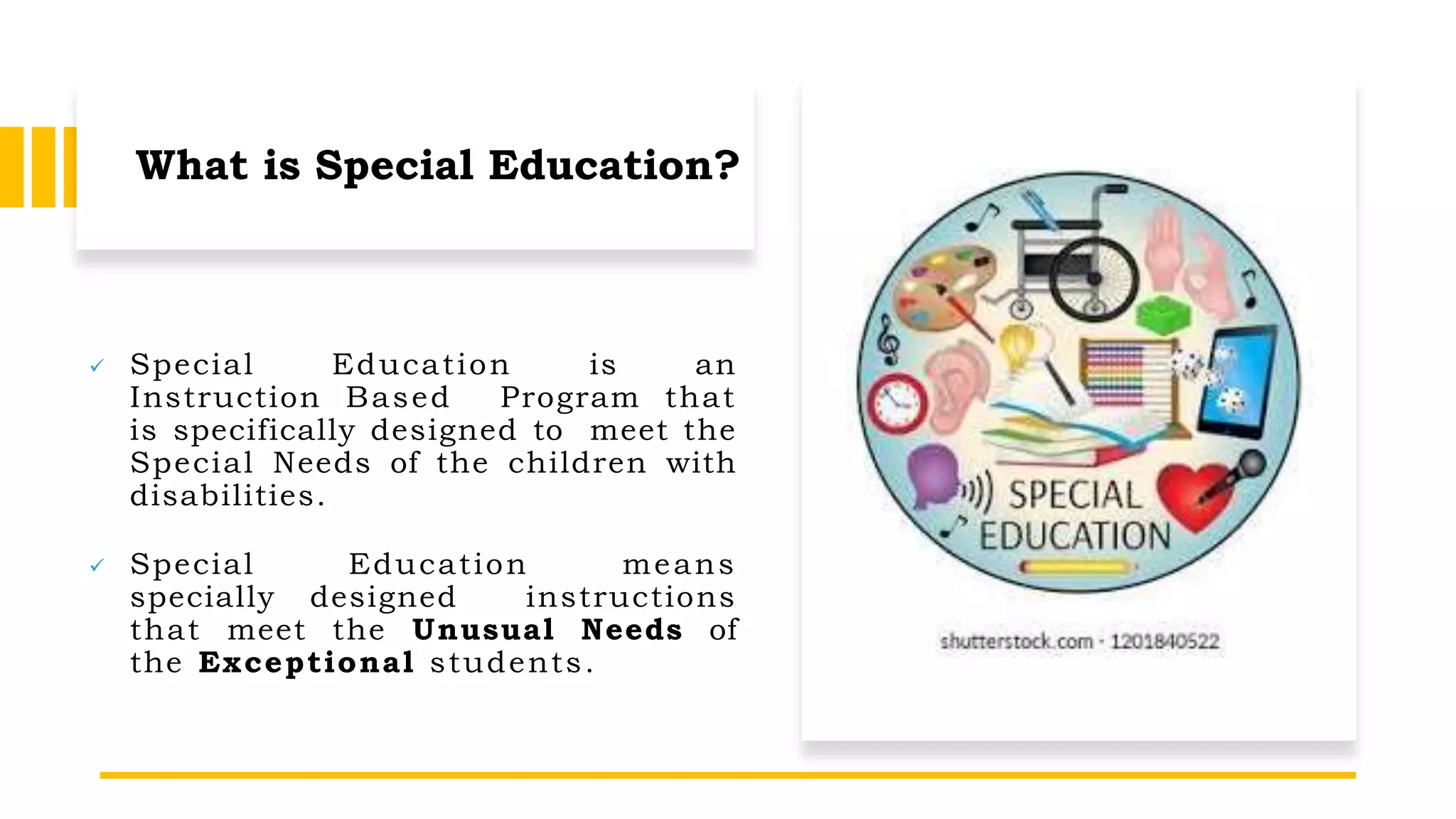
 Special Education is an
Instruction Based Program that
is specifically designed to meet the
Special Needs of the children with
disabilities.
 Special Education means
specially designed instructions
that meet the Unusual Needs of
the Exceptional students.
What is Special Education?
 Special Education or Special Needs
Education is a form of education
planned for the students with Special
Needs in a way that addresses the
students:
1. Individual Differences
2. Needs
 Special education is a form of learning
provided to the students with
Exceptional Needs, such as students
with Learning Disabilities or Mental
Abnormalities.
What is Special Education?
• The Individuals with Disabilities Act (IDEA) defines
Special Education as “specially designed instruction, at
no cost to the parents, to meet the unique needs of a
child with a disability,” but still, what exactly is
Special Education? Often met with an ambiguous
definition, the umbrella term of Special Education
broadly identifies the academic, physical, cognitive
and social-emotional instruction offered to children
who are faced with one or more disabilities.
Possible Forms of Special Education
◦ Specialized Teaching
Techniques
◦ Special Materials
◦ Special Facilities
In practical terms, specially designed instruction (SDI)
is instruction that is tailored to a particular student. It
addresses their Individualized Education Program (IEP) goals;
accounts for their disability; provides modifications or
adaptations to content; and encourages access to the general
education curriculum.
Effective teaching strategies include:
 Use a multiple-scenario approach to developing lesson plans.
 Monitor and verify student responses to lessons.
 Evaluate and adapt lessons, as necessary.
 Use peers to review lesson plans and to develop ideas that
might be applicable.
 Develop and maintain a pool of mentors.
Accessible instructional materials are
specialized or alternative formats of
textbooks and other instructional
materials. Examples are Braille,
audio, large print, and digital text.
Some students with disabilities need
accessible instructional materials to
access the same curriculum as other
students.
There are a growing number of disabled
people who are interested in recreation
and sport activities. Engineering has
several devices to offer for activities in
many places in the world. There are many
examples of simple and sophisticated
equipment, including computerized
devices like wheelchairs for recreation and
sport activities. There are sport
competitions involving four groups of
disabled sportspersons, namely:
1. the deaf,
2. people with physical disability,
3. people with intellectual (mental)
disability,
4. people supported by specially designed
high level engineering equipment.
All of them can use many kinds of
equipment and facilities.
Special
education as
intervention
Preventive: Designed to keep
minor problems from becoming a
disability
Remedial: Attempt to eliminate
the effects of a disability
Compensatory: Enable successful
functioning despite the disability
Special
education as
instruction
Individually planned
Specialized
Intensive
Goal-directed
Special education as instruction
Individually planned
It is an individually planned, systematically implemented and carefully
evaluated instruction to help exceptional children achieve greatest possible
personal self-sufficiency and success in the present and future
environment.
Specialized
It is specially designed instruction is the core job responsibility of
special education teachers. IDEA regulations define “specially designed
instruction” as “adapting, as appropriate to the needs of an eligible child
under this part, the content, methodology or delivery of instruction:
1. to address the unique needs of the child that result from the child’s
disability; and
2. Ensure access of the child to the general curriculum, so that the
child can meet the educational standards within the jurisdiction of
the public agency that apply to all children.”
Special education as instruction
Intensive
Intensive instruction (also referred to as tertiary or Tier
3 instruction) is provided in a smaller-group setting of one
to three students or more frequently than in
targeted instruction to meet the individual needs of
students; it is provided to students in addition to
primary instruction.
Goal-directed
Goal directed instruction is, simply put, training on a specific
task to be achieved, which is related to various functions in
everyday life. For example, it involves learning activities such as
using a knife and fork, doing up buttons, tying shoelaces and
everything else we do on a daily basis. In order to succeed, it is
important that the individual practices goals on a daily, or at
least regular, basis. Goal directed training is also referred to as
task-oriented therapy, goal focused task practice, or functional
therapy.
Goals and Philosophy of Special Education
 A belief that all learners have equal value and deserve to be treated with dignity and
respect, and be held to high standards
 Disability is a normally occurring phenomenon in the human condition requiring a
challenge to the notion of disability as “other”.
 Professionals must work together in collaboration in order to provide optimal services to
children with learning differences
 Teaching is both a science and an art. Therefore, teachers must be well-prepared with a
wide and rich knowledge base of evidence-based practices and be able to see each
student as an individual, developing positive relationships with students and their
families
 Social and cultural factors continue to prevent some children from receiving the best
possible education and lead to over-representation of minorities and children living in
poverty in special education. Educators must be aware of these factors and develop
tools to work against these forces while cultivating pathways for success for all learners
 Because of inequities in our field, we must take leadership in envisioning and shaping
new means of meeting the needs of all students in public schools in a just and
equitable fashion
Purpose of Special Education
 Special Education aims at to
ensure that students with
disabilities are provided with the
environment that allows them to
be educated effectively.
 Disabilities that qualify for
Special Education include all
type of Physical, Mental and
Behavioral Disabilities.
Objectives of Special Education
To provide appropriate
educational program, related
services to each child with a
disability requiring special
education, from age Three
through Twenty-one years.
To provide activities that foster
social development and,
adjustment into the
regular school and community
activities
To Identify disability among
the preschool children
To provide opportunity to
participate in an approved
preschool program within a
reasonable distance from the
child's home, or
Objectives of Special Education
To provide a coordinated
and comprehensive
instructional program
from kindergarten
through high school.
To provide appropriate
related services to the
students with disabilities
according to their needs.
To encourage parental
involvement and
understanding of Special
Education programs.
To provide appropriate
Vocational Services to
the students with
disabilities.
To provide Healthy and
Friendly Environment in
and outside the school
for each student with
disability.
Special
Education
Services
Special Education services are designed to help the
child learn skills that other children learn during
general educational settings.
These are services that includes, Therapy,
Counseling, Adaptive equipment, Transportation,
Accommodations and/ or Modifications
Special Education services are provided
in public/private schools and include special
instruction in the classroom, at home,
hospital, in the institutions, or in other settings.
Who Are
Exceptional
Children?
Exceptional children differ from the norm
(either below or above) to such an extent that
they require an individualized program of
special education
Four key terms
1. Impairment - The loss or reduced function
of a body part or organ
2. Disability - Exists when an impairment
limits the ability to perform certain tasks
3. Handicap - A problem encountered when
interacting with the environment
• Not all children with a disability are
handicapped
4. At risk - Children who have a greater-than-
usual chance of developing a disability
How Many Exceptional Children Are There?
 It is impossible to state the precise number
 Different criteria used for identification
 Preventive services
 Imprecise nature of assessment
 The child may be eligible at one point in time and not eligible at another
 Children in special education represent about 9% of the school age population
 Approximately 75% of students with disabilities receive at least part of their
education in regular classrooms
 Children with disabilities in special education represent 13% of the school age
population.
 Twice as many males as females receive special education.
Why Do We Label and Classify Exceptional Children?
Possible benefits of labeling
 Recognizing differences in learning and behavior is the first step to
responding responsibly to those differences
 May lead to more acceptance of a typical behavior by peers
 Helps professionals communicate and disseminate research findings
 Funding and resources are often based on categories
 Helps advocacy groups promote more awareness
 Makes special needs more visible
Possible disadvantages of labeling
 Focuses on what students cannot do
 May stigmatize the child and lead to peer rejection
 May negatively affect self-esteem
 May cause others to have low expectations for the student
 Disproportionate number of culturally diverse groups are labeled
 May take the role of fictional explanatory constructs
 Takes away from the child’s individuality
 Suggest that there is something wrong with the child
 Labels have permanence
 Basis for keeping children out of the regular classroom
 Requires great expenditure that might be better spent on planning and delivering instruction
Guiding
Principles
Policies
and Legal
Basis of
Special
Education
Why Are
There Laws
Governing
the
Education
of
Exceptional
Children
Necessary?
An Exclusionary Past
 Children who are different have
often been denied full and fair
access to educational
opportunities
Separate Is Not Equal
 Special education was
strongly influenced by social
developments and court
decisions in the 1950s and
1960s (e.g., Brown v. Board
of Education)
Equal Protection
 All children are entitled to a
free, appropriate public
education
United Nations Convention on the Rights of Persons with Disabilities (UNCRPD),2006
full and effective participation in society on an equal basis
with others
 sets out the legal obligation on States Parties to promote,
protect and ensure the full and equal enjoyment of all
human rights and fundamental freedom by all persons with
disabilities, and to protect for their inherent dignity
 recognizes various international covenants on the rights of
persons with disabilities as well as the importance of the
principles and policy guidelines contained in the World
Programme of Action Concerning PWDs (1982) and in the
Standard Rules on the Equalization of Persons with Disabilities
(1994) in influencing the promotion, formulation and evaluation
of the policies, plans, programs and actions at the national,
regional and international levels
 defines persons with disabilities as those who have long-
term physical, mental, intellectual or sensory impairments
in which interaction with various barriers may hinder their
UN Sec-Gen Ban Ki-moon
appoints Stevie Wonder,an
internationally celebrated
musician, as the new UN
Messenger of Peace at UN
Headquarters.
The Individuals with Disabilities Education Act
Six Major Principles of IDEA
 Zero Reject:
Schools must educate all children with disabilities
 Nondiscriminatory Identification and Evaluation:
Schools must used nonbiased, multifactored methods of
evaluation
 Free, Appropriate Public Education:
An IEP must be developed for each child
 Least Restrictive Environment:
Must be educated with children without disabilities to the
maximum extent appropriate
 Due Process Safeguards:
Parents’ and children’s rights protected
 Shared Decision Making:
Schools must collaborate with parents
Related Legislation
Gifted and Talented Children
 The Gifted and Talented Children’s Education
Act of 1978 provides financial incentives for
states to develop programs for students
Section 504 of the Rehabilitation Act of 1973
 Extends civil rights to people with disabilities
Americans with Disabilities Act
 Extends civil rights protection to private sector
employment, all public services, public
accommodation, and transportation
General Principles in
Special Education
 Each child
has a Right
to Education.
 Equal opportunity
assurance of quality
education to all
regardless of their
assessed needs will be
fully met. Placing a
handicapped students in
a normal setting is only
the first step to
integration
 Educational resources for
handicapped students
should be comparable to
those available for non-
handicapped students and
appropriate to meet the
special needs of those
children, since these
needs have often been
long neglected or
received unduly low
priority.
Special Education services should be:
 Individualized, that
is based on the
assessed and agreed
needs of the child.
 Locally accessible, that
is within reasonable
traveling distance of
the pupil’s house or
residence.
 Comprehensive, that is serving
all persons with special needs
irrespective of degree of
handicap, such that no child
of school age is excluded from
educational provision on the
grounds of severity or
handicap or receive
educational services
significantly inferior to those
enjoyed by other students.
 Educational services should
be made available to
children below school age
and be educationally and
developmentally oriented.
home visiting services should
be available starting from
the first weeks of life.
 Educational opportunities
should also be provided to
adolescents and adults, at
least on the same scale as to
all others in the community.
Abigail had little formal
schooling but a quick wit and
was a colorful writer.
 Comprehensive programming
for disabled persons will
require a full range of
services: health, social
welfare, rehabilitation,
employment and placement.
 Failure to educate and train
handicapped persons in
proportion equal to the
provision of services for the
non-handicapped, because
of the problem being
perceived as a lower priority,
results in later expensive
programs to care for the
untreated disabled. Further
handicapping conditions
results because of the
under-development and
dependency.
Conclusion:
REFERENCES:
 https://www.google.com/search?q=classification+and+labelling+in+special+education
 https://www.slideshare.net/huntleyc/introduction-to-special-education?from_action=save
 https://www.slideshare.net/UsmanKhan225/1-special-education-56874585
 https://www.theravive.com/therapedia/exceptional-children
 https://miamioh.edu/ehs/academics/departments/edp/academics/major-special-ed/handbook/goals-philosophy-
perspectives/index.html
 https://www.google.com/search?q=what+is+intensive+instruction+for+special+education+students&bih=
 https://www.understood.org/articles/en/understanding-special-education
 https://www.uft.org/teaching/students-disabilities/specially-designed-instruction
 https://blog.madeformovement.com/the-benefits-of-goal-directed-training-for-individuals-with-disabilities
 https://www.google.com/search?rlz=1C1VDKB_enPH955PH955&q=History+of+Special+Education+in+the+Philippi
nes+timeline&sa=X&ved=2ahUKEwjc8ZC6193yAhXRZN4KHWtLArQQ1QIwFHoECBYQAQ&biw=1280&bih=609
 https://medcraveonline.com/MOJABB/equipment-and-facilities-adapted-for-disabled-people-in-recreation-and-
sport.html
 https://www.google.com/search?q=SPECIALIZED+TEACHING+MATERIALS+FOR+SPED&rlz=1C1VDKB
 https://www.google.com/search?q=SPECIALIZED+TEACHING+TECHNIQUES+FOR+SPED&rlz

Topic 1. The Purpose and Promise of Special Education and its Guiding Principles Policies and Legal Bases.pptx

  • 1.
    The Purpose andPromise of
  • 2.
    What is SpecialEducation?  Special Education is an Instruction Based Program that is specifically designed to meet the Special Needs of the children with disabilities.  Special Education means specially designed instructions that meet the Unusual Needs of the Exceptional students.
  • 3.
    What is SpecialEducation?  Special Education or Special Needs Education is a form of education planned for the students with Special Needs in a way that addresses the students: 1. Individual Differences 2. Needs  Special education is a form of learning provided to the students with Exceptional Needs, such as students with Learning Disabilities or Mental Abnormalities.
  • 4.
    What is SpecialEducation? • The Individuals with Disabilities Act (IDEA) defines Special Education as “specially designed instruction, at no cost to the parents, to meet the unique needs of a child with a disability,” but still, what exactly is Special Education? Often met with an ambiguous definition, the umbrella term of Special Education broadly identifies the academic, physical, cognitive and social-emotional instruction offered to children who are faced with one or more disabilities.
  • 5.
    Possible Forms ofSpecial Education ◦ Specialized Teaching Techniques ◦ Special Materials ◦ Special Facilities
  • 6.
    In practical terms,specially designed instruction (SDI) is instruction that is tailored to a particular student. It addresses their Individualized Education Program (IEP) goals; accounts for their disability; provides modifications or adaptations to content; and encourages access to the general education curriculum.
  • 7.
    Effective teaching strategiesinclude:  Use a multiple-scenario approach to developing lesson plans.  Monitor and verify student responses to lessons.  Evaluate and adapt lessons, as necessary.  Use peers to review lesson plans and to develop ideas that might be applicable.  Develop and maintain a pool of mentors.
  • 8.
    Accessible instructional materialsare specialized or alternative formats of textbooks and other instructional materials. Examples are Braille, audio, large print, and digital text. Some students with disabilities need accessible instructional materials to access the same curriculum as other students.
  • 9.
    There are agrowing number of disabled people who are interested in recreation and sport activities. Engineering has several devices to offer for activities in many places in the world. There are many examples of simple and sophisticated equipment, including computerized devices like wheelchairs for recreation and sport activities. There are sport competitions involving four groups of disabled sportspersons, namely: 1. the deaf, 2. people with physical disability, 3. people with intellectual (mental) disability, 4. people supported by specially designed high level engineering equipment. All of them can use many kinds of equipment and facilities.
  • 10.
    Special education as intervention Preventive: Designedto keep minor problems from becoming a disability Remedial: Attempt to eliminate the effects of a disability Compensatory: Enable successful functioning despite the disability
  • 11.
  • 12.
    Special education asinstruction Individually planned It is an individually planned, systematically implemented and carefully evaluated instruction to help exceptional children achieve greatest possible personal self-sufficiency and success in the present and future environment. Specialized It is specially designed instruction is the core job responsibility of special education teachers. IDEA regulations define “specially designed instruction” as “adapting, as appropriate to the needs of an eligible child under this part, the content, methodology or delivery of instruction: 1. to address the unique needs of the child that result from the child’s disability; and 2. Ensure access of the child to the general curriculum, so that the child can meet the educational standards within the jurisdiction of the public agency that apply to all children.”
  • 13.
    Special education asinstruction Intensive Intensive instruction (also referred to as tertiary or Tier 3 instruction) is provided in a smaller-group setting of one to three students or more frequently than in targeted instruction to meet the individual needs of students; it is provided to students in addition to primary instruction. Goal-directed Goal directed instruction is, simply put, training on a specific task to be achieved, which is related to various functions in everyday life. For example, it involves learning activities such as using a knife and fork, doing up buttons, tying shoelaces and everything else we do on a daily basis. In order to succeed, it is important that the individual practices goals on a daily, or at least regular, basis. Goal directed training is also referred to as task-oriented therapy, goal focused task practice, or functional therapy.
  • 14.
    Goals and Philosophyof Special Education  A belief that all learners have equal value and deserve to be treated with dignity and respect, and be held to high standards  Disability is a normally occurring phenomenon in the human condition requiring a challenge to the notion of disability as “other”.  Professionals must work together in collaboration in order to provide optimal services to children with learning differences  Teaching is both a science and an art. Therefore, teachers must be well-prepared with a wide and rich knowledge base of evidence-based practices and be able to see each student as an individual, developing positive relationships with students and their families  Social and cultural factors continue to prevent some children from receiving the best possible education and lead to over-representation of minorities and children living in poverty in special education. Educators must be aware of these factors and develop tools to work against these forces while cultivating pathways for success for all learners  Because of inequities in our field, we must take leadership in envisioning and shaping new means of meeting the needs of all students in public schools in a just and equitable fashion
  • 15.
    Purpose of SpecialEducation  Special Education aims at to ensure that students with disabilities are provided with the environment that allows them to be educated effectively.  Disabilities that qualify for Special Education include all type of Physical, Mental and Behavioral Disabilities.
  • 16.
    Objectives of SpecialEducation To provide appropriate educational program, related services to each child with a disability requiring special education, from age Three through Twenty-one years. To provide activities that foster social development and, adjustment into the regular school and community activities To Identify disability among the preschool children To provide opportunity to participate in an approved preschool program within a reasonable distance from the child's home, or
  • 17.
    Objectives of SpecialEducation To provide a coordinated and comprehensive instructional program from kindergarten through high school. To provide appropriate related services to the students with disabilities according to their needs. To encourage parental involvement and understanding of Special Education programs. To provide appropriate Vocational Services to the students with disabilities. To provide Healthy and Friendly Environment in and outside the school for each student with disability.
  • 18.
    Special Education Services Special Education servicesare designed to help the child learn skills that other children learn during general educational settings. These are services that includes, Therapy, Counseling, Adaptive equipment, Transportation, Accommodations and/ or Modifications Special Education services are provided in public/private schools and include special instruction in the classroom, at home, hospital, in the institutions, or in other settings.
  • 19.
    Who Are Exceptional Children? Exceptional childrendiffer from the norm (either below or above) to such an extent that they require an individualized program of special education Four key terms 1. Impairment - The loss or reduced function of a body part or organ 2. Disability - Exists when an impairment limits the ability to perform certain tasks 3. Handicap - A problem encountered when interacting with the environment • Not all children with a disability are handicapped 4. At risk - Children who have a greater-than- usual chance of developing a disability
  • 20.
    How Many ExceptionalChildren Are There?  It is impossible to state the precise number  Different criteria used for identification  Preventive services  Imprecise nature of assessment  The child may be eligible at one point in time and not eligible at another  Children in special education represent about 9% of the school age population  Approximately 75% of students with disabilities receive at least part of their education in regular classrooms  Children with disabilities in special education represent 13% of the school age population.  Twice as many males as females receive special education.
  • 21.
    Why Do WeLabel and Classify Exceptional Children?
  • 22.
    Possible benefits oflabeling  Recognizing differences in learning and behavior is the first step to responding responsibly to those differences  May lead to more acceptance of a typical behavior by peers  Helps professionals communicate and disseminate research findings  Funding and resources are often based on categories  Helps advocacy groups promote more awareness  Makes special needs more visible
  • 23.
    Possible disadvantages oflabeling  Focuses on what students cannot do  May stigmatize the child and lead to peer rejection  May negatively affect self-esteem  May cause others to have low expectations for the student  Disproportionate number of culturally diverse groups are labeled  May take the role of fictional explanatory constructs  Takes away from the child’s individuality  Suggest that there is something wrong with the child  Labels have permanence  Basis for keeping children out of the regular classroom  Requires great expenditure that might be better spent on planning and delivering instruction
  • 24.
  • 25.
    Why Are There Laws Governing the Education of Exceptional Children Necessary? AnExclusionary Past  Children who are different have often been denied full and fair access to educational opportunities Separate Is Not Equal  Special education was strongly influenced by social developments and court decisions in the 1950s and 1960s (e.g., Brown v. Board of Education) Equal Protection  All children are entitled to a free, appropriate public education
  • 26.
    United Nations Conventionon the Rights of Persons with Disabilities (UNCRPD),2006 full and effective participation in society on an equal basis with others  sets out the legal obligation on States Parties to promote, protect and ensure the full and equal enjoyment of all human rights and fundamental freedom by all persons with disabilities, and to protect for their inherent dignity  recognizes various international covenants on the rights of persons with disabilities as well as the importance of the principles and policy guidelines contained in the World Programme of Action Concerning PWDs (1982) and in the Standard Rules on the Equalization of Persons with Disabilities (1994) in influencing the promotion, formulation and evaluation of the policies, plans, programs and actions at the national, regional and international levels  defines persons with disabilities as those who have long- term physical, mental, intellectual or sensory impairments in which interaction with various barriers may hinder their UN Sec-Gen Ban Ki-moon appoints Stevie Wonder,an internationally celebrated musician, as the new UN Messenger of Peace at UN Headquarters.
  • 27.
    The Individuals withDisabilities Education Act Six Major Principles of IDEA  Zero Reject: Schools must educate all children with disabilities  Nondiscriminatory Identification and Evaluation: Schools must used nonbiased, multifactored methods of evaluation  Free, Appropriate Public Education: An IEP must be developed for each child  Least Restrictive Environment: Must be educated with children without disabilities to the maximum extent appropriate  Due Process Safeguards: Parents’ and children’s rights protected  Shared Decision Making: Schools must collaborate with parents
  • 28.
    Related Legislation Gifted andTalented Children  The Gifted and Talented Children’s Education Act of 1978 provides financial incentives for states to develop programs for students Section 504 of the Rehabilitation Act of 1973  Extends civil rights to people with disabilities Americans with Disabilities Act  Extends civil rights protection to private sector employment, all public services, public accommodation, and transportation
  • 29.
    General Principles in SpecialEducation  Each child has a Right to Education.
  • 30.
     Equal opportunity assuranceof quality education to all regardless of their assessed needs will be fully met. Placing a handicapped students in a normal setting is only the first step to integration  Educational resources for handicapped students should be comparable to those available for non- handicapped students and appropriate to meet the special needs of those children, since these needs have often been long neglected or received unduly low priority.
  • 31.
    Special Education servicesshould be:  Individualized, that is based on the assessed and agreed needs of the child.  Locally accessible, that is within reasonable traveling distance of the pupil’s house or residence.
  • 32.
     Comprehensive, thatis serving all persons with special needs irrespective of degree of handicap, such that no child of school age is excluded from educational provision on the grounds of severity or handicap or receive educational services significantly inferior to those enjoyed by other students.  Educational services should be made available to children below school age and be educationally and developmentally oriented. home visiting services should be available starting from the first weeks of life.  Educational opportunities should also be provided to adolescents and adults, at least on the same scale as to all others in the community. Abigail had little formal schooling but a quick wit and was a colorful writer.
  • 33.
     Comprehensive programming fordisabled persons will require a full range of services: health, social welfare, rehabilitation, employment and placement.  Failure to educate and train handicapped persons in proportion equal to the provision of services for the non-handicapped, because of the problem being perceived as a lower priority, results in later expensive programs to care for the untreated disabled. Further handicapping conditions results because of the under-development and dependency.
  • 34.
  • 36.
    REFERENCES:  https://www.google.com/search?q=classification+and+labelling+in+special+education  https://www.slideshare.net/huntleyc/introduction-to-special-education?from_action=save https://www.slideshare.net/UsmanKhan225/1-special-education-56874585  https://www.theravive.com/therapedia/exceptional-children  https://miamioh.edu/ehs/academics/departments/edp/academics/major-special-ed/handbook/goals-philosophy- perspectives/index.html  https://www.google.com/search?q=what+is+intensive+instruction+for+special+education+students&bih=  https://www.understood.org/articles/en/understanding-special-education  https://www.uft.org/teaching/students-disabilities/specially-designed-instruction  https://blog.madeformovement.com/the-benefits-of-goal-directed-training-for-individuals-with-disabilities  https://www.google.com/search?rlz=1C1VDKB_enPH955PH955&q=History+of+Special+Education+in+the+Philippi nes+timeline&sa=X&ved=2ahUKEwjc8ZC6193yAhXRZN4KHWtLArQQ1QIwFHoECBYQAQ&biw=1280&bih=609  https://medcraveonline.com/MOJABB/equipment-and-facilities-adapted-for-disabled-people-in-recreation-and- sport.html  https://www.google.com/search?q=SPECIALIZED+TEACHING+MATERIALS+FOR+SPED&rlz=1C1VDKB  https://www.google.com/search?q=SPECIALIZED+TEACHING+TECHNIQUES+FOR+SPED&rlz