AEROSOL PRODUCT
STABILITY STUDIES
PREPARED BY:
MOHD TANZEEM M.
PHARM 2ND SEM
CONTENT
• INTRODUCTION
• COMPONETS OF AEROSOLS
• QUALITY CONTROL FOR AEROSOLS
• TESTING OF AEROSOLS
• Biological Testing
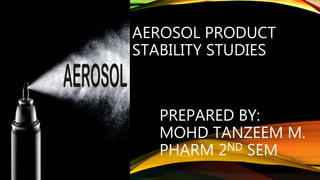
DEFINITION
•Aerosol is a pressurized dosage forms containing
one or more therapeutic active ingredients which
upon actuation emit a fine dispersion of liquid
and/or solid materials in a gaseous medium.
ADVANTAGES
• Easily withdrawn of drug
• Easy and convenient to apply.
• Faster Onset of action.
• No manual/ direct contact with the medicament.
• Avoid the first pass metabolism.
• A specific amount of dose or drug can be removed.
• No microorganism can enter.
• Release the contents in Controlled and Uniformly.
• Protect the photosensitive medicaments and oxygen sensitive material.
• Provides efficacy of a drug.
• Irritation can be reduced.
DISADVANTAGES
• Costly.
• Difficult disposal of empty aerosol containers.
• Allergic in some cases.
• Explosive.
• Some formulation is difficult.
• Sometimes propellants may cause toxic reactions
COMPONENTS OF AEROSOL
•Propellant
•Container
•Valve and actuator
•Product concentrate
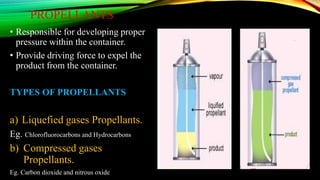
PROPELLANTS
• Responsible for developing proper
pressure within the container.
• Provide driving force to expel the
product from the container.
TYPES OF PROPELLANTS
a) Liquefied gases Propellants.
Eg. Chlorofluorocarbons and Hydrocarbons
b) Compressed gases
Propellants.
Eg. Carbon dioxide and nitrous oxide
CONTAINERS
A. Metals
1. TIN PLATED STEEL CONTAINERS
• It consist of a sheet of steel plate, this sheet is coated with tin by
electrolytic process .
• The coated sheet is cut into three pieces ( top , bottom and body) .
• Recent developments in welding include Soudronic system and
Conoweld system
2. ALUMINIUM CONTAINERS.
• Used for inhalation and topical aerosols .
• Manufactured by impact extrusion process.
• Light in weight, less fragile, Less incompatibility due to its seamless
nature
3. STAINLESS STEEL CONTAINERS
• Used for inhalation aerosols
Advantage :
• Extremely Strong.
• Resistant to many materials.
• No need for internal coating
Disadvantage :
• Costly
B. GLASS CONTAINERS
Two types of glass aerosol containers
i) Uncoated glass container: Less cost and high clarity and
contents can be viewed at all times.
ii) Plastic coated glass containers: These are protected by
plastic coating that prevents the glass from shattering in
the event of breakage
B. GLASS CONTAINERS
Two types of glass aerosol containers
i) Uncoated glass container: Less cost and high clarity and contents can be
viewed at all times.
ii) Plastic coated glass containers: These are protected by plastic coating that
prevents the glass from shattering in the event of breakage
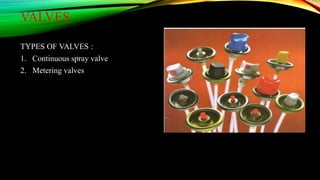
VALVES
TYPES OF VALVES :
1. Continuous spray valve
2. Metering valves
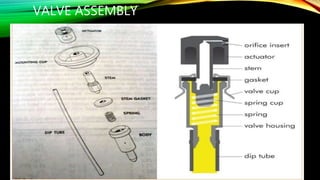
VALVE ASSEMBLY
1. Continuous spray valve
A. FERRULE OR MOUNTING CUP :
• Used to attach valve to container.
• Tin plated steel, Al , Brass .
• Under side of the valve cup is coated with single or double epoxy or vinyl resins.
B. VALVE BODY OR HOUSING :
• Nylon or Derlin (0.013 to 0.080 inch)
C. STEM :
• Nylon or Derlin , brass and stainless steel can also be used. (orifice - 0.013 to
0.030 inch OR 0.033 to 0.076 cm)
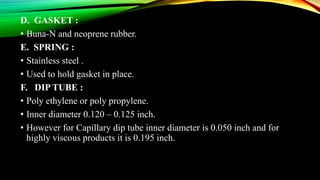
D. GASKET :
• Buna-N and neoprene rubber.
E. SPRING :
• Stainless steel .
• Used to hold gasket in place.
F. DIP TUBE :
• Poly ethylene or poly propylene.
• Inner diameter 0.120 – 0.125 inch.
• However for Capillary dip tube inner diameter is 0.050 inch and for
highly viscous products it is 0.195 inch.
2. METERING VALVES
• Used for dispensing of potent medication.
• Operates on the principle of a chamber whose size determines the
amount of medication dispensed.
• Approximately 50 to 150 mg ±10 % of liquid materials can be
dispensed at one time with the use of such valve
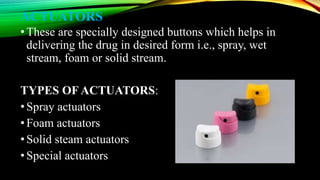
ACTUATORS
•These are specially designed buttons which helps in
delivering the drug in desired form i.e., spray, wet
stream, foam or solid stream.
TYPES OF ACTUATORS:
•Spray actuators
•Foam actuators
•Solid steam actuators
•Special actuators
QUALITY CONTROL TESTS
PROPELLANTS
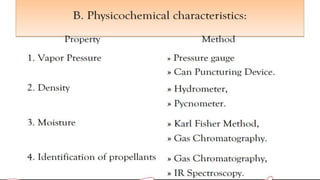
VAPOR PRESSURE AND DENSITY OF THE PROPELLANT ARE DETERMINED AND COMPARED
WITH SPECIFICATION SHEET
Parameter
• Identification
• Purity and acceptability
Tested By
• Gas Chromatography and IR Spectroscopy
• Moisture, Halogen, Non-Volatile Residue
determinations
CONTAINERS
1. Weight checking
• Is done by periodically adding to the filling line tared empty aerosol
containers, which after filling with concentrate are removed & weighed.
2. Leak Testing
• It is done by measuring the crimp’s valve dimension and comparing. Final
testing of valve enclosure is done by passing filled containers through the
water bath.
3. Spray Testing
• It is done to clear up dip tube of pure propellant and concentrate and to
check any defects in the valve and the spray pattern.
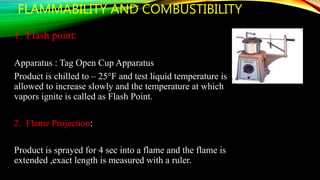
FLAMMABILITY AND COMBUSTIBILITY
1. Flash point:
Apparatus : Tag Open Cup Apparatus
Product is chilled to – 25°F and test liquid temperature is
allowed to increase slowly and the temperature at which
vapors ignite is called as Flash Point.
2. Flame Projection:
Product is sprayed for 4 sec into a flame and the flame is
extended ,exact length is measured with a ruler.
PERFORMANCE TESTS
1. Spray Pattern
The method involves the impingement of sprays on a piece of
paper that has been treated with dye-talc mixture. It gives a
record of the spray pattern.
2. Aerosol Valve Discharge Rate
An aerosol product of known weight is taken and its contents are
discharged using standard apparatus for a given period of time.
The container is reweighed. Then the change in weight per time
dispensed is the discharge rate. The discharge rate can also be
expressed as grams per second.
3. Dosage with metered valves
The doses are dispensed into the solvents or onto a material that
absorbs the active ingredients. The assay of the solution gives the
amount of active ingredients present.
4. Net contents
The tared cans are placed onto the filling line are weighed, the
difference in weight is equal to the net contents. The other method is
a Destructive method and consists of weighing a full container and
then dispensing the contents. The contents are then weighed. The
difference in weight gives the amount of contents present in the
container.
5. Foam stability
The life of a foam ranges from a few seconds (for quick breaking
foam) to one hour or more depending on the formulation. The
methods which are used to determine the foam stability includes
visual evaluation, time for a given mass to penetrate the foam,
time for a given rod that is inserted into the foam to fall and
rotational viscometer.
6. Particle size determination
Methods :
Cascade Impactor
Light Scattering Decay.
Particle size 0.1- 30 micron
BIOLOGICAL TESTING
1. Therapeutic Activity :
For Inhalation Aerosols : dosage of the product is determined
and is related to the particle size distribution.
For Topical Aerosols : is applied to test areas and adsorption of
therapeutic ingredient is determined.
2. Toxicity :
For Inhalation Aerosols : exposing test animals to vapors
sprayed from aerosol container.
For Topical Aerosols : Irritation and Chilling effects are
determined
CONCLUSION
aerosols represent a significant dosage form based
on their acceptability to both patient & physician
Aerosols require more stringent attention &
perhaps more conservative approach

Aerosol product stability studies

  • 1.
    AEROSOL PRODUCT STABILITY STUDIES PREPAREDBY: MOHD TANZEEM M. PHARM 2ND SEM
  • 2.
    CONTENT • INTRODUCTION • COMPONETSOF AEROSOLS • QUALITY CONTROL FOR AEROSOLS • TESTING OF AEROSOLS • Biological Testing
  • 3.
    DEFINITION •Aerosol is apressurized dosage forms containing one or more therapeutic active ingredients which upon actuation emit a fine dispersion of liquid and/or solid materials in a gaseous medium.
  • 4.
    ADVANTAGES • Easily withdrawnof drug • Easy and convenient to apply. • Faster Onset of action. • No manual/ direct contact with the medicament. • Avoid the first pass metabolism. • A specific amount of dose or drug can be removed. • No microorganism can enter. • Release the contents in Controlled and Uniformly. • Protect the photosensitive medicaments and oxygen sensitive material. • Provides efficacy of a drug. • Irritation can be reduced.
  • 5.
    DISADVANTAGES • Costly. • Difficultdisposal of empty aerosol containers. • Allergic in some cases. • Explosive. • Some formulation is difficult. • Sometimes propellants may cause toxic reactions
  • 6.
  • 7.
    PROPELLANTS • Responsible fordeveloping proper pressure within the container. • Provide driving force to expel the product from the container. TYPES OF PROPELLANTS a) Liquefied gases Propellants. Eg. Chlorofluorocarbons and Hydrocarbons b) Compressed gases Propellants. Eg. Carbon dioxide and nitrous oxide
  • 8.
    CONTAINERS A. Metals 1. TINPLATED STEEL CONTAINERS • It consist of a sheet of steel plate, this sheet is coated with tin by electrolytic process . • The coated sheet is cut into three pieces ( top , bottom and body) . • Recent developments in welding include Soudronic system and Conoweld system 2. ALUMINIUM CONTAINERS. • Used for inhalation and topical aerosols . • Manufactured by impact extrusion process. • Light in weight, less fragile, Less incompatibility due to its seamless nature
  • 9.
    3. STAINLESS STEELCONTAINERS • Used for inhalation aerosols Advantage : • Extremely Strong. • Resistant to many materials. • No need for internal coating Disadvantage : • Costly
  • 10.
    B. GLASS CONTAINERS Twotypes of glass aerosol containers i) Uncoated glass container: Less cost and high clarity and contents can be viewed at all times. ii) Plastic coated glass containers: These are protected by plastic coating that prevents the glass from shattering in the event of breakage
  • 11.
    B. GLASS CONTAINERS Twotypes of glass aerosol containers i) Uncoated glass container: Less cost and high clarity and contents can be viewed at all times. ii) Plastic coated glass containers: These are protected by plastic coating that prevents the glass from shattering in the event of breakage
  • 12.
    VALVES TYPES OF VALVES: 1. Continuous spray valve 2. Metering valves
  • 13.
  • 14.
    1. Continuous sprayvalve A. FERRULE OR MOUNTING CUP : • Used to attach valve to container. • Tin plated steel, Al , Brass . • Under side of the valve cup is coated with single or double epoxy or vinyl resins. B. VALVE BODY OR HOUSING : • Nylon or Derlin (0.013 to 0.080 inch) C. STEM : • Nylon or Derlin , brass and stainless steel can also be used. (orifice - 0.013 to 0.030 inch OR 0.033 to 0.076 cm)
  • 15.
    D. GASKET : •Buna-N and neoprene rubber. E. SPRING : • Stainless steel . • Used to hold gasket in place. F. DIP TUBE : • Poly ethylene or poly propylene. • Inner diameter 0.120 – 0.125 inch. • However for Capillary dip tube inner diameter is 0.050 inch and for highly viscous products it is 0.195 inch.
  • 16.
    2. METERING VALVES •Used for dispensing of potent medication. • Operates on the principle of a chamber whose size determines the amount of medication dispensed. • Approximately 50 to 150 mg ±10 % of liquid materials can be dispensed at one time with the use of such valve
  • 17.
    ACTUATORS •These are speciallydesigned buttons which helps in delivering the drug in desired form i.e., spray, wet stream, foam or solid stream. TYPES OF ACTUATORS: •Spray actuators •Foam actuators •Solid steam actuators •Special actuators
  • 18.
    QUALITY CONTROL TESTS PROPELLANTS VAPORPRESSURE AND DENSITY OF THE PROPELLANT ARE DETERMINED AND COMPARED WITH SPECIFICATION SHEET Parameter • Identification • Purity and acceptability Tested By • Gas Chromatography and IR Spectroscopy • Moisture, Halogen, Non-Volatile Residue determinations
  • 19.
    CONTAINERS 1. Weight checking •Is done by periodically adding to the filling line tared empty aerosol containers, which after filling with concentrate are removed & weighed. 2. Leak Testing • It is done by measuring the crimp’s valve dimension and comparing. Final testing of valve enclosure is done by passing filled containers through the water bath. 3. Spray Testing • It is done to clear up dip tube of pure propellant and concentrate and to check any defects in the valve and the spray pattern.
  • 20.
    FLAMMABILITY AND COMBUSTIBILITY 1.Flash point: Apparatus : Tag Open Cup Apparatus Product is chilled to – 25°F and test liquid temperature is allowed to increase slowly and the temperature at which vapors ignite is called as Flash Point. 2. Flame Projection: Product is sprayed for 4 sec into a flame and the flame is extended ,exact length is measured with a ruler.
  • 22.
    PERFORMANCE TESTS 1. SprayPattern The method involves the impingement of sprays on a piece of paper that has been treated with dye-talc mixture. It gives a record of the spray pattern. 2. Aerosol Valve Discharge Rate An aerosol product of known weight is taken and its contents are discharged using standard apparatus for a given period of time. The container is reweighed. Then the change in weight per time dispensed is the discharge rate. The discharge rate can also be expressed as grams per second.
  • 23.
    3. Dosage withmetered valves The doses are dispensed into the solvents or onto a material that absorbs the active ingredients. The assay of the solution gives the amount of active ingredients present. 4. Net contents The tared cans are placed onto the filling line are weighed, the difference in weight is equal to the net contents. The other method is a Destructive method and consists of weighing a full container and then dispensing the contents. The contents are then weighed. The difference in weight gives the amount of contents present in the container.
  • 24.
    5. Foam stability Thelife of a foam ranges from a few seconds (for quick breaking foam) to one hour or more depending on the formulation. The methods which are used to determine the foam stability includes visual evaluation, time for a given mass to penetrate the foam, time for a given rod that is inserted into the foam to fall and rotational viscometer. 6. Particle size determination Methods : Cascade Impactor Light Scattering Decay. Particle size 0.1- 30 micron
  • 25.
    BIOLOGICAL TESTING 1. TherapeuticActivity : For Inhalation Aerosols : dosage of the product is determined and is related to the particle size distribution. For Topical Aerosols : is applied to test areas and adsorption of therapeutic ingredient is determined. 2. Toxicity : For Inhalation Aerosols : exposing test animals to vapors sprayed from aerosol container. For Topical Aerosols : Irritation and Chilling effects are determined
  • 26.
    CONCLUSION aerosols represent asignificant dosage form based on their acceptability to both patient & physician Aerosols require more stringent attention & perhaps more conservative approach