EFFERVESCENT GRANULES
Effervescent Granulated Salts
Effervescent salts are granules or coarse to very coarse powders containing a
medicinal agent in a dry mixture usually· composed of sodium bicarbonate,
citric acid, and tartaric acid. When added to water, the acids and base react to
liberate carbon dioxide, resulting in effervescence.
Advantages of effervescent salts
1- Psychological reasons: Some patients like the effervescence appearance of
the dosage form. This effervescence appearance makes the patient more
ready to administer the dosage form.
2- Mask the undesirable taste of certain medicinal agents, e.g., alkaloids.
3- Fast absorption of the drug.
Types of effervescent Granules
1- Medicated: Contain certain medicinal ingredients.
2- Non Medicated: Do not contain any medicinal ingredients
(relief moderate dyspepsia).
Methods of Preparation
Effervescent salts are prepared by three general methods:
(1) Wet method
(2) Dry or fusion method
(3) Dry granulation
General notices should be considered:-
1- Ratios of acids to base in the effervescent salts should be 19% citric acid, 28%
tartaric ail, and 53% sodium bicarbonate in any effervescent mixture.
2- The amount of acids may be slightly more than that required to neutralize
sodium bicarbonate because effervescent salts are more acceptable to the
patients when they are slightly acidic.
3- The used citric acid should be un-effloresced and powdered just prior to use.
4- Other components should be dried at 100°C until constant weight.
5- All equipments used in preparation should be acid resistant.
6- The dried .formula of effervescent salts should be uniformly mixed, and stored
in well closed and moisture resistant bottles to avoid premature chemical reaction.
7- Effervescent salts should not be used for long time, especially for hypertensive
persons due to its sodium contents.-
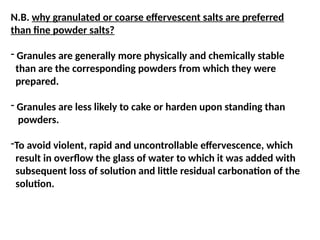
N.B. why granulated or coarse effervescent salts are preferred
than fine powder salts?
- Granules are generally more physically and chemically stable
than are the corresponding powders from which they were
prepared.
- Granules are less likely to cake or harden upon standing than
powders.
-To avoid violent, rapid and uncontrollable effervescence, which
result in overflow the glass of water to which it was added with
subsequent loss of solution and little residual carbonation of the
solution.
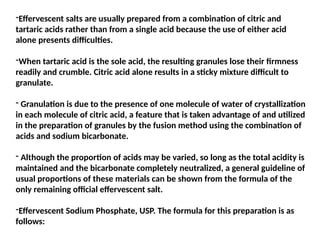
-Effervescent salts are usually prepared from a combination of citric and
tartaric acids rather than from a single acid because the use of either acid
alone presents difficulties.
-When tartaric acid is the sole acid, the resulting granules lose their firmness
readily and crumble. Citric acid alone results in a sticky mixture difficult to
granulate.
- Granulation is due to the presence of one molecule of water of crystallization
in each molecule of citric acid, a feature that is taken advantage of and utilized
in the preparation of granules by the fusion method using the combination of
acids and sodium bicarbonate.
- Although the proportion of acids may be varied, so long as the total acidity is
maintained and the bicarbonate completely neutralized, a general guideline of
usual proportions of these materials can be shown from the formula of the
only remaining official effervescent salt.
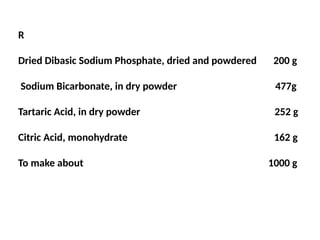
-Effervescent Sodium Phosphate, USP. The formula for this preparation is as
follows:
R
Dried Dibasic Sodium Phosphate, dried and powdered 200 g
Sodium Bicarbonate, in dry powder 477g
Tartaric Acid, in dry powder 252 g
Citric Acid, monohydrate 162 g
To make about 1000 g
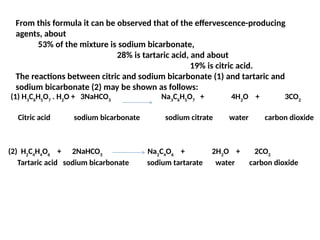
From this formula it can be observed that of the effervescence-producing
agents, about
53% of the mixture is sodium bicarbonate,
28% is tartaric acid, and about
19% is citric acid.
The reactions between citric and sodium bicarbonate (1) and tartaric and
sodium bicarbonate (2) may be shown as follows:
(1) H3
C6
H5
O7
. H2
O + 3NaHCO3
Na3
C6
H5
O7
+ 4H2
O + 3CO2
Citric acid sodium bicarbonate sodium citrate water carbon dioxide
(2) H2
C4
H4
O6
+ 2NaHCO3
Na2
C4
O6
+ 2H2
O + 2CO2
Tartaric acid sodium bicarbonate sodium tartarate water carbon dioxide
Fusion Method
- In the fusion method, the one molecule of water present in each molecule of
citric acid acts as the binding agent for the powder mixture.
- Just before mixing the powders, the citric acid crystals are powdered and then
mixed with the other powders (previously passed through a number 60 sieve) to
ensure uniformity of the mixture. The sieves and the mixing equipment should
be made of stainless steel or other material resistant to the effect of the acids.
- The mixing of the powders is performed rapidly in an environment of low
humidity to avoid the absorption of moisture from the air and a premature
chemical reaction.
- After mixing, the powder is placed on a plate or a suitable dish in an oven
previously heated to between 93° F and 1040
F. The heat causes the release of
the water of crystallization from the citric acid, which in turn dissolves a portion
of the powder mixture, setting of the chemical reaction and the consequent
release of some carbon dioxide.
-This causes the softened mass of powder to become somewhat spongy, and
when of the proper consistency (as bread dough), it is removed from the oven
and rubbed through an acid-resistant sieve to produce granules of the desired
size.
-A No.4 sieve may be used to produce large granules, a No. 8 sieve to produce
medium size granules and a No. 10 sieve to prepare small granules.
-When all of the mass has passed through the sieve, the granules are
immediately dried at a temperature not exceeding 540
and immediately
transferred to containers which are then promptly and tightly sealed.
- The fusion method is used in the preparation of most commercial
effervescent powders and in the preparation of the official Effervescent
Sodium Phosphate, USP.
Wet Method
-The wet method differs from the fusion method in that the source of
binding agent is not necessarily the water of crystallization from the citric
acid but may be water added to the non-­
solvent (such as alcohol), which is
employed as the moistening agent, to form the mass of material for
granulation.
-In this method all of the powders may be anhydrous so long as water is
added to the moistening liquid. Just enough liquid is added (in portions) to
prepare a mass of proper consistency; then the granules are prepared and
dried in the same manner as just above.
Dry Granulation Method
- Typically, the process involves compressing a powder mixture into a tablet
slug on a heavy duty rotary tablet press.
- The slugs are then broken up into granular particles by grinding operation,
usually by passage through an oscillating granulator.

Effervescent granules.pptx pharmaceutica

  • 1.
  • 2.
    Effervescent Granulated Salts Effervescentsalts are granules or coarse to very coarse powders containing a medicinal agent in a dry mixture usually· composed of sodium bicarbonate, citric acid, and tartaric acid. When added to water, the acids and base react to liberate carbon dioxide, resulting in effervescence. Advantages of effervescent salts 1- Psychological reasons: Some patients like the effervescence appearance of the dosage form. This effervescence appearance makes the patient more ready to administer the dosage form. 2- Mask the undesirable taste of certain medicinal agents, e.g., alkaloids. 3- Fast absorption of the drug.
  • 3.
    Types of effervescentGranules 1- Medicated: Contain certain medicinal ingredients. 2- Non Medicated: Do not contain any medicinal ingredients (relief moderate dyspepsia). Methods of Preparation Effervescent salts are prepared by three general methods: (1) Wet method (2) Dry or fusion method (3) Dry granulation
  • 4.
    General notices shouldbe considered:- 1- Ratios of acids to base in the effervescent salts should be 19% citric acid, 28% tartaric ail, and 53% sodium bicarbonate in any effervescent mixture. 2- The amount of acids may be slightly more than that required to neutralize sodium bicarbonate because effervescent salts are more acceptable to the patients when they are slightly acidic. 3- The used citric acid should be un-effloresced and powdered just prior to use. 4- Other components should be dried at 100°C until constant weight. 5- All equipments used in preparation should be acid resistant. 6- The dried .formula of effervescent salts should be uniformly mixed, and stored in well closed and moisture resistant bottles to avoid premature chemical reaction. 7- Effervescent salts should not be used for long time, especially for hypertensive persons due to its sodium contents.-
  • 5.
    N.B. why granulatedor coarse effervescent salts are preferred than fine powder salts? - Granules are generally more physically and chemically stable than are the corresponding powders from which they were prepared. - Granules are less likely to cake or harden upon standing than powders. -To avoid violent, rapid and uncontrollable effervescence, which result in overflow the glass of water to which it was added with subsequent loss of solution and little residual carbonation of the solution.
  • 6.
    -Effervescent salts areusually prepared from a combination of citric and tartaric acids rather than from a single acid because the use of either acid alone presents difficulties. -When tartaric acid is the sole acid, the resulting granules lose their firmness readily and crumble. Citric acid alone results in a sticky mixture difficult to granulate. - Granulation is due to the presence of one molecule of water of crystallization in each molecule of citric acid, a feature that is taken advantage of and utilized in the preparation of granules by the fusion method using the combination of acids and sodium bicarbonate. - Although the proportion of acids may be varied, so long as the total acidity is maintained and the bicarbonate completely neutralized, a general guideline of usual proportions of these materials can be shown from the formula of the only remaining official effervescent salt. -Effervescent Sodium Phosphate, USP. The formula for this preparation is as follows:
  • 7.
    R Dried Dibasic SodiumPhosphate, dried and powdered 200 g Sodium Bicarbonate, in dry powder 477g Tartaric Acid, in dry powder 252 g Citric Acid, monohydrate 162 g To make about 1000 g
  • 8.
    From this formulait can be observed that of the effervescence-producing agents, about 53% of the mixture is sodium bicarbonate, 28% is tartaric acid, and about 19% is citric acid. The reactions between citric and sodium bicarbonate (1) and tartaric and sodium bicarbonate (2) may be shown as follows: (1) H3 C6 H5 O7 . H2 O + 3NaHCO3 Na3 C6 H5 O7 + 4H2 O + 3CO2 Citric acid sodium bicarbonate sodium citrate water carbon dioxide (2) H2 C4 H4 O6 + 2NaHCO3 Na2 C4 O6 + 2H2 O + 2CO2 Tartaric acid sodium bicarbonate sodium tartarate water carbon dioxide
  • 9.
    Fusion Method - Inthe fusion method, the one molecule of water present in each molecule of citric acid acts as the binding agent for the powder mixture. - Just before mixing the powders, the citric acid crystals are powdered and then mixed with the other powders (previously passed through a number 60 sieve) to ensure uniformity of the mixture. The sieves and the mixing equipment should be made of stainless steel or other material resistant to the effect of the acids. - The mixing of the powders is performed rapidly in an environment of low humidity to avoid the absorption of moisture from the air and a premature chemical reaction. - After mixing, the powder is placed on a plate or a suitable dish in an oven previously heated to between 93° F and 1040 F. The heat causes the release of the water of crystallization from the citric acid, which in turn dissolves a portion of the powder mixture, setting of the chemical reaction and the consequent release of some carbon dioxide.
  • 10.
    -This causes thesoftened mass of powder to become somewhat spongy, and when of the proper consistency (as bread dough), it is removed from the oven and rubbed through an acid-resistant sieve to produce granules of the desired size. -A No.4 sieve may be used to produce large granules, a No. 8 sieve to produce medium size granules and a No. 10 sieve to prepare small granules. -When all of the mass has passed through the sieve, the granules are immediately dried at a temperature not exceeding 540 and immediately transferred to containers which are then promptly and tightly sealed. - The fusion method is used in the preparation of most commercial effervescent powders and in the preparation of the official Effervescent Sodium Phosphate, USP.
  • 11.
    Wet Method -The wetmethod differs from the fusion method in that the source of binding agent is not necessarily the water of crystallization from the citric acid but may be water added to the non-­ solvent (such as alcohol), which is employed as the moistening agent, to form the mass of material for granulation. -In this method all of the powders may be anhydrous so long as water is added to the moistening liquid. Just enough liquid is added (in portions) to prepare a mass of proper consistency; then the granules are prepared and dried in the same manner as just above. Dry Granulation Method - Typically, the process involves compressing a powder mixture into a tablet slug on a heavy duty rotary tablet press. - The slugs are then broken up into granular particles by grinding operation, usually by passage through an oscillating granulator.