Presented by
Sk. Md. Zakir Hossain
Sr. Executive, QA, QOD, GNU
IN-PROCESS CONTROL
Here you will find answers to the following questions:
 What are the in-process control tasks?
 Where should the in-process control group be established in organizational and
disciplinary terms?
 How are the responsibilities regulated?
 How are in-process controls carried out?
In-process controls (IPC) are checks that are carried out before the manufacturing
process is completed. The function of in-process controls is monitoring and – if
necessary – adaptation of the manufacturing process in order to comply with the
specifications. This may include control of equipment and environment, too.
In-process materials should be tested for identity, strength, quality and purity
as appropriate and approved or rejected by the Quality Control unit during the
production process. Rejected in-process materials should be identified and controlled
under a quarantine system designed to prevent their use in manufacturing.
Written procedures should be established and followed that describe the In-process
controls and tests as specified:
.Tablet or capsule weight variation,
• Disintegration time,
• Content uniformity and homogeneity,
• Dissolution time and rate,
• Clarity, completeness or pH of solutions.
In-process controls may be performed in regular intervals during a process step
(e.g. tabletting, encapsulation) or at the end of a process step (e.g. granulation,
blending). The objectives of in-process control are both quality control and process
control.
 WHO says, Checks Performed during production in order to monitor and, if necessary, to adjust
the process to ensure that the product conforms to its specifications. The control of the
environment or equiment may also be regarded as a part of in-process control.
During manufacturing and packaging a lot of data are recorded which represent
control factors of the manufacturing process. These data may be process parameters
(e.g. outlet air temperature of a fluid bed dryer) or product attributes (e.g.
hardness of tablet cores). The results of the measurements may indicate that a
corrective action is required to maintain the process and the product within the
specified ranges. The limits within which modifications may be carried out to
match measured values must be determined in advance.
The drying of a granulate is described here as an example. The objective, i.e. the
resultant granulate humidity, is determined within the scope of the manufacturing
instructions. If the specified range has not yet been achieved, the normal course of
action is to extend the drying time. In this case, it is irrelevant whether the control is
automatic, e.g. by means of online measurement within a fluid bed dryer or manual
sampling.
This function is performed by documenting production parameters. In a broader
sense, this includes the following in-process controls:
• measured values obtained from process equipment, e.g. temperatures
• measured values obtained by persons, e.g. times
• product attributes, e.g. weight, hardness, friability
• measured values obtained from the room environment, e.g. particle counts
• tests following completion of intermediate products
The classic interpretation of the term in-process control includes the recording of
measured values by members of the in-process control group.
“Finished product assessment should embrace all relevant factors, including
results of in-process testing.
The documented in-process data are therefore evaluated by quality control.
In-process results are evaluated by quality control in the context of batch
record review . Good Manufacturing Practice for Finished Pharmaceuticals.
This evaluation is part of the release procedure.
The investigation of intermediate manufacturing steps also falls into the category
Of in-process controls. An example of this is the homogeneity investigation
carried out on a blend. Normally, such quantitative determinations are the direct
responsibility of quality control. In a broader sense, yields of the various
intermediate products are also in-process control values.
Measured values obtained from persons e.g. Times
Product attributes e.g. Weight, Hardness, friability
Measured values obtained from the room environment e.g. Temperature, Humidity.
Physical parameters • temperature
• time
• pressure
• weight e.g. Average weight, Uniformity of weight, Individual weight.
• hardness
• disintegration time
• loss on drying
• pH
• visible impurity
• color
• integrity (leakage test)
• fractional part
. Water Content
.Bubble point etc.
Note: Rejected in process materials should be identified and controlled under a
quarantine system designed to prevent their use in manufacturing.
. Verification of the status labels on the area, equipment's and process containers.
. Online stage wise review of the batch record (Online review).
. Cleanliness of the area, equipment and line clearance.
. Confirming material correctness, quantity & vendor against the batch record.
. Product attributes like weight variation, avg. wt, hardness, thickness, D.T, friability.
. Monitoring environmental conditions.
. Weight of the blend & other intermediates.
. Checking the appearance tablet during compression & coating
. Solution preparation.
. Film formation and integrity.
. Ensure machine setting parameters match with batch records.
. Yield verification of various stages of production
. Sampling
 Ensure correct materials are brought in for manufacturing activity.
 Check sieve integrity.
 Ensure manufacturing is carried out as per the instruction given in the
BMR.
 Ensure operators are wearing hand gloves and nose mask during all
stages of manufacturing.
 Verify the records for online entries.
 Environmental Monitoring.
 Check & verify equipment parameters like temperature, drying time etc.
 Checking process parameters like Appearance , Avg. Weight, Group
Weight, Hardness, friability, DT etc.
 Yield verification.
 Checking the weights of in process materials.
 Checking labeling status of the quarantine materials.
 Ensure doors are closed during processing.
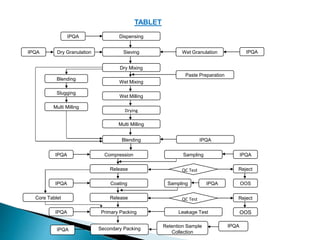
Process Flow Diagram For IPC
Retention Sample
Collection
Secondary PackingIPQA
IPQA
Sieving
Dry Mixing
Drying
Multi Milling
Compression
Release
Coating
Release
Primary Packing
IPQA
IPQA
IPQA
Core Tablet
Sampling
QC Test
IPQA
Reject
Sampling OOS
QC Test Reject
Leakage Test OOS
Wet GranulationDry Granulation
Blending
IPQA
Paste Preparation
Blending
Slugging
Multi Milling
IPQA
IPQA
Wet Mixing
Wet Milling
Dispensing
IPQA
IPQA
TABLET
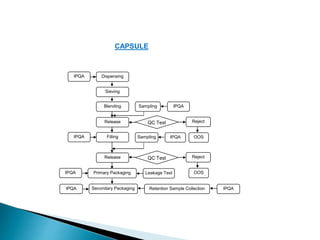
CAPSULE
Dispensing
Blending
Release QC Test Reject
Filling
Sampling
Sampling OOS
Leakage Test
IPQA
IPQA
Release QC Test Reject
OOS
IPQA
IPQA
Primary PackagingIPQA
Sieving
IPQARetention Sample CollectionSecondary PackagingIPQA
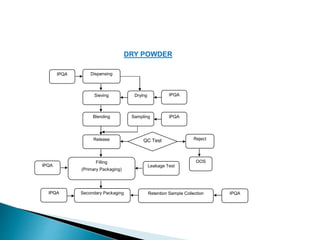
DRY POWDER
Dispensing
Blending
Release QC Test Reject
Filling
(Primary Packaging)
Sampling
OOS
IPQARetention Sample CollectionSecondary Packaging
Leakage Test
IPQA
IPQA
IPQA
Sieving Drying
IPQA
IPQA
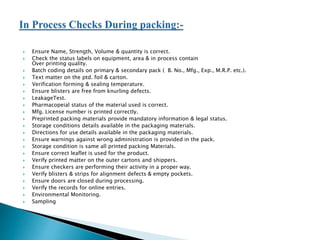
 Ensure Name, Strength, Volume & quantity is correct.
 Check the status labels on equipment, area & in process contain
Over printing quality.
 Batch coding details on primary & secondary pack ( B. No., Mfg., Exp., M.R.P. etc.).
 Text matter on the ptd. foil & carton.
 Verification forming & sealing temperature.
 Ensure blisters are free from knurling defects.
 LeakageTest.
 Pharmacopeial status of the material used is correct.
 Mfg. License number is printed correctly.
 Preprinted packing materials provide mandatory information & legal status.
 Storage conditions details available in the packaging materials.
 Directions for use details available in the packaging materials.
 Ensure warnings against wrong administration is provided in the pack.
 Storage condition is same all printed packing Materials.
 Ensure correct leaflet is used for the product.
 Verify printed matter on the outer cartons and shippers.
 Ensure checkers are performing their activity in a proper way.
 Verify blisters & strips for alignment defects & empty pockets.
 Ensure doors are closed during processing.
 Verify the records for online entries.
 Environmental Monitoring.
 Sampling
Results of the in process checks shall be documented with initials of the
person carrying them out and results obtained. If problems or deviations
from the manufacturing formula and processing instructions occurred, all
relevant information associated to this have to be documented well.
Thank you

In process control, slide

  • 1.
    Presented by Sk. Md.Zakir Hossain Sr. Executive, QA, QOD, GNU
  • 2.
    IN-PROCESS CONTROL Here youwill find answers to the following questions:  What are the in-process control tasks?  Where should the in-process control group be established in organizational and disciplinary terms?  How are the responsibilities regulated?  How are in-process controls carried out? In-process controls (IPC) are checks that are carried out before the manufacturing process is completed. The function of in-process controls is monitoring and – if necessary – adaptation of the manufacturing process in order to comply with the specifications. This may include control of equipment and environment, too. In-process materials should be tested for identity, strength, quality and purity as appropriate and approved or rejected by the Quality Control unit during the production process. Rejected in-process materials should be identified and controlled under a quarantine system designed to prevent their use in manufacturing. Written procedures should be established and followed that describe the In-process controls and tests as specified: .Tablet or capsule weight variation, • Disintegration time, • Content uniformity and homogeneity, • Dissolution time and rate, • Clarity, completeness or pH of solutions. In-process controls may be performed in regular intervals during a process step (e.g. tabletting, encapsulation) or at the end of a process step (e.g. granulation, blending). The objectives of in-process control are both quality control and process control.  WHO says, Checks Performed during production in order to monitor and, if necessary, to adjust the process to ensure that the product conforms to its specifications. The control of the environment or equiment may also be regarded as a part of in-process control.
  • 3.
    During manufacturing andpackaging a lot of data are recorded which represent control factors of the manufacturing process. These data may be process parameters (e.g. outlet air temperature of a fluid bed dryer) or product attributes (e.g. hardness of tablet cores). The results of the measurements may indicate that a corrective action is required to maintain the process and the product within the specified ranges. The limits within which modifications may be carried out to match measured values must be determined in advance. The drying of a granulate is described here as an example. The objective, i.e. the resultant granulate humidity, is determined within the scope of the manufacturing instructions. If the specified range has not yet been achieved, the normal course of action is to extend the drying time. In this case, it is irrelevant whether the control is automatic, e.g. by means of online measurement within a fluid bed dryer or manual sampling.
  • 4.
    This function isperformed by documenting production parameters. In a broader sense, this includes the following in-process controls: • measured values obtained from process equipment, e.g. temperatures • measured values obtained by persons, e.g. times • product attributes, e.g. weight, hardness, friability • measured values obtained from the room environment, e.g. particle counts • tests following completion of intermediate products The classic interpretation of the term in-process control includes the recording of measured values by members of the in-process control group. “Finished product assessment should embrace all relevant factors, including results of in-process testing. The documented in-process data are therefore evaluated by quality control. In-process results are evaluated by quality control in the context of batch record review . Good Manufacturing Practice for Finished Pharmaceuticals. This evaluation is part of the release procedure. The investigation of intermediate manufacturing steps also falls into the category Of in-process controls. An example of this is the homogeneity investigation carried out on a blend. Normally, such quantitative determinations are the direct responsibility of quality control. In a broader sense, yields of the various intermediate products are also in-process control values.
  • 5.
    Measured values obtainedfrom persons e.g. Times Product attributes e.g. Weight, Hardness, friability Measured values obtained from the room environment e.g. Temperature, Humidity. Physical parameters • temperature • time • pressure • weight e.g. Average weight, Uniformity of weight, Individual weight. • hardness • disintegration time • loss on drying • pH • visible impurity • color • integrity (leakage test) • fractional part . Water Content .Bubble point etc. Note: Rejected in process materials should be identified and controlled under a quarantine system designed to prevent their use in manufacturing.
  • 6.
    . Verification ofthe status labels on the area, equipment's and process containers. . Online stage wise review of the batch record (Online review). . Cleanliness of the area, equipment and line clearance. . Confirming material correctness, quantity & vendor against the batch record. . Product attributes like weight variation, avg. wt, hardness, thickness, D.T, friability. . Monitoring environmental conditions. . Weight of the blend & other intermediates. . Checking the appearance tablet during compression & coating . Solution preparation. . Film formation and integrity. . Ensure machine setting parameters match with batch records. . Yield verification of various stages of production . Sampling
  • 7.
     Ensure correctmaterials are brought in for manufacturing activity.  Check sieve integrity.  Ensure manufacturing is carried out as per the instruction given in the BMR.  Ensure operators are wearing hand gloves and nose mask during all stages of manufacturing.  Verify the records for online entries.  Environmental Monitoring.  Check & verify equipment parameters like temperature, drying time etc.  Checking process parameters like Appearance , Avg. Weight, Group Weight, Hardness, friability, DT etc.  Yield verification.  Checking the weights of in process materials.  Checking labeling status of the quarantine materials.  Ensure doors are closed during processing.
  • 8.
  • 9.
    Retention Sample Collection Secondary PackingIPQA IPQA Sieving DryMixing Drying Multi Milling Compression Release Coating Release Primary Packing IPQA IPQA IPQA Core Tablet Sampling QC Test IPQA Reject Sampling OOS QC Test Reject Leakage Test OOS Wet GranulationDry Granulation Blending IPQA Paste Preparation Blending Slugging Multi Milling IPQA IPQA Wet Mixing Wet Milling Dispensing IPQA IPQA TABLET
  • 10.
    CAPSULE Dispensing Blending Release QC TestReject Filling Sampling Sampling OOS Leakage Test IPQA IPQA Release QC Test Reject OOS IPQA IPQA Primary PackagingIPQA Sieving IPQARetention Sample CollectionSecondary PackagingIPQA
  • 11.
    DRY POWDER Dispensing Blending Release QCTest Reject Filling (Primary Packaging) Sampling OOS IPQARetention Sample CollectionSecondary Packaging Leakage Test IPQA IPQA IPQA Sieving Drying IPQA IPQA
  • 12.
     Ensure Name,Strength, Volume & quantity is correct.  Check the status labels on equipment, area & in process contain Over printing quality.  Batch coding details on primary & secondary pack ( B. No., Mfg., Exp., M.R.P. etc.).  Text matter on the ptd. foil & carton.  Verification forming & sealing temperature.  Ensure blisters are free from knurling defects.  LeakageTest.  Pharmacopeial status of the material used is correct.  Mfg. License number is printed correctly.  Preprinted packing materials provide mandatory information & legal status.  Storage conditions details available in the packaging materials.  Directions for use details available in the packaging materials.  Ensure warnings against wrong administration is provided in the pack.  Storage condition is same all printed packing Materials.  Ensure correct leaflet is used for the product.  Verify printed matter on the outer cartons and shippers.  Ensure checkers are performing their activity in a proper way.  Verify blisters & strips for alignment defects & empty pockets.  Ensure doors are closed during processing.  Verify the records for online entries.  Environmental Monitoring.  Sampling
  • 13.
    Results of thein process checks shall be documented with initials of the person carrying them out and results obtained. If problems or deviations from the manufacturing formula and processing instructions occurred, all relevant information associated to this have to be documented well.
  • 14.