RDIC
RESEARCH DEVELOPMENTAND INNOVATION CENTER
O U R L A D Y O F F AT I M A U N I V E R S I T Y
8
STUDENT ORIENTATION
Friday, July 26, 13
SERVICE. STYLE.
BY MICHAEL JOSEPH S. DIÑO 
RESPONSIBILITY.
Friday, July 26, 13
RDIC
RESEARCH DEVELOPMENTAND INNOVATION CENTER
O U R L A D Y O F F AT I M A U N I V E R S I T Y
8
SERVICE.
STYLE.
RESPONSIBILITY.
Friday, July 26, 13
RDIC
RESEARCH DEVELOPMENTAND INNOVATION CENTER
O U R L A D Y O F F AT I M A U N I V E R S I T Y
8
rdic personnel, research office
achievements, university role
undergraduate research format
services, proposal and final defense
SERVICE.
STYLE.
RESPONSIBILITY.
Friday, July 26, 13
UNIVERSITY RESEARCH CENTER
SERVICE.
Friday, July 26, 13
RDIC ORGANIZATION
Friday, July 26, 13
DIRECTOR
AST. DIRECTOR
CAMPUS COOR.
RDIC ORGANIZATION
Friday, July 26, 13
DIRECTOR
AST. DIRECTOR
CAMPUS COOR.
ETHICAL BOARD
RDIC ORGANIZATION
Friday, July 26, 13
DIRECTOR
AST. DIRECTOR
CAMPUS COOR.
ETHICAL BOARD
CLUSTER 1 CLUSTER 2 CLUSTER 3 CLUSTER 4
RDIC ORGANIZATION
Friday, July 26, 13
DIRECTOR
AST. DIRECTOR
CAMPUS COOR.
ETHICAL BOARD
CLUSTER 1 CLUSTER 2 CLUSTER 3 CLUSTER 4
COLLEGE REP. COLLEGE REP. COLLEGE REP. COLLEGE REP.
RDIC ORGANIZATION
Friday, July 26, 13
DIRECTOR
AST. DIRECTOR
CAMPUS COOR.
ETHICAL BOARD
CLUSTER 1 CLUSTER 2 CLUSTER 3 CLUSTER 4
COLLEGE REP. COLLEGE REP. COLLEGE REP. COLLEGE REP.
research
analytics
research
consultants
english
dept.
research
publication
RDIC ORGANIZATION
Friday, July 26, 13
DIRECTOR
AST. DIRECTOR
CAMPUS COOR.
ETHICAL BOARD
CLUSTER 1 CLUSTER 2 CLUSTER 3 CLUSTER 4
COLLEGE REP. COLLEGE REP. COLLEGE REP. COLLEGE REP.
FACULTY
research
analytics
research
consultants
english
dept.
research
publication
RDIC ORGANIZATION
Friday, July 26, 13
DIRECTOR
AST. DIRECTOR
CAMPUS COOR.
ETHICAL BOARD
CLUSTER 1 CLUSTER 2 CLUSTER 3 CLUSTER 4
COLLEGE REP. COLLEGE REP. COLLEGE REP. COLLEGE REP.
FACULTY
STUDENTS
research
analytics
research
consultants
english
dept.
research
publication
RDIC ORGANIZATION
Friday, July 26, 13
6
CLUSTER 1 CLUSTER 2
CLUSTER 1 CLUSTER 2 CLUSTER 3 CLUSTER 4
CLUSTER 3 CLUSTER 4
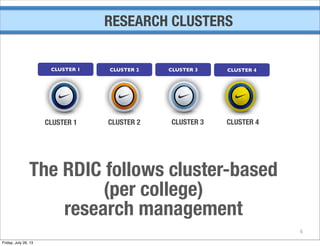
The RDIC follows cluster-based
(per college)
research management
RESEARCH CLUSTERS
Friday, July 26, 13
6
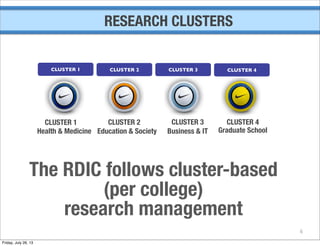
CLUSTER 1
Health & Medicine
CLUSTER 2
Education & Society
CLUSTER 1 CLUSTER 2 CLUSTER 3 CLUSTER 4
CLUSTER 3
Business & IT
CLUSTER 4
Graduate School
The RDIC follows cluster-based
(per college)
research management
RESEARCH CLUSTERS
Friday, July 26, 13
7
Health & Medicine
Education & Society
CLUSTER 1
CLUSTER 2
CLUSTER 3
Business & IT
medicine.dentistry.nursing.medtech.
pharmacy. physical therapy. biology
education. psychology.criminology.
philosophy. physical educ. cas
business. accountancy. chim.
comp-sci. technology. maritime
RESEARCH CLUSTERS
Friday, July 26, 13
RDIC OFFICE - MAIN
Friday, July 26, 13
RDIC SERVICES
Research
Management
Research
Consultancy
Research
Analytics
Friday, July 26, 13
RDIC PUBLICATIONS
Book of Abstracts
Fatima University
Research Journal The OLFU Review
Friday, July 26, 13
RDIC PRESENTATIONS (1st SEM)
BS Pharma: 4 Papers
23rd Pharmacy Congress
Singapore, August 2013
Nursing: 3 Papers
Asian Conference on education
Japan, October 2013
RDIC: 2 Paper
Asian Conference on S.E.T
Japan, October 2013
RDIC: 1 Paper
HIMSS AsiaPac Health IT
Singapore, October 2013
Friday, July 26, 13
RDIC
RESEARCH DEVELOPMENTAND INNOVATION CENTER
O U R L A D Y O F F AT I M A U N I V E R S I T Y
8
INFINITY SYMBOL
(research)
PLANT ICON
(development)
GLOBE
(innovation)
LAUREL LEAF
(scholarship)
RDIC LOGO
Friday, July 26, 13
STYLE.
UNDERGRADUATE RESEARCH FORMAT
Friday, July 26, 13
I THE PROBLEM AND ITS BACKGROUND
Introduction
Statement of the Problem
Hypothesis of the Study
Significance of the Study
Scope and Limitation of the Study
II REVIEW OF RELATED LITERATURE AND STUDIES
Review of Related Literature and Studies
Conceptual Framework
Research Paradigm
Definition of Terms
III METHODOLOGY
Research Design
Locale and Population of the Study
Description of the Respondents
Data Gathering, Instrumentation and
Procedures
Statistical Treatment Used
IV PRESENTATION, ANALYSIS AND INTERPRETATION OF DATA
V SUMMARY OF FINDINGS, CONCLUSIONS AND
RECOMMENDATIONS
Summary
Findings
Conclusions
Recommendations
TRADITIONAL RESEARCH FORMAT
Friday, July 26, 13
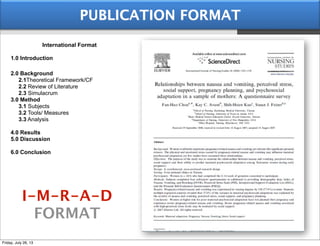
PUBLICATION FORMAT
International Format
1.0 Introduction
2.0 Background
2.1Theoretical Framework/CF
2.2 Review of Literature
2.3 Simulacrum
3.0 Method
3.1 Subjects
3.2 Tools/ Measures
3.3 Analysis
4.0 Results
5.0 Discussion
6.0 Conclusion
I-M-R-A-D
FORMAT
Friday, July 26, 13
PRELIMINARY
PAGES
CONTENT
PAGES
REFERENCES,
APPENDICES
RESEARCH MANUSCRIPT
(numbered as
i, ii, iii, iv)
(numbered as
1, 2, 3, 4)
(continue
numbering from
previous)(with header/
footer)
Friday, July 26, 13
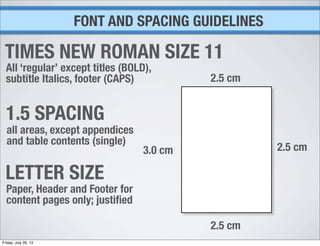
FONT AND SPACING GUIDELINES
TIMES NEW ROMAN SIZE 11
All ‘regular’ except titles (BOLD),
subtitle Italics, footer (CAPS)
1.5 SPACING
all areas, except appendices
and table contents (single)
LETTER SIZE
Paper, Header and Footer for
content pages only; justified
2.5 cm
2.5 cm
2.5 cm
3.0 cm
Friday, July 26, 13
HEADER AND FOOTER
first 5
words of
title...
page
number
OUR LADY
OF FATIMA
UNIVERSITY COLLEGE
Friday, July 26, 13
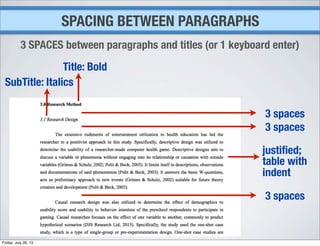
SPACING BETWEEN PARAGRAPHS
3 SPACES between paragraphs and titles (or 1 keyboard enter)
3 spaces
3 spaces
3 spaces
Title: Bold
SubTitle: Italics
justified;
table with
indent
Friday, July 26, 13
PRELIMINARY
PAGES
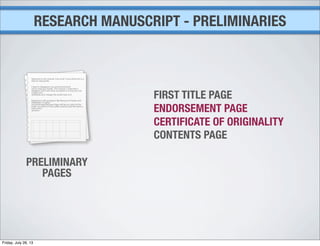
RESEARCH MANUSCRIPT - PRELIMINARIES
FIRST TITLE PAGE
CONTENTS PAGE
ENDORSEMENT PAGE
CERTIFICATE OF ORIGINALITY
Friday, July 26, 13
1.0 INTRODUCTION
2.0 REVIEW OF RELATED LITERATURE
2.1. Theoretical Framework
CONTENT
PAGES
2.2. Literature Review
2.3. Research Simulacrum
3.0 RESEARCH METHOD
3.1. Research Design
3.2. Research Locale
3.3. Population and Sampling
3.4. Research Ethics
3.5. Research Instruments
3.6. Data Collection
3.7. Data Analysis
4.0 RESULT(S)
5.0 DISCUSSION
6.0 CONCLUSION
7.0 RECOMMENDATION
RESEARCH ABSTRACT
SECOND TITLE PAGE
RESEARCH MANUSCRIPT - CONTENT (QUANTI)
Friday, July 26, 13
1.0 INTRODUCTION
2.0 REVIEW OF RELATED LITERATURE
2.1. Theoretical Framework
CONTENT
PAGES
2.2. Literature Review
2.3. Research Simulacrum
3.0 RESEARCH METHOD
3.1. Research Design
3.2. Research Locale
3.3. Population and Sampling
3.4. Research Ethics
3.5. Research Instruments
3.6. Data Collection
3.7. Data Analysis
4.0 RESULT(S)
5.0 DISCUSSION
6.0 CONCLUSION
7.0 RECOMMENDATION
RESEARCH ABSTRACT
SECOND TITLE PAGE
RESEARCH MANUSCRIPT - CONTENT (QUALI)
(omitted)
(Key
Informat
Selection)
moderatum
generalization
reflection
Friday, July 26, 13
REFERENCES,
APPENDICES
REFERENCES
LIST OF APPENDICES
Letters of Permission
Consent
Research Instrument(s)
Research Tally/ Interview Text
Research Plates
Research Budget
Timeline
Certifications/ Ethics
Correspondence
Authors
Acknowledgement
SELECTED LITERATURE (MIN 10)
RESEARCH MANUSCRIPT - REF/APPENDICES
GLOSSARY OF TERMS
Friday, July 26, 13
SAMPLE TEMPLATE CAN BE ACCESSED FROM
YOUR RESEARCH COORDINATORS STARTING
AUGUST 1, 2013
Friday, July 26, 13
STYLE-CONTENT GUIDE.
UNDERGRADUATE RESEARCH FORMAT
Friday, July 26, 13
PLEASE REFER TO YOUR HANDOUT
Friday, July 26, 13
MINIMUM REQUIREMENT: TITLE PAGE
6 spaces from top of page
Title: bold
Authors + adviser
College
RDIC
OLFU
superscripts on authors
and affiliations
no header and footer for
title page
Friday, July 26, 13
MINIMUM REQUIREMENT: CONTENT
1.0 INTRODUCTION
2.0 REVIEW OF RELATED LITERATURE
2.1. Theoretical Framework
2.2. Literature Review
2.3. Research Simulacrum
3.0 RESEARCH METHOD
3.1. Research Design
3.2. Research Locale
3.3. Population and Sampling
3.4. Research Ethics
3.5. Research Instruments
3.6. Data Collection
3.7. Data Analysis
4.0 RESULT(S)
5.0 DISCUSSION
6.0 CONCLUSION
7.0 RECOMMENDATION
RESEARCH ABSTRACT
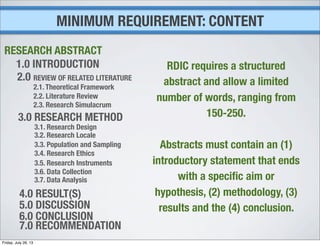
RDIC requires a structured
abstract and allow a limited
number of words, ranging from
150-250.
Abstracts must contain an (1)
introductory statement that ends
with a specific aim or
hypothesis, (2) methodology, (3)
results and the (4) conclusion.
Friday, July 26, 13
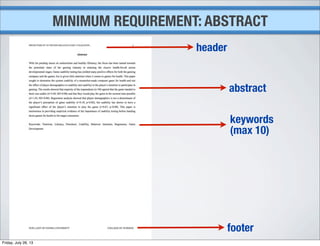
MINIMUM REQUIREMENT: ABSTRACT
header
footer
abstract
keywords
(max 10)
Friday, July 26, 13
MINIMUM REQUIREMENT: ABSTRACT CONTENT
With the pending issues on malnutrition and healthy illiteracy, the focus has
been turned towards the potentials share of the gaming industry in attaining
the elusive health-for-all across developmental stages. This paper sought to
determine the system usability of a researcher-made computer game for
health and test the effect of player demographics to usability and usability to
the player’s intention to participate in gaming. The results showed that
majority of the respondents (n=30) agreed that the game handed to them was
usable (x̄=5.40; SD=0.88) and that they would play the game at the soonest
time possible (x̄=1.43; SD=0.68). Regression analysis showed that player
demographics is not a determinant of the player’s perception of game
usability (r=0.18; p=0.82), but usability has shown to have a significant
effect of the player’s intention to play the game (r=0.67; p=0.00). This paper
is meritorious in providing empirical evidence of the importance of usability
testing before handing down games for health to the target consumers.
Friday, July 26, 13
MINIMUM REQUIREMENT: ABSTRACT CONTENT
With the pending issues on malnutrition and healthy illiteracy, the focus has
been turned towards the potentials share of the gaming industry in attaining
the elusive health-for-all across developmental stages. This paper sought to
determine the system usability of a researcher-made computer game for
health and test the effect of player demographics to usability and usability to
the player’s intention to participate in gaming. The results showed that
majority of the respondents (n=30) agreed that the game handed to them was
usable (x̄=5.40; SD=0.88) and that they would play the game at the soonest
time possible (x̄=1.43; SD=0.68). Regression analysis showed that player
demographics is not a determinant of the player’s perception of game
usability (r=0.18; p=0.82), but usability has shown to have a significant
effect of the player’s intention to play the game (r=0.67; p=0.00). This paper
is meritorious in providing empirical evidence of the importance of usability
testing before handing down games for health to the target consumers.
Abstracts must contain an (1) introductory statement that ends
with a specific aim or hypothesis, (2) methodology, (3) results
and the (4) conclusion.
Friday, July 26, 13
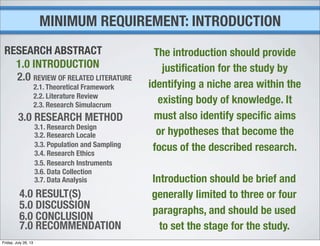
MINIMUM REQUIREMENT: INTRODUCTION
1.0 INTRODUCTION
2.0 REVIEW OF RELATED LITERATURE
2.1. Theoretical Framework
2.2. Literature Review
2.3. Research Simulacrum
3.0 RESEARCH METHOD
3.1. Research Design
3.2. Research Locale
3.3. Population and Sampling
3.4. Research Ethics
3.5. Research Instruments
3.6. Data Collection
3.7. Data Analysis
4.0 RESULT(S)
5.0 DISCUSSION
6.0 CONCLUSION
7.0 RECOMMENDATION
RESEARCH ABSTRACT The introduction should provide
justification for the study by
identifying a niche area within the
existing body of knowledge. It
must also identify specific aims
or hypotheses that become the
focus of the described research.
Introduction should be brief and
generally limited to three or four
paragraphs, and should be used
to set the stage for the study.
Friday, July 26, 13
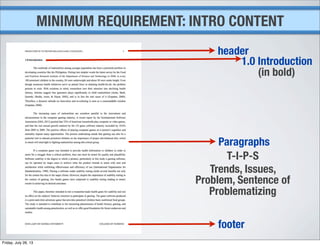
MINIMUM REQUIREMENT: INTRO CONTENT
header
footer
1.0 Introduction
(in bold)
Paragraphs
T-I-P-S
Trends, Issues,
Problem, Sentence of
Problematizing
Friday, July 26, 13
MINIMUM REQUIREMENT: REVLIT
1.0 INTRODUCTION
2.0 REVIEW OF RELATED LITERATURE
2.1. Theoretical Framework
2.2. Literature Review
2.3. Research Simulacrum
3.0 RESEARCH METHOD
3.1. Research Design
3.2. Research Locale
3.3. Population and Sampling
3.4. Research Ethics
3.5. Research Instruments
3.6. Data Collection
3.7. Data Analysis
4.0 RESULT(S)
5.0 DISCUSSION
6.0 CONCLUSION
7.0 RECOMMENDATION
RESEARCH ABSTRACT 2.1 Theoretical Framework
in S-E-C format
2.2. Should be presented
thematically with proper
citation (APA style), ends
with research question
and hypothesis
Research simulacrum is
the research paradigm
(figure)
Friday, July 26, 13
MINIMUM REQUIREMENT: RESEARCH METHOD
1.0 INTRODUCTION
2.0 REVIEW OF RELATED LITERATURE
2.1. Theoretical Framework
2.2. Literature Review
2.3. Research Simulacrum
3.0 RESEARCH METHOD
3.1. Research Design
3.2. Research Locale
3.3. Population and Sampling
3.4. Research Ethics
3.5. Research Instruments
3.6. Data Collection
3.7. Data Analysis
4.0 RESULT(S)
5.0 DISCUSSION
6.0 CONCLUSION
7.0 RECOMMENDATION
RESEARCH ABSTRACT
3.1 State the approach
and design and the
reason(s) why it is the
most appropriate
3.2. Describe the setting
for the study and why it
was chosen
Friday, July 26, 13
1.0 INTRODUCTION
2.0 REVIEW OF RELATED LITERATURE
2.1. Theoretical Framework
2.2. Literature Review
2.3. Research Simulacrum
3.0 RESEARCH METHOD
3.1. Research Design
3.2. Research Locale
3.3. Population and Sampling
3.4. Research Ethics
3.5. Research Instruments
3.6. Data Collection
3.7. Data Analysis
4.0 RESULT(S)
5.0 DISCUSSION
6.0 CONCLUSION
7.0 RECOMMENDATION
RESEARCH ABSTRACT
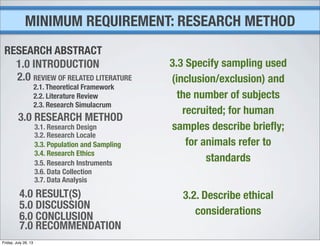
3.3 Specify sampling used
(inclusion/exclusion) and
the number of subjects
recruited; for human
samples describe briefly;
for animals refer to
standards
3.2. Describe ethical
considerations
MINIMUM REQUIREMENT: RESEARCH METHOD
Friday, July 26, 13
1.0 INTRODUCTION
2.0 REVIEW OF RELATED LITERATURE
2.1. Theoretical Framework
2.2. Literature Review
2.3. Research Simulacrum
3.0 RESEARCH METHOD
3.1. Research Design
3.2. Research Locale
3.3. Population and Sampling
3.4. Research Ethics
3.5. Research Instruments
3.6. Data Collection
3.7. Data Analysis
4.0 RESULT(S)
5.0 DISCUSSION
6.0 CONCLUSION
7.0 RECOMMENDATION
RESEARCH ABSTRACT
3.5 Discuss content/
sections of the instrument
and credibility (eg
reliability and validity),
pilot testing, or
adaptation/adoptation
3.6. Data collection in
detail including protocol
MINIMUM REQUIREMENT: RESEARCH METHOD
Friday, July 26, 13
1.0 INTRODUCTION
2.0 REVIEW OF RELATED LITERATURE
2.1. Theoretical Framework
2.2. Literature Review
2.3. Research Simulacrum
3.0 RESEARCH METHOD
3.1. Research Design
3.2. Research Locale
3.3. Population and Sampling
3.4. Research Ethics
3.5. Research Instruments
3.6. Data Collection
3.7. Data Analysis
4.0 RESULT(S)
5.0 DISCUSSION
6.0 CONCLUSION
7.0 RECOMMENDATION
RESEARCH ABSTRACT
3.7 Describe variables
measured and how
measurement was made;
include statistics/analysis
done, software used and
validation techniques
MINIMUM REQUIREMENT: RESEARCH METHOD
Friday, July 26, 13
MINIMUM REQUIREMENT: RESULTS
1.0 INTRODUCTION
2.0 REVIEW OF RELATED LITERATURE
2.1. Theoretical Framework
2.2. Literature Review
2.3. Research Simulacrum
3.0 RESEARCH METHOD
3.1. Research Design
3.2. Research Locale
3.3. Population and Sampling
3.4. Research Ethics
3.5. Research Instruments
3.6. Data Collection
3.7. Data Analysis
4.0 RESULT(S)
5.0 DISCUSSION
6.0 CONCLUSION
7.0 RECOMMENDATION
RESEARCH ABSTRACT
Section Title
Present Table
Describe Table
Table
Friday, July 26, 13
MINIMUM REQUIREMENT: RESULTS
Section Title
Present Table
Discuss
(dont present
analysis and
implications here)
Friday, July 26, 13
MINIMUM REQUIREMENT: DISCUSSION
1.0 INTRODUCTION
2.0 REVIEW OF RELATED LITERATURE
2.1. Theoretical Framework
2.2. Literature Review
2.3. Research Simulacrum
3.0 RESEARCH METHOD
3.1. Research Design
3.2. Research Locale
3.3. Population and Sampling
3.4. Research Ethics
3.5. Research Instruments
3.6. Data Collection
3.7. Data Analysis
4.0 RESULT(S)
5.0 DISCUSSION
6.0 CONCLUSION
7.0 RECOMMENDATION
RESEARCH ABSTRACT
For every section:
(1) 1 sentence summary
of result, (2) possible
reasons for the result
(cross ref or not), and (3)
implication of the finding
with reference to
previous literature
Friday, July 26, 13
MINIMUM REQUIREMENT: CONCLUSION
1.0 INTRODUCTION
2.0 REVIEW OF RELATED LITERATURE
2.1. Theoretical Framework
2.2. Literature Review
2.3. Research Simulacrum
3.0 RESEARCH METHOD
3.1. Research Design
3.2. Research Locale
3.3. Population and Sampling
3.4. Research Ethics
3.5. Research Instruments
3.6. Data Collection
3.7. Data Analysis
4.0 RESULT(S)
5.0 DISCUSSION
6.0 CONCLUSION
7.0 RECOMMENDATION
RESEARCH ABSTRACT
1 sentence summary of
the paper objective
1-3 sentence(s) of
method used
1-3 sentence summary of
finding
implication to research,
practice and education
Friday, July 26, 13
MINIMUM REQUIREMENT: RECOMMENDATION
1.0 INTRODUCTION
2.0 REVIEW OF RELATED LITERATURE
2.1. Theoretical Framework
2.2. Literature Review
2.3. Research Simulacrum
3.0 RESEARCH METHOD
3.1. Research Design
3.2. Research Locale
3.3. Population and Sampling
3.4. Research Ethics
3.5. Research Instruments
3.6. Data Collection
3.7. Data Analysis
4.0 RESULT(S)
5.0 DISCUSSION
6.0 CONCLUSION
7.0 RECOMMENDATION
RESEARCH ABSTRACT
Discuss limitation of the
paper and
recommendation to
future researchers
Friday, July 26, 13
TO KNOW MORE ABOUT MINIMUM REQUIREMENT FOR
EACH MANUSCRIPT SECTION, PLEASE VISIT JOURNAL
REPORTING STANDARDS (JARS) AT:
http://www.apa.org/pubs/authors/jars.pdf
Friday, July 26, 13
OLFU GUIDE ON RESEARCH FORMAT
NOW ON
iTunes U
Friday, July 26, 13
OPEN iTunes U application from your iOS device
Friday, July 26, 13
at the bottom of the screen, click/touch enroll
Friday, July 26, 13
an enrollment request dialogue box will pop-up
Friday, July 26, 13
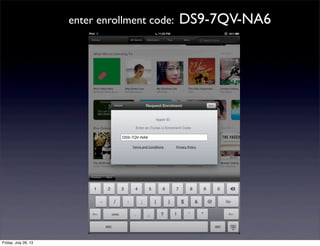
enter enrollment code: DS9-7QV-NA6
Friday, July 26, 13
click/touch next
Friday, July 26, 13
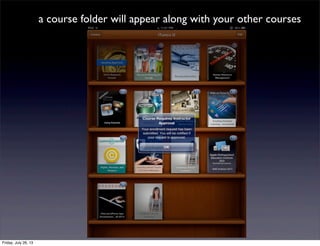
a course folder will appear along with your other courses
Friday, July 26, 13
a course folder will appear along with your other courses
Friday, July 26, 13
a course folder will appear along with your other courses
GUIDE ACCESS WILL START ON AUGUST 1, 2013
Friday, July 26, 13
browse through notes and materials related to research format
Friday, July 26, 13
RESPONSIBILITY.
UNDERGRADUATE STUDENTS AS RESEARCHERS
Friday, July 26, 13
COMPLETE YOUR PAPER WITHIN THE SEMESTER
(NO EXTRA SEMESTER EXTENSION; NO GRADE OF INC)
Friday, July 26, 13
THROWBACK THURSDAY... COST OF MY PAPER
DEFENSE 1,200
BIND (4) 600
STATISTICS 6,000
ADVISER 400
PHP 8,200
(6 in a group)
PHP 1,366
Friday, July 26, 13
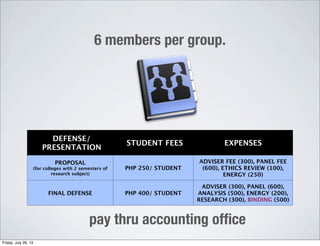
DEFENSE/
PRESENTATION
DEFENSE/
PRESENTATION
STUDENT FEES EXPENSES
PROPOSAL
(for colleges with 2 semesters of
research subject)
PHP 250/ STUDENTPHP 250/ STUDENT
ADVISER FEE (300), PANEL FEE
(600), ETHICS REVIEW (100),
ENERGY (250)
FINAL DEFENSE PHP 400/ STUDENTPHP 400/ STUDENT
ADVISER (300), PANEL (600),
ANALYSIS (500), ENERGY (200),
RESEARCH (300), BINDING (500)
6 members per group.
pay thru accounting office
Friday, July 26, 13
STANDARD FEES FOR PROPOSAL AND FINAL DEFENSE
DEFENSE/
PRESENTATION
DEFENSE/
PRESENTATION
STUDENT FEES EXPENSES
PROPOSAL
(for colleges with 2 semesters of
research subject)
PHP 250/ STUDENTPHP 250/ STUDENT
ADVISER FEE (300), PANEL FEE
(600), ETHICS REVIEW (100),
ENERGY (250)
FINAL DEFENSE PHP 400/ STUDENTPHP 400/ STUDENT
ADVISER (300), PANEL (600),
ANALYSIS (500), ENERGY (200),
RESEARCH (300), BINDING (500)
6 members per group.
pay thru accounting office
Friday, July 26, 13
NO TOKENS SHALL BE GIVEN TO ADVISERS AND PANEL
MEMBERS ON PAPER COMPLETION/DEFENSE
Friday, July 26, 13
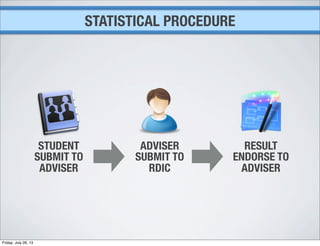
STATISTICAL PROCEDURE
STUDENT
SUBMIT TO
ADVISER
ADVISER
SUBMIT TO
RDIC
RESULT
ENDORSE TO
ADVISER
Friday, July 26, 13
DEFENSE PROCEDURE
STUDENT
SUBMIT TO
ADVISER
DEFENSE
SUBMIT TO
ADVISER
(form, 3 copies, receipt) (student comply with
changes)
(2 copies, CD softcopy)
Friday, July 26, 13
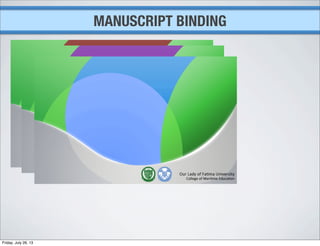
MANUSCRIPT BINDING
Friday, July 26, 13
MANUSCRIPT BINDING
Friday, July 26, 13
MANUSCRIPT BINDING
Friday, July 26, 13
MANUSCRIPT BINDING
Friday, July 26, 13
MANUSCRIPT BINDING
Friday, July 26, 13
MANUSCRIPT BINDING
Friday, July 26, 13
MANUSCRIPT BINDING
Friday, July 26, 13
MANUSCRIPT BINDING
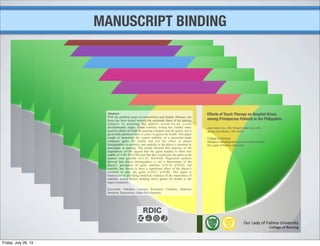
Effects of Touch Therapy on Hospital Stress
among Primiparous Patients in the Philippines
Abstract
With the pending issues on malnutrition and healthy illiteracy, the
focus has been turned towards the potentials share of the gaming
industry in attaining the elusive health-for-all across
developmental stages. Game usability testing has yielded many
positive effects for both the gaming company and the gamer, but is
given little attention when it comes to games for health. This paper
sought to determine the system usability of a researcher-made
computer game for health and test the effect of player
demographics to usability and usability to the player’s intention to
participate in gaming. The results showed that majority of the
respondents (n=30) agreed that the game handed to them was
usable (x̄=5.40; SD=0.88) and that they would play the game at the
soonest time possible (x̄=1.43; SD=0.68). Regression analysis
showed that player demographics is not a determinant of the
player’s perception of game usability (r=0.18; p=0.82), but
usability has shown to have a significant effect of the player’s
intention to play the game (r=0.67; p=0.00). This paper is
meritorious in providing empirical evidence of the importance of
usability testing before handing down games for health to the
target consumers.
Keywords: Nutrition, Literacy, Preschool, Usability, Behavior
Intention, Regression, Game Development
Juan dela Cruz, SN; Rosario dela Cruz, SN,
Jenica Ana Rivero, RN, MAN
College of Nursing
Research Development and Innovation Center
Our Lady of Fatima University
Friday, July 26, 13
Friday, July 26, 13
RX
LFU
OUR LADY OF FATIMA UNIVERSITY
RESEARCH EXPOSITION 2013
Friday, July 26, 13
Our Lady of Fatima University Research Exposition (OLFU-RX)
Valenzuela City, Quezon City, Antipolo City
The Research Development and Innovation Center (RDIC) of the Our Lady
of Fatima University recognizes the importance of research culture growth
among the members of the university community through conceptualization
of valuable research programs and events that will highlight and recognize
scientific research products of faculty and students. In pursuant of this the,
OLFU-RX was conceptualized that will serve as an annual research event of
the research departments across programs and campuses starting AY
2013-2014.
RX
LFU
OUR LADY OF FATIMA UNIVERSITY
RESEARCH EXPOSITION 2013
Friday, July 26, 13
RX
LFU
OUR LADY OF FATIMA UNIVERSITY
RESEARCH EXPOSITION 2013
Friday, July 26, 13
RX
LFU
OUR LADY OF FATIMA UNIVERSITY
RESEARCH EXPOSITION 2013
✓To expose the university community to a favorable and challenging avenue for
research presentation centered on friendly competition and research
camaraderie across colleges and campuses
✓To express recognition and reward exemplary research work and efforts of
faculty and students towards attaining sustainable research productivity and
excellence
✓To expound a culture of research by engaging the community in series of
worthy research activities and education sessions concurrent with the
needs of the research society and responsive to the challenges brought by the
dynamic research field
✓To exhilarate the university community on the reward and benefits of
productive research work towards creation of scholar and honor societies of
researchers
Friday, July 26, 13
RX
LFU
OUR LADY OF FATIMA UNIVERSITY
RESEARCH EXPOSITION 2013
Friday, July 26, 13
RX
LFU
OUR LADY OF FATIMA UNIVERSITY
RESEARCH EXPOSITION 2013
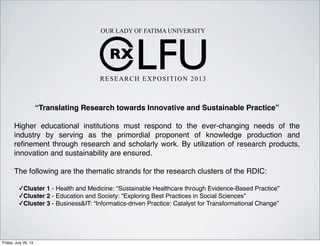
“Translating Research towards Innovative and Sustainable Practice”
Higher educational institutions must respond to the ever-changing needs of the
industry by serving as the primordial proponent of knowledge production and
refinement through research and scholarly work. By utilization of research products,
innovation and sustainability are ensured.
The following are the thematic strands for the research clusters of the RDIC:
✓Cluster 1 - Health and Medicine: “Sustainable Healthcare through Evidence-Based Practice”
✓Cluster 2 - Education and Society: “Exploring Best Practices in Social Sciences”
✓Cluster 3 - Business&IT: “Informatics-driven Practice: Catalyst for Transformational Change”
Friday, July 26, 13
CERTIFICATES WILL BE GIVEN TO ALL STUDENT
PARTICIPANTS
Friday, July 26, 13
CERTIFICATES WILL BE GIVEN TO ALL STUDENT
PARTICIPANTS
special label at
your binded
manuscript
Friday, July 26, 13
RX
LFU
OUR LADY OF FATIMA UNIVERSITY
RESEARCH EXPOSITION 2013
Friday, July 26, 13
RX
LFU
OUR LADY OF FATIMA UNIVERSITY
RESEARCH EXPOSITION 2013
Oral, AV, Poster Presentations
Best College Research
Best Cluster Research
Ricierca Award of Excellence
Best Faculty Research
Innovation/Product Award
Friday, July 26, 13
Friday, July 26, 13
DATE TIME
ACTIVITIES PER CAMPUSACTIVITIES PER CAMPUSACTIVITIES PER CAMPUS
DATE TIME
Valenzuela Campus QC Campus Antipolo Campus
Day 1
September 24
10:00 - 12:00
Opening Ceremonies Opening Ceremonies Opening Ceremonies
1:00 - 3:00 Education Session 1
Updates: Quali Research Poster Viewing and
Ribbon Cutting Session
for Cluster 1
Poster Viewing and
Ribbon Cutting Session
for Cluster 2 and 33:00 - 5:00 Education Session 2
Multidisciplinary Research
Poster Viewing and
Ribbon Cutting Session
for Cluster 1
Poster Viewing and
Ribbon Cutting Session
for Cluster 2 and 3
Day 2
September 25
9:00 - 12:00
Oral Presentation Cluster 1
Day 2
September 25
9:00 - 12:00
Research Product and
Innovation Presentation for
Cluster 1
1:00 - 4:00
Research Product and
Innovation Presentation for
Cluster 1
Day 3
September 26
9:00 - 12:00 Oral Presentation for
Cluster 2 and 3
1:00 - 4:00
Research Product and
Innovation Presentation
for Cluster 2 and 3
Day 4
September 27
8:00 - 9:00 Poster Viewing and Ribbon
Cutting Session for Winning
Entries from Clusters 1-3
9:00 - 12:00 Audio-Video Research
Presentation
6:00 - 9:00 Researchers’ Night and Award
Ceremonies
Launching of FURJ issue 5
Launching of eJournals
Induction ceremony for Ethics
Board and Research Council
Friday, July 26, 13
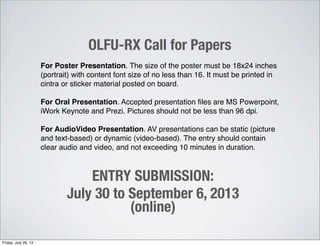
OLFU-RX Call for Papers
For Poster Presentation. The size of the poster must be 18x24 inches
(portrait) with content font size of no less than 16. It must be printed in
cintra or sticker material posted on board.
For Oral Presentation. Accepted presentation files are MS Powerpoint,
iWork Keynote and Prezi. Pictures should not be less than 96 dpi.
For AudioVideo Presentation. AV presentations can be static (picture
and text-based) or dynamic (video-based). The entry should contain
clear audio and video, and not exceeding 10 minutes in duration.
ENTRY SUBMISSION:
July 30 to September 6, 2013
(online)
Friday, July 26, 13
8
RDIC
Friday, July 26, 13
8
RDIC
Doing research to improve man as man,
publishing research work to rise to the top!
Friday, July 26, 13

IMRAD FORMAT FOR OLFU STUDENTS orient copy

  • 1.
    RDIC RESEARCH DEVELOPMENTAND INNOVATIONCENTER O U R L A D Y O F F AT I M A U N I V E R S I T Y 8 STUDENT ORIENTATION Friday, July 26, 13
  • 2.
    SERVICE. STYLE. BY MICHAELJOSEPH S. DIÑO  RESPONSIBILITY. Friday, July 26, 13
  • 3.
    RDIC RESEARCH DEVELOPMENTAND INNOVATIONCENTER O U R L A D Y O F F AT I M A U N I V E R S I T Y 8 SERVICE. STYLE. RESPONSIBILITY. Friday, July 26, 13
  • 4.
    RDIC RESEARCH DEVELOPMENTAND INNOVATIONCENTER O U R L A D Y O F F AT I M A U N I V E R S I T Y 8 rdic personnel, research office achievements, university role undergraduate research format services, proposal and final defense SERVICE. STYLE. RESPONSIBILITY. Friday, July 26, 13
  • 5.
  • 6.
  • 7.
    DIRECTOR AST. DIRECTOR CAMPUS COOR. RDICORGANIZATION Friday, July 26, 13
  • 8.
    DIRECTOR AST. DIRECTOR CAMPUS COOR. ETHICALBOARD RDIC ORGANIZATION Friday, July 26, 13
  • 9.
    DIRECTOR AST. DIRECTOR CAMPUS COOR. ETHICALBOARD CLUSTER 1 CLUSTER 2 CLUSTER 3 CLUSTER 4 RDIC ORGANIZATION Friday, July 26, 13
  • 10.
    DIRECTOR AST. DIRECTOR CAMPUS COOR. ETHICALBOARD CLUSTER 1 CLUSTER 2 CLUSTER 3 CLUSTER 4 COLLEGE REP. COLLEGE REP. COLLEGE REP. COLLEGE REP. RDIC ORGANIZATION Friday, July 26, 13
  • 11.
    DIRECTOR AST. DIRECTOR CAMPUS COOR. ETHICALBOARD CLUSTER 1 CLUSTER 2 CLUSTER 3 CLUSTER 4 COLLEGE REP. COLLEGE REP. COLLEGE REP. COLLEGE REP. research analytics research consultants english dept. research publication RDIC ORGANIZATION Friday, July 26, 13
  • 12.
    DIRECTOR AST. DIRECTOR CAMPUS COOR. ETHICALBOARD CLUSTER 1 CLUSTER 2 CLUSTER 3 CLUSTER 4 COLLEGE REP. COLLEGE REP. COLLEGE REP. COLLEGE REP. FACULTY research analytics research consultants english dept. research publication RDIC ORGANIZATION Friday, July 26, 13
  • 13.
    DIRECTOR AST. DIRECTOR CAMPUS COOR. ETHICALBOARD CLUSTER 1 CLUSTER 2 CLUSTER 3 CLUSTER 4 COLLEGE REP. COLLEGE REP. COLLEGE REP. COLLEGE REP. FACULTY STUDENTS research analytics research consultants english dept. research publication RDIC ORGANIZATION Friday, July 26, 13
  • 14.
    6 CLUSTER 1 CLUSTER2 CLUSTER 1 CLUSTER 2 CLUSTER 3 CLUSTER 4 CLUSTER 3 CLUSTER 4 The RDIC follows cluster-based (per college) research management RESEARCH CLUSTERS Friday, July 26, 13
  • 15.
    6 CLUSTER 1 Health &Medicine CLUSTER 2 Education & Society CLUSTER 1 CLUSTER 2 CLUSTER 3 CLUSTER 4 CLUSTER 3 Business & IT CLUSTER 4 Graduate School The RDIC follows cluster-based (per college) research management RESEARCH CLUSTERS Friday, July 26, 13
  • 16.
    7 Health & Medicine Education& Society CLUSTER 1 CLUSTER 2 CLUSTER 3 Business & IT medicine.dentistry.nursing.medtech. pharmacy. physical therapy. biology education. psychology.criminology. philosophy. physical educ. cas business. accountancy. chim. comp-sci. technology. maritime RESEARCH CLUSTERS Friday, July 26, 13
  • 17.
    RDIC OFFICE -MAIN Friday, July 26, 13
  • 18.
  • 19.
    RDIC PUBLICATIONS Book ofAbstracts Fatima University Research Journal The OLFU Review Friday, July 26, 13
  • 20.
    RDIC PRESENTATIONS (1stSEM) BS Pharma: 4 Papers 23rd Pharmacy Congress Singapore, August 2013 Nursing: 3 Papers Asian Conference on education Japan, October 2013 RDIC: 2 Paper Asian Conference on S.E.T Japan, October 2013 RDIC: 1 Paper HIMSS AsiaPac Health IT Singapore, October 2013 Friday, July 26, 13
  • 21.
    RDIC RESEARCH DEVELOPMENTAND INNOVATIONCENTER O U R L A D Y O F F AT I M A U N I V E R S I T Y 8 INFINITY SYMBOL (research) PLANT ICON (development) GLOBE (innovation) LAUREL LEAF (scholarship) RDIC LOGO Friday, July 26, 13
  • 22.
  • 23.
    I THE PROBLEMAND ITS BACKGROUND Introduction Statement of the Problem Hypothesis of the Study Significance of the Study Scope and Limitation of the Study II REVIEW OF RELATED LITERATURE AND STUDIES Review of Related Literature and Studies Conceptual Framework Research Paradigm Definition of Terms III METHODOLOGY Research Design Locale and Population of the Study Description of the Respondents Data Gathering, Instrumentation and Procedures Statistical Treatment Used IV PRESENTATION, ANALYSIS AND INTERPRETATION OF DATA V SUMMARY OF FINDINGS, CONCLUSIONS AND RECOMMENDATIONS Summary Findings Conclusions Recommendations TRADITIONAL RESEARCH FORMAT Friday, July 26, 13
  • 24.
    PUBLICATION FORMAT International Format 1.0Introduction 2.0 Background 2.1Theoretical Framework/CF 2.2 Review of Literature 2.3 Simulacrum 3.0 Method 3.1 Subjects 3.2 Tools/ Measures 3.3 Analysis 4.0 Results 5.0 Discussion 6.0 Conclusion I-M-R-A-D FORMAT Friday, July 26, 13
  • 25.
    PRELIMINARY PAGES CONTENT PAGES REFERENCES, APPENDICES RESEARCH MANUSCRIPT (numbered as i,ii, iii, iv) (numbered as 1, 2, 3, 4) (continue numbering from previous)(with header/ footer) Friday, July 26, 13
  • 26.
    FONT AND SPACINGGUIDELINES TIMES NEW ROMAN SIZE 11 All ‘regular’ except titles (BOLD), subtitle Italics, footer (CAPS) 1.5 SPACING all areas, except appendices and table contents (single) LETTER SIZE Paper, Header and Footer for content pages only; justified 2.5 cm 2.5 cm 2.5 cm 3.0 cm Friday, July 26, 13
  • 27.
    HEADER AND FOOTER first5 words of title... page number OUR LADY OF FATIMA UNIVERSITY COLLEGE Friday, July 26, 13
  • 28.
    SPACING BETWEEN PARAGRAPHS 3SPACES between paragraphs and titles (or 1 keyboard enter) 3 spaces 3 spaces 3 spaces Title: Bold SubTitle: Italics justified; table with indent Friday, July 26, 13
  • 29.
    PRELIMINARY PAGES RESEARCH MANUSCRIPT -PRELIMINARIES FIRST TITLE PAGE CONTENTS PAGE ENDORSEMENT PAGE CERTIFICATE OF ORIGINALITY Friday, July 26, 13
  • 30.
    1.0 INTRODUCTION 2.0 REVIEWOF RELATED LITERATURE 2.1. Theoretical Framework CONTENT PAGES 2.2. Literature Review 2.3. Research Simulacrum 3.0 RESEARCH METHOD 3.1. Research Design 3.2. Research Locale 3.3. Population and Sampling 3.4. Research Ethics 3.5. Research Instruments 3.6. Data Collection 3.7. Data Analysis 4.0 RESULT(S) 5.0 DISCUSSION 6.0 CONCLUSION 7.0 RECOMMENDATION RESEARCH ABSTRACT SECOND TITLE PAGE RESEARCH MANUSCRIPT - CONTENT (QUANTI) Friday, July 26, 13
  • 31.
    1.0 INTRODUCTION 2.0 REVIEWOF RELATED LITERATURE 2.1. Theoretical Framework CONTENT PAGES 2.2. Literature Review 2.3. Research Simulacrum 3.0 RESEARCH METHOD 3.1. Research Design 3.2. Research Locale 3.3. Population and Sampling 3.4. Research Ethics 3.5. Research Instruments 3.6. Data Collection 3.7. Data Analysis 4.0 RESULT(S) 5.0 DISCUSSION 6.0 CONCLUSION 7.0 RECOMMENDATION RESEARCH ABSTRACT SECOND TITLE PAGE RESEARCH MANUSCRIPT - CONTENT (QUALI) (omitted) (Key Informat Selection) moderatum generalization reflection Friday, July 26, 13
  • 32.
    REFERENCES, APPENDICES REFERENCES LIST OF APPENDICES Lettersof Permission Consent Research Instrument(s) Research Tally/ Interview Text Research Plates Research Budget Timeline Certifications/ Ethics Correspondence Authors Acknowledgement SELECTED LITERATURE (MIN 10) RESEARCH MANUSCRIPT - REF/APPENDICES GLOSSARY OF TERMS Friday, July 26, 13
  • 33.
    SAMPLE TEMPLATE CANBE ACCESSED FROM YOUR RESEARCH COORDINATORS STARTING AUGUST 1, 2013 Friday, July 26, 13
  • 34.
  • 35.
    PLEASE REFER TOYOUR HANDOUT Friday, July 26, 13
  • 36.
    MINIMUM REQUIREMENT: TITLEPAGE 6 spaces from top of page Title: bold Authors + adviser College RDIC OLFU superscripts on authors and affiliations no header and footer for title page Friday, July 26, 13
  • 37.
    MINIMUM REQUIREMENT: CONTENT 1.0INTRODUCTION 2.0 REVIEW OF RELATED LITERATURE 2.1. Theoretical Framework 2.2. Literature Review 2.3. Research Simulacrum 3.0 RESEARCH METHOD 3.1. Research Design 3.2. Research Locale 3.3. Population and Sampling 3.4. Research Ethics 3.5. Research Instruments 3.6. Data Collection 3.7. Data Analysis 4.0 RESULT(S) 5.0 DISCUSSION 6.0 CONCLUSION 7.0 RECOMMENDATION RESEARCH ABSTRACT RDIC requires a structured abstract and allow a limited number of words, ranging from 150-250. Abstracts must contain an (1) introductory statement that ends with a specific aim or hypothesis, (2) methodology, (3) results and the (4) conclusion. Friday, July 26, 13
  • 38.
  • 39.
    MINIMUM REQUIREMENT: ABSTRACTCONTENT With the pending issues on malnutrition and healthy illiteracy, the focus has been turned towards the potentials share of the gaming industry in attaining the elusive health-for-all across developmental stages. This paper sought to determine the system usability of a researcher-made computer game for health and test the effect of player demographics to usability and usability to the player’s intention to participate in gaming. The results showed that majority of the respondents (n=30) agreed that the game handed to them was usable (x̄=5.40; SD=0.88) and that they would play the game at the soonest time possible (x̄=1.43; SD=0.68). Regression analysis showed that player demographics is not a determinant of the player’s perception of game usability (r=0.18; p=0.82), but usability has shown to have a significant effect of the player’s intention to play the game (r=0.67; p=0.00). This paper is meritorious in providing empirical evidence of the importance of usability testing before handing down games for health to the target consumers. Friday, July 26, 13
  • 40.
    MINIMUM REQUIREMENT: ABSTRACTCONTENT With the pending issues on malnutrition and healthy illiteracy, the focus has been turned towards the potentials share of the gaming industry in attaining the elusive health-for-all across developmental stages. This paper sought to determine the system usability of a researcher-made computer game for health and test the effect of player demographics to usability and usability to the player’s intention to participate in gaming. The results showed that majority of the respondents (n=30) agreed that the game handed to them was usable (x̄=5.40; SD=0.88) and that they would play the game at the soonest time possible (x̄=1.43; SD=0.68). Regression analysis showed that player demographics is not a determinant of the player’s perception of game usability (r=0.18; p=0.82), but usability has shown to have a significant effect of the player’s intention to play the game (r=0.67; p=0.00). This paper is meritorious in providing empirical evidence of the importance of usability testing before handing down games for health to the target consumers. Abstracts must contain an (1) introductory statement that ends with a specific aim or hypothesis, (2) methodology, (3) results and the (4) conclusion. Friday, July 26, 13
  • 41.
    MINIMUM REQUIREMENT: INTRODUCTION 1.0INTRODUCTION 2.0 REVIEW OF RELATED LITERATURE 2.1. Theoretical Framework 2.2. Literature Review 2.3. Research Simulacrum 3.0 RESEARCH METHOD 3.1. Research Design 3.2. Research Locale 3.3. Population and Sampling 3.4. Research Ethics 3.5. Research Instruments 3.6. Data Collection 3.7. Data Analysis 4.0 RESULT(S) 5.0 DISCUSSION 6.0 CONCLUSION 7.0 RECOMMENDATION RESEARCH ABSTRACT The introduction should provide justification for the study by identifying a niche area within the existing body of knowledge. It must also identify specific aims or hypotheses that become the focus of the described research. Introduction should be brief and generally limited to three or four paragraphs, and should be used to set the stage for the study. Friday, July 26, 13
  • 42.
    MINIMUM REQUIREMENT: INTROCONTENT header footer 1.0 Introduction (in bold) Paragraphs T-I-P-S Trends, Issues, Problem, Sentence of Problematizing Friday, July 26, 13
  • 43.
    MINIMUM REQUIREMENT: REVLIT 1.0INTRODUCTION 2.0 REVIEW OF RELATED LITERATURE 2.1. Theoretical Framework 2.2. Literature Review 2.3. Research Simulacrum 3.0 RESEARCH METHOD 3.1. Research Design 3.2. Research Locale 3.3. Population and Sampling 3.4. Research Ethics 3.5. Research Instruments 3.6. Data Collection 3.7. Data Analysis 4.0 RESULT(S) 5.0 DISCUSSION 6.0 CONCLUSION 7.0 RECOMMENDATION RESEARCH ABSTRACT 2.1 Theoretical Framework in S-E-C format 2.2. Should be presented thematically with proper citation (APA style), ends with research question and hypothesis Research simulacrum is the research paradigm (figure) Friday, July 26, 13
  • 44.
    MINIMUM REQUIREMENT: RESEARCHMETHOD 1.0 INTRODUCTION 2.0 REVIEW OF RELATED LITERATURE 2.1. Theoretical Framework 2.2. Literature Review 2.3. Research Simulacrum 3.0 RESEARCH METHOD 3.1. Research Design 3.2. Research Locale 3.3. Population and Sampling 3.4. Research Ethics 3.5. Research Instruments 3.6. Data Collection 3.7. Data Analysis 4.0 RESULT(S) 5.0 DISCUSSION 6.0 CONCLUSION 7.0 RECOMMENDATION RESEARCH ABSTRACT 3.1 State the approach and design and the reason(s) why it is the most appropriate 3.2. Describe the setting for the study and why it was chosen Friday, July 26, 13
  • 45.
    1.0 INTRODUCTION 2.0 REVIEWOF RELATED LITERATURE 2.1. Theoretical Framework 2.2. Literature Review 2.3. Research Simulacrum 3.0 RESEARCH METHOD 3.1. Research Design 3.2. Research Locale 3.3. Population and Sampling 3.4. Research Ethics 3.5. Research Instruments 3.6. Data Collection 3.7. Data Analysis 4.0 RESULT(S) 5.0 DISCUSSION 6.0 CONCLUSION 7.0 RECOMMENDATION RESEARCH ABSTRACT 3.3 Specify sampling used (inclusion/exclusion) and the number of subjects recruited; for human samples describe briefly; for animals refer to standards 3.2. Describe ethical considerations MINIMUM REQUIREMENT: RESEARCH METHOD Friday, July 26, 13
  • 46.
    1.0 INTRODUCTION 2.0 REVIEWOF RELATED LITERATURE 2.1. Theoretical Framework 2.2. Literature Review 2.3. Research Simulacrum 3.0 RESEARCH METHOD 3.1. Research Design 3.2. Research Locale 3.3. Population and Sampling 3.4. Research Ethics 3.5. Research Instruments 3.6. Data Collection 3.7. Data Analysis 4.0 RESULT(S) 5.0 DISCUSSION 6.0 CONCLUSION 7.0 RECOMMENDATION RESEARCH ABSTRACT 3.5 Discuss content/ sections of the instrument and credibility (eg reliability and validity), pilot testing, or adaptation/adoptation 3.6. Data collection in detail including protocol MINIMUM REQUIREMENT: RESEARCH METHOD Friday, July 26, 13
  • 47.
    1.0 INTRODUCTION 2.0 REVIEWOF RELATED LITERATURE 2.1. Theoretical Framework 2.2. Literature Review 2.3. Research Simulacrum 3.0 RESEARCH METHOD 3.1. Research Design 3.2. Research Locale 3.3. Population and Sampling 3.4. Research Ethics 3.5. Research Instruments 3.6. Data Collection 3.7. Data Analysis 4.0 RESULT(S) 5.0 DISCUSSION 6.0 CONCLUSION 7.0 RECOMMENDATION RESEARCH ABSTRACT 3.7 Describe variables measured and how measurement was made; include statistics/analysis done, software used and validation techniques MINIMUM REQUIREMENT: RESEARCH METHOD Friday, July 26, 13
  • 48.
    MINIMUM REQUIREMENT: RESULTS 1.0INTRODUCTION 2.0 REVIEW OF RELATED LITERATURE 2.1. Theoretical Framework 2.2. Literature Review 2.3. Research Simulacrum 3.0 RESEARCH METHOD 3.1. Research Design 3.2. Research Locale 3.3. Population and Sampling 3.4. Research Ethics 3.5. Research Instruments 3.6. Data Collection 3.7. Data Analysis 4.0 RESULT(S) 5.0 DISCUSSION 6.0 CONCLUSION 7.0 RECOMMENDATION RESEARCH ABSTRACT Section Title Present Table Describe Table Table Friday, July 26, 13
  • 49.
    MINIMUM REQUIREMENT: RESULTS SectionTitle Present Table Discuss (dont present analysis and implications here) Friday, July 26, 13
  • 50.
    MINIMUM REQUIREMENT: DISCUSSION 1.0INTRODUCTION 2.0 REVIEW OF RELATED LITERATURE 2.1. Theoretical Framework 2.2. Literature Review 2.3. Research Simulacrum 3.0 RESEARCH METHOD 3.1. Research Design 3.2. Research Locale 3.3. Population and Sampling 3.4. Research Ethics 3.5. Research Instruments 3.6. Data Collection 3.7. Data Analysis 4.0 RESULT(S) 5.0 DISCUSSION 6.0 CONCLUSION 7.0 RECOMMENDATION RESEARCH ABSTRACT For every section: (1) 1 sentence summary of result, (2) possible reasons for the result (cross ref or not), and (3) implication of the finding with reference to previous literature Friday, July 26, 13
  • 51.
    MINIMUM REQUIREMENT: CONCLUSION 1.0INTRODUCTION 2.0 REVIEW OF RELATED LITERATURE 2.1. Theoretical Framework 2.2. Literature Review 2.3. Research Simulacrum 3.0 RESEARCH METHOD 3.1. Research Design 3.2. Research Locale 3.3. Population and Sampling 3.4. Research Ethics 3.5. Research Instruments 3.6. Data Collection 3.7. Data Analysis 4.0 RESULT(S) 5.0 DISCUSSION 6.0 CONCLUSION 7.0 RECOMMENDATION RESEARCH ABSTRACT 1 sentence summary of the paper objective 1-3 sentence(s) of method used 1-3 sentence summary of finding implication to research, practice and education Friday, July 26, 13
  • 52.
    MINIMUM REQUIREMENT: RECOMMENDATION 1.0INTRODUCTION 2.0 REVIEW OF RELATED LITERATURE 2.1. Theoretical Framework 2.2. Literature Review 2.3. Research Simulacrum 3.0 RESEARCH METHOD 3.1. Research Design 3.2. Research Locale 3.3. Population and Sampling 3.4. Research Ethics 3.5. Research Instruments 3.6. Data Collection 3.7. Data Analysis 4.0 RESULT(S) 5.0 DISCUSSION 6.0 CONCLUSION 7.0 RECOMMENDATION RESEARCH ABSTRACT Discuss limitation of the paper and recommendation to future researchers Friday, July 26, 13
  • 53.
    TO KNOW MOREABOUT MINIMUM REQUIREMENT FOR EACH MANUSCRIPT SECTION, PLEASE VISIT JOURNAL REPORTING STANDARDS (JARS) AT: http://www.apa.org/pubs/authors/jars.pdf Friday, July 26, 13
  • 54.
    OLFU GUIDE ONRESEARCH FORMAT NOW ON iTunes U Friday, July 26, 13
  • 55.
    OPEN iTunes Uapplication from your iOS device Friday, July 26, 13
  • 56.
    at the bottomof the screen, click/touch enroll Friday, July 26, 13
  • 57.
    an enrollment requestdialogue box will pop-up Friday, July 26, 13
  • 58.
    enter enrollment code:DS9-7QV-NA6 Friday, July 26, 13
  • 59.
  • 60.
    a course folderwill appear along with your other courses Friday, July 26, 13
  • 61.
    a course folderwill appear along with your other courses Friday, July 26, 13
  • 62.
    a course folderwill appear along with your other courses GUIDE ACCESS WILL START ON AUGUST 1, 2013 Friday, July 26, 13
  • 63.
    browse through notesand materials related to research format Friday, July 26, 13
  • 64.
    RESPONSIBILITY. UNDERGRADUATE STUDENTS ASRESEARCHERS Friday, July 26, 13
  • 65.
    COMPLETE YOUR PAPERWITHIN THE SEMESTER (NO EXTRA SEMESTER EXTENSION; NO GRADE OF INC) Friday, July 26, 13
  • 66.
    THROWBACK THURSDAY... COSTOF MY PAPER DEFENSE 1,200 BIND (4) 600 STATISTICS 6,000 ADVISER 400 PHP 8,200 (6 in a group) PHP 1,366 Friday, July 26, 13
  • 67.
    DEFENSE/ PRESENTATION DEFENSE/ PRESENTATION STUDENT FEES EXPENSES PROPOSAL (forcolleges with 2 semesters of research subject) PHP 250/ STUDENTPHP 250/ STUDENT ADVISER FEE (300), PANEL FEE (600), ETHICS REVIEW (100), ENERGY (250) FINAL DEFENSE PHP 400/ STUDENTPHP 400/ STUDENT ADVISER (300), PANEL (600), ANALYSIS (500), ENERGY (200), RESEARCH (300), BINDING (500) 6 members per group. pay thru accounting office Friday, July 26, 13
  • 68.
    STANDARD FEES FORPROPOSAL AND FINAL DEFENSE DEFENSE/ PRESENTATION DEFENSE/ PRESENTATION STUDENT FEES EXPENSES PROPOSAL (for colleges with 2 semesters of research subject) PHP 250/ STUDENTPHP 250/ STUDENT ADVISER FEE (300), PANEL FEE (600), ETHICS REVIEW (100), ENERGY (250) FINAL DEFENSE PHP 400/ STUDENTPHP 400/ STUDENT ADVISER (300), PANEL (600), ANALYSIS (500), ENERGY (200), RESEARCH (300), BINDING (500) 6 members per group. pay thru accounting office Friday, July 26, 13
  • 69.
    NO TOKENS SHALLBE GIVEN TO ADVISERS AND PANEL MEMBERS ON PAPER COMPLETION/DEFENSE Friday, July 26, 13
  • 70.
    STATISTICAL PROCEDURE STUDENT SUBMIT TO ADVISER ADVISER SUBMITTO RDIC RESULT ENDORSE TO ADVISER Friday, July 26, 13
  • 71.
    DEFENSE PROCEDURE STUDENT SUBMIT TO ADVISER DEFENSE SUBMITTO ADVISER (form, 3 copies, receipt) (student comply with changes) (2 copies, CD softcopy) Friday, July 26, 13
  • 72.
  • 73.
  • 74.
  • 75.
  • 76.
  • 77.
  • 78.
  • 79.
    MANUSCRIPT BINDING Effects ofTouch Therapy on Hospital Stress among Primiparous Patients in the Philippines Abstract With the pending issues on malnutrition and healthy illiteracy, the focus has been turned towards the potentials share of the gaming industry in attaining the elusive health-for-all across developmental stages. Game usability testing has yielded many positive effects for both the gaming company and the gamer, but is given little attention when it comes to games for health. This paper sought to determine the system usability of a researcher-made computer game for health and test the effect of player demographics to usability and usability to the player’s intention to participate in gaming. The results showed that majority of the respondents (n=30) agreed that the game handed to them was usable (x̄=5.40; SD=0.88) and that they would play the game at the soonest time possible (x̄=1.43; SD=0.68). Regression analysis showed that player demographics is not a determinant of the player’s perception of game usability (r=0.18; p=0.82), but usability has shown to have a significant effect of the player’s intention to play the game (r=0.67; p=0.00). This paper is meritorious in providing empirical evidence of the importance of usability testing before handing down games for health to the target consumers. Keywords: Nutrition, Literacy, Preschool, Usability, Behavior Intention, Regression, Game Development Juan dela Cruz, SN; Rosario dela Cruz, SN, Jenica Ana Rivero, RN, MAN College of Nursing Research Development and Innovation Center Our Lady of Fatima University Friday, July 26, 13
  • 80.
  • 81.
    RX LFU OUR LADY OFFATIMA UNIVERSITY RESEARCH EXPOSITION 2013 Friday, July 26, 13
  • 82.
    Our Lady ofFatima University Research Exposition (OLFU-RX) Valenzuela City, Quezon City, Antipolo City The Research Development and Innovation Center (RDIC) of the Our Lady of Fatima University recognizes the importance of research culture growth among the members of the university community through conceptualization of valuable research programs and events that will highlight and recognize scientific research products of faculty and students. In pursuant of this the, OLFU-RX was conceptualized that will serve as an annual research event of the research departments across programs and campuses starting AY 2013-2014. RX LFU OUR LADY OF FATIMA UNIVERSITY RESEARCH EXPOSITION 2013 Friday, July 26, 13
  • 83.
    RX LFU OUR LADY OFFATIMA UNIVERSITY RESEARCH EXPOSITION 2013 Friday, July 26, 13
  • 84.
    RX LFU OUR LADY OFFATIMA UNIVERSITY RESEARCH EXPOSITION 2013 ✓To expose the university community to a favorable and challenging avenue for research presentation centered on friendly competition and research camaraderie across colleges and campuses ✓To express recognition and reward exemplary research work and efforts of faculty and students towards attaining sustainable research productivity and excellence ✓To expound a culture of research by engaging the community in series of worthy research activities and education sessions concurrent with the needs of the research society and responsive to the challenges brought by the dynamic research field ✓To exhilarate the university community on the reward and benefits of productive research work towards creation of scholar and honor societies of researchers Friday, July 26, 13
  • 85.
    RX LFU OUR LADY OFFATIMA UNIVERSITY RESEARCH EXPOSITION 2013 Friday, July 26, 13
  • 86.
    RX LFU OUR LADY OFFATIMA UNIVERSITY RESEARCH EXPOSITION 2013 “Translating Research towards Innovative and Sustainable Practice” Higher educational institutions must respond to the ever-changing needs of the industry by serving as the primordial proponent of knowledge production and refinement through research and scholarly work. By utilization of research products, innovation and sustainability are ensured. The following are the thematic strands for the research clusters of the RDIC: ✓Cluster 1 - Health and Medicine: “Sustainable Healthcare through Evidence-Based Practice” ✓Cluster 2 - Education and Society: “Exploring Best Practices in Social Sciences” ✓Cluster 3 - Business&IT: “Informatics-driven Practice: Catalyst for Transformational Change” Friday, July 26, 13
  • 87.
    CERTIFICATES WILL BEGIVEN TO ALL STUDENT PARTICIPANTS Friday, July 26, 13
  • 88.
    CERTIFICATES WILL BEGIVEN TO ALL STUDENT PARTICIPANTS special label at your binded manuscript Friday, July 26, 13
  • 89.
    RX LFU OUR LADY OFFATIMA UNIVERSITY RESEARCH EXPOSITION 2013 Friday, July 26, 13
  • 90.
    RX LFU OUR LADY OFFATIMA UNIVERSITY RESEARCH EXPOSITION 2013 Oral, AV, Poster Presentations Best College Research Best Cluster Research Ricierca Award of Excellence Best Faculty Research Innovation/Product Award Friday, July 26, 13
  • 91.
  • 92.
    DATE TIME ACTIVITIES PERCAMPUSACTIVITIES PER CAMPUSACTIVITIES PER CAMPUS DATE TIME Valenzuela Campus QC Campus Antipolo Campus Day 1 September 24 10:00 - 12:00 Opening Ceremonies Opening Ceremonies Opening Ceremonies 1:00 - 3:00 Education Session 1 Updates: Quali Research Poster Viewing and Ribbon Cutting Session for Cluster 1 Poster Viewing and Ribbon Cutting Session for Cluster 2 and 33:00 - 5:00 Education Session 2 Multidisciplinary Research Poster Viewing and Ribbon Cutting Session for Cluster 1 Poster Viewing and Ribbon Cutting Session for Cluster 2 and 3 Day 2 September 25 9:00 - 12:00 Oral Presentation Cluster 1 Day 2 September 25 9:00 - 12:00 Research Product and Innovation Presentation for Cluster 1 1:00 - 4:00 Research Product and Innovation Presentation for Cluster 1 Day 3 September 26 9:00 - 12:00 Oral Presentation for Cluster 2 and 3 1:00 - 4:00 Research Product and Innovation Presentation for Cluster 2 and 3 Day 4 September 27 8:00 - 9:00 Poster Viewing and Ribbon Cutting Session for Winning Entries from Clusters 1-3 9:00 - 12:00 Audio-Video Research Presentation 6:00 - 9:00 Researchers’ Night and Award Ceremonies Launching of FURJ issue 5 Launching of eJournals Induction ceremony for Ethics Board and Research Council Friday, July 26, 13
  • 93.
    OLFU-RX Call forPapers For Poster Presentation. The size of the poster must be 18x24 inches (portrait) with content font size of no less than 16. It must be printed in cintra or sticker material posted on board. For Oral Presentation. Accepted presentation files are MS Powerpoint, iWork Keynote and Prezi. Pictures should not be less than 96 dpi. For AudioVideo Presentation. AV presentations can be static (picture and text-based) or dynamic (video-based). The entry should contain clear audio and video, and not exceeding 10 minutes in duration. ENTRY SUBMISSION: July 30 to September 6, 2013 (online) Friday, July 26, 13
  • 94.
  • 95.
    8 RDIC Doing research toimprove man as man, publishing research work to rise to the top! Friday, July 26, 13