Analyzing and
Managing Tourist
Transport
Subject Areas that have a direct
contribution to the analysis of
tourist transport system
 Economics
 Geography
 Marketing
 Management
ECONOMICS
 According to Craven (1990) Economics
is concerned with the economy of
economic system ad the problem of
allocating resources is a central theme
of economics, because most resources
are scarce
Resources :
 Natural resources ( land )
 Labor ( human resources)
 Capital (man- made aid to assist in producing
goods )
 Methods and Machines
Collectively these resources constitute the
factors of production which are used to
produce commodities
The commodities can be
divided into :
 Goods ( tangible products such as an
aircraft )
 Services ( intangible items such as in-
flight service )
Microeconomics :
 The firm
 The consumer
 Production and Selling
 The demand for goods
 The supply of goods
Macroeconomics :
 How the national economy operates
 Employment and unemployment
 Inflation
 National production and consumption
 The money supply in a country
Demand :
 Within economics, the concern with the
allocation of resources to satisfy
individual’s desire to travel means that
transport economist examine the
demand for different modes of travel
and the competition between such
modes of in relation to price, speed
and convenience
 What affects people’s travel behavior
Supply :
 Supply of a commodity, which is often
seen as a function of its price and the
price of alternative goods
 Price is often influenced by the cost of
the factors of production
Supply
 From the transport operator’s
perspective, the main objective in supply
terms is to maximize profitability from
the available capacity, which is usually
expressed in terms of the load factor
 Transport companies can maximize
passenger revenue by minimizing costs
and pricing their product or service at a
competitive rate.
The supply of tourist transport
can be characterized by :
 Major capital requirements for passenger
carriage (cost of the aircraft, passenger trains
and ferries)
 Government regulations and restrictions to
monitor the supply which is determined by
state policy
 Competitive reaction from other business
involved in tourist transport
 A high level of expertise required to operate
and manage tourist transport enterprises
The pricing of Air travel -
The various price strategies are:
 Single - pricing , where a uniform price
is charged for passengers on the same
flight
 Multiple – pricing, which involves
segmenting the market and offering
empty seats at a lower price
 Yield management, involving
management planning, and computer
programming to optimize revenue by
selecting the optimum mix of travelers
The pricing of Air travel -
The various price strategies are:
 Yield management, enhances revenue
from the seat allocation, by restricting
the availability of lower – priced fares,
airlines are able to safeguard against
revenue dilution in an environment
where many of the costs of airline
operations are relatively fixed for each
departure
The pricing of Air travel -
The various price strategies are:
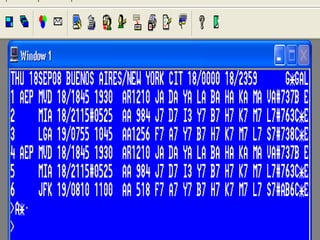
 Leg- Based pricing , where seat
allocation is used to maximize revenue
on each sector of a flight
 Origin – destination pricing models ,
where complex linear programming
techniques are used to compare
whether a multi-leg passenger trip will
generate more revenue than a single leg
trip , and to allocate seats accordingly
GEOGRAPHY:
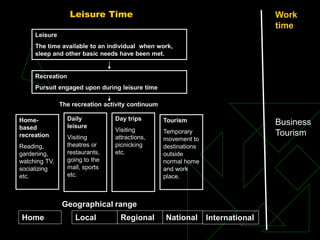
Leisure Time
Leisure
The time available to an individual when work,
sleep and other basic needs have been met.
Recreation
Pursuit engaged upon during leisure time
The recreation activity continuum
Home-
based
recreation
Reading,
gardening,
watching TV,
socializing
etc.
Daily
leisure
Visiting
theatres or
restaurants,
going to the
mall, sports
etc.
Day trips
Visiting
attractions,
picnicking
etc.
Tourism
Temporary
movement to
destinations
outside
normal home
and work
place.
Geographical range
Home Local Regional National International
Work
time
Business
Tourism
Geography and
Tourism
 When we study the geography of travel and
tourism, three key concepts need to be
considered:
1. spatial scale
2. the geographical components of the
tourism system
3. spatial interaction between the components
of the tourist system
Spatial scale
 This idea of scale, keeps in focus the
area being dealt with
 From the geographical point of view,
tourism can be considered from number
of scale
- world scale
- regional scale
- local scale
The geographical components
of the tourism system
 Tourist generating areas - represent the
homes of tourists, where journeys begin
and end.
 Tourist receiving areas - attract tourists
to stay temporarily and will have
features and attractions that may not be
fund in the generating area
 Transit routes – link these two types of
areas and are a key element in the
system as their effectiveness and
characteristics shape the volume and
direction of tourist flows.
- Such routes represent the transport
component of the tourism industry.
The geographical components
of the tourism system
Spatial interaction between the
components of the tourist system
 Tourist flow
An understanding of tourist flow is
critical for managing the environmental
and social impacts of tourism , securing
commercial viability of the tourism
industry and for planning new
developments
Explaining tourist flow
 Factors that helped to explain these flows:
1. Distances between countries ( the greater
the distance, the smaller the volume of
flow)
2. International connectivity ( shared business
or cultural ties between countries
3. The general attractiveness of the country
MARKETING:
 Kotler and Armstrong (1991), marketing
is a process whereby individuals and
groups obtain the type of products or
goods they value
MARKETING:
 These goods are created and
exchanged through a social and
managerial process which requires a
detailed understanding of consumers
and their wants and desires so that
product or service is effectively
delivered to the client or purchaser
Within Marketing
Three Areas exist:
Strategic Planning
Marketing Research
The marketing mix
Strategic Planning:
 Formal planning process
 The process of developing and
maintaining a strategic fit
between the organization’s goal
and capabilities and its
changing marketing
opportunities
Organizations
 Mission
 To serve great tasting food, bringing the joy of eating to
everyone.
 Vision
 We are the best tasting QSR..
 The most endearing brand that has ever been...
 We will lead in product taste at all times...
 We will provide FSC excellence
 in every encounter...
 Happiness in every moment...
 By year 2020, with over 4,000 stores
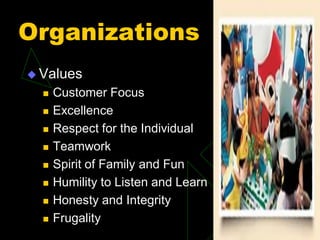
Organizations
 Values
 Customer Focus
 Excellence
 Respect for the Individual
 Teamwork
 Spirit of Family and Fun
 Humility to Listen and Learn
 Honesty and Integrity
 Frugality
Organizations
 Globe Telecom is a leading
telecommunications company in the
Philippines. We continue to grow and
engage our customers through our clear
commitment of "Making Great Things
Possible."
Organizations
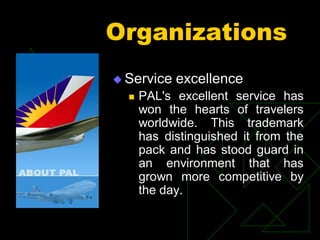
 Service excellence
 PAL's excellent service has
won the hearts of travelers
worldwide. This trademark
has distinguished it from the
pack and has stood guard in
an environment that has
grown more competitive by
the day.
Strategic Planning:
 SWOT Analysis
S – Strength
W – Weaknesses
O – Opportunities
T – Threats
Marketing Research :
 is an organized process associated with the
gathering, processing, analysis, storage and
dissemination of information to facilitate and
improve decision making
 It incorporates various forms and research
undertaken by organizations to understand
their customers, markets and business
efficiency
Marketing Mix :
 is the mixture of controllable marketing
variables that the firm uses to pursue
the sought level of sales in the target
market
 There are four main market variables :
product formulation, price, promotion
and place
Marketing Mix :
 Product formulation – the ability of the
company to adapt to the needs of its
consumers in terms of the services it
provides
 Price – the economic concept used to
adjust the supply of a service to meet
the demand, taking account of sales
targets
Marketing Mix :
 Promotion – the manner in which the
company seek improve customers knowledge
of the services it sells so that those people
who are made aware may be turned into
actual purchasers
- To achieve promotional aims,
advertising, public relations, sales and
brochure production functions are undertaken
Marketing Mix :
 Place – the location at which
prospective customers may be induced
to purchase a service - the point of sale
( Travel Agency )
Airline Marketing :
 Is to bring together the supply of air
services, which each airline can largely
control , with the demand, and which
can influence but not control and to do
this in a way which is both profitable and
meets the airline’s corporate objectives
Airline Marketing
Strategies:
 Strategic Alliances
Examples:
 Oneworld is a global alliance that brings
together ten of the world's biggest and best
airlines, all committed to providing world-
class service and value.
Airline Marketing
Strategies:Strategic Alliances
Examples:
 StarAlliance - the airline network was established in 1997 as
the first truly global airline alliance to offer customers
worldwide reach and a smooth travel experience.
Airline Marketing
Strategies:Strategic Alliances
Examples:
 Sky Team -
Airline Marketing
Strategies:
 Acquisition
 Joint Ventures
 Franchising
 Ancillary Services
The role of marketing in the
management of airline services:
1. Identify markets and market segments
using research methods and existing
data sources and traffic forecasts.
2. Use the market analysis to assess
which products to offer.
The role of marketing in the
management of airline services:
3. Develop a marketing plan to plan and
organize the selling of the products
4. Monitor and review the airline’s ability
to meet service standards , assessed
through sales figures, customers
surveys, analysis of complaints and
long term planning to develop new
service and product features
MANAGEMENT:
 Getting things done in organizations
through other people
 Is concerned with the ability of
individuals to conduct, control, take
charge of, or manipulate the world to
achieve a desired outcome
 Management occurs in the context of
formal environment – ORGANIZATION
Management Process :
 Planning - so that goals are set out
and the means of achieving the goals
are recognized
 Organizing – whereby the work
functions are broken down into a
series of tasks and linked to some
form of structure
Management Process :
 Leading – which the method of
motivating and influencing staff so
that they perform their tasks
effectively
 Controlling – which is the method by
which information is gathered about
what has to be done
Airline Management :
 The process whereby individual ( and
group of) airlines seek to organize,
direct and harness their resources,
personnel and their business activities
to meet the needs of their organization
and customers in an effective and
efficient manner

TOUR8 MIDTERM: E analyzing and managing tourist transport

  • 1.
  • 2.
    Subject Areas thathave a direct contribution to the analysis of tourist transport system  Economics  Geography  Marketing  Management
  • 3.
    ECONOMICS  According toCraven (1990) Economics is concerned with the economy of economic system ad the problem of allocating resources is a central theme of economics, because most resources are scarce
  • 4.
    Resources :  Naturalresources ( land )  Labor ( human resources)  Capital (man- made aid to assist in producing goods )  Methods and Machines Collectively these resources constitute the factors of production which are used to produce commodities
  • 5.
    The commodities canbe divided into :  Goods ( tangible products such as an aircraft )  Services ( intangible items such as in- flight service )
  • 6.
    Microeconomics :  Thefirm  The consumer  Production and Selling  The demand for goods  The supply of goods
  • 7.
    Macroeconomics :  Howthe national economy operates  Employment and unemployment  Inflation  National production and consumption  The money supply in a country
  • 8.
    Demand :  Withineconomics, the concern with the allocation of resources to satisfy individual’s desire to travel means that transport economist examine the demand for different modes of travel and the competition between such modes of in relation to price, speed and convenience  What affects people’s travel behavior
  • 9.
    Supply :  Supplyof a commodity, which is often seen as a function of its price and the price of alternative goods  Price is often influenced by the cost of the factors of production
  • 10.
    Supply  From thetransport operator’s perspective, the main objective in supply terms is to maximize profitability from the available capacity, which is usually expressed in terms of the load factor  Transport companies can maximize passenger revenue by minimizing costs and pricing their product or service at a competitive rate.
  • 11.
    The supply oftourist transport can be characterized by :  Major capital requirements for passenger carriage (cost of the aircraft, passenger trains and ferries)  Government regulations and restrictions to monitor the supply which is determined by state policy  Competitive reaction from other business involved in tourist transport  A high level of expertise required to operate and manage tourist transport enterprises
  • 12.
    The pricing ofAir travel - The various price strategies are:  Single - pricing , where a uniform price is charged for passengers on the same flight  Multiple – pricing, which involves segmenting the market and offering empty seats at a lower price  Yield management, involving management planning, and computer programming to optimize revenue by selecting the optimum mix of travelers
  • 13.
    The pricing ofAir travel - The various price strategies are:  Yield management, enhances revenue from the seat allocation, by restricting the availability of lower – priced fares, airlines are able to safeguard against revenue dilution in an environment where many of the costs of airline operations are relatively fixed for each departure
  • 14.
    The pricing ofAir travel - The various price strategies are:  Leg- Based pricing , where seat allocation is used to maximize revenue on each sector of a flight  Origin – destination pricing models , where complex linear programming techniques are used to compare whether a multi-leg passenger trip will generate more revenue than a single leg trip , and to allocate seats accordingly
  • 16.
  • 17.
    Leisure Time Leisure The timeavailable to an individual when work, sleep and other basic needs have been met. Recreation Pursuit engaged upon during leisure time The recreation activity continuum Home- based recreation Reading, gardening, watching TV, socializing etc. Daily leisure Visiting theatres or restaurants, going to the mall, sports etc. Day trips Visiting attractions, picnicking etc. Tourism Temporary movement to destinations outside normal home and work place. Geographical range Home Local Regional National International Work time Business Tourism
  • 18.
    Geography and Tourism  Whenwe study the geography of travel and tourism, three key concepts need to be considered: 1. spatial scale 2. the geographical components of the tourism system 3. spatial interaction between the components of the tourist system
  • 19.
    Spatial scale  Thisidea of scale, keeps in focus the area being dealt with  From the geographical point of view, tourism can be considered from number of scale - world scale - regional scale - local scale
  • 20.
    The geographical components ofthe tourism system  Tourist generating areas - represent the homes of tourists, where journeys begin and end.  Tourist receiving areas - attract tourists to stay temporarily and will have features and attractions that may not be fund in the generating area
  • 21.
     Transit routes– link these two types of areas and are a key element in the system as their effectiveness and characteristics shape the volume and direction of tourist flows. - Such routes represent the transport component of the tourism industry. The geographical components of the tourism system
  • 22.
    Spatial interaction betweenthe components of the tourist system  Tourist flow An understanding of tourist flow is critical for managing the environmental and social impacts of tourism , securing commercial viability of the tourism industry and for planning new developments
  • 23.
    Explaining tourist flow Factors that helped to explain these flows: 1. Distances between countries ( the greater the distance, the smaller the volume of flow) 2. International connectivity ( shared business or cultural ties between countries 3. The general attractiveness of the country
  • 24.
    MARKETING:  Kotler andArmstrong (1991), marketing is a process whereby individuals and groups obtain the type of products or goods they value
  • 25.
    MARKETING:  These goodsare created and exchanged through a social and managerial process which requires a detailed understanding of consumers and their wants and desires so that product or service is effectively delivered to the client or purchaser
  • 26.
    Within Marketing Three Areasexist: Strategic Planning Marketing Research The marketing mix
  • 27.
    Strategic Planning:  Formalplanning process  The process of developing and maintaining a strategic fit between the organization’s goal and capabilities and its changing marketing opportunities
  • 28.
    Organizations  Mission  Toserve great tasting food, bringing the joy of eating to everyone.  Vision  We are the best tasting QSR..  The most endearing brand that has ever been...  We will lead in product taste at all times...  We will provide FSC excellence  in every encounter...  Happiness in every moment...  By year 2020, with over 4,000 stores
  • 29.
    Organizations  Values  CustomerFocus  Excellence  Respect for the Individual  Teamwork  Spirit of Family and Fun  Humility to Listen and Learn  Honesty and Integrity  Frugality
  • 30.
    Organizations  Globe Telecomis a leading telecommunications company in the Philippines. We continue to grow and engage our customers through our clear commitment of "Making Great Things Possible."
  • 31.
    Organizations  Service excellence PAL's excellent service has won the hearts of travelers worldwide. This trademark has distinguished it from the pack and has stood guard in an environment that has grown more competitive by the day.
  • 33.
    Strategic Planning:  SWOTAnalysis S – Strength W – Weaknesses O – Opportunities T – Threats
  • 34.
    Marketing Research : is an organized process associated with the gathering, processing, analysis, storage and dissemination of information to facilitate and improve decision making  It incorporates various forms and research undertaken by organizations to understand their customers, markets and business efficiency
  • 35.
    Marketing Mix : is the mixture of controllable marketing variables that the firm uses to pursue the sought level of sales in the target market  There are four main market variables : product formulation, price, promotion and place
  • 36.
    Marketing Mix : Product formulation – the ability of the company to adapt to the needs of its consumers in terms of the services it provides  Price – the economic concept used to adjust the supply of a service to meet the demand, taking account of sales targets
  • 37.
    Marketing Mix : Promotion – the manner in which the company seek improve customers knowledge of the services it sells so that those people who are made aware may be turned into actual purchasers - To achieve promotional aims, advertising, public relations, sales and brochure production functions are undertaken
  • 38.
    Marketing Mix : Place – the location at which prospective customers may be induced to purchase a service - the point of sale ( Travel Agency )
  • 39.
    Airline Marketing : Is to bring together the supply of air services, which each airline can largely control , with the demand, and which can influence but not control and to do this in a way which is both profitable and meets the airline’s corporate objectives
  • 40.
    Airline Marketing Strategies:  StrategicAlliances Examples:  Oneworld is a global alliance that brings together ten of the world's biggest and best airlines, all committed to providing world- class service and value.
  • 41.
    Airline Marketing Strategies:Strategic Alliances Examples: StarAlliance - the airline network was established in 1997 as the first truly global airline alliance to offer customers worldwide reach and a smooth travel experience.
  • 42.
  • 43.
    Airline Marketing Strategies:  Acquisition Joint Ventures  Franchising  Ancillary Services
  • 44.
    The role ofmarketing in the management of airline services: 1. Identify markets and market segments using research methods and existing data sources and traffic forecasts. 2. Use the market analysis to assess which products to offer.
  • 45.
    The role ofmarketing in the management of airline services: 3. Develop a marketing plan to plan and organize the selling of the products 4. Monitor and review the airline’s ability to meet service standards , assessed through sales figures, customers surveys, analysis of complaints and long term planning to develop new service and product features
  • 46.
    MANAGEMENT:  Getting thingsdone in organizations through other people  Is concerned with the ability of individuals to conduct, control, take charge of, or manipulate the world to achieve a desired outcome  Management occurs in the context of formal environment – ORGANIZATION
  • 47.
    Management Process : Planning - so that goals are set out and the means of achieving the goals are recognized  Organizing – whereby the work functions are broken down into a series of tasks and linked to some form of structure
  • 48.
    Management Process : Leading – which the method of motivating and influencing staff so that they perform their tasks effectively  Controlling – which is the method by which information is gathered about what has to be done
  • 49.
    Airline Management : The process whereby individual ( and group of) airlines seek to organize, direct and harness their resources, personnel and their business activities to meet the needs of their organization and customers in an effective and efficient manner