
www.heatflux.com
Improving Performance of Coker Heaters
Ashutosh Garg
Furnace Improvements
Sugar Land, TX
www.heatflux.com
Coker Heaters
 Most critical heaters in the refineries
 Objective: Heavy feedstock is converted to higher value products, such as
gasoline, diesel fuel, LPG, and petroleum coke
 Delayed coking is an endothermic reaction with the heater supplying heat
 Coking in Tubes:
 Pressure drop goes up
 Tube metal temperatures go up
 The rate of coke deposition determine Coker heater run length
 Coke removal by steam spalling/pigging (1-4 days lost)
 Any shutdown for coke removal causes production loss
2
www.heatflux.com
Coker Heater Typical Design Parameters
 Inlet temperature
 500-600°F
 Outlet temperature
 900-950°F
 Coil Pressure Drop
 350-450 Psi (EOR)
 Condensate Flow Rate
 0.5–1% of heater feed
 Average Heat Flux
 < 10,000 Btu/hr.ft2 (Single
Fired)
 Mass velocity
 350-550 lb/sec.ft2
 Cold oil velocity
 around 6-10 ft/s
3
www.heatflux.com
Coker Heater
4
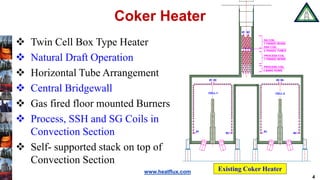
 Twin Cell Box Type Heater
 Natural Draft Operation
 Horizontal Tube Arrangement
 Central Bridgewall
 Gas fired floor mounted Burners
 Process, SSH and SG Coils in
Convection Section
 Self- supported stack on top of
Convection Section
Existing Coker Heater
PROCESS COIL
4 BARE ROWS
SG COIL
7 FINNED ROWS
SSH COIL
2 FINNED TUBES
PROCESS COIL
7 FINNED ROWS
#1 #2
CELL-1 CELL-2
#1
#1
#2
#2
#4
#4#3
www.heatflux.com
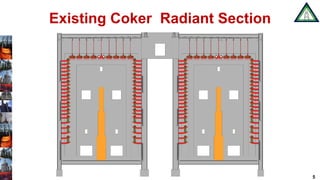
Existing Coker Radiant Section
5
www.heatflux.com
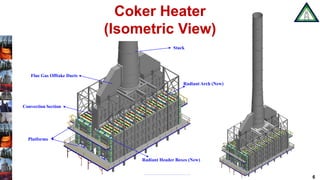
Stack
Flue Gas Offtake Ducts
Convection Section
Platforms
Radiant Header Boxes (New)
Radiant Arch (New)
Coker Heater
(Isometric View)
6
www.heatflux.com
Coker Heater Operating Issues
Coking
 Frequent decoking requirement (every year)
 Short tube life around 5-6 years
Overheating and flame impingement on roof tubes
 Longer flame lengths
 Low roof tubes elevation
 Firing Imbalance
 Higher firing in outer cells by almost 30%
7
www.heatflux.com
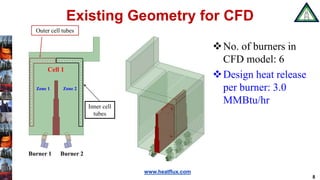
Existing Geometry for CFD
8
Burner 1 Burner 2
Cell 1
Zone 1 Zone 2
Inner cell
tubes
Outer cell tubes
No. of burners in
CFD model: 6
Design heat release
per burner: 3.0
MMBtu/hr
www.heatflux.com
Flue Gas Flow and Temperature Profile
9
 Higher
velocity flue
gas is
observed on
the inner side
 Higher flue
gas
temperature
observed near
the inner cell
tubes
Existing Design
[°F]
[ft/s]
www.heatflux.com
Radiant Heat Flux Profile
10
 Radiant heat flux for
inner cell tubes is
higher as compared to
the outer cell tubes
Existing Design
Inner Tubes Outer Tubes
[Btu/hr.ft2]
www.heatflux.com
Flue Gas Temperature around Tubes
11
[°F]
Inner Tubes Outer Tubes
 Flue gas temperatures around
inner cell tubes and outer cell
tubes are significantly
different
Existing Design
www.heatflux.com
[°F]
Flue Gas Flow and Temperature Profile
12
 High flue gas temperature and
velocity is reduced for the inner
tubes
Existing Operating[ft/s]
www.heatflux.com
Radiant Heat Flux
13
Inner Tubes Outer Tubes
 Radiant heat flux is
similar for inner and
outer tubes for
operating case
Existing Operating
[Btu/hr.ft2]
www.heatflux.com
Flue Gas Temperature around Tubes
Inner Tubes
Existing Operating
[°F]
Outer Tubes
 Clearly, the difference in
flue gas temperatures around
inner and outer cell tubes
have reduced significantly as
compared to the design case
 This reduction is because
inner cells were fired at 30%
lower firing rate than outer
cells
14
www.heatflux.com
Design = 12 Psi
Average = 17.58 Psi
10
13
16
18
21
24
15-May-14 8-Jan-15 2-Sep-15 26-Apr-16 19-Dec-16 14-Aug-17
Pressure,(Psi)
TIME
Fuel Gas Pressure
15
West Outer Cell West Center Cell
Design = 12 Psi
Average = 12.45 Psi
6
9
12
14
17
20
15-May-14 8-Jan-15 2-Sep-15 26-Apr-16 19-Dec-16 14-Aug-17
Pressure,(Psi)
TIME
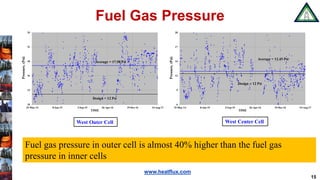
Fuel gas pressure in outer cell is almost 40% higher than the fuel gas
pressure in inner cells
www.heatflux.com
1
(Pass
inlet)
5
10
31
(Pass
outlet)
800
810
820
830
840
850
860
870
880
890
900
1 2 3 4 5 6 7 8 9 10 11-15
TubeMetalTemperature,ºF
Tube No(s).
Operating: Inner Tubes
Operating: Outer Tubes
0.6°F
1.5°F
4.2°F
5.2°F
4.8°F
5.8°F
6.8°F
6.8°F
7.6°F
5.6°F
7.5°F
800
810
820
830
840
850
860
870
880
890
900
1 2 3 4 5 6 7 8 9 10 11-15
TubeMetalTemperature,ºF
Tube No(s).
Design: Inner Tubes
Design: Outer Tubes2.9°F
7.7°F
13.4°F
15.7°F
17.9°F
16.9°F
17.1°F
15.3°F
16.8°F
14.5°F
16.4°F
TMT Comparison with Existing Design
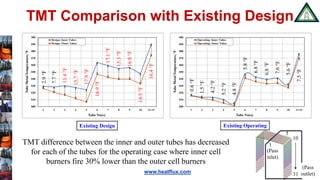
TMT difference between the inner and outer tubes has decreased
for each of the tubes for the operating case where inner cell
burners fire 30% lower than the outer cell burners
Existing Design Existing Operating
www.heatflux.com
Flue Gas Temperature Profile
17
Operating Case
For operating case flue
gas temperature in the
inner cell has reduced
[°F]
Design Case
www.heatflux.com
Radiant Heat Flux Profile
18
Design Case Operating Case
Radiant tubes heat flux
for inner tubes has
been reduced for the
operating case
[Btu/hr.ft2]
www.heatflux.com
Radiant Re-Tubing Proposed Options
(Design TMTs)
19
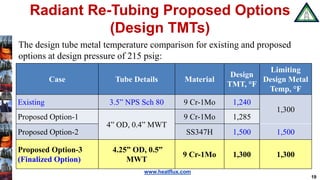
The design tube metal temperature comparison for existing and proposed
options at design pressure of 215 psig:
Case Tube Details Material
Design
TMT, °F
Limiting
Design Metal
Temp, °F
Existing 3.5” NPS Sch 80 9 Cr-1Mo 1,240
1,300
Proposed Option-1
4” OD, 0.4” MWT
9 Cr-1Mo 1,285
Proposed Option-2 SS347H 1,500 1,500
Proposed Option-3
(Finalized Option)
4.25” OD, 0.5”
MWT
9 Cr-1Mo 1,300 1,300
www.heatflux.com
Radiant Coil Re-Tubing
 No. of radiant tubes: 62 per box
 Tube size: 4” OD, Sch 80
 Heat transfer area: 7,770 ft2
 Tube material: 9 Cr
 Coker Mass Velocity-295 lbs/s ft2
 Pressure drop-210 psi
 Total radiant tubes: 66 per box
 Addition of 4 new radiant tubes
 2 tubes installed at outlet and 2
at roof
 Tube size: 4.25” OD, 0.5” MWT
 Heat transfer area: 8,880 ft2
 Tube material: 9 Cr
 Coker Mass Velocity-347 lbs/s ft2
 Pressure Drop- 242 psi
20
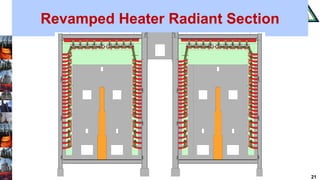
Existing Design Proposed Design
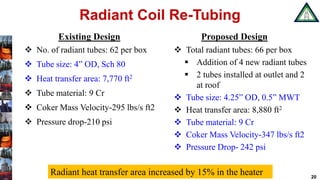
Radiant heat transfer area increased by 15% in the heater
www.heatflux.com
Revamped Heater Radiant Section
21
www.heatflux.com
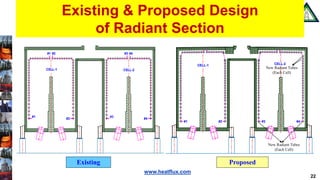
Existing & Proposed Design
of Radiant Section
22
New Radiant Tubes
(Each Cell)
New Radiant Tubes
(Each Cell)
ProposedExisting
CELL-1 CELL-2
#1
#1
#2
#2
#4
#4#3
#1 #2 #4#3
CELL-1 CELL-2
www.heatflux.com
Velocity Vectors
 Flue gas velocity near inner
tubes is very high and getting
deflected downward
 Flue gas velocity is shifted
downward with addition of baffle
 Roof tubes are away from flue gas
Adding refractory baffle at the top further improves the flue gas recirculation pattern
Existing Proposed Case with
Baffle
Proposed Case
[ft/s]
www.heatflux.com
Flue Gas Temperature Contours
Addition of refractory baffle further increased the distance of hot flue gas with
respect to roof tubes
 High temperature flue gas is
touching the inner roof tubes
 Shifting roof tubes reduces chances of
flame impingement / coking issues
24
[°F]
Existing Proposed Case with
Baffle
Proposed Case
www.heatflux.com
Radiant Tube Heat Flux (Arch)
Maximum heat flux on roof tubes is reduced by ~4,200 Btu/hr.ft2
Proposed Case
Heat Flux 18,651 Btu/hr.ft2 Heat Flux 14,443 Btu/hr.ft2
Existing
25
[Btu/hr.ft2]
www.heatflux.com
5,000
9,000
13,000
17,000
21,000
25,000
0 5 10 15 20 25 30
RadiantHeatFlux,Btu/hr-ft2
Radiant Tube No.
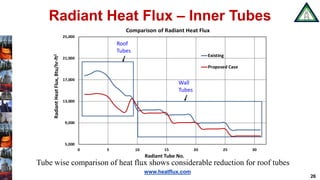
Comparison of Radiant Heat Flux
Existing
Proposed Case
Roof
Tubes
Wall
Tubes
Tube wise comparison of heat flux shows considerable reduction for roof tubes
Radiant Heat Flux – Inner Tubes
26
www.heatflux.com
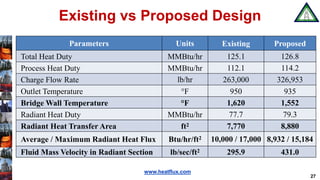
Existing vs Proposed Design
Parameters Units Existing Proposed
Total Heat Duty MMBtu/hr 125.1 126.8
Process Heat Duty MMBtu/hr 112.1 114.2
Charge Flow Rate lb/hr 263,000 326,953
Outlet Temperature °F 950 935
Bridge Wall Temperature °F 1,620 1,552
Radiant Heat Duty MMBtu/hr 77.7 79.3
Radiant Heat Transfer Area ft2 7,770 8,880
Average / Maximum Radiant Heat Flux Btu/hr/ft2 10,000 / 17,000 8,932 / 15,184
Fluid Mass Velocity in Radiant Section lb/sec/ft2 295.9 431.0
27
www.heatflux.com
Future Revamping
 The convection section needs upgrading. Feed outlet
temperature from convection section is 650-660F as
compared to design of 710F.
 The flue gas temperature approach to the coker feed is
around 250-300 F and can be reduced significantly.
 Convection upgrade will substantially help the coker heater
further.
 Future revamping window opens up around 2026
28
www.heatflux.com
Thank you very much
 Questions and Comments are Welcome
29
Travel Tip- Download “ Gypsy Guide for Hawaii” on your cell phone and start driving.

Improving Performance of Coker Heaters

  • 1.
    www.heatflux.com Improving Performance ofCoker Heaters Ashutosh Garg Furnace Improvements Sugar Land, TX
  • 2.
    www.heatflux.com Coker Heaters  Mostcritical heaters in the refineries  Objective: Heavy feedstock is converted to higher value products, such as gasoline, diesel fuel, LPG, and petroleum coke  Delayed coking is an endothermic reaction with the heater supplying heat  Coking in Tubes:  Pressure drop goes up  Tube metal temperatures go up  The rate of coke deposition determine Coker heater run length  Coke removal by steam spalling/pigging (1-4 days lost)  Any shutdown for coke removal causes production loss 2
  • 3.
    www.heatflux.com Coker Heater TypicalDesign Parameters  Inlet temperature  500-600°F  Outlet temperature  900-950°F  Coil Pressure Drop  350-450 Psi (EOR)  Condensate Flow Rate  0.5–1% of heater feed  Average Heat Flux  < 10,000 Btu/hr.ft2 (Single Fired)  Mass velocity  350-550 lb/sec.ft2  Cold oil velocity  around 6-10 ft/s 3
  • 4.
    www.heatflux.com Coker Heater 4  TwinCell Box Type Heater  Natural Draft Operation  Horizontal Tube Arrangement  Central Bridgewall  Gas fired floor mounted Burners  Process, SSH and SG Coils in Convection Section  Self- supported stack on top of Convection Section Existing Coker Heater PROCESS COIL 4 BARE ROWS SG COIL 7 FINNED ROWS SSH COIL 2 FINNED TUBES PROCESS COIL 7 FINNED ROWS #1 #2 CELL-1 CELL-2 #1 #1 #2 #2 #4 #4#3
  • 5.
  • 6.
    www.heatflux.com Stack Flue Gas OfftakeDucts Convection Section Platforms Radiant Header Boxes (New) Radiant Arch (New) Coker Heater (Isometric View) 6
  • 7.
    www.heatflux.com Coker Heater OperatingIssues Coking  Frequent decoking requirement (every year)  Short tube life around 5-6 years Overheating and flame impingement on roof tubes  Longer flame lengths  Low roof tubes elevation  Firing Imbalance  Higher firing in outer cells by almost 30% 7
  • 8.
    www.heatflux.com Existing Geometry forCFD 8 Burner 1 Burner 2 Cell 1 Zone 1 Zone 2 Inner cell tubes Outer cell tubes No. of burners in CFD model: 6 Design heat release per burner: 3.0 MMBtu/hr
  • 9.
    www.heatflux.com Flue Gas Flowand Temperature Profile 9  Higher velocity flue gas is observed on the inner side  Higher flue gas temperature observed near the inner cell tubes Existing Design [°F] [ft/s]
  • 10.
    www.heatflux.com Radiant Heat FluxProfile 10  Radiant heat flux for inner cell tubes is higher as compared to the outer cell tubes Existing Design Inner Tubes Outer Tubes [Btu/hr.ft2]
  • 11.
    www.heatflux.com Flue Gas Temperaturearound Tubes 11 [°F] Inner Tubes Outer Tubes  Flue gas temperatures around inner cell tubes and outer cell tubes are significantly different Existing Design
  • 12.
    www.heatflux.com [°F] Flue Gas Flowand Temperature Profile 12  High flue gas temperature and velocity is reduced for the inner tubes Existing Operating[ft/s]
  • 13.
    www.heatflux.com Radiant Heat Flux 13 InnerTubes Outer Tubes  Radiant heat flux is similar for inner and outer tubes for operating case Existing Operating [Btu/hr.ft2]
  • 14.
    www.heatflux.com Flue Gas Temperaturearound Tubes Inner Tubes Existing Operating [°F] Outer Tubes  Clearly, the difference in flue gas temperatures around inner and outer cell tubes have reduced significantly as compared to the design case  This reduction is because inner cells were fired at 30% lower firing rate than outer cells 14
  • 15.
    www.heatflux.com Design = 12Psi Average = 17.58 Psi 10 13 16 18 21 24 15-May-14 8-Jan-15 2-Sep-15 26-Apr-16 19-Dec-16 14-Aug-17 Pressure,(Psi) TIME Fuel Gas Pressure 15 West Outer Cell West Center Cell Design = 12 Psi Average = 12.45 Psi 6 9 12 14 17 20 15-May-14 8-Jan-15 2-Sep-15 26-Apr-16 19-Dec-16 14-Aug-17 Pressure,(Psi) TIME Fuel gas pressure in outer cell is almost 40% higher than the fuel gas pressure in inner cells
  • 16.
    www.heatflux.com 1 (Pass inlet) 5 10 31 (Pass outlet) 800 810 820 830 840 850 860 870 880 890 900 1 2 34 5 6 7 8 9 10 11-15 TubeMetalTemperature,ºF Tube No(s). Operating: Inner Tubes Operating: Outer Tubes 0.6°F 1.5°F 4.2°F 5.2°F 4.8°F 5.8°F 6.8°F 6.8°F 7.6°F 5.6°F 7.5°F 800 810 820 830 840 850 860 870 880 890 900 1 2 3 4 5 6 7 8 9 10 11-15 TubeMetalTemperature,ºF Tube No(s). Design: Inner Tubes Design: Outer Tubes2.9°F 7.7°F 13.4°F 15.7°F 17.9°F 16.9°F 17.1°F 15.3°F 16.8°F 14.5°F 16.4°F TMT Comparison with Existing Design TMT difference between the inner and outer tubes has decreased for each of the tubes for the operating case where inner cell burners fire 30% lower than the outer cell burners Existing Design Existing Operating
  • 17.
    www.heatflux.com Flue Gas TemperatureProfile 17 Operating Case For operating case flue gas temperature in the inner cell has reduced [°F] Design Case
  • 18.
    www.heatflux.com Radiant Heat FluxProfile 18 Design Case Operating Case Radiant tubes heat flux for inner tubes has been reduced for the operating case [Btu/hr.ft2]
  • 19.
    www.heatflux.com Radiant Re-Tubing ProposedOptions (Design TMTs) 19 The design tube metal temperature comparison for existing and proposed options at design pressure of 215 psig: Case Tube Details Material Design TMT, °F Limiting Design Metal Temp, °F Existing 3.5” NPS Sch 80 9 Cr-1Mo 1,240 1,300 Proposed Option-1 4” OD, 0.4” MWT 9 Cr-1Mo 1,285 Proposed Option-2 SS347H 1,500 1,500 Proposed Option-3 (Finalized Option) 4.25” OD, 0.5” MWT 9 Cr-1Mo 1,300 1,300
  • 20.
    www.heatflux.com Radiant Coil Re-Tubing No. of radiant tubes: 62 per box  Tube size: 4” OD, Sch 80  Heat transfer area: 7,770 ft2  Tube material: 9 Cr  Coker Mass Velocity-295 lbs/s ft2  Pressure drop-210 psi  Total radiant tubes: 66 per box  Addition of 4 new radiant tubes  2 tubes installed at outlet and 2 at roof  Tube size: 4.25” OD, 0.5” MWT  Heat transfer area: 8,880 ft2  Tube material: 9 Cr  Coker Mass Velocity-347 lbs/s ft2  Pressure Drop- 242 psi 20 Existing Design Proposed Design Radiant heat transfer area increased by 15% in the heater
  • 21.
  • 22.
    www.heatflux.com Existing & ProposedDesign of Radiant Section 22 New Radiant Tubes (Each Cell) New Radiant Tubes (Each Cell) ProposedExisting CELL-1 CELL-2 #1 #1 #2 #2 #4 #4#3 #1 #2 #4#3 CELL-1 CELL-2
  • 23.
    www.heatflux.com Velocity Vectors  Fluegas velocity near inner tubes is very high and getting deflected downward  Flue gas velocity is shifted downward with addition of baffle  Roof tubes are away from flue gas Adding refractory baffle at the top further improves the flue gas recirculation pattern Existing Proposed Case with Baffle Proposed Case [ft/s]
  • 24.
    www.heatflux.com Flue Gas TemperatureContours Addition of refractory baffle further increased the distance of hot flue gas with respect to roof tubes  High temperature flue gas is touching the inner roof tubes  Shifting roof tubes reduces chances of flame impingement / coking issues 24 [°F] Existing Proposed Case with Baffle Proposed Case
  • 25.
    www.heatflux.com Radiant Tube HeatFlux (Arch) Maximum heat flux on roof tubes is reduced by ~4,200 Btu/hr.ft2 Proposed Case Heat Flux 18,651 Btu/hr.ft2 Heat Flux 14,443 Btu/hr.ft2 Existing 25 [Btu/hr.ft2]
  • 26.
    www.heatflux.com 5,000 9,000 13,000 17,000 21,000 25,000 0 5 1015 20 25 30 RadiantHeatFlux,Btu/hr-ft2 Radiant Tube No. Comparison of Radiant Heat Flux Existing Proposed Case Roof Tubes Wall Tubes Tube wise comparison of heat flux shows considerable reduction for roof tubes Radiant Heat Flux – Inner Tubes 26
  • 27.
    www.heatflux.com Existing vs ProposedDesign Parameters Units Existing Proposed Total Heat Duty MMBtu/hr 125.1 126.8 Process Heat Duty MMBtu/hr 112.1 114.2 Charge Flow Rate lb/hr 263,000 326,953 Outlet Temperature °F 950 935 Bridge Wall Temperature °F 1,620 1,552 Radiant Heat Duty MMBtu/hr 77.7 79.3 Radiant Heat Transfer Area ft2 7,770 8,880 Average / Maximum Radiant Heat Flux Btu/hr/ft2 10,000 / 17,000 8,932 / 15,184 Fluid Mass Velocity in Radiant Section lb/sec/ft2 295.9 431.0 27
  • 28.
    www.heatflux.com Future Revamping  Theconvection section needs upgrading. Feed outlet temperature from convection section is 650-660F as compared to design of 710F.  The flue gas temperature approach to the coker feed is around 250-300 F and can be reduced significantly.  Convection upgrade will substantially help the coker heater further.  Future revamping window opens up around 2026 28
  • 29.
    www.heatflux.com Thank you verymuch  Questions and Comments are Welcome 29 Travel Tip- Download “ Gypsy Guide for Hawaii” on your cell phone and start driving.