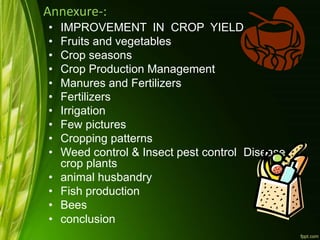
This document discusses various ways to improve food resources through better crop yields, management, and agriculture. It covers improving yields through better seeds, fruits, vegetables, and crop seasons. It also discusses crop production management through fertilizers, manures, irrigation, cropping patterns, and pest and disease control. Lastly, it mentions animal husbandry, fish production, and bees as additional sources of food.
![IMPROVEMENT IN CROP YIELDS . TYPES:-
1] Seeds : Not all seeds of plants are edible like seeds of apple or
cherries. Edible seeds include cereals, pulses , oil seeds & nuts.
Cereals : They include crops like wheat, rice, maize, barley etc.
Pulses : They include legumes such as chicken pea gram, pea,
black gram, pigeon pea etc.
Oil seed crop: They include cotton seed, Niger , soybean etc.
Nuts or Dry Fruits : Nuts are rich in proteins . Example include –
coconut, peanut, date, walnut.](https://image.slidesharecdn.com/improvementinfoodresource-161206014354/85/Improvement-in-food-resource-3-320.jpg)
![Kharif Crop : these crop grow during rainy season -
[ June to October] . They are also known as summer season
crops .few examples of kharif crops are –
Garlic ,lady finger, black gram, green gram, plum ,peach etc.
Rabi Crop: these crops are grown during November to April .
Rabi crops are known as winter crops . Some examples of
rabi crops are – cabbage , cauliflower , carrot , radish , beans
etc.](https://image.slidesharecdn.com/improvementinfoodresource-161206014354/85/Improvement-in-food-resource-6-320.jpg)
![Manures and Fertilizers
• Manures :-manures are natural fertilizers . They are bulky sources of organic
matter which supply nutrients in small quantities , and organic matter in
large quantities. Manure enrich the soil with nutrients , they add organic
matter , the organic matter in manures provides food for the soil organism .
Types of manure :- Farmyard Manure [FYM]
Compost: Prepared from farm and town refuse such as vegetables and animal
refuse](https://image.slidesharecdn.com/improvementinfoodresource-161206014354/85/Improvement-in-food-resource-9-320.jpg)
![Fertilizers
Fertilizers provide plant nutrients , commercially manufactured
using chemicals. Fertilizers supply Nitrogen, Phosphorus and
Potassium [NPK] . They are used for the vegetative growth.
Fertilizers are divided into following group :-
1] Nitrogenous fertilizers
2] Phosphatic fertilizers
3] Potassic fertilizers
4] Complex fertilizers](https://image.slidesharecdn.com/improvementinfoodresource-161206014354/85/Improvement-in-food-resource-10-320.jpg)
![Irrigation
The process of supplying water to crop plants by means of
canals , wells , reservoirs, tube-wells, etc. is known as
irrigation.
Factors of controlling irrigation :
Irrigation depends on the nature of the crop
Irrigation dependent on the nature fields
1] Crop based production : some crop plants require more
water & some less water for cereals as wheat irrigation is
required before ploughing the field
2] Soil based irrigation : irrigation also depends on the
nature of the soil in which the crop is grown](https://image.slidesharecdn.com/improvementinfoodresource-161206014354/85/Improvement-in-food-resource-11-320.jpg)
![Irrigation systems
Canal system ;in canal system , human made canals are used to
receive water from one or two reservoir
Tanks: tanks are small storage reservoir.
Wells : wells are constructed whenever exploitable ground water are
present
1] dug well and 2] tube well are two types of wells
River lift system : in this system water is directly drawn from rivers
drip and sprinkler system : this method save water and use pipes .](https://image.slidesharecdn.com/improvementinfoodresource-161206014354/85/Improvement-in-food-resource-12-320.jpg)

![Cropping patterns
1] mixed cropping : this is a process in
which more than one or two plants are
grown together.
2] intercropping : it aims to increase
productivity per unit area.
3] Crop rotation : the particles of
growing of different crops on a price of
land in a prepared succession.](https://image.slidesharecdn.com/improvementinfoodresource-161206014354/85/Improvement-in-food-resource-14-320.jpg)
![Weed control & Insect pest control
Weeds are the unwanted plants in the
cultivated fields.
Many insects are serious pests of plants they
attack plants in the following ways
1] chewing insects
2] sucking insects
3] internal feeders](https://image.slidesharecdn.com/improvementinfoodresource-161206014354/85/Improvement-in-food-resource-15-320.jpg)
![Disease of crop plants
There are some names of diseases of plants
1] seed-borne disease
2] soil-borne disease
3] air-borne disease
4] water-borne disease](https://image.slidesharecdn.com/improvementinfoodresource-161206014354/85/Improvement-in-food-resource-16-320.jpg)
![Animal husbandry
The branch of agriculture that deals with the
feeding , caring ,and breeding of domestic
animals is called animal husbandry . they
include :-
1] cattle farming
2] breeds of buffaloes](https://image.slidesharecdn.com/improvementinfoodresource-161206014354/85/Improvement-in-food-resource-17-320.jpg)
![Fish production
Marine fishes :- India is a vast scope of marine
fishery . Our marine fishery resources include 7500
kms cost line and extensive deep sea . popularly
consumed fishes are as follows :-
1] pomphrets2
2] mackerels
3] tuna
4] eel
5] hilsa
6] salmon , etc.](https://image.slidesharecdn.com/improvementinfoodresource-161206014354/85/Improvement-in-food-resource-18-320.jpg)
![Bees……..
Honey & bee wax are obtained from bees
There are three types of bees . They are :-
1] the worker
2] queen
3] drone](https://image.slidesharecdn.com/improvementinfoodresource-161206014354/85/Improvement-in-food-resource-19-320.jpg)