WATER RESOURCES
DEVELOPMENT IN INDIA
Water Resources
Besides oceans covering roughly 3/4th of
the earth surface, numerous water bodies such as
rivers, lakes, ponds, tanks and ground water
constitute important sources of water.
1. Rain water:
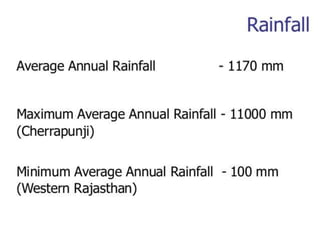
The average annual rainfall over India is 1170
mm as against worlds average of 1100 mm.
Despite this favourable endowment, serious
water shortage is experienced in many areas
due toerratic and uncertain rainfall and lack of
water conservation measures.
Cherrapunji in Meghalaya in North-East of
India with the highest rainfall (Over 11,000
mm) in the world, is the most glaring example
of water scarcity in the non-monsoon months
due to utter neglect of water conservation.
Likewise, Kerala state in the South-West
suffers from water stress during the non-rainy
period inspite of about 3000 mm annual
rainfall, due to excessive runoff loss caused by
indiscriminate deforestation, sloping
mountainous terrain, road construction, and
absence of conservation measures.
2. Surface water:
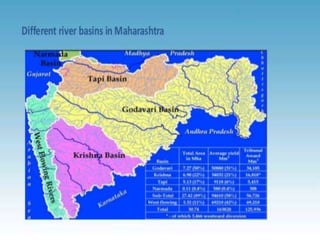
Of several rivers that flow through India, there are
12 major rivers with total catchment area of 258 m
ha, out of which the Ganga-Brahmaputra-Meghna
system is the largest with catchment area of about
110 m ha (44%).
The other rivers with catchment area of more than
10 m ha are: Indus (32.1 m ha), Godavari (31.1 m
ha), Krishna (25.9 m ha) and Mahanadi (14.2 m ha).
3. Ground Water:
It is an important source of irrigation. It also
meets the demands of drinking water,
household uses and industry.
Although groundwater use for irrigation is
termed as minor irrigation.
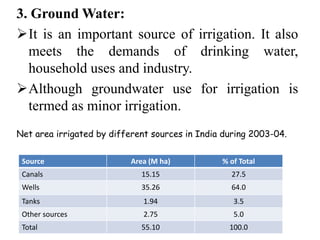
Net area irrigated by different sources in India during 2003-04.
Source Area (M ha) % of Total
Canals 15.15 27.5
Wells 35.26 64.0
Tanks 1.94 3.5
Other sources 2.75 5.0
Total 55.10 100.0
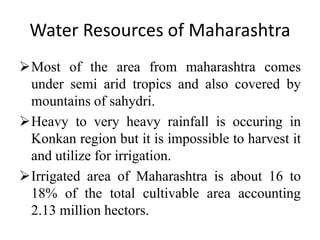
Water Resources of Maharashtra
Most of the area from maharashtra comes
under semi arid tropics and also covered by
mountains of sahydri.
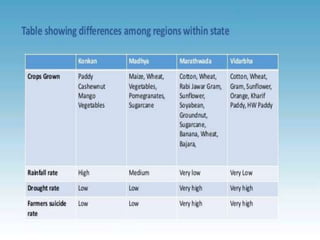
Heavy to very heavy rainfall is occuring in
Konkan region but it is impossible to harvest it
and utilize for irrigation.
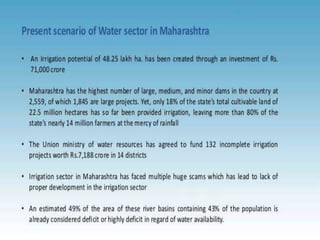
Irrigated area of Maharashtra is about 16 to
18% of the total cultivable area accounting
2.13 million hectors.
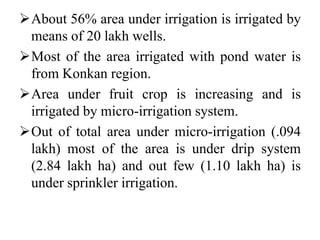
About 56% area under irrigation is irrigated by
means of 20 lakh wells.
Most of the area irrigated with pond water is
from Konkan region.
Area under fruit crop is increasing and is
irrigated by micro-irrigation system.
Out of total area under micro-irrigation (.094
lakh) most of the area is under drip system
(2.84 lakh ha) and out few (1.10 lakh ha) is
under sprinkler irrigation.
Water resources development in India

Water resources development in India

  • 1.
  • 5.
    Water Resources Besides oceanscovering roughly 3/4th of the earth surface, numerous water bodies such as rivers, lakes, ponds, tanks and ground water constitute important sources of water. 1. Rain water: The average annual rainfall over India is 1170 mm as against worlds average of 1100 mm. Despite this favourable endowment, serious water shortage is experienced in many areas due toerratic and uncertain rainfall and lack of water conservation measures.
  • 6.
    Cherrapunji in Meghalayain North-East of India with the highest rainfall (Over 11,000 mm) in the world, is the most glaring example of water scarcity in the non-monsoon months due to utter neglect of water conservation. Likewise, Kerala state in the South-West suffers from water stress during the non-rainy period inspite of about 3000 mm annual rainfall, due to excessive runoff loss caused by indiscriminate deforestation, sloping mountainous terrain, road construction, and absence of conservation measures.
  • 7.
    2. Surface water: Ofseveral rivers that flow through India, there are 12 major rivers with total catchment area of 258 m ha, out of which the Ganga-Brahmaputra-Meghna system is the largest with catchment area of about 110 m ha (44%). The other rivers with catchment area of more than 10 m ha are: Indus (32.1 m ha), Godavari (31.1 m ha), Krishna (25.9 m ha) and Mahanadi (14.2 m ha).
  • 9.
    3. Ground Water: Itis an important source of irrigation. It also meets the demands of drinking water, household uses and industry. Although groundwater use for irrigation is termed as minor irrigation. Net area irrigated by different sources in India during 2003-04. Source Area (M ha) % of Total Canals 15.15 27.5 Wells 35.26 64.0 Tanks 1.94 3.5 Other sources 2.75 5.0 Total 55.10 100.0
  • 18.
    Water Resources ofMaharashtra Most of the area from maharashtra comes under semi arid tropics and also covered by mountains of sahydri. Heavy to very heavy rainfall is occuring in Konkan region but it is impossible to harvest it and utilize for irrigation. Irrigated area of Maharashtra is about 16 to 18% of the total cultivable area accounting 2.13 million hectors.
  • 19.
    About 56% areaunder irrigation is irrigated by means of 20 lakh wells. Most of the area irrigated with pond water is from Konkan region. Area under fruit crop is increasing and is irrigated by micro-irrigation system. Out of total area under micro-irrigation (.094 lakh) most of the area is under drip system (2.84 lakh ha) and out few (1.10 lakh ha) is under sprinkler irrigation.