IMPROVEMENT IN FOOD
RESOURCES
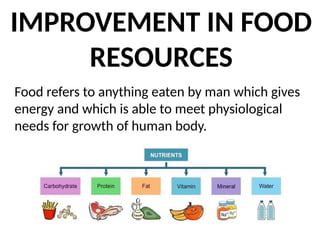
Food refers to anything eaten by man which gives
energy and which is able to meet physiological
needs for growth of human body.
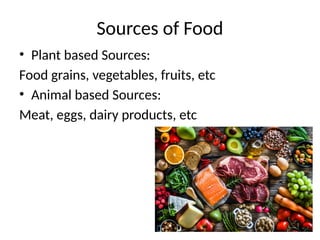
Sources of Food
• Plant based Sources:
Food grains, vegetables, fruits, etc
• Animal based Sources:
Meat, eggs, dairy products, etc
Why to Improve ?
• India is a very populous country. Our population
is more than 1.3 billion people. and it is still
growing. As we need food for this growing
population, we will soon need more than a
quarter of a billion tones of grain every year.
• India is already intensively cultivated. Therefore it
is necessary to increase our production efficiency
for both crops & livestock.
• Green Revolution:
Started in 1960s by M.S. Swaminathan
Use of high yielding variety (HYV) seeds,
tractors, irrigation facilities, pesticides, and
fertilizers.
• White Revolution:
Started in 1970s by Dr Tribhuvan Das Patel
This led to better & more efficient use as well as
availability of milk.
Crop Yields
• Crop yield is a measurement of the amount of
agricultural production harvested per unit of land
area.
• Carbohydrates: Wheat, rice, maize, millets(bajra),
sorghum(chaara), etc
• Protein: gram (chana), pea (matar), black gram
(urad), green gram (moong), pigeon pea (arhar),
lentil (masoor), etc
• Fats: soyabean, ground nut, sesame (til), castor,
mustard, linseed(alsi) and sunflower, etc
• Vitamins & Minerals: Vegetables, spices and fruits
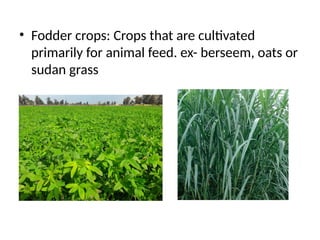
• Fodder crops: Crops that are cultivated
primarily for animal feed. ex- berseem, oats or
sudan grass
• Different crops require different climatic
conditions, temperature and photoperiods for
their growth and completion of their life cycle.
• Photoperiod: Duration of Sunlight or Day
length
• In India there has been a four times increase
in the production of food grains from 1952 to
2010 with only 25% increase in the cultivable
land area.
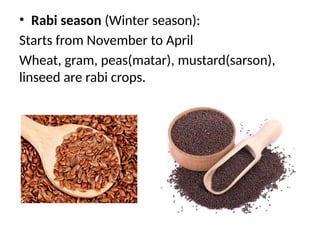
• Rabi season (Winter season):
Starts from November to April
Wheat, gram, peas(matar), mustard(sarson),
linseed are rabi crops.
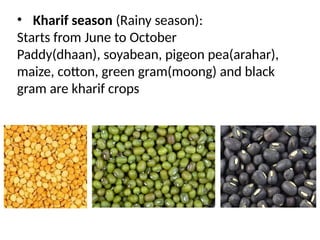
• Kharif season (Rainy season):
Starts from June to October
Paddy(dhaan), soyabean, pigeon pea(arahar),
maize, cotton, green gram(moong) and black
gram are kharif crops
Three stages of Farming
• Crop variety improvement: Choice of seeds
for planting.
• Crop production improvement: Nurturing of
the crop plants.
• Crop protection management: Protection of
the growing and harvested crops from loss.
Crop Variety Improvement
• This approach depends on finding a crop variety
that can give a good yield.
• One way of incorporating desirable characters
into crop varieties is by hybridisation.
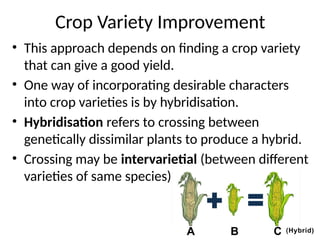
• Hybridisation refers to crossing between
genetically dissimilar plants to produce a hybrid.
• Crossing may be intervarietial (between different
varieties of same species)
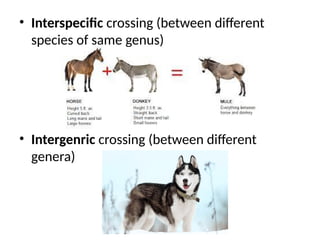
• Interspecific crossing (between different
species of same genus)
• Intergenric crossing (between different
genera)
Factors for which Improvement is done for:
• Higher yield: To increase the productivity of the crop per
acre.
• Improved quality: Quality considerations of crop
products vary from crop to crop. Baking quality is
important in wheat, protein quality in pulses, oil quality
in oilseeds and preserving quality in fruits and
vegetables.
• Biotic and abiotic resistance: Crops production can go
down due to biotic (diseases, insects and nematodes)
and abiotic (drought. salinity, water logging, heat, cold
and frost) stresses under different situations. Varieties
resistant to these stresses can improve crop production.
• Change in maturity duration: The shorter the duration
of the crop from sowing to harvesting, the more
economical is the variety. Such short durations allow
farmers to grow multiple rounds of crops in a year.
Short duration also reduces the cost of crop production.
• Wider adaptability: Developing varieties for wider
adaptability will help in stabilising the crop production
under different environmental conditions. One variety
can then be grown under different climatic conditions in
different areas.
• Desirable agronomic characteristics: Tallness and
profuse branching are desirable characters for fodder
crops.Dwarfness is desired in cereals, so that less
nutrients are consumed by these crops.
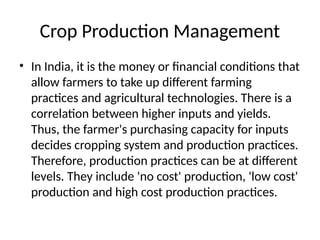
Crop Production Management
• In India, it is the money or financial conditions that
allow farmers to take up different farming
practices and agricultural technologies. There is a
correlation between higher inputs and yields.
Thus, the farmer's purchasing capacity for inputs
decides cropping system and production practices.
Therefore, production practices can be at different
levels. They include 'no cost' production, 'low cost'
production and high cost production practices.
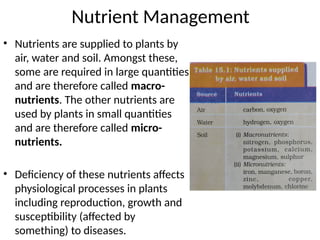
Nutrient Management
• Nutrients are supplied to plants by
air, water and soil. Amongst these,
some are required in large quantities
and are therefore called macro-
nutrients. The other nutrients are
used by plants in small quantities
and are therefore called micro-
nutrients.
• Deficiency of these nutrients affects
physiological processes in plants
including reproduction, growth and
susceptibility (affected by
something) to diseases.
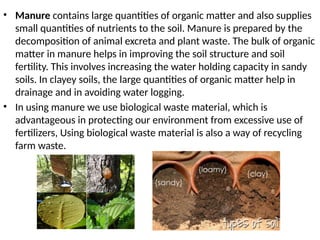
• Manure contains large quantities of organic matter and also supplies
small quantities of nutrients to the soil. Manure is prepared by the
decomposition of animal excreta and plant waste. The bulk of organic
matter in manure helps in improving the soil structure and soil
fertility. This involves increasing the water holding capacity in sandy
soils. In clayey soils, the large quantities of organic matter help in
drainage and in avoiding water logging.
• In using manure we use biological waste material, which is
advantageous in protecting our environment from excessive use of
fertilizers, Using biological waste material is also a way of recycling
farm waste.
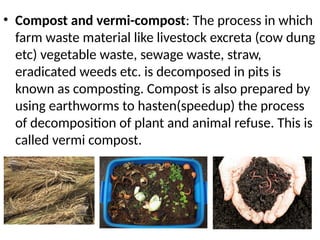
• Compost and vermi-compost: The process in which
farm waste material like livestock excreta (cow dung
etc) vegetable waste, sewage waste, straw,
eradicated weeds etc. is decomposed in pits is
known as composting. Compost is also prepared by
using earthworms to hasten(speedup) the process
of decomposition of plant and animal refuse. This is
called vermi compost.
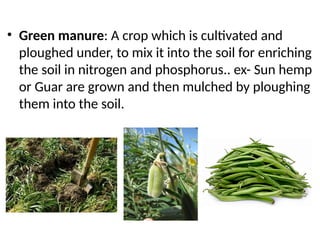
• Green manure: A crop which is cultivated and
ploughed under, to mix it into the soil for enriching
the soil in nitrogen and phosphorus.. ex- Sun hemp
or Guar are grown and then mulched by ploughing
them into the soil.
• Fertilizers are commercially produced plant
nutrients. Fertilizers supply nitrogen, phosphorus
and potassium. They are used to ensure good
vegetative growth. Fertilizers are a factor in the
higher yields of high-cost farming.
• Fertilizers should be applied carefully in terms of
proper dose, time, and observing pre and post-
application precautions for their complete
utilisation. For example, sometimes fertilizers get
washed away due to excessive irrigation and are
not fully absorbed by the plants. Continuous use
of fertilizers in an area can destroy soil fertility.
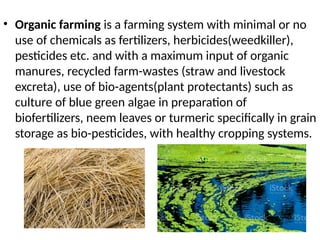
• Organic farming is a farming system with minimal or no
use of chemicals as fertilizers, herbicides(weedkiller),
pesticides etc. and with a maximum input of organic
manures, recycled farm-wastes (straw and livestock
excreta), use of bio-agents(plant protectants) such as
culture of blue green algae in preparation of
biofertilizers, neem leaves or turmeric specifically in grain
storage as bio-pesticides, with healthy cropping systems.
• Irrigation is the process of applying controlled
amounts of water to land to assist the
production of crops Most agriculture in India
is dependent on timely monsoons and
sufficient rainfall. Hence, poor monsoons
cause crop failure. Ensuring that the crops get
water at the right stages during their growing
season can increase the expected yields of any
crop. Different kinds of irrigation systems are
adopted to supply water to agricultural lands
including wells, canals, rivers and tanks.
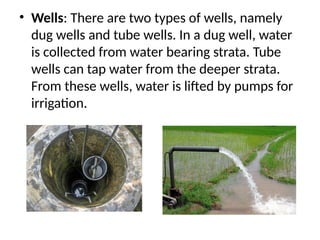
• Wells: There are two types of wells, namely
dug wells and tube wells. In a dug well, water
is collected from water bearing strata. Tube
wells can tap water from the deeper strata.
From these wells, water is lifted by pumps for
irrigation.
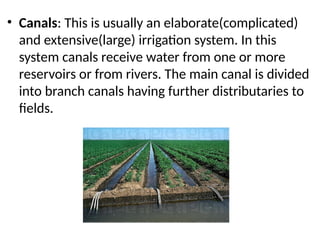
• Canals: This is usually an elaborate(complicated)
and extensive(large) irrigation system. In this
system canals receive water from one or more
reservoirs or from rivers. The main canal is divided
into branch canals having further distributaries to
fields.
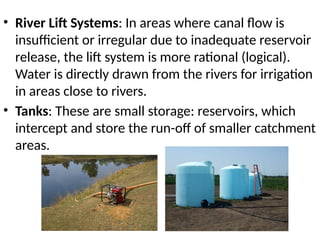
• River Lift Systems: In areas where canal flow is
insufficient or irregular due to inadequate reservoir
release, the lift system is more rational (logical).
Water is directly drawn from the rivers for irrigation
in areas close to rivers.
• Tanks: These are small storage: reservoirs, which
intercept and store the run-off of smaller catchment
areas.
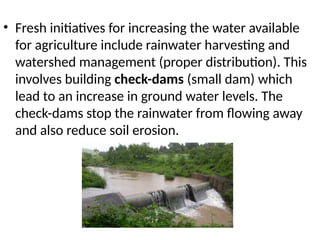
• Fresh initiatives for increasing the water available
for agriculture include rainwater harvesting and
watershed management (proper distribution). This
involves building check-dams (small dam) which
lead to an increase in ground water levels. The
check-dams stop the rainwater from flowing away
and also reduce soil erosion.
Cropping Pattern
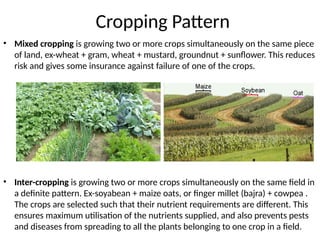
• Mixed cropping is growing two or more crops simultaneously on the same piece
of land, ex-wheat + gram, wheat + mustard, groundnut + sunflower. This reduces
risk and gives some insurance against failure of one of the crops.
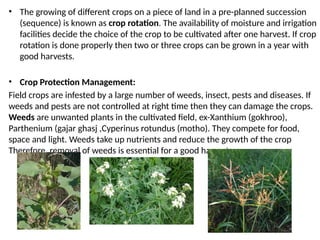
• Inter-cropping is growing two or more crops simultaneously on the same field in
a definite pattern. Ex-soyabean + maize oats, or finger millet (bajra) + cowpea .
The crops are selected such that their nutrient requirements are different. This
ensures maximum utilisation of the nutrients supplied, and also prevents pests
and diseases from spreading to all the plants belonging to one crop in a field.
• The growing of different crops on a piece of land in a pre-planned succession
(sequence) is known as crop rotation. The availability of moisture and irrigation
facilities decide the choice of the crop to be cultivated after one harvest. If crop
rotation is done properly then two or three crops can be grown in a year with
good harvests.
• Crop Protection Management:
Field crops are infested by a large number of weeds, insect, pests and diseases. If
weeds and pests are not controlled at right time then they can damage the crops.
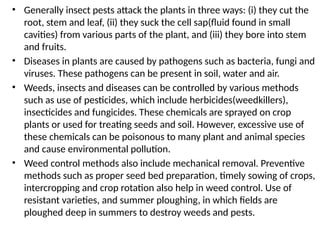
Weeds are unwanted plants in the cultivated field, ex-Xanthium (gokhroo),
Parthenium (gajar ghasj ,Cyperinus rotundus (motho). They compete for food,
space and light. Weeds take up nutrients and reduce the growth of the crop
Therefore, removal of weeds is essential for a good harvest.
• Generally insect pests attack the plants in three ways: (i) they cut the
root, stem and leaf, (ii) they suck the cell sap(fluid found in small
cavities) from various parts of the plant, and (iii) they bore into stem
and fruits.
• Diseases in plants are caused by pathogens such as bacteria, fungi and
viruses. These pathogens can be present in soil, water and air.
• Weeds, insects and diseases can be controlled by various methods
such as use of pesticides, which include herbicides(weedkillers),
insecticides and fungicides. These chemicals are sprayed on crop
plants or used for treating seeds and soil. However, excessive use of
these chemicals can be poisonous to many plant and animal species
and cause environmental pollution.
• Weed control methods also include mechanical removal. Preventive
methods such as proper seed bed preparation, timely sowing of crops,
intercropping and crop rotation also help in weed control. Use of
resistant varieties, and summer ploughing, in which fields are
ploughed deep in summers to destroy weeds and pests.
• Storage of grains: Factors responsible for
storage losses are biotic-insects, rodents,
fungi, mites and bacteria, and abiotic-
inappropriate moisture and temperature in
the place of storage. These cause degradation
in quality, loss in weight, poor germinability
(growth ability), discoloration of produce, all
leading to poor marketability.
• Preventive measures include cleaning of the
crop produce before storage, proper drying of
the produce first in sunlight and then in shade,
and fumigation(chemical smoke) that can kill
pests.
• Scientific management of animal livestock. It includes
various aspects such as feeding, breeding and disease
control. It includes cattle, goat, sheep, poultry & fish
farming. As the population increases, the demand for
milk, eggs and meat is also going up. Also, the growing
awareness of the need for humane treatment of
livestock has brought in new limitations in livestock
farming.
1. Cattle Farming
2. Poultry Farming (Egg & Broiler Production)
3. Fish Production (Marine & Inland Fisheries)
4. Bee Keeping
Animal Husbandry
• Cattle farming is done for two purposes milk and draught labour such as
tilling (preparing soil), irrigation and carting.
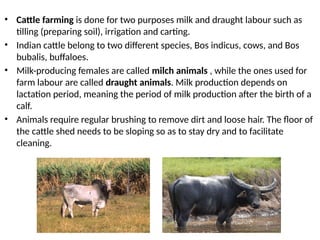
• Indian cattle belong to two different species, Bos indicus, cows, and Bos
bubalis, buffaloes.
• Milk-producing females are called milch animals , while the ones used for
farm labour are called draught animals. Milk production depends on
lactation period, meaning the period of milk production after the birth of a
calf.
• Animals require regular brushing to remove dirt and loose hair. The floor of
the cattle shed needs to be sloping so as to stay dry and to facilitate
cleaning.
• Two types of food: (a) maintenance requirement for animal to live a
healthy life, and (b) milk producing requirement, required during the
lactation period.
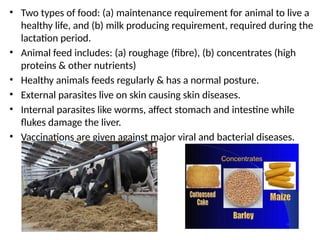
• Animal feed includes: (a) roughage (fibre), (b) concentrates (high
proteins & other nutrients)
• Healthy animals feeds regularly & has a normal posture.
• External parasites live on skin causing skin diseases.
• Internal parasites like worms, affect stomach and intestine while
flukes damage the liver.
• Vaccinations are given against major viral and bacterial diseases.
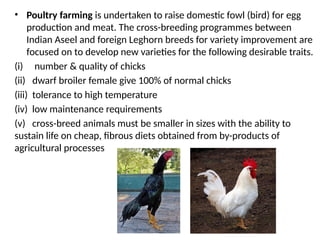
• Poultry farming is undertaken to raise domestic fowl (bird) for egg
production and meat. The cross-breeding programmes between
Indian Aseel and foreign Leghorn breeds for variety improvement are
focused on to develop new varieties for the following desirable traits.
(i) number & quality of chicks
(ii) dwarf broiler female give 100% of normal chicks
(iii) tolerance to high temperature
(iv) low maintenance requirements
(v) cross-breed animals must be smaller in sizes with the ability to
sustain life on cheap, fibrous diets obtained from by-products of
agricultural processes
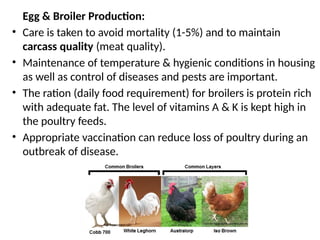
Egg & Broiler Production:
• Care is taken to avoid mortality (1-5%) and to maintain
carcass quality (meat quality).
• Maintenance of temperature & hygienic conditions in housing
as well as control of diseases and pests are important.
• The ration (daily food requirement) for broilers is protein rich
with adequate fat. The level of vitamins A & K is kept high in
the poultry feeds.
• Appropriate vaccination can reduce loss of poultry during an
outbreak of disease.
• Fish production includes the finned true fish (possess fins &
gills) as well as shellfish such as prawns and molluscs. One
way is from natural resources called capture fishing. The
other way is by fish farming, which is called culture fishery.
• Aquaculture (aquafarming), is the controlled cultivation of
aquatic plants & animals.
• Marine Fisheries:
1. 7500 km of coastline and deep seas beyond it.
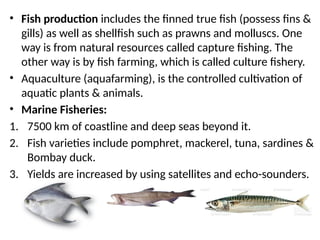
2. Fish varieties include pomphret, mackerel, tuna, sardines &
Bombay duck.
3. Yields are increased by using satellites and echo-sounders.
• Inland Fisheries:
1. Includes canals, ponds. reservoirs and rivers.
2. Brackish water resources, where seawater &
fresh water mix together, such as estuaries and
lagoons.
3. Fish culture is sometimes done in combination
with a rice crop, so that fish are grown in the
water of paddy field.
4. More intensive fish farming can be done in
composite fish culture systems. Both local &
imported fish species are used in such systems.
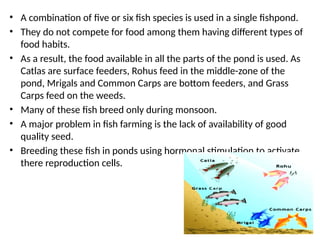
• A combination of five or six fish species is used in a single fishpond.
• They do not compete for food among them having different types of
food habits.
• As a result, the food available in all the parts of the pond is used. As
Catlas are surface feeders, Rohus feed in the middle-zone of the
pond, Mrigals and Common Carps are bottom feeders, and Grass
Carps feed on the weeds.
• Many of these fish breed only during monsoon.
• A major problem in fish farming is the lack of availability of good
quality seed.
• Breeding these fish in ponds using hormonal stimulation to activate
there reproduction cells.
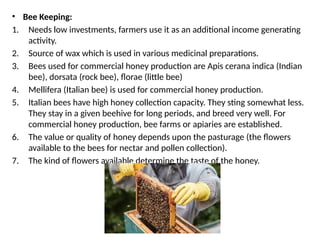
• Bee Keeping:
1. Needs low investments, farmers use it as an additional income generating
activity.
2. Source of wax which is used in various medicinal preparations.
3. Bees used for commercial honey production are Apis cerana indica (Indian
bee), dorsata (rock bee), florae (little bee)
4. Mellifera (Italian bee) is used for commercial honey production.
5. Italian bees have high honey collection capacity. They sting somewhat less.
They stay in a given beehive for long periods, and breed very well. For
commercial honey production, bee farms or apiaries are established.
6. The value or quality of honey depends upon the pasturage (the flowers
available to the bees for nectar and pollen collection).
7. The kind of flowers available determine the taste of the honey.
improvementinfoodresources-220128065954.pptx

  • 1.
    IMPROVEMENT IN FOOD RESOURCES Foodrefers to anything eaten by man which gives energy and which is able to meet physiological needs for growth of human body.
  • 2.
    Sources of Food •Plant based Sources: Food grains, vegetables, fruits, etc • Animal based Sources: Meat, eggs, dairy products, etc
  • 3.
    Why to Improve? • India is a very populous country. Our population is more than 1.3 billion people. and it is still growing. As we need food for this growing population, we will soon need more than a quarter of a billion tones of grain every year. • India is already intensively cultivated. Therefore it is necessary to increase our production efficiency for both crops & livestock.
  • 4.
    • Green Revolution: Startedin 1960s by M.S. Swaminathan Use of high yielding variety (HYV) seeds, tractors, irrigation facilities, pesticides, and fertilizers. • White Revolution: Started in 1970s by Dr Tribhuvan Das Patel This led to better & more efficient use as well as availability of milk.
  • 5.
    Crop Yields • Cropyield is a measurement of the amount of agricultural production harvested per unit of land area. • Carbohydrates: Wheat, rice, maize, millets(bajra), sorghum(chaara), etc • Protein: gram (chana), pea (matar), black gram (urad), green gram (moong), pigeon pea (arhar), lentil (masoor), etc • Fats: soyabean, ground nut, sesame (til), castor, mustard, linseed(alsi) and sunflower, etc • Vitamins & Minerals: Vegetables, spices and fruits
  • 6.
    • Fodder crops:Crops that are cultivated primarily for animal feed. ex- berseem, oats or sudan grass
  • 7.
    • Different cropsrequire different climatic conditions, temperature and photoperiods for their growth and completion of their life cycle. • Photoperiod: Duration of Sunlight or Day length • In India there has been a four times increase in the production of food grains from 1952 to 2010 with only 25% increase in the cultivable land area.
  • 8.
    • Rabi season(Winter season): Starts from November to April Wheat, gram, peas(matar), mustard(sarson), linseed are rabi crops.
  • 9.
    • Kharif season(Rainy season): Starts from June to October Paddy(dhaan), soyabean, pigeon pea(arahar), maize, cotton, green gram(moong) and black gram are kharif crops
  • 10.
    Three stages ofFarming • Crop variety improvement: Choice of seeds for planting. • Crop production improvement: Nurturing of the crop plants. • Crop protection management: Protection of the growing and harvested crops from loss.
  • 11.
    Crop Variety Improvement •This approach depends on finding a crop variety that can give a good yield. • One way of incorporating desirable characters into crop varieties is by hybridisation. • Hybridisation refers to crossing between genetically dissimilar plants to produce a hybrid. • Crossing may be intervarietial (between different varieties of same species)
  • 12.
    • Interspecific crossing(between different species of same genus) • Intergenric crossing (between different genera)
  • 13.
    Factors for whichImprovement is done for: • Higher yield: To increase the productivity of the crop per acre. • Improved quality: Quality considerations of crop products vary from crop to crop. Baking quality is important in wheat, protein quality in pulses, oil quality in oilseeds and preserving quality in fruits and vegetables. • Biotic and abiotic resistance: Crops production can go down due to biotic (diseases, insects and nematodes) and abiotic (drought. salinity, water logging, heat, cold and frost) stresses under different situations. Varieties resistant to these stresses can improve crop production.
  • 14.
    • Change inmaturity duration: The shorter the duration of the crop from sowing to harvesting, the more economical is the variety. Such short durations allow farmers to grow multiple rounds of crops in a year. Short duration also reduces the cost of crop production. • Wider adaptability: Developing varieties for wider adaptability will help in stabilising the crop production under different environmental conditions. One variety can then be grown under different climatic conditions in different areas. • Desirable agronomic characteristics: Tallness and profuse branching are desirable characters for fodder crops.Dwarfness is desired in cereals, so that less nutrients are consumed by these crops.
  • 15.
    Crop Production Management •In India, it is the money or financial conditions that allow farmers to take up different farming practices and agricultural technologies. There is a correlation between higher inputs and yields. Thus, the farmer's purchasing capacity for inputs decides cropping system and production practices. Therefore, production practices can be at different levels. They include 'no cost' production, 'low cost' production and high cost production practices.
  • 16.
    Nutrient Management • Nutrientsare supplied to plants by air, water and soil. Amongst these, some are required in large quantities and are therefore called macro- nutrients. The other nutrients are used by plants in small quantities and are therefore called micro- nutrients. • Deficiency of these nutrients affects physiological processes in plants including reproduction, growth and susceptibility (affected by something) to diseases.
  • 17.
    • Manure containslarge quantities of organic matter and also supplies small quantities of nutrients to the soil. Manure is prepared by the decomposition of animal excreta and plant waste. The bulk of organic matter in manure helps in improving the soil structure and soil fertility. This involves increasing the water holding capacity in sandy soils. In clayey soils, the large quantities of organic matter help in drainage and in avoiding water logging. • In using manure we use biological waste material, which is advantageous in protecting our environment from excessive use of fertilizers, Using biological waste material is also a way of recycling farm waste.
  • 18.
    • Compost andvermi-compost: The process in which farm waste material like livestock excreta (cow dung etc) vegetable waste, sewage waste, straw, eradicated weeds etc. is decomposed in pits is known as composting. Compost is also prepared by using earthworms to hasten(speedup) the process of decomposition of plant and animal refuse. This is called vermi compost.
  • 19.
    • Green manure:A crop which is cultivated and ploughed under, to mix it into the soil for enriching the soil in nitrogen and phosphorus.. ex- Sun hemp or Guar are grown and then mulched by ploughing them into the soil.
  • 20.
    • Fertilizers arecommercially produced plant nutrients. Fertilizers supply nitrogen, phosphorus and potassium. They are used to ensure good vegetative growth. Fertilizers are a factor in the higher yields of high-cost farming. • Fertilizers should be applied carefully in terms of proper dose, time, and observing pre and post- application precautions for their complete utilisation. For example, sometimes fertilizers get washed away due to excessive irrigation and are not fully absorbed by the plants. Continuous use of fertilizers in an area can destroy soil fertility.
  • 21.
    • Organic farmingis a farming system with minimal or no use of chemicals as fertilizers, herbicides(weedkiller), pesticides etc. and with a maximum input of organic manures, recycled farm-wastes (straw and livestock excreta), use of bio-agents(plant protectants) such as culture of blue green algae in preparation of biofertilizers, neem leaves or turmeric specifically in grain storage as bio-pesticides, with healthy cropping systems.
  • 22.
    • Irrigation isthe process of applying controlled amounts of water to land to assist the production of crops Most agriculture in India is dependent on timely monsoons and sufficient rainfall. Hence, poor monsoons cause crop failure. Ensuring that the crops get water at the right stages during their growing season can increase the expected yields of any crop. Different kinds of irrigation systems are adopted to supply water to agricultural lands including wells, canals, rivers and tanks.
  • 23.
    • Wells: Thereare two types of wells, namely dug wells and tube wells. In a dug well, water is collected from water bearing strata. Tube wells can tap water from the deeper strata. From these wells, water is lifted by pumps for irrigation.
  • 24.
    • Canals: Thisis usually an elaborate(complicated) and extensive(large) irrigation system. In this system canals receive water from one or more reservoirs or from rivers. The main canal is divided into branch canals having further distributaries to fields.
  • 25.
    • River LiftSystems: In areas where canal flow is insufficient or irregular due to inadequate reservoir release, the lift system is more rational (logical). Water is directly drawn from the rivers for irrigation in areas close to rivers. • Tanks: These are small storage: reservoirs, which intercept and store the run-off of smaller catchment areas.
  • 26.
    • Fresh initiativesfor increasing the water available for agriculture include rainwater harvesting and watershed management (proper distribution). This involves building check-dams (small dam) which lead to an increase in ground water levels. The check-dams stop the rainwater from flowing away and also reduce soil erosion.
  • 27.
    Cropping Pattern • Mixedcropping is growing two or more crops simultaneously on the same piece of land, ex-wheat + gram, wheat + mustard, groundnut + sunflower. This reduces risk and gives some insurance against failure of one of the crops. • Inter-cropping is growing two or more crops simultaneously on the same field in a definite pattern. Ex-soyabean + maize oats, or finger millet (bajra) + cowpea . The crops are selected such that their nutrient requirements are different. This ensures maximum utilisation of the nutrients supplied, and also prevents pests and diseases from spreading to all the plants belonging to one crop in a field.
  • 28.
    • The growingof different crops on a piece of land in a pre-planned succession (sequence) is known as crop rotation. The availability of moisture and irrigation facilities decide the choice of the crop to be cultivated after one harvest. If crop rotation is done properly then two or three crops can be grown in a year with good harvests. • Crop Protection Management: Field crops are infested by a large number of weeds, insect, pests and diseases. If weeds and pests are not controlled at right time then they can damage the crops. Weeds are unwanted plants in the cultivated field, ex-Xanthium (gokhroo), Parthenium (gajar ghasj ,Cyperinus rotundus (motho). They compete for food, space and light. Weeds take up nutrients and reduce the growth of the crop Therefore, removal of weeds is essential for a good harvest.
  • 29.
    • Generally insectpests attack the plants in three ways: (i) they cut the root, stem and leaf, (ii) they suck the cell sap(fluid found in small cavities) from various parts of the plant, and (iii) they bore into stem and fruits. • Diseases in plants are caused by pathogens such as bacteria, fungi and viruses. These pathogens can be present in soil, water and air. • Weeds, insects and diseases can be controlled by various methods such as use of pesticides, which include herbicides(weedkillers), insecticides and fungicides. These chemicals are sprayed on crop plants or used for treating seeds and soil. However, excessive use of these chemicals can be poisonous to many plant and animal species and cause environmental pollution. • Weed control methods also include mechanical removal. Preventive methods such as proper seed bed preparation, timely sowing of crops, intercropping and crop rotation also help in weed control. Use of resistant varieties, and summer ploughing, in which fields are ploughed deep in summers to destroy weeds and pests.
  • 30.
    • Storage ofgrains: Factors responsible for storage losses are biotic-insects, rodents, fungi, mites and bacteria, and abiotic- inappropriate moisture and temperature in the place of storage. These cause degradation in quality, loss in weight, poor germinability (growth ability), discoloration of produce, all leading to poor marketability. • Preventive measures include cleaning of the crop produce before storage, proper drying of the produce first in sunlight and then in shade, and fumigation(chemical smoke) that can kill pests.
  • 31.
    • Scientific managementof animal livestock. It includes various aspects such as feeding, breeding and disease control. It includes cattle, goat, sheep, poultry & fish farming. As the population increases, the demand for milk, eggs and meat is also going up. Also, the growing awareness of the need for humane treatment of livestock has brought in new limitations in livestock farming. 1. Cattle Farming 2. Poultry Farming (Egg & Broiler Production) 3. Fish Production (Marine & Inland Fisheries) 4. Bee Keeping Animal Husbandry
  • 32.
    • Cattle farmingis done for two purposes milk and draught labour such as tilling (preparing soil), irrigation and carting. • Indian cattle belong to two different species, Bos indicus, cows, and Bos bubalis, buffaloes. • Milk-producing females are called milch animals , while the ones used for farm labour are called draught animals. Milk production depends on lactation period, meaning the period of milk production after the birth of a calf. • Animals require regular brushing to remove dirt and loose hair. The floor of the cattle shed needs to be sloping so as to stay dry and to facilitate cleaning.
  • 33.
    • Two typesof food: (a) maintenance requirement for animal to live a healthy life, and (b) milk producing requirement, required during the lactation period. • Animal feed includes: (a) roughage (fibre), (b) concentrates (high proteins & other nutrients) • Healthy animals feeds regularly & has a normal posture. • External parasites live on skin causing skin diseases. • Internal parasites like worms, affect stomach and intestine while flukes damage the liver. • Vaccinations are given against major viral and bacterial diseases.
  • 34.
    • Poultry farmingis undertaken to raise domestic fowl (bird) for egg production and meat. The cross-breeding programmes between Indian Aseel and foreign Leghorn breeds for variety improvement are focused on to develop new varieties for the following desirable traits. (i) number & quality of chicks (ii) dwarf broiler female give 100% of normal chicks (iii) tolerance to high temperature (iv) low maintenance requirements (v) cross-breed animals must be smaller in sizes with the ability to sustain life on cheap, fibrous diets obtained from by-products of agricultural processes
  • 35.
    Egg & BroilerProduction: • Care is taken to avoid mortality (1-5%) and to maintain carcass quality (meat quality). • Maintenance of temperature & hygienic conditions in housing as well as control of diseases and pests are important. • The ration (daily food requirement) for broilers is protein rich with adequate fat. The level of vitamins A & K is kept high in the poultry feeds. • Appropriate vaccination can reduce loss of poultry during an outbreak of disease.
  • 36.
    • Fish productionincludes the finned true fish (possess fins & gills) as well as shellfish such as prawns and molluscs. One way is from natural resources called capture fishing. The other way is by fish farming, which is called culture fishery. • Aquaculture (aquafarming), is the controlled cultivation of aquatic plants & animals. • Marine Fisheries: 1. 7500 km of coastline and deep seas beyond it. 2. Fish varieties include pomphret, mackerel, tuna, sardines & Bombay duck. 3. Yields are increased by using satellites and echo-sounders.
  • 37.
    • Inland Fisheries: 1.Includes canals, ponds. reservoirs and rivers. 2. Brackish water resources, where seawater & fresh water mix together, such as estuaries and lagoons. 3. Fish culture is sometimes done in combination with a rice crop, so that fish are grown in the water of paddy field. 4. More intensive fish farming can be done in composite fish culture systems. Both local & imported fish species are used in such systems.
  • 38.
    • A combinationof five or six fish species is used in a single fishpond. • They do not compete for food among them having different types of food habits. • As a result, the food available in all the parts of the pond is used. As Catlas are surface feeders, Rohus feed in the middle-zone of the pond, Mrigals and Common Carps are bottom feeders, and Grass Carps feed on the weeds. • Many of these fish breed only during monsoon. • A major problem in fish farming is the lack of availability of good quality seed. • Breeding these fish in ponds using hormonal stimulation to activate there reproduction cells.
  • 39.
    • Bee Keeping: 1.Needs low investments, farmers use it as an additional income generating activity. 2. Source of wax which is used in various medicinal preparations. 3. Bees used for commercial honey production are Apis cerana indica (Indian bee), dorsata (rock bee), florae (little bee) 4. Mellifera (Italian bee) is used for commercial honey production. 5. Italian bees have high honey collection capacity. They sting somewhat less. They stay in a given beehive for long periods, and breed very well. For commercial honey production, bee farms or apiaries are established. 6. The value or quality of honey depends upon the pasturage (the flowers available to the bees for nectar and pollen collection). 7. The kind of flowers available determine the taste of the honey.