// Improved Schedule Risk Analysis
  (SRA) through Metric Assessment
 Enhanced Schedule Delay Forensics through Project Metrics and Ribbon Analysis


                 Dr. Dan Patterson, PMP
                   CEO & President, Acumen

                        February 2010


                                      +1 512 291 6261 // info@projectacumen.com

                                               www.projectacumen.com
Table of Contents

  Contents ...................................................................................................................... 2
  Introduction ................................................................................................................. 3
         Background to Schedule Risk Analysis ................................................................ 3
         How Does a Monte Carlo Schedule Risk Analysis (SRA) Work? ............................. 3
                    Figure 1 – SRA Analysis and the Changing Critical Path ......................... 4
                    Figure 2 – SRA Showing a 36% Chance of Achieving Completion Date.... 5
  Creating a Risk-Ready Schedule ................................................................................. 5
         Sound Logic ......................................................................................................... 5
                    Figure 3 – Example Schedule with Missing Successor on Task 1 ............. 6
                    Figure 4 – Flawed Risk results due to Missing Logic ................................ 6
         Minimal Use of Constraints ................................................................................. 6
                    Figure 5 – Constraints Invalidating a Network Path During a SRA ........... 7
         Other Criteria for Risk-Ready Schedules .............................................................. 7
  Risk-Check Metric Analysis ......................................................................................... 7
                    Figure 6 – Analysis of Schedule Assessing Risk-Readiness ..................... 7
                    Figure 7 – Example of Risk Input Metrics being applied to a Project........ 8
                    Figure 8 – Analysis of Risk Inputs Looking at Average Risk Range .......... 9
  Risk Exposure Metric Analysis ..................................................................................... 9
                    Figure 9 – Risk Exposure Analysis by Discipline ....................................... 9
                    Figure 10 – Risk Exposure Analysis by Discipline ................................... 10
                    Figure 11 – Risk Hot Spots ..................................................................... 11
  Concluding Comments .............................................................................................. 11
  Additional Information ............................................................................................... 11


+1 512 291 6261 // info@projectacumen.com
www.projectacumen.com                                      2
Introduction
This paper discusses the importance of establishing a sound schedule basis and ensuring valid
risk inputs so as to generate an accurate and realistic schedule risk model. A technique for
ensuring both of these criteria is discussed using specific metrics targeted at risk model
validation.

Once a risk analysis is completed, interpreting the results can often be a challenge. This is
especially true within large projects, and so a complimentary approach to interpreting risk
results, pinpointing true risk exposure, understanding when in time the project is at greatest
risk and providing this in a language that is easy to relay to the project team and stakeholders
is also discussed.

Background to Schedule Risk Analysis
Schedule Risk Analysis (SRA) is fast becoming an integral part of project planning.

Instead of forecasting a single deterministic completion date through CPM scheduling, more
and more projects are now leaning towards providing a range of completion dates within the
context of a given confidence level. The technique for calculating such information is based on
an accepted approach using a Monte Carlo analysis. This simulates all possible outcomes in
light of what is known as scope uncertainty and risk events (the two primary sources of
schedule risk).

Unlike other forms of Monte Carlo simulation, a SRA is highly dependent on the structure and
quality of the project schedule itself. In fact, the outputs from a SRA are dependent on two
moving parts:

    1. The project schedule: the CPM schedule containing activities, logic links, calendars,
       resources and other standard components that make up a CPM schedule.
    2. The risk inputs: ranges of uncertainty and discrete risk events typically provided by the
       project team that get overlaid onto the schedule prior to running an analysis.

How Does a Monte Carlo Schedule Risk Analysis (SRA) Work?
A SRA analysis is an evolution of a traditional CPM analysis. Rather than each activity having a
single duration value, activities carry a range of durations (often described as a three point
distribution e.g. min, most likely, max values). During each run of a simulation, values are
sampled from the defined ranges of each activity duration and are then applied to a CPM
analysis (calculating early and late dates). Subsequent simulations are then run so that a
representative range of possible outcomes is established giving the analyst a confidence level
surrounding project completion dates.


+1 512 291 6261 // info@projectacumen.com
www.projectacumen.com                       3
SRA is different to standard Monte Carlo analysis in that a delay on an activity does not
necessarily result in a delay to the overall project. An activity with 10 days of float may incur up
to 10 days of risk delay without actually becoming critical (and thus impacting the project
completion). For simple networks this may seem like an obvious statement but apply this to
large schedules with multiple parallel and interlinking paths and the equation can really only be
solved through simulation.

Even more significant than the duration of a schedule changing, is the changing of the location
of the critical path itself! Activities that may be non critical in the deterministic schedule often
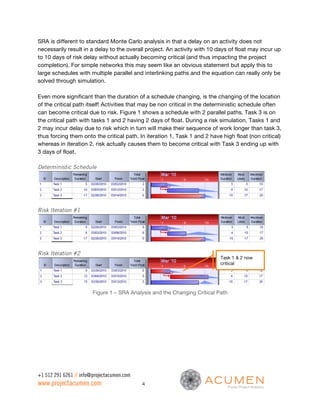
can become critical due to risk. Figure 1 shows a schedule with 2 parallel paths. Task 3 is on
the critical path with tasks 1 and 2 having 2 days of float. During a risk simulation, Tasks 1 and
2 may incur delay due to risk which in turn will make their sequence of work longer than task 3,
thus forcing them onto the critical path. In iteration 1, Task 1 and 2 have high float (non critical)
whereas in iteration 2, risk actually causes them to become critical with Task 3 ending up with
3 days of float.

Deterministic Schedule


Risk Iteration #1


Risk Iteration #2
                                                                           Task 1 & 2 now
                                                                           critical


                        Figure 1 – SRA Analysis and the Changing Critical Path


+1 512 291 6261 // info@projectacumen.com
www.projectacumen.com                       4
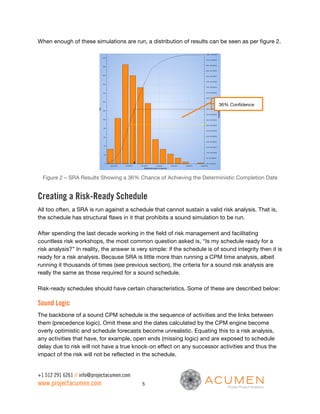
When enough of these simulations are run, a distribution of results can be seen as per figure 2.


                                                                            36% Confidence


  Figure 2 – SRA Results Showing a 36% Chance of Achieving the Deterministic Completion Date


Creating a Risk-Ready Schedule
All too often, a SRA is run against a schedule that cannot sustain a valid risk analysis. That is,
the schedule has structural flaws in it that prohibits a sound simulation to be run.

After spending the last decade working in the field of risk management and facilitating
countless risk workshops, the most common question asked is, “Is my schedule ready for a
risk analysis?” In reality, the answer is very simple: if the schedule is of sound integrity then it is
ready for a risk analysis. Because SRA is little more than running a CPM time analysis, albeit
running it thousands of times (see previous section), the criteria for a sound risk analysis are
really the same as those required for a sound schedule.

Risk-ready schedules should have certain characteristics. Some of these are described below:

Sound Logic
The backbone of a sound CPM schedule is the sequence of activities and the links between
them (precedence logic). Omit these and the dates calculated by the CPM engine become
overly optimistic and schedule forecasts become unrealistic. Equating this to a risk analysis,
any activities that have, for example, open ends (missing logic) and are exposed to schedule
delay due to risk will not have a true knock-on effect on any successor activities and thus the
impact of the risk will not be reflected in the schedule.


+1 512 291 6261 // info@projectacumen.com
www.projectacumen.com                       5
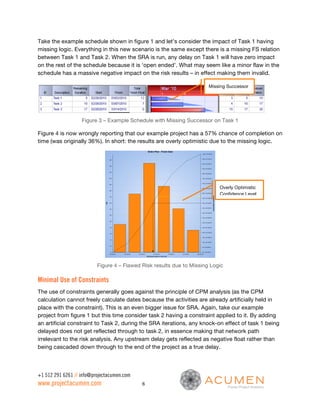
Take the example schedule shown in figure 1 and let’s consider the impact of Task 1 having
missing logic. Everything in this new scenario is the same except there is a missing FS relation
between Task 1 and Task 2. When the SRA is run, any delay on Task 1 will have zero impact
on the rest of the schedule because it is ‘open ended’. What may seem like a minor flaw in the
schedule has a massive negative impact on the risk results – in effect making them invalid.

                                                                       Missing Successor


                   Figure 3 – Example Schedule with Missing Successor on Task 1

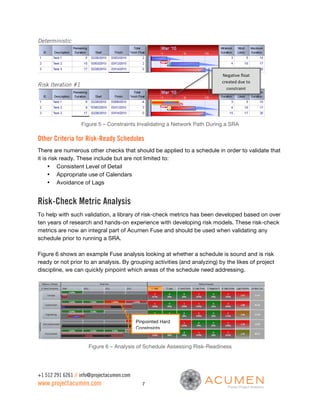
Figure 4 is now wrongly reporting that our example project has a 57% chance of completion on
time (was originally 36%). In short: the results are overly optimistic due to the missing logic.


                                                                           Overly Optimistic
                                                                           Confidence Level


                          Figure 4 – Flawed Risk results due to Missing Logic

Minimal Use of Constraints
The use of constraints generally goes against the principle of CPM analysis (as the CPM
calculation cannot freely calculate dates because the activities are already artificially held in
place with the constraint). This is an even bigger issue for SRA. Again, take our example
project from figure 1 but this time consider task 2 having a constraint applied to it. By adding
an artificial constraint to Task 2, during the SRA iterations, any knock-on effect of task 1 being
delayed does not get reflected through to task 2, in essence making that network path
irrelevant to the risk analysis. Any upstream delay gets reflected as negative float rather than
being cascaded down through to the end of the project as a true delay.


+1 512 291 6261 // info@projectacumen.com
www.projectacumen.com                       6
Deterministic


                                                                            Negative	
  float	
  
                                                                            created	
  due	
  to	
  
Risk Iteration #1
                                                                              constraint	


                    Figure 5 – Constraints Invalidating a Network Path During a SRA

Other Criteria for Risk-Ready Schedules
There are numerous other checks that should be applied to a schedule in order to validate that
it is risk ready. These include but are not limited to:
     • Consistent Level of Detail
     • Appropriate use of Calendars
     • Avoidance of Lags


Risk-Check Metric Analysis
To help with such validation, a library of risk-check metrics has been developed based on over
ten years of research and hands-on experience with developing risk models. These risk-check
metrics are now an integral part of Acumen Fuse and should be used when validating any
schedule prior to running a SRA.

Figure 6 shows an example Fuse analysis looking at whether a schedule is sound and is risk
ready or not prior to an analysis. By grouping activities (and analyzing) by the likes of project
discipline, we can quickly pinpoint which areas of the schedule need addressing.


                                            Pinpointed Hard
                                            Constraints


                      Figure 6 – Analysis of Schedule Assessing Risk-Readiness


+1 512 291 6261 // info@projectacumen.com
www.projectacumen.com                         7
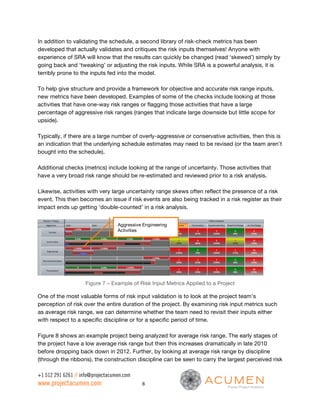
In addition to validating the schedule, a second library of risk-check metrics has been
developed that actually validates and critiques the risk inputs themselves! Anyone with
experience of SRA will know that the results can quickly be changed (read ‘skewed’) simply by
going back and ‘tweaking’ or adjusting the risk inputs. While SRA is a powerful analysis, it is
terribly prone to the inputs fed into the model.

To help give structure and provide a framework for objective and accurate risk range inputs,
new metrics have been developed. Examples of some of the checks include looking at those
activities that have one-way risk ranges or flagging those activities that have a large
percentage of aggressive risk ranges (ranges that indicate large downside but little scope for
upside).

Typically, if there are a large number of overly-aggressive or conservative activities, then this is
an indication that the underlying schedule estimates may need to be revised (or the team aren’t
bought into the schedule).

Additional checks (metrics) include looking at the range of uncertainty. Those activities that
have a very broad risk range should be re-estimated and reviewed prior to a risk analysis.

Likewise, activities with very large uncertainty range skews often reflect the presence of a risk
event. This then becomes an issue if risk events are also being tracked in a risk register as their
impact ends up getting ‘double-counted’ in a risk analysis.


                                   Aggressive Engineering
                                   Activities


                     Figure 7 – Example of Risk Input Metrics Applied to a Project

One of the most valuable forms of risk input validation is to look at the project team’s
perception of risk over the entire duration of the project. By examining risk input metrics such
as average risk range, we can determine whether the team need to revisit their inputs either
with respect to a specific discipline or for a specific period of time.

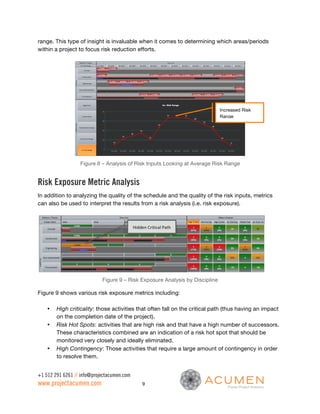
Figure 8 shows an example project being analyzed for average risk range. The early stages of
the project have a low average risk range but then this increases dramatically in late 2010
before dropping back down in 2012. Further, by looking at average risk range by discipline
(through the ribbons), the construction discipline can be seen to carry the largest perceived risk

+1 512 291 6261 // info@projectacumen.com
www.projectacumen.com                        8
range. This type of insight is invaluable when it comes to determining which areas/periods
within a project to focus risk reduction efforts.


                                                                              Increased Risk
                                                                              Range


                  Figure 8 – Analysis of Risk Inputs Looking at Average Risk Range


Risk Exposure Metric Analysis
In addition to analyzing the quality of the schedule and the quality of the risk inputs, metrics
can also be used to interpret the results from a risk analysis (i.e. risk exposure).


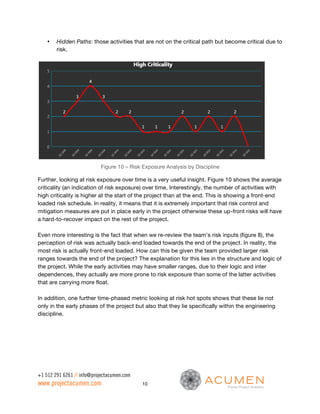
                                            Hidden	
  Critical	
  Path	


                            Figure 9 – Risk Exposure Analysis by Discipline

Figure 9 shows various risk exposure metrics including:

    •   High criticality: those activities that often fall on the critical path (thus having an impact
        on the completion date of the project).
    •   Risk Hot Spots: activities that are high risk and that have a high number of successors.
        These characteristics combined are an indication of a risk hot spot that should be
        monitored very closely and ideally eliminated.
    •   High Contingency: Those activities that require a large amount of contingency in order
        to resolve them.


+1 512 291 6261 // info@projectacumen.com
www.projectacumen.com                              9
•   Hidden Paths: those activities that are not on the critical path but become critical due to
        risk.


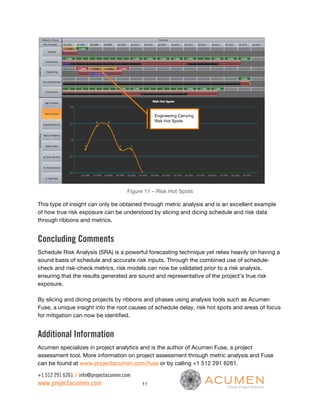
                           Figure 10 – Risk Exposure Analysis by Discipline

Further, looking at risk exposure over time is a very useful insight. Figure 10 shows the average
criticality (an indication of risk exposure) over time. Interestingly, the number of activities with
high criticality is higher at the start of the project than at the end. This is showing a front-end
loaded risk schedule. In reality, it means that it is extremely important that risk control and
mitigation measures are put in place early in the project otherwise these up-front risks will have
a hard-to-recover impact on the rest of the project.

Even more interesting is the fact that when we re-review the team’s risk inputs (figure 8), the
perception of risk was actually back-end loaded towards the end of the project. In reality, the
most risk is actually front-end loaded. How can this be given the team provided larger risk
ranges towards the end of the project? The explanation for this lies in the structure and logic of
the project. While the early activities may have smaller ranges, due to their logic and inter
dependences, they actually are more prone to risk exposure than some of the latter activities
that are carrying more float.

In addition, one further time-phased metric looking at risk hot spots shows that these lie not
only in the early phases of the project but also that they lie specifically within the engineering
discipline.


+1 512 291 6261 // info@projectacumen.com
www.projectacumen.com                       10
Engineering Carrying
                                                 Risk Hot Spots


                                       Figure 11 – Risk Hot Spots

This type of insight can only be obtained through metric analysis and is an excellent example
of how true risk exposure can be understood by slicing and dicing schedule and risk data
through ribbons and metrics.


Concluding Comments
Schedule Risk Analysis (SRA) is a powerful forecasting technique yet relies heavily on having a
sound basis of schedule and accurate risk inputs. Through the combined use of schedule-
check and risk-check metrics, risk models can now be validated prior to a risk analysis,
ensuring that the results generated are sound and representative of the project’s true risk
exposure.

By slicing and dicing projects by ribbons and phases using analysis tools such as Acumen
Fuse, a unique insight into the root causes of schedule delay, risk hot spots and areas of focus
for mitigation can now be identified.


Additional Information
Acumen specializes in project analytics and is the author of Acumen Fuse, a project
assessment tool. More information on project assessment through metric analysis and Fuse
can be found at www.projectacumen.com/fuse or by calling +1 512 291 6261.

+1 512 291 6261 // info@projectacumen.com
www.projectacumen.com                       11

Improved Schedule Risk Analysis through Metric Assessment

  • 1.
    // Improved ScheduleRisk Analysis (SRA) through Metric Assessment Enhanced Schedule Delay Forensics through Project Metrics and Ribbon Analysis Dr. Dan Patterson, PMP CEO & President, Acumen February 2010 +1 512 291 6261 // info@projectacumen.com www.projectacumen.com
  • 2.
    Table of Contents Contents ...................................................................................................................... 2 Introduction ................................................................................................................. 3 Background to Schedule Risk Analysis ................................................................ 3 How Does a Monte Carlo Schedule Risk Analysis (SRA) Work? ............................. 3 Figure 1 – SRA Analysis and the Changing Critical Path ......................... 4 Figure 2 – SRA Showing a 36% Chance of Achieving Completion Date.... 5 Creating a Risk-Ready Schedule ................................................................................. 5 Sound Logic ......................................................................................................... 5 Figure 3 – Example Schedule with Missing Successor on Task 1 ............. 6 Figure 4 – Flawed Risk results due to Missing Logic ................................ 6 Minimal Use of Constraints ................................................................................. 6 Figure 5 – Constraints Invalidating a Network Path During a SRA ........... 7 Other Criteria for Risk-Ready Schedules .............................................................. 7 Risk-Check Metric Analysis ......................................................................................... 7 Figure 6 – Analysis of Schedule Assessing Risk-Readiness ..................... 7 Figure 7 – Example of Risk Input Metrics being applied to a Project........ 8 Figure 8 – Analysis of Risk Inputs Looking at Average Risk Range .......... 9 Risk Exposure Metric Analysis ..................................................................................... 9 Figure 9 – Risk Exposure Analysis by Discipline ....................................... 9 Figure 10 – Risk Exposure Analysis by Discipline ................................... 10 Figure 11 – Risk Hot Spots ..................................................................... 11 Concluding Comments .............................................................................................. 11 Additional Information ............................................................................................... 11 +1 512 291 6261 // info@projectacumen.com www.projectacumen.com 2
  • 3.
    Introduction This paper discussesthe importance of establishing a sound schedule basis and ensuring valid risk inputs so as to generate an accurate and realistic schedule risk model. A technique for ensuring both of these criteria is discussed using specific metrics targeted at risk model validation. Once a risk analysis is completed, interpreting the results can often be a challenge. This is especially true within large projects, and so a complimentary approach to interpreting risk results, pinpointing true risk exposure, understanding when in time the project is at greatest risk and providing this in a language that is easy to relay to the project team and stakeholders is also discussed. Background to Schedule Risk Analysis Schedule Risk Analysis (SRA) is fast becoming an integral part of project planning. Instead of forecasting a single deterministic completion date through CPM scheduling, more and more projects are now leaning towards providing a range of completion dates within the context of a given confidence level. The technique for calculating such information is based on an accepted approach using a Monte Carlo analysis. This simulates all possible outcomes in light of what is known as scope uncertainty and risk events (the two primary sources of schedule risk). Unlike other forms of Monte Carlo simulation, a SRA is highly dependent on the structure and quality of the project schedule itself. In fact, the outputs from a SRA are dependent on two moving parts: 1. The project schedule: the CPM schedule containing activities, logic links, calendars, resources and other standard components that make up a CPM schedule. 2. The risk inputs: ranges of uncertainty and discrete risk events typically provided by the project team that get overlaid onto the schedule prior to running an analysis. How Does a Monte Carlo Schedule Risk Analysis (SRA) Work? A SRA analysis is an evolution of a traditional CPM analysis. Rather than each activity having a single duration value, activities carry a range of durations (often described as a three point distribution e.g. min, most likely, max values). During each run of a simulation, values are sampled from the defined ranges of each activity duration and are then applied to a CPM analysis (calculating early and late dates). Subsequent simulations are then run so that a representative range of possible outcomes is established giving the analyst a confidence level surrounding project completion dates. +1 512 291 6261 // info@projectacumen.com www.projectacumen.com 3
  • 4.
    SRA is differentto standard Monte Carlo analysis in that a delay on an activity does not necessarily result in a delay to the overall project. An activity with 10 days of float may incur up to 10 days of risk delay without actually becoming critical (and thus impacting the project completion). For simple networks this may seem like an obvious statement but apply this to large schedules with multiple parallel and interlinking paths and the equation can really only be solved through simulation. Even more significant than the duration of a schedule changing, is the changing of the location of the critical path itself! Activities that may be non critical in the deterministic schedule often can become critical due to risk. Figure 1 shows a schedule with 2 parallel paths. Task 3 is on the critical path with tasks 1 and 2 having 2 days of float. During a risk simulation, Tasks 1 and 2 may incur delay due to risk which in turn will make their sequence of work longer than task 3, thus forcing them onto the critical path. In iteration 1, Task 1 and 2 have high float (non critical) whereas in iteration 2, risk actually causes them to become critical with Task 3 ending up with 3 days of float. Deterministic Schedule Risk Iteration #1 Risk Iteration #2 Task 1 & 2 now critical Figure 1 – SRA Analysis and the Changing Critical Path +1 512 291 6261 // info@projectacumen.com www.projectacumen.com 4
  • 5.
    When enough ofthese simulations are run, a distribution of results can be seen as per figure 2. 36% Confidence Figure 2 – SRA Results Showing a 36% Chance of Achieving the Deterministic Completion Date Creating a Risk-Ready Schedule All too often, a SRA is run against a schedule that cannot sustain a valid risk analysis. That is, the schedule has structural flaws in it that prohibits a sound simulation to be run. After spending the last decade working in the field of risk management and facilitating countless risk workshops, the most common question asked is, “Is my schedule ready for a risk analysis?” In reality, the answer is very simple: if the schedule is of sound integrity then it is ready for a risk analysis. Because SRA is little more than running a CPM time analysis, albeit running it thousands of times (see previous section), the criteria for a sound risk analysis are really the same as those required for a sound schedule. Risk-ready schedules should have certain characteristics. Some of these are described below: Sound Logic The backbone of a sound CPM schedule is the sequence of activities and the links between them (precedence logic). Omit these and the dates calculated by the CPM engine become overly optimistic and schedule forecasts become unrealistic. Equating this to a risk analysis, any activities that have, for example, open ends (missing logic) and are exposed to schedule delay due to risk will not have a true knock-on effect on any successor activities and thus the impact of the risk will not be reflected in the schedule. +1 512 291 6261 // info@projectacumen.com www.projectacumen.com 5
  • 6.
    Take the exampleschedule shown in figure 1 and let’s consider the impact of Task 1 having missing logic. Everything in this new scenario is the same except there is a missing FS relation between Task 1 and Task 2. When the SRA is run, any delay on Task 1 will have zero impact on the rest of the schedule because it is ‘open ended’. What may seem like a minor flaw in the schedule has a massive negative impact on the risk results – in effect making them invalid. Missing Successor Figure 3 – Example Schedule with Missing Successor on Task 1 Figure 4 is now wrongly reporting that our example project has a 57% chance of completion on time (was originally 36%). In short: the results are overly optimistic due to the missing logic. Overly Optimistic Confidence Level Figure 4 – Flawed Risk results due to Missing Logic Minimal Use of Constraints The use of constraints generally goes against the principle of CPM analysis (as the CPM calculation cannot freely calculate dates because the activities are already artificially held in place with the constraint). This is an even bigger issue for SRA. Again, take our example project from figure 1 but this time consider task 2 having a constraint applied to it. By adding an artificial constraint to Task 2, during the SRA iterations, any knock-on effect of task 1 being delayed does not get reflected through to task 2, in essence making that network path irrelevant to the risk analysis. Any upstream delay gets reflected as negative float rather than being cascaded down through to the end of the project as a true delay. +1 512 291 6261 // info@projectacumen.com www.projectacumen.com 6
  • 7.
    Deterministic Negative  float   created  due  to   Risk Iteration #1 constraint   Figure 5 – Constraints Invalidating a Network Path During a SRA Other Criteria for Risk-Ready Schedules There are numerous other checks that should be applied to a schedule in order to validate that it is risk ready. These include but are not limited to: • Consistent Level of Detail • Appropriate use of Calendars • Avoidance of Lags Risk-Check Metric Analysis To help with such validation, a library of risk-check metrics has been developed based on over ten years of research and hands-on experience with developing risk models. These risk-check metrics are now an integral part of Acumen Fuse and should be used when validating any schedule prior to running a SRA. Figure 6 shows an example Fuse analysis looking at whether a schedule is sound and is risk ready or not prior to an analysis. By grouping activities (and analyzing) by the likes of project discipline, we can quickly pinpoint which areas of the schedule need addressing. Pinpointed Hard Constraints Figure 6 – Analysis of Schedule Assessing Risk-Readiness +1 512 291 6261 // info@projectacumen.com www.projectacumen.com 7
  • 8.
    In addition tovalidating the schedule, a second library of risk-check metrics has been developed that actually validates and critiques the risk inputs themselves! Anyone with experience of SRA will know that the results can quickly be changed (read ‘skewed’) simply by going back and ‘tweaking’ or adjusting the risk inputs. While SRA is a powerful analysis, it is terribly prone to the inputs fed into the model. To help give structure and provide a framework for objective and accurate risk range inputs, new metrics have been developed. Examples of some of the checks include looking at those activities that have one-way risk ranges or flagging those activities that have a large percentage of aggressive risk ranges (ranges that indicate large downside but little scope for upside). Typically, if there are a large number of overly-aggressive or conservative activities, then this is an indication that the underlying schedule estimates may need to be revised (or the team aren’t bought into the schedule). Additional checks (metrics) include looking at the range of uncertainty. Those activities that have a very broad risk range should be re-estimated and reviewed prior to a risk analysis. Likewise, activities with very large uncertainty range skews often reflect the presence of a risk event. This then becomes an issue if risk events are also being tracked in a risk register as their impact ends up getting ‘double-counted’ in a risk analysis. Aggressive Engineering Activities Figure 7 – Example of Risk Input Metrics Applied to a Project One of the most valuable forms of risk input validation is to look at the project team’s perception of risk over the entire duration of the project. By examining risk input metrics such as average risk range, we can determine whether the team need to revisit their inputs either with respect to a specific discipline or for a specific period of time. Figure 8 shows an example project being analyzed for average risk range. The early stages of the project have a low average risk range but then this increases dramatically in late 2010 before dropping back down in 2012. Further, by looking at average risk range by discipline (through the ribbons), the construction discipline can be seen to carry the largest perceived risk +1 512 291 6261 // info@projectacumen.com www.projectacumen.com 8
  • 9.
    range. This typeof insight is invaluable when it comes to determining which areas/periods within a project to focus risk reduction efforts. Increased Risk Range Figure 8 – Analysis of Risk Inputs Looking at Average Risk Range Risk Exposure Metric Analysis In addition to analyzing the quality of the schedule and the quality of the risk inputs, metrics can also be used to interpret the results from a risk analysis (i.e. risk exposure). Hidden  Critical  Path   Figure 9 – Risk Exposure Analysis by Discipline Figure 9 shows various risk exposure metrics including: • High criticality: those activities that often fall on the critical path (thus having an impact on the completion date of the project). • Risk Hot Spots: activities that are high risk and that have a high number of successors. These characteristics combined are an indication of a risk hot spot that should be monitored very closely and ideally eliminated. • High Contingency: Those activities that require a large amount of contingency in order to resolve them. +1 512 291 6261 // info@projectacumen.com www.projectacumen.com 9
  • 10.
    Hidden Paths: those activities that are not on the critical path but become critical due to risk. Figure 10 – Risk Exposure Analysis by Discipline Further, looking at risk exposure over time is a very useful insight. Figure 10 shows the average criticality (an indication of risk exposure) over time. Interestingly, the number of activities with high criticality is higher at the start of the project than at the end. This is showing a front-end loaded risk schedule. In reality, it means that it is extremely important that risk control and mitigation measures are put in place early in the project otherwise these up-front risks will have a hard-to-recover impact on the rest of the project. Even more interesting is the fact that when we re-review the team’s risk inputs (figure 8), the perception of risk was actually back-end loaded towards the end of the project. In reality, the most risk is actually front-end loaded. How can this be given the team provided larger risk ranges towards the end of the project? The explanation for this lies in the structure and logic of the project. While the early activities may have smaller ranges, due to their logic and inter dependences, they actually are more prone to risk exposure than some of the latter activities that are carrying more float. In addition, one further time-phased metric looking at risk hot spots shows that these lie not only in the early phases of the project but also that they lie specifically within the engineering discipline. +1 512 291 6261 // info@projectacumen.com www.projectacumen.com 10
  • 11.
    Engineering Carrying Risk Hot Spots Figure 11 – Risk Hot Spots This type of insight can only be obtained through metric analysis and is an excellent example of how true risk exposure can be understood by slicing and dicing schedule and risk data through ribbons and metrics. Concluding Comments Schedule Risk Analysis (SRA) is a powerful forecasting technique yet relies heavily on having a sound basis of schedule and accurate risk inputs. Through the combined use of schedule- check and risk-check metrics, risk models can now be validated prior to a risk analysis, ensuring that the results generated are sound and representative of the project’s true risk exposure. By slicing and dicing projects by ribbons and phases using analysis tools such as Acumen Fuse, a unique insight into the root causes of schedule delay, risk hot spots and areas of focus for mitigation can now be identified. Additional Information Acumen specializes in project analytics and is the author of Acumen Fuse, a project assessment tool. More information on project assessment through metric analysis and Fuse can be found at www.projectacumen.com/fuse or by calling +1 512 291 6261. +1 512 291 6261 // info@projectacumen.com www.projectacumen.com 11