Critical Thinking on Critical Path Analysis
Glen B. Alleman
Niwot Ridge L.L.C.
glen.alleman@niwotridge.com
+1 303 241 9633
EVM World 2016
Rick Price
Project Management & Planning
Operations Principal
Lockheed Martin Space Systems Company
Rick.a.price@lmco.com
+1 303 971 1826
2
Learning Objectives
 Understanding the importance of looking beyond “THE critical
path”
– Reasons why we do critical path analyses
– Reassessing definitions
– What we should do based on the analyses
– How to communicate critical path information
 Focus on what you learn from the analysis and the decisions
you make with the info
3
Framing Assumptions for Managing in the
Presence of Uncertainty
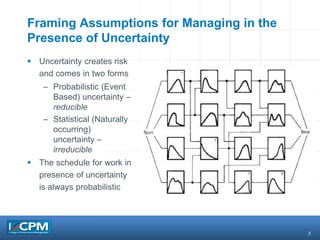
 Uncertainty creates risk
and comes in two forms
– Probabilistic (Event
Based) uncertainty ‒
reducible
– Statistical (Naturally
occurring)
uncertainty ‒
irreducible
 The schedule for work in
presence of uncertainty
is always probabilistic
4
What Can Confidence Intervals Tell Us about
the validity of the IMS?
4
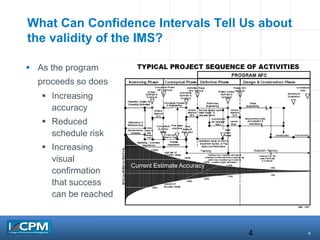
 As the program
proceeds so does
 Increasing
accuracy
 Reduced
schedule risk
 Increasing
visual
confirmation
that success
can be reached
Current Estimate Accuracy
5
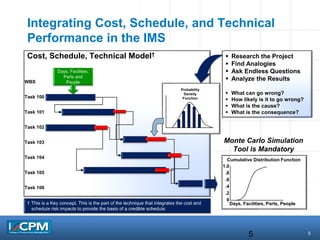
Integrating Cost, Schedule, and Technical
Performance in the IMS
5
Cost, Schedule, Technical Model†
WBS
Task 100
Task 101
Task 102
Task 103
Task 104
Task 105
Task 106
Probability
Density
Function
 Research the Project
 Find Analogies
 Ask Endless Questions
 Analyze the Results
 What can go wrong?
 How likely is it to go wrong?
 What is the cause?
 What is the consequence?
Monte Carlo Simulation
Tool is Mandatory
1.0
.8
.6
.4
.2
0
Days, Facilities, Parts, People
Cumulative Distribution Function
6
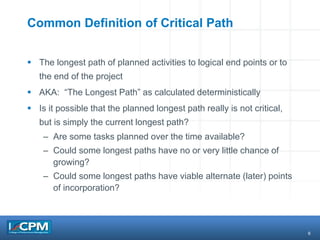
Common Definition of Critical Path
 The longest path of planned activities to logical end points or to
the end of the project
 AKA: “The Longest Path” as calculated deterministically
 Is it possible that the planned longest path really is not critical,
but is simply the current longest path?
– Are some tasks planned over the time available?
– Could some longest paths have no or very little chance of
growing?
– Could some longest paths have viable alternate (later) points
of incorporation?
7
Definition(s) of “critical”:
 Having the potential to become disastrous
 At a point of crisis
 Grave, serious, dangerous, risky, perilous, hazardous,
precarious, uncertain
 Extremely important
 Crucial
8
Advancing the Art…(and the Science)
 Focusing solely on “THE critical path” calculated by scheduling
software is likely an unhealthy program management practice.
It’s probably important and may end up as the longest path
but…
 To ignore alternate paths that are most likely to be your longest
path(s) is a limiting approach and likely not an effective
management action
9
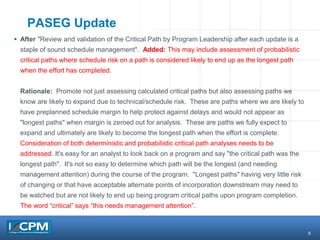
PASEG Update
 After "Review and validation of the Critical Path by Program Leadership after each update is a
staple of sound schedule management". Added: This may include assessment of probabilistic
critical paths where schedule risk on a path is considered likely to end up as the longest path
when the effort has completed.
Rationale: Promote not just assessing calculated critical paths but also assessing paths we
know are likely to expand due to technical/schedule risk. These are paths where we are likely to
have preplanned schedule margin to help protect against delays and would not appear as
"longest paths" when margin is zeroed out for analysis. These are paths we fully expect to
expand and ultimately are likely to become the longest path when the effort is complete.
Consideration of both deterministic and probabilistic critical path analyses needs to be
addressed. It's easy for an analyst to look back on a program and say "the critical path was the
longest path". It's not so easy to determine which path will be the longest (and needing
management attention) during the course of the program. "Longest paths" having very little risk
of changing or that have acceptable alternate points of incorporation downstream may need to
be watched but are not likely to end up being program critical paths upon program completion.
The word “critical” says “this needs management attention”.
10
Recognition and Management of
Probabilistic Paths
 Probabilistic critical paths may have greater total float than the
deterministic path.
 But probabilistic critical paths have higher schedule risk
(consequence and probability) and need to be managed
 Strategically placed schedule margin is an effective tool for
managing unmitigated schedule risks
11
Examples of Probabilistic Critical Path
Approach
 Insert a generic spacecraft ATLO flow to discuss alternate
points of incorporation on deterministic CPs and no alternate
POI on payload with higher risk and margin to delivery.
 Insert Wright brothers example with SRA helping you decide
where and how much margin.
12
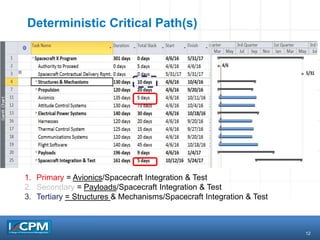
Deterministic Critical Path(s)
1. Primary = Avionics/Spacecraft Integration & Test
2. Secondary = Payloads/Spacecraft Integration & Test
3. Tertiary = Structures & Mechanisms/Spacecraft Integration & Test
13
Alternate Points of Integration
14
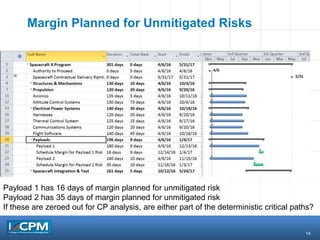
Margin Planned for Unmitigated Risks
Payload 1 has 16 days of margin planned for unmitigated risk
Payload 2 has 35 days of margin planned for unmitigated risk
If these are zeroed out for CP analysis, are either part of the deterministic critical paths?
15
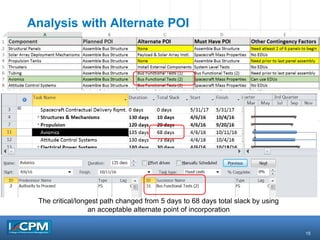
Analysis with Alternate POI
The critical/longest path changed from 5 days to 68 days total slack by using
an acceptable alternate point of incorporation
16
Pitfalls & Challenges of Critical Path
Management
 Major space programs are extremely complex with multiple
interacting critical paths
 A significant portion of these paths may be planned/managed by
subcontractors
 Use of date constraints (valid or not) complicate analysis of the
analysis
 Determining the right level of detail to perform accurate CP
analysis is not a science
 There’s never a single logic solution
17
Things To Remember
 All critical path analyses are entirely dependent upon well
defined, structured, and managed schedule data
 CP analysis is based off a single set of data (including logic);
you may have viable options
 The real value of critical path analysis is intelligent forecasting of
your ability to meet contractual schedule requirements.
 “Keeping score” (status) is most important for how it impacts
forecasts
Backup Info
19
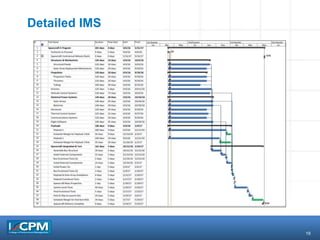
Detailed IMS

Critical Thinking on Critical Path Analysis

  • 1.
    Critical Thinking onCritical Path Analysis Glen B. Alleman Niwot Ridge L.L.C. glen.alleman@niwotridge.com +1 303 241 9633 EVM World 2016 Rick Price Project Management & Planning Operations Principal Lockheed Martin Space Systems Company Rick.a.price@lmco.com +1 303 971 1826
  • 2.
    2 Learning Objectives  Understandingthe importance of looking beyond “THE critical path” – Reasons why we do critical path analyses – Reassessing definitions – What we should do based on the analyses – How to communicate critical path information  Focus on what you learn from the analysis and the decisions you make with the info
  • 3.
    3 Framing Assumptions forManaging in the Presence of Uncertainty  Uncertainty creates risk and comes in two forms – Probabilistic (Event Based) uncertainty ‒ reducible – Statistical (Naturally occurring) uncertainty ‒ irreducible  The schedule for work in presence of uncertainty is always probabilistic
  • 4.
    4 What Can ConfidenceIntervals Tell Us about the validity of the IMS? 4  As the program proceeds so does  Increasing accuracy  Reduced schedule risk  Increasing visual confirmation that success can be reached Current Estimate Accuracy
  • 5.
    5 Integrating Cost, Schedule,and Technical Performance in the IMS 5 Cost, Schedule, Technical Model† WBS Task 100 Task 101 Task 102 Task 103 Task 104 Task 105 Task 106 Probability Density Function  Research the Project  Find Analogies  Ask Endless Questions  Analyze the Results  What can go wrong?  How likely is it to go wrong?  What is the cause?  What is the consequence? Monte Carlo Simulation Tool is Mandatory 1.0 .8 .6 .4 .2 0 Days, Facilities, Parts, People Cumulative Distribution Function
  • 6.
    6 Common Definition ofCritical Path  The longest path of planned activities to logical end points or to the end of the project  AKA: “The Longest Path” as calculated deterministically  Is it possible that the planned longest path really is not critical, but is simply the current longest path? – Are some tasks planned over the time available? – Could some longest paths have no or very little chance of growing? – Could some longest paths have viable alternate (later) points of incorporation?
  • 7.
    7 Definition(s) of “critical”: Having the potential to become disastrous  At a point of crisis  Grave, serious, dangerous, risky, perilous, hazardous, precarious, uncertain  Extremely important  Crucial
  • 8.
    8 Advancing the Art…(andthe Science)  Focusing solely on “THE critical path” calculated by scheduling software is likely an unhealthy program management practice. It’s probably important and may end up as the longest path but…  To ignore alternate paths that are most likely to be your longest path(s) is a limiting approach and likely not an effective management action
  • 9.
    9 PASEG Update  After"Review and validation of the Critical Path by Program Leadership after each update is a staple of sound schedule management". Added: This may include assessment of probabilistic critical paths where schedule risk on a path is considered likely to end up as the longest path when the effort has completed. Rationale: Promote not just assessing calculated critical paths but also assessing paths we know are likely to expand due to technical/schedule risk. These are paths where we are likely to have preplanned schedule margin to help protect against delays and would not appear as "longest paths" when margin is zeroed out for analysis. These are paths we fully expect to expand and ultimately are likely to become the longest path when the effort is complete. Consideration of both deterministic and probabilistic critical path analyses needs to be addressed. It's easy for an analyst to look back on a program and say "the critical path was the longest path". It's not so easy to determine which path will be the longest (and needing management attention) during the course of the program. "Longest paths" having very little risk of changing or that have acceptable alternate points of incorporation downstream may need to be watched but are not likely to end up being program critical paths upon program completion. The word “critical” says “this needs management attention”.
  • 10.
    10 Recognition and Managementof Probabilistic Paths  Probabilistic critical paths may have greater total float than the deterministic path.  But probabilistic critical paths have higher schedule risk (consequence and probability) and need to be managed  Strategically placed schedule margin is an effective tool for managing unmitigated schedule risks
  • 11.
    11 Examples of ProbabilisticCritical Path Approach  Insert a generic spacecraft ATLO flow to discuss alternate points of incorporation on deterministic CPs and no alternate POI on payload with higher risk and margin to delivery.  Insert Wright brothers example with SRA helping you decide where and how much margin.
  • 12.
    12 Deterministic Critical Path(s) 1.Primary = Avionics/Spacecraft Integration & Test 2. Secondary = Payloads/Spacecraft Integration & Test 3. Tertiary = Structures & Mechanisms/Spacecraft Integration & Test
  • 13.
  • 14.
    14 Margin Planned forUnmitigated Risks Payload 1 has 16 days of margin planned for unmitigated risk Payload 2 has 35 days of margin planned for unmitigated risk If these are zeroed out for CP analysis, are either part of the deterministic critical paths?
  • 15.
    15 Analysis with AlternatePOI The critical/longest path changed from 5 days to 68 days total slack by using an acceptable alternate point of incorporation
  • 16.
    16 Pitfalls & Challengesof Critical Path Management  Major space programs are extremely complex with multiple interacting critical paths  A significant portion of these paths may be planned/managed by subcontractors  Use of date constraints (valid or not) complicate analysis of the analysis  Determining the right level of detail to perform accurate CP analysis is not a science  There’s never a single logic solution
  • 17.
    17 Things To Remember All critical path analyses are entirely dependent upon well defined, structured, and managed schedule data  CP analysis is based off a single set of data (including logic); you may have viable options  The real value of critical path analysis is intelligent forecasting of your ability to meet contractual schedule requirements.  “Keeping score” (status) is most important for how it impacts forecasts
  • 18.
  • 19.

Editor's Notes

  • #5 Last Updated: 3/17/2019