IMPRESSIONISM
JENNIFER KARCH
ART AND ART HISTORY TEACHER
Verona, Italy
The Impressionist movement was born
in Paris in the studio of photographer
Felix Nadar 15 April 1874 where they
held their first exhibition. As the jury of
the " salon" had always rejected the
works of these artists, the idea arose
to organize a solo exhibition. The
group of painters started from
spontaneous aggregation and unity of
purpose at the Cafe where daily the
painters used to meet and where they
discussed their ideas of renewal of
painting.
The founding members of the group
were: Claude Monet, Edward Degas,
Auguste Renoir, Camille Pissarro,
Alfred Sisley and Berthe Morisot.
The first exhibition also took part Paul
Cezanne and Giuseppe De Nittis .
Felix Nadar, Parigi 1820 - 1910
The term Impressionism was born
from an ironic article of Louis
Leroy that , which states that
after seeing the first exhibition
of these artists, he criticized
and despised this type of
painting. The journalist said
that it was only an impression
with no meditation, it was
superficial, undefined; the
paintings seem only sketches
waiting to be finished . .
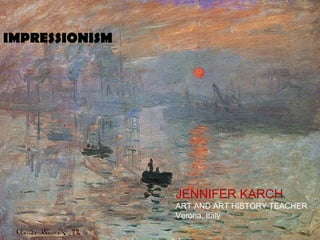
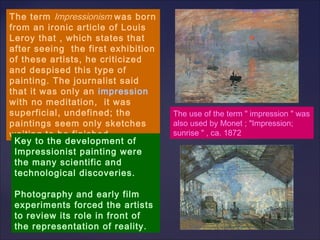
The use of the term " impression " was
also used by Monet ; "Impression;
sunrise " , ca. 1872
Key to the development of
Impressionist painting were
the many scientific and
technological discoveries.
Photography and early film
experiments forced the artists
to review its role in front of
the representation of reality.
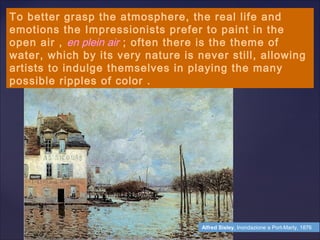
To better grasp the atmosphere, the real life and
emotions the Impressionists prefer to paint in the
open air , en plein air ; often there is the theme of
water, which by its very nature is never still, allowing
artists to indulge themselves in playing the many
possible ripples of color .
Alfred Sisley, Inondazione a Port-Marty, 1876
Camille Pissarro, Boulevard Montmartre, 1897
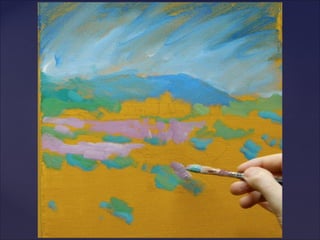
Impressionist painting wanted to highlight the great variety of
colors, The objects painted don’t live with a specific colour, but
it changes according the the light source. For this reason,
impressionist painters smear the colors directly on the canvas
without mixing them through a painting technique of quick
touches and short , pure colors placed side by side , excluding
black and white . This technique is possible thanks to the
changes made by the chemistry that had made ​​it possible to
make oil paints in tubes , easy to transport and straightforward
to use .
The understanding of Japanese
prints influenced significantly to
Impressionist theories. The
ancient Japanese tradition of
painting , show a remarkable
sensitivity to color and volumes ,
the use of a simple and clear lines
and the drawing up of the colors in
simple backgrounds and dazzling
angles...
Claude Monet, 1840 - 1926
He can be defined as the
most impressionistic of
the Impressionists and
the main promoter of the
first exhibition in the
studio of the
photographer Nadar .
From 1880 onwards
hewill be recognized as
one of the leading man
and symbol of
Impressionism.
Impressione, levar del sole, 1872
" I was asked the title for the exhibition catalog , and since I couldn’ get
people to understand it was a view of Le Havre , I said to put impression
instead." Claude Monet
There is no record of preparatory drawings and the color is placed directly
on the canvas with short, quick strokes. All objectivity of the nature of the
subject is outdated and distorted by the artist's desire to make the painting
show the feelings of watching the sunrise . Monet does not want to describe
reality , but wants to make the impression of a moment . The use of
juxtaposed warm colors ( red and orange ) and cool ( bluish green ) makes
it extremely evocative sense of morning mist where the sun whose pale
orange highlights are reflected water.
Boulevard de Capucines , 1873.
Monet shows the busy road
from the studio window of
Nadar .. The avenue is animated
by cars and people all described
with swift strokes representing
what he sees from that height ;
an exact representation of the
frenetic movement of the crowd
surrounded the city.
Cathedral of Rouen, 1892 - 1893
The Cathedral di Rouen in full sun, 1894
In the ‘90s , Monet is increasingly
impressed by the problems of light
and color sensations. So he
dedicated a series in which he
depicts the same subject in dozens
of paintings. The exact position is
almost always the same and what
changes are only the objective
conditions of light .
Important is the cycle of paintings
(50 ) depicting the facade of Rouen
Cathedral. Monet paints the facade
of the church through the window of
the same rented room or a nearby
shop in different climatic conditions
(sun , rain , fog ) at different times of
day in two successive stays .
The Cathedral di Rouen in full sun, 1894
Monet is indifferent to the
details of the architecture
of the Gothic building. He
focuses only on the play
of light and shadows that
the sun produces in the
late morning on the
surface the facade. You
can see the pattern of
outside decoration and it
creates harmony between
the areas of bright clear
blue sky .“Every day I add and discover
something that I never have seen
before.” Claude Monet
Waterlilies , 1919. On increasingly large canvases, Monet came to
pure painting , that is not really a reference to landscape. The
flowers are not forms, but lights from myriads of other lights , the
pond water is pure abstract color , and the painting focuses on the
expressive capabilities of the ground color .
Berthe Morisot, 1841 – 1895
Pupil of Corot , Berthe was
Manet’s sister-in-law. You could
see the influence of Manet in the
use of the white color and the
painting of veils and
transparencies. Typically
Impressionist are soft lighting
effects , and the painting style
done by vibrating brush strokes ,
which create an atmosphere of
warmth and intimacy ..
The crib, 1872
Hilaire-Germain Edgar Degas
(all'anagrafe de Gas) Parigi 1834 – 1917.
Degas, different than the other
Impressionists who love to paint
" en plein air " , prepares the
paintings through a careful
sketching, taking even
photographs to try to get unusual
perspective and using all colors
including white and black .
The Absinthe Drinker of
1876 , is set in one of the
landmarks of the
Impressionists, the Café
de la Nouvelle Atnènes.
This work is characterized
by an original zig-zag
pattern that leads the eye
from the table in the
bottom left corner to the
two people who are sitting
diagonally on the right
corner . The characters
represent two absinthe
drinkers , each absorbed
in their thoughts .
La lezione di ballo, 1873 - 75
The theme of dance occurs throughout
the life of the artist . Degas observes
what is going on as if he were a
spectator, from the audience. The artist
portrays the moment when a dancer is
trying the dance steps under the
watchful eye of the master while the
other girls arranged in a semicircle,
observe waiting their turn to try . The
diagonoal style show how Degas uses
photography and , asif in a snapshot,
some figures are fall off the frame. The
gestures of the dancers are shown with
obsessive attention; the left one with
the yellow bow sitting on piano wants to
scratch her back, the back of the girl
with the red bow is done like an air fan.
You can see how the artist highlights
the painstaking attention to every detail
or movement .
Degas recreates the atmosphere of the
ballroom by inserting his girls in a soft light
which refines the elegant movements of
the dancers. Both the wooden floor and
the color of the walls of the hall give the
composition a certain realism. From the
technical point of view he does not reject
as opposed to the theories impressionist
design, the use of white and black ( you
can see in tutus of the dancers ) .
Pierre – Auguste Renoir (Limoges 1841 – Nizza 1919)
Renoir’s friendship with Monet
helped define a style without
regard to details. He developed a
technique for rapid, minute
brushstrokes that allowed him to
capture the light and the effect of
fragmented reality .
Il ballo al Moulin de la Galette, 1878
Renoir takes this subject from everyday modern life: dancing
outdoors in a youth club in Montmartre. It’s not a dance of rich
older people, but of young people in their everyday clothes.
Renoir loves the movement and action; you can see the dancing
of couples which move to the music.
The painting expresses the momentum of all the figures in depth
and the light falling from the trees above that creates bright
spots , on people and objects. Form and color become one,
there is contrast between light and shadow and between warm
and cold tones .
{{
I hope you enjoyedI hope you enjoyed
The Impressionists.The Impressionists.

Impressionism

  • 1.
    IMPRESSIONISM JENNIFER KARCH ART ANDART HISTORY TEACHER Verona, Italy
  • 2.
    The Impressionist movementwas born in Paris in the studio of photographer Felix Nadar 15 April 1874 where they held their first exhibition. As the jury of the " salon" had always rejected the works of these artists, the idea arose to organize a solo exhibition. The group of painters started from spontaneous aggregation and unity of purpose at the Cafe where daily the painters used to meet and where they discussed their ideas of renewal of painting. The founding members of the group were: Claude Monet, Edward Degas, Auguste Renoir, Camille Pissarro, Alfred Sisley and Berthe Morisot. The first exhibition also took part Paul Cezanne and Giuseppe De Nittis . Felix Nadar, Parigi 1820 - 1910
  • 3.
    The term Impressionismwas born from an ironic article of Louis Leroy that , which states that after seeing the first exhibition of these artists, he criticized and despised this type of painting. The journalist said that it was only an impression with no meditation, it was superficial, undefined; the paintings seem only sketches waiting to be finished . . The use of the term " impression " was also used by Monet ; "Impression; sunrise " , ca. 1872 Key to the development of Impressionist painting were the many scientific and technological discoveries. Photography and early film experiments forced the artists to review its role in front of the representation of reality.
  • 4.
    To better graspthe atmosphere, the real life and emotions the Impressionists prefer to paint in the open air , en plein air ; often there is the theme of water, which by its very nature is never still, allowing artists to indulge themselves in playing the many possible ripples of color . Alfred Sisley, Inondazione a Port-Marty, 1876
  • 5.
    Camille Pissarro, BoulevardMontmartre, 1897 Impressionist painting wanted to highlight the great variety of colors, The objects painted don’t live with a specific colour, but it changes according the the light source. For this reason, impressionist painters smear the colors directly on the canvas without mixing them through a painting technique of quick touches and short , pure colors placed side by side , excluding black and white . This technique is possible thanks to the changes made by the chemistry that had made ​​it possible to make oil paints in tubes , easy to transport and straightforward to use .
  • 7.
    The understanding ofJapanese prints influenced significantly to Impressionist theories. The ancient Japanese tradition of painting , show a remarkable sensitivity to color and volumes , the use of a simple and clear lines and the drawing up of the colors in simple backgrounds and dazzling angles...
  • 8.
    Claude Monet, 1840- 1926 He can be defined as the most impressionistic of the Impressionists and the main promoter of the first exhibition in the studio of the photographer Nadar . From 1880 onwards hewill be recognized as one of the leading man and symbol of Impressionism.
  • 9.
  • 10.
    " I wasasked the title for the exhibition catalog , and since I couldn’ get people to understand it was a view of Le Havre , I said to put impression instead." Claude Monet There is no record of preparatory drawings and the color is placed directly on the canvas with short, quick strokes. All objectivity of the nature of the subject is outdated and distorted by the artist's desire to make the painting show the feelings of watching the sunrise . Monet does not want to describe reality , but wants to make the impression of a moment . The use of juxtaposed warm colors ( red and orange ) and cool ( bluish green ) makes it extremely evocative sense of morning mist where the sun whose pale orange highlights are reflected water.
  • 11.
    Boulevard de Capucines, 1873. Monet shows the busy road from the studio window of Nadar .. The avenue is animated by cars and people all described with swift strokes representing what he sees from that height ; an exact representation of the frenetic movement of the crowd surrounded the city.
  • 12.
  • 13.
    The Cathedral diRouen in full sun, 1894 In the ‘90s , Monet is increasingly impressed by the problems of light and color sensations. So he dedicated a series in which he depicts the same subject in dozens of paintings. The exact position is almost always the same and what changes are only the objective conditions of light . Important is the cycle of paintings (50 ) depicting the facade of Rouen Cathedral. Monet paints the facade of the church through the window of the same rented room or a nearby shop in different climatic conditions (sun , rain , fog ) at different times of day in two successive stays .
  • 14.
    The Cathedral diRouen in full sun, 1894 Monet is indifferent to the details of the architecture of the Gothic building. He focuses only on the play of light and shadows that the sun produces in the late morning on the surface the facade. You can see the pattern of outside decoration and it creates harmony between the areas of bright clear blue sky .“Every day I add and discover something that I never have seen before.” Claude Monet
  • 15.
    Waterlilies , 1919.On increasingly large canvases, Monet came to pure painting , that is not really a reference to landscape. The flowers are not forms, but lights from myriads of other lights , the pond water is pure abstract color , and the painting focuses on the expressive capabilities of the ground color .
  • 18.
    Berthe Morisot, 1841– 1895 Pupil of Corot , Berthe was Manet’s sister-in-law. You could see the influence of Manet in the use of the white color and the painting of veils and transparencies. Typically Impressionist are soft lighting effects , and the painting style done by vibrating brush strokes , which create an atmosphere of warmth and intimacy .. The crib, 1872
  • 19.
    Hilaire-Germain Edgar Degas (all'anagrafede Gas) Parigi 1834 – 1917. Degas, different than the other Impressionists who love to paint " en plein air " , prepares the paintings through a careful sketching, taking even photographs to try to get unusual perspective and using all colors including white and black .
  • 20.
    The Absinthe Drinkerof 1876 , is set in one of the landmarks of the Impressionists, the Café de la Nouvelle Atnènes. This work is characterized by an original zig-zag pattern that leads the eye from the table in the bottom left corner to the two people who are sitting diagonally on the right corner . The characters represent two absinthe drinkers , each absorbed in their thoughts .
  • 21.
    La lezione diballo, 1873 - 75
  • 22.
    The theme ofdance occurs throughout the life of the artist . Degas observes what is going on as if he were a spectator, from the audience. The artist portrays the moment when a dancer is trying the dance steps under the watchful eye of the master while the other girls arranged in a semicircle, observe waiting their turn to try . The diagonoal style show how Degas uses photography and , asif in a snapshot, some figures are fall off the frame. The gestures of the dancers are shown with obsessive attention; the left one with the yellow bow sitting on piano wants to scratch her back, the back of the girl with the red bow is done like an air fan. You can see how the artist highlights the painstaking attention to every detail or movement .
  • 23.
    Degas recreates theatmosphere of the ballroom by inserting his girls in a soft light which refines the elegant movements of the dancers. Both the wooden floor and the color of the walls of the hall give the composition a certain realism. From the technical point of view he does not reject as opposed to the theories impressionist design, the use of white and black ( you can see in tutus of the dancers ) .
  • 24.
    Pierre – AugusteRenoir (Limoges 1841 – Nizza 1919) Renoir’s friendship with Monet helped define a style without regard to details. He developed a technique for rapid, minute brushstrokes that allowed him to capture the light and the effect of fragmented reality .
  • 25.
    Il ballo alMoulin de la Galette, 1878
  • 26.
    Renoir takes thissubject from everyday modern life: dancing outdoors in a youth club in Montmartre. It’s not a dance of rich older people, but of young people in their everyday clothes. Renoir loves the movement and action; you can see the dancing of couples which move to the music. The painting expresses the momentum of all the figures in depth and the light falling from the trees above that creates bright spots , on people and objects. Form and color become one, there is contrast between light and shadow and between warm and cold tones .
  • 27.
    {{ I hope youenjoyedI hope you enjoyed The Impressionists.The Impressionists.