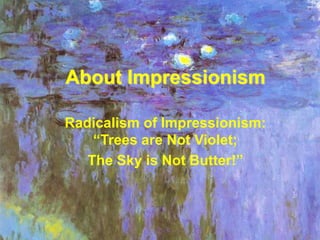
About Impressionism
Radicalism of Impressionism:
“Trees are Not Violet;
The Sky is Not Butter!”
• In 1874, fifty-five artists
held the first independent
group show of
“Impressionist” art.
Cezanne, Pissarro,
Renoir, Degas, Monet,
Manet, and his sister-in-
law Berthe Morisot were
some of the
impressionists included in
the show.
– (“a bunch of lunatics and a
woman,” muttered one
observer)
• Most of them had been
rejected by the Salon, the
annual French state-
sponsored exhibition that
offered the only real
opportunity for artists to
• Never mind, they told each other. At the Salon, paintings were
stacked 3 or 4 high, and crowded too closely together on the
walls.
• At their independent exhibition, mounted in what was formerly a
photographer’s studio, the artists could hang their works at eye
level with space between them.
• Although the artists didn’t call themselves "Impressionists" at
first, this occasion would be the first of eight "Impressionist"
exhibits over the next twelve years.
• An outraged critic, Louis Leroy, coined the label
"Impressionist."
• He looked at Monet’s Impression Sunrise, the
artist’s sensory response to a harbor at dawn, painted
with sketchy brushstrokes.
• "Impression!" the journalist snorted. "Wallpaper in its
embryonic state is more finished!" Within a year, the
name Impressionism was an accepted term in the art
world.
• If the name was
accepted, the art itself
was not.
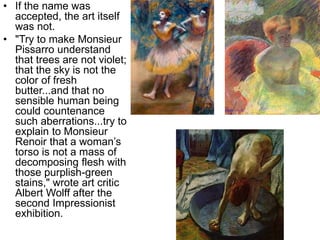
• "Try to make Monsieur
Pissarro understand
that trees are not violet;
that the sky is not the
color of fresh
butter...and that no
sensible human being
could countenance
such aberrations...try to
explain to Monsieur
Renoir that a woman’s
torso is not a mass of
decomposing flesh with
those purplish-green
stains," wrote art critic
Albert Wolff after the
second Impressionist
exhibition.
• Although some people
appreciated the new paintings,
many did not.
• The critics and the public
agreed the Impressionists
couldn’t draw and their colors
were considered vulgar.
• Their compositions were
strange.
• Their short, slapdash
brushstrokes made their
paintings practically illegible.
• Why didn’t these artists take
the time to finish their
canvases, viewers wondered?
• Impressionism broke every rule
of the French Academy of Fine
Arts, the conservative school
that had dominated art training
and taste since 1648.
• Impressionist scenes of
modern urban and country life
were a far cry from the
Academic efforts to teach
moral lessons through historic,
mythological, and Biblical
themes. This tradition, drawn
from ancient Greek and Roman
art, featured idealized images.
• Symmetrical compositions,
hard outlines, and meticulously
smooth paint surfaces
characterized academic
paintings.
Impressionism
Academic
The Painting of Modern Life and
Real Life Subjects
The sturdiest thread linking
the Impressionists was an
interest in the world around
them. For subject matter, they
looked to contemporary
people at work and play.
Inventions such as the steam
engine, power loom,
streetlights, camera, ready-
made fashions, cast iron, and
steel had changed the lives of
ordinary people.
Underlying the Industrial
Revolution was a belief that
technological progress was
key to all human progress. In
this climate of discovery,
people felt they could do
anything.
• Degas prowled behind the
scenes of the opera and
ballet for his subjects.
• Monet immortalized Paris
railroad stations.
• Nearly all the
Impressionist artists
painted people hurrying
through busy streets and
enjoying their leisure time
on the boulevard, at the
racetrack, in café-
concerts, shops,
restaurants, and parks.
• However, it was not just city
bustle that intrigued the
Impressionists. Country
themes appealed to them, too.
• Railroads gave people a new
mobility. They could hop on a
train and be in the countryside
in an hour. Commuters
escaped the crowded city to
the suburbs that sprouted
around Paris.
• The Seine River, parks, and
gardens provided recreation
for weekend picnickers,
swimmers, and boat parties,
which the Impressionists duly
recorded.
• One key to Impressionism’s
popularity, it has been written,
is that the artist often put the
viewer in the position of
someone on holiday
enjoying a beautiful scene.
"Monet never painted
weekdays," one critic noted
wryly.
• The home offered
other real-life subjects.
• It was unacceptable
for women painters
like Berthe Morisot or
Mary Cassatt to set up
an easel in most
public places.
• They relied on
domestic scenes of
women from their own
social class cuddling
babies, playing with
their children, dressing
in the boudoir, or
tending their gardens.
En Plein Air and "The Painter of
the Passing Moment"
• Painting the sidewalk café,
the racetrack, or the
boating party attracted the
Impressionists to work
outdoors, or en plein air.
• Most Impressionists
worked directly and
spontaneously from nature.
• It was Barbizon painter
Camille Corot who first
advised artists to "submit to
the first impression" of what
they saw - a real landscape
without the contrived
classical ruins or Biblical
parables of French
Academic painting.
• A wish to capture nature’s fleeting moment led many Impressionists to paint the
same scene at different times and in different weather.
• They had to work fast to capture the moment, or to finish an outdoor painting before
the light changed. Artists had often made quick sketches in pencil or diluted oil paint
on location, but now the sketch became the finished work.
• Impressionist painters adopted a distinctive style of rapid, broken brushstrokes:
lines for people on a busy street, or specks to re-create flowers in a meadow.
• These artists often applied paint so thickly that it created a
rough texture on the canvas.
• Impressionists mixed colors right on the canvas or stroked on
the hues next to each other and let the viewer’s eye do the
blending.
– This process was called optical color mixing.
• Not only did this sketchy technique suggest motion, but it also
captured the shimmering effects of light that engaged these
artists.
• The rough, brilliant paintings of Impressionism were a
drastic departure from the slick, highly finished
canvases of Academic painters.
• Although the Impressionists wanted their work to look
almost accidental, it’s no surprise that early critics
called it "lazy" and unfinished.

About_Impressionism.ppt

  • 1.
    About Impressionism Radicalism ofImpressionism: “Trees are Not Violet; The Sky is Not Butter!”
  • 2.
    • In 1874,fifty-five artists held the first independent group show of “Impressionist” art. Cezanne, Pissarro, Renoir, Degas, Monet, Manet, and his sister-in- law Berthe Morisot were some of the impressionists included in the show. – (“a bunch of lunatics and a woman,” muttered one observer) • Most of them had been rejected by the Salon, the annual French state- sponsored exhibition that offered the only real opportunity for artists to
  • 3.
    • Never mind,they told each other. At the Salon, paintings were stacked 3 or 4 high, and crowded too closely together on the walls. • At their independent exhibition, mounted in what was formerly a photographer’s studio, the artists could hang their works at eye level with space between them. • Although the artists didn’t call themselves "Impressionists" at first, this occasion would be the first of eight "Impressionist" exhibits over the next twelve years.
  • 4.
    • An outragedcritic, Louis Leroy, coined the label "Impressionist." • He looked at Monet’s Impression Sunrise, the artist’s sensory response to a harbor at dawn, painted with sketchy brushstrokes. • "Impression!" the journalist snorted. "Wallpaper in its embryonic state is more finished!" Within a year, the name Impressionism was an accepted term in the art world.
  • 5.
    • If thename was accepted, the art itself was not. • "Try to make Monsieur Pissarro understand that trees are not violet; that the sky is not the color of fresh butter...and that no sensible human being could countenance such aberrations...try to explain to Monsieur Renoir that a woman’s torso is not a mass of decomposing flesh with those purplish-green stains," wrote art critic Albert Wolff after the second Impressionist exhibition.
  • 6.
    • Although somepeople appreciated the new paintings, many did not. • The critics and the public agreed the Impressionists couldn’t draw and their colors were considered vulgar. • Their compositions were strange. • Their short, slapdash brushstrokes made their paintings practically illegible. • Why didn’t these artists take the time to finish their canvases, viewers wondered?
  • 7.
    • Impressionism brokeevery rule of the French Academy of Fine Arts, the conservative school that had dominated art training and taste since 1648. • Impressionist scenes of modern urban and country life were a far cry from the Academic efforts to teach moral lessons through historic, mythological, and Biblical themes. This tradition, drawn from ancient Greek and Roman art, featured idealized images. • Symmetrical compositions, hard outlines, and meticulously smooth paint surfaces characterized academic paintings. Impressionism Academic
  • 8.
    The Painting ofModern Life and Real Life Subjects The sturdiest thread linking the Impressionists was an interest in the world around them. For subject matter, they looked to contemporary people at work and play. Inventions such as the steam engine, power loom, streetlights, camera, ready- made fashions, cast iron, and steel had changed the lives of ordinary people. Underlying the Industrial Revolution was a belief that technological progress was key to all human progress. In this climate of discovery, people felt they could do anything.
  • 9.
    • Degas prowledbehind the scenes of the opera and ballet for his subjects. • Monet immortalized Paris railroad stations. • Nearly all the Impressionist artists painted people hurrying through busy streets and enjoying their leisure time on the boulevard, at the racetrack, in café- concerts, shops, restaurants, and parks.
  • 10.
    • However, itwas not just city bustle that intrigued the Impressionists. Country themes appealed to them, too. • Railroads gave people a new mobility. They could hop on a train and be in the countryside in an hour. Commuters escaped the crowded city to the suburbs that sprouted around Paris. • The Seine River, parks, and gardens provided recreation for weekend picnickers, swimmers, and boat parties, which the Impressionists duly recorded. • One key to Impressionism’s popularity, it has been written, is that the artist often put the viewer in the position of someone on holiday enjoying a beautiful scene. "Monet never painted weekdays," one critic noted wryly.
  • 11.
    • The homeoffered other real-life subjects. • It was unacceptable for women painters like Berthe Morisot or Mary Cassatt to set up an easel in most public places. • They relied on domestic scenes of women from their own social class cuddling babies, playing with their children, dressing in the boudoir, or tending their gardens.
  • 12.
    En Plein Airand "The Painter of the Passing Moment" • Painting the sidewalk café, the racetrack, or the boating party attracted the Impressionists to work outdoors, or en plein air. • Most Impressionists worked directly and spontaneously from nature. • It was Barbizon painter Camille Corot who first advised artists to "submit to the first impression" of what they saw - a real landscape without the contrived classical ruins or Biblical parables of French Academic painting.
  • 13.
    • A wishto capture nature’s fleeting moment led many Impressionists to paint the same scene at different times and in different weather. • They had to work fast to capture the moment, or to finish an outdoor painting before the light changed. Artists had often made quick sketches in pencil or diluted oil paint on location, but now the sketch became the finished work. • Impressionist painters adopted a distinctive style of rapid, broken brushstrokes: lines for people on a busy street, or specks to re-create flowers in a meadow.
  • 14.
    • These artistsoften applied paint so thickly that it created a rough texture on the canvas. • Impressionists mixed colors right on the canvas or stroked on the hues next to each other and let the viewer’s eye do the blending. – This process was called optical color mixing. • Not only did this sketchy technique suggest motion, but it also captured the shimmering effects of light that engaged these artists.
  • 15.
    • The rough,brilliant paintings of Impressionism were a drastic departure from the slick, highly finished canvases of Academic painters. • Although the Impressionists wanted their work to look almost accidental, it’s no surprise that early critics called it "lazy" and unfinished.