IMPRESSION PROCEDURES IN
REMOVABLE PARTIAL DENTURE
Presented by : Guided by :
Dr. Kavinci Sihag Dr. H.S.
Shashidhara
1st year MDS Professor
DEPARTMENT OF PROSTHODONTICS AND CROWN & BRIDGE
COLLEGE OF DENTAL SCIENCES, DAVANGERE
CONTENTS
• INTRODUCTION
• DEFINITIONS
• IMPRESSION MATERIALS
• IMPRESSION TECHNIQUES
• RECENT ADVANCES
• SUMMARY AND CONCLUSION
• REFERNCES
INTRODUCTION
• A widely accepted axiom of removable partial denture
prosthodontics holds that it is fully important that the denture be
designed and constructed in such a way as to preserve the oral
structures as it is to restore function.
• An impression of a partially edentulous arch must accurately record
the anatomic form of teeth and surrounding tissues. Unless the cast
upon which the prosthesis is to be constructed is a replica of the
mouth, the prosthesis can‘t be expected to fit properly and an
accurate cast can be obtained from an accurate impression.
IMPRESSION
A negative likeness or copy in reverse of the surface of an object ;
imprint of teeth and adjacent structures for use in dentistry. (GPT9)
PARTIAL DENTURE IMPRESSION
A negative likeness of a part or all of a partially edentulous arches.
(GPT9)
REMOVABLE PARTIAL DENTURE
It is defined as any prosthesis that replaces some teeth in a partially
dentate arch. It can be removed from the mouth and replaced at
will – also called partial removable dental prosthesis.(GPT9)
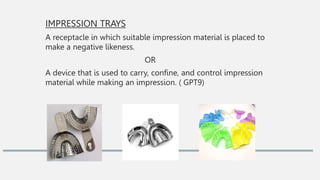
IMPRESSION TRAYS
A receptacle in which suitable impression material is placed to
make a negative likeness.
OR
A device that is used to carry, confine, and control impression
material while making an impression. ( GPT9)
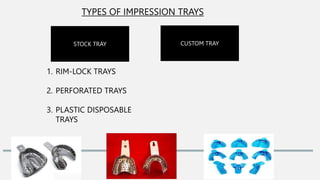
TYPES OF IMPRESSION TRAYS
STOCK TRAY CUSTOM TRAY
1. RIM-LOCK TRAYS
2. PERFORATED TRAYS
3. PLASTIC DISPOSABLE
TRAYS
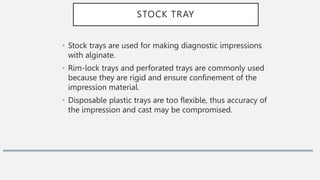
STOCK TRAY
• Stock trays are used for making diagnostic impressions
with alginate.
• Rim-lock trays and perforated trays are commonly used
because they are rigid and ensure confinement of the
impression material.
• Disposable plastic trays are too flexible, thus accuracy of
the impression and cast may be compromised.
ADVANTAGES
1. Impression can be accomplished in one appointment.
2. Can be used in patients with a tendency to gag.
3. Especially useful for a mouth that is either exceptionally large or small or
one with an anomalous contour that cannot be accurately fitted with a
conventional stock tray( Rim-lock stock tray).
DISADVANTAGES:
1. The peripheral borders can not be accurately recorded.
2. Considerably more bulkier than a custom tray.
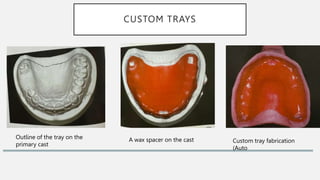
CUSTOM TRAYS
Outline of the tray on the
primary cast
A wax spacer on the cast Custom tray fabrication
(Auto
ADVANTAGES
1. Peripheral borders can be precisely recorded in the impression
2. The Thickness of impression material can be controlled.
3. Well-fitted tray will better support the impression in the palate,
then avoid even present danger of material slumping in vital areas.
Custom trays are sometimes needed for mouths that are abnormally
or of unusual configuration.
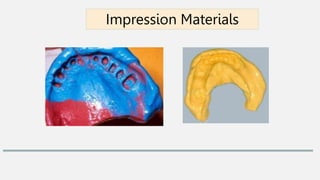
Impression Materials
FACTORS THAT INFLUENCE THE SELECTION OF
IMPRESSION MATERIALS ARE
Convenience of use
Time of manipulation and setting time
Cost
Operator training and preference
Need for special trays
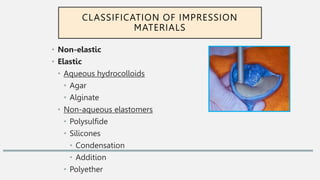
• Non-elastic
• Elastic
• Aqueous hydrocolloids
• Agar
• Alginate
• Non-aqueous elastomers
• Polysulfide
• Silicones
• Condensation
• Addition
• Polyether
CLASSIFICATION OF IMPRESSION
MATERIALS
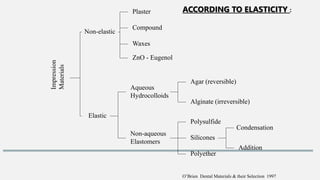
Impression
Materials
Non-elastic
Elastic
Aqueous
Hydrocolloids
Non-aqueous
Elastomers
Polysulfide
Silicones
Polyether
Condensation
Addition
Agar (reversible)
Alginate (irreversible)
Plaster
Compound
ZnO - Eugenol
Waxes
O’Brien Dental Materials & their Selection 1997
ACCORDING TO ELASTICITY :
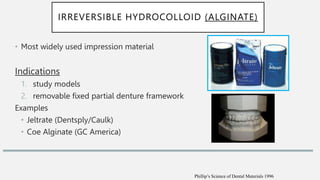
IRREVERSIBLE HYDROCOLLOID (ALGINATE)
• Most widely used impression material
Indications
1. study models
2. removable fixed partial denture framework
Examples
• Jeltrate (Dentsply/Caulk)
• Coe Alginate (GC America)
Phillip’s Science of Dental Materials 1996
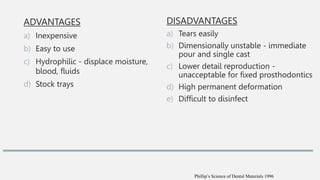
ADVANTAGES
a) Inexpensive
b) Easy to use
c) Hydrophilic - displace moisture,
blood, fluids
d) Stock trays
Phillip’s Science of Dental Materials 1996
DISADVANTAGES
a) Tears easily
b) Dimensionally unstable - immediate
pour and single cast
c) Lower detail reproduction -
unacceptable for fixed prosthodontics
d) High permanent deformation
e) Difficult to disinfect
• Removable partial denture impressions need to record the teeth that are
irregular in contour as well as varying in their vertical relations to the
occlusal plane. The chosen impression material must be capable of
recording the tissue contours as accurately as possible without distortion,
which occurs as the impression is withdrawn.
• Primary impression – study / diagnostic cast
• Checking Maxillary Tray and Mandibular Tray for Correct Size.
• Control of Gagging
• Control of Saliva
PRIMARY IMPRESSION
Objective:
To obtain an impression of all the standing teeth and
denture-supporting tissues of each jaw from which study
casts may be prepared.
The purpose of the study casts are:
• To enable special trays and occlusion rims to be constructed if
necessary.
• To examine the occlusion in detail on an articulator.
• By use of a surveyor, plan the path of insertion of the proposed
denture, arrive at a tentative design, and plan any mouth
preparation.
BASED ON METHOD OF IMPRESSION
MAKING
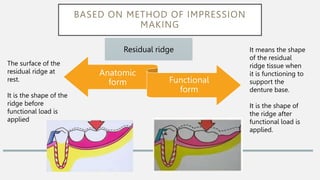
Anatomic
form Functional
form
Residual ridge
The surface of the
residual ridge at
rest.
It is the shape of the
ridge before
functional load is
applied
It means the shape
of the residual
ridge tissue when
it is functioning to
support the
denture base.
It is the shape of
the ridge after
functional load is
applied.
ANATOMICAL IMPRESSION
• Pressure free impression
• Anatomic form is the surface contour of the ridge when it is not
supporting an occlusal load.
• Indicated for tooth supported partial dentures (Kennedy class 111
and mainly 1V arches).
• Most maxillary distension extension bases.
• Impression plaster and zinc oxide eugenol impression paste is
used.
FUNCTIONAL IMPRESSION
• Functional form is the form of the residual ridge recorded under some loading
or compression.
• Achieved by occlusal loading, finger loading
• High viscosity materials like waxes, impression pastes and elastomers
INDICATIONS
I. Distal extension bases (class1 and 11) especially in the mandibular arch.
II. Long span anterior edentulous ridges (class 1V)
• Maxillary distal extension ridges are covered by firm mucosa, stress is borne by
crest and slopes of the ridge and hence functional impression may not be
recorded.
REQUIREMENTS
• Record the tissues under the same loading as the
teeth
• Distribute the load over large area as possible
• Accurately delineate the peripheral extent of the
denture base
FACTORS INFLUENCING SUPPORT OF
DISTAL EXTENSION BASE
• Quality of soft tissue covering edentulous ridge
• Type of bone architecture of denture bearing area
• Design of partial denture
• Amount of tissue coverage of denture base
• Amount of occlusal force
• Support from denture bearing area
• Fit of denture base
FUNCTIONAL IMPRESSION
PROCEDURES
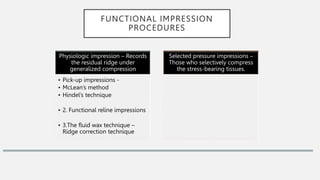
Physiologic impression – Records
the residual ridge under
generalized compression
• Pick-up impressions -
• McLean’s method
• Hindel’s technique
• 2. Functional reline impressions
• 3.The fluid wax technique –
Ridge correction technique
Selected pressure impressions –
Those who selectively compress
the stress-bearing tissues.
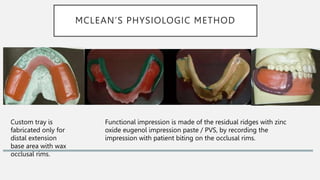
MCLEAN’S PHYSIOLOGIC METHOD
Custom tray is
fabricated only for
distal extension
base area with wax
occlusal rims.
Functional impression is made of the residual ridges with zinc
oxide eugenol impression paste / PVS, by recording the
impression with patient biting on the occlusal rims.
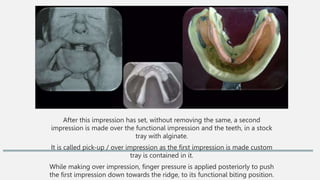
After this impression has set, without removing the same, a second
impression is made over the functional impression and the teeth, in a stock
tray with alginate.
It is called pick-up / over impression as the first impression is made custom
tray is contained in it.
While making over impression, finger pressure is applied posteriorly to push
the first impression down towards the ridge, to its functional biting position.
DISADVANTAGES
• Finger pressure on the second impression is not equal
to biting pressure
• Closely affect the direct retention
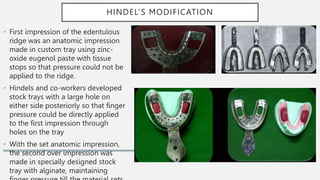
HINDEL’S MODIFICATION
• First impression of the edentulous
ridge was an anatomic impression
made in custom tray using zinc-
oxide eugenol paste with tissue
stops so that pressure could not be
applied to the ridge.
• Hindels and co-workers developed
stock trays with a large hole on
either side posteriorly so that finger
pressure could be directly applied
to the first impression through
holes on the tray
• With the set anatomic impression,
the second over impression was
made in specially designed stock
tray with alginate, maintaining
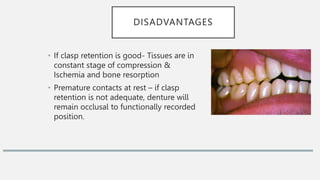
DISADVANTAGES
• If clasp retention is good- Tissues are in
constant stage of compression &
Ischemia and bone resorption
• Premature contacts at rest – if clasp
retention is not adequate, denture will
remain occlusal to functionally recorded
position.
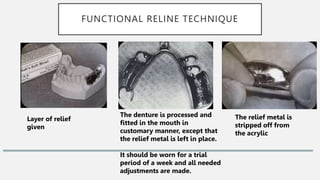
FUNCTIONAL RELINE TECHNIQUE
Layer of relief
given
The denture is processed and
fitted in the mouth in
customary manner, except that
the relief metal is left in place.
It should be worn for a trial
period of a week and all needed
adjustments are made.
The relief metal is
stripped off from
the acrylic
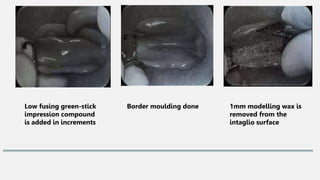
Low fusing green-stick
impression compound
is added in increments
Border moulding done 1mm modelling wax is
removed from the
intaglio surface
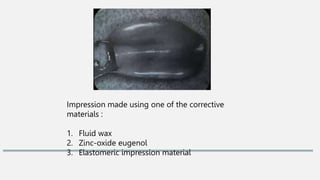
Impression made using one of the corrective
materials :
1. Fluid wax
2. Zinc-oxide eugenol
3. Elastomeric impression material
DISADVANTAGES
• Occlusion may be altered slightly
• Fine line of demarcation between the newly added
and old resin of the denture
FLUID WAX TECHNIQUE
Korrecta wax no. 4
• Applegate at university of michigan
Iowa wax
• University of Iowa
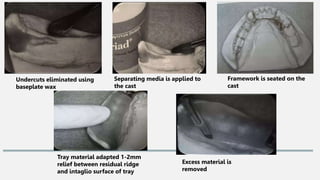
Undercuts eliminated using
baseplate wax
Separating media is applied to
the cast
Framework is seated on the
cast
Tray material adapted 1-2mm
relief between residual ridge
and intaglio surface of tray
Excess material is
removed
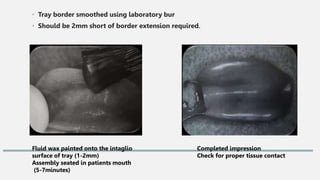
• Tray border smoothed using laboratory bur
• Should be 2mm short of border extension required.
Fluid wax painted onto the intaglio
surface of tray (1-2mm)
Assembly seated in patients mouth
(5-7minutes)
Completed impression
Check for proper tissue contact
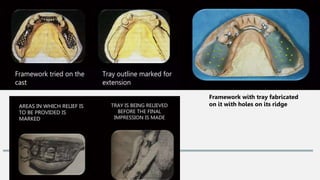
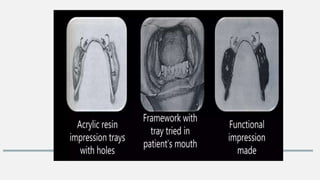
SELECTIVE PRESSURE TECHNIQUE
• Direct more force to those portions of the ridge able
to absorb stress without adverse response and protect
the areas of the ridge which are least able to absorb
forces.
Framework with tray fabricated
on it with holes on its ridge
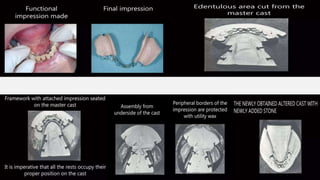
ALTERED CAST TECHNIQUE
CONCLUSION
• For the production of accurate master cast the
impression technique far outweighs the selection of
the impression materials.
• Glossary of Prosthodontic Terms – 9th edition
• Stewart, Rudd, Kuebker : Clinical Removable Partial
Prosthodontics.
• McGivney GP, Alan B Carr David T Brown : McCracken’s
Removable Partial Dentures-11 th Edn.
REFERENCES
THANK YOU

IMPRESSION MATERILS IN Removable partial denture in prosthodontics

  • 1.
    IMPRESSION PROCEDURES IN REMOVABLEPARTIAL DENTURE Presented by : Guided by : Dr. Kavinci Sihag Dr. H.S. Shashidhara 1st year MDS Professor DEPARTMENT OF PROSTHODONTICS AND CROWN & BRIDGE COLLEGE OF DENTAL SCIENCES, DAVANGERE
  • 2.
    CONTENTS • INTRODUCTION • DEFINITIONS •IMPRESSION MATERIALS • IMPRESSION TECHNIQUES • RECENT ADVANCES • SUMMARY AND CONCLUSION • REFERNCES
  • 3.
    INTRODUCTION • A widelyaccepted axiom of removable partial denture prosthodontics holds that it is fully important that the denture be designed and constructed in such a way as to preserve the oral structures as it is to restore function. • An impression of a partially edentulous arch must accurately record the anatomic form of teeth and surrounding tissues. Unless the cast upon which the prosthesis is to be constructed is a replica of the mouth, the prosthesis can‘t be expected to fit properly and an accurate cast can be obtained from an accurate impression.
  • 4.
    IMPRESSION A negative likenessor copy in reverse of the surface of an object ; imprint of teeth and adjacent structures for use in dentistry. (GPT9) PARTIAL DENTURE IMPRESSION A negative likeness of a part or all of a partially edentulous arches. (GPT9) REMOVABLE PARTIAL DENTURE It is defined as any prosthesis that replaces some teeth in a partially dentate arch. It can be removed from the mouth and replaced at will – also called partial removable dental prosthesis.(GPT9)
  • 5.
    IMPRESSION TRAYS A receptaclein which suitable impression material is placed to make a negative likeness. OR A device that is used to carry, confine, and control impression material while making an impression. ( GPT9)
  • 6.
    TYPES OF IMPRESSIONTRAYS STOCK TRAY CUSTOM TRAY 1. RIM-LOCK TRAYS 2. PERFORATED TRAYS 3. PLASTIC DISPOSABLE TRAYS
  • 7.
    STOCK TRAY • Stocktrays are used for making diagnostic impressions with alginate. • Rim-lock trays and perforated trays are commonly used because they are rigid and ensure confinement of the impression material. • Disposable plastic trays are too flexible, thus accuracy of the impression and cast may be compromised.
  • 8.
    ADVANTAGES 1. Impression canbe accomplished in one appointment. 2. Can be used in patients with a tendency to gag. 3. Especially useful for a mouth that is either exceptionally large or small or one with an anomalous contour that cannot be accurately fitted with a conventional stock tray( Rim-lock stock tray). DISADVANTAGES: 1. The peripheral borders can not be accurately recorded. 2. Considerably more bulkier than a custom tray.
  • 9.
    CUSTOM TRAYS Outline ofthe tray on the primary cast A wax spacer on the cast Custom tray fabrication (Auto
  • 10.
    ADVANTAGES 1. Peripheral borderscan be precisely recorded in the impression 2. The Thickness of impression material can be controlled. 3. Well-fitted tray will better support the impression in the palate, then avoid even present danger of material slumping in vital areas. Custom trays are sometimes needed for mouths that are abnormally or of unusual configuration.
  • 11.
  • 12.
    FACTORS THAT INFLUENCETHE SELECTION OF IMPRESSION MATERIALS ARE Convenience of use Time of manipulation and setting time Cost Operator training and preference Need for special trays
  • 13.
    • Non-elastic • Elastic •Aqueous hydrocolloids • Agar • Alginate • Non-aqueous elastomers • Polysulfide • Silicones • Condensation • Addition • Polyether CLASSIFICATION OF IMPRESSION MATERIALS
  • 14.
  • 15.
    IRREVERSIBLE HYDROCOLLOID (ALGINATE) •Most widely used impression material Indications 1. study models 2. removable fixed partial denture framework Examples • Jeltrate (Dentsply/Caulk) • Coe Alginate (GC America) Phillip’s Science of Dental Materials 1996
  • 16.
    ADVANTAGES a) Inexpensive b) Easyto use c) Hydrophilic - displace moisture, blood, fluids d) Stock trays Phillip’s Science of Dental Materials 1996 DISADVANTAGES a) Tears easily b) Dimensionally unstable - immediate pour and single cast c) Lower detail reproduction - unacceptable for fixed prosthodontics d) High permanent deformation e) Difficult to disinfect
  • 17.
    • Removable partialdenture impressions need to record the teeth that are irregular in contour as well as varying in their vertical relations to the occlusal plane. The chosen impression material must be capable of recording the tissue contours as accurately as possible without distortion, which occurs as the impression is withdrawn. • Primary impression – study / diagnostic cast • Checking Maxillary Tray and Mandibular Tray for Correct Size. • Control of Gagging • Control of Saliva
  • 18.
    PRIMARY IMPRESSION Objective: To obtainan impression of all the standing teeth and denture-supporting tissues of each jaw from which study casts may be prepared.
  • 19.
    The purpose ofthe study casts are: • To enable special trays and occlusion rims to be constructed if necessary. • To examine the occlusion in detail on an articulator. • By use of a surveyor, plan the path of insertion of the proposed denture, arrive at a tentative design, and plan any mouth preparation.
  • 20.
    BASED ON METHODOF IMPRESSION MAKING Anatomic form Functional form Residual ridge The surface of the residual ridge at rest. It is the shape of the ridge before functional load is applied It means the shape of the residual ridge tissue when it is functioning to support the denture base. It is the shape of the ridge after functional load is applied.
  • 21.
    ANATOMICAL IMPRESSION • Pressurefree impression • Anatomic form is the surface contour of the ridge when it is not supporting an occlusal load. • Indicated for tooth supported partial dentures (Kennedy class 111 and mainly 1V arches). • Most maxillary distension extension bases. • Impression plaster and zinc oxide eugenol impression paste is used.
  • 22.
    FUNCTIONAL IMPRESSION • Functionalform is the form of the residual ridge recorded under some loading or compression. • Achieved by occlusal loading, finger loading • High viscosity materials like waxes, impression pastes and elastomers INDICATIONS I. Distal extension bases (class1 and 11) especially in the mandibular arch. II. Long span anterior edentulous ridges (class 1V) • Maxillary distal extension ridges are covered by firm mucosa, stress is borne by crest and slopes of the ridge and hence functional impression may not be recorded.
  • 23.
    REQUIREMENTS • Record thetissues under the same loading as the teeth • Distribute the load over large area as possible • Accurately delineate the peripheral extent of the denture base
  • 24.
    FACTORS INFLUENCING SUPPORTOF DISTAL EXTENSION BASE • Quality of soft tissue covering edentulous ridge • Type of bone architecture of denture bearing area • Design of partial denture • Amount of tissue coverage of denture base • Amount of occlusal force • Support from denture bearing area • Fit of denture base
  • 25.
    FUNCTIONAL IMPRESSION PROCEDURES Physiologic impression– Records the residual ridge under generalized compression • Pick-up impressions - • McLean’s method • Hindel’s technique • 2. Functional reline impressions • 3.The fluid wax technique – Ridge correction technique Selected pressure impressions – Those who selectively compress the stress-bearing tissues.
  • 26.
    MCLEAN’S PHYSIOLOGIC METHOD Customtray is fabricated only for distal extension base area with wax occlusal rims. Functional impression is made of the residual ridges with zinc oxide eugenol impression paste / PVS, by recording the impression with patient biting on the occlusal rims.
  • 27.
    After this impressionhas set, without removing the same, a second impression is made over the functional impression and the teeth, in a stock tray with alginate. It is called pick-up / over impression as the first impression is made custom tray is contained in it. While making over impression, finger pressure is applied posteriorly to push the first impression down towards the ridge, to its functional biting position.
  • 28.
    DISADVANTAGES • Finger pressureon the second impression is not equal to biting pressure • Closely affect the direct retention
  • 29.
    HINDEL’S MODIFICATION • Firstimpression of the edentulous ridge was an anatomic impression made in custom tray using zinc- oxide eugenol paste with tissue stops so that pressure could not be applied to the ridge. • Hindels and co-workers developed stock trays with a large hole on either side posteriorly so that finger pressure could be directly applied to the first impression through holes on the tray • With the set anatomic impression, the second over impression was made in specially designed stock tray with alginate, maintaining
  • 30.
    DISADVANTAGES • If claspretention is good- Tissues are in constant stage of compression & Ischemia and bone resorption • Premature contacts at rest – if clasp retention is not adequate, denture will remain occlusal to functionally recorded position.
  • 31.
    FUNCTIONAL RELINE TECHNIQUE Layerof relief given The denture is processed and fitted in the mouth in customary manner, except that the relief metal is left in place. It should be worn for a trial period of a week and all needed adjustments are made. The relief metal is stripped off from the acrylic
  • 32.
    Low fusing green-stick impressioncompound is added in increments Border moulding done 1mm modelling wax is removed from the intaglio surface
  • 33.
    Impression made usingone of the corrective materials : 1. Fluid wax 2. Zinc-oxide eugenol 3. Elastomeric impression material
  • 34.
    DISADVANTAGES • Occlusion maybe altered slightly • Fine line of demarcation between the newly added and old resin of the denture
  • 35.
    FLUID WAX TECHNIQUE Korrectawax no. 4 • Applegate at university of michigan Iowa wax • University of Iowa
  • 36.
    Undercuts eliminated using baseplatewax Separating media is applied to the cast Framework is seated on the cast Tray material adapted 1-2mm relief between residual ridge and intaglio surface of tray Excess material is removed
  • 37.
    • Tray bordersmoothed using laboratory bur • Should be 2mm short of border extension required. Fluid wax painted onto the intaglio surface of tray (1-2mm) Assembly seated in patients mouth (5-7minutes) Completed impression Check for proper tissue contact
  • 38.
    SELECTIVE PRESSURE TECHNIQUE •Direct more force to those portions of the ridge able to absorb stress without adverse response and protect the areas of the ridge which are least able to absorb forces.
  • 39.
    Framework with trayfabricated on it with holes on its ridge
  • 41.
  • 43.
    CONCLUSION • For theproduction of accurate master cast the impression technique far outweighs the selection of the impression materials.
  • 44.
    • Glossary ofProsthodontic Terms – 9th edition • Stewart, Rudd, Kuebker : Clinical Removable Partial Prosthodontics. • McGivney GP, Alan B Carr David T Brown : McCracken’s Removable Partial Dentures-11 th Edn. REFERENCES
  • 45.