IMPRESSION MATERIALS
&
PROCEDURES FOR
R.P.D
PRESNTED BY :
VIBHOR TYAGI
(FINAL YEAR )
INTRODUCTION
An impression is defined as a negative likeness of the teeth and of/or edentulous
areas where the teeth have been removed made in a plastic material which becomes
relatively hard while in contact with these tissues.
 Classification of impression materials
 Rigid materials
 Plaster of paris
 Metallic oxide plaster
 Thermoplastic materials
 Modelling plastic
 Impression waxes and natural resins
Elastic material
 Reversible hydrocolloid
 Irreversible hydrocolloid
 Silicone impression material
 Condensation
 Addition
 Indicated for diagnostic casts,orthodontic
treatment casts and master cast for R.P.D
Can be used in presence of saliva
>Hydrophilic
>Pleasant taste and smell
>Nontoxic,nonstaining &inexpensive
IRREVERSIBLE HYDROCOLLOID
Can be disinfected with 2% gluteraldehyde
Should be stored in 100% moisture & poured within 1
hour
Low tear strength
Surface details-less than elastomeric impression
material
Dimensional stability-less than elastomeric impression
material
Polysulfide impression materials
• High tear strength
• Long workin and setting time(8 to 10 min)
• Can be disinfected
• Cast poured will have smoother texture & will be
harder as they do not retard or etch
the surface of setting stone
• Should have a uniform thickness that does not
exceed 3mm
• Medium and heavy body should not be used in case of large
multiple undercuts
• Long term dimension stability is poor due to water loss after
setting
• Should be held still during the impression making procedure
• Allow to rebound for 7 to 15 minutes after removal from
mouth and pour immediately
• Unplaesant odour & stains clothes
Polyether impression materials
Good surface details
Hydrophilic-good wettability for easy cast forming
Shorter working and setting time
 flow characteristic and flow-lowest among others
 Stiffness -cast removal of while removal from tray
Unpleasant taste
Absorb water
Cannot be immersed in disinfecting solutions
Pour within 2 hours for better results
 Condensation silicones
 Moderate working time(5-7minutes)
 Pleasant odor
 Good tear strength
 Excellent recovery from deformation
 Can be disinfected from disinfecting solutions without any
alternation in accuracy
 Hydrophobic
 Ideally poured within 1 hour
 ADDITION SILICONES
• Most accurate among elastic impression
material
• Low polymerisation shrinkage and
distortion
• Fast recovery from distortion
• Good tear strength
• Working time-3 to 5 minutes
• Both hydrophilic an hydrophobic forms are available
in automixing devices
• Pouring can be delayed upto 1 week
• Stable in streilising solutions
• Sulphur in latex gloves-reatards the setting reaction
IMPRESSION OF PARTICULLY
EDENTULOUS ARCH
 Elastic impression materials are used for making impression of
partially edentulaous arch
 This is due to the presence of undercuts in the partially
edentulous mouth
 MATERIALS AVAILABLE FOR MAKING IMPRESSION
 Reversible hydrocolloids (agar-agar)
Irreversible hydrocolloids (alginate)
Elastomeric impression materials
Steps in impression making
 Position of patient and dentist
 Tray selection
 Mixing the material &loading into the tray
 Impression making & removal
 Inspecting,cleaning &disinfecting the impression
Position of patient and dentist
 Dentist should stand & patient should sit upright
 Occlusal plane should be parallel to the floor
 Maxillary impression dentist should stand at the right rear of the
patient
 Mandibular impression dentist shold stand at the right front of
the patient
Impression tray selection
Stock trays fordentulous & partially edentulous arches
are of 3 types:
 Rimlock trays
 Perforated metal trays
 Plastic disposable trays
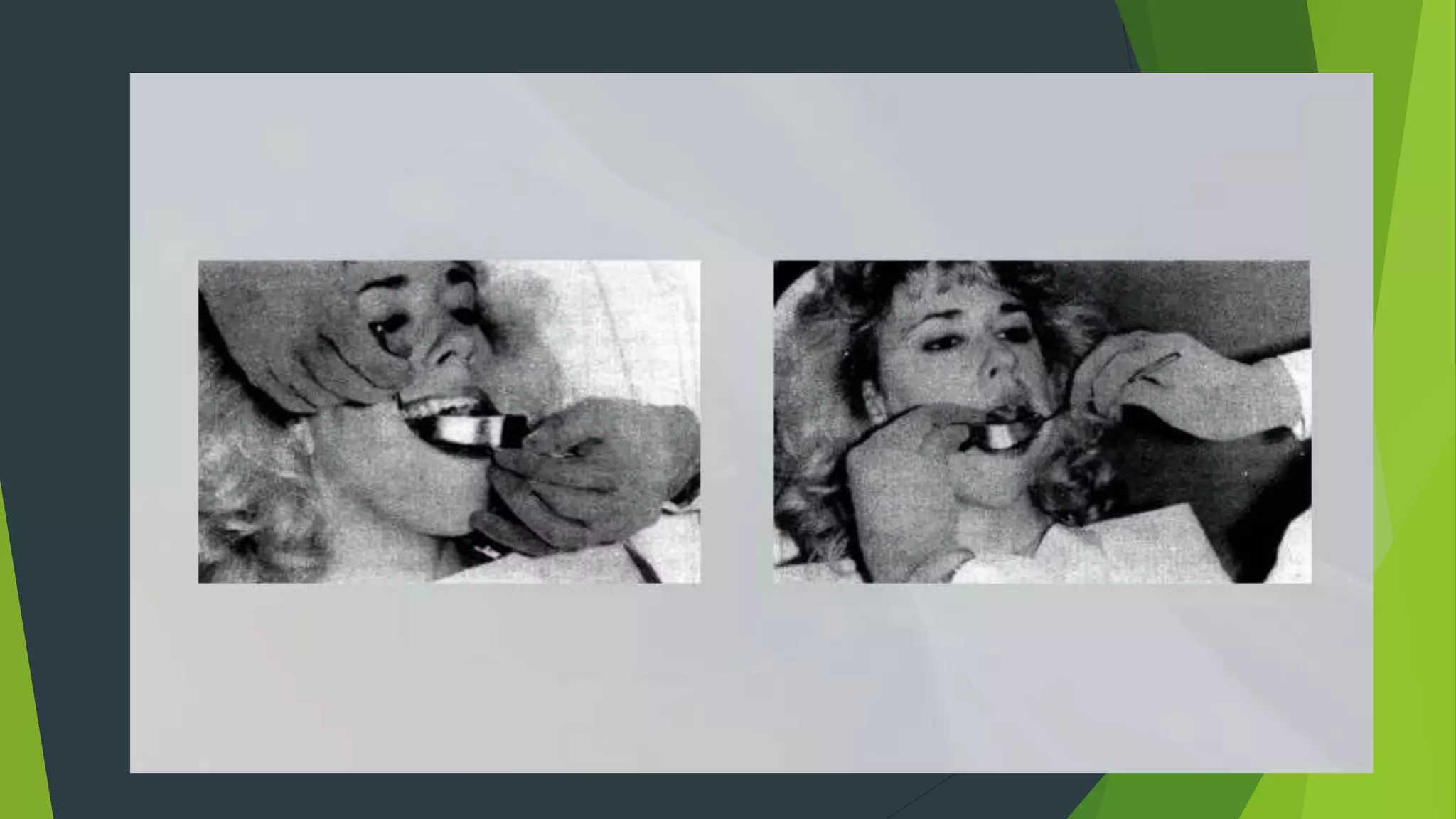
Checking maxillary tray size
There should be a clearance of 5-7 mm between the inner flanges
of the tray & facial surface of teeth& edentulous ridge
Tray should cover the desired anatomic areas
Too large a tray may be difficult to insert & may interfere with the coronoid
process of mandible
Checking mandibular tray size
 There should be a clearance of 5-7 between the tray and tooth surface
and ridge
 If the tray extends too far in the lingually , there is a tendency to trap the
tongue or floor of the mouth
 Tray is held in the right hand
 Left thumb & index fingers are used to manipulate the right corner of the
mouth
 As the right flange of tray is rotated toward mouth , depress the lower lip
and stretch the right corner of mouth with the left thumb and index finger
Extending an impression tray
o Sometimes impression tray of adequate width may not cover the
desired impression area
o In such cases,the tray is lengthened using modelling wax
MIXING IMPRESSION MATERIAL
Loading impression tray
• Place impression material in small amount
• Tray should be filled in level with the flangers
• Overfilling should be avoided
Mandibular impression technique
• Inject some material over occlusal surface of teeth,into vestibular
area& alveolo-lingual sulcus
• Then tray is rotated into mouth & carefully seated
• The patient is asked to keep the tip of tounge in contact with the
upper surface of tray during gelation
• Maintain the position of tray by placing the forefinger of each hand on
top of tray on premolar area & thum under patient’s chin
Maxillary impressIon technique
Inject alginate into occlusal surface &vestibular areas & wipe some
amount pn the palate
Tray must be centered & properly alginate and verify the position by
looking at the patient’s face from above
It should protrude straight from the center of the mouth
After this,the tray is seated by using fingers of both hands over the
premolar areas & stabilise the tray
Removal of impression from mouth
 Clinically the initial set of alginate is determined by loss of
surface tackiness
 Release seal by retracting lips 7 cheek
 Then impression is removed by a sudden jerk
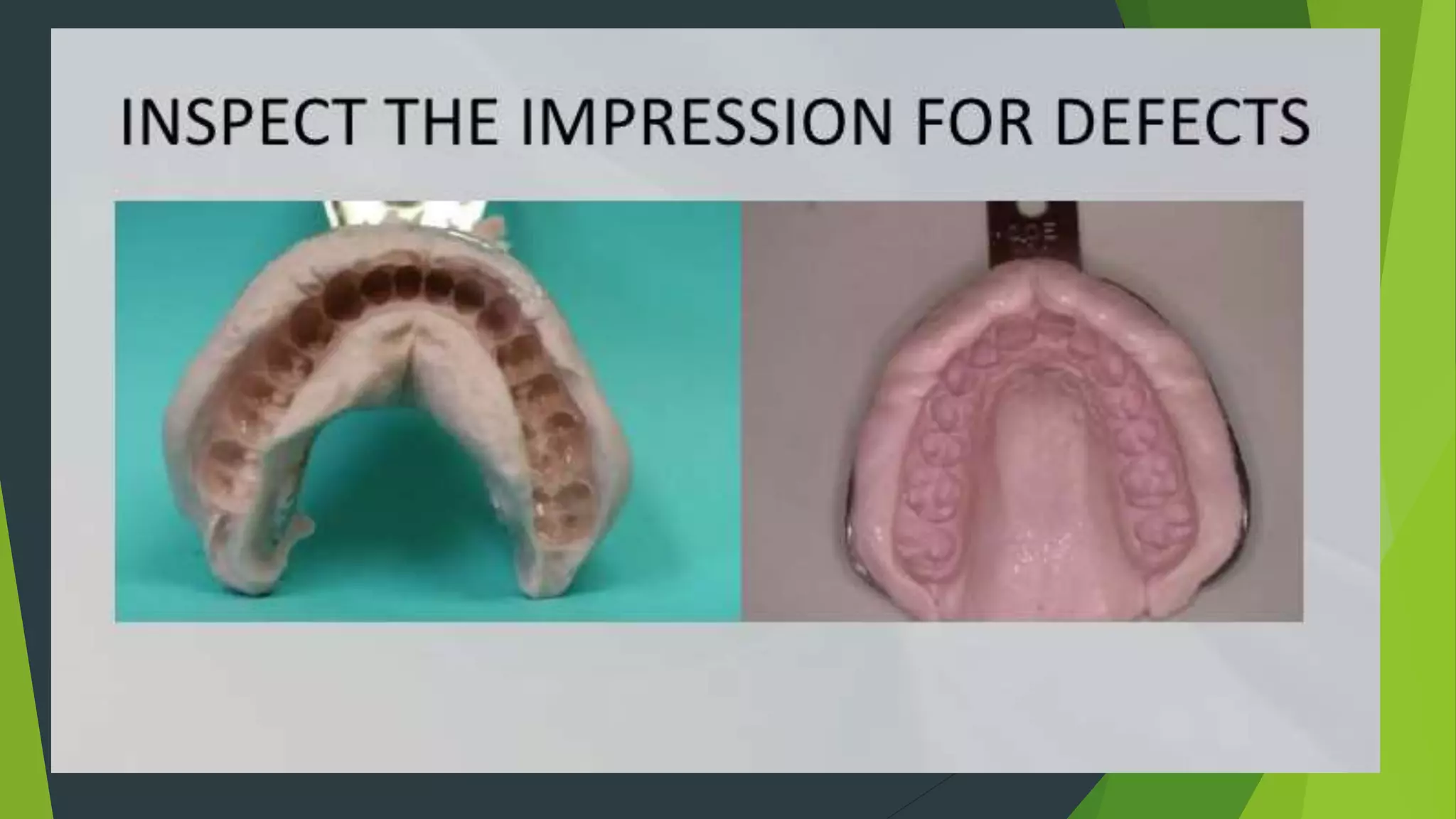
INSPECTTHE IMPRESSION FOR DEFECTS
CLEANANDDISINFECT THE IMPRESSION
Preparation of custom tray
MARKING THE OUTLINE OF THE CAST
WAXSPACER ADAPTATION
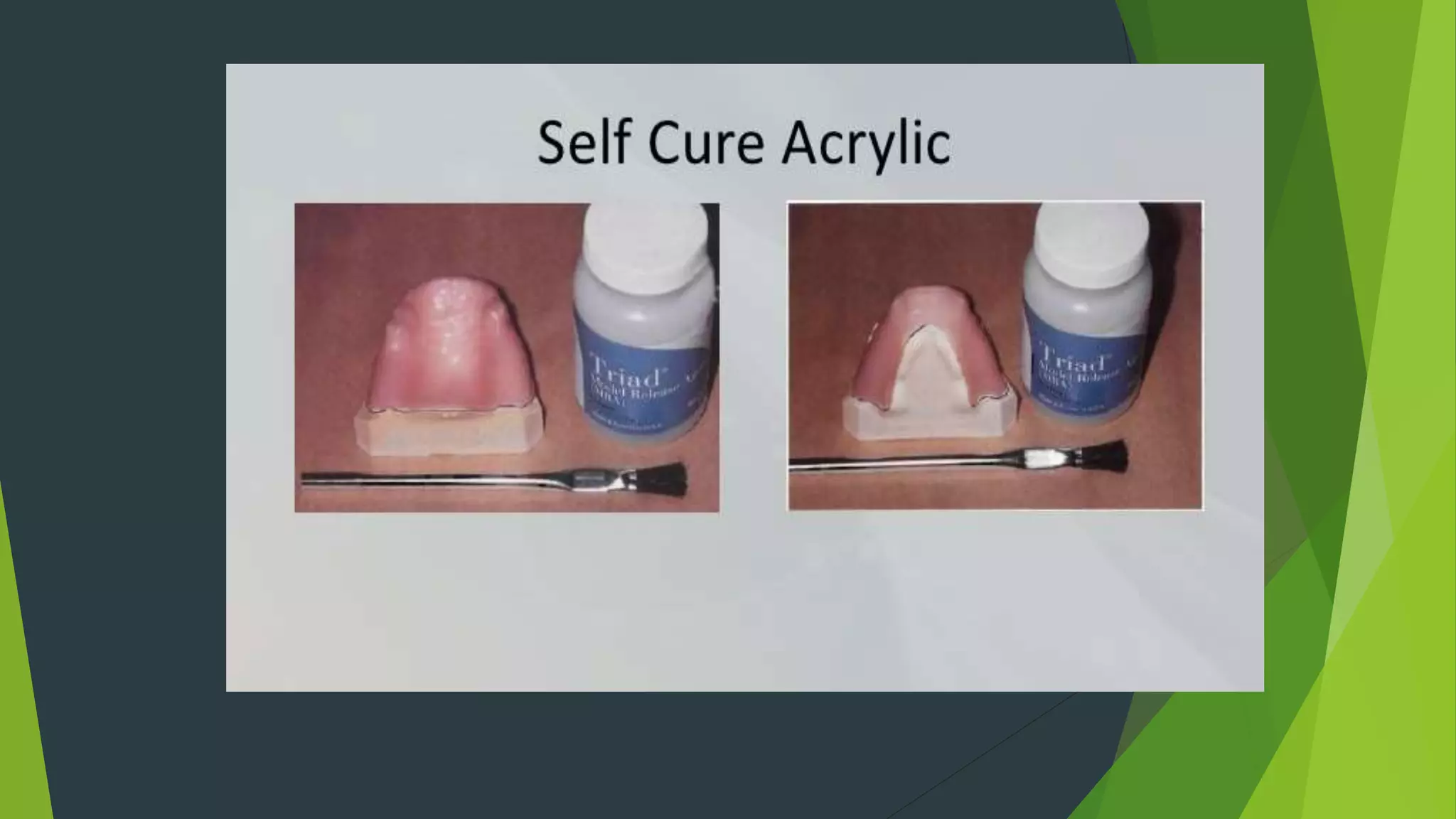
SELF CURE ACRYLIC
Attaching the Handle And Polishing
Wax spacer scraped and tray perforated
Secondary impression
• Same as that for diagnostic impression
• In this procedure paint or inject impression material in
critical areas:
 Rest preparation
 Hard palate
 Peripheral extensions
SPECIAL IMPRESSION PROCEDURES
ANATOMIC AND FUNCTIONAL FORM
OF
RIDGE
ANATOMICAL FORM OF RIDGE
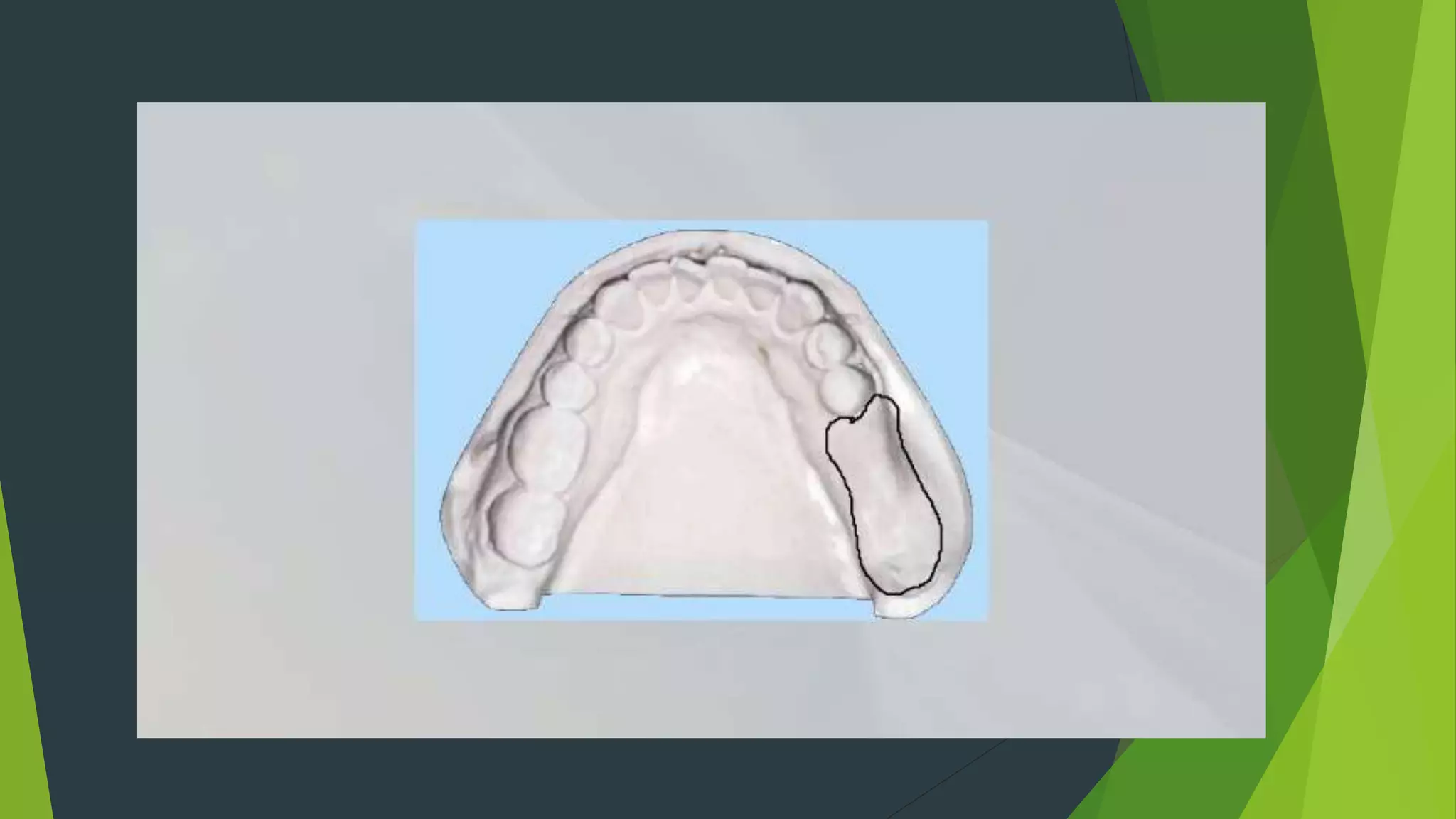
The anatomic form is surface contour of the
ridge when it is not supporting an occlusal load
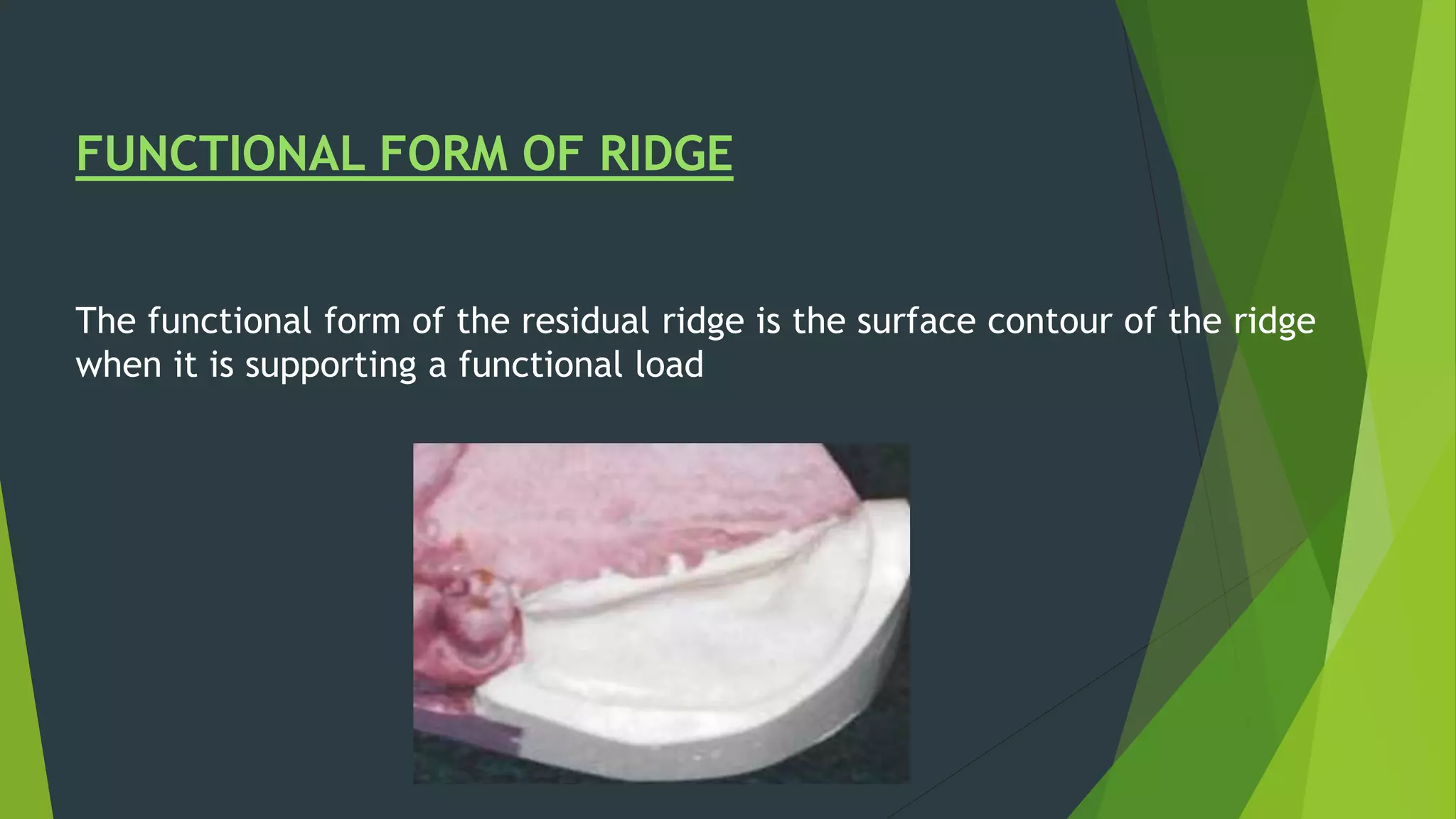
FUNCTIONAL FORM OF RIDGE
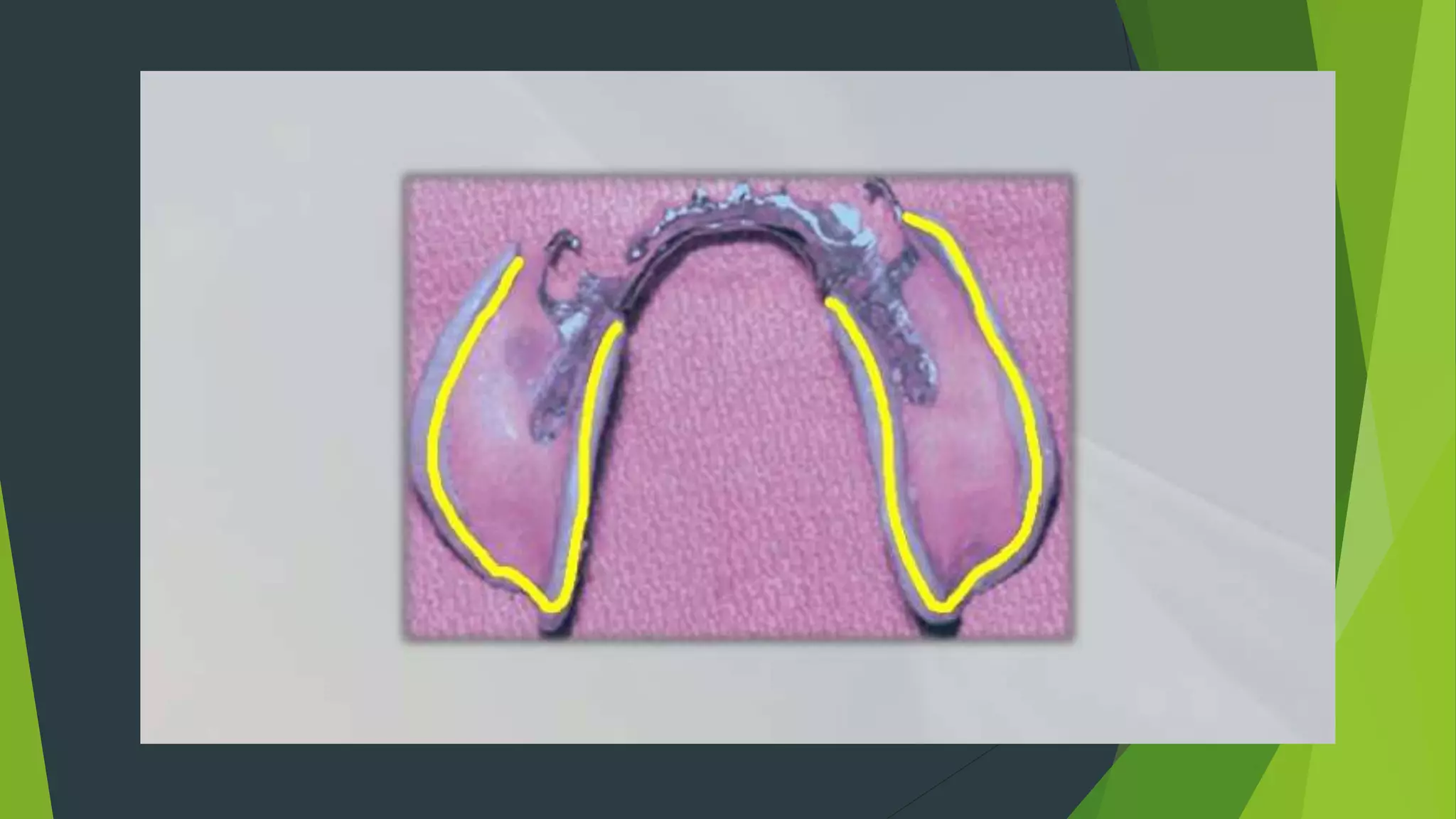
The functional form of the residual ridge is the surface contour of the ridge
when it is supporting a functional load
SPECIAL IMPRESSION PROCEDURES
1.Physiologic or functional impression technique
 Functional relining method
 Mc lean’s and Hindel’s methods
 Fluid wax method
2.Selected pressure technique
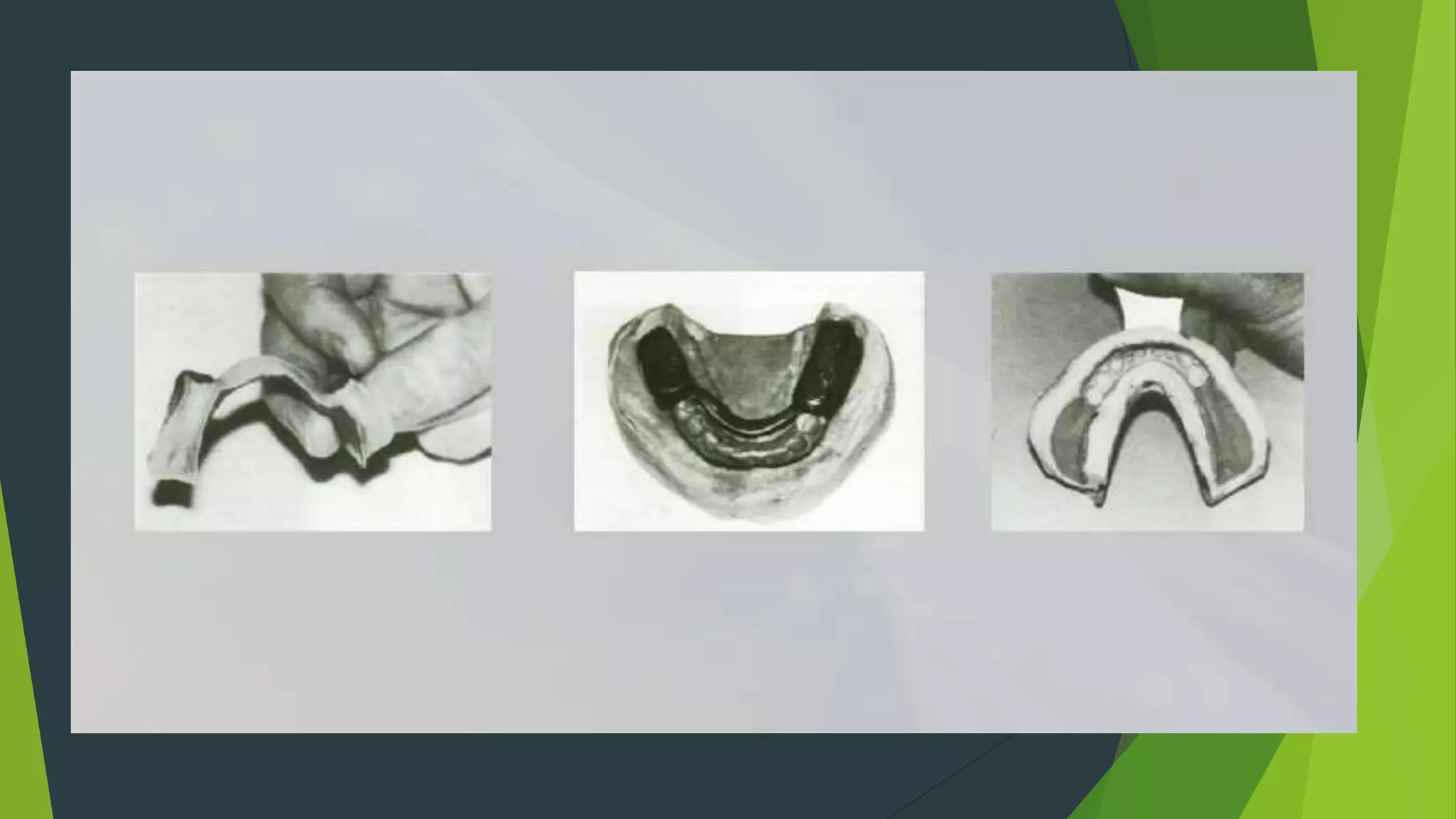
MC LEAN’S PHYSIOLOGIC IMPRESSION
Procedure
A custom impression tray is constructed over a preliminary cast
Functional impression of distal extension ridge is made.Patient applies
some biting force with occlusion rims
Then an alginate impression is made with the 1st impression held in it’s
functional position with finger pressure.
HINDEL’SMODIFICATION
Main difference of this Mc leans’s is that impression of
edentulous ridge is not made under pressure but is an anatomic
impression made at rest with ZOE paste
As the hydrocolloid impression was being made finger pressure
was applied through holes in the tray to the anatomic
impression
Disadvantage of these methods
 Constantly compressed residual ridge is prone to excessive bone resorption
 If the clasp do not hold the partial denturethe denture will be pushed slightly
occlusally by the tissue causing premature contacta(TISSUE REBOUND)
FUNCTIONALRELININGMETHOD
Here a new surface is added into the inner or tissue side of the denture base
The partial denture is made fro a cast made from impression made with alginate
A space is provide by adapting a metal spacer over the ridge on
the cast before processing the denture base
A functional impression impression of the edentulous area is
made using the cast partial denture framework
 The patient must maintain the mouth in a partially
opened position
 Border moulding is carried out
 Then a low fusing modelling plastic/green stick
compound is allowed to
flow over the tissue side of denture base
 It is tempered in water bath and seated in patient’s
mouth
• To provide space for the impression material plastic is scraped to a depth of
1mm
• The modelling plastic serves as a tray material for the secondary impression
material
• The final impression is made with a zinc oxide eugenol impression paste
• If undercuts are present,light bodied rubber based impressin material can be
used
Advantages
 The amount of soft tissue displacement is controlled by the amount of relief given
to modelling plastic before the final impression is made
 Greater the relief,the less will be the tissue displacement
 Tissue surface of metal frame work can be relined after insertion
Disadvantage
 Since open mouth technique is used it is difficult to maintain the
previous oocclusal contact
FLUIDWAX FUNCTIONAL IMPRESSION
 Make an anatomic impression of the arch using aliginate
 Fabricate a refractory cast using alginate
 Fabricate the partial denture framework over the
refractory cast
 Draw the outline of the denture base
 Cast is coated with separating medium
 Wax spacer is adapted over the crest of the edentulous ridge
 Framework is placed over the spacer
 Auto-polymerisation resin is mixed to dough stage and is
adapted and contoured over the framework along the
length of the ridge
 Borders of the tray are trimmed
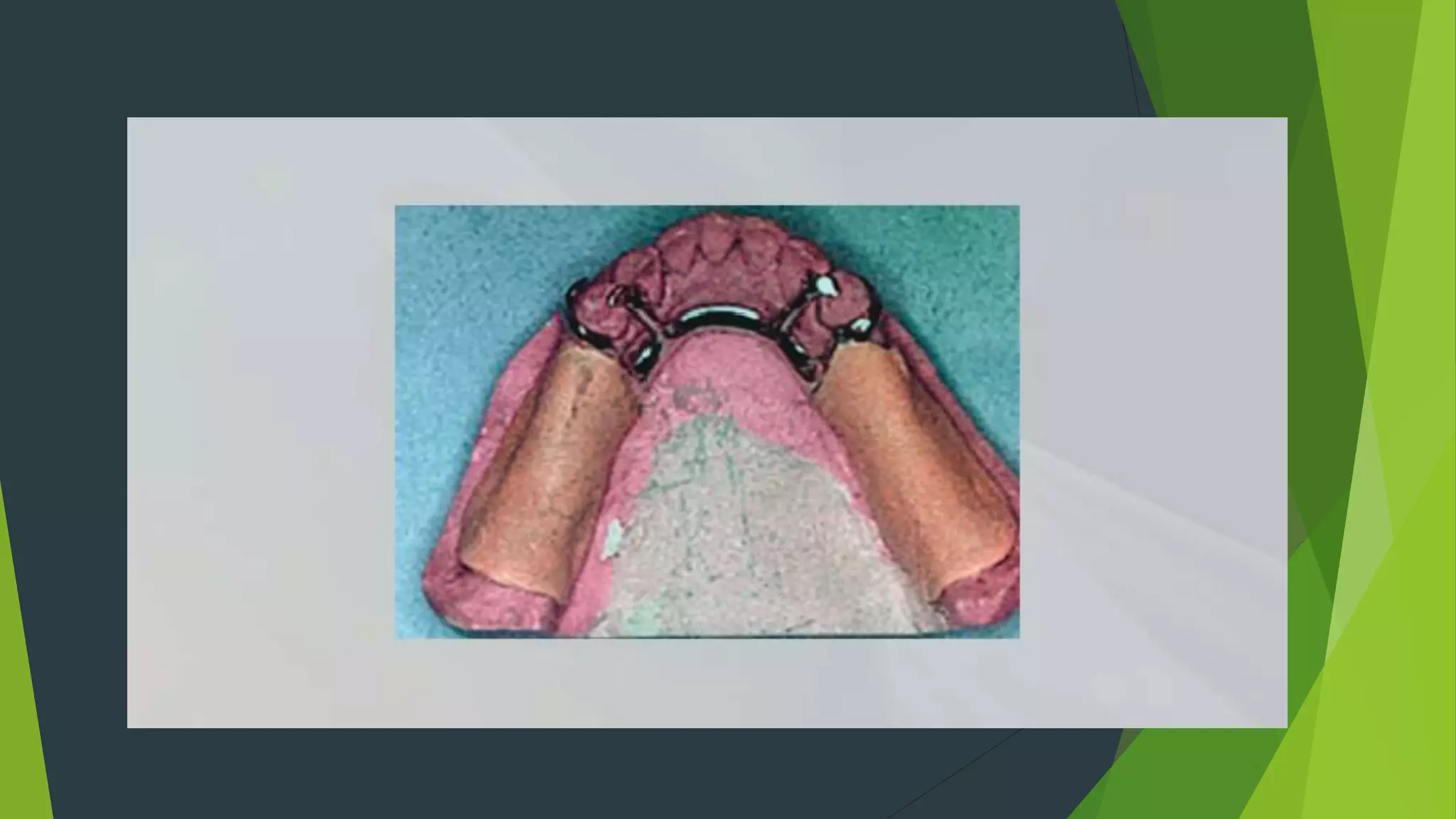
IMPRESSIONPROCEDURE
• Wax is softened at 51* to 54*
• Softened wax is painted on the tissue surface with a brush
• Wax is painted in excess near the border to record the sulcus
• Tray is seated and held in position
• It takes at least 5min for the wax to set
• The tray is removed and the impression is examined
• The wax surface that has contracted soft tissue appers glossy and the
other areas that has not contacted the tissues will appear dull
• The impression should be placed in the mouth finally for 12 min
SELECTIVEDPRESSURE IMPRESSION
 More force are applied to areas that can absorb stress without adverse response
& protect that
areas that is least able to absorb force
 Stress bearing areas are the buccal shelf area and lingual slopes pf residual ridge
stress
bearing areas
 The denture base made from this impression will be closely adapted & in firm
contact with tissues in buccal shelf area
CUSTOM TRAYS
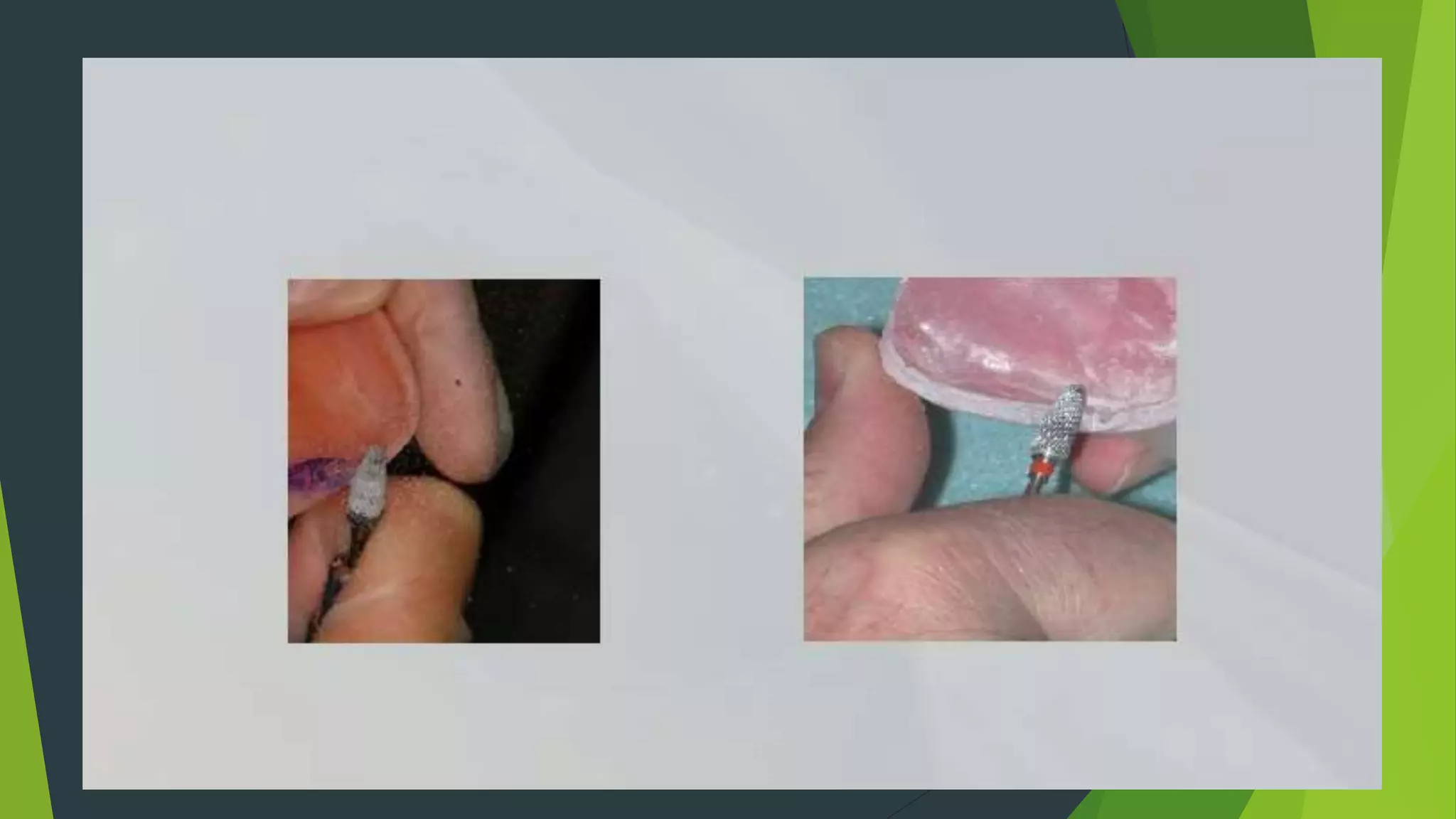
 The tissue surface if the tray is trimmed with burs to provide
adequate relief
 Impression material is loaded on the prepared special tray and inserted into
the patient’s mouth
 Impression is made with the patient with his mouth open under finger
pressure
 Only the stress bearing areas will be compressed during the impression
making
Materials used for secondary impression
Zinc oxide eugenol impression Paste
Rubber base material
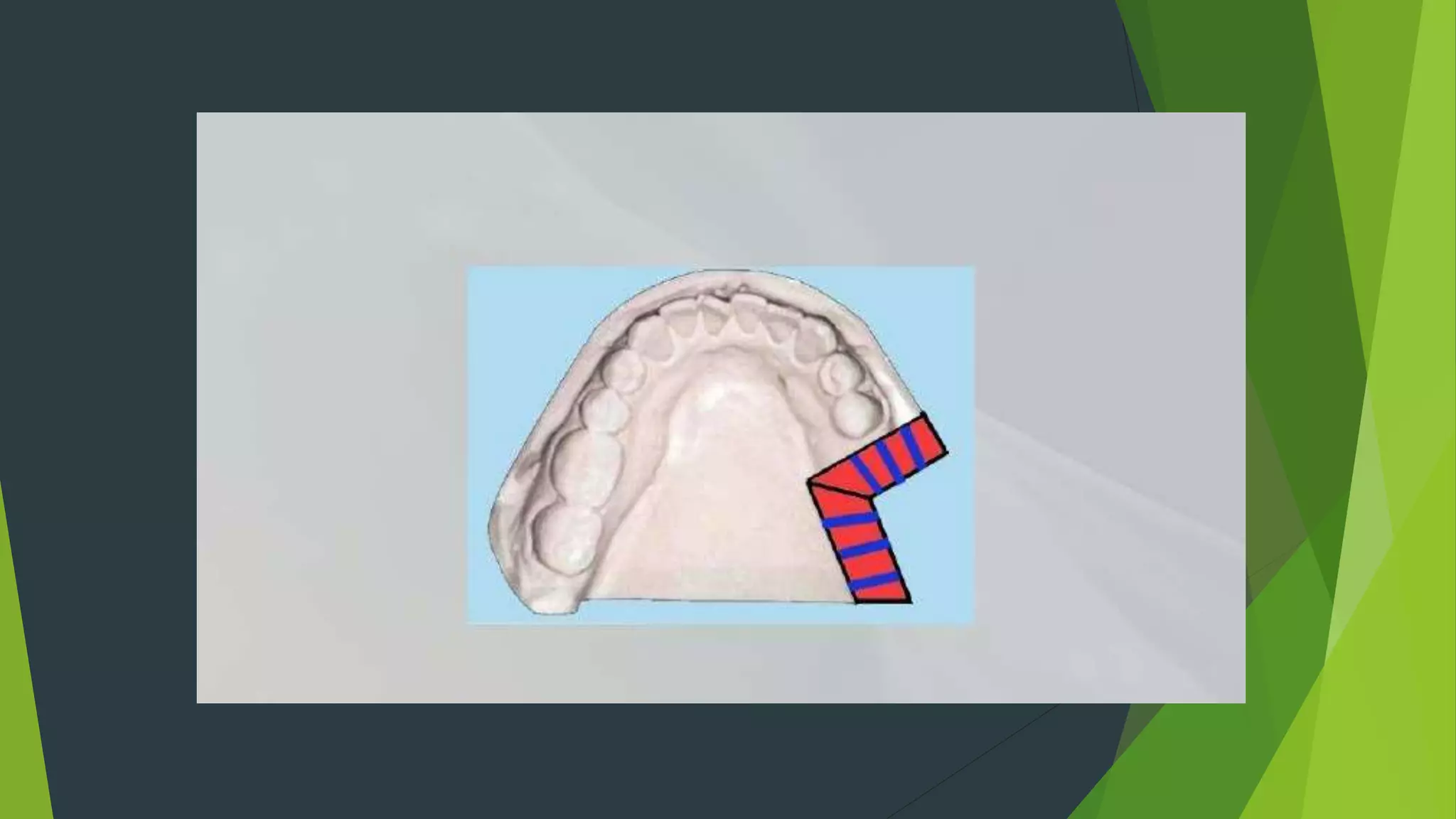
Altering the Master Cast
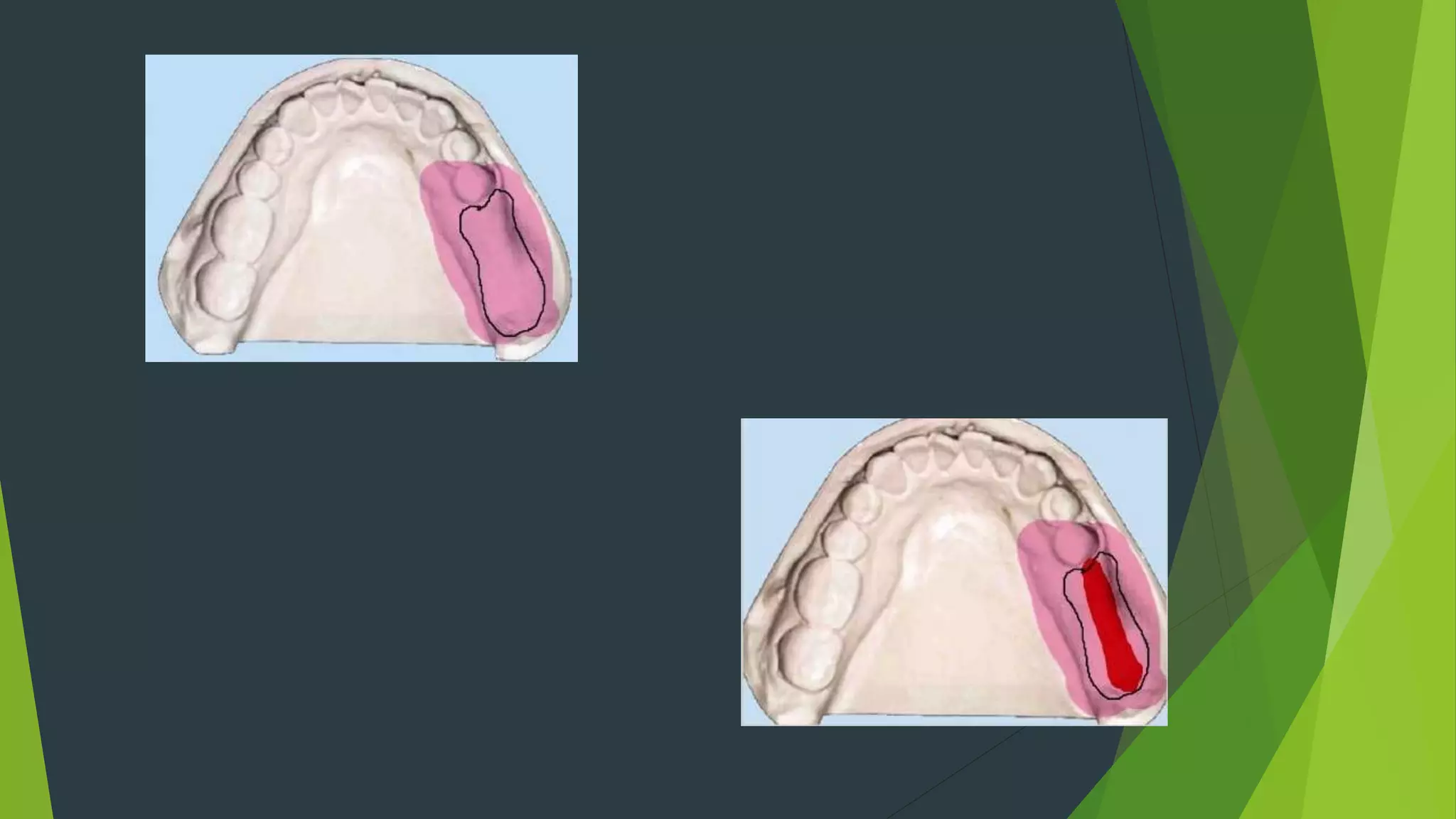
This procedure is done to obtain a ‘hybrid cast’which
records the edentulous areas in the functional form
and the dentulous areas in the anatomic form
Conclusion
An accurate impression is vital for the success of a cast partial denture.
So proper selection of material , impression technique and the skills of
the dentist plays a key role in the success of the overall treatment
REFERENCE:
• Mc Cracken’s R.P.D
• Stewart textbook of RPD
• Nallaswami textbook of
prosthodontics
• www.google.co.in
THANK YOU
PRESENTED BY :
VIBHOR TYAGI (FINAL YEAR)

Vibhor impression in rpd

  • 1.
  • 2.
    INTRODUCTION An impression isdefined as a negative likeness of the teeth and of/or edentulous areas where the teeth have been removed made in a plastic material which becomes relatively hard while in contact with these tissues.
  • 3.
     Classification ofimpression materials  Rigid materials  Plaster of paris  Metallic oxide plaster  Thermoplastic materials  Modelling plastic  Impression waxes and natural resins
  • 4.
    Elastic material  Reversiblehydrocolloid  Irreversible hydrocolloid  Silicone impression material  Condensation  Addition
  • 5.
     Indicated fordiagnostic casts,orthodontic treatment casts and master cast for R.P.D Can be used in presence of saliva >Hydrophilic >Pleasant taste and smell >Nontoxic,nonstaining &inexpensive IRREVERSIBLE HYDROCOLLOID
  • 6.
    Can be disinfectedwith 2% gluteraldehyde Should be stored in 100% moisture & poured within 1 hour Low tear strength Surface details-less than elastomeric impression material Dimensional stability-less than elastomeric impression material
  • 7.
    Polysulfide impression materials •High tear strength • Long workin and setting time(8 to 10 min) • Can be disinfected • Cast poured will have smoother texture & will be harder as they do not retard or etch the surface of setting stone • Should have a uniform thickness that does not exceed 3mm
  • 8.
    • Medium andheavy body should not be used in case of large multiple undercuts • Long term dimension stability is poor due to water loss after setting • Should be held still during the impression making procedure • Allow to rebound for 7 to 15 minutes after removal from mouth and pour immediately • Unplaesant odour & stains clothes
  • 9.
    Polyether impression materials Goodsurface details Hydrophilic-good wettability for easy cast forming Shorter working and setting time  flow characteristic and flow-lowest among others  Stiffness -cast removal of while removal from tray
  • 10.
    Unpleasant taste Absorb water Cannotbe immersed in disinfecting solutions Pour within 2 hours for better results
  • 11.
     Condensation silicones Moderate working time(5-7minutes)  Pleasant odor  Good tear strength  Excellent recovery from deformation  Can be disinfected from disinfecting solutions without any alternation in accuracy  Hydrophobic  Ideally poured within 1 hour
  • 12.
     ADDITION SILICONES •Most accurate among elastic impression material • Low polymerisation shrinkage and distortion • Fast recovery from distortion • Good tear strength • Working time-3 to 5 minutes
  • 13.
    • Both hydrophilican hydrophobic forms are available in automixing devices • Pouring can be delayed upto 1 week • Stable in streilising solutions • Sulphur in latex gloves-reatards the setting reaction
  • 14.
    IMPRESSION OF PARTICULLY EDENTULOUSARCH  Elastic impression materials are used for making impression of partially edentulaous arch  This is due to the presence of undercuts in the partially edentulous mouth
  • 15.
     MATERIALS AVAILABLEFOR MAKING IMPRESSION  Reversible hydrocolloids (agar-agar) Irreversible hydrocolloids (alginate) Elastomeric impression materials
  • 16.
    Steps in impressionmaking  Position of patient and dentist  Tray selection  Mixing the material &loading into the tray  Impression making & removal  Inspecting,cleaning &disinfecting the impression
  • 17.
    Position of patientand dentist  Dentist should stand & patient should sit upright  Occlusal plane should be parallel to the floor  Maxillary impression dentist should stand at the right rear of the patient  Mandibular impression dentist shold stand at the right front of the patient
  • 19.
    Impression tray selection Stocktrays fordentulous & partially edentulous arches are of 3 types:  Rimlock trays  Perforated metal trays  Plastic disposable trays
  • 20.
    Checking maxillary traysize There should be a clearance of 5-7 mm between the inner flanges of the tray & facial surface of teeth& edentulous ridge Tray should cover the desired anatomic areas Too large a tray may be difficult to insert & may interfere with the coronoid process of mandible
  • 21.
    Checking mandibular traysize  There should be a clearance of 5-7 between the tray and tooth surface and ridge  If the tray extends too far in the lingually , there is a tendency to trap the tongue or floor of the mouth  Tray is held in the right hand  Left thumb & index fingers are used to manipulate the right corner of the mouth  As the right flange of tray is rotated toward mouth , depress the lower lip and stretch the right corner of mouth with the left thumb and index finger
  • 22.
    Extending an impressiontray o Sometimes impression tray of adequate width may not cover the desired impression area o In such cases,the tray is lengthened using modelling wax
  • 23.
  • 24.
    Loading impression tray •Place impression material in small amount • Tray should be filled in level with the flangers • Overfilling should be avoided
  • 25.
    Mandibular impression technique •Inject some material over occlusal surface of teeth,into vestibular area& alveolo-lingual sulcus • Then tray is rotated into mouth & carefully seated • The patient is asked to keep the tip of tounge in contact with the upper surface of tray during gelation • Maintain the position of tray by placing the forefinger of each hand on top of tray on premolar area & thum under patient’s chin
  • 27.
    Maxillary impressIon technique Injectalginate into occlusal surface &vestibular areas & wipe some amount pn the palate Tray must be centered & properly alginate and verify the position by looking at the patient’s face from above It should protrude straight from the center of the mouth After this,the tray is seated by using fingers of both hands over the premolar areas & stabilise the tray
  • 29.
    Removal of impressionfrom mouth  Clinically the initial set of alginate is determined by loss of surface tackiness  Release seal by retracting lips 7 cheek  Then impression is removed by a sudden jerk
  • 30.
  • 31.
  • 32.
  • 33.
  • 34.
  • 35.
  • 37.
    Attaching the HandleAnd Polishing
  • 38.
    Wax spacer scrapedand tray perforated
  • 39.
    Secondary impression • Sameas that for diagnostic impression • In this procedure paint or inject impression material in critical areas:  Rest preparation  Hard palate  Peripheral extensions
  • 40.
  • 41.
  • 42.
    ANATOMICAL FORM OFRIDGE The anatomic form is surface contour of the ridge when it is not supporting an occlusal load
  • 43.
    FUNCTIONAL FORM OFRIDGE The functional form of the residual ridge is the surface contour of the ridge when it is supporting a functional load
  • 44.
    SPECIAL IMPRESSION PROCEDURES 1.Physiologicor functional impression technique  Functional relining method  Mc lean’s and Hindel’s methods  Fluid wax method 2.Selected pressure technique
  • 45.
    MC LEAN’S PHYSIOLOGICIMPRESSION Procedure A custom impression tray is constructed over a preliminary cast Functional impression of distal extension ridge is made.Patient applies some biting force with occlusion rims Then an alginate impression is made with the 1st impression held in it’s functional position with finger pressure.
  • 48.
    HINDEL’SMODIFICATION Main difference ofthis Mc leans’s is that impression of edentulous ridge is not made under pressure but is an anatomic impression made at rest with ZOE paste As the hydrocolloid impression was being made finger pressure was applied through holes in the tray to the anatomic impression
  • 49.
    Disadvantage of thesemethods  Constantly compressed residual ridge is prone to excessive bone resorption  If the clasp do not hold the partial denturethe denture will be pushed slightly occlusally by the tissue causing premature contacta(TISSUE REBOUND)
  • 50.
    FUNCTIONALRELININGMETHOD Here a newsurface is added into the inner or tissue side of the denture base The partial denture is made fro a cast made from impression made with alginate A space is provide by adapting a metal spacer over the ridge on the cast before processing the denture base A functional impression impression of the edentulous area is made using the cast partial denture framework
  • 51.
     The patientmust maintain the mouth in a partially opened position  Border moulding is carried out  Then a low fusing modelling plastic/green stick compound is allowed to flow over the tissue side of denture base  It is tempered in water bath and seated in patient’s mouth
  • 52.
    • To providespace for the impression material plastic is scraped to a depth of 1mm • The modelling plastic serves as a tray material for the secondary impression material • The final impression is made with a zinc oxide eugenol impression paste • If undercuts are present,light bodied rubber based impressin material can be used
  • 54.
    Advantages  The amountof soft tissue displacement is controlled by the amount of relief given to modelling plastic before the final impression is made  Greater the relief,the less will be the tissue displacement  Tissue surface of metal frame work can be relined after insertion Disadvantage  Since open mouth technique is used it is difficult to maintain the previous oocclusal contact
  • 55.
    FLUIDWAX FUNCTIONAL IMPRESSION Make an anatomic impression of the arch using aliginate  Fabricate a refractory cast using alginate  Fabricate the partial denture framework over the refractory cast
  • 57.
     Draw theoutline of the denture base  Cast is coated with separating medium  Wax spacer is adapted over the crest of the edentulous ridge
  • 60.
     Framework isplaced over the spacer  Auto-polymerisation resin is mixed to dough stage and is adapted and contoured over the framework along the length of the ridge  Borders of the tray are trimmed
  • 62.
    IMPRESSIONPROCEDURE • Wax issoftened at 51* to 54* • Softened wax is painted on the tissue surface with a brush • Wax is painted in excess near the border to record the sulcus • Tray is seated and held in position • It takes at least 5min for the wax to set
  • 63.
    • The trayis removed and the impression is examined • The wax surface that has contracted soft tissue appers glossy and the other areas that has not contacted the tissues will appear dull • The impression should be placed in the mouth finally for 12 min
  • 65.
    SELECTIVEDPRESSURE IMPRESSION  Moreforce are applied to areas that can absorb stress without adverse response & protect that areas that is least able to absorb force  Stress bearing areas are the buccal shelf area and lingual slopes pf residual ridge stress bearing areas  The denture base made from this impression will be closely adapted & in firm contact with tissues in buccal shelf area
  • 66.
  • 67.
     The tissuesurface if the tray is trimmed with burs to provide adequate relief
  • 69.
     Impression materialis loaded on the prepared special tray and inserted into the patient’s mouth  Impression is made with the patient with his mouth open under finger pressure  Only the stress bearing areas will be compressed during the impression making
  • 70.
    Materials used forsecondary impression Zinc oxide eugenol impression Paste Rubber base material
  • 71.
    Altering the MasterCast This procedure is done to obtain a ‘hybrid cast’which records the edentulous areas in the functional form and the dentulous areas in the anatomic form
  • 77.
    Conclusion An accurate impressionis vital for the success of a cast partial denture. So proper selection of material , impression technique and the skills of the dentist plays a key role in the success of the overall treatment REFERENCE: • Mc Cracken’s R.P.D • Stewart textbook of RPD • Nallaswami textbook of prosthodontics • www.google.co.in
  • 78.
    THANK YOU PRESENTED BY: VIBHOR TYAGI (FINAL YEAR)