TLE COOKERY
10
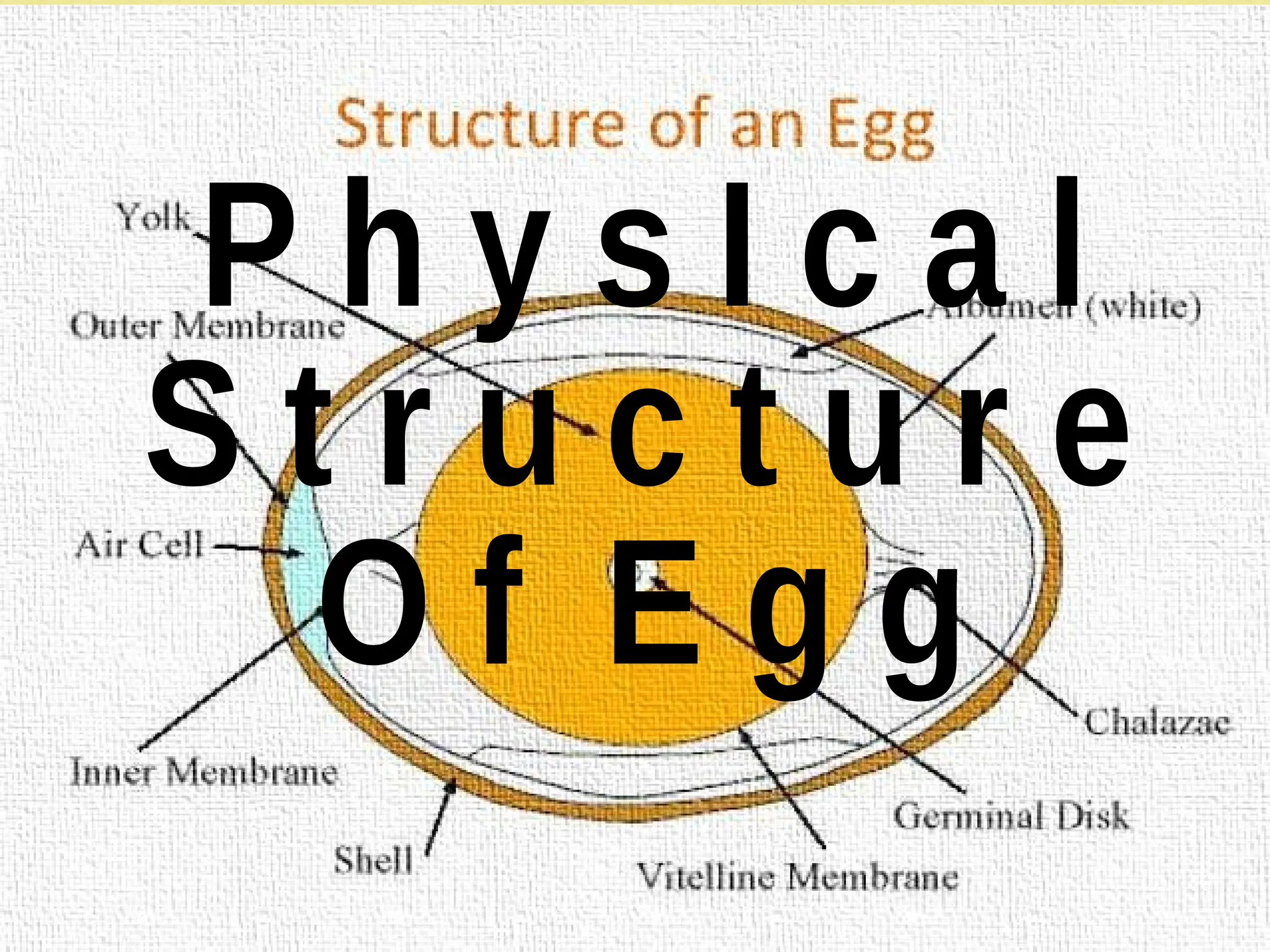
PHYSICAL STRUCTURE
AND
COMPOSITION
OF EGGS
Prepared by: ROWENA M.GONZAGA
We normally
distinguish 3 parts of
an egg: the shell, the
egg white, and the
egg yolk, but a closer
scrutiny reveals a
much more detailed
structure of an egg.
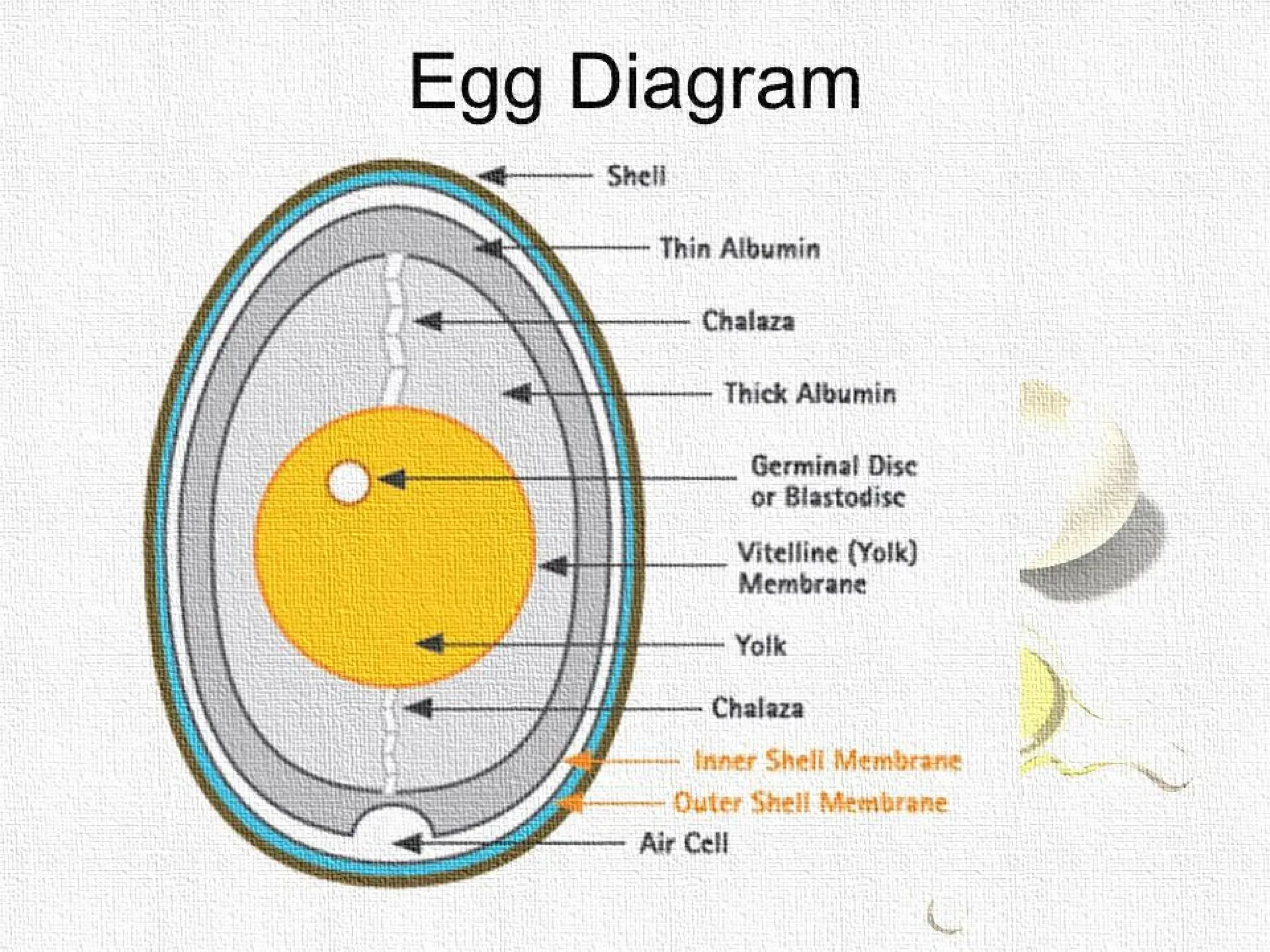
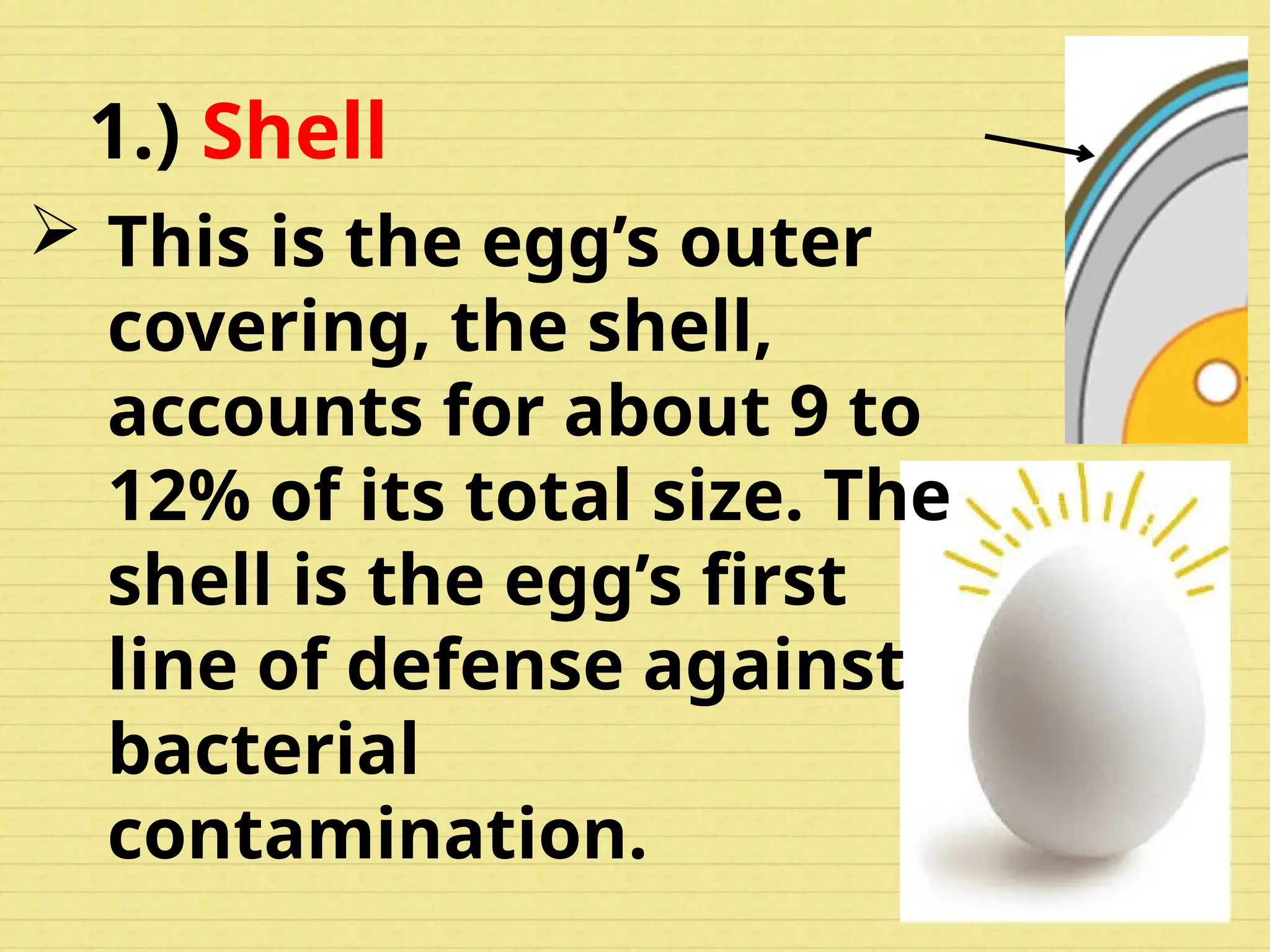
1.) Shell
 This is the egg’s outer
covering, the shell,
accounts for about 9 to
12% of its total size. The
shell is the egg’s first
line of defense against
bacterial
contamination.
2.) Air Cell
 This is the empty
space between the
white and shell at the
large end of the egg
which is barely
existent in newly laid
egg.
Thick Albumin
Thin Albumin
3.) Albumen
 Also called egg white,
accounts for most of
an egg’s liquid weight,
about 67%. This is
produced by the
oviduct and consists of
four alternating layers
of thick and thin
consistencies.
4.) Chalaza
 This is the ropey
strands of egg white
at both sides of the
egg, which anchor
the yolk in place in
the center of the
thick white.
5.) Germinal Disc/
Blastodisc
 This is the entrance
of the latebra, the
channel leading to
the center of the
yolk.
6.) Membranes
 There are two(2) kinds
of membranes, one just
under the shell and the
other covering the yolk.
These are the shell
membrane and vitelline
membrane.
 Shell Membrane
- it has two types of
membrane, the outer
membrane sticks to
the shell while the
inner membrane sticks
to the albumen.
 Vitelline Membrane
- is the covering
that protects the yolk
from breaking. It is
also the weakest at the
germinal disc and
tends to become more
fragile as the egg ages.
7.) Yolk
 This is the yellow
to yellow-orange
portion makes up
about 33% of the
liquid weight of
the egg.
Composition of an Egg
% %
Water
%
Protein
%
Fat
%
Ash
Whole
Egg
100 65.5 11.8 11.0 11.7
Albume
n
58 88 11.0 0.2 0.8
Yolk
31 48 17.5 32.5 2.0
Nutritive Value of Eggs
 Eggs are indeed one of
nature’s complete food.
It contains high quality
protein with all the
essential amino acids,
all of the vitamins
except Vit. C, and any
minerals.
Egg Quality,
Grading &
Size
Egg Quality
 Shell Quality –
also known as
exterior
quality that
has direct
influence to
microbiologi-
cal quality
 Interior Quality
– has direct bearing
on the functional
properties of eggs.
Egg Grading
 Is a form of quality control used
to classify eggs for exterior and
interior quality. In our country,
the grade designations are A,B,C
and D.
QUALITY
FACTOR
A B C D
SHELL • Clean
• Unbroken
• Normal
Shape
• Clean
• Unbroken
• Normal
Shape
• Moderatel
y stained
• Unbroken
• Slightly
abnormal
shape
• Moderatel
y stained
• Unbroken
• Maybe
abnormal
shape
AIR CELL • Depth of
0.3 cm or
less
• Practically
regular
• Depth of
0.5 cm or
less
• Practically
regular
• Depth of
1.0 cm or
less
• May be
loose or
bubbly
• Depth of 1
cm
• May be
loose or
bubbly
P H I LI P P I NE S T A ND A RD OF QU A LI T Y
FOR CH I C K E N E G GS
EGG WHITE • Clear
• Firm
• 72 Haugh
units or
higher
• Clear
• Reasonably
Firm
• 60-71
Haugh
units or
higher
• Clear
• May be
slightly weak
• 31-59 Haugh
units
• May be weak
and watery
• Small clots or
spots may be
present
• Less than 31
Haugh units
EGG YOLK • Outlined
defined
• Round
and firm
• Free from
defects
• Outlined
fairly well
defined
• Round and
firm
• Free from
defects
• Outline may
be well
defined
• May be
slightly
enlarge and
flattened
• Practically free
from defects
• May have
embryonic
developments
• Outline may
be well
defined
• May be
slightly
enlarge and
flattened
• May have
embryonic
developments
Egg Size
 Egg sizes are classify into jumbo, extra
large, large, medium, small and
peewee.
EGG SIZE CLASSIFICATION
SIZE JUMBO XL L M S PEEWEE
WEIGHT OF 12 EGGS IN GRAMS 840 756 672 588 504 420
AVERAGE WEIGHT PER EGG IN GRAMS 70 63 56 49 42 35
Factors that Affect the
Sizes of an Egg
 Breed
 Age of Hen
 Weight
 Feed/s
 Environmental
Factors
-Heat
-Stress
-Overcrowding
That’s All
Thank You!
Have a Nice Day

PHYSICAL STRUCTURE OF EGG TLE 1010.pptx

  • 1.
    TLE COOKERY 10 PHYSICAL STRUCTURE AND COMPOSITION OFEGGS Prepared by: ROWENA M.GONZAGA
  • 2.
    We normally distinguish 3parts of an egg: the shell, the egg white, and the egg yolk, but a closer scrutiny reveals a much more detailed structure of an egg.
  • 5.
    1.) Shell  Thisis the egg’s outer covering, the shell, accounts for about 9 to 12% of its total size. The shell is the egg’s first line of defense against bacterial contamination.
  • 6.
    2.) Air Cell This is the empty space between the white and shell at the large end of the egg which is barely existent in newly laid egg.
  • 7.
    Thick Albumin Thin Albumin 3.)Albumen  Also called egg white, accounts for most of an egg’s liquid weight, about 67%. This is produced by the oviduct and consists of four alternating layers of thick and thin consistencies.
  • 8.
    4.) Chalaza  Thisis the ropey strands of egg white at both sides of the egg, which anchor the yolk in place in the center of the thick white.
  • 9.
    5.) Germinal Disc/ Blastodisc This is the entrance of the latebra, the channel leading to the center of the yolk.
  • 10.
    6.) Membranes  Thereare two(2) kinds of membranes, one just under the shell and the other covering the yolk. These are the shell membrane and vitelline membrane.
  • 11.
     Shell Membrane -it has two types of membrane, the outer membrane sticks to the shell while the inner membrane sticks to the albumen.
  • 12.
     Vitelline Membrane -is the covering that protects the yolk from breaking. It is also the weakest at the germinal disc and tends to become more fragile as the egg ages.
  • 13.
    7.) Yolk  Thisis the yellow to yellow-orange portion makes up about 33% of the liquid weight of the egg.
  • 15.
    Composition of anEgg % % Water % Protein % Fat % Ash Whole Egg 100 65.5 11.8 11.0 11.7 Albume n 58 88 11.0 0.2 0.8 Yolk 31 48 17.5 32.5 2.0
  • 16.
    Nutritive Value ofEggs  Eggs are indeed one of nature’s complete food. It contains high quality protein with all the essential amino acids, all of the vitamins except Vit. C, and any minerals.
  • 17.
  • 18.
    Egg Quality  ShellQuality – also known as exterior quality that has direct influence to microbiologi- cal quality  Interior Quality – has direct bearing on the functional properties of eggs.
  • 19.
    Egg Grading  Isa form of quality control used to classify eggs for exterior and interior quality. In our country, the grade designations are A,B,C and D.
  • 20.
    QUALITY FACTOR A B CD SHELL • Clean • Unbroken • Normal Shape • Clean • Unbroken • Normal Shape • Moderatel y stained • Unbroken • Slightly abnormal shape • Moderatel y stained • Unbroken • Maybe abnormal shape AIR CELL • Depth of 0.3 cm or less • Practically regular • Depth of 0.5 cm or less • Practically regular • Depth of 1.0 cm or less • May be loose or bubbly • Depth of 1 cm • May be loose or bubbly P H I LI P P I NE S T A ND A RD OF QU A LI T Y FOR CH I C K E N E G GS
  • 21.
    EGG WHITE •Clear • Firm • 72 Haugh units or higher • Clear • Reasonably Firm • 60-71 Haugh units or higher • Clear • May be slightly weak • 31-59 Haugh units • May be weak and watery • Small clots or spots may be present • Less than 31 Haugh units EGG YOLK • Outlined defined • Round and firm • Free from defects • Outlined fairly well defined • Round and firm • Free from defects • Outline may be well defined • May be slightly enlarge and flattened • Practically free from defects • May have embryonic developments • Outline may be well defined • May be slightly enlarge and flattened • May have embryonic developments
  • 22.
    Egg Size  Eggsizes are classify into jumbo, extra large, large, medium, small and peewee. EGG SIZE CLASSIFICATION SIZE JUMBO XL L M S PEEWEE WEIGHT OF 12 EGGS IN GRAMS 840 756 672 588 504 420 AVERAGE WEIGHT PER EGG IN GRAMS 70 63 56 49 42 35
  • 23.
    Factors that Affectthe Sizes of an Egg  Breed  Age of Hen  Weight  Feed/s  Environmental Factors -Heat -Stress -Overcrowding
  • 24.