BUSINESS ENVIRONMENT
IMPORT OF TECHNOLOGY
By: Dharmender
MBA
INTRODUCTION
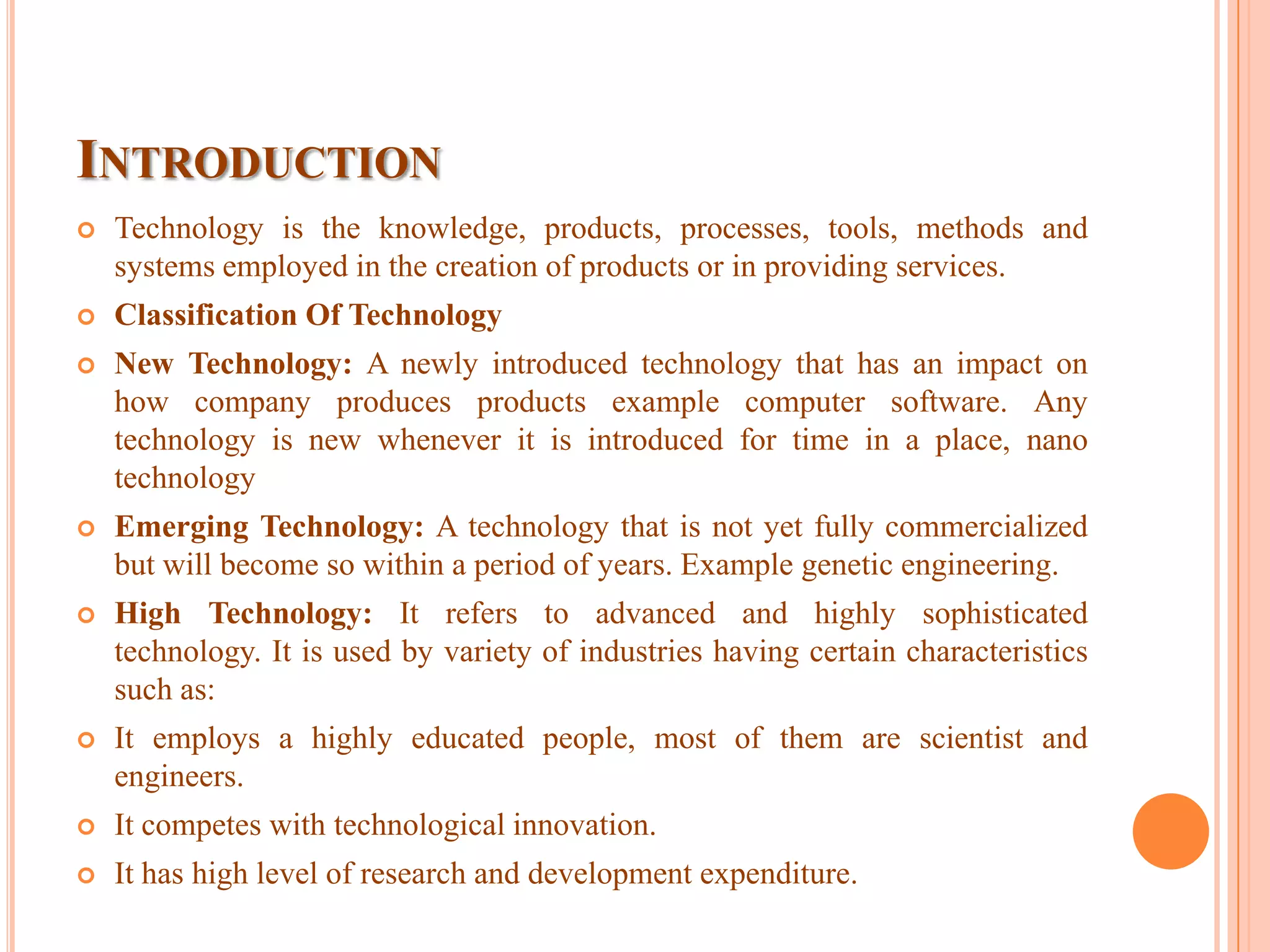
 Technology is the knowledge, products, processes, tools, methods and
systems employed in the creation of products or in providing services.
 Classification Of Technology
 New Technology: A newly introduced technology that has an impact on
how company produces products example computer software. Any
technology is new whenever it is introduced for time in a place, nano
technology
 Emerging Technology: A technology that is not yet fully commercialized
but will become so within a period of years. Example genetic engineering.
 High Technology: It refers to advanced and highly sophisticated
technology. It is used by variety of industries having certain characteristics
such as:
 It employs a highly educated people, most of them are scientist and
engineers.
 It competes with technological innovation.
 It has high level of research and development expenditure.
IMPORT OF TECHNOLOGY
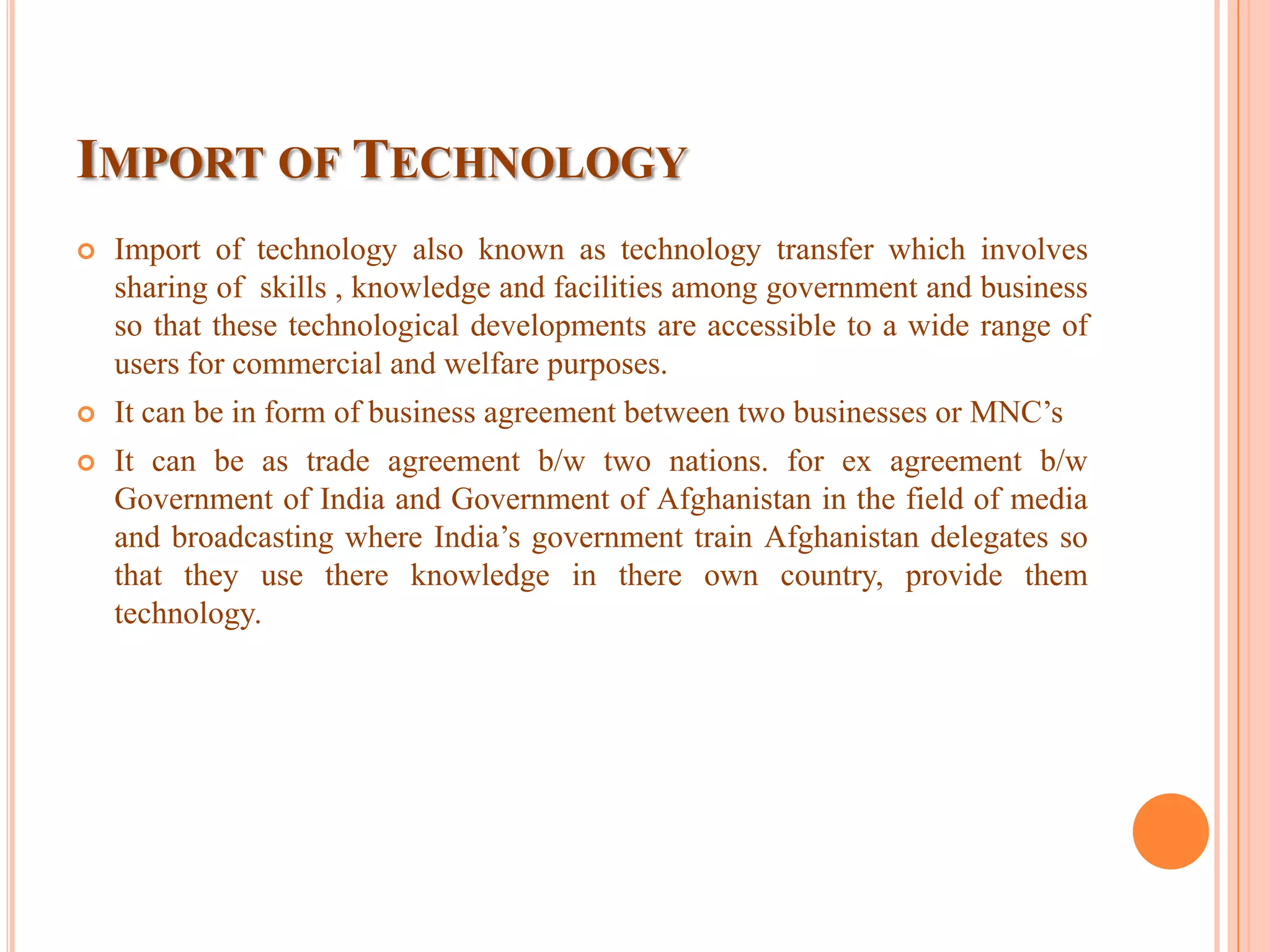
 Import of technology also known as technology transfer which involves
sharing of skills , knowledge and facilities among government and business
so that these technological developments are accessible to a wide range of
users for commercial and welfare purposes.
 It can be in form of business agreement between two businesses or MNC’s
 It can be as trade agreement b/w two nations. for ex agreement b/w
Government of India and Government of Afghanistan in the field of media
and broadcasting where India’s government train Afghanistan delegates so
that they use there knowledge in there own country, provide them
technology.
FORMS OF TECHNOLOGY TRANSFER
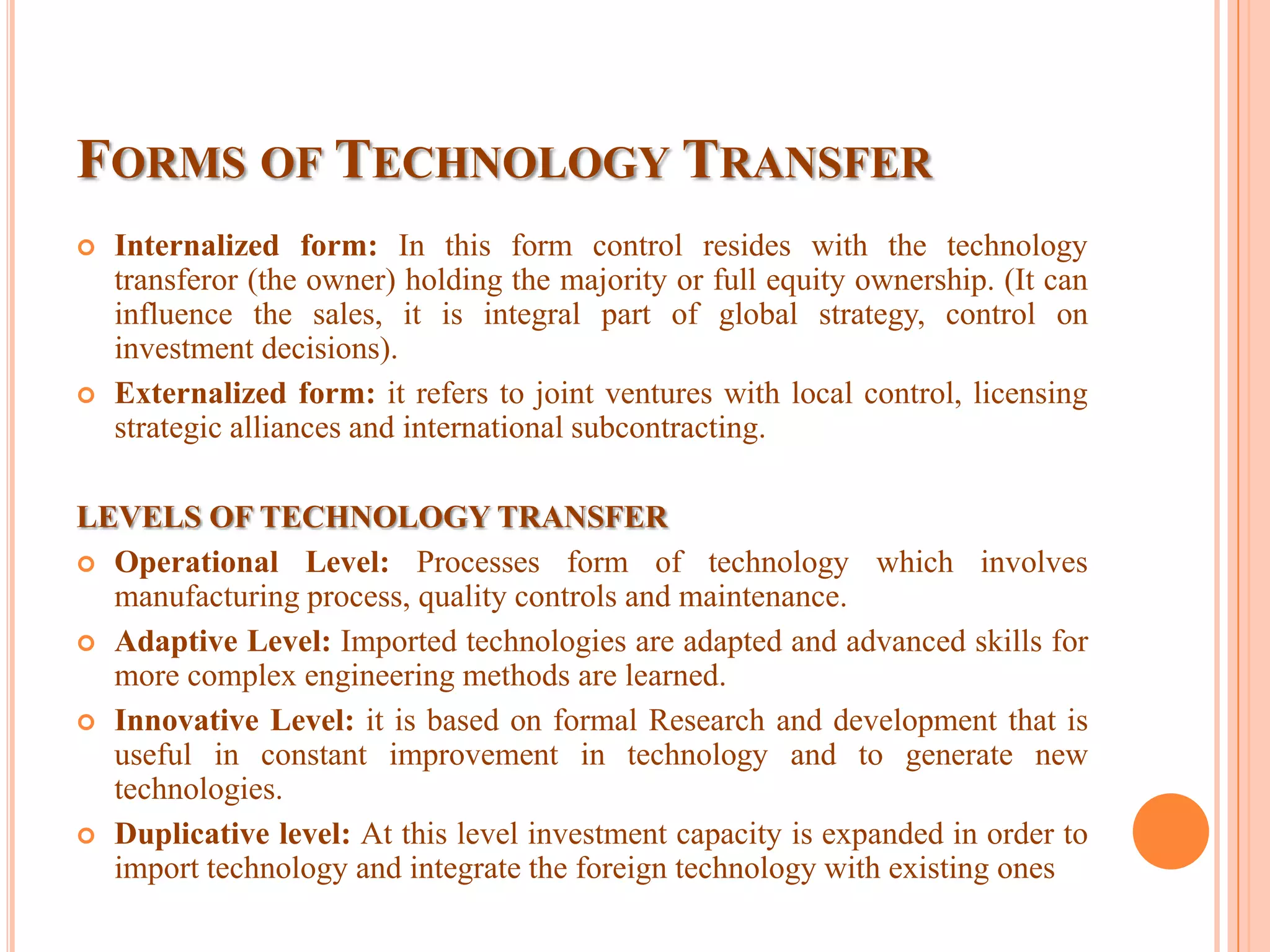
 Internalized form: In this form control resides with the technology
transferor (the owner) holding the majority or full equity ownership. (It can
influence the sales, it is integral part of global strategy, control on
investment decisions).
 Externalized form: it refers to joint ventures with local control, licensing
strategic alliances and international subcontracting.
LEVELS OF TECHNOLOGY TRANSFER
 Operational Level: Processes form of technology which involves
manufacturing process, quality controls and maintenance.
 Adaptive Level: Imported technologies are adapted and advanced skills for
more complex engineering methods are learned.
 Innovative Level: it is based on formal Research and development that is
useful in constant improvement in technology and to generate new
technologies.
 Duplicative level: At this level investment capacity is expanded in order to
import technology and integrate the foreign technology with existing ones
TECHNIQUES IN TECHNOLOGY TRANSFER
 Foreign Direct Investment: Through this technique organization transfer
its technology to target nation through its subsidiary i.e. by investing
themselves for example Toyota Motors brought in its technology of
invisible mirror through its subsidiaries in various countries.
 Licensing: License is provided for the use of technology to the user Under
which only a license holder can use the technology for example software
like operating systems of Windows or Linux etc. comes with specific code
and identity of the system through which they can be used on authorized
system only by the authorized user of that system.
 Franchising: It is quite similar to licensing where organization set up there
franchises and transfer there technology to the franchisee. The franchisee
operates on behalf of the organization under this the company have direct
control, the franchisee only carry the name and trademark for example KFC,
McDonalds, Peter England, Monginis, Nescafe etc
 Management Contracts: Here technology is transferred under certain
terms and conditions or by establishing projects for host and training there
personnel to operate it and transfer the control to hosts.
 Contract Manufacturing: It refer to transfer of technology to the user and
get the product manufactured from user themselves for example BPO’s this
happens due to low cost of manufacturing in India. Example Pharma
Campanies Kremoint Pharma Pvt. Ltd
 Joint Venture: Technology is transferred to joint venture partner and
technology is provided to host nation through a partner from host nation.
Example maruti suzuki, ING Vysa etc.
APPROPRIATE TECHNOLOGY
 Appropriate technology is the appropriate selection of a device or solution
to a problem based on the individual needs of an area, or a population;
which generally utilizes simple and user friendly products and or systems.
 Simple: technology that is simple in using and effectively achieve the
desired results.
 Environment friendly: Technology that support the environment by avoiding
all possible activities that could cause harm to nature.
 Non-Violent / sustainable (no damage to the environment)
 Renewable Sources of Energy
 Create Job opportunities
 Created locally
 Use Local skills
 Use local materials
 Low Cost
PROBLEMS IN TECHNOLOGY TRANSFER
 Costly: Investment in technology higher than the level of attained profits.
Cast paid for royalty and interest is higher than that of inflow.
 Appropriateness: Technology in many cases is not suitable with the socio
economic priorities and conditions
 Dependence: Technological dependence has to increase in import of
modern sophisticated technology that has displaced indigenous technology.
The new product and processes introduced by multinational into developing
countries discouraged the self dependence on technology
 Obsolescence: Import of outdated technology thus the importing action lag
behind, the owners of modern technology view developing nations as a
mean to salvage technology that is obsolescent in advanced country if when
they posses advanced technology.

Import of Technology and Technology Transfer

  • 1.
    BUSINESS ENVIRONMENT IMPORT OFTECHNOLOGY By: Dharmender MBA
  • 2.
    INTRODUCTION  Technology isthe knowledge, products, processes, tools, methods and systems employed in the creation of products or in providing services.  Classification Of Technology  New Technology: A newly introduced technology that has an impact on how company produces products example computer software. Any technology is new whenever it is introduced for time in a place, nano technology  Emerging Technology: A technology that is not yet fully commercialized but will become so within a period of years. Example genetic engineering.  High Technology: It refers to advanced and highly sophisticated technology. It is used by variety of industries having certain characteristics such as:  It employs a highly educated people, most of them are scientist and engineers.  It competes with technological innovation.  It has high level of research and development expenditure.
  • 3.
    IMPORT OF TECHNOLOGY Import of technology also known as technology transfer which involves sharing of skills , knowledge and facilities among government and business so that these technological developments are accessible to a wide range of users for commercial and welfare purposes.  It can be in form of business agreement between two businesses or MNC’s  It can be as trade agreement b/w two nations. for ex agreement b/w Government of India and Government of Afghanistan in the field of media and broadcasting where India’s government train Afghanistan delegates so that they use there knowledge in there own country, provide them technology.
  • 4.
    FORMS OF TECHNOLOGYTRANSFER  Internalized form: In this form control resides with the technology transferor (the owner) holding the majority or full equity ownership. (It can influence the sales, it is integral part of global strategy, control on investment decisions).  Externalized form: it refers to joint ventures with local control, licensing strategic alliances and international subcontracting. LEVELS OF TECHNOLOGY TRANSFER  Operational Level: Processes form of technology which involves manufacturing process, quality controls and maintenance.  Adaptive Level: Imported technologies are adapted and advanced skills for more complex engineering methods are learned.  Innovative Level: it is based on formal Research and development that is useful in constant improvement in technology and to generate new technologies.  Duplicative level: At this level investment capacity is expanded in order to import technology and integrate the foreign technology with existing ones
  • 5.
    TECHNIQUES IN TECHNOLOGYTRANSFER  Foreign Direct Investment: Through this technique organization transfer its technology to target nation through its subsidiary i.e. by investing themselves for example Toyota Motors brought in its technology of invisible mirror through its subsidiaries in various countries.  Licensing: License is provided for the use of technology to the user Under which only a license holder can use the technology for example software like operating systems of Windows or Linux etc. comes with specific code and identity of the system through which they can be used on authorized system only by the authorized user of that system.  Franchising: It is quite similar to licensing where organization set up there franchises and transfer there technology to the franchisee. The franchisee operates on behalf of the organization under this the company have direct control, the franchisee only carry the name and trademark for example KFC, McDonalds, Peter England, Monginis, Nescafe etc
  • 6.
     Management Contracts:Here technology is transferred under certain terms and conditions or by establishing projects for host and training there personnel to operate it and transfer the control to hosts.  Contract Manufacturing: It refer to transfer of technology to the user and get the product manufactured from user themselves for example BPO’s this happens due to low cost of manufacturing in India. Example Pharma Campanies Kremoint Pharma Pvt. Ltd  Joint Venture: Technology is transferred to joint venture partner and technology is provided to host nation through a partner from host nation. Example maruti suzuki, ING Vysa etc.
  • 7.
    APPROPRIATE TECHNOLOGY  Appropriatetechnology is the appropriate selection of a device or solution to a problem based on the individual needs of an area, or a population; which generally utilizes simple and user friendly products and or systems.  Simple: technology that is simple in using and effectively achieve the desired results.  Environment friendly: Technology that support the environment by avoiding all possible activities that could cause harm to nature.  Non-Violent / sustainable (no damage to the environment)  Renewable Sources of Energy  Create Job opportunities  Created locally  Use Local skills  Use local materials  Low Cost
  • 8.
    PROBLEMS IN TECHNOLOGYTRANSFER  Costly: Investment in technology higher than the level of attained profits. Cast paid for royalty and interest is higher than that of inflow.  Appropriateness: Technology in many cases is not suitable with the socio economic priorities and conditions  Dependence: Technological dependence has to increase in import of modern sophisticated technology that has displaced indigenous technology. The new product and processes introduced by multinational into developing countries discouraged the self dependence on technology  Obsolescence: Import of outdated technology thus the importing action lag behind, the owners of modern technology view developing nations as a mean to salvage technology that is obsolescent in advanced country if when they posses advanced technology.